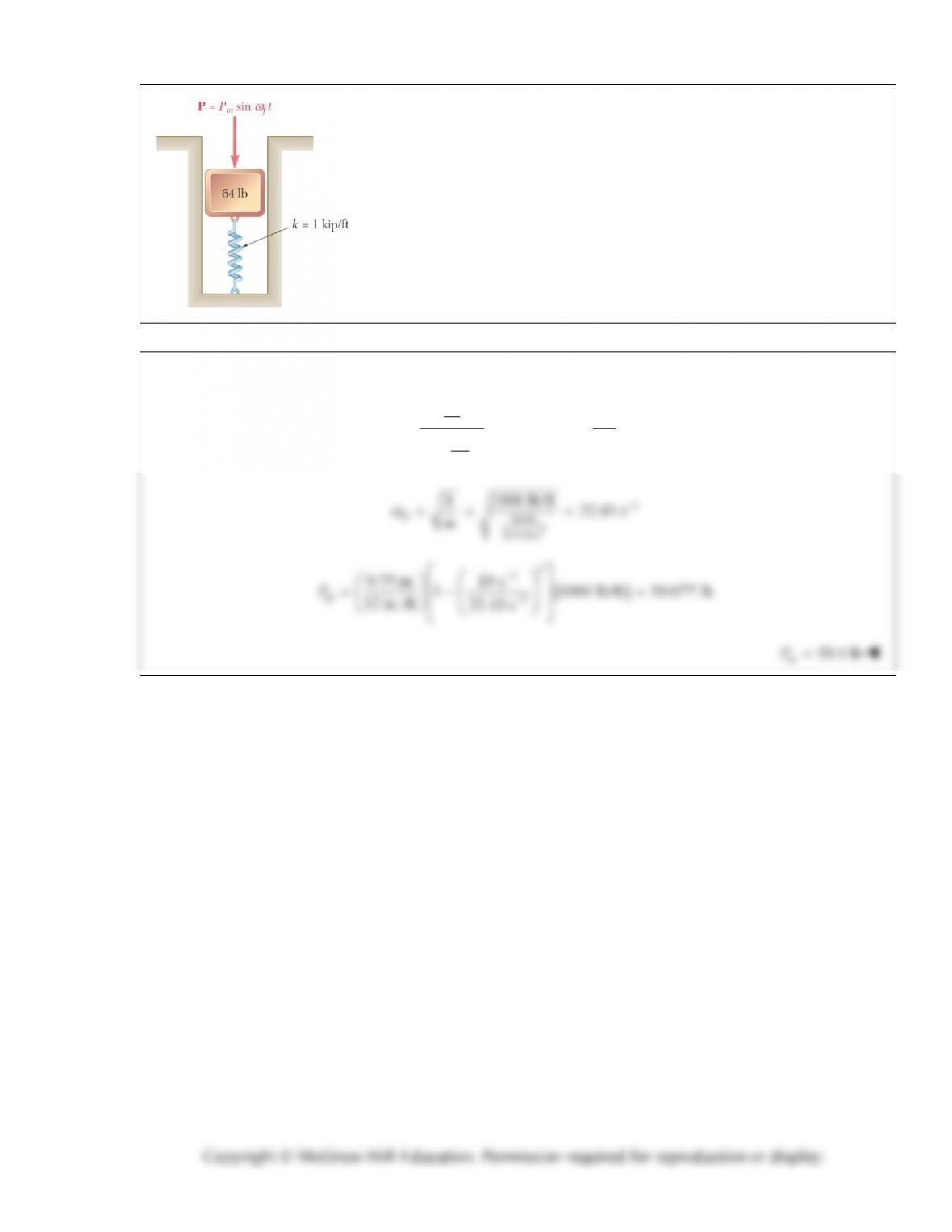
PROBLEM 19.102
A 64-lb block is attached to a spring of constant 1kip/ftk= and can move
without friction in a vertical slot as shown. It is acted upon by a periodic
force of magnitude sin ,
mf
P
Pt
ω
= where 10
f
ω
= rad/s. Knowing that
the amplitude of the motion is 0.75 in., determine .
m
P
SOLUTION
()
2
2, 1
1
m
f
n
P
f
k
mmm
n
x
Px k
ω
ω
ω
ω
⎡
⎤
⎛⎞
⎢
⎥
==−
⎜⎟
⎢
⎥
⎝⎠
−
⎣
⎦
1
64 lb
1000 lb/ft 22.43 s
n
k
m
ω
−
== =
m
Copyright © McGraw-Hill Education. Permission required for reproduction or display.
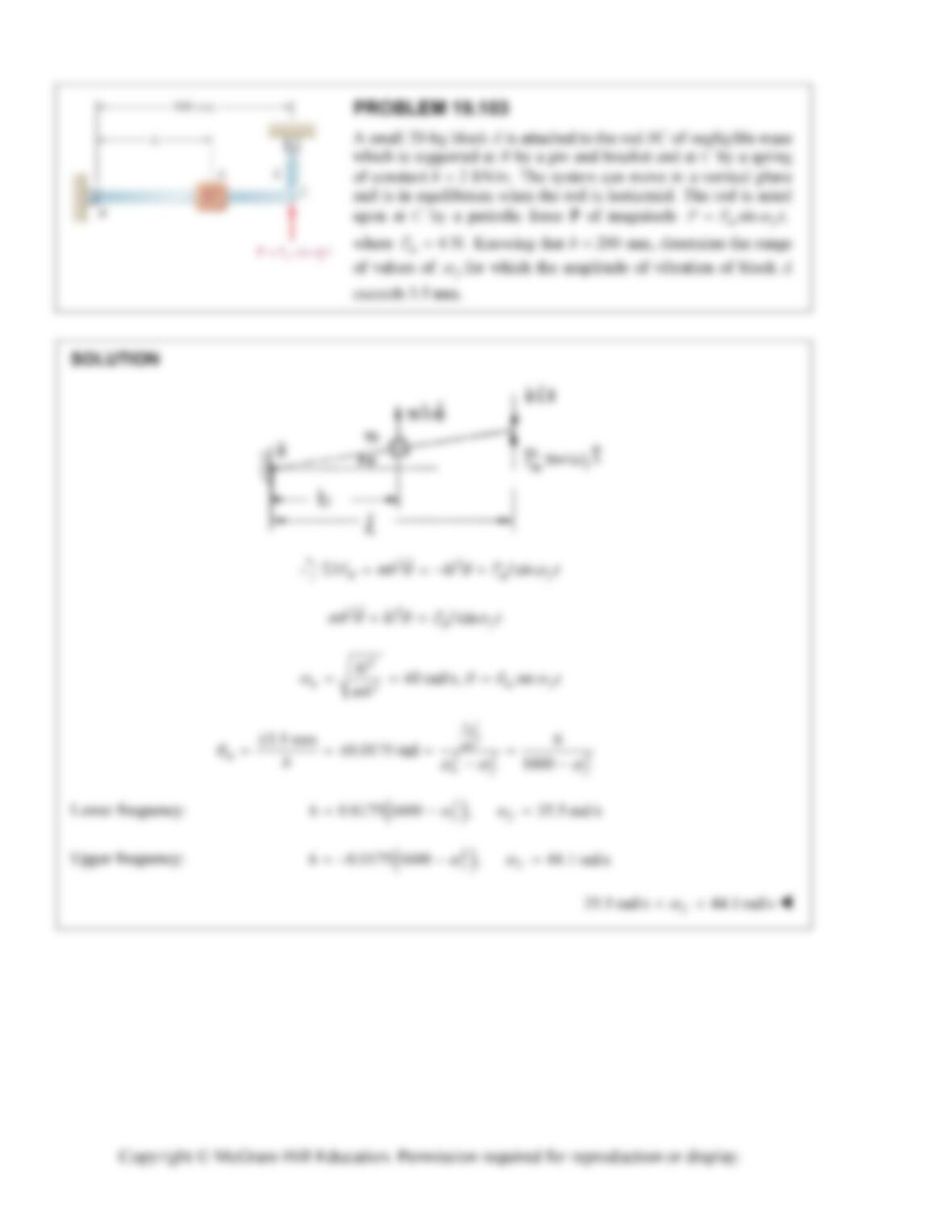
PROBLEM 19.103
A small 20-kg block A is attached to the rod BC of negligible mass
which is supported at B by a pin and bracket and at C by a spring
of constant k = 2 kN/m. The system can move in a vertical plane
and is in equilibrium when the rod is horizontal. The rod is acted
upon at C by a periodic force P of magnitude sin ,
mf
P
Pt
ω
=
where 6 N.
m
P= Knowing that b = 200 mm, determine the range
of values of
f
ω
for which the amplitude of vibration of block A
exceeds 3.5 mm.
SOLUTION
22
sin
Bmf
M
mb kl P l t
θ
θω
Σ= =− +
22 sin
mf
mb kl P l t
θ
θω
+=
2
240 rad/s, sin
nmf
kl t
mb
ω
θθ ω
== =
2
22 2
3.5 mm 6
0.0175 rad 1600
m
Pl
mb
m
nf f
b
θ
ω
ωω
±
==±==
−−
Lower frequency:
(
)
2
6 0.0175 1600 , 35.5 rad/s
ff
ωω
=−=
Upper frequency:
(
)
2
6 0.0175 1600 , 44.1 rad/s
ff
ωω
=− − =
35.5 rad/s 44.1 rad/s
f
ω
<<
Copyright © McGraw-Hill Education. Permission required for reproduction or display.
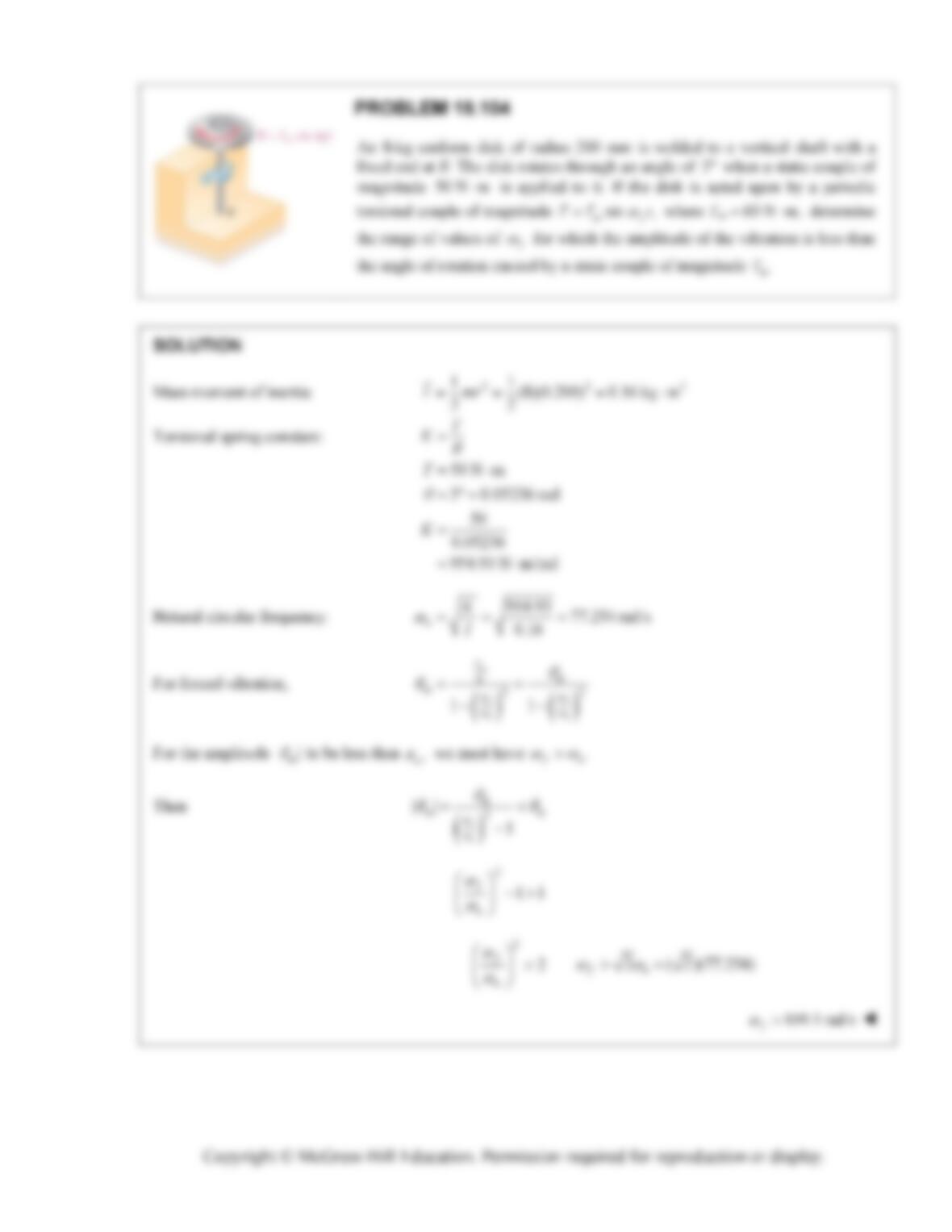
PROBLEM 19.104
An 8-kg uniform disk of radius 200 mm is welded to a vertical shaft with a
fixed end at B. The disk rotates through an angle of 3° when a static couple of
magnitude 50 N m
⋅
is applied to it. If the disk is acted upon by a periodic
torsional couple of magnitude sin ,
mf
TT t
ω
= where Tm60 N m,=⋅
determine
the range of values of
f
ω
for which the amplitude of the vibration is less than
the angle of rotation caused by a static couple of magnitude .
m
T
SOLUTION
Mass moment of inertia: 222
11
(8)(0.200) 0.16 kg m
22
Imr
=
==⋅
Torsional spring constant:
50 N m
3 0.05236 rad
50
0.05236
954.93 N m/rad
T
K
T
K
θ
θ
=
=⋅
=°=
=
=⋅
Natural circular frequency: 954.93 77.254 rad/s
0.16
n
K
I
ω
== =
For forced vibration,
()()
st
22
11
m
ff
nn
T
K
m
ωω
ωω
θ
θ
==
−−
For the amplitude ||
m
θ
to be less than st ,
θ
we must have .
f
n
ω
ω
>
Then
()
st
st
2
||
1
f
n
m
ω
ω
θ
θ
θ
=
<
−
2
11
f
n
ω
ω
⎛⎞
−
>
⎜⎟
⎝⎠
2
2
f
n
ω
ω
⎛⎞
>
⎜⎟
⎝⎠ 2 ( 2)(77.254)
fn
ωω
>=
109.3 rad/s
f
ω
>
Copyright © McGraw-Hill Education. Permission required for reproduction or display.
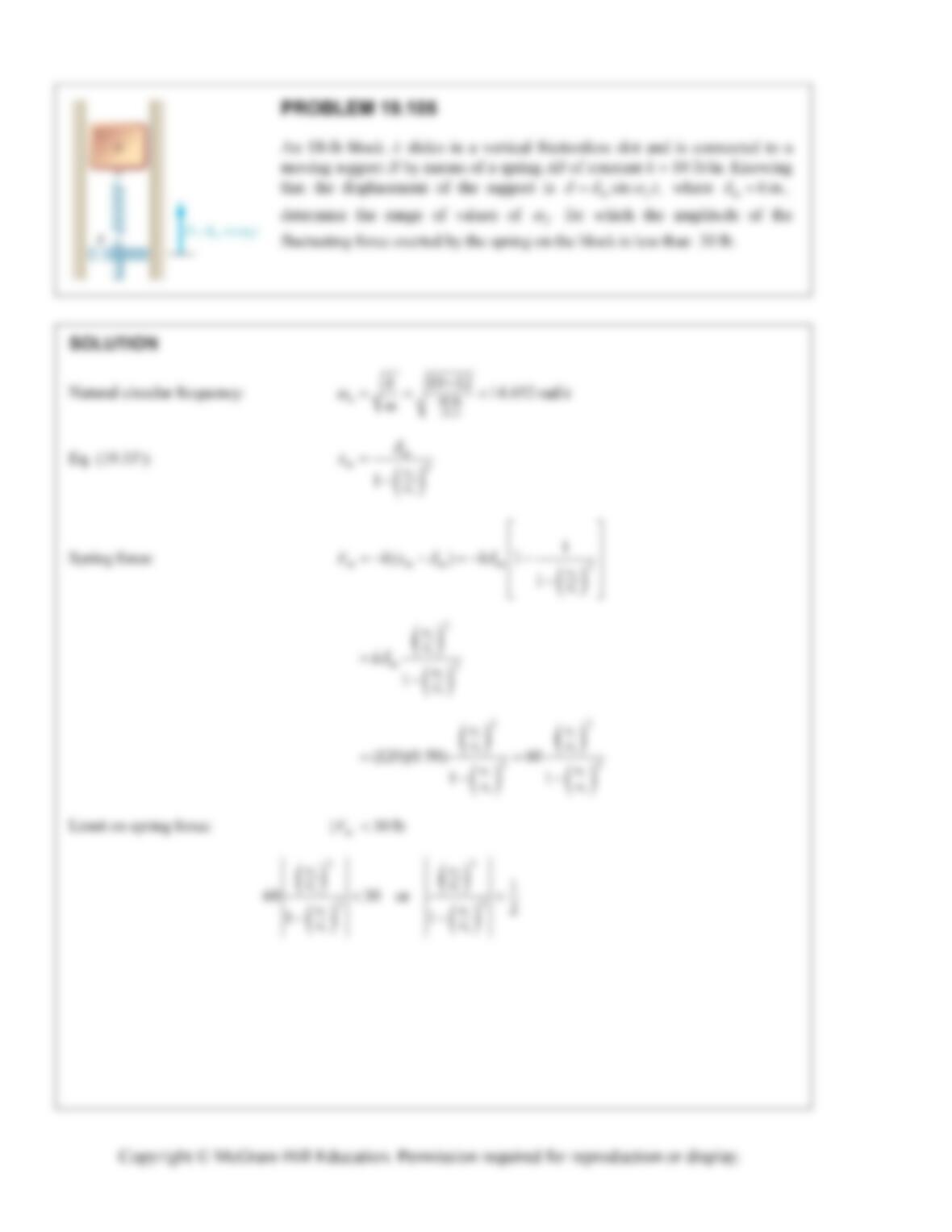
PROBLEM 19.105
An 18-lb block A slides in a vertical frictionless slot and is connected to a
moving support B by means of a spring AB of constant k = 10 lb/in. Knowing
that the displacement of the support is sin ,
mf
t
δ
δω
= where 6in.,
m
δ
=
determine the range of values of
f
ω
for which the amplitude of the
fluctuating force exerted by the spring on the block is less than 30 lb.
SOLUTION
Natural circular frequency: 18 lb
32.2
10 12 14.652 rad/s
n
k
m
ω
×
== =
Eq. (19.33′):
()
2
1f
n
m
m
x
ω
ω
δ
=
−
Spring force:
()
2
1
() 1
1f
n
mmmm
Fkx k
ω
ω
δδ
⎡
⎤
⎢
⎥
=− − =− −
⎢
⎥
⎢
⎥
−
⎢
⎥
⎣
⎦
(
)
()
2
2
1
f
n
f
n
m
k
ω
ω
ω
ω
δ
=
−
(
)
()
(
)
()
22
22
(120)(0.50) 60
11
ff
nn
ff
nn
ωω
ωω
ωω
ωω
==
−−
Limit on spring force: ||30lb
m
F<
()
()
(
)
()
22
22
1
60 30 or 2
11
ff
nn
ff
nn
ωω
ωω
ωω
ωω
<<
−−
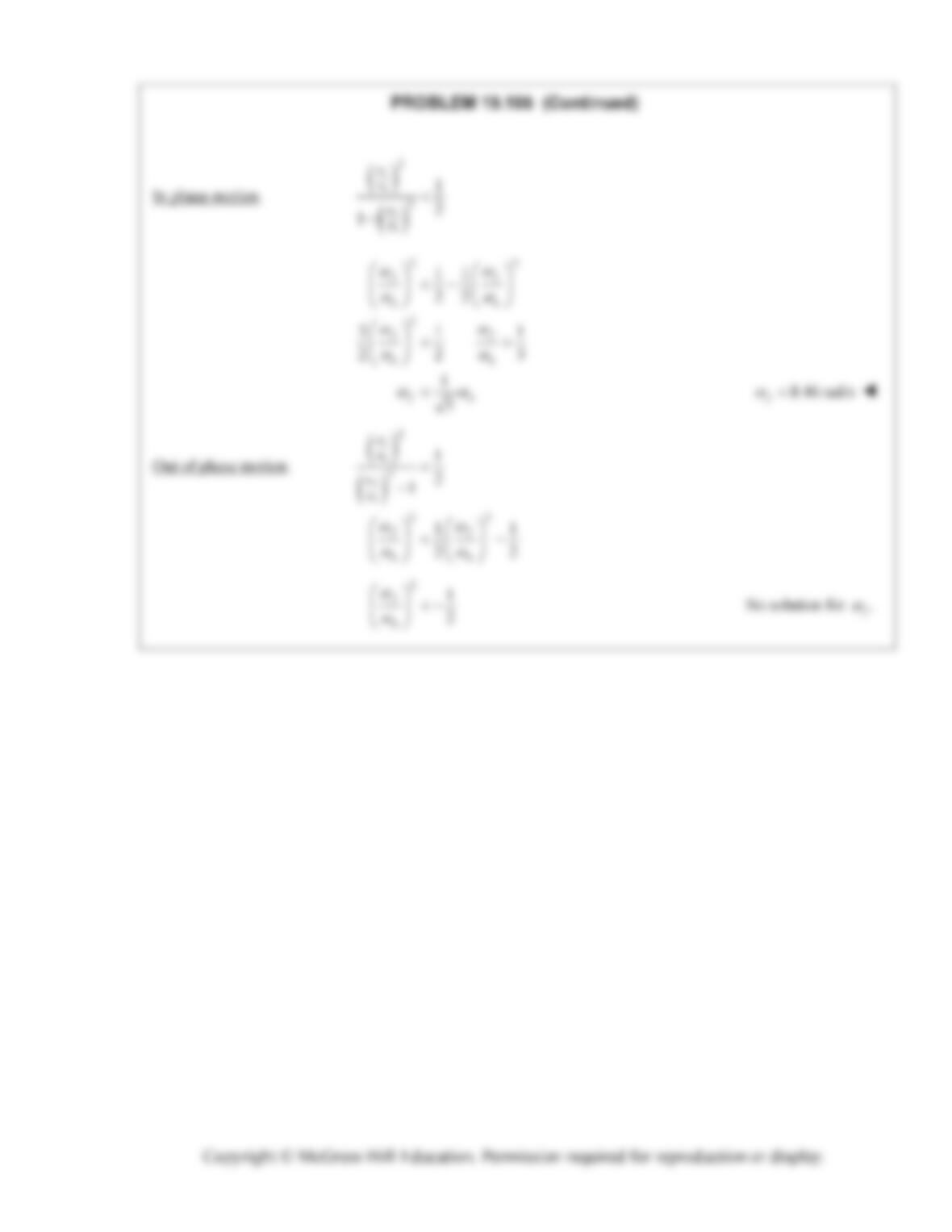
Copyright © McGraw-Hill Education. Permission required for reproduction or display.
PROBLEM 19.105 (Continued)
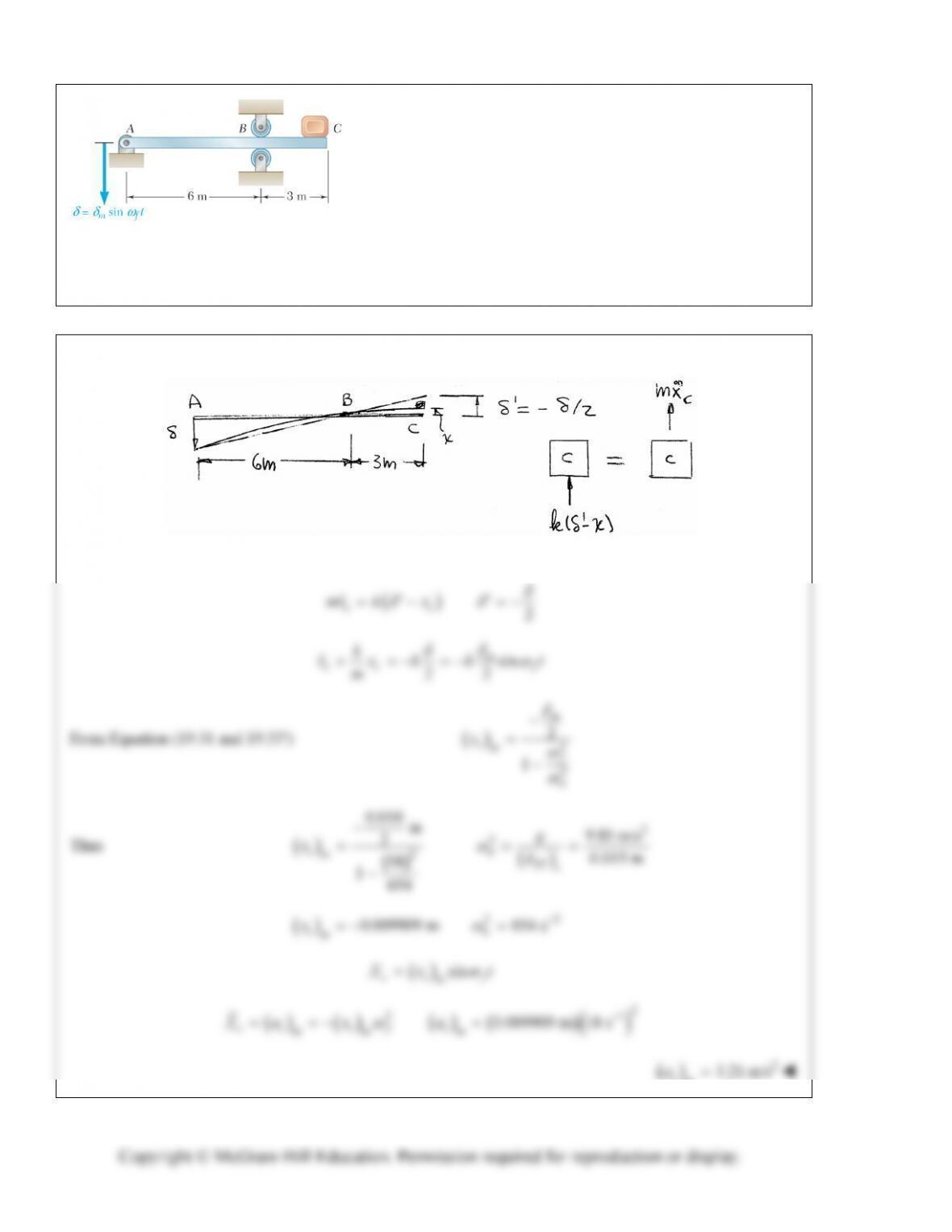
In phase motion.
(
)
()
2
2
1
2
1
f
n
f
n
ω
ω
ω
ω
<
−
22
2
11
22
31 1
22 3
1
3
ff
nn
ff
nn
fn
ωω
ωω
ωω
ωω
ωω
⎛⎞ ⎛⎞
<−
⎜⎟ ⎜⎟
⎝⎠ ⎝⎠
⎛⎞
<
>
⎜⎟
⎝⎠
< 8.46 rad/s
f
ω
<
Out of phase motion.
(
)
()
2
2
22
1
2
1
11
22
f
n
f
n
ff
nn
ω
ω
ω
ω
ωω
ωω
<
−
⎛⎞ ⎛⎞
<
−
⎜⎟ ⎜⎟
⎝⎠ ⎝⎠
21
2
f
n
ω
ω
⎛⎞
<
−
⎜⎟
⎝⎠ No solution for .
f
ω
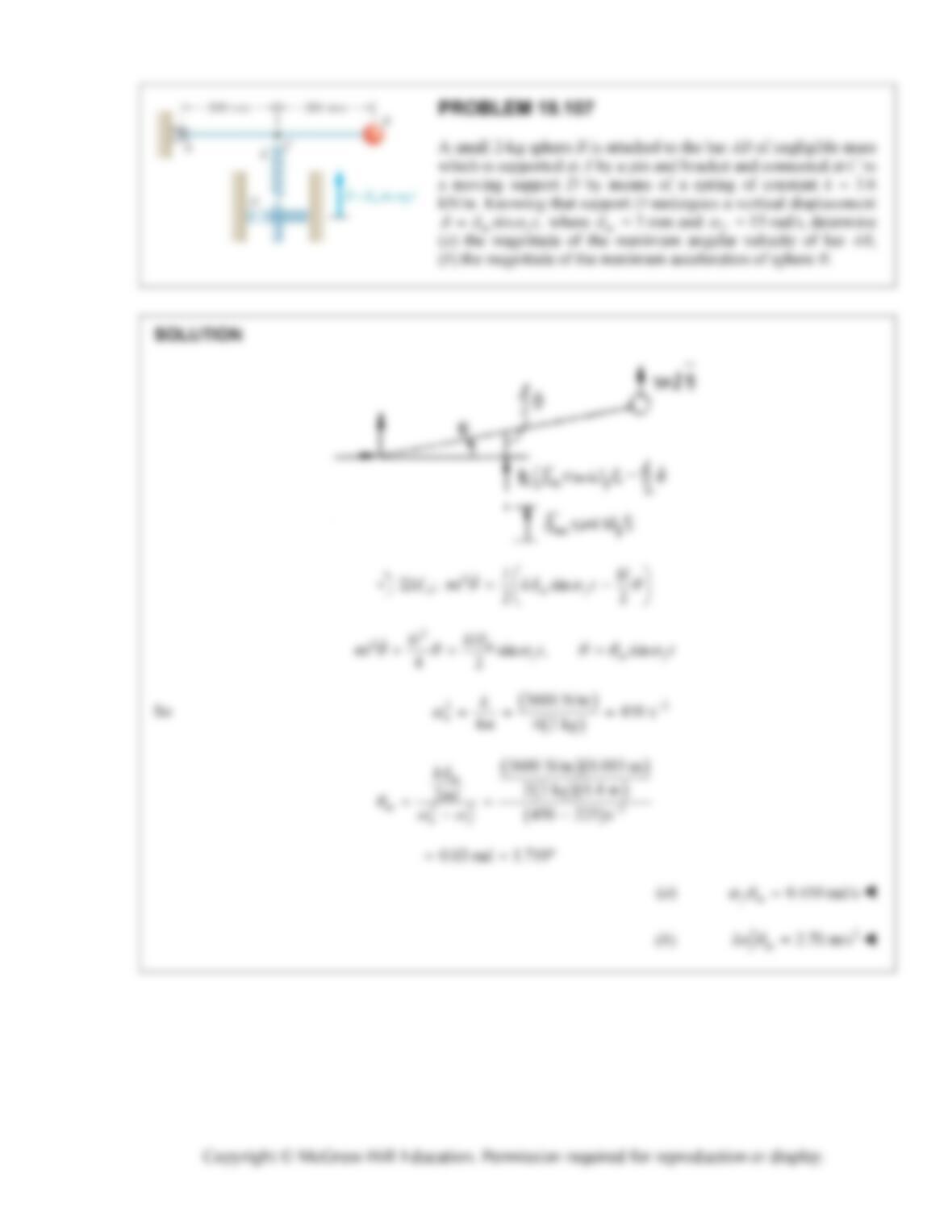
PROBLEM 19.106
A beam ABC is supported by a pin connection at A and by rollers
at B. A 120-kg block placed on the end of the beam causes a
static deflection of 15 mm at C. Assuming that the support at A
undergoes a vertical periodic displacement sin ,
mf
t
δ
δω
=
where 10
m
δ
= mm and 18
f
ω
= rad/s, and the support at B
does not move, determine the maximum acceleration of the
block at C. Neglect the weight of the beam and assume that the
block does not leave the beam.
SOLUTION
Fma
Σ
=
δ
ω
δ
cm
Copyright © McGraw-Hill Education. Permission required for reproduction or display.
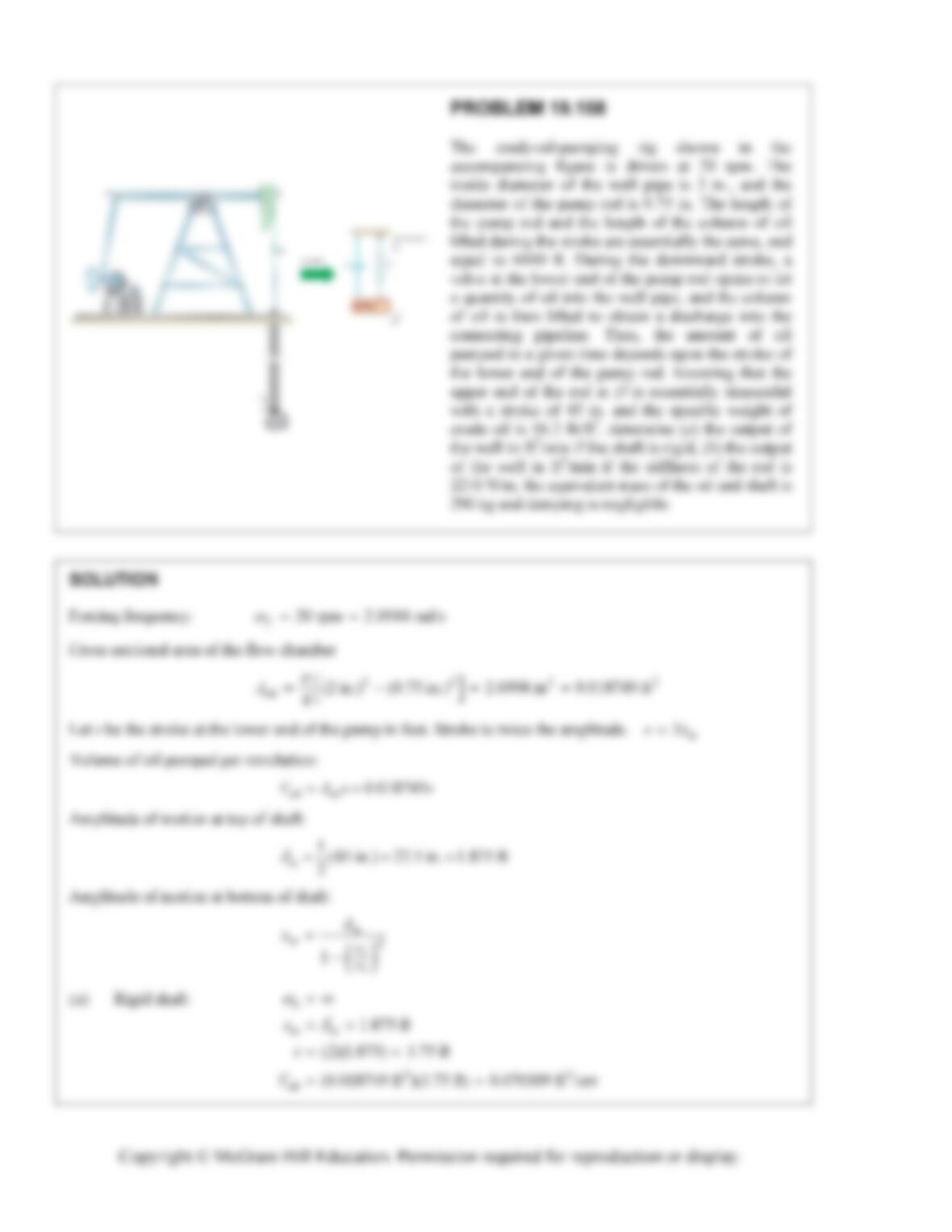
PROBLEM 19.107
A small 2-kg sphere B is attached to the bar AB of negligible mass
which is supported at A by a pin and bracket and connected at C to
a moving support D by means of a spring of constant k = 3.6
kN/m. Knowing that support D undergoes a vertical displacement
sin ,
mf
t
δ
δω
= where m
δ
= 3 mm and
f
ω
= 15 rad/s, determine
(a) the magnitude of the maximum angular velocity of bar AB,
(b) the magnitude of the maximum acceleration of sphere B.
SOLUTION
2
; sin
22
Amf
lkl
Mml k t
θ
δω θ
⎛⎞
Σ= −
⎜⎟
⎝⎠
2
2sin , sin
42
m
f
mf
kl kl
ml t t
δ
θ
θωθθω
+= =
So
(
)
()
22
3600 N/m 450 s
442kg
n
k
m
ω
−
== =
(
)
(
)
()( )
()
22 2
3600 N/m 0.003 m
22kg 0.4m
2
450 225 s
m
m
nf
k
ml
δ
θωω
−
==
−−
0.03 rad 1.719
=
=°
(
a) 0.450 rad/s
fm
ωθ
=
(
b) 22
2.70 m/s
fm
l
ωθ
=
Copyright © McGraw-Hill Education. Permission required for reproduction or display.
PROBLEM 19.108
The crude-oil-pumping rig shown in the
accompanying figure is driven at 20 rpm. The
inside diameter of the well pipe is 2 in., and the
diameter of the pump rod is 0.75 in. The length of
the pump rod and the length of the column of oil
lifted during the stroke are essentially the same, and
equal to 6000 ft. During the downward stroke, a
valve at the lower end of the pump rod opens to let
a quantity of oil into the well pipe, and the column
of oil is then lifted to obtain a discharge into the
connecting pipeline. Thus, the amount of oil
pumped in a given time depends upon the stroke of
the lower end of the pump rod. Knowing that the
upper end of the rod at D is essentially sinusoidal
with a stroke of 45 in. and the specific weight of
crude oil is 56.2 lb/ft3, determine (a) the output of
the well in ft3/min if the shaft is rigid, (b) the output
of the well in ft3/min if the stiffness of the rod is
2210 N/m, the equivalent mass of the oil and shaft is
290 kg and damping is negligible.
SOLUTION
Forcing frequency: 20 rpm 2.0944 rad/s
f
ω
==
Cross sectional area of the flow chamber
22 2 2
oil (2 in.) (0.75 in.) 2.6998 in 0.018749 ft
4
A
π
⎡⎤
=− ==
⎣⎦
Let s be the stroke at the lower end of the pump in feet. Stroke is twice the amplitude. 2m
s
x=
Volume of oil pumped per revolution:
oil oil 0.018749VAs s==
Amplitude of motion at top of shaft:
1(45 in.) 22.5 in. 1.875 ft
2
m
δ
===
Amplitude of motion at bottom of shaft:
()
2
1f
n
m
m
x
ω
ω
δ
=
−
(a) Rigid shaft:
23
oil
1.875 ft
(2)(1.875) 3.75 ft
(0.018749 ft )(3.75 ft) 0.070309 ft /rev
n
mm
x
s
V
ω
δ
=∞
==
==
==
Copyright © McGraw-Hill Education. Permission required for reproduction or display.
PROBLEM 19.108 (Continued)
output rate: 3
(0.070309 ft /rev)(20 rev/min) 3
1.406 ft /min
(b) Flexible shaft.
eq
eq
2
23
oil
2210 N/m 290 kg
2210 N/m 2.7606 rad/s
290 kg
2.0944 0.75869
2.7606
1.875 4.4178 ft
1 (0.75869)
(2)(4.4178) 8.8358 ft
(0.018749 ft )(8.8358 ft) 0.16566 ft /rev
n
f
n
m
km
k
m
x
s
V
ω
ω
ω
==
== =
==
==
−
==
==
output rate: 3
(0.16566 ft /rev)(20 rev/min) 3
3.31 ft /min
S
O
G
e
Us
Ci
r
Th
C
o
Copyri
g
O
LUTION
e
ometry.
ing the given
r
cular natural
e steady state
o
nside
r
g
h
t
© McGra
w
y
y
F
ma
Σ=
:
x
x
F
maΣ=
motion of x
C
,
frequency.
response is
w
-Hill Educ
a
PROBLE
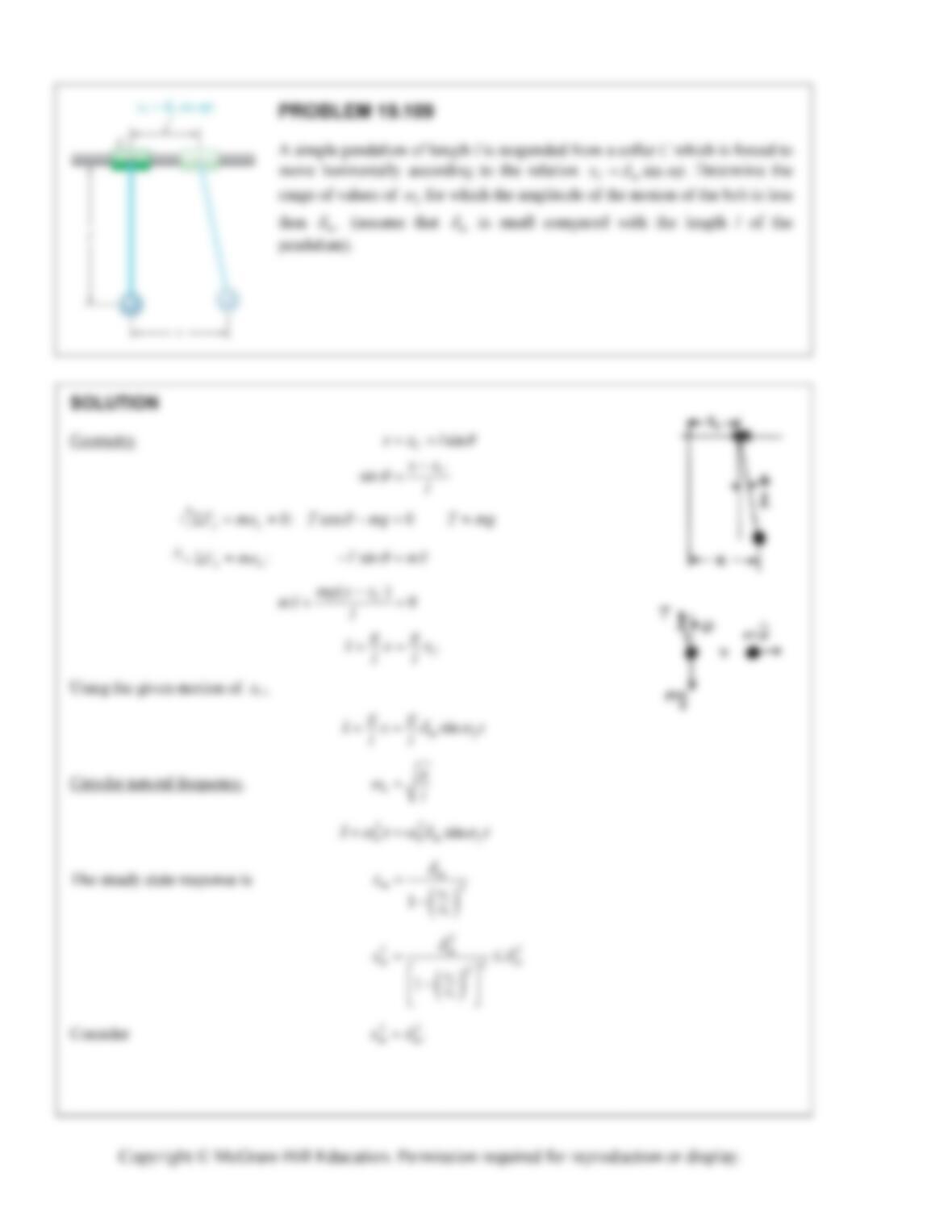
A simple p
e
move hori
z
range of va
l
than
.
m
δ
(
pendulum).
0: cosT
θ
≈
:
T
−
(mg x
mx l
x
−
+
,
x
+
x
+
a
tion. Permi
s
M 19.109
e
ndulum of le
n
z
ontally accor
l
ues of
f
ω
fo
r
(
assume that
sin
C
C
x
xl
x
x
l
θ
=
+
−
=
0mg
−=
sin
T
mx
θ
=
)0
C
C
x
gg
xx
ll
−
=
+=
s
m
gg
x
ll
δ
+
=
n
g
l
ω
=
22
nnm
x
ω
ωδ
+
=
(
1
m
m
x
ω
ω
δ
=
−
(
2
1
m
x
ω
ω
δ
=
⎡
−
⎢
⎣
22
.
mm
x
δ
=
s
sion require
d
n
gth l is susp
e
ding to the
r
r
which the a
m
m
δ
is smal
l
sin
C
θ
Tmg
≈
s
in ft
ω
sin
f
t
ω
)
2
f
n
m
ω
ω
)
2
2
2
2
f
n
m
m
ω
ω
δ
δ
≤
⎤
⎥
⎦
d
for reprod
u
e
nded from a
c
r
elation
C
x
δ
=
m
plitude of th
e
l
compared
w
u
ction or dis
p
c
ollar C whic
h
sin
m
δ
ω
f
t. D
e
e
motion of t
h
w
ith the len
g
p
lay.
h
is forced to
e
termine the
h
e bob is less
g
th l of the