PROBLEM 15.254 (Continued)
(a) Angular acceleration of AB.
2
7.90 rad/s
AB
α
=
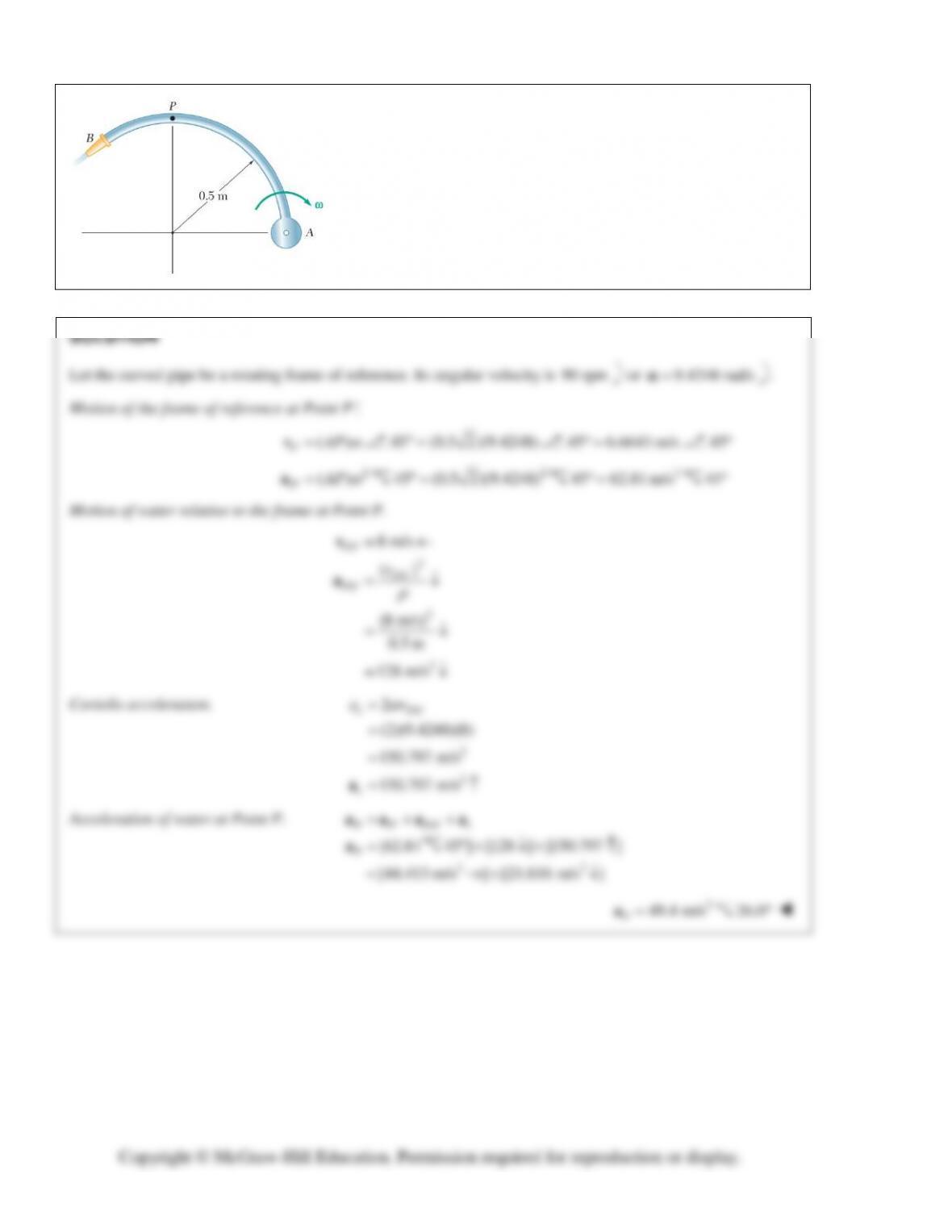
PROBLEM 15.255
Water flows through a curved pipe AB that rotates with a constant
clockwise angular velocity of 90 rpm. If the velocity of the water
relative to the pipe is 8 m/s, determine the total acceleration of a
particle of water at Point P.
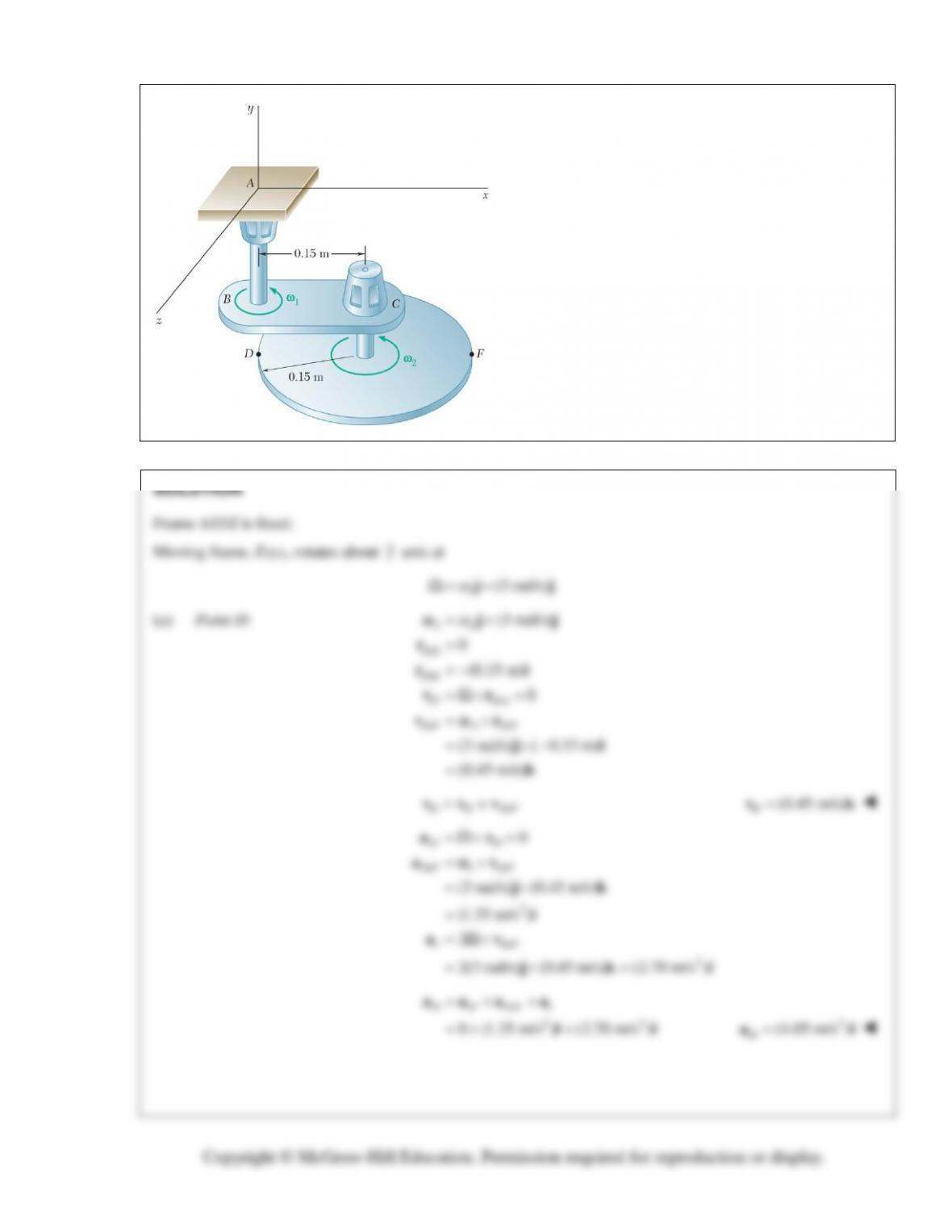
PROBLEM 15.256
A disk of 0.15–m radius rotates at the constant rate
2
ω
with respect to plate BC, which itself rotates at the
constant rate
1
ω
about the y axis. Knowing that
12
3 rad/s,
ωω
= =
determine, for the position shown,
the velocity and acceleration (a) of Point D, (b) of
Point F.
PROBLEM 15.256 (Continued)
(b) Point F:
22
/
/
/
(3 rad/s)
(0.3 m) ;
(0.15 m)
(3 rad/s) (0.3 m)
(0.9 m/s)
FA
FE
F FA
ω
′
= =
=
=
= ×
= ×
= −
jj
ri
ri
vr
ji
k
ω
Ω
/ 2/
/
(3 rad/s) (0.15 m)
(0.45 m/s)
FF FE
F F FF
′
= ×
= ×
= −
= +
vr
ji
k
vvv
ω
/
2
/
2 22
2
2(3 rad/s) ( 0.45 m/s)
(2.7 m/s )
(2.7 m/s ) (1.35 m/s ) (2.7 m/s )
c FF
F F FF c
′
= ×
= ×−
= −
=++
=−− −
av
jk
i
aaa a
i ii
Ω
2
(6.75 m/s )
F
= −ai
PROBLEM 15.257
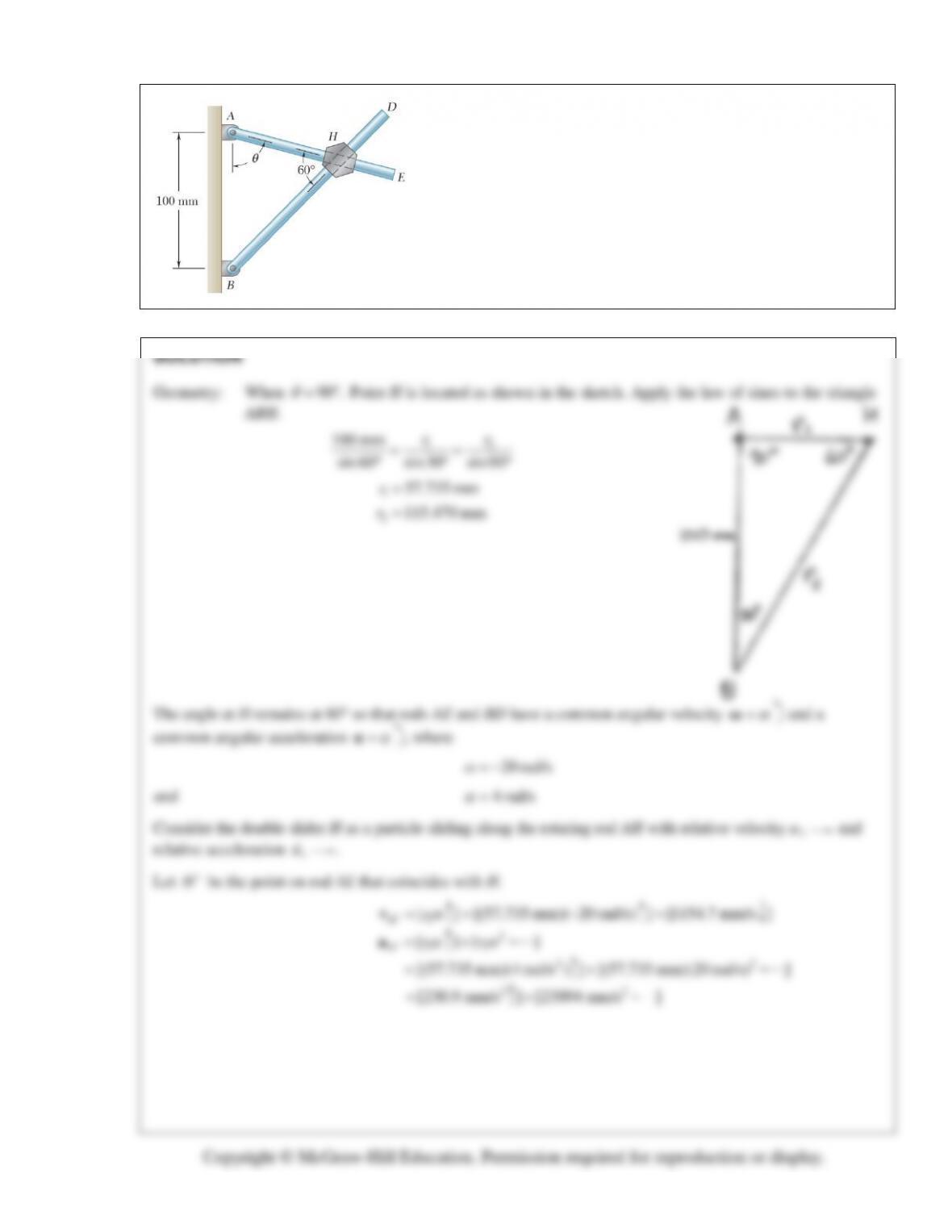
Two rods AE and BD pass through holes drilled into a hexagonal
block. (The holes are drilled in different planes so that the rods will
not touch each other.) Knowing that rod AE has an angular velocity
of 20 rad/s clockwise and an angular acceleration of 4 rad/s2
counterclockwise when
θ
= 90°, determine, (a) the relative velocity
of the block with respect to each rod, (b) the relative acceleration
of the block with respect to each rod.
PROBLEM 15.257 (Continued)
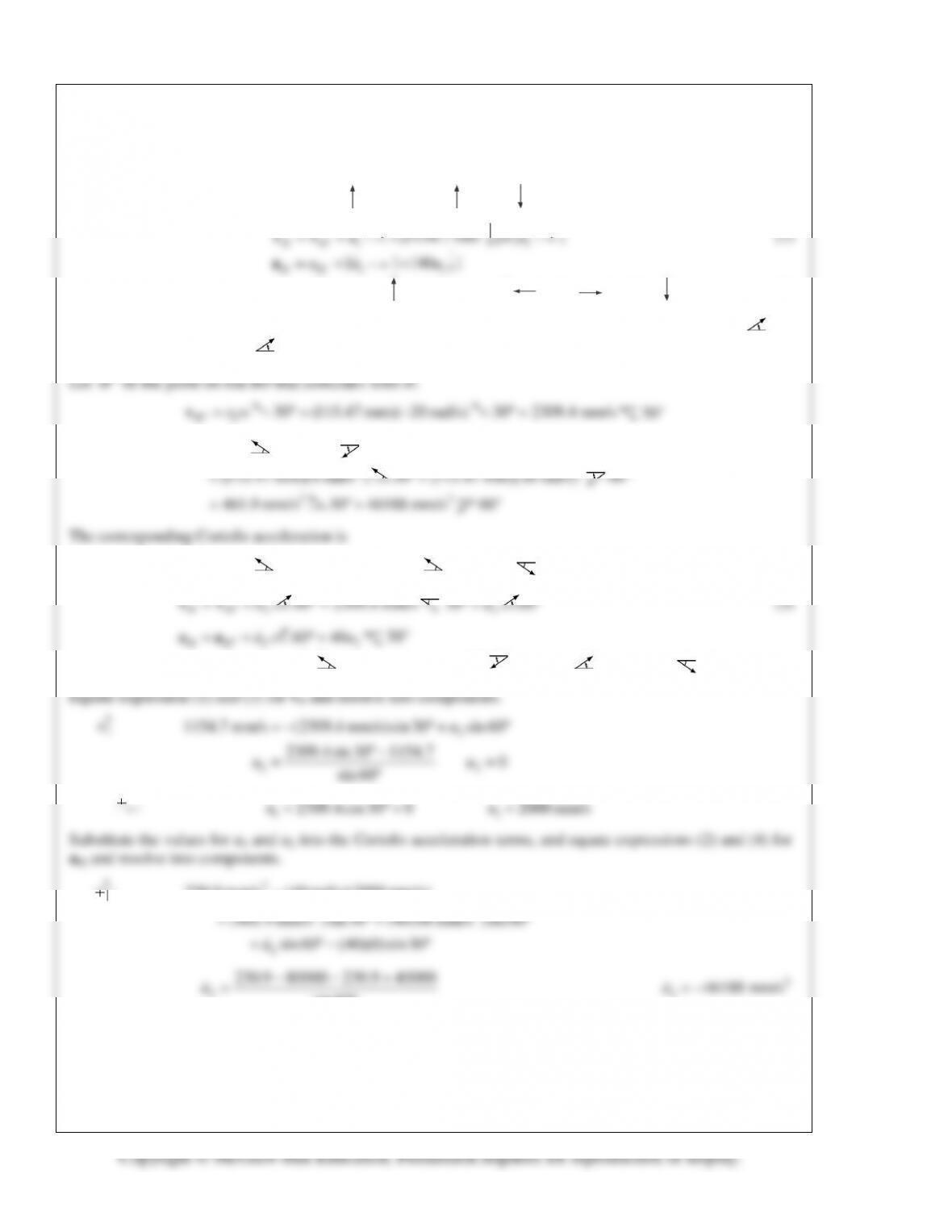
The corresponding Coriolis acceleration is
11
[2 u
ω
=a
1
] [(2)( 20)u
= −
1
] 40u=
1
HH
1
[230.9 mm/s=
2
] [23094 mm/s+
1
][u
+
1
] [40u+
]
(2)
Now consider the double slider H as a particle sliding along the rotating rod BD with relative velocity u2 60°
and relative acceleration
2
u
60°.
2H
r
α
′′
=a
2
2
30 r
ω
°+
60°
2
2
22
2u
ω
=a
2
30 (2)( 20 rad/s)u
°= −
2
60 40u
°=
30°
2HH
2
2
[(461.9 mm/s )
=
2
30 ] [(46188 mm/s )
°+
2
60 ] [u°+
2
60 ] [40u°+
30°
]
(4)
:
2
22
2
230.9 mm/s (40 rad/s)(2000 mm/s)
(461.9 mm/s )sin30 (46188 mm/s )sin60
sin60 (40)(0)sin30u
−
= °+ °
+ °− °
2
PROBLEM 15.257 (Continued)
:
22 2
1
2
23094 mm/s (461.4 mm/s )cos30 (46188 mm/s )cos60
(46188 mm/s )cos60 0
u− =− °− °
− °+
2
123494 mm/su= −
(a) Relative velocities:
1
:AE u
2.00 m/s=
2
:BD u
60 0°=
(b) Relative accelerations:
2
1
: 23.5 m/sAE u =
2
:BD u
2
60 46.2 m/s°=
60°
Copyright © McGraw–Hill Education. Permission required for reproduction or display.
PROBLEM 15.258
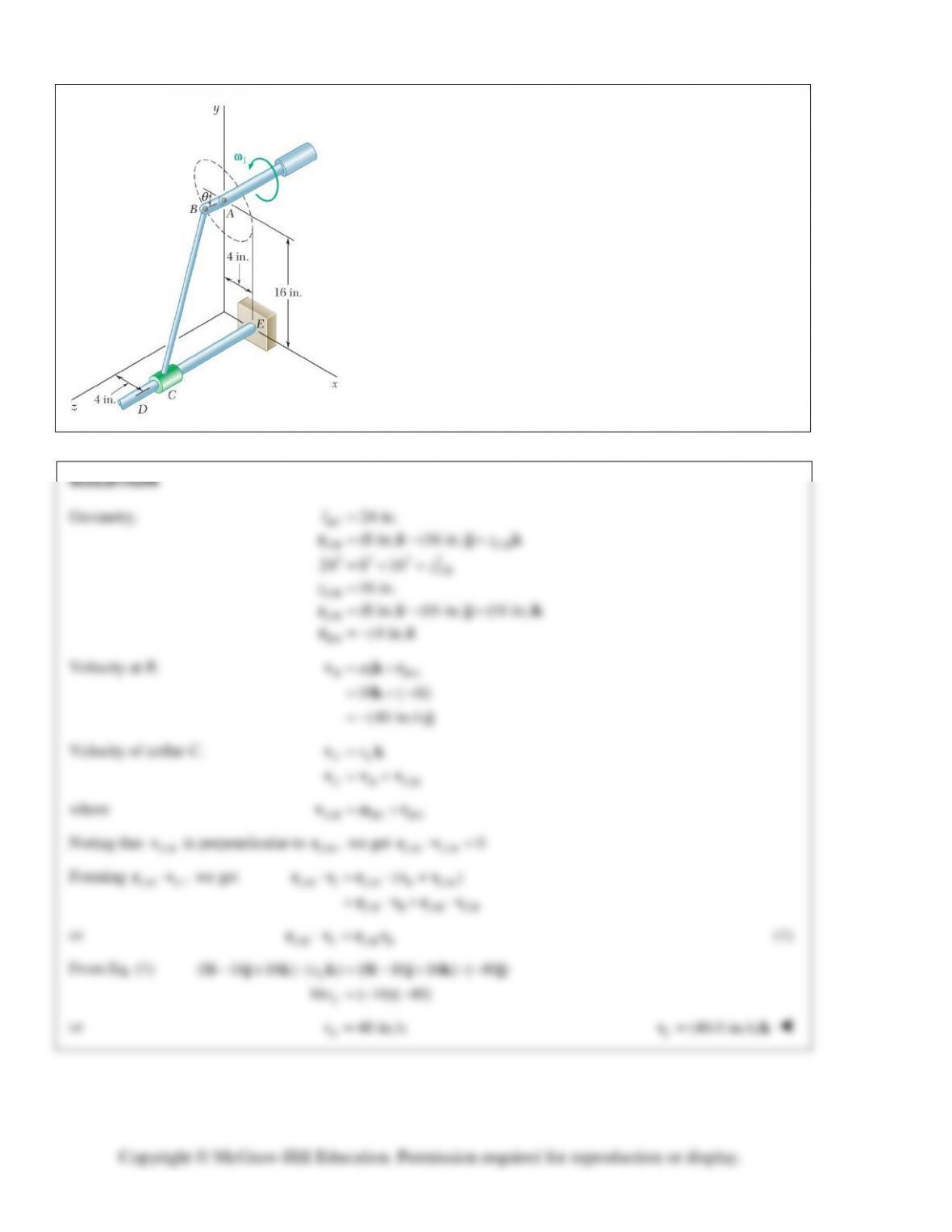
Rod BC of length 24 in. is connected by ball–and–socket joints to
a rotating arm AB and to a collar C that slides on the fixed rod
DE. Knowing that the length of arm AB is 4 in. and that it rotates
at the constant rate
110 rad/s,
ω
=
determine the velocity of
collar C when
0.
θ
=
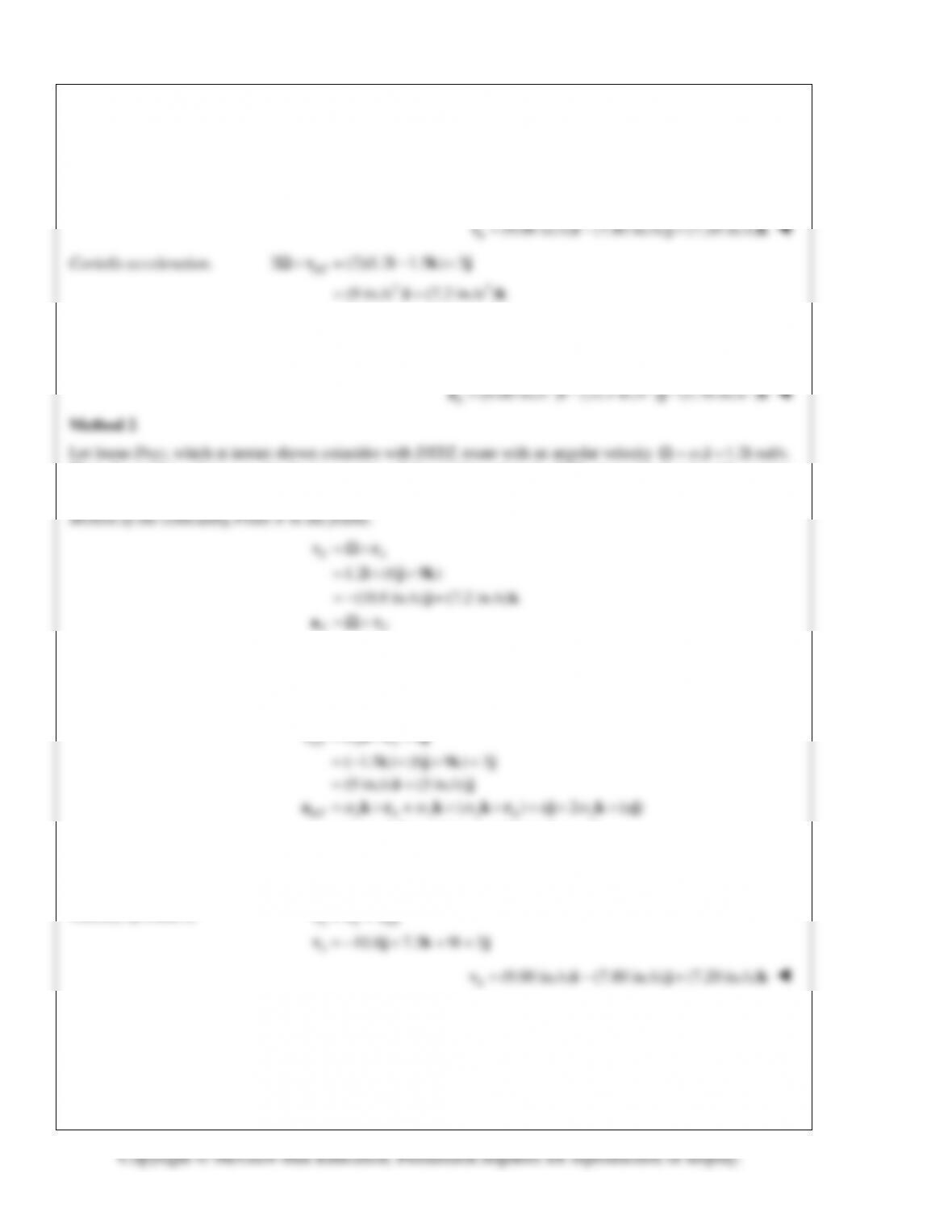
PROBLEM 15.259
In the position shown, the thin rod moves at a constant speed u
3 in./s=
out of the tube BC. At the same time, tube BC rotates
at the constant rate
2
1.5
ω
=
rad/s with respect to arm CD.
Knowing that the entire assembly rotates about the X axis at
the constant rate
1
1.2
ω
=
rad/s, determine the velocity and
acceleration of end A of the rod.
PROBLEM 15.259 (Continued)
Velocity of Point A.
/
9 10.8 7.2 3
A A AF
A
′
= +
=− ++
vvv
v i j kj
22
(9 in./s ) (7.2 in./s )
= +
ik
Acceleration of Point A.
//
2
22.14 12.92 9 7.2
A A AF AF
A
′
=+ +×
=− − ++
aaa v
a j ki k
Ω
222
1
Then the motion relative to the frame consists of the rotation of body DCB about the Z axis with angular
velocity
2
(1.5 rad/s)
ω
= −kk
plus the sliding motion
(3 in./s)u= =ui j
of the rod AB relative to the body DCB.
22
1.2 ( 10.8 7.2 )
(8.64 in./s ) (12.96 in./s )
AA
′′
= ×
= ×− +
=−−
av
i jk
jk
Ω
Motion of Point A relative to the frame.
/2
( 1.5 ) (6 9 ) 3
(9 in./s) (3 in./s)
AF A
u
ω
= ×+
=− ×+ +
= +
v kr j
k jk j
ij