Copyright © McGraw-Hill Education. Permission required for reproduction or display.
PROBLEM 12.7 (Continued)
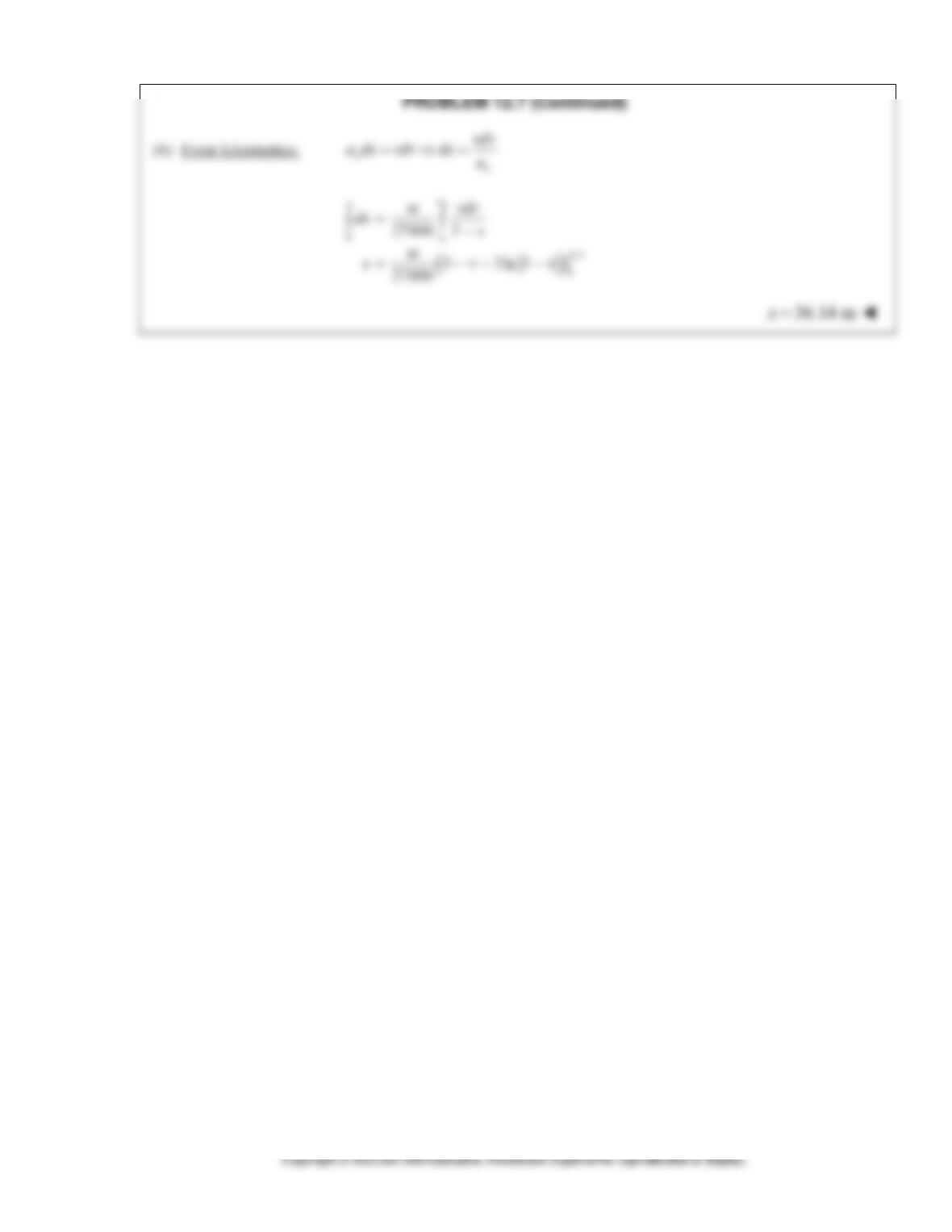
(b) From Kinematics: x
x
vdv
adx vdv dx a
2
1
0
2.5
1
27000 3
33ln3
27000 |
v
x
v
mvdv
dx v
m
xvv
36.14 mx
PROBLEM 12.8
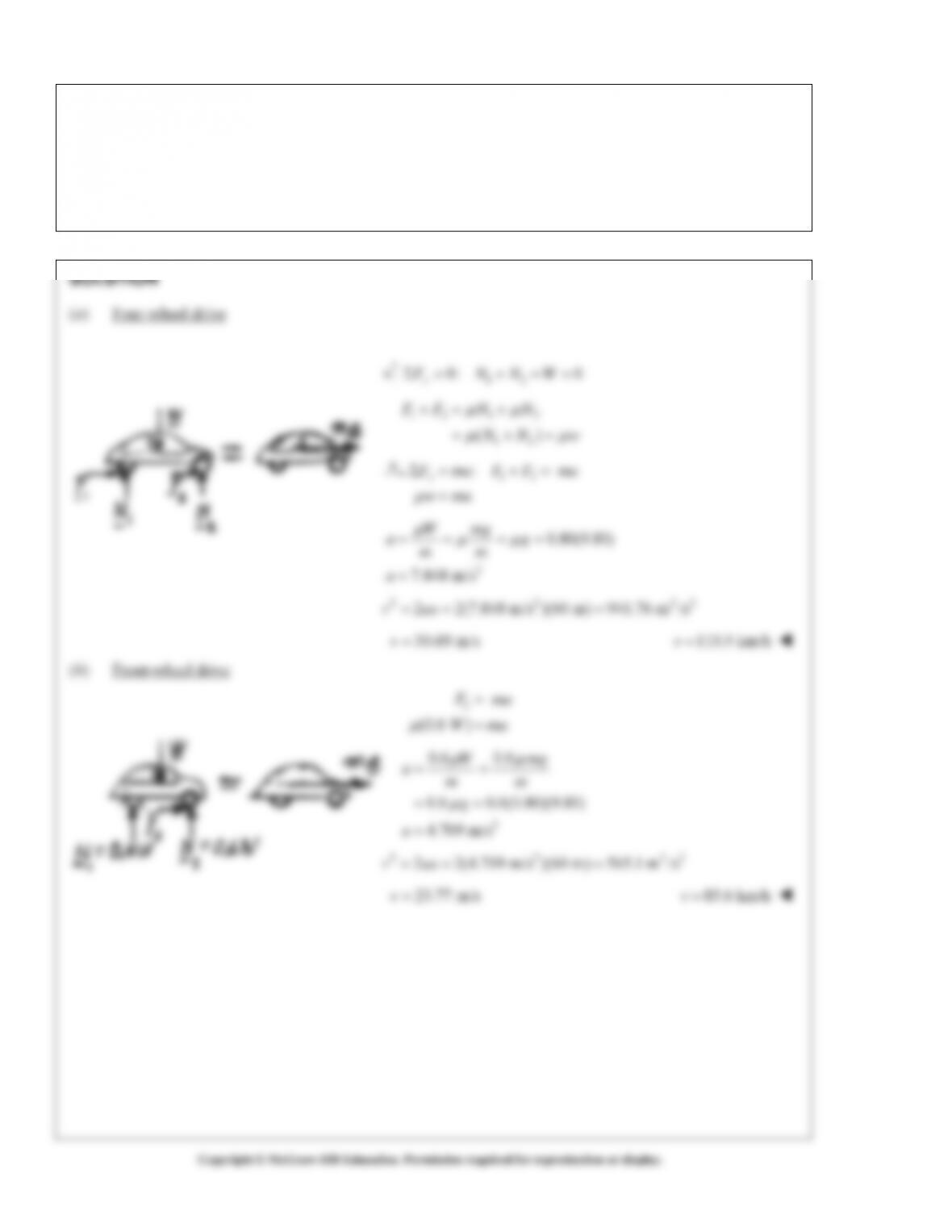
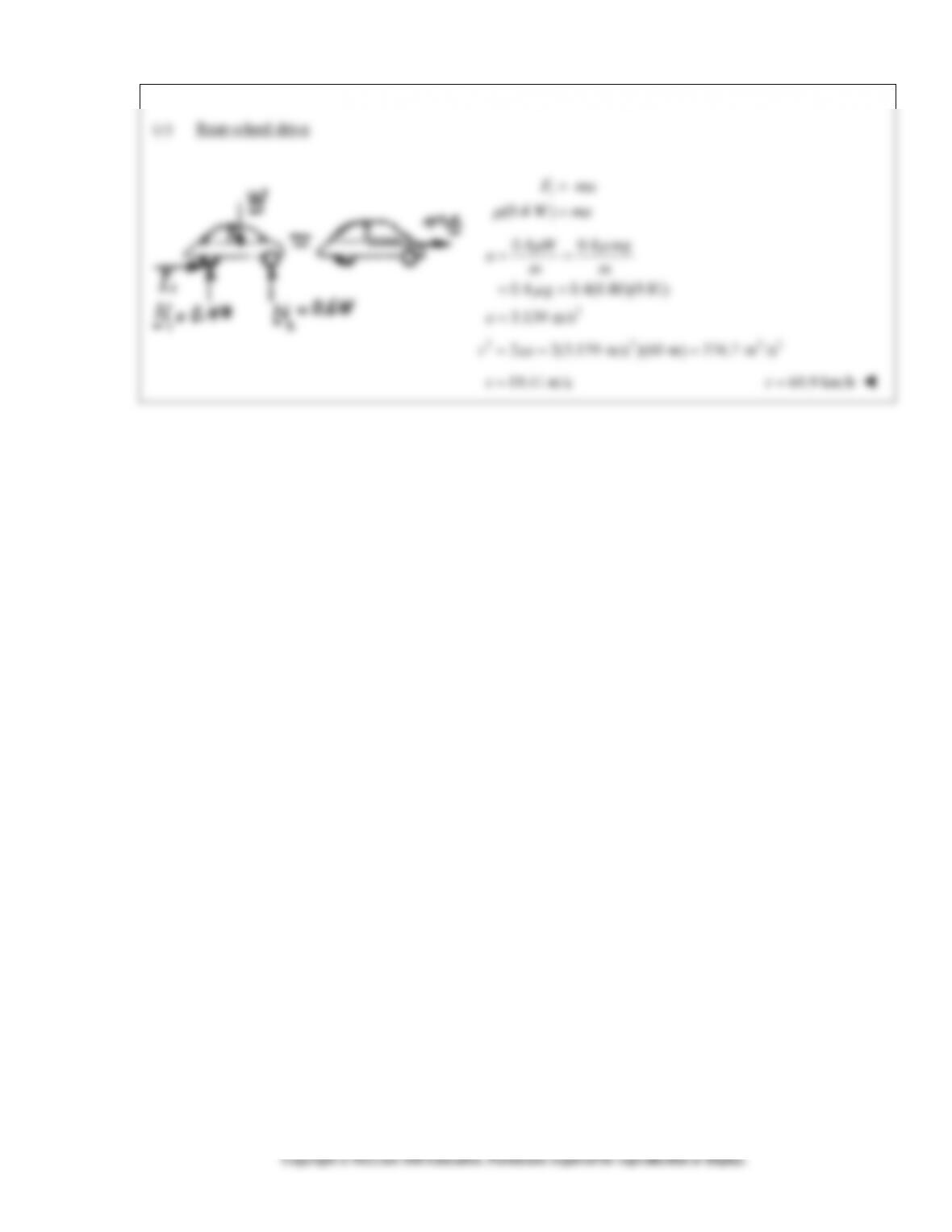
Determine the maximum theoretical speed that may be achieved over a distance of 60 m by a car starting from
rest, knowing that the coefficient of static friction is 0.80 between the tires and the pavement and that 60 percent
of the weight of the car is distributed over its front wheels and 40 percent over its rear wheels. Assume
(a) four-wheel drive, (b) front-wheel drive, (c) rear-wheel drive.
PROBLEM 12.8 (Continued)
Copyright © McGraw-Hill Education. Permission required for reproduction or display.
PROBLEM 12.9
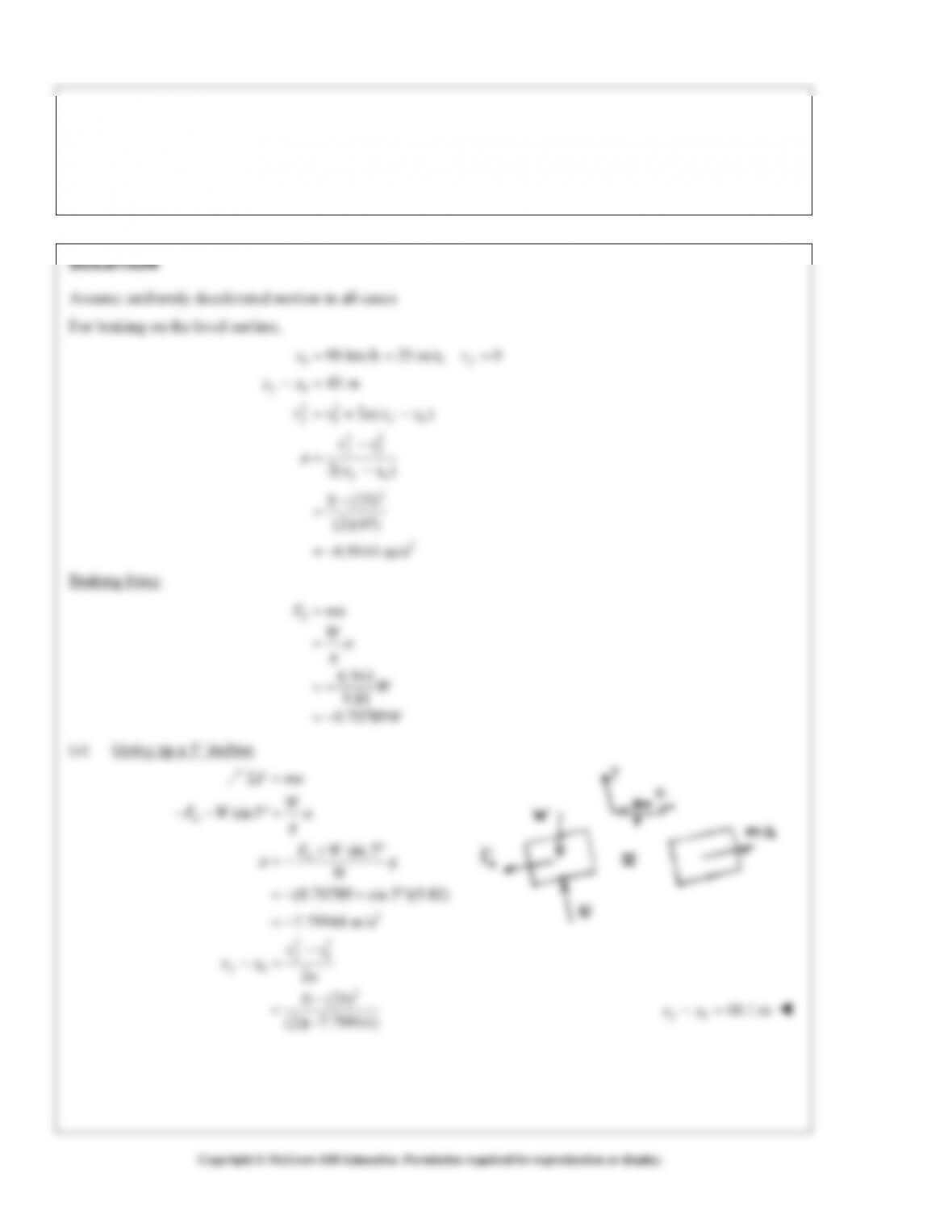
If an automobile’s braking distance from 90 km/h is 45 m on level pavement, determine the automobile’s
braking distance from 90 km/h when it is (a) going up a 5° incline, (b) going down a 3-percent incline.
Assume the braking force is independent of grade.
PROBLEM 12.9 (Continued)
PROBLEM 12.10
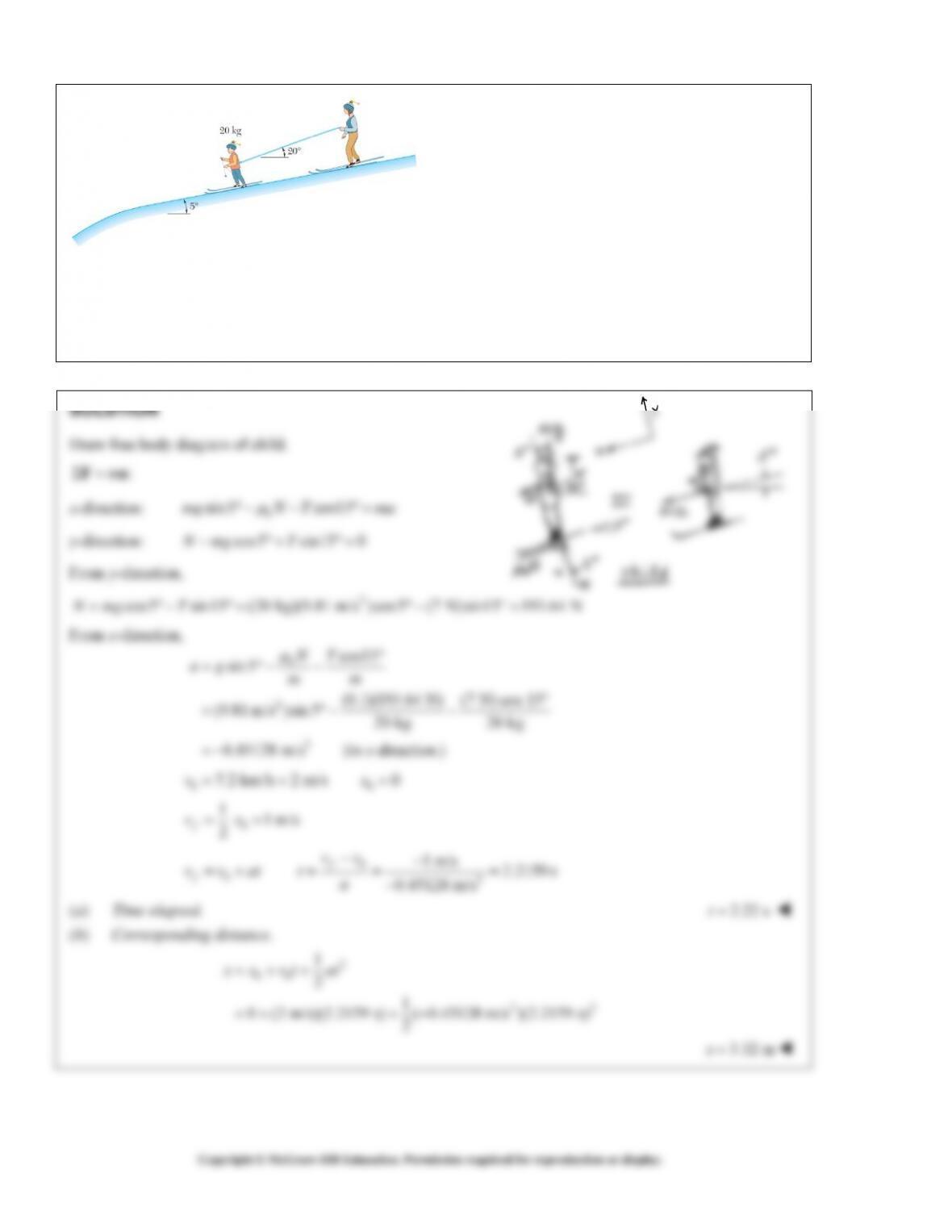
A mother and her child are skiing together, and the
mother is holding the end of a rope tied to the child’s
waist. They are moving at a speed of 7.2 km/h on a
gently sloping portion of the ski slope when the
mother observes that they are approaching a steep
descent. She pulls on the rope with an average force
of 7 N. Knowing the coefficient of friction between
the child and the ground is 0.1 and the angle of the
rope does not change, determine (a) the time required
for the child’s speed to be cut in half, (b) the distance
traveled in this time.
PROBLEM 12.11
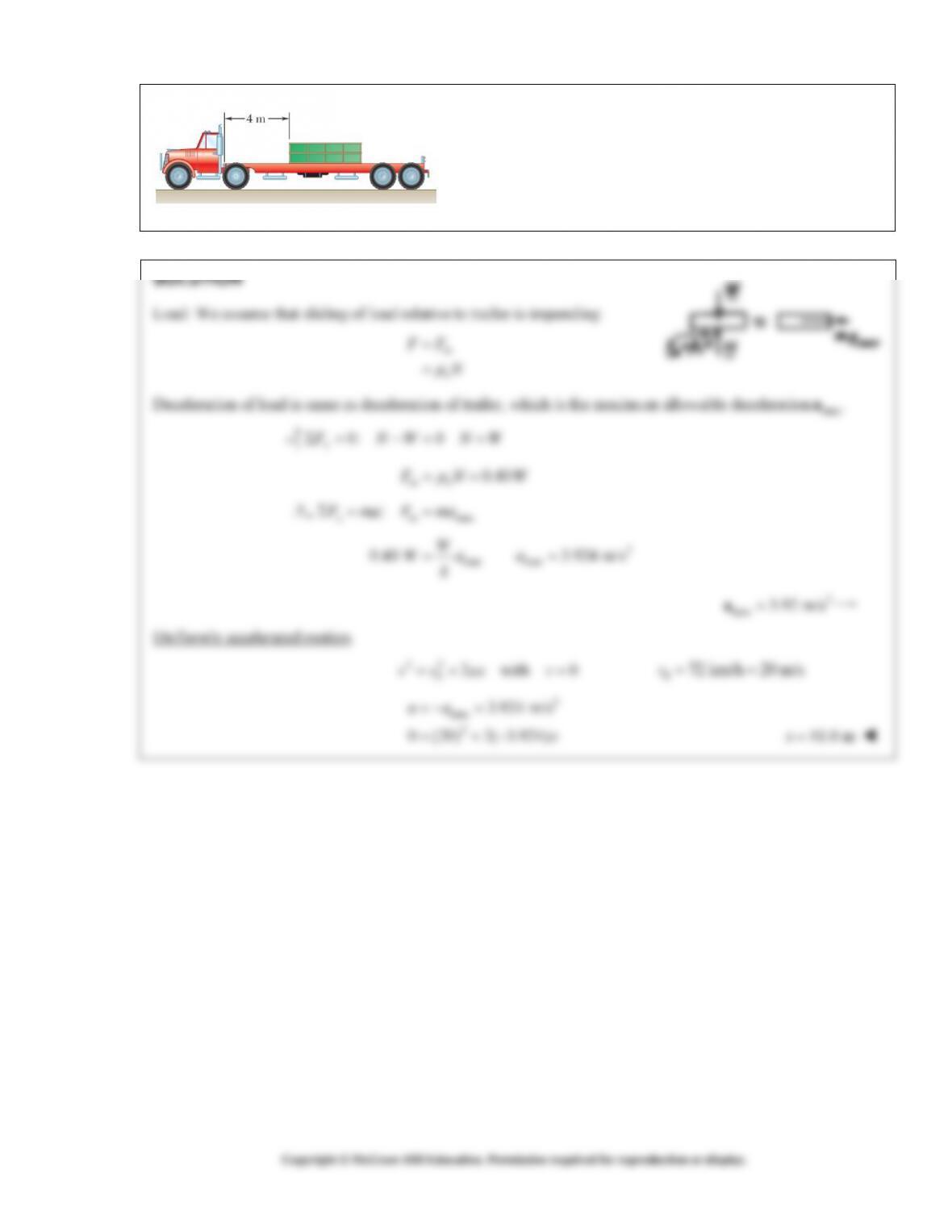
The coefficients of friction between the load and the flat-bed
trailer shown are
0.40
s
and
0.30.
k
Knowing that the
speed of the rig is 72 km/h, determine the shortest distance in
which the rig can be brought to a stop if the load is not to shift.
Copyright © McGraw-Hill Education. Permission required for reproduction or display.
PROBLEM 12.12
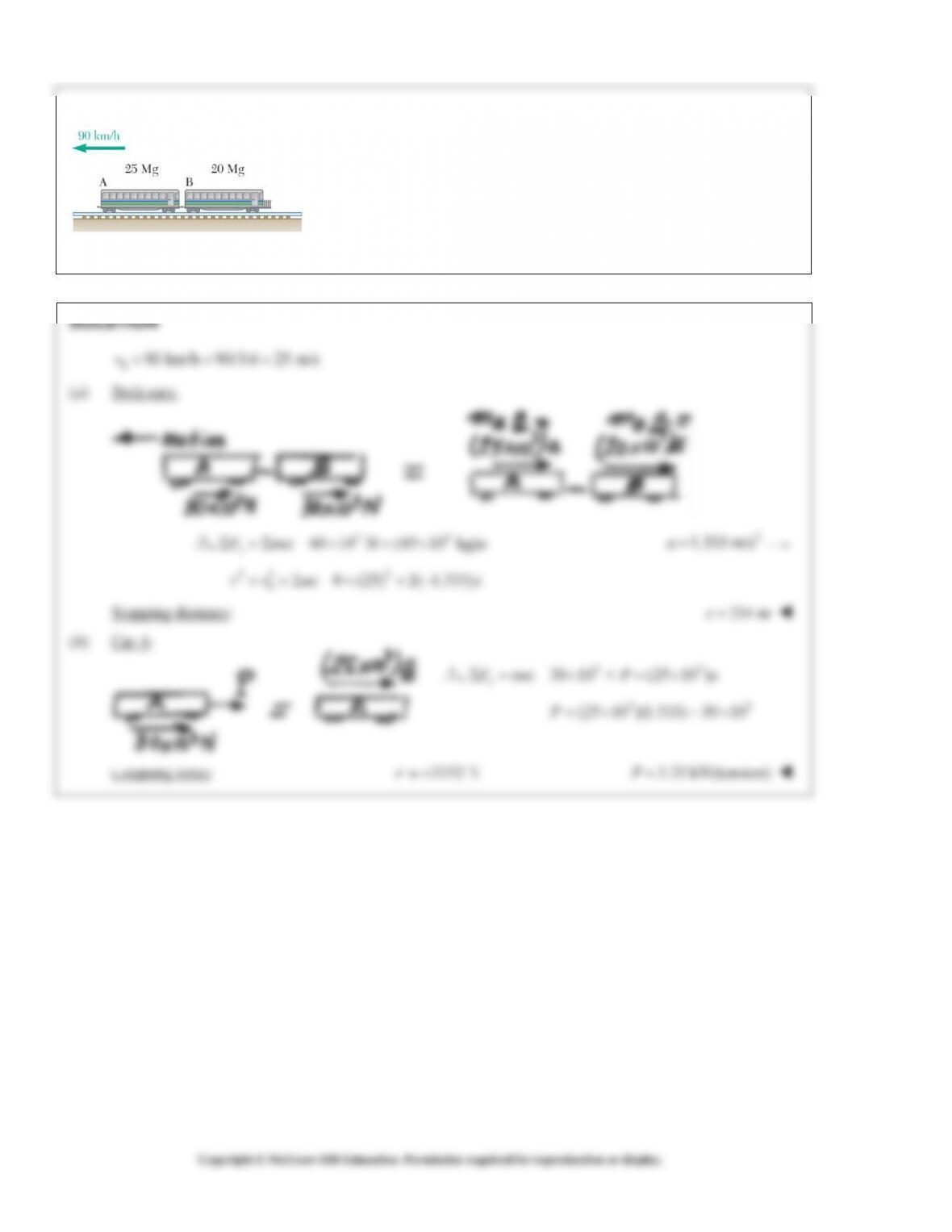
A light train made up of two cars is traveling at 90 km/h when the
brakes are applied to both cars. Knowing that car A has a mass of 25
Mg and car B a mass of 20 Mg, and that the braking force is 30 kN
on each car, determine (a) the distance traveled by the train before it
comes to a stop, (b) the force in the coupling between the cars while
the train is showing down.
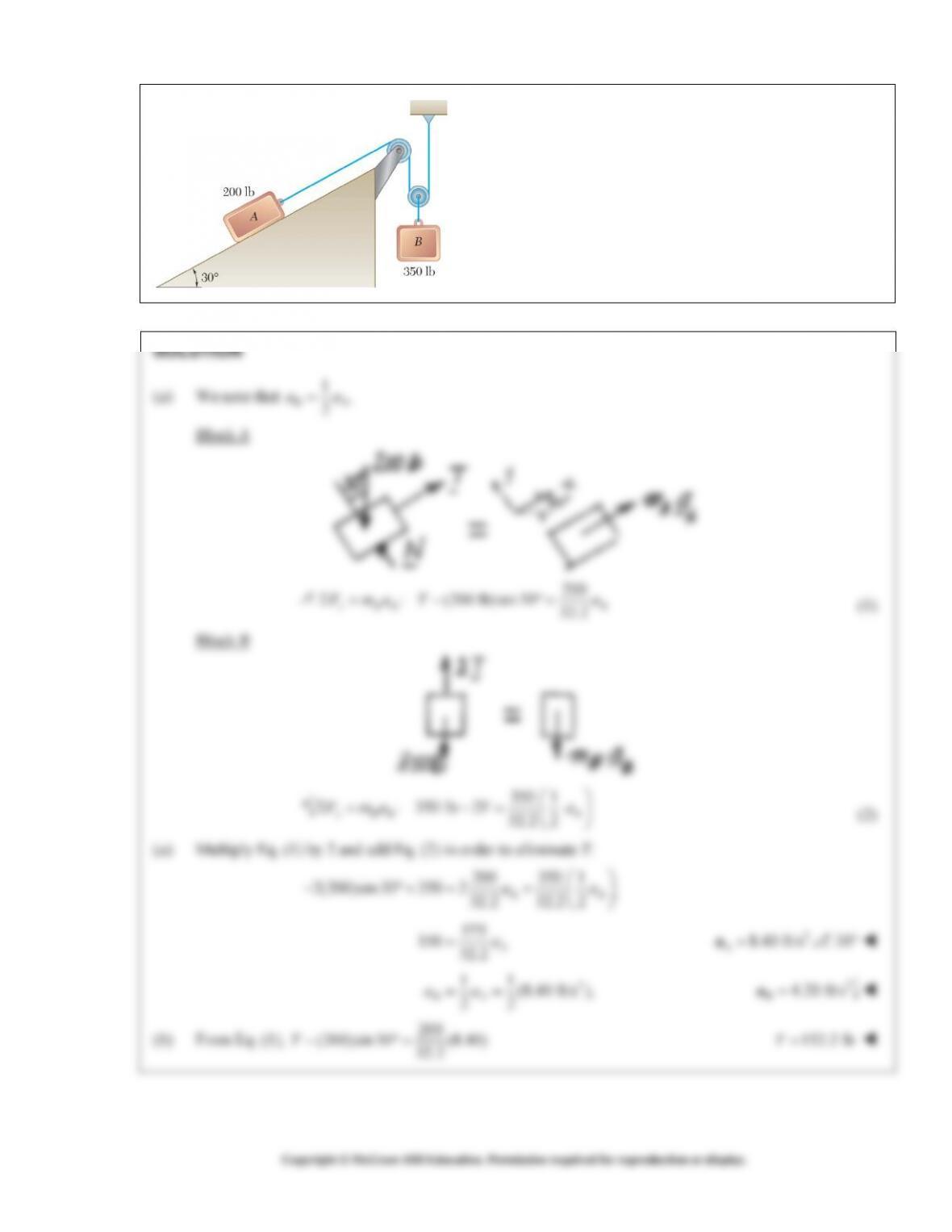
PROBLEM 12.13
The two blocks shown are originally at rest. Neglecting the
masses of the pulleys and the effect of friction in the pulleys
and between block A and the incline, determine (a) the
acceleration of each block, (b) the tension in the cable.
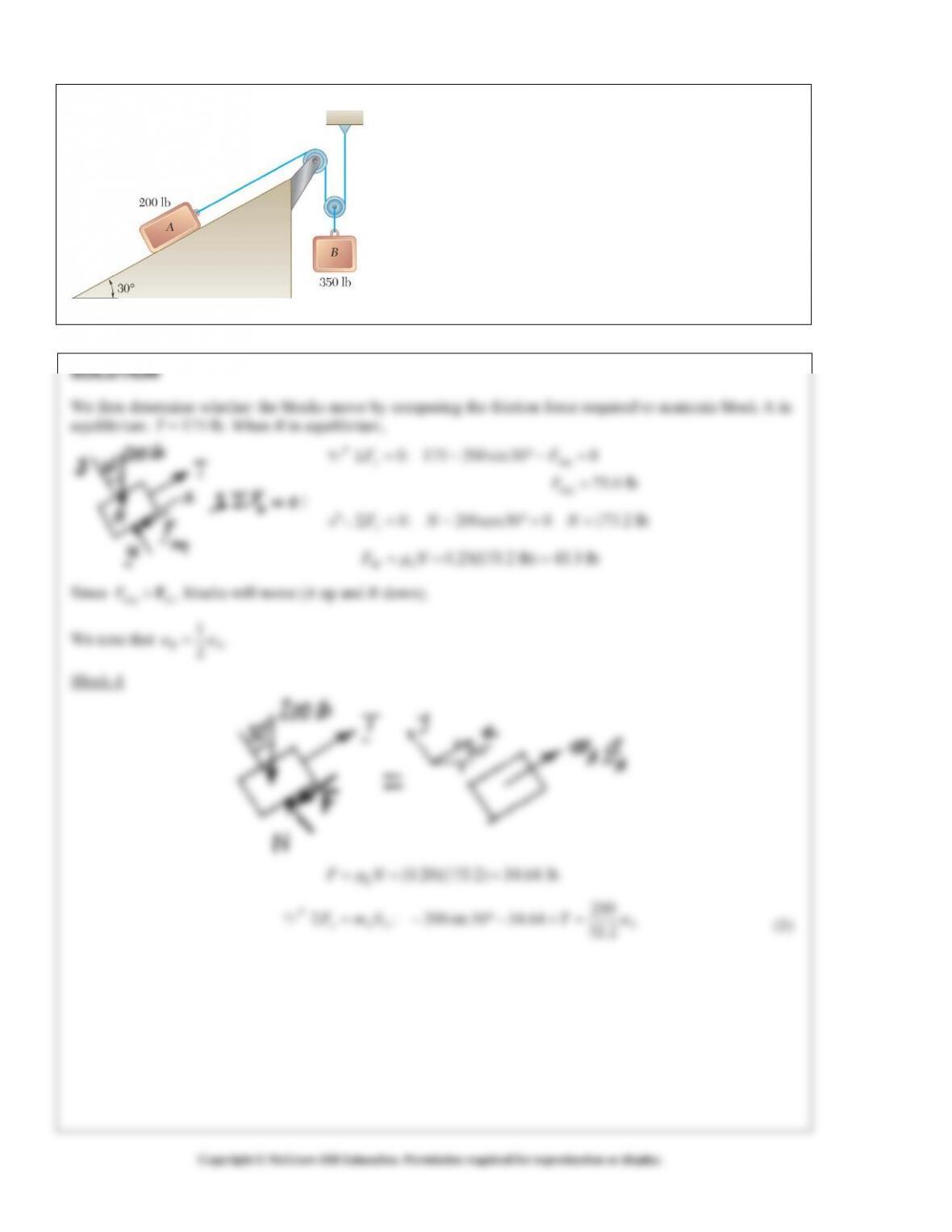
PROBLEM 12.14
Solve Problem 12.13, assuming that the coefficients of
friction between block A and the incline are
0.25
s
and
0.20.
k
PROBLEM 12.13 The two blocks shown are originally at
rest. Neglecting the masses of the pulleys and the effect of
friction in the pulleys and between block A and the incline,
determine (a) the acceleration of each block, (b) the tension
in the cable.