8-81
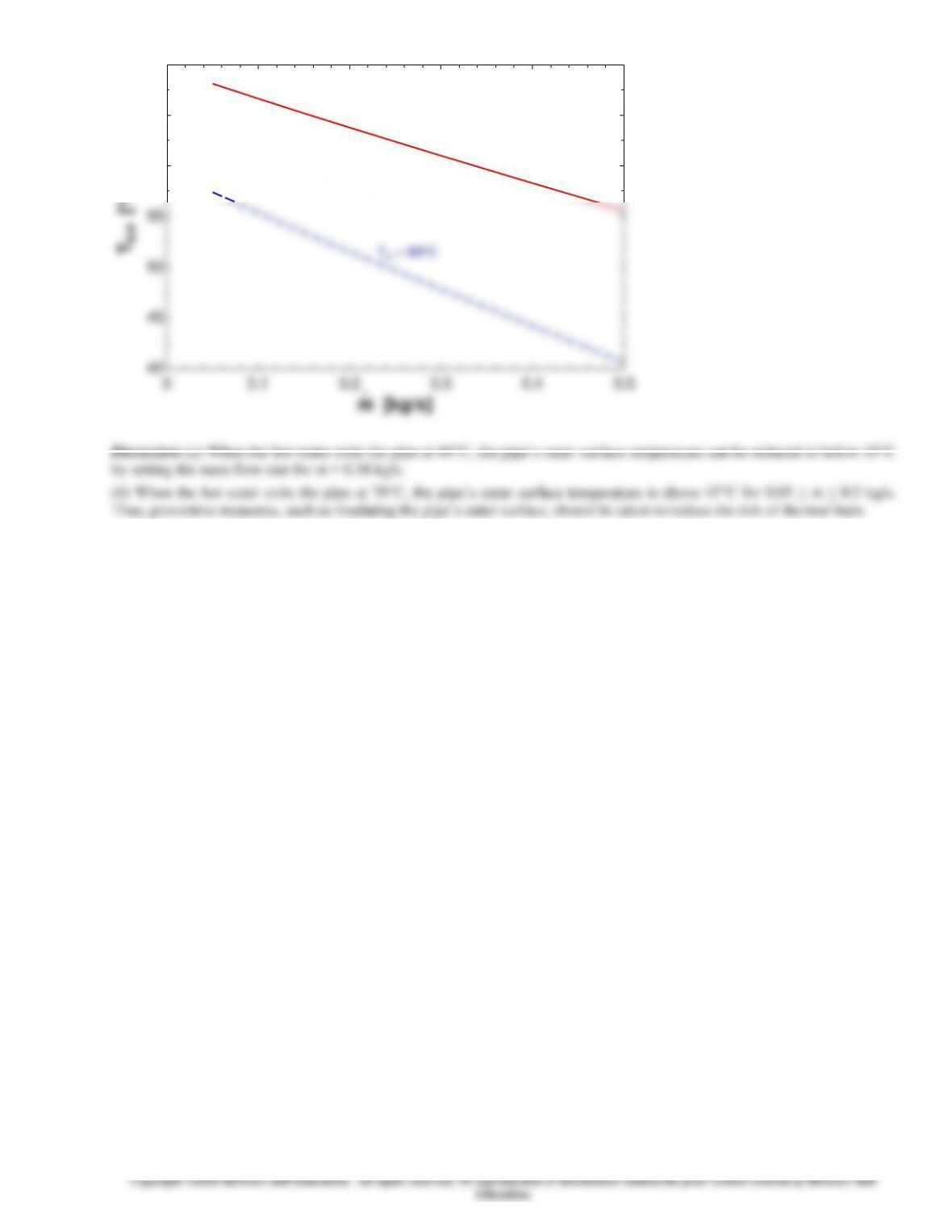
0 0.1 0.2 0.3 0.4 0.5
40
45
50
55
60
65
70
m [kg/s]
Ts,o [°C]
Te = 70°C
Te = 60°C

8-83
T_b=(T_i+T_e)/2 “T_b = 1/2*(T_i+T_e)”
c_p=cP(water, T=T_b, x=1)*Convert(kJ/kg-C, J/kg-C)
k=Conductivity(water, T=T_b, x=1)
f=(0.790*ln(Re)-1.64)^(-2) “Petukhov correlation”
Nusselt=((f/8)*(Re-1000)*Pr)/(1+12.7*(f/8)^0.5*(Pr^(2/3)-1)) “Gnielinski correlation”
h=k/D_i*Nusselt
Q_dot=m_dot*c_p*(T_i-T_e)

8-85
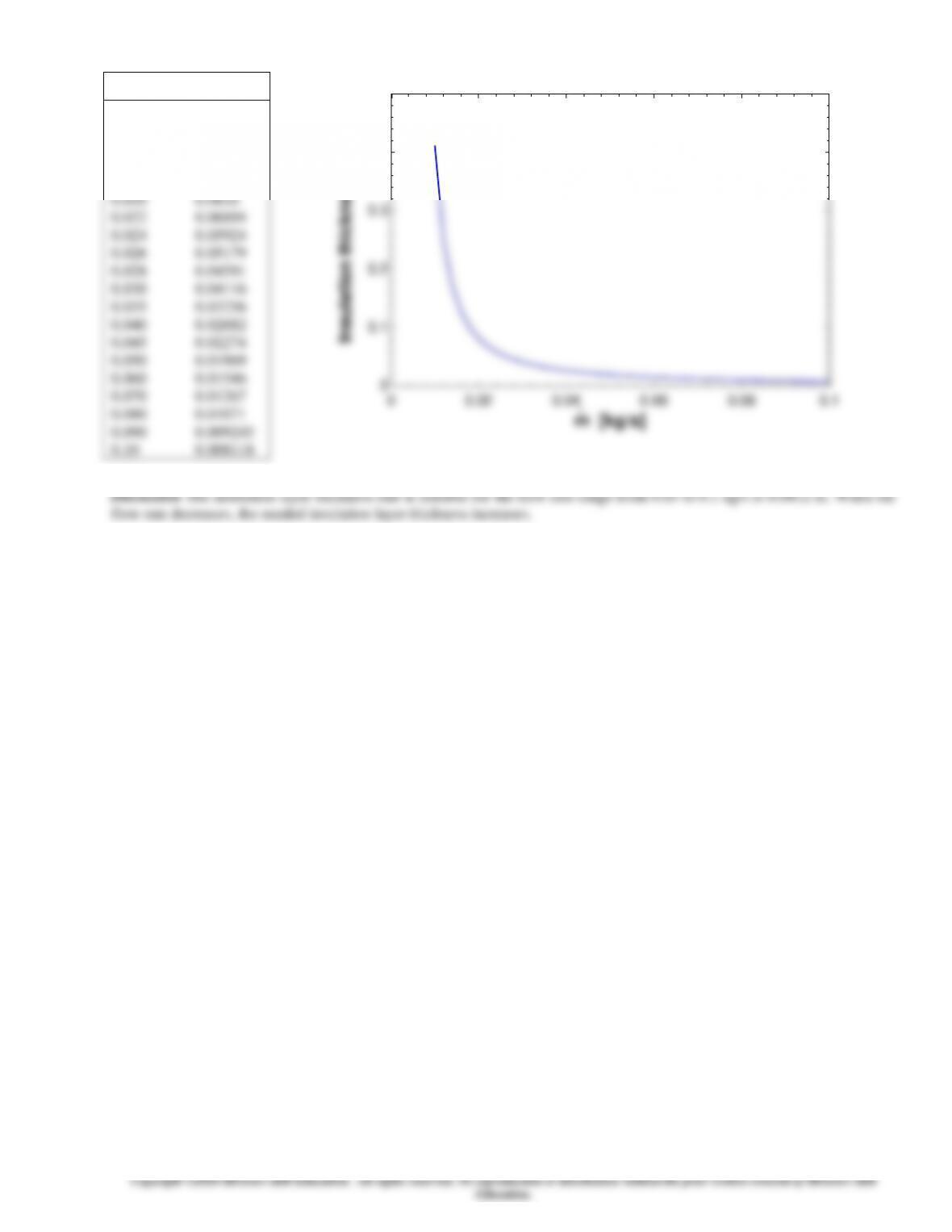
ṁ [kg/s] tins [m]
0.01 0.4119
0.012 0.2493
0.014 0.1714
0.016 0.1277
0.018 0.1004
0.020 0.0820
0.022 0.06894
0.024 0.05924
0.026 0.05179
0.028 0.04591
0.030 0.04116
0.035 0.03256
0.040 0.02682
0.045 0.02274
0.050 0.01969
0.060 0.01546
0.070 0.01267
0.080 0.01071
0.090 0.009245
0.10 0.008118
0 0.02 0.04 0.06 0.08 0.1
0
0.1
0.2
0.3
0.4
0.5
m [kg/s]
Insulation thickness [m]
8-86
8-98 Liquid NH3 flows in a pipe, which is insulated. The insulation thickness on the pipe that is necessary to keep
the liquid NH3 exit temperature at −20°C is to be determined.
Assumptions 1 Steady operating conditions exist. 2 Radiation effects are negligible. 3 Convection effects on the outer pipe
surface are negligible. 4 One-dimensional heat conduction through pipe wall. 5 The thermal properties of pipe wall and
insulation are constant. 6 Thermal resistance at the interface is negligible. 7 The surface temperatures are uniform. 8 The
inner surfaces of the tube are smooth.
Properties The properties of liquid NH3 at Tb = (Ti + Te)/2 = [(−30 +(− 20)]/2 = −25°C are cp = 4489 J/kg∙K, k = 0.5968
W/m∙K, μ = 2.492 × 10⁻⁴ kg/m∙s, and Pr = 1.875 (EES or Table A-11). The thermal conductivities of the pipe and the
insulation are given to be kpipe = 15 W/mK and kins = 0.95 W/mK, respectively.
Analysis The Reynolds number of the sat. water vapor flow in the pipe is
4
m
The inner pipe surface temperature is
−−−=
s
hA
“GIVEN”

8-87
T_b=(T_i+T_e)/2 “T_b = 1/2*(T_i+T_e)”
c_p=4489 [J/kg-K]
k=0.5968 [W/m-K]
rho=671.5 [kg/m^2]
Pr=1.875
mu=2.492e-4 [kg/m-s]
“Pipe & insulation”
k_pipe=15 [W/m-K] “pipe thermal conductivity”
f=(0.790*ln(Re)-1.64)^(-2) “Petukhov correlation”
Nusselt=((f/8)*(Re-1000)*Pr)/(1+12.7*(f/8)^0.5*(Pr^(2/3)-1)) “Gnielinski correlation”
h=k/D_i*Nusselt
Q_dot=m_dot*c_p*(T_i-T_e)

8-89
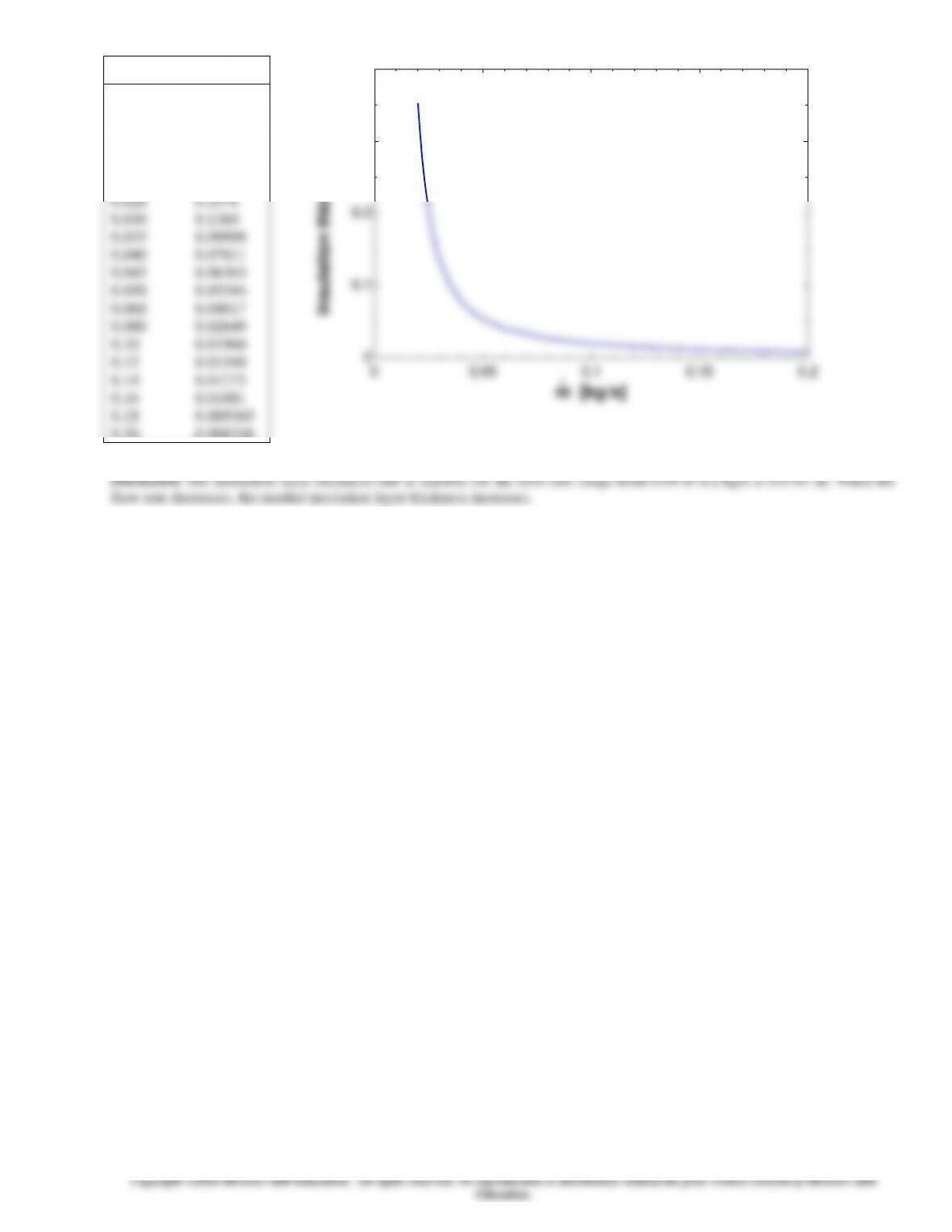
ṁ [kg/s] tins [m]
0.02 0.3528
0.021 0.3106
0.022 0.2760
0.023 0.2473
0.024 0.2233
0.026 0.1855
0.028 0.1574
0.030 0.1360
0.035 0.09998
0.040 0.07811
0.045 0.06363
0.050 0.05344
0.060 0.04017
0.080 0.02649
0.10 0.01960
0.12 0.01548
0.14 0.01275
0.16 0.01081
0.18 0.009365
0.20 0.008248
0 0.05 0.1 0.15 0.2
0
0.1
0.2
0.3
0.4
m [kg/s]
Insulation thickness [m]
8-90
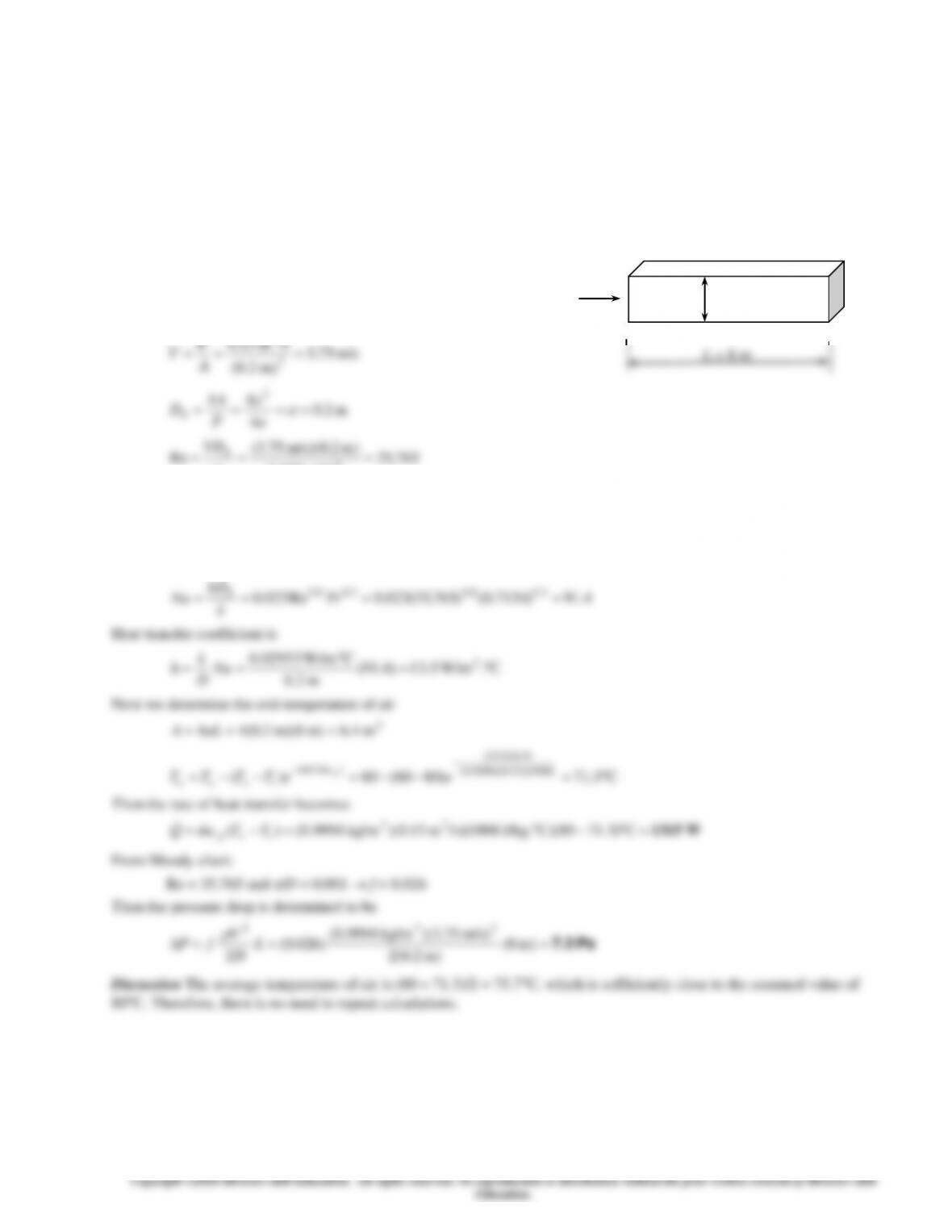
8-100 Air flows in a square cross section pipe. The rate of heat loss and the pressure difference between the inlet and outlet
sections of the duct are to be determined.
Assumptions 1 Steady operating conditions exist. 2 Air is an ideal gas with constant properties. 3 The pressure of air is 1 atm.
Properties Taking a bulk mean fluid temperature of 80C based on the problem statement (this assumes that the air does not
loose much heat to the attic), the properties of air are (Table A–15)
7154.0Pr
CJ/kg. 1008
/sm 10097.2
C W/m.02953.0
kg/m 9994.0
25–
3
=
=
=
=
=
p
c
k
Analysis The mean velocity of air, the hydraulic
diameter, and the Reynolds number are
/sm 15.0
3
V
Air
80ºC
0.15 m3/s
a = 0.2 m
8-91
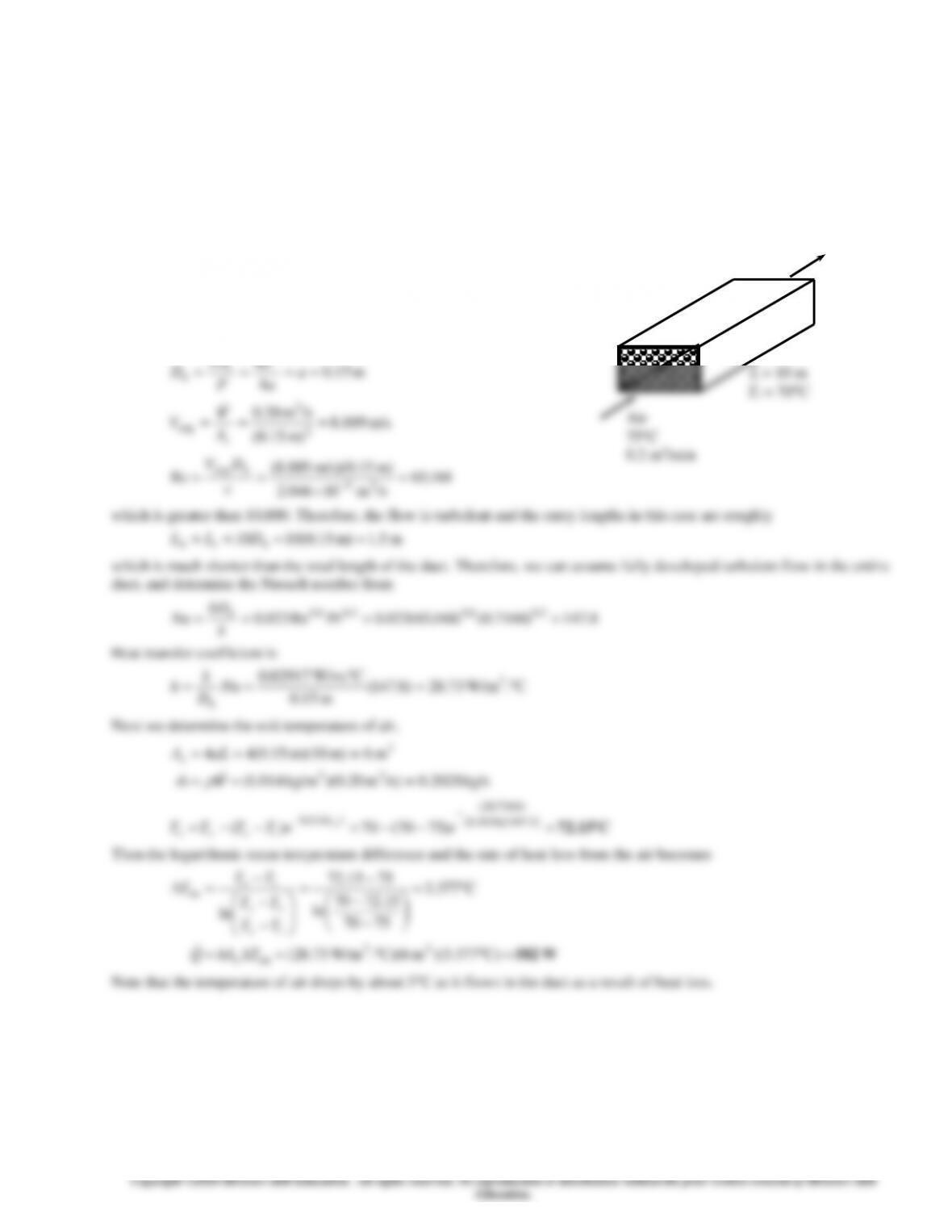
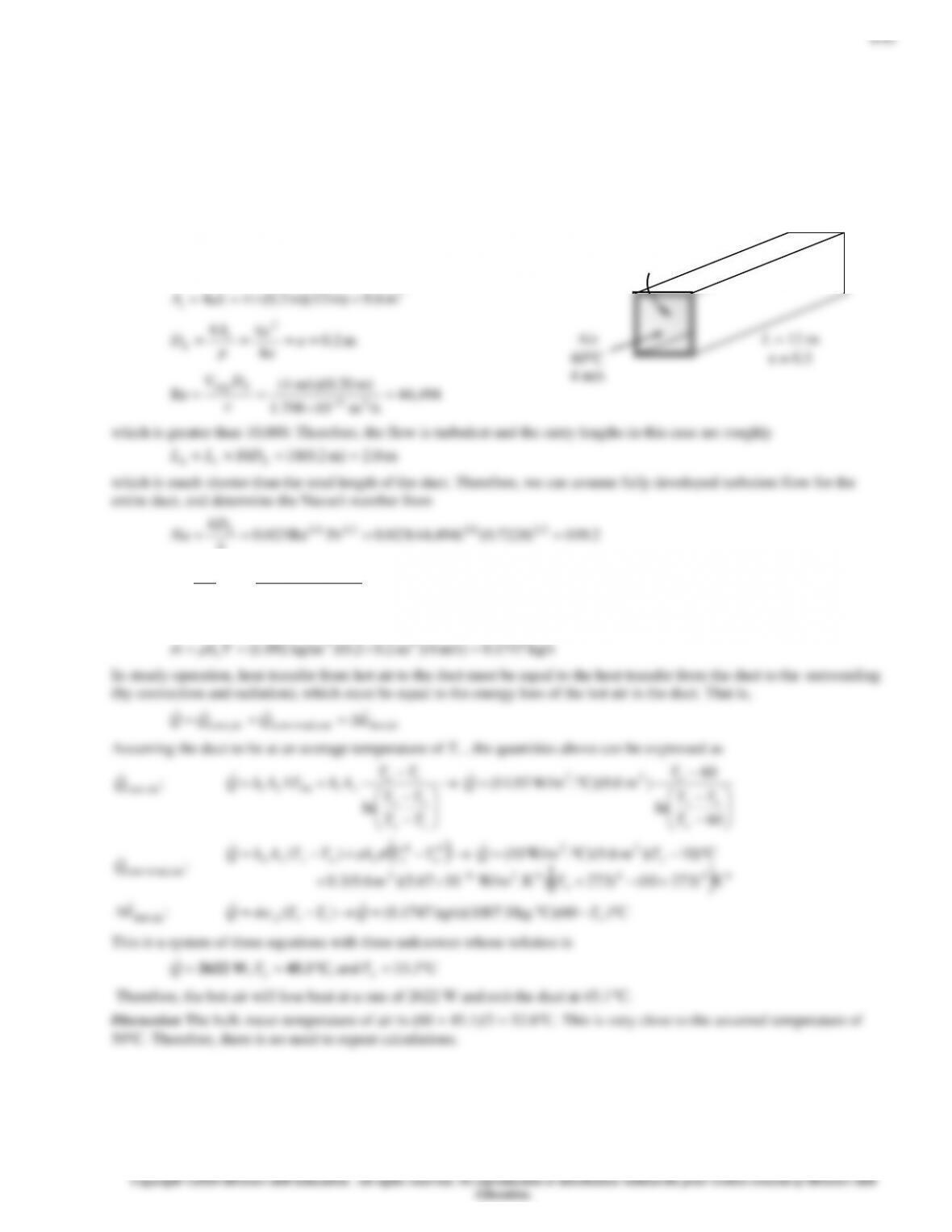
8-101 Flow of hot air through uninsulated square ducts of a heating system in the attic is considered. The exit temperature
and the rate of heat loss are to be determined.
Assumptions 1 Steady operating conditions exist. 2 The inner surfaces of the duct are smooth. 3 Air is an ideal gas with
constant properties. 4 The pressure of air is 1 atm.
Properties We assume the bulk mean temperature for air to be 75C since the mean temperature of air at the inlet will not
drop significantly because the surfaces are at 70C. The properties of air at 1 atm and this temperature are (Table A–15)
7166.0Pr
CJ/kg. 5.1007
/sm 10046.2
C W/m.02917.0
kg/m 014.1
25–
3
=
=
=
=
=
p
c
k
Analysis The characteristic length that is the hydraulic diameter, the
mean velocity of air, and the Reynolds number are
4
42
a
A
Te

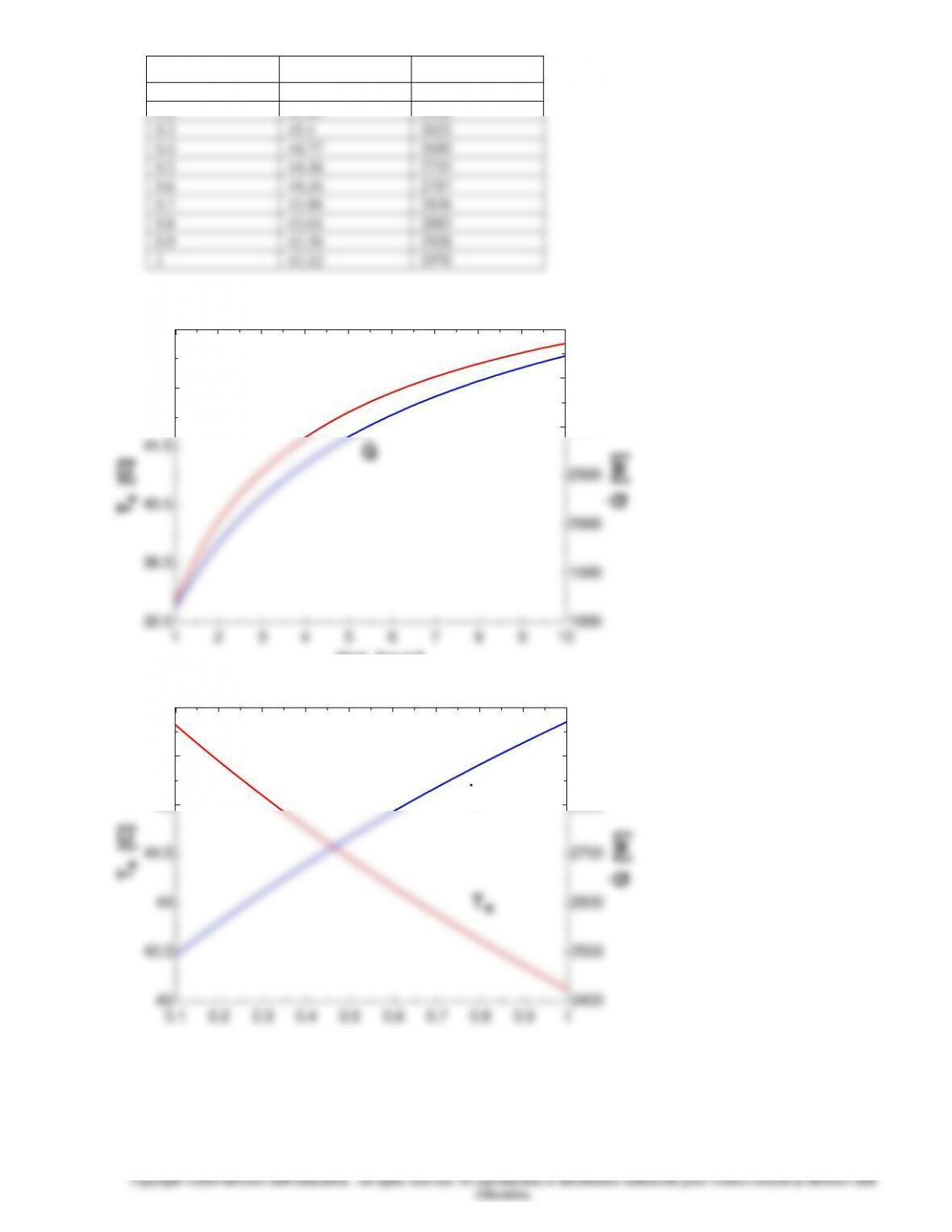
8-95
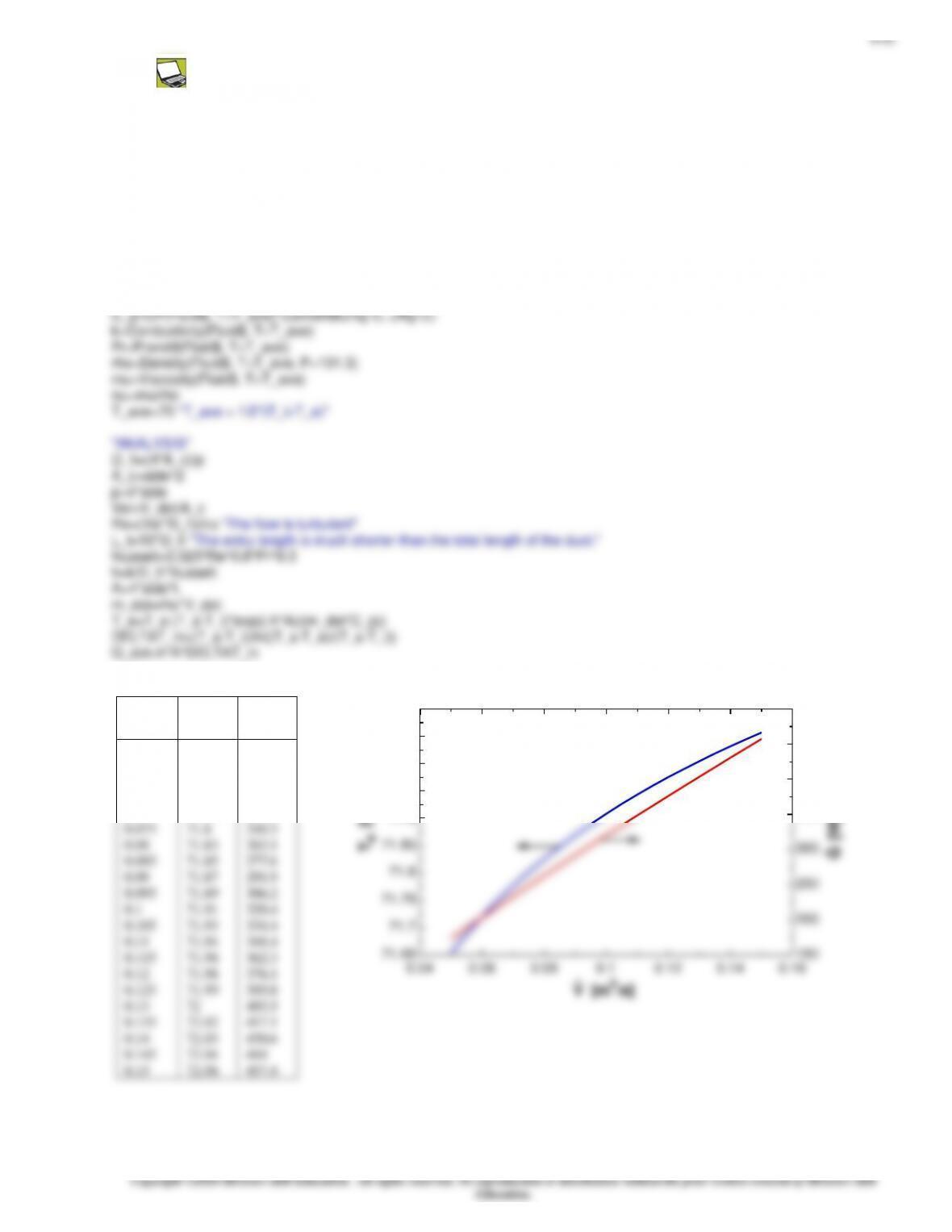
Te [C]
Q
[W]
0.1
45.82
2495
0.2
45.45
2560
0.3
45.1
2622
0.4
44.77
2680
0.5
44.46
2735
0.6
44.16
2787
0.7
43.88
2836
0.8
43.61
2883
0.9
43.36
2928
1
43.12
2970
1 2 3 4 5 6 7 8 9 10
32.5
36.5
40.5
44.5
48.5
52.5
1000
1500
2000
2500
3000
3500
4000
Vel [m/s]
Te [C]
Q [W]
Te
Q
43
43.5
44
44.5
45
45.5
46
2400
2500
2600
2700
2800
2900
3000
e
Te [C]
Q [W]
Te
Q
8-96
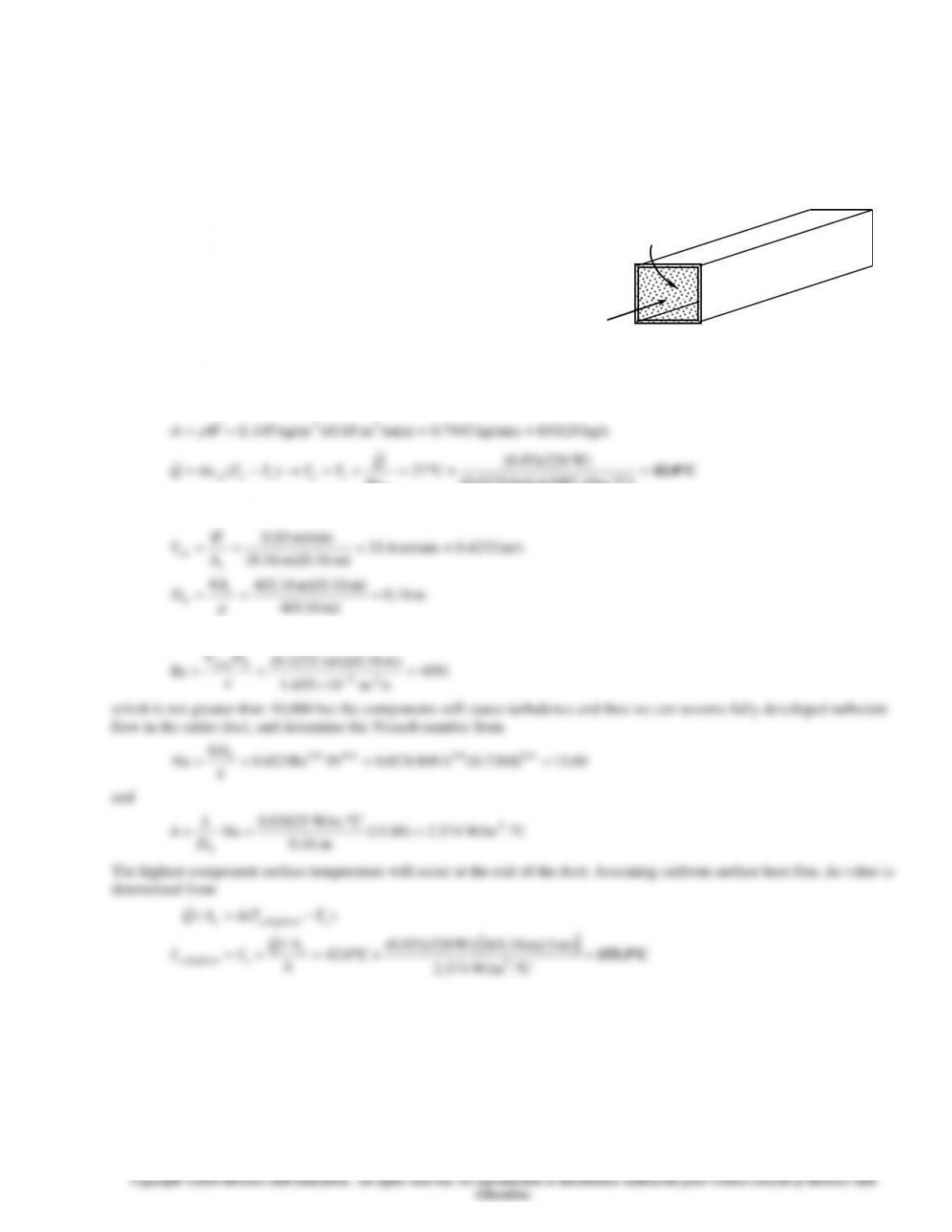
8-105 The components of an electronic system located in a rectangular horizontal duct are cooled by forced air. The exit
temperature of the air and the highest component surface temperature are to be determined.
Assumptions 1 Steady flow conditions exist. 2 The inner surfaces of the duct are smooth. 3 The thermal resistance of the duct
is negligible. 4 Air is an ideal gas with constant properties. 5 The pressure of air is 1 atm. 6 Fully developed turbulent flow in
the channel.
Properties We assume the bulk mean temperature for air to be
35C since the mean temperature of air at the inlet will rise
somewhat as a result of heat gain through the duct whose
surface is exposed to a constant heat flux. The properties of air
at 1 atm and this temperature are (Table A–15)
7268.0Pr
CJ/kg. 1007
/sm 10655.1
C W/m.02625.0
kg/m 145.1
25–
3
=
=
=
=
=
p
c
k
Analysis (a) The mass flow rate of air and the exit
temperature are determined from
Air
27C
0.65 m3/min
L = 1 m
Air duct
16 cm 16 cm
220 W
8-97
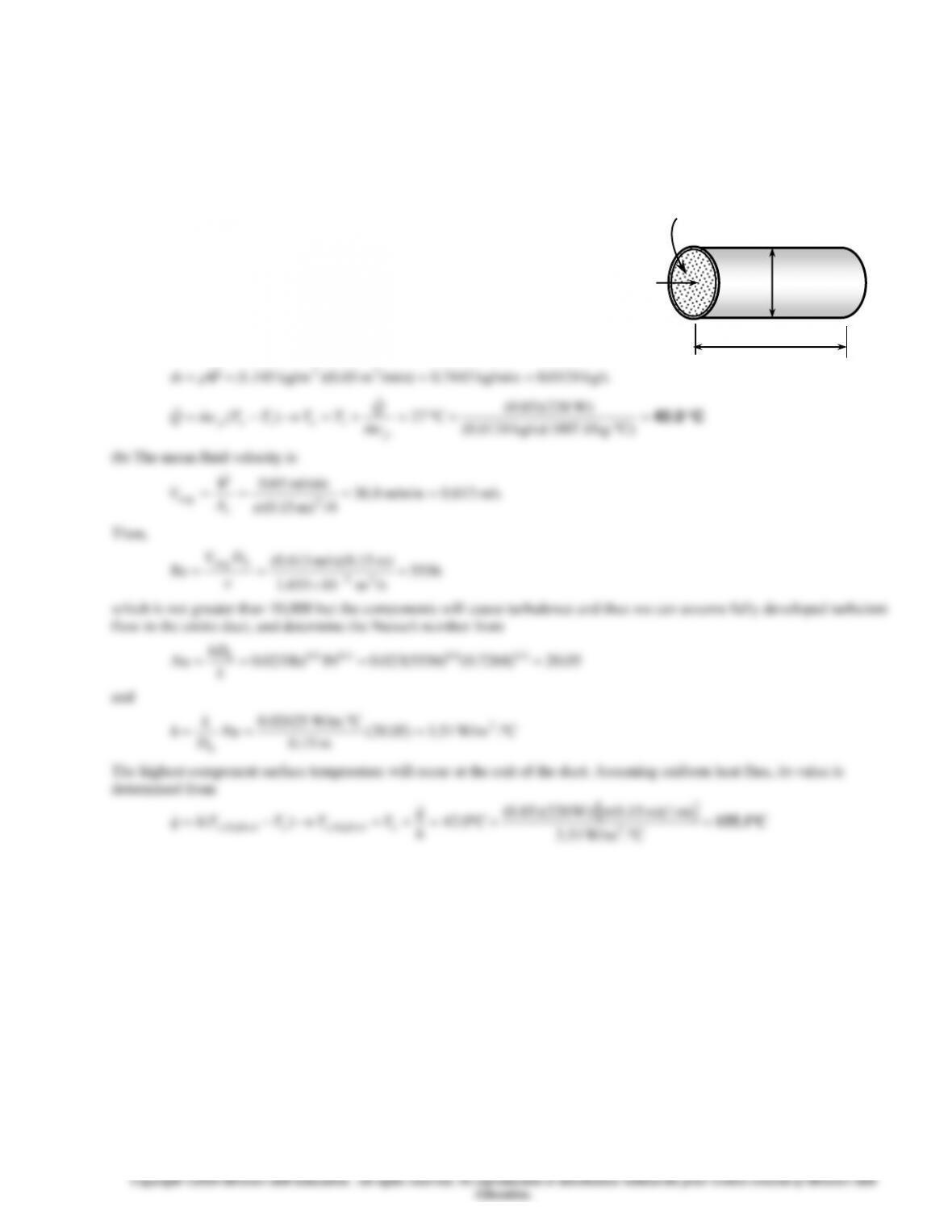
8-106 The components of an electronic system located in a circular horizontal duct are cooled by forced air. The exit
temperature of the air and the highest component surface temperature are to be determined.
Assumptions 1 Steady flow conditions exist. 2 The inner surfaces of the duct are smooth. 3 The thermal resistance of the duct
is negligible. 4 Air is an ideal gas with constant properties. 5 The pressure of air is 1 atm.
Properties We assume the bulk mean temperature for air to be 35C since the mean temperature of air at the inlet will rise
somewhat as a result of heat gain through the duct whose surface is exposed to a constant heat flux. The properties of air at 1
atm and this temperature are (Table A–15)
7268.0Pr
CJ/kg. 1007
/sm 10655.1
C W/m.02625.0
kg/m 145.1
25–
3
=
=
=
=
=
p
c
k
Analysis (a) The mass flow rate of air and the exit temperature are
determined from
,,
h
Air
27C
0.65 m3/min
Electronics, 220 W
L = 1 m
D = 15 cm
8-99
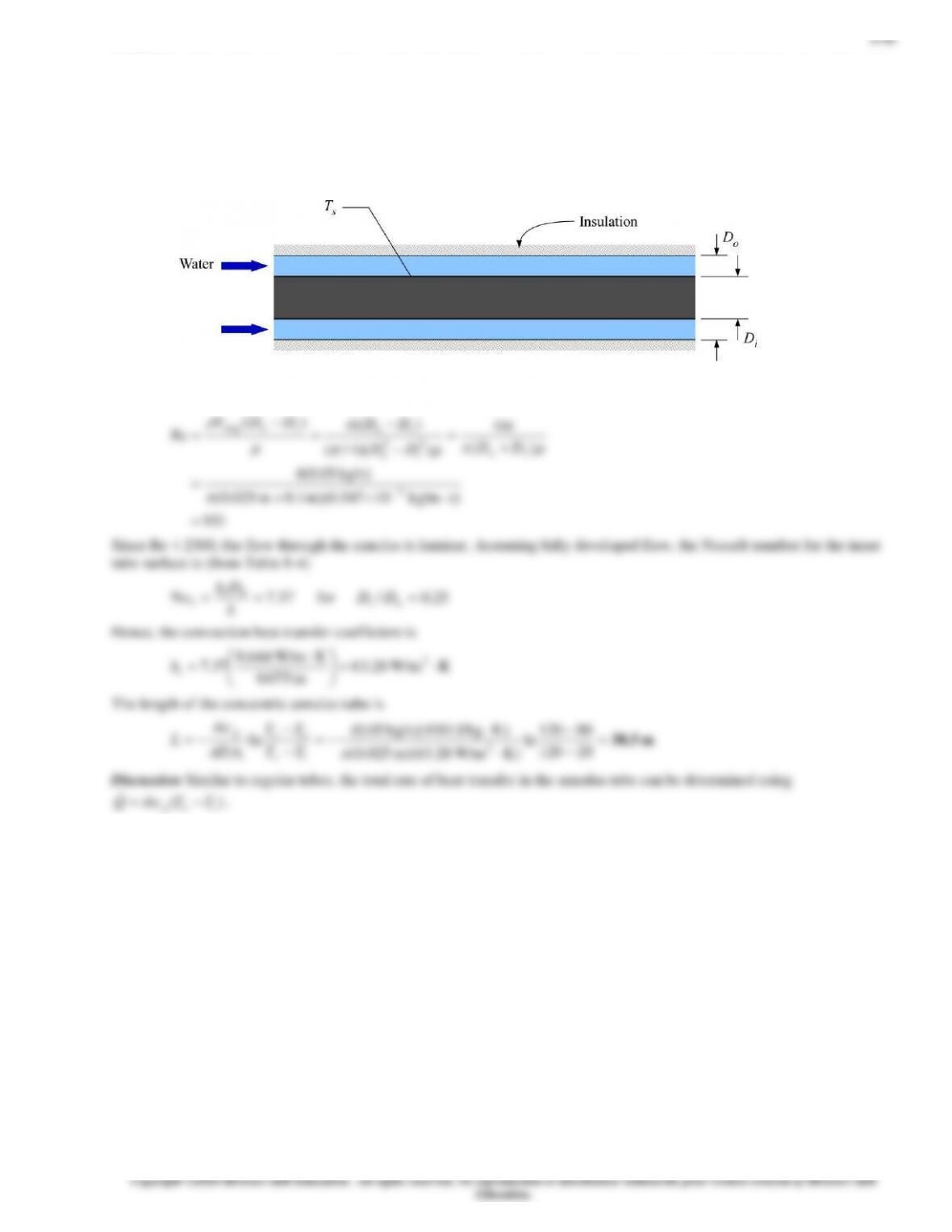
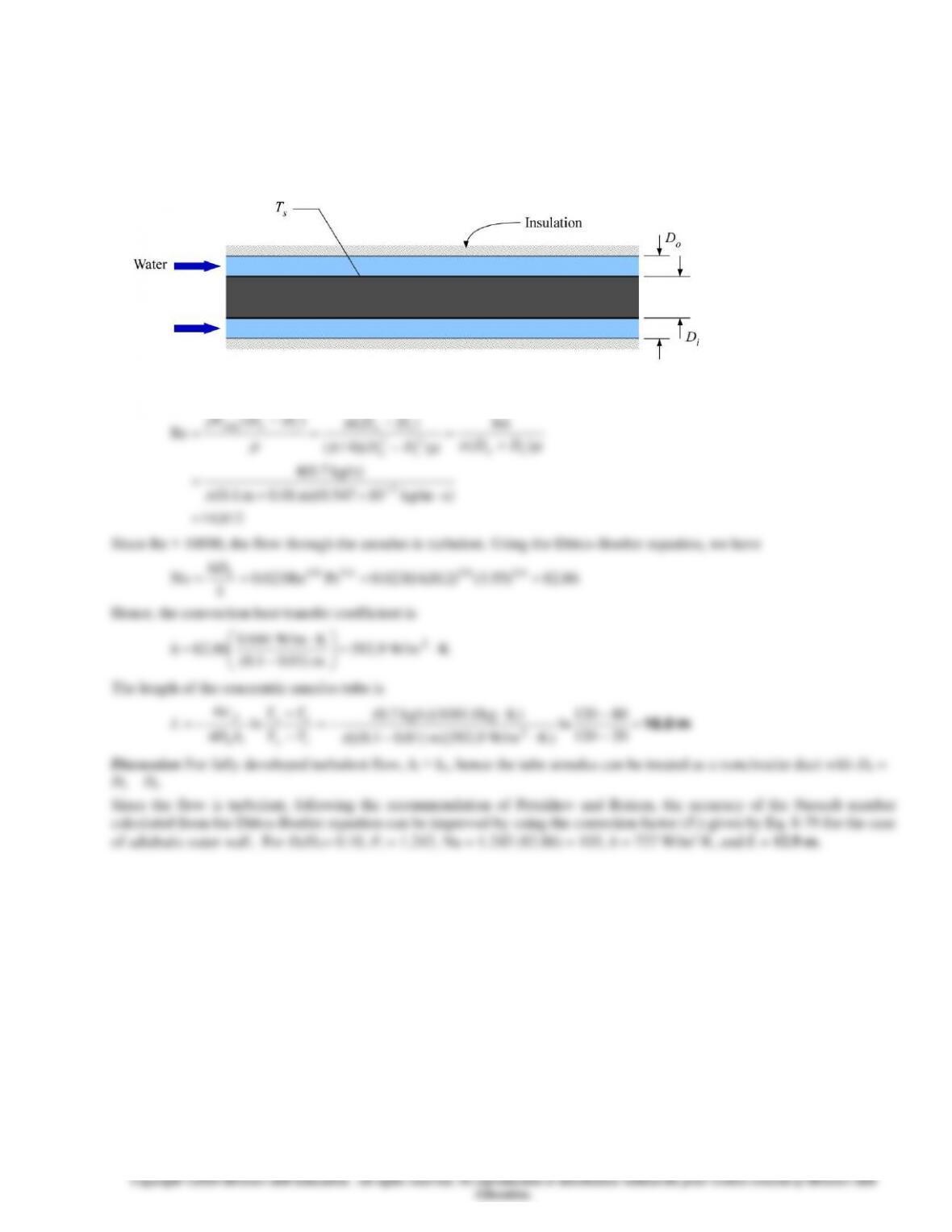
8-108 Water flows through a concentric annulus tube with constant inner surface temperature and insulated outer surface, the
length of the annulus tube is to be determined.
Assumptions 1 Steady operating conditions exist. 2 Properties are constant. 3 Constant inner tube surface temperature. 4
Insulated outer tube surface. 5 Fully developed flow.
Properties The properties of water at Tb = (Ti + Te)/2 = 50°C: cp = 4181 J/kg∙K, k = 0.644 W/m∙K,
= 0.547 10−3 kg/m∙s,
and Pr = 3.55 (Table A-15).
Analysis The Reynolds number is
)kg/s 7.0(4
)(
4
))(4/(
)(
)(
Re
22
avg
+
=
−
−
=
−
=
io
io
io
io
DD
m
DD
DDm
DDV
8-100
Special Topic: Transitional Flow
8-109 A liquid mixture flowing in a tube with a bell-mouth inlet is subjected to uniform wall heat flux. The friction
coefficient is to be determined.
Assumptions Steady operating conditions exist.
Properties The properties of the ethylene glycol-distilled water mixture are given to be Pr = 14.85, ν = 1.9310-6 m2/s and
b/
s = 1.07.
Analysis: For the calculation of the non-isothermal fully developed friction coefficient, it is necessary to determine the flow
regime before making any decision regarding which friction coefficient relation to use. The Reynolds number at the specified
location is
( )
m0158.0)]m10961.1/()/sm1043.1[(
)/(
2434
−−
DAc
V
8-110 A liquid mixture flowing in a tube with a bell-mouth inlet is subjected to uniform wall heat flux. The friction
coefficient is to be determined.
Assumptions Steady operating conditions exist.
Properties The properties of the ethylene glycol-distilled water mixture are given to be Pr = 14.85, ν = 1.9310-6 m2/s and
b/
s = 1.07.
Analysis: For the calculation of the non-isothermal fully developed friction coefficient, it is necessary to determine the flow
regime before making any decision regarding which friction coefficient relation to use. If the volume flow rate is increased
by 50%, the Reynolds number becomes
( )
m0158.0)]m10961.1/()/sm1043.15.1[(
)/(
2434
−−
DAc
V
25.025.0
8960
Re
s