
5-81
(c) The rate of heat loss through a 1-m long section of the chimney is determined from
−===
)(444
surface,surfaceinner element,chimney offourth –one
TTAhQQQ
m
mimi
5-82
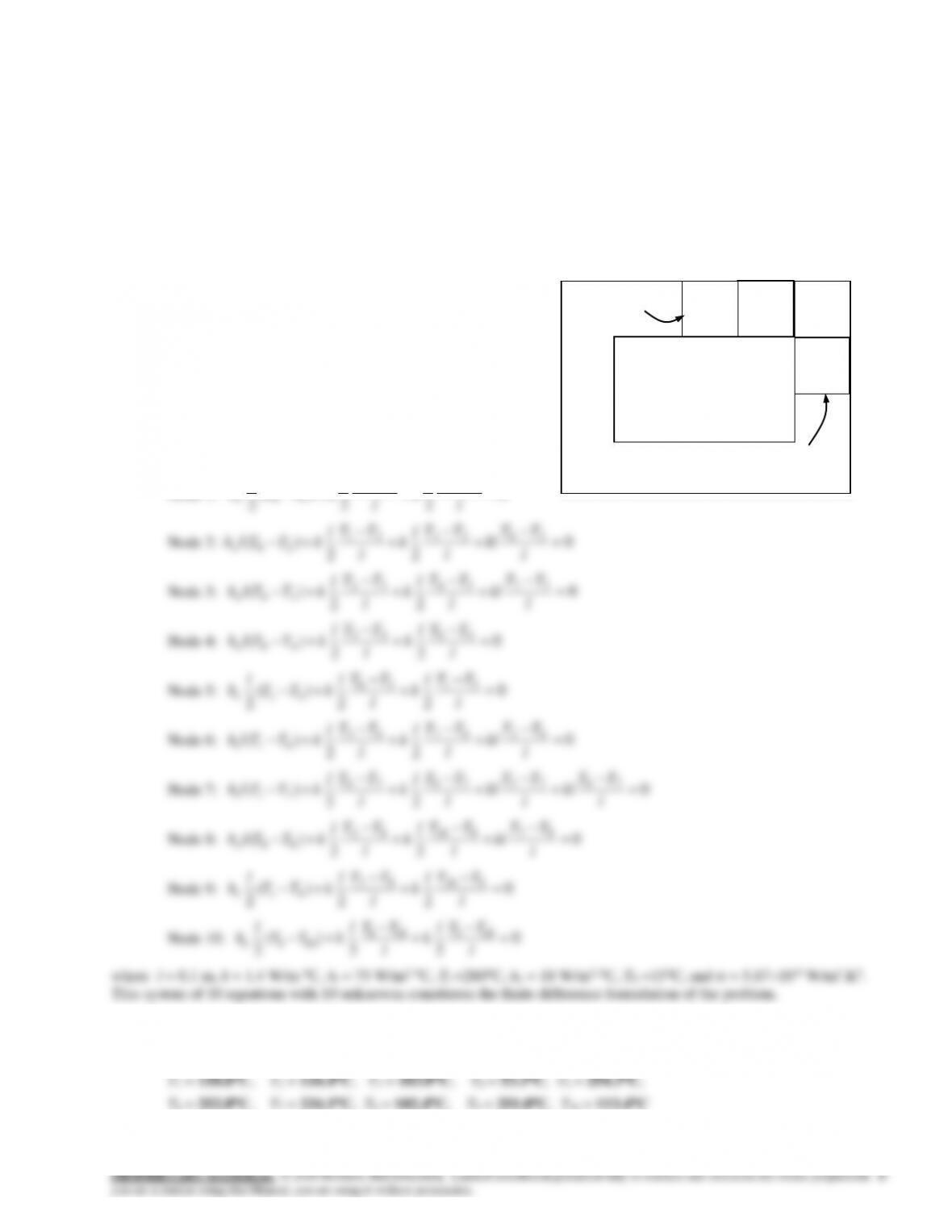
5-82 Heat transfer through a square chimney is considered. The nodal temperatures and the rate of heat loss per unit length
are to be determined with the finite difference method.
Assumptions 1 Heat transfer is given to be steady and two-dimensional since the height of the chimney is large relative to its
cross-section, and thus heat conduction through the chimney in the axial direction is negligible. It is tempting to simplify the
problem further by considering heat transfer in each wall to be one dimensional which would be the case if the walls were
thin and thus the corner effects were negligible. This assumption cannot be justified in this case since the walls are very thick
and the corner sections constitute a considerable portion of the chimney structure. 2 There is no heat generation in the
chimney. 3 Thermal conductivity is constant. 4 Radiation heat transfer is negligible.
Properties The thermal conductivity of chimney is given to
be k = 1.4 W/m°C.
Analysis (a) The most striking aspect of this problem is the
apparent symmetry about the horizontal and vertical lines
passing through the midpoint of the chimney. Therefore, we
need to consider only one-fourth of the geometry in the
solution whose nodal network consists of 10 equally spaced
nodes. No heat can cross a symmetry line, and thus symmetry
lines can be treated as insulated surfaces and thus “mirrors” in
the finite-difference formulation. Considering a unit depth and
using the energy balance approach for the boundary nodes
(again assuming all heat transfer to be into the volume element
for convenience), the finite difference formulation is obtained
to be
Node 1:
0
22
)(
2
15
12
10 =
−
+
−
+− l
TT
l
k
l
TT
l
kTT
l
ho
l
21
−
−
−
TT
TT
l
TT
l
(b) The 10 nodal temperatures under steady conditions are determined by solving the 10 equations above simultaneously with
an equation solver to be
• • • •
1 2 3 4
ho, To
• • • •
• •
5 6 7 8
9 10
hi, Ti
Insulated
Insulated
Hot gases

5-83
(c) The rate of heat loss through a 1-m long section of the chimney is determined from
−===
)(444
surface,surfaceinner element,chimney offourth –one
TTAhQQQ
m
mimi
5-85
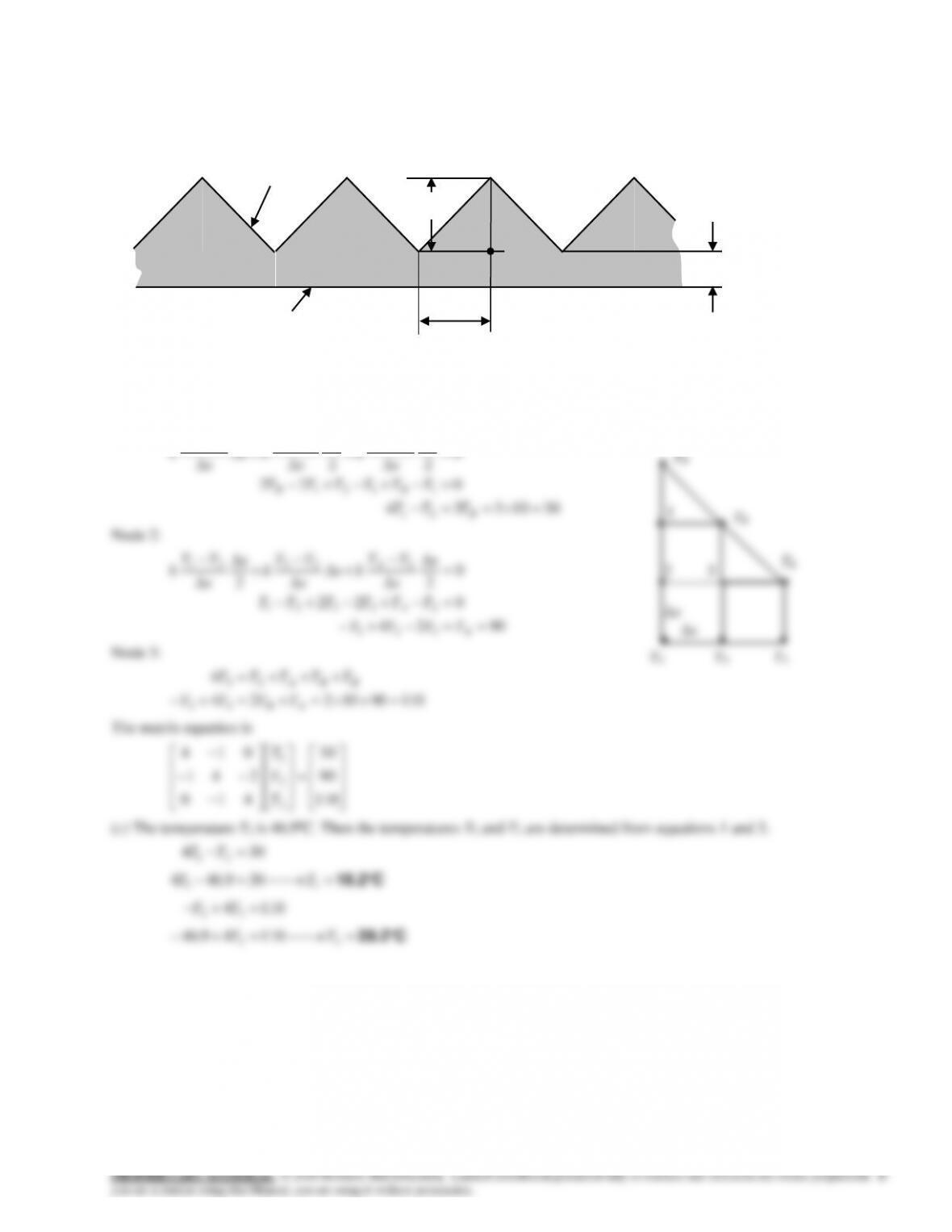
(b) The temperature at each node is determined by solving the 15 equations for 15 unknown nodal temperatures using EES or
any other software. The temperature at different nodes are as follows
5-86
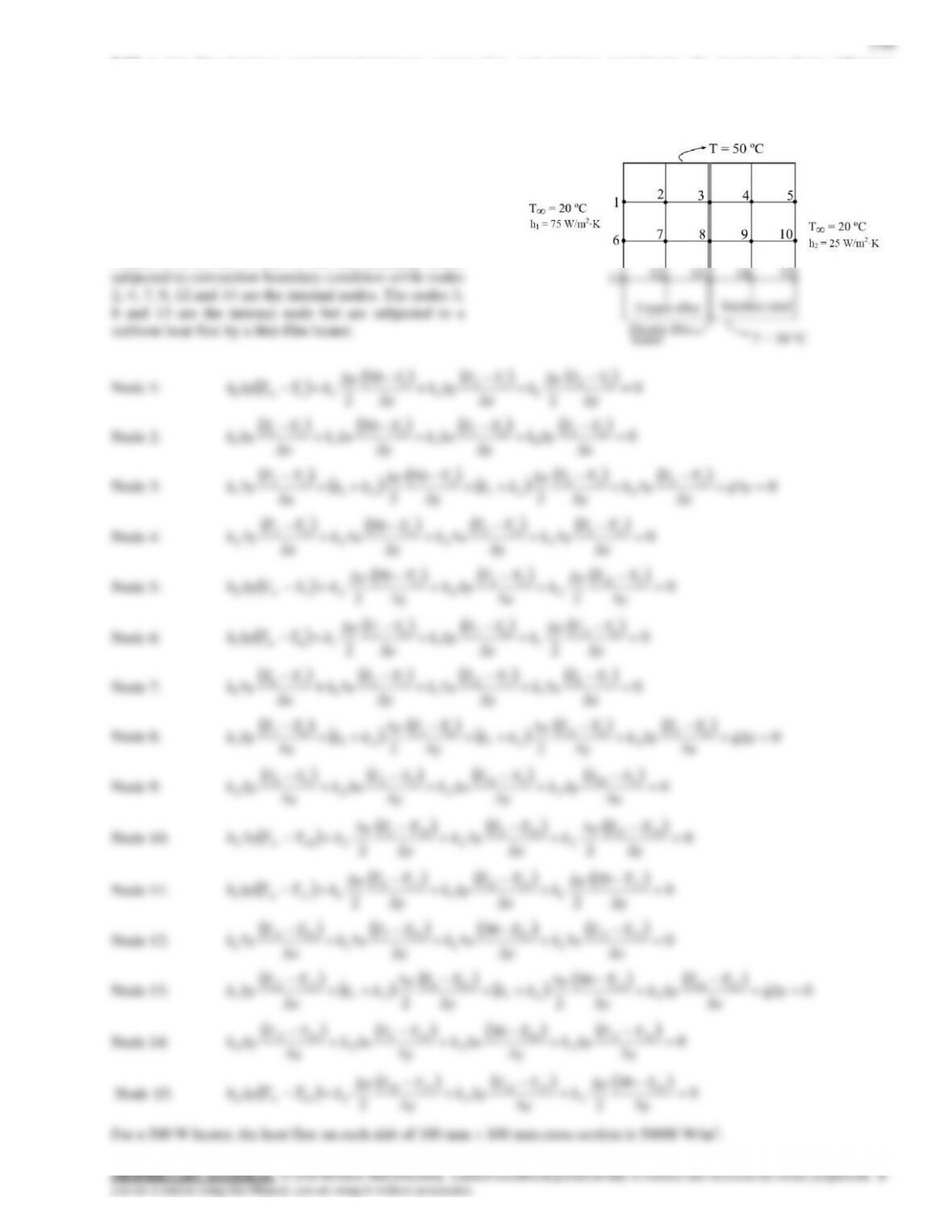
5-84 Two dimensional ridges are machined on the cold side of a heat exchanger. The smallest section of the wall is to be
identified. A two-dimensional grid is to be constructed and the unknown temperatures in the grid are to be determined.
Assumptions 1 Heat transfer through the body is given to be steady and two-dimensional. 2 Thermal conductivity is constant.
3 There is no heat generation.
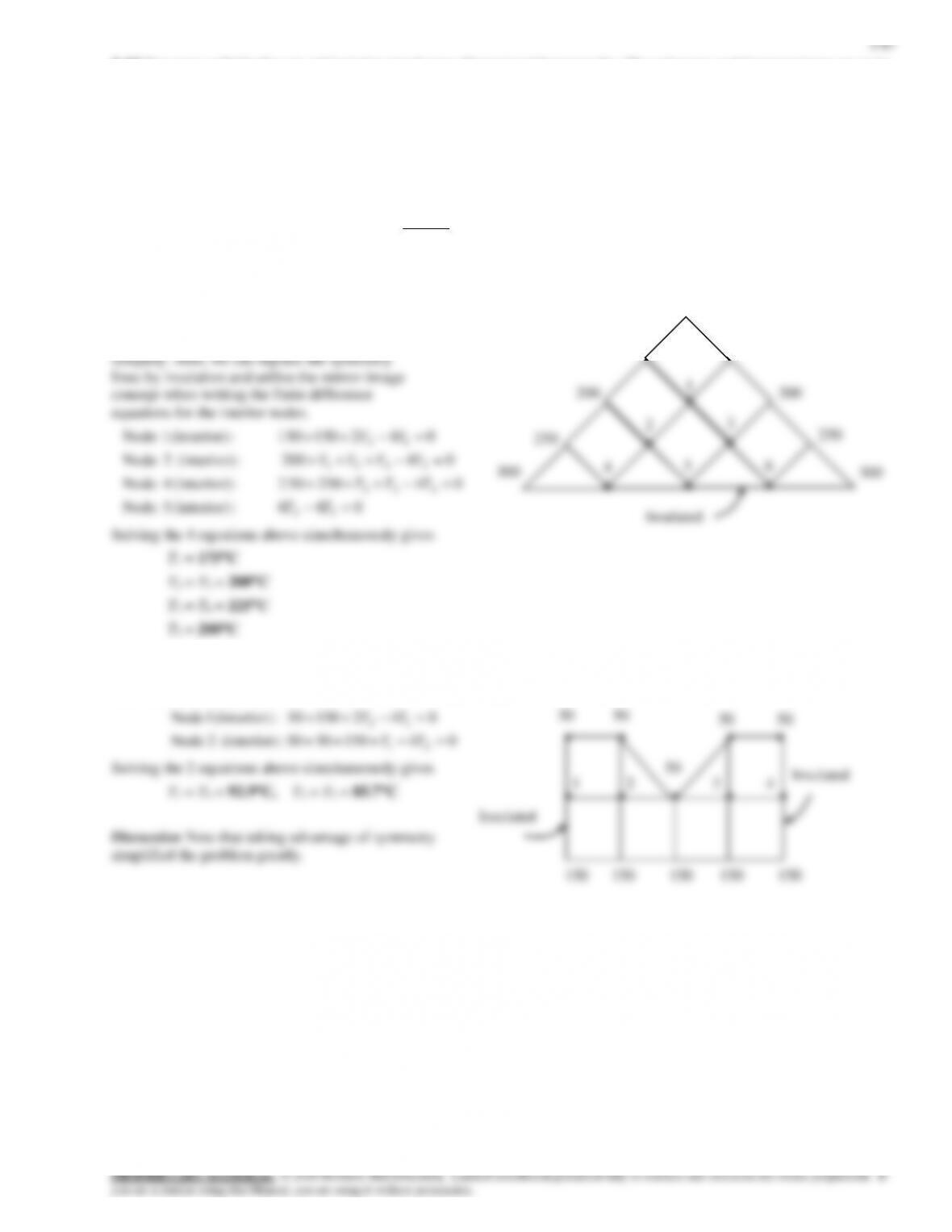
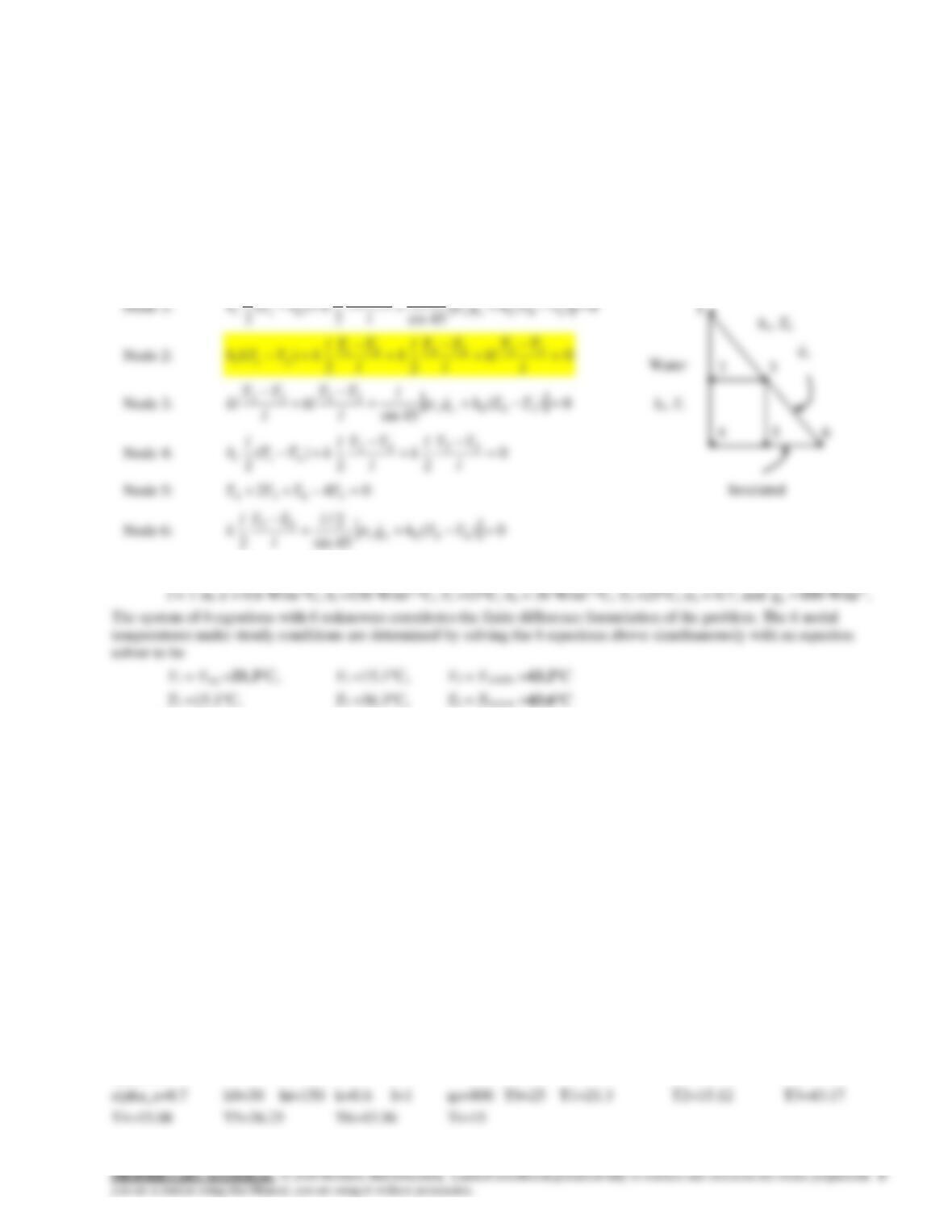
Analysis (a) From symmetry, the smallest domain is between the top and the base of one ridge.
(b) The unknown temperatures at nodes 1, 2, and 3 are to be determined from finite difference formulations
Node 1:
3010334
022
0
22
21
1121
1121
===−
=−+−+−
=
−
+
−
+
−
B
BB
BB
TTT
TTTTTT
x
x
TT
k
x
x
TT
kx
x
TT
k
Node 2:
9024
022
0
22
321
22321
2
23
21
==−+−
=−+−+−
=
−
+
−
+
−
A
A
A
TTTT
TTTTTT
x
x
TT
kx
x
TT
k
x
x
TT
k
Node 3:
1109010224
4
32
23
=+=+=+−
+++=
AB
BBA
TTTT
TTTTT
The matrix equation is
=
−
−−
−
110
90
30
410
241
014
3
2
1
T
T
T
(c) The temperature T2 is 46.9ºC. Then the temperatures T1 and T3 are determined from equations 1 and 3.
C19.2=⎯→⎯=−
=−
11
21
309.464
304
TT
TT
C39.2=⎯→⎯=+−
=+−
33
32
11049.46
1104
TT
TT
5 mm
10 mm
TA
TB
M
10 mm
• •
• • •
• • •
x
1
•
2
3
TA
TA
TA
TB
TB
TB
x
5-88
5-86 The exposed surface of a long concrete damn of triangular cross-section is subjected to solar heat flux and convection
and radiation heat transfer. The vertical section of the damn is subjected to convection with water. The temperatures at the
top, middle, and bottom of the exposed surface of the damn are to be determined.
Assumptions 1 Heat transfer through the damn is given to be steady and two-dimensional. 2 There is no heat generation
within the damn. 3 Heat transfer through the base is negligible. 4 Thermal properties and heat transfer coefficients are
constant.
Properties The thermal conductivity and solar absorptivity are given to be k = 0.6 W/m°C and s = 0.7.
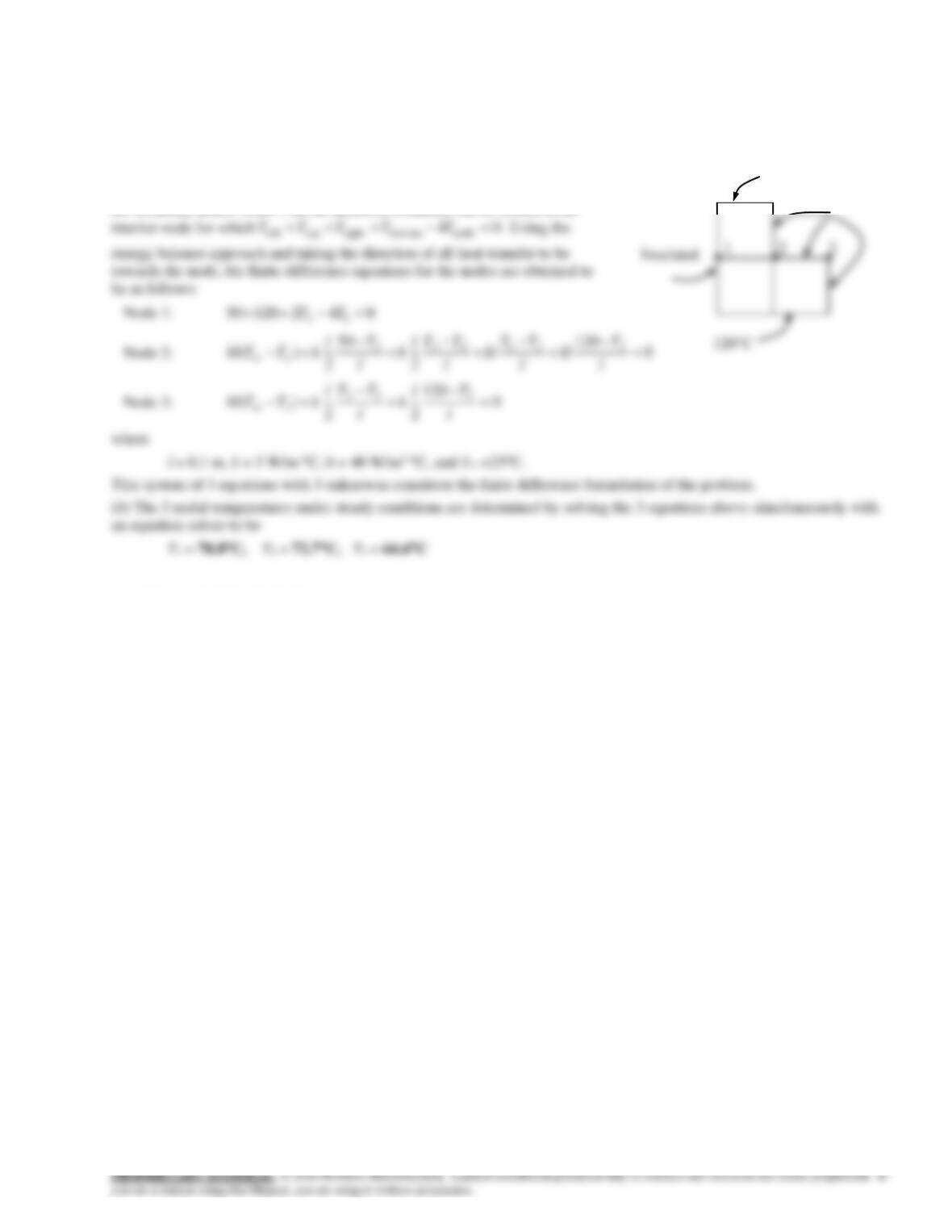
Analysis The nodal spacing is given to be x=x=l=1 m, and all nodes are boundary nodes. Node 5 on the insulated
boundary can be treated as an interior node for which
04 nodebottomrighttopleft =−+++ TTTTT
. Using the energy balance
approach and taking the direction of all heat transfer to be towards the node, the finite difference equations for the nodes are
obtained to be as follows:
2/
12
−
l
TT
l
l
5-89
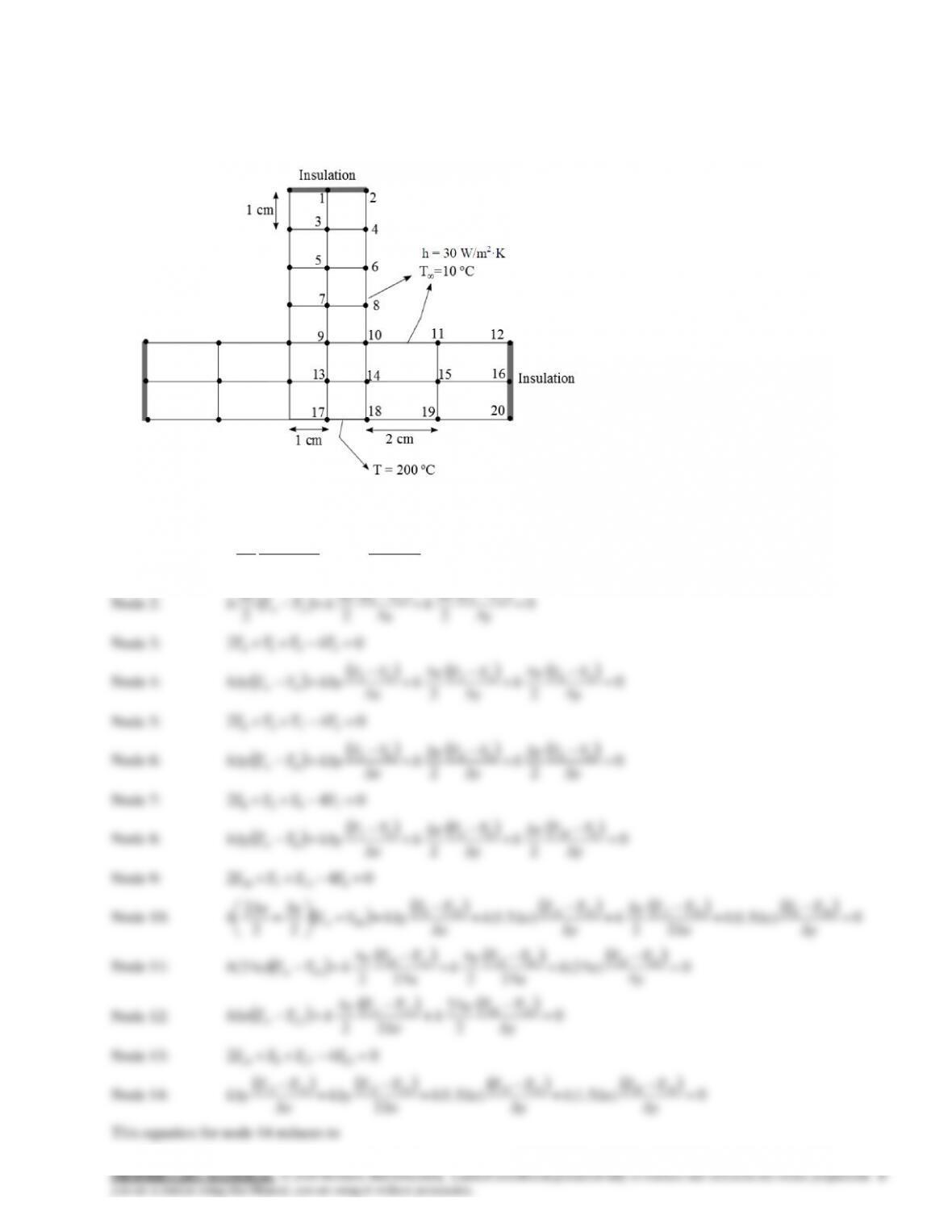
5-87 The top and bottom surfaces of an L-shaped long solid bar are maintained at specified temperatures while the left
surface is insulated and the remaining 3 surfaces are subjected to convection. The finite difference formulation of the
problem is to be obtained, and the unknown nodal temperatures are to be determined.
Assumptions 1 Heat transfer through the bar is given to be steady and two–dimensional. 2 There is no heat generation within
the bar. 3 Thermal properties and heat transfer coefficients are constant. 4 Radiation heat transfer is negligible.
Properties The thermal conductivity is given to be k = 5 W/m°C.
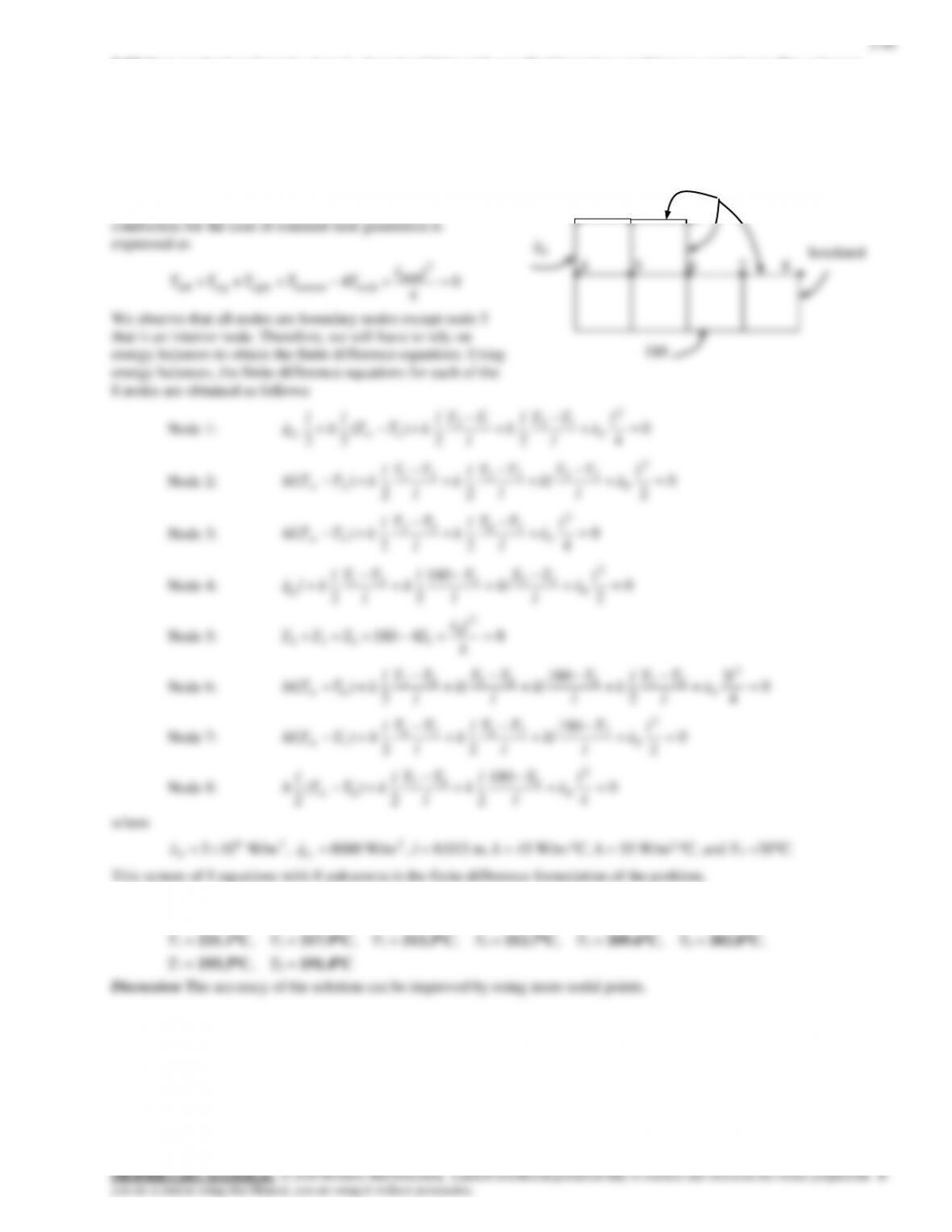
Analysis (a) The nodal spacing is given to be x=x=l=0.1 m, and all nodes
are boundary nodes. Node 1 on the insulated boundary can be treated as an
120°C
h, T
50°C
5-91
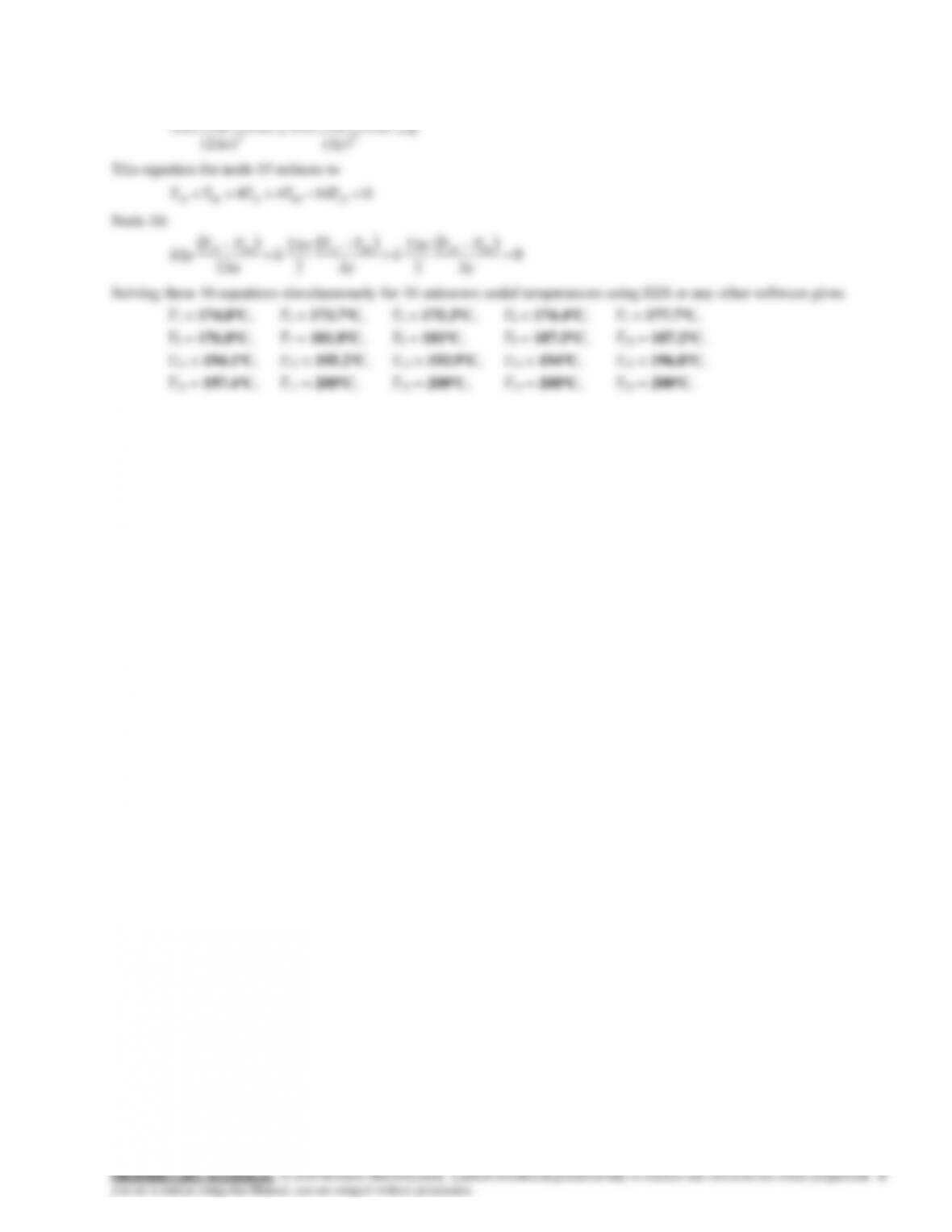
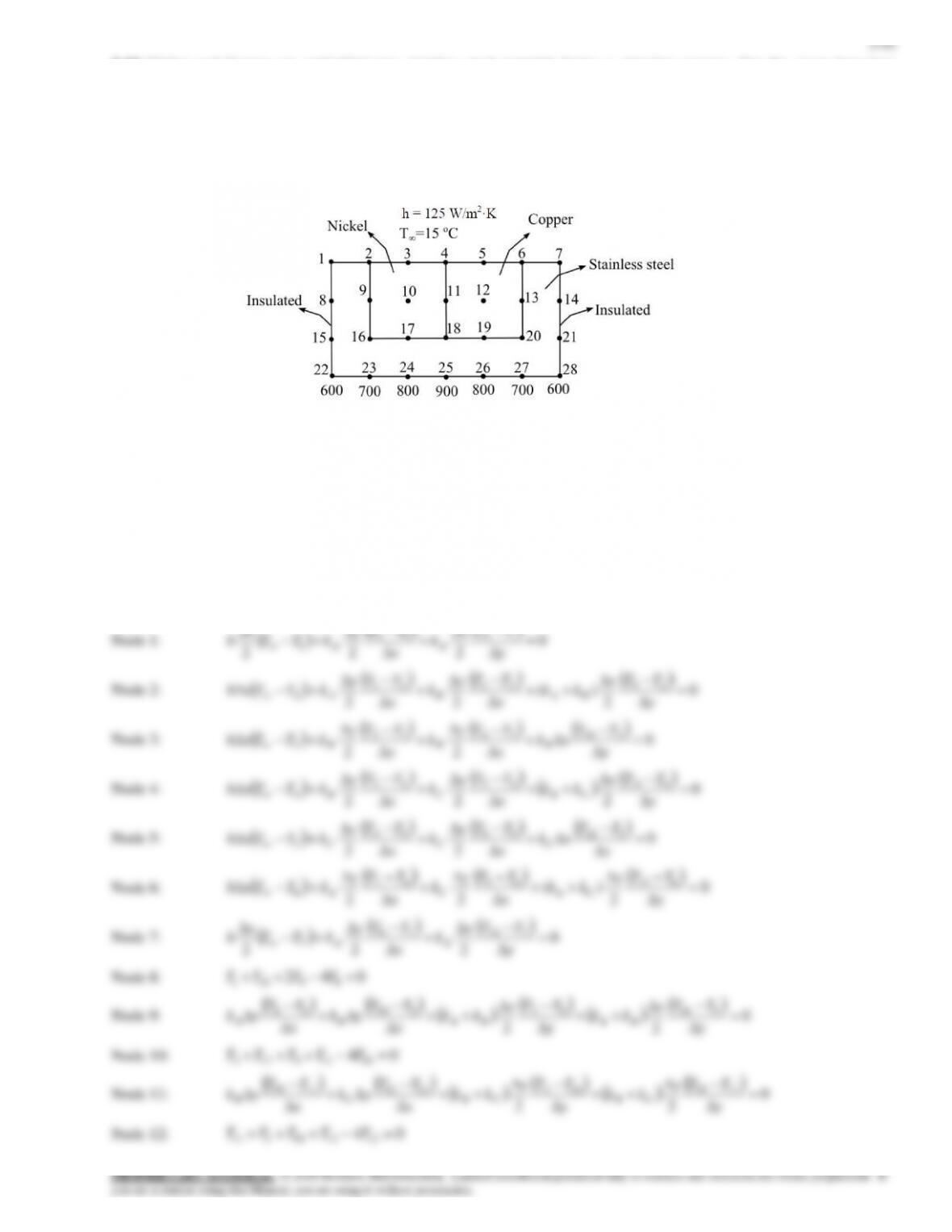
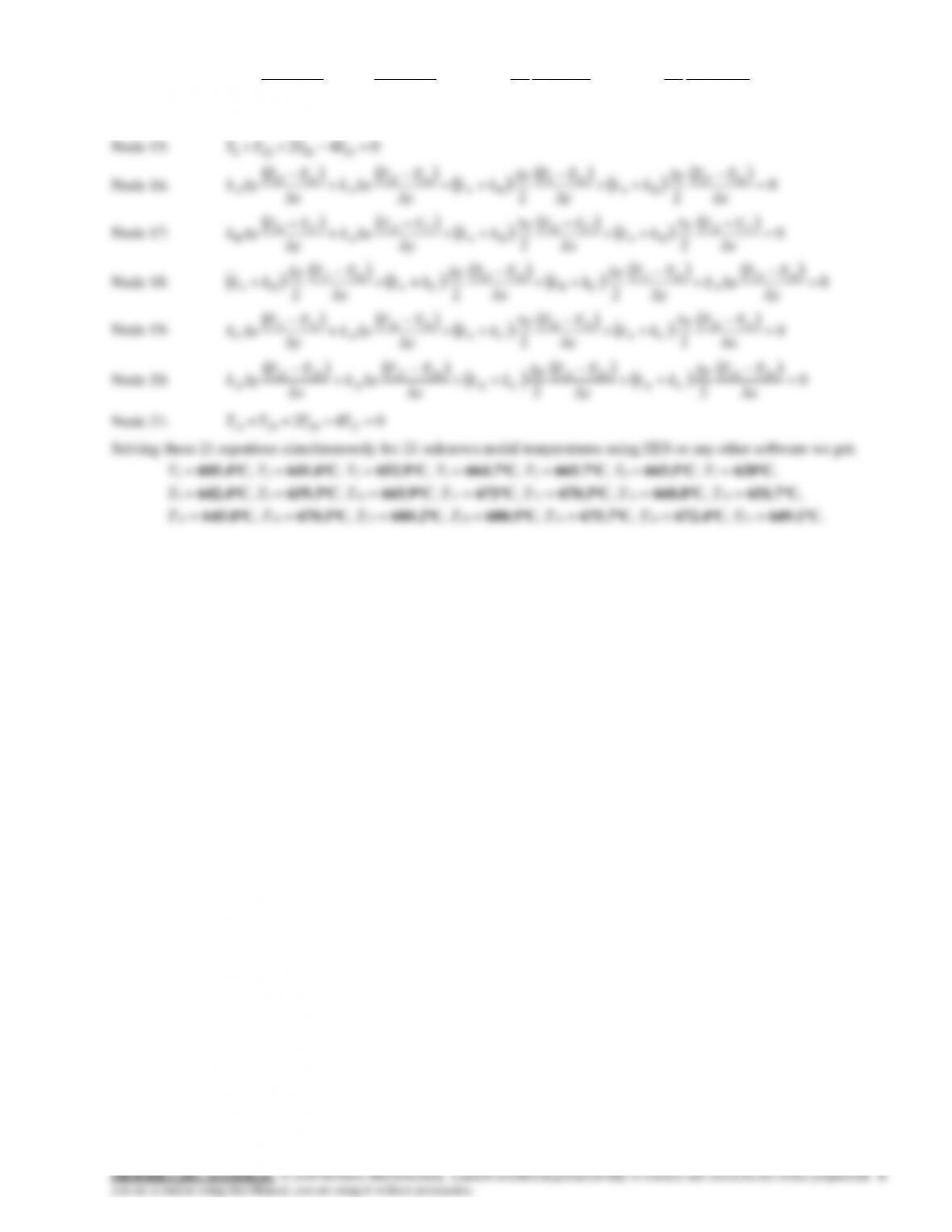
5-89 T shaped bar with known thermal properties is subjected to convection environment. Taking the advantage of symmetry
develop finite difference formulation and determine the nodal temperatures.
Assumptions 1 Steady state two-dimensional heat conduction. 2 Constant thermal conductivities. 3 No internal heat
generation.
Properties: The thermal conductivity of the T shaped bar is given as 28 W/m·K.
Analysis The finite difference formulation at all boundary nodes is done by doing energy balance at each node assuming all
heat transfer entering the node.
Node 1:
( ) ( )
02
2
2
13
12 =
−
+
−
y
TT
xk
x
TTy
k
2421
−
−
TT
x
TT
y
y
5-92
05.45.15.15.0 1418101513 =−+++ TTTTT
Node 15:
( ) ( )
2
2
151911
151614 =
−+
−+
TTT
TTT
5-94
Node 13:
( ) ( ) ( ) ( ) ( ) ( )
0
22
132013613121314 =
−
++
−
++
−
+
−
y
TT
x
kk
y
TT
x
kk
x
TT
yk
x
TT
yk CACACA
Node 14:
042 1413217=−++ TTTT
5-95
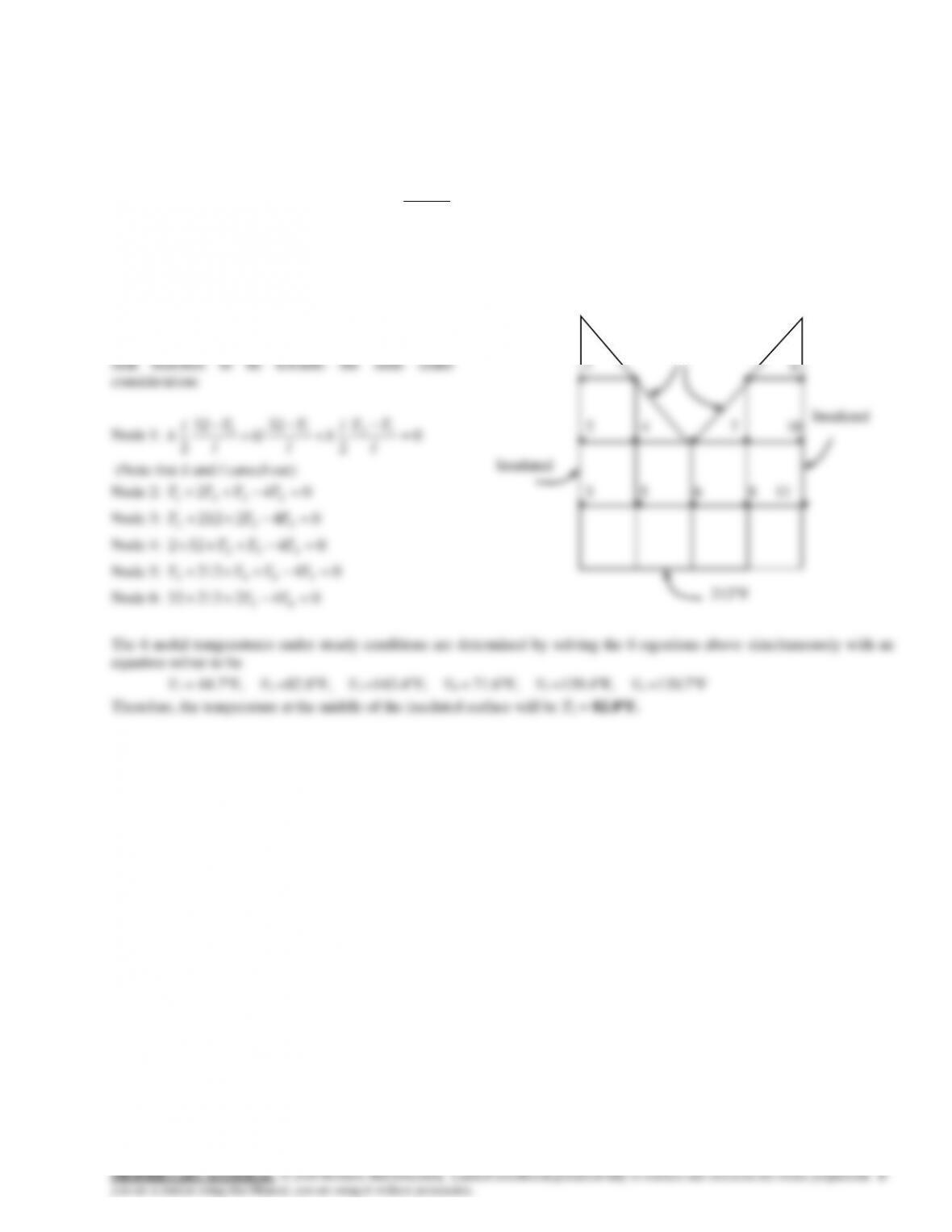
5-91E The top and bottom surfaces of a V-grooved long solid bar are maintained at specified temperatures while the left and
right surfaces are insulated. The temperature at the middle of the insulated surface is to be determined.
Assumptions 1 Heat transfer through the bar is given to be steady and two-dimensional. 2 There is no heat generation within
the bar. 3 Thermal conductivity is constant.
Analysis The nodal spacing is given to be x=y=l=1 ft, and the general finite difference form of an interior node for steady
two-dimensional heat conduction with no heat generation is expressed as
04 04 nodebottomrighttopleft
2
node
nodebottomrighttopleft =−+++→=+−+++ TTTTT
k
le
TTTTT
There is symmetry about the vertical plane passing through the center. Therefore, T1 = T9, T2 = T10, T3 = T11, T4 = T7, and T5 =
T8. Therefore, there are only 6 unknown nodal temperatures, and thus we need only 6 equations to determine them uniquely.
Also, we can replace the symmetry lines by insulation and utilize the mirror-image concept when writing the finite difference
equations for the interior nodes.
The finite difference equations for boundary
nodes are obtained by applying an energy balance on
the volume elements and taking the direction of all
212F
32F
5-97
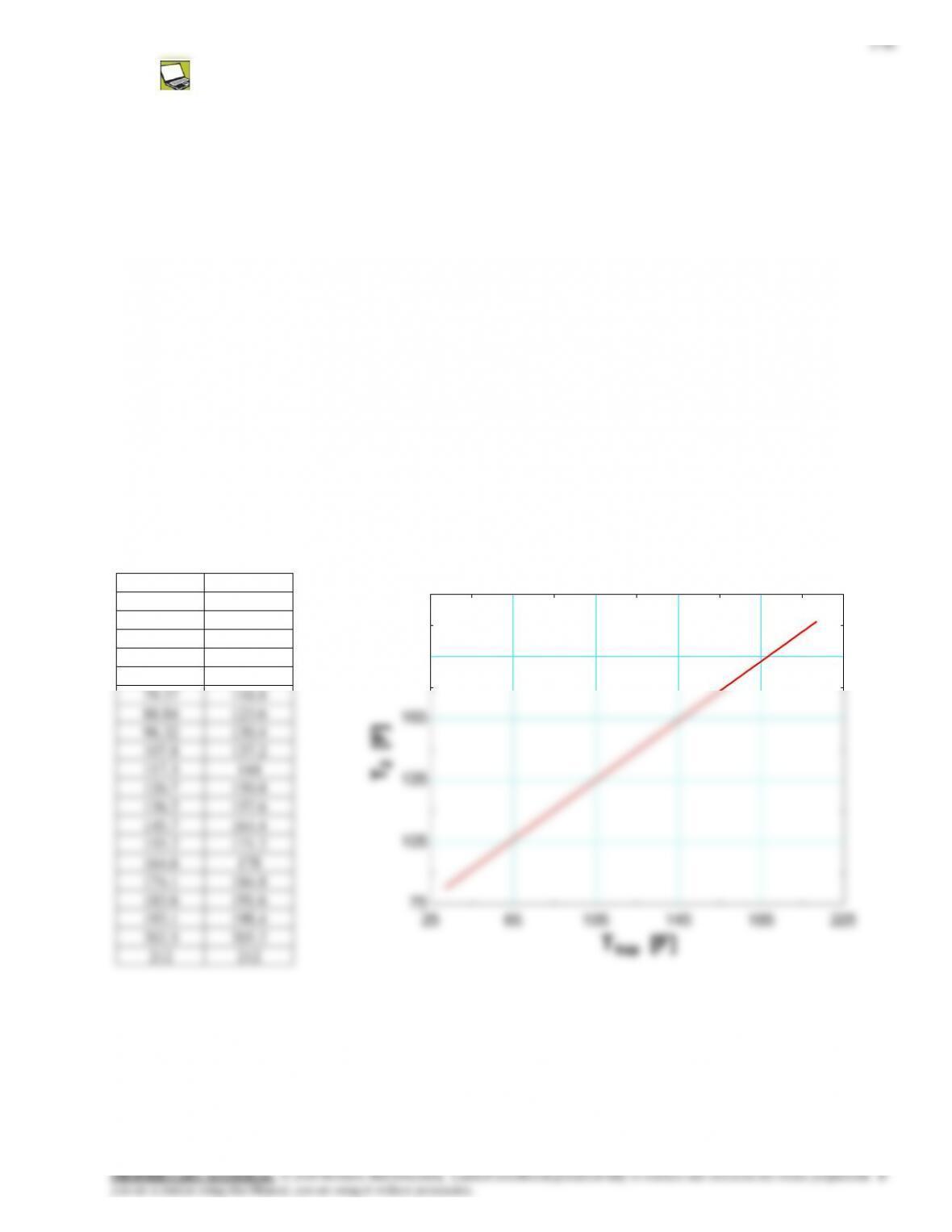
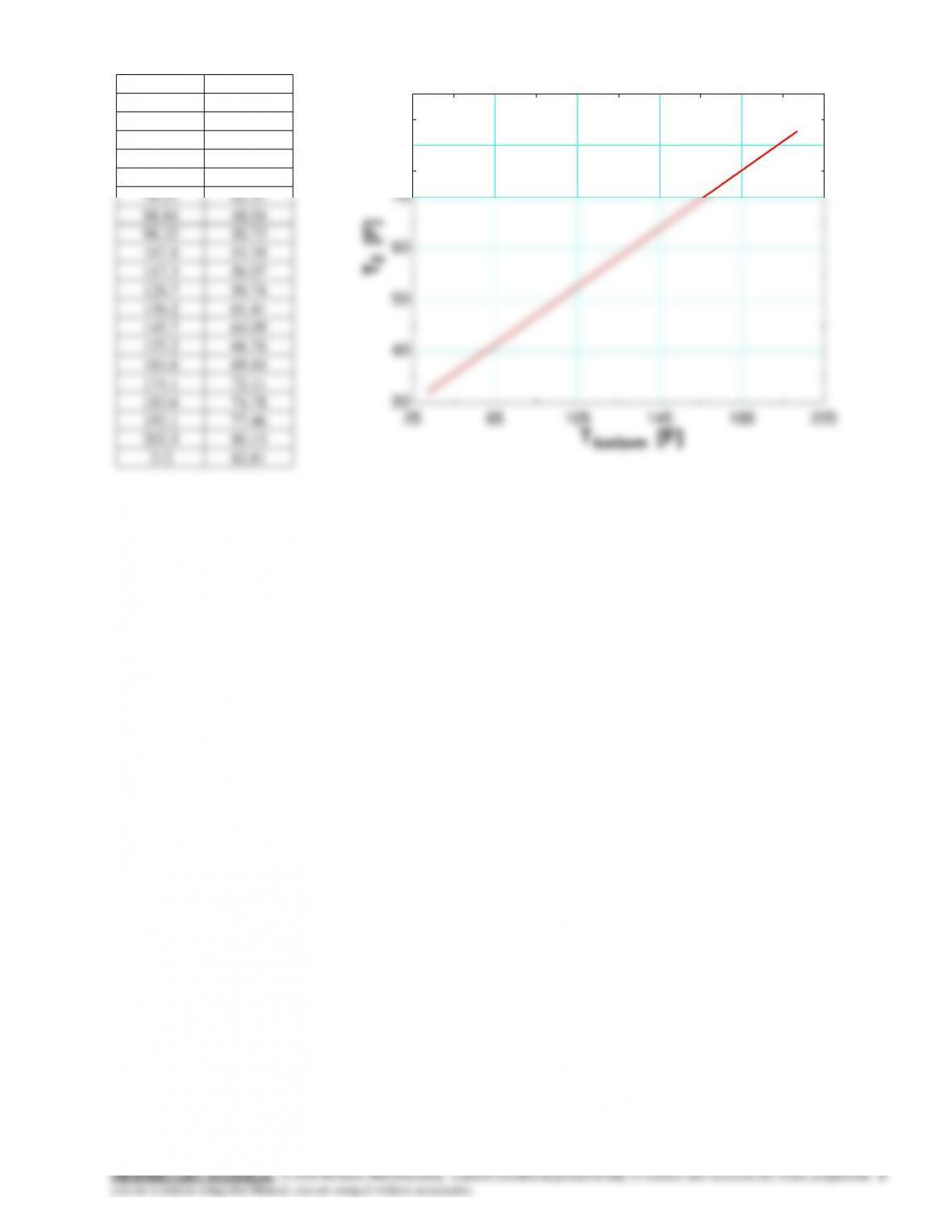
Tbottom [F]
T2 [F]
32
32
41.47
34.67
50.95
37.35
60.42
40.02
69.89
42.7
79.37
45.37
88.84
48.04
98.32
50.72
107.8
53.39
117.3
56.07
126.7
58.74
136.2
61.41
145.7
64.09
155.2
66.76
164.6
69.44
174.1
72.11
183.6
74.78
193.1
77.46
202.5
80.13
212
82.81
25 65 105 145 185 225
30
40
50
60
70
80
90
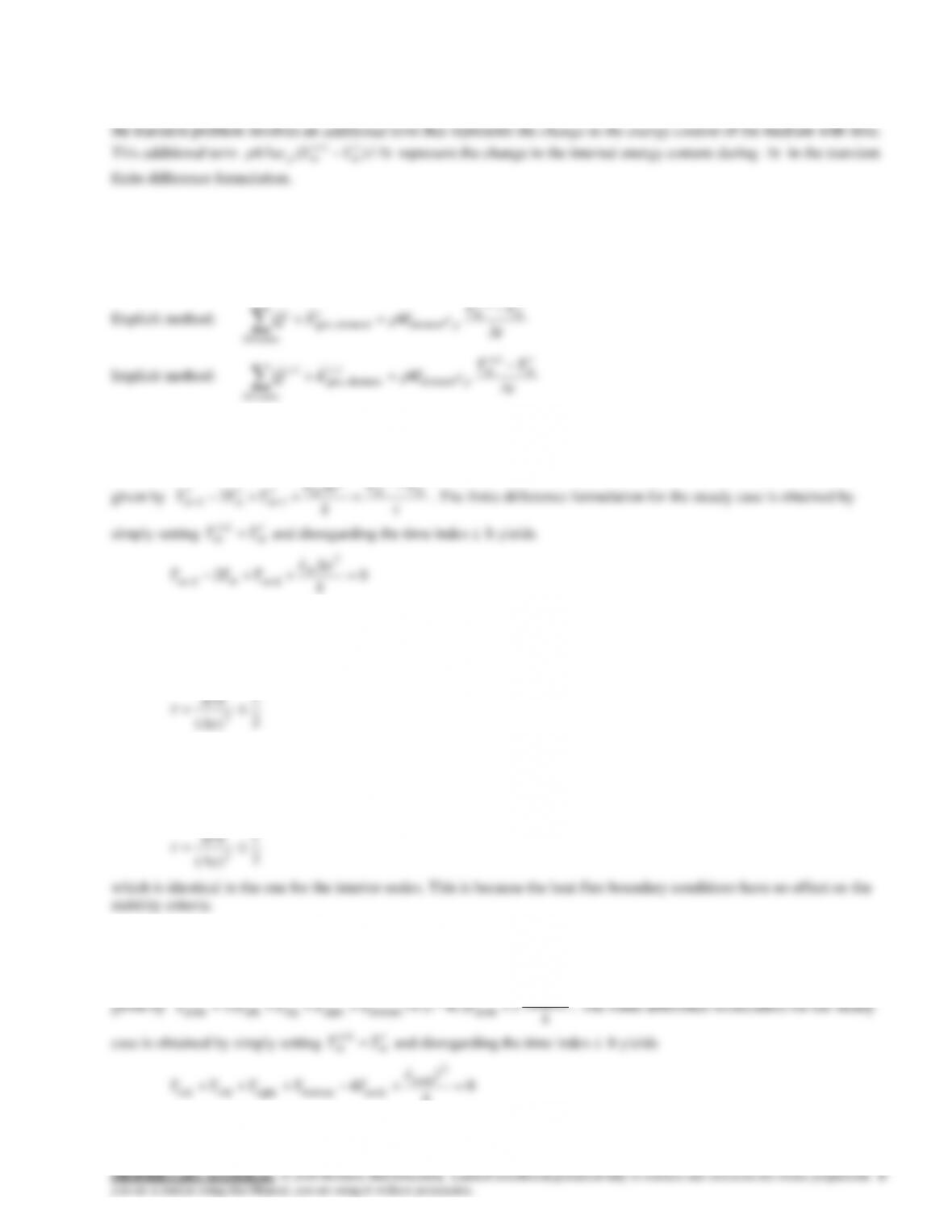
Tbottom [F]
T2 [F]
5-98
Transient Heat Conduction
5-93C The formulation of a transient heat conduction problem differs from that of a steady heat conduction problem in that
5-94C The two basic methods of solution of transient problems based on finite differencing are the explicit and the implicit
methods. The heat transfer terms are expressed at time step i in the explicit method, and at the future time step i + 1 in the
implicit method as
TT
i
m
i
m
i
−
+
i
5-99
5-99C There is a limitation on the size of the time step t in the solution of transient heat conduction problems using the
explicit method, but there is no such limitation in the implicit method.
5-100C The general stability criteria for the explicit method of solution of transient heat conduction problems is expressed as
i
1+i
5-101C For transient two-dimensional heat conduction in a rectangular region with insulation or specified temperature
boundary conditions, the stability criteria for the explicit method can be expressed in its simplest form as
1
t
5-102C The implicit method is unconditionally stable and thus any value of time step t can be used in the solution of
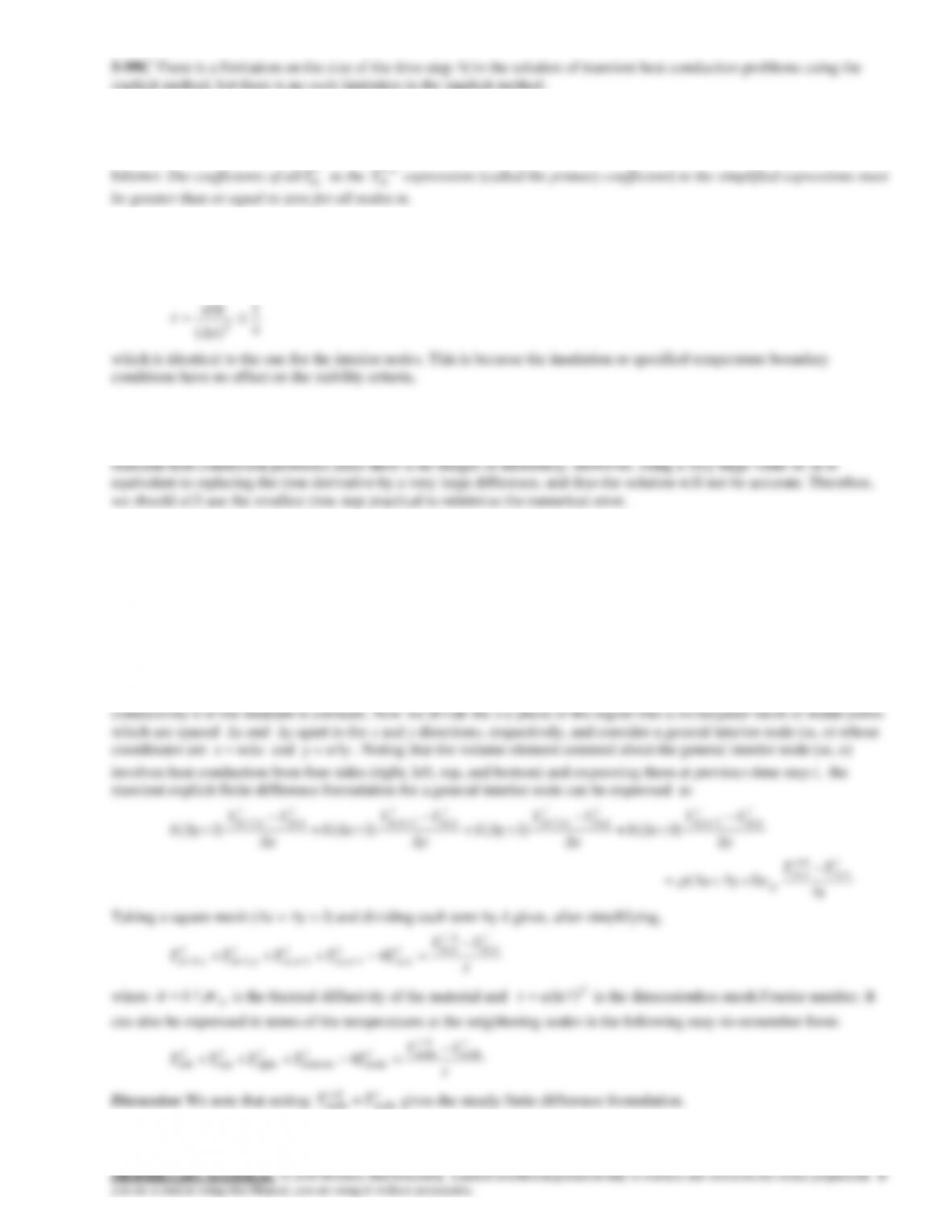
5-103 Starting with an energy balance on a volume element, the two-dimensional transient explicit finite difference equation
for a general interior node in rectangular coordinates for
T x y t( , , )
for the case of constant thermal conductivity and no heat
generation is to be obtained.
Analysis (See Figure 5-49 in the text). We consider a rectangular region in which heat conduction is significant in the x and y
directions, and consider a unit depth of z = 1 in the z direction. There is no heat generation in the medium, and the thermal
5-100
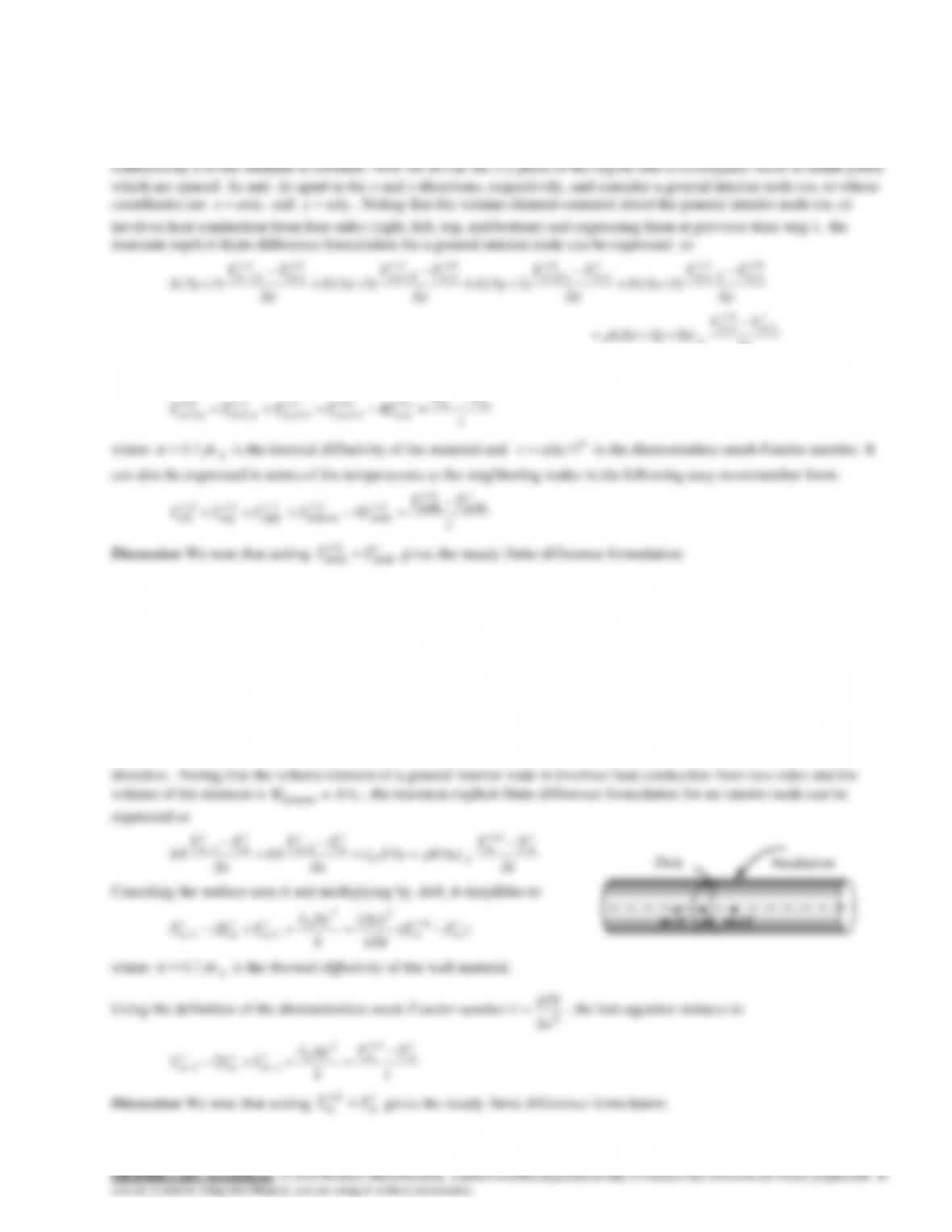
5-104 Starting with an energy balance on a volume element, the two-dimensional transient implicit finite difference equation
for a general interior node in rectangular coordinates for
),,( tyxT
for the case of constant thermal conductivity and no heat
generation is to be obtained.
Analysis (See Figure 5-49 in the text). We consider a rectangular region in which heat conduction is significant in the x and y
directions, and consider a unit depth of z = 1 in the z direction. There is no heat generation in the medium, and the thermal
t
TT
cyx
i
nm
i
nm
p
−
=
+
,
1
,
)1(
Taking a square mesh (x = y = l) and dividing each term by k gives, after simplifying,
i
m
i
m
i
nm
i
nm
i
nm
i
nm
i
nm
TT
TTTTT −
=−+++
+
++ −
++
+
+
+
−
1
1
,
1
1,
1
1,
1
,1
1
,1 4
where
p
ck
/=
is the thermal diffusivity of the material and
2
/lt=
is the dimensionless mesh Fourier number. It
can also be expressed in terms of the temperatures at the neighboring nodes in the following easy–to-remember form:
ii
iiiii TT
TTTTT node
1
node
1
node
1
bottom
1
right
1
top
1
left 4−
=−+++
+
+++++
Discussion We note that setting
ii TT node
1
node =
+
gives the steady finite difference formulation.
5-105 Starting with an energy balance on a disk volume element, the one–dimensional transient explicit finite difference
equation for a general interior node for
),( tzT
in a cylinder whose side surface is insulated for the case of constant thermal
conductivity with uniform heat generation is to be obtained.
Analysis We consider transient one-dimensional heat conduction in the axial z direction in an insulated cylindrical rod of
constant cross-sectional area A with constant heat generation
0
g
and constant conductivity k with a mesh size of
z
in the z