4-61
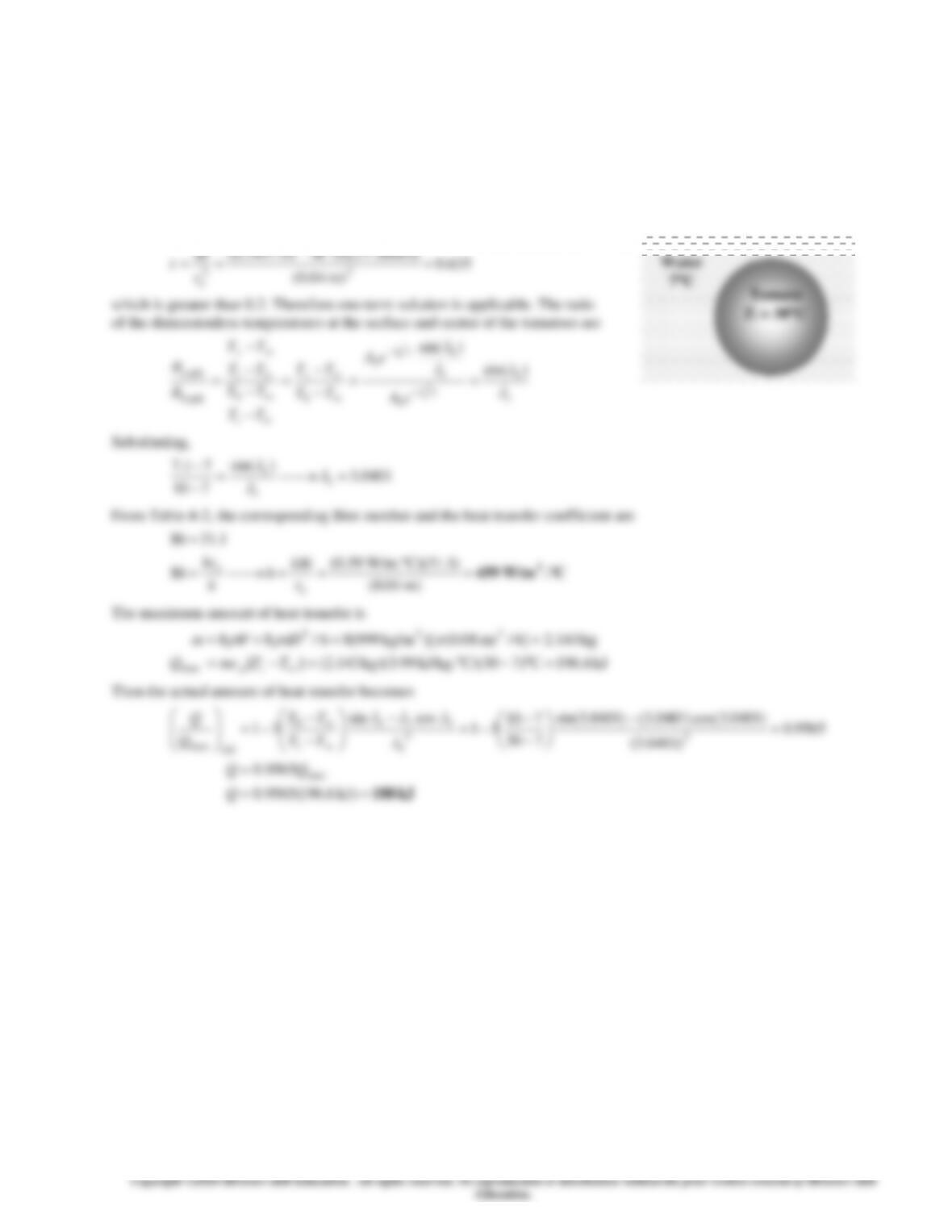
4-79 Tomatoes are placed into cold water to cool them. The heat transfer coefficient and the amount of heat transfer are to be
determined.
Assumptions 1 The tomatoes are spherical in shape. 2 Heat conduction in the tomatoes is one-dimensional because of
symmetry about the midpoint. 3 The thermal properties of the tomatoes are constant. 4 The heat transfer coefficient is
constant and uniform over the entire surface. 5 The Fourier number is > 0.2 so that the one-term approximate solutions are
applicable (this assumption will be verified).
Properties The properties of the tomatoes are given to be k = 0.59 W/m.C,
= 0.14110-6 m2/s,
= 999 kg/m3 and cp = 3.99
kJ/kg.C.
Analysis The Fourier number is
635.0
m) 04.0(
s) 3600/s)(2m 10141.0(
2
26
2=
==
−
o
r
t
which is greater than 0.2. Therefore one-term solution is applicable. The ratio
of the dimensionless temperatures at the surface and center of the tomatoes are
1
1
1
1
1
1
0
0
sph0,
sphs, )sin(
)sin(
2
1
2
1
==
−
−
=
−
−
−
−
=−
−
eA
eA
TT
TT
TT
TT
TT
TT
s
i
i
s
Substituting,
0401.3
)sin(
710
71.7
1
1
1=⎯→⎯=
−
−
From Table 4-2, the corresponding Biot number and the heat transfer coefficient are
C. W/m459 2=
==⎯→⎯=
=
)m 04.0(
)1.31)(C W/m.59.0(
Bi
1.31Bi
o
o
r
kBi
h
k
hr
The maximum amount of heat transfer is
kJ 196.6C)730)(CkJ/kg. 99.3)(kg 143.2(][
kg 143.2]6/m) 08.0()[kg/m 999(86/88
max
333
=−=−=
====
TTmcQ
Dm
ip
V
Then the actual amount of heat transfer becomes
kJ 188==
=
=
−
−
−
−=
−
−
−
−=
)kJ 6.196(9565.0
9565.0
9565.0
)0401.3(
)0401.3cos()0401.3()0401.3sin(
730
710
31
cossin
31
max
33
1
111
0
cyl
max
Q
QQ
TT
TT
Q
Q
i
Tomato
Ti = 30C
Water
7C
4-62
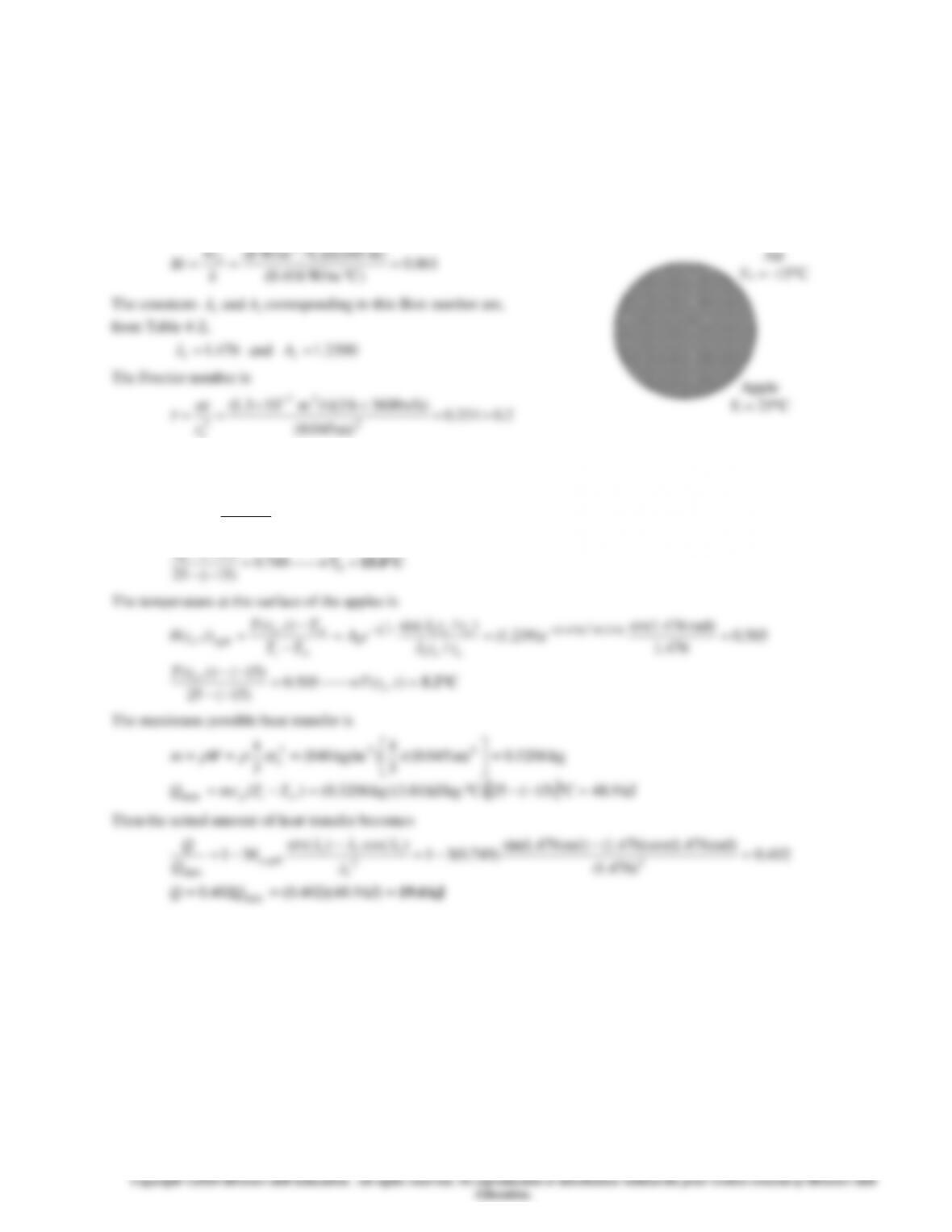
4-80 A person puts apples into the freezer to cool them quickly. The center and surface temperatures of the apples, and the
amount of heat transfer from each apple in 1 h are to be determined.
Assumptions 1 The apples are spherical in shape with a diameter of 9 cm. 2 Heat conduction in the apples is one-dimensional
because of symmetry about the midpoint. 3 The thermal properties of the apples are constant. 4 The heat transfer coefficient
is constant and uniform over the entire surface. 5 The Fourier number is > 0.2 so that the one-term approximate solutions
are applicable (this assumption will be verified).
Properties The properties of the apples are given to be k = 0.418 W/m.C, = 840 kg/m3, cp = 3.81 kJ/kg.C, and
=
1.310-7 m2/s.
Analysis The Biot number is
)m 045.0)(C. W/m8( 2
hr
m) 045.0(
2
2=
o
r
which is greater than 0.2. Therefore one-term solution is applicable.
Then the temperature at the center of the apples becomes
C15.0=⎯→⎯=
−−
−−
===
−
−
=−
−
0
0
)231.0()476.1(
1
i
0
sph,0
T749.0
)15(25
)15(T
749.0e)2390.1(eA
TT
TT 2
2
1
Air

4-63
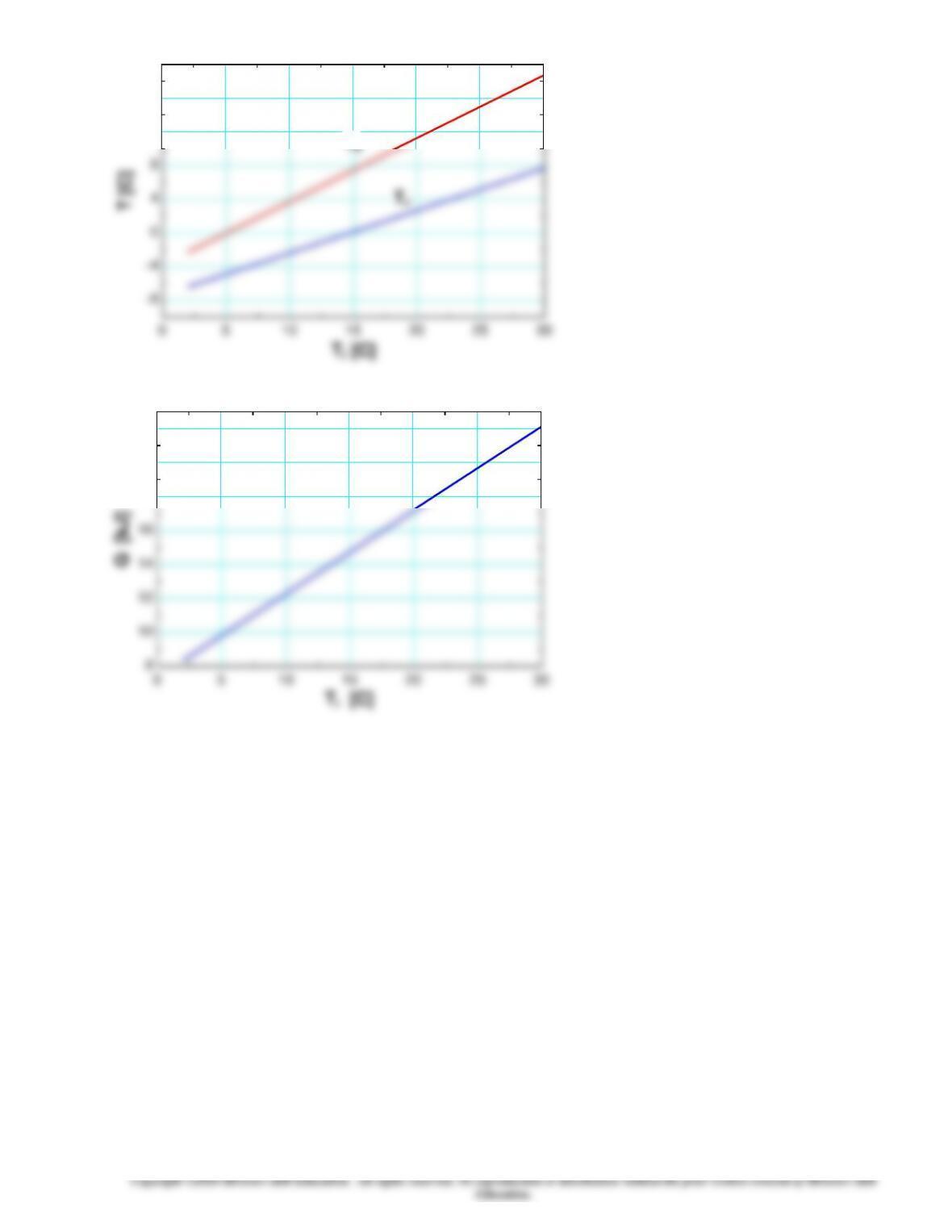
4-81 Prob. 4-80 is reconsidered. The effect of the initial temperature of the apples on the final center and surface
temperatures and the amount of heat transfer is to be investigated.
Analysis The problem is solved using EES, and the solution is given below.
“GIVEN”
T_infinity=-15 [C]
T_i=25 [C]
h=8 [W/m^2-C]
r_o=(0.09/2) [m]
time=1*3600 [s]
“PROPERTIES”
k=0.418 [W/m-C]
rho=840 [kg/m^3]
c_p=3.81 [kJ/kg–C]
alpha=1.3E-7 [m^2/s]
“ANALYSIS”
Bi=(h*r_o)/k
“From Table 4-2 corresponding to this Bi number, we read”
lambda_1=1.476
A_1=1.2390
tau=(alpha*time)/r_o^2
(T_o-T_infinity)/(T_i-T_infinity)=A_1*exp(-lambda_1^2*tau)
(T_r-T_infinity)/(T_i-T_infinity)=A_1*exp(-lambda_1^2*tau)*Sin(lambda_1*r_o/r_o)/(lambda_1*r_o/r_o)
V=4/3*pi*r_o^3
m=rho*V
Q_max=m*c_p*(T_i-T_infinity)
Q/Q_max=1-3*(T_o-T_infinity)/(T_i-T_infinity)*(Sin(lambda_1)-lambda_1*Cos(lambda_1))/lambda_1^3
Ti
[C]
To
[C]
Tr
[C]
Q
[kJ]
2
4
6
8
10
12
14
16
18
20
22
24
26
28
30
–2.269
-0.7715
0.7263
2.224
3.722
5.22
6.717
8.215
9.713
11.21
12.71
14.21
15.7
17.2
18.7
–6.414
–5.403
–4.393
–3.383
–2.373
–1.363
-0.3525
0.6577
1.668
2.678
3.688
4.698
5.709
6.719
7.729
8.35
9.333
10.31
11.3
12.28
13.26
14.24
15.23
16.21
17.19
18.17
19.16
20.14
21.12
22.1
4-64
0 5 10 15 20 25 30
-8
-4
0
4
8
12
16
20
Ti [C]
T [C]
T0
Tr
0 5 10 15 20 25 30
8
10
12
14
16
18
20
22
Ti [C]
Q [kJ]
4-65
4-66
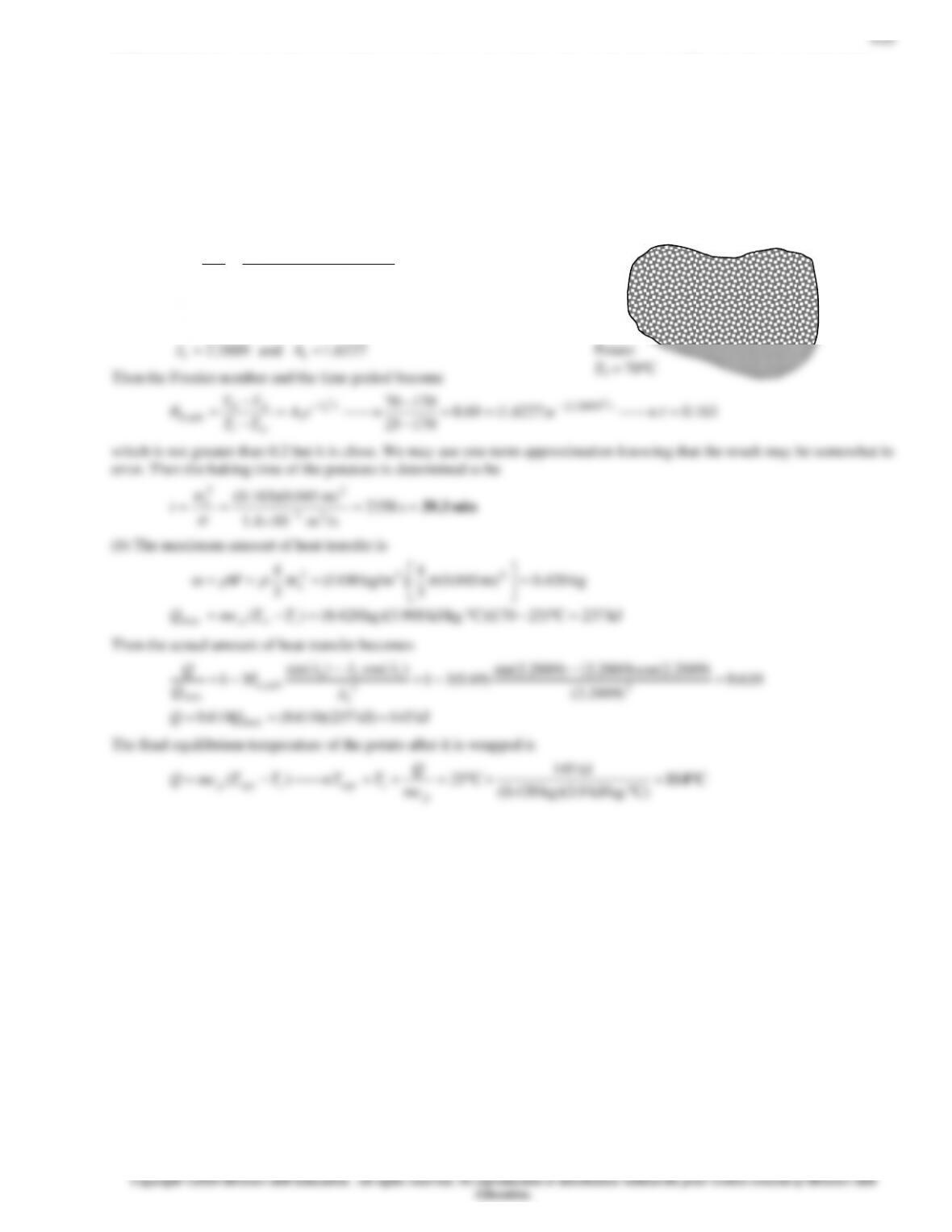
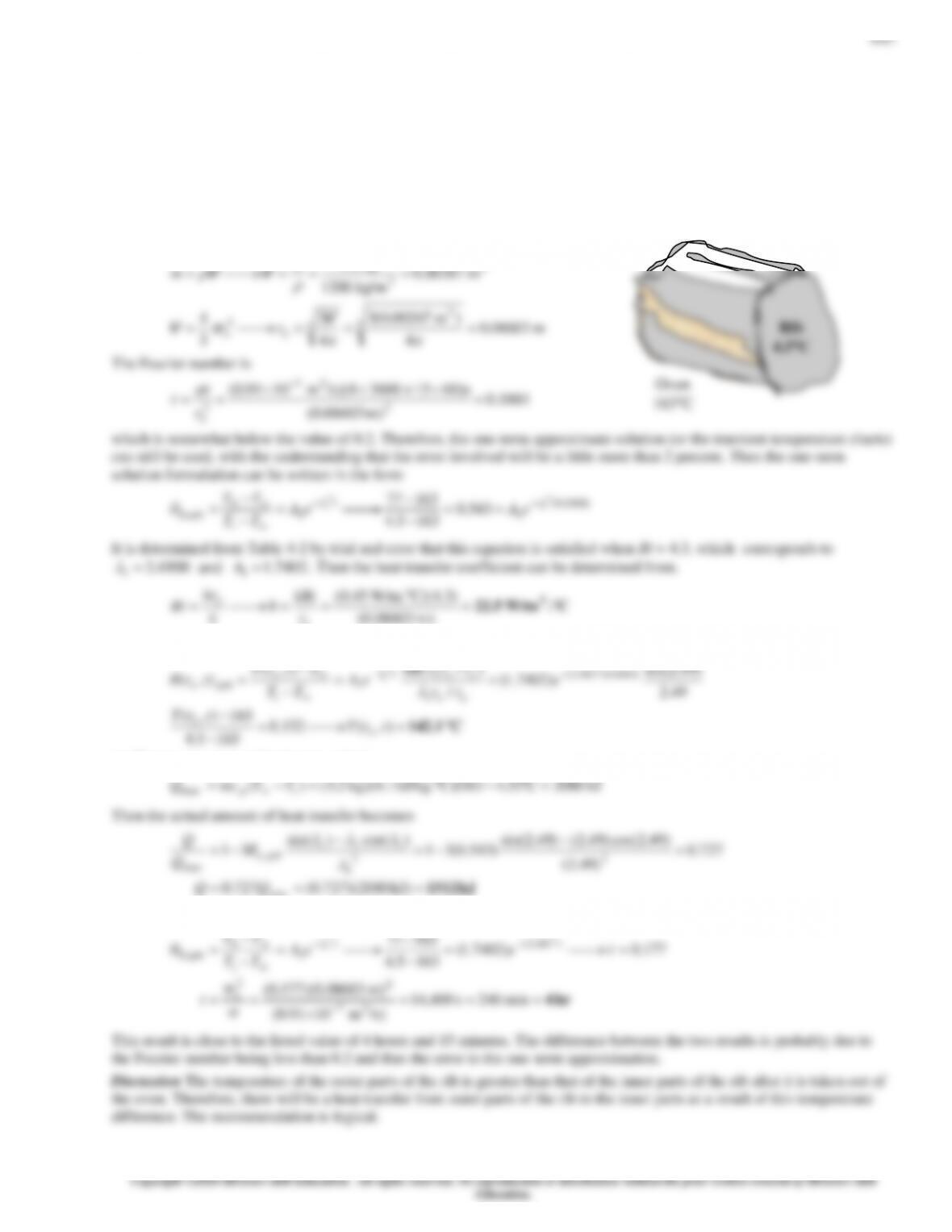
4-83 A rib is roasted in an oven. The heat transfer coefficient at the surface of the rib, the temperature of the outer surface of
the rib and the amount of heat transfer when it is rare done are to be determined. The time it will take to roast this rib to
medium level is also to be determined.
Assumptions 1 The rib is a homogeneous spherical object. 2 Heat conduction in the rib is one-dimensional because of
symmetry about the midpoint. 3 The thermal properties of the rib are constant. 4 The heat transfer coefficient is constant and
uniform over the entire surface. 5 The Fourier number is > 0.2 so that the one-term approximate solutions are applicable
(this assumption will be verified).
Properties The properties of the rib are given to be k = 0.45 W/m.C, = 1200 kg/m3, cp = 4.1 kJ/kg.C, and = 0.9110-7
m2/s.
Analysis (a) The radius of the roast is determined to be
m 08603.0
4
)m 002667.0(3
4
3
3
4
m 002667.0
kg/m 1200
kg 2.3
3
3
3
3
3
3
===⎯→⎯=
===⎯→⎯=
V
V
VV
oo rr
m
m
Rib
4.5C
4-67
4-68
Transient Heat Conduction in Semi-Infinite Solids
4-87C The total amount of heat transfer from a semi–infinite solid up to a specified time t0 can be determined by integration
from
t
4-69
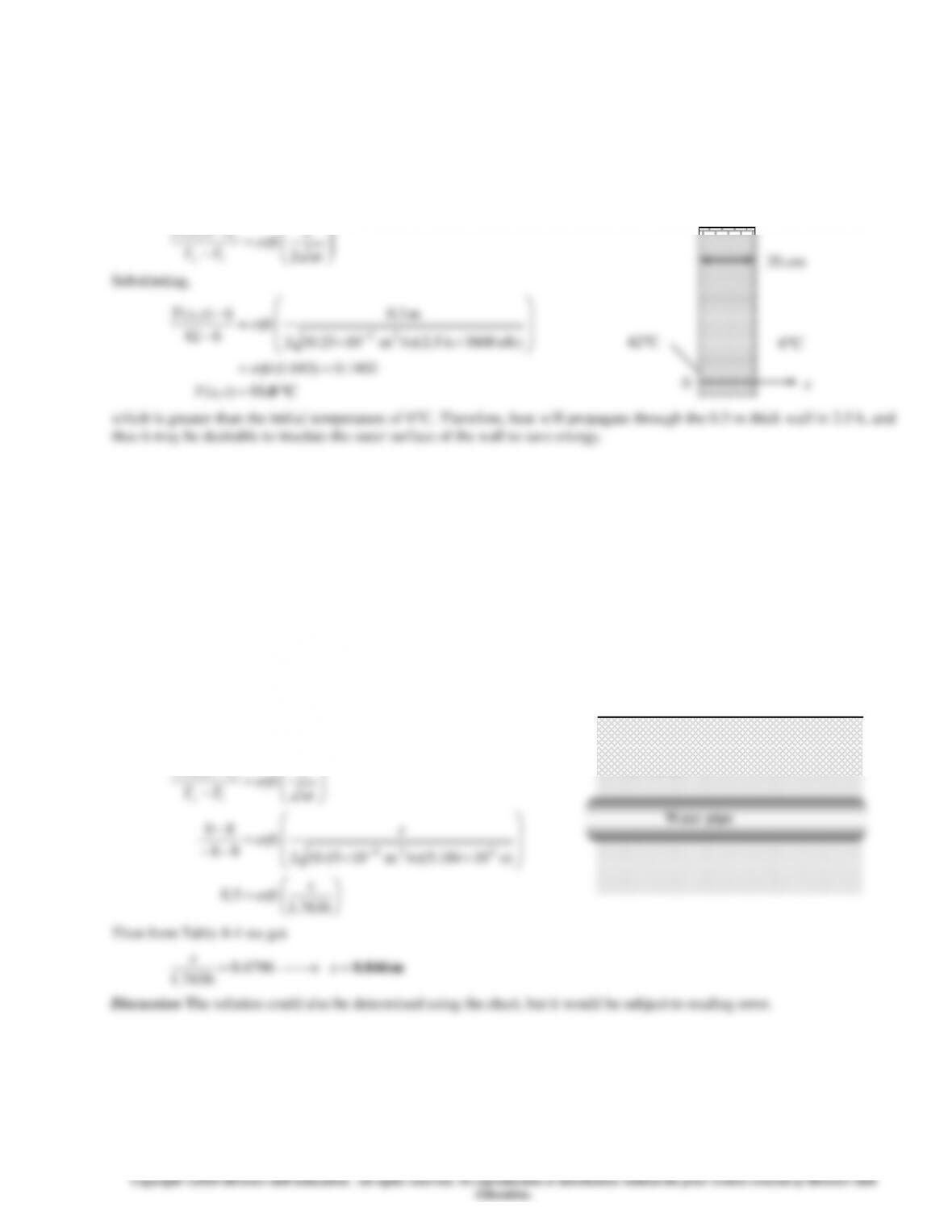
4-89 A curing kiln is heated by injecting steam into it and raising its inner surface temperature to a specified value. It is to be
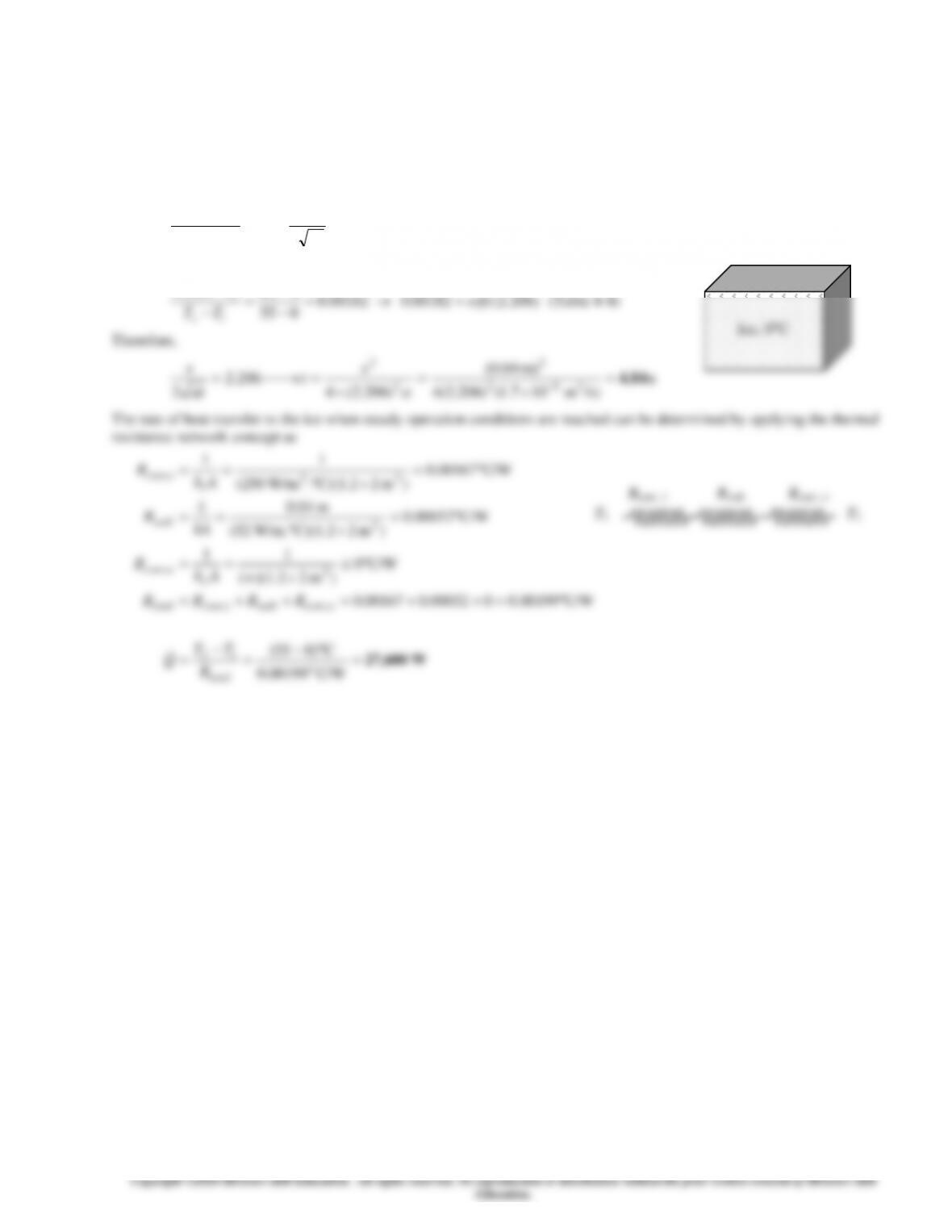
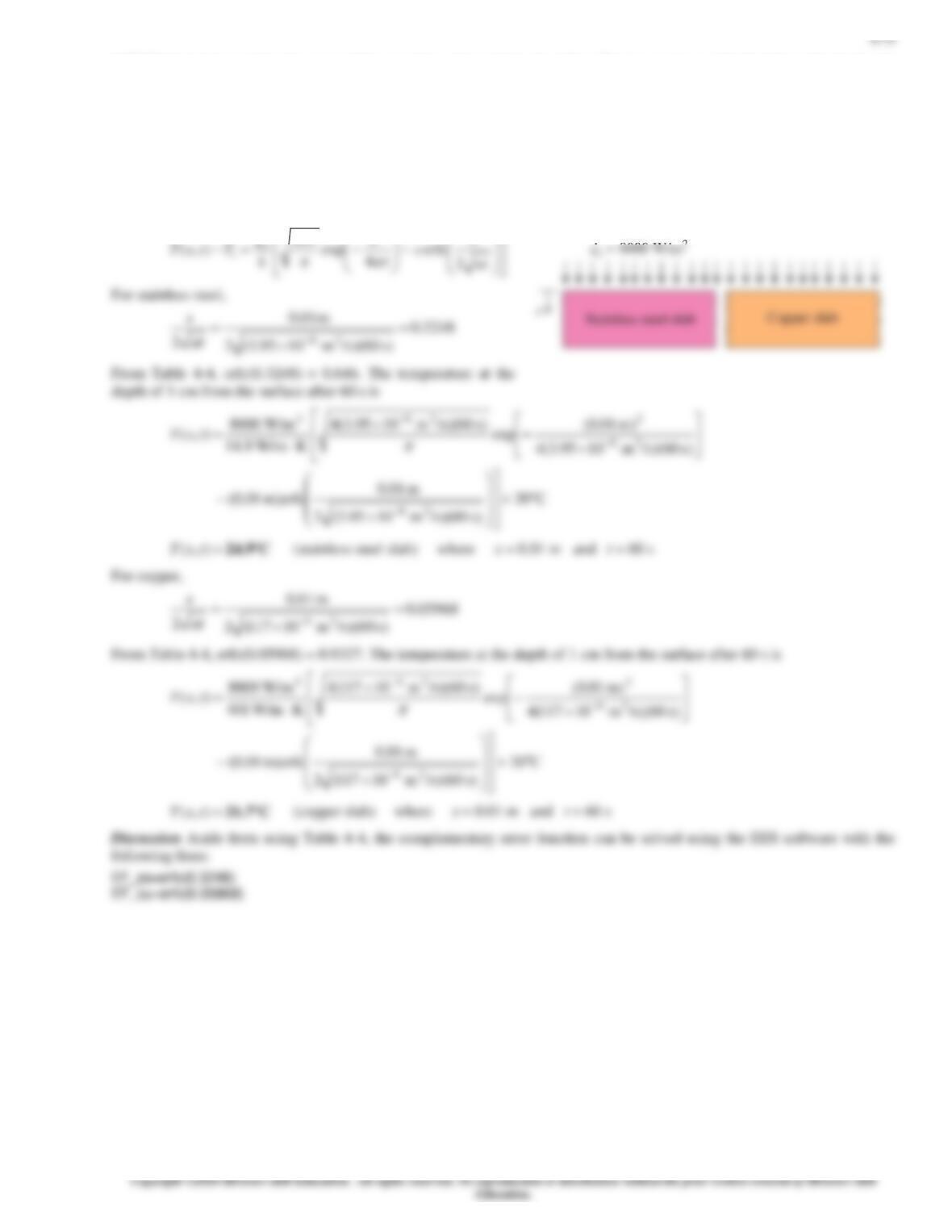
determined whether the temperature at the outer surfaces of the kiln changes during the curing period.
Assumptions 1 The temperature in the wall is affected by the thermal conditions at inner surfaces only and the convection
heat transfer coefficient inside is very large. Therefore, the wall can be considered to be a semi-infinite medium with a
specified surface temperature of 45C. 2 The thermal properties of the concrete wall are constant.
Properties The thermal diffusivity of the concrete wall is given to be = 0.2310-5 m2/s.
Analysis We determine the temperature at a depth of x = 0.3 m in 2.5 h using the analytical solution,
−
x
TtxT
i
),(
Kiln wall
4-70
Ice chest
Hot water
55C
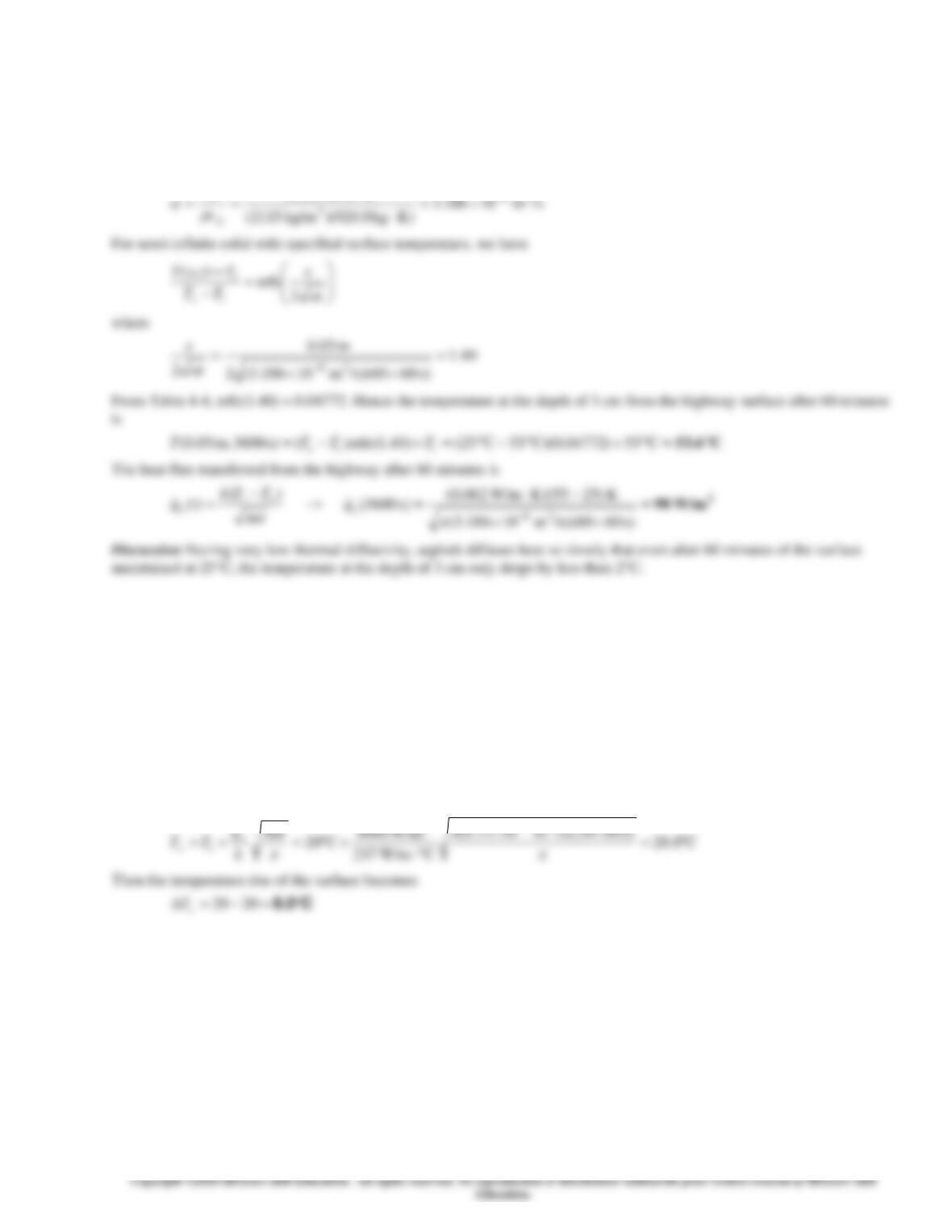
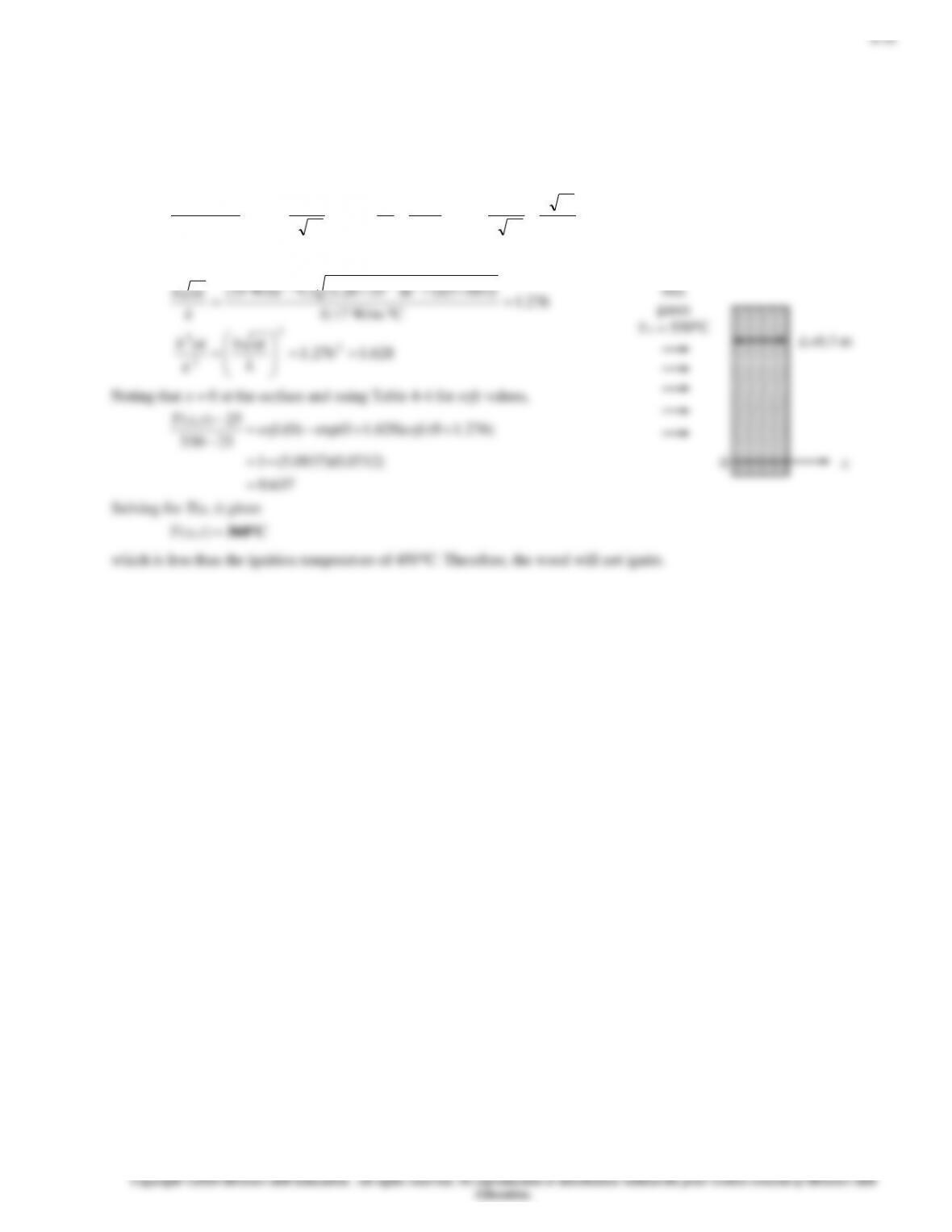
4-91 The outer surfaces of a large cast iron container filled with ice are exposed to hot water. The time before the ice starts
melting and the rate of heat transfer to the ice are to be determined.
Assumptions 1 The temperature in the container walls is affected by the thermal conditions at outer surfaces only and the
convection heat transfer coefficient outside is given to be very large. Therefore, the wall can be considered to be a semi-
infinite medium with a specified surface temperature. 2 The thermal properties of the wall are constant.
Properties The thermal properties of the cast iron are given to be k = 52 W/m.C and = 1.7010-5 m2/s.
Analysis The one-dimensional transient temperature distribution in the wall for that time period can be determined from
=
−
−
t
x
erfc
TT
TtxT
is
i
2
),(
But,
01.0
),( erfc
TtxT
i=→=
−
−
4-71
4-92 With the highway surface temperature maintained at 25°C, the temperature at the depth of 3 cm from surface and the
heat flux transferred after 60 minutes are to be determined.
Assumptions 1 The highway is treated as semi-infinite solid. 2 Thermal properties are constant. 3 Heat transfer by radiation
is negligible.
Properties The properties of asphalt are
= 2115 kg/m3, cp = 920 J/kg ∙ K, and k = 0.062 W/m ∙ K (from Table A–8).
Analysis The thermal diffusivity for asphalt is
K W/m062.0 28
−
k
4-72
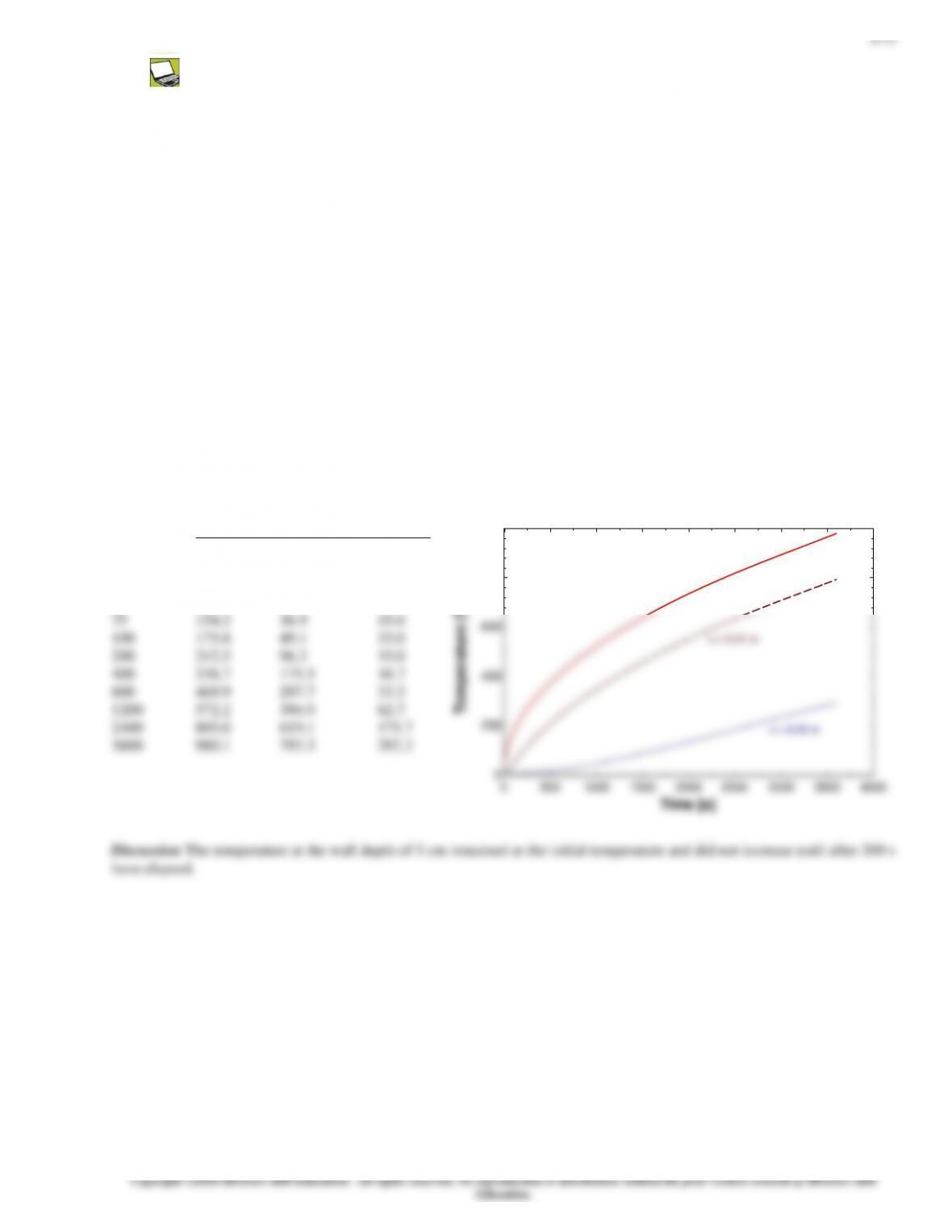
4-94 A thick refractory brick wall is subjected to uniform heat flux. The temperature at the depth of 10 cm from the wall
surface after an hour is to be determined.
Assumptions 1 The wall is thick and can be treated as a semi-infinite medium with a specified surface heat flux. 2 The
thermal properties of the wall are constant.
Properties The properties of the brick wall are given as k = 1.0
W/mK and α = 5.08 × 10⁻⁷ m2/s.
Analysis This is a transient conduction problem in a semi-infinite
medium subjected to constant surface heat flux, and the wall
temperature at x = 0.1 m and t = 3600 s can be determined from
−
−=−
tα
x
x
t
x
t
k
q
TtxT s
i2
erfc
4
exp
4
),(
2
where
m 1.0
x
4-73
4-74
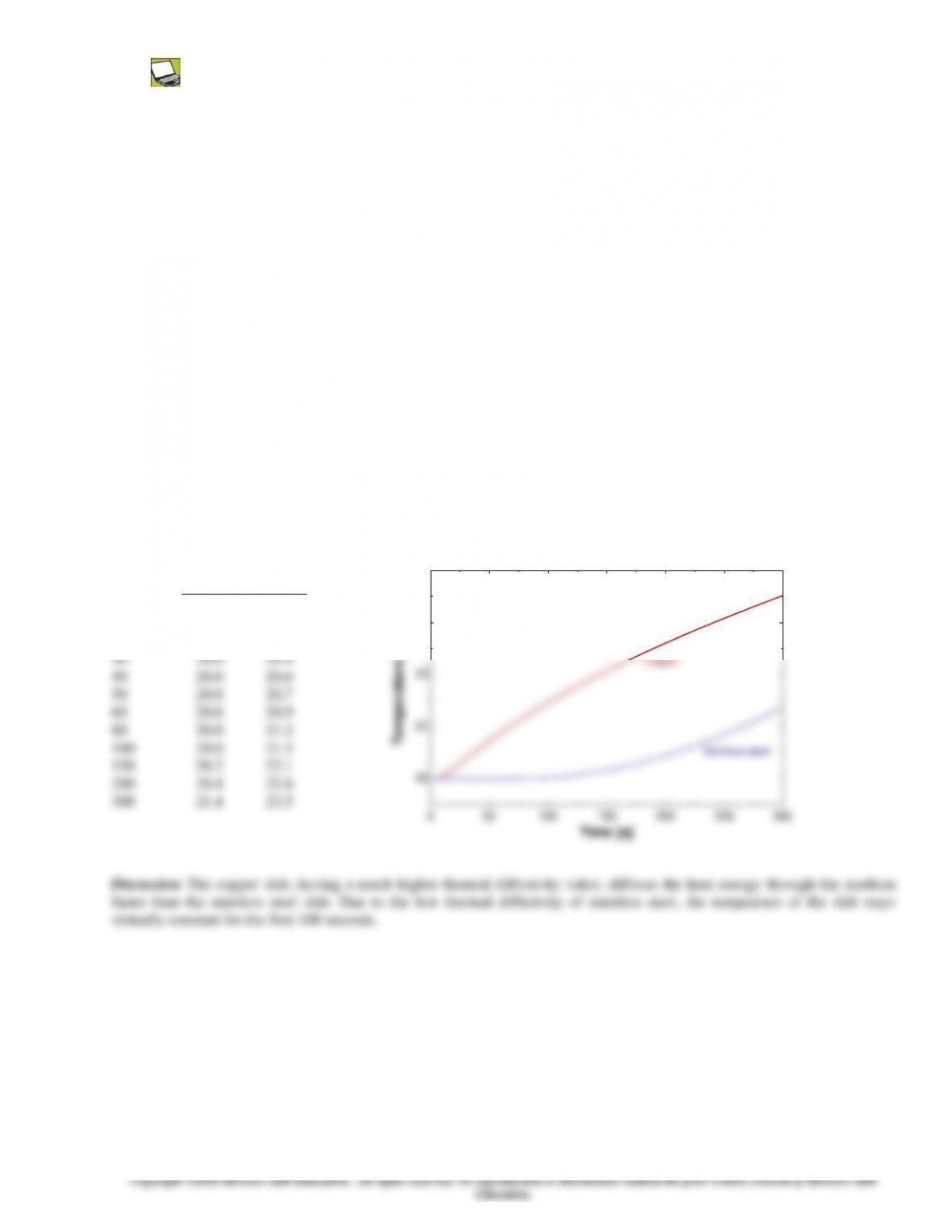
4-96 Thick stainless steel and copper slabs are subjected to uniform heat flux. The temperatures of both slabs at the
depth of 8 cm from the surface as a function of time are to be determined.
Assumptions 1 The slabs are treated as a semi-infinite medium with a specified surface heat flux. 2 The thermal properties of
the slabs are constant.
Properties The properties of stainless steel are given as k = 14.9 W/mK and α = 3.95× 10⁻⁶ m2/s; the properties of copper are
given as k = 401 W/mK and α = 117 × 10−6 m2/s.
Analysis The problem is solved using EES, and the solution is given below.
“GIVEN”
q_dot_s=10000 [W/m^2]
T_i=20 [C]
x=0.08 [m]
“PROPERTIES”
“stainless steel”
k_ss=14.9 [W/m-K]
alpha_ss=3.95e-6 [m^2/s]
“copper”
k_cu=401 [W/m-K]
alpha_cu=117e-6 [m^2/s]
“ANALYSIS”
T_ss-T_i=q_dot_s/k_ss*((4*alpha_ss*t/pi#)^0.5*exp(-x^2/(4*alpha_ss*t))-x*erfc(x/(2*(alpha_ss*t)^0.5)))
T_cu-T_i=q_dot_s/k_cu*((4*alpha_cu*t/pi#)^0.5*exp(-x^2/(4*alpha_cu*t))-x*erfc(x/(2*(alpha_cu*t)^0.5)))
T (x, t) [°C]
Time [s] SS Cu
5 20.0 20.0
10 20.0 20.1
20 20.0 20.2
30 20.0 20.4
40 20.0 20.6
50 20.0 20.7
60 20.0 20.9
80 20.0 21.2
100 20.0 21.5
150 20.2 22.1
200 20.4 22.6
300 21.4 23.5
Discussion The copper slab, having a much higher thermal diffusivity value, diffuses the heat energy through the medium
faster than the stainless steel slab. Due to the low thermal diffusivity of stainless steel, the tempearure of the slab stays
virtually constant for the first 100 seconds.
050 100 150 200 250 300
20
21
22
23
24
Time [s]
Temperature [°C]
x = 0.08 m
Stainless steel
Copper
4-75
4-76
4-77
4-78
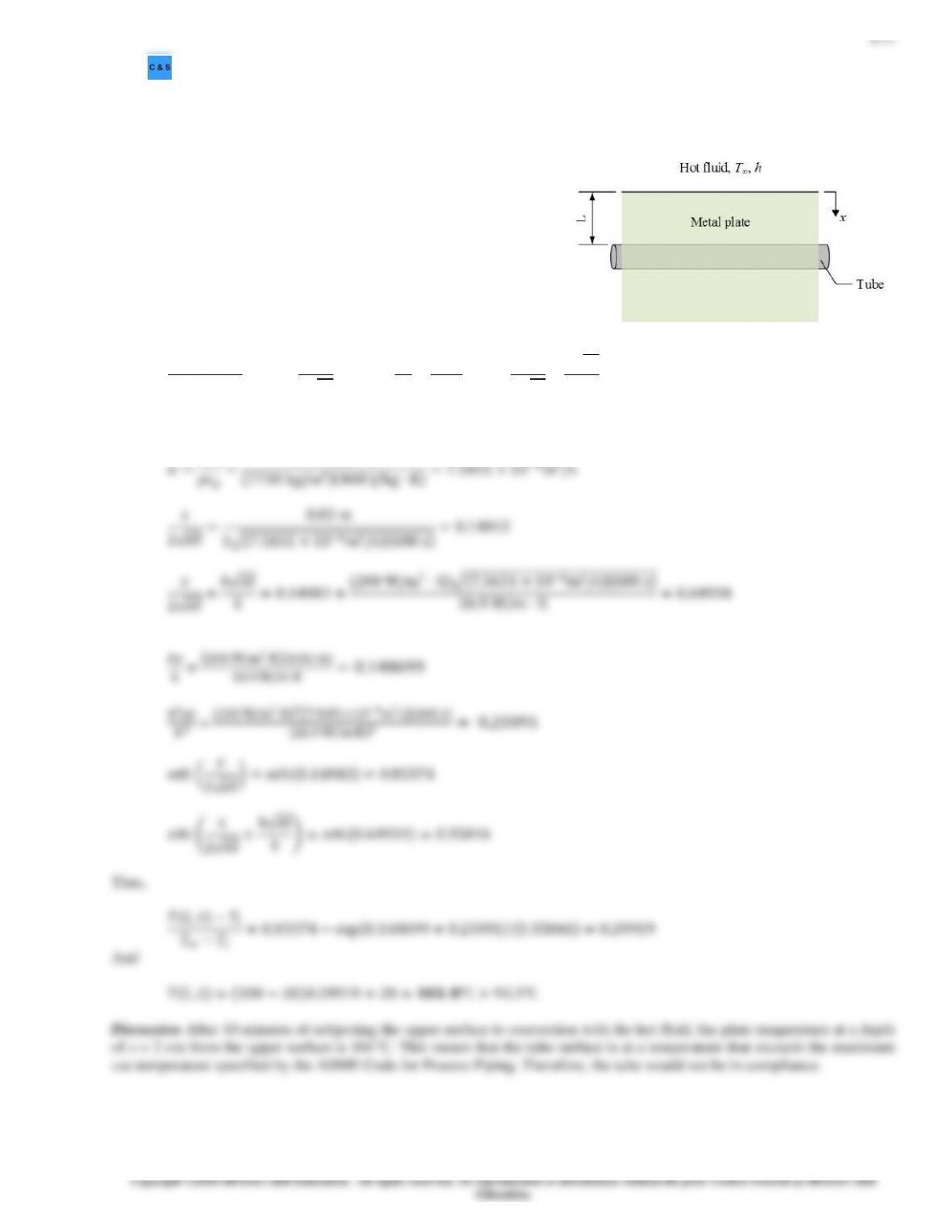
4-100 An area is subjected to cold air for a 10-h period. The soil temperatures at distances 0, 10, 20, and 50 cm from the
earth’s surface are to be determined.
Assumptions 1 The temperature in the soil is affected by the thermal conditions at one surface only, and thus the soil can be
considered to be a semi-infinite medium with a specified surface temperature. 2 The thermal properties of the soil are
constant.
Properties The thermal properties of the soil are given to be k = 0.9 W/m.C and = 1.610-5 m2/s.
Analysis The one-dimensional transient temperature distribution in the ground can be determined from
+
+−
=
−
−
k
th
t
x
erfc
k
th
k
hx
t
x
erfc
TT
TtxT
i
i
2
exp
2
),(
2
2
where
7.33
C W/m.0.9
)s 360010)(s/m 10(1.6C). W/m40(
2-52
=
=
k
th
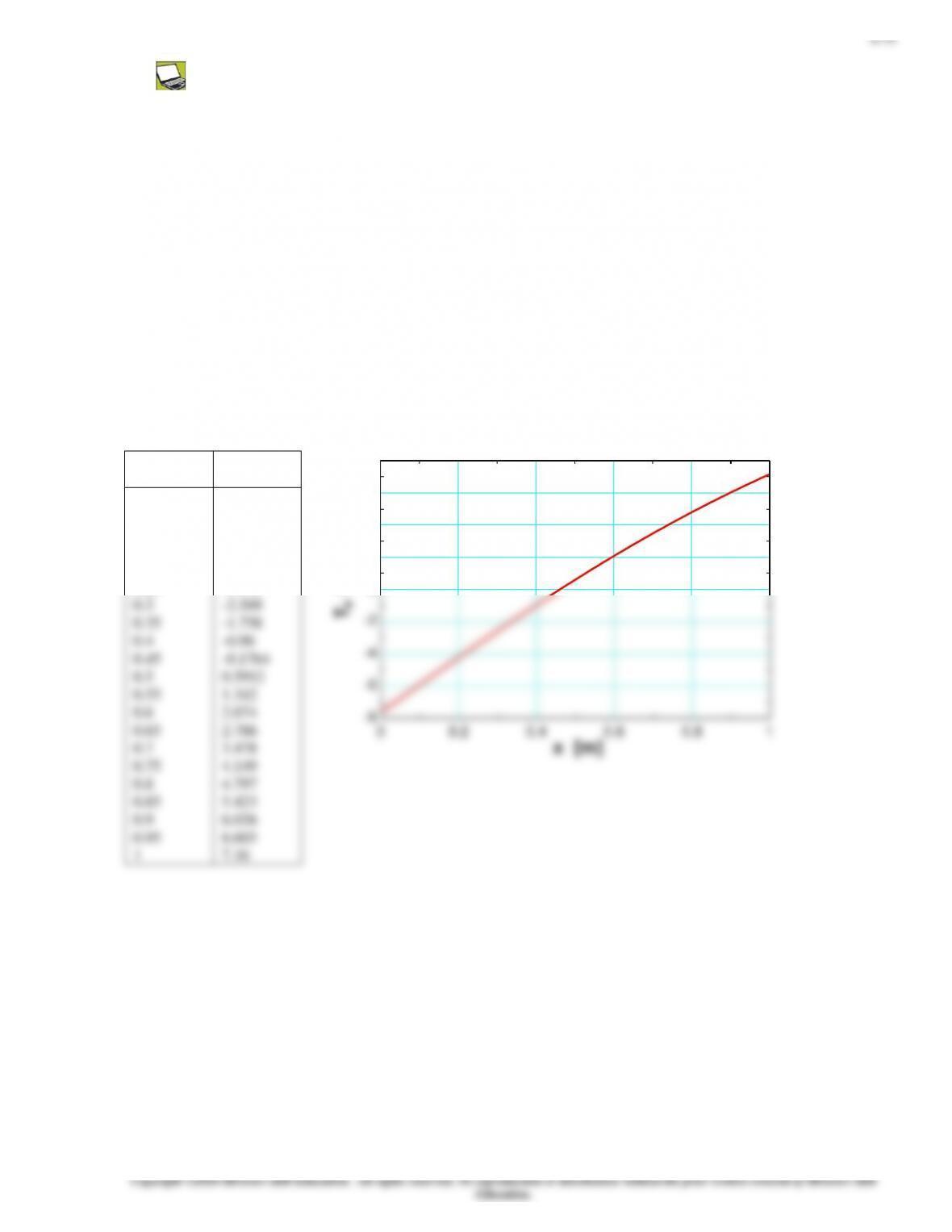
Soil
Winds
T = −8C
4-79
4-80