13-122
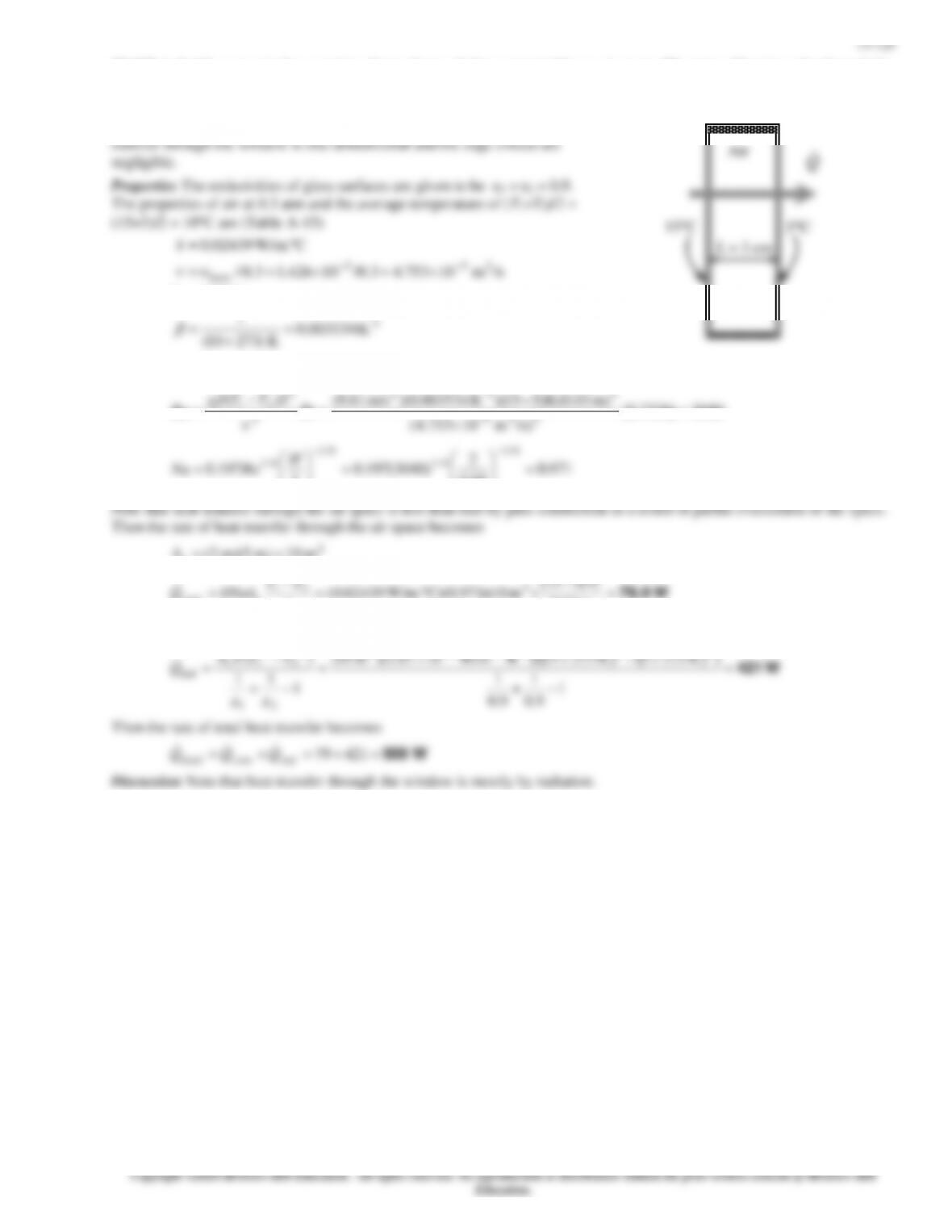
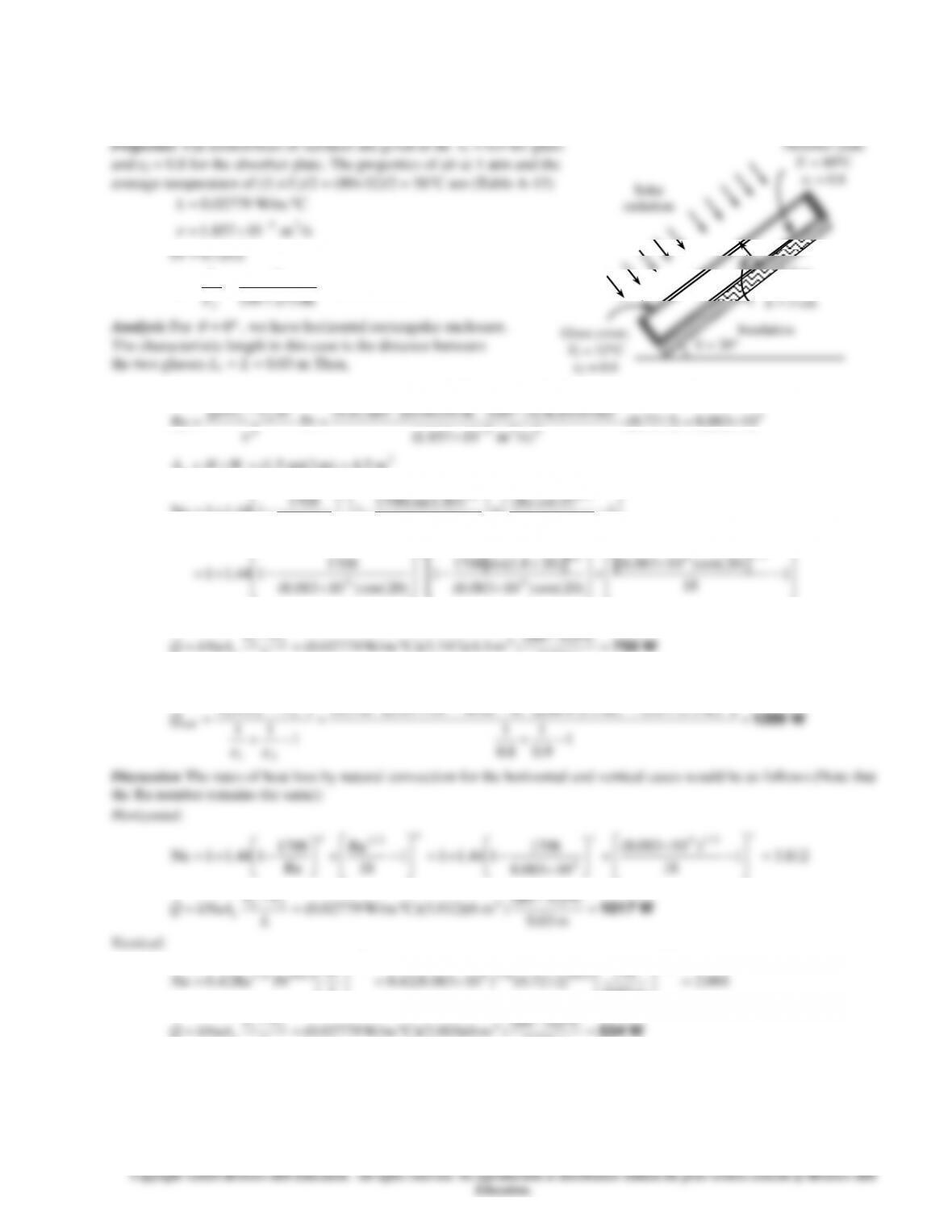
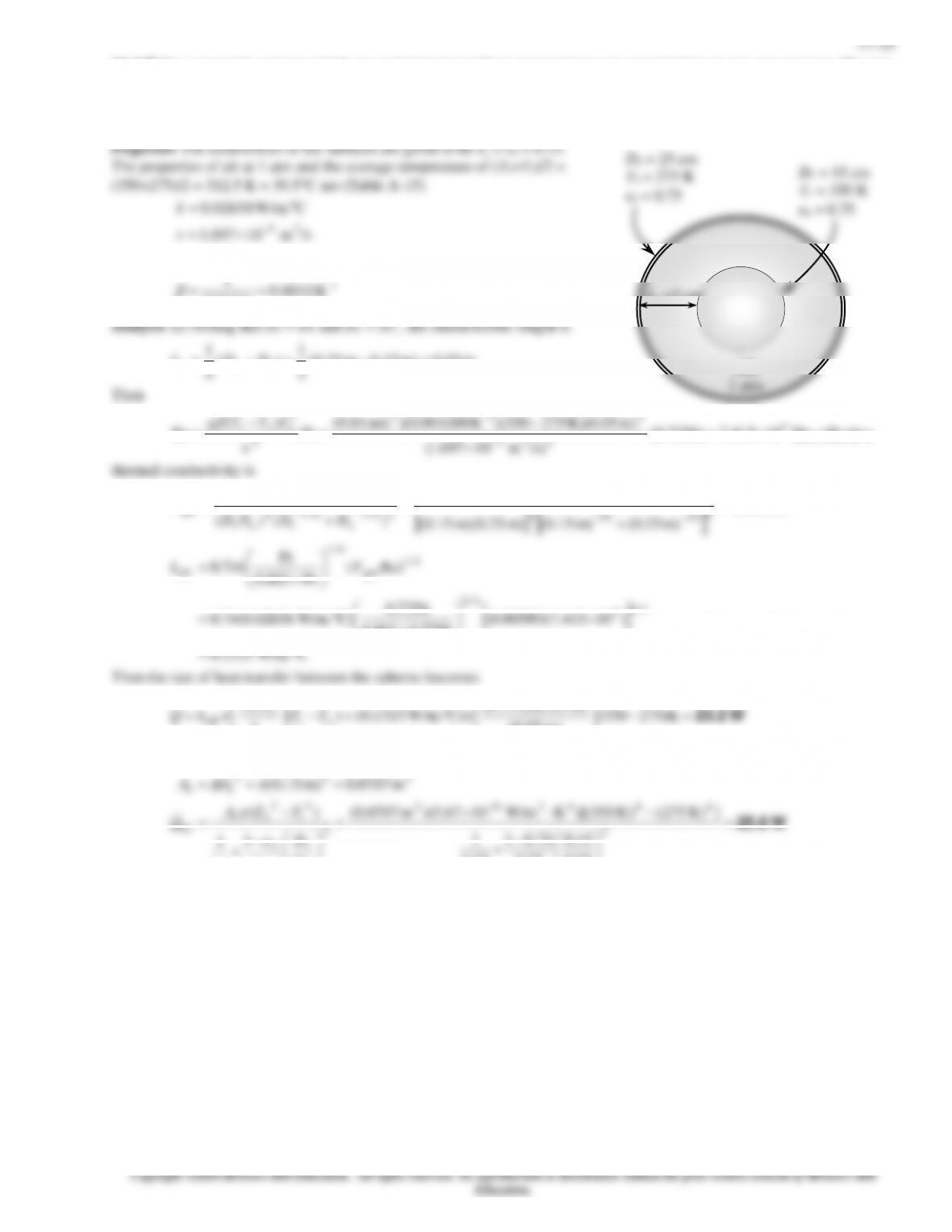
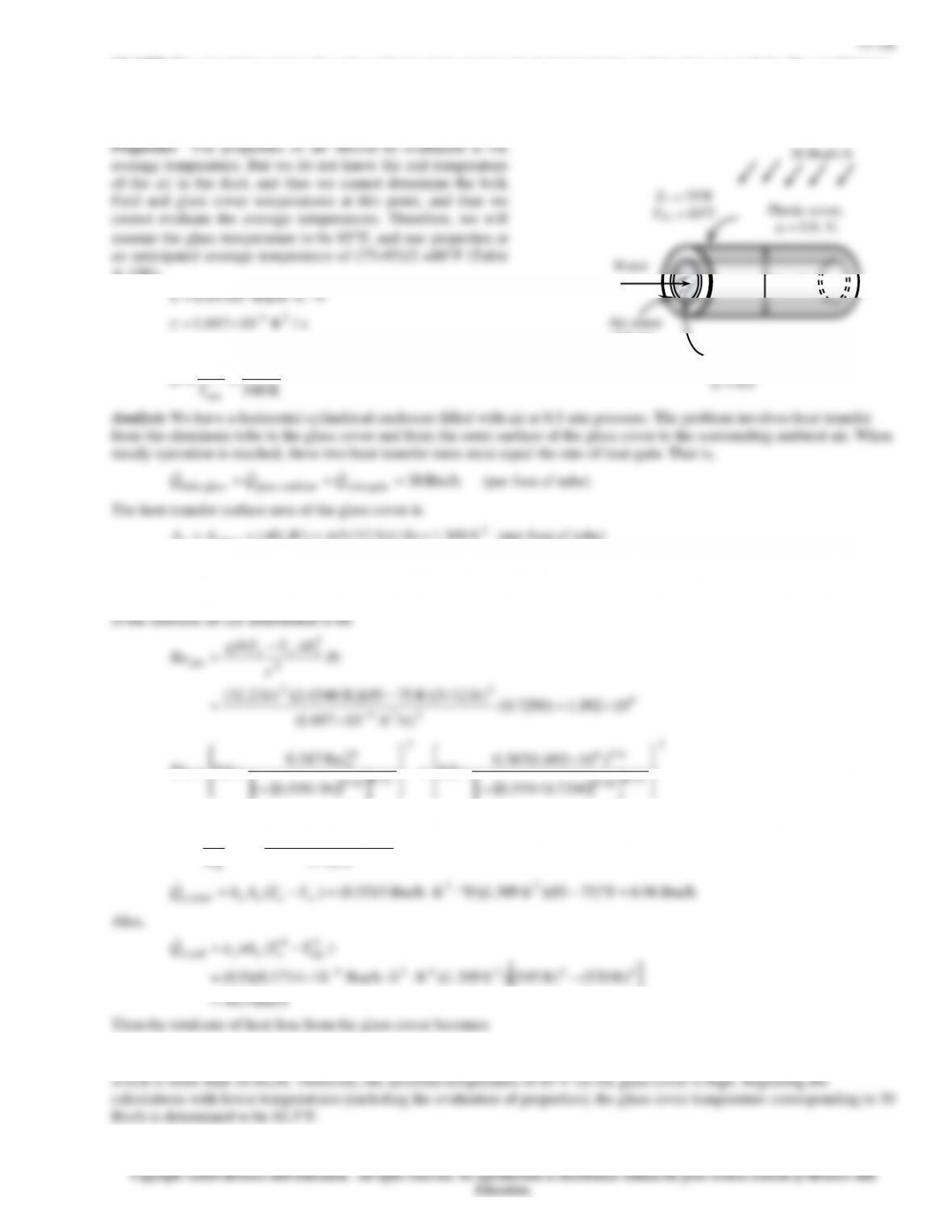
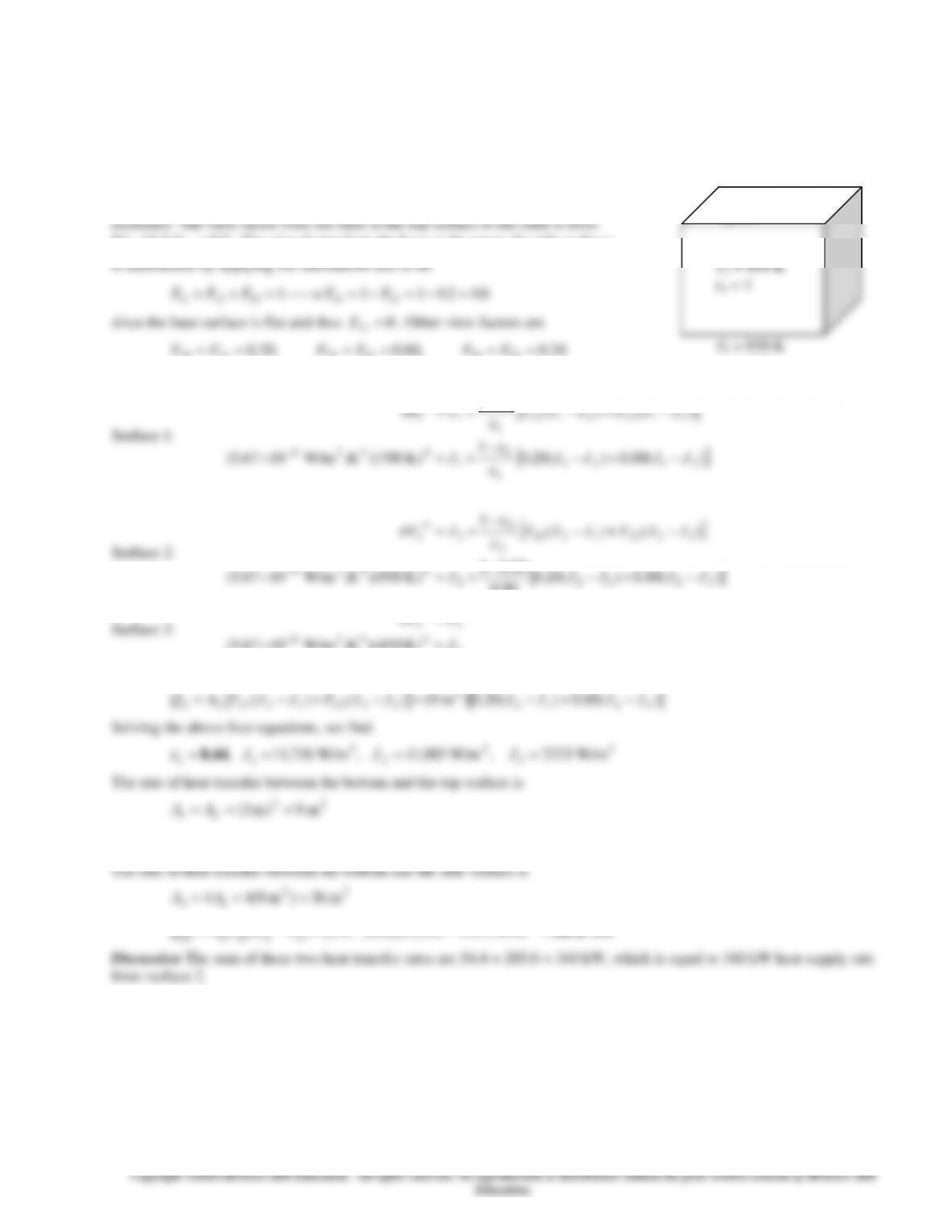
13-144 A solar collector is considered. The absorber plate and the glass cover are maintained at uniform temperatures, and
are separated by air. The rate of heat loss from the absorber plate by natural convection and radiation is to be determined.
Assumptions 1 Steady operating conditions exist 2 The surfaces are opaque, diffuse, and gray. 3 Air is an ideal gas with
constant properties.
Absorber plate
1–
K 003040.0
K)27356(
11
=
+
==
f
T
Analysis For
= 0
, we have horizontal rectangular enclosure.
The characteristic length in this case is the distance between
the two glasses Lc = L = 0.03 m Then,
4
225
3-12
2
3
21 10083.8)7212.0(
)/sm 10857.1(
)m 03.0)(K 3280)(K 00304.0)(m/s 81.9(
Pr
)( =
−
=
−
=−
LTTg
Ra
2
m 5.4m) 3(m) 5.1( === WHAs
747.3
1
18
)20cos()10083.8(
)20cos()10083.8(
)208.1sin(1708
1
)20cos()10083.8(
1708
144.11
1
18
)cosRa(
cosRa
)8.1(sin1708
1
cosRa
1708
144.11Nu
3/1
4
4
6.1
4
3/16.1
=
−
+
−
−+=
−+
−
−+=
+
+
+
+
W750=
−
=
−
=m 03.0
C)3280(
)m 5.4)(747.3)(C W/m.02779.0( 2
21
L
TT
kNuAQ s
Neglecting the end effects, the rate of heat transfer by radiation is determined from
+−+
−
−
])K 27332()K 27380)[(K W/m1067.5)(m 5.4(
)( 444282
4
2
4
1
TTA
= 20
Insulation
Glass cover,
T2 = 32C
2 = 0.9
1.5 m
L = 3 cm
13-127
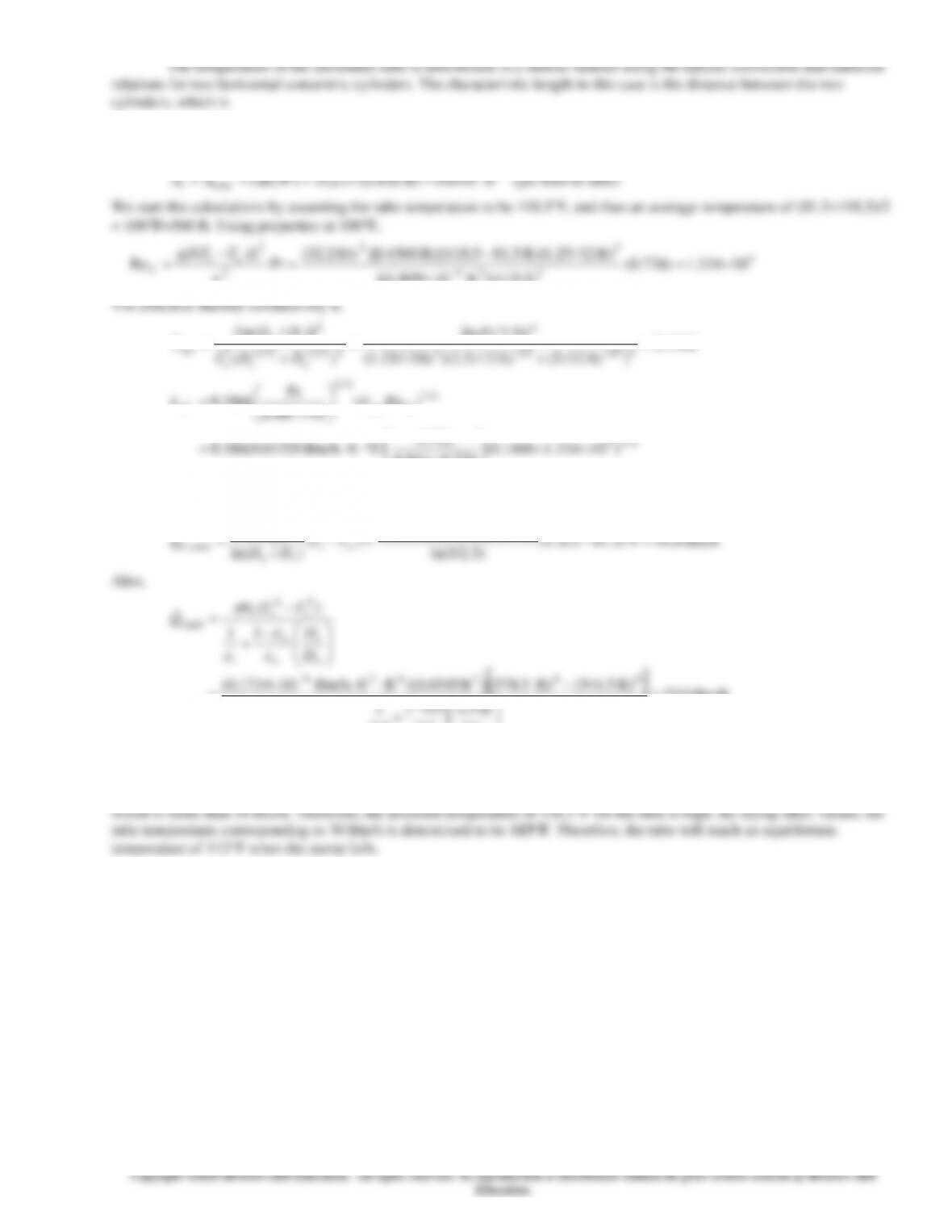
The temperature of the aluminum tube is determined in a similar manner using the natural convection and radiation
relations for two horizontal concentric cylinders. The characteristic length in this case is the distance between the two
cylinders, which is
ft 1.25/12in 25.12/)5.25(2/)( ==−=−= ioc DDL
Also,
2
We start the calculations by assuming the tube temperature to be 118.5°F, and thus an average temperature of (81.5+118.5)/2
= 100F=560 R. Using properties at 100F,
4
224
32
2
3
10334.1)726.0(
]5.0/)/sft 10809.1[(
)ft 12/25.1)(R 5.815.118](R) 560/(1)[ft/s 2.32(
Pr
)(
Ra =
−
=
−
=−
LTTg oi
L
The effective thermal conductivity is
]ft) 12/5(ft) 12/5.2[(ft) (1.25/12
)]5.2/5[ln(
)(
)]/[ln(
53/5–3/5–3
4
55/35/33
4
+
+
oic
io
DDL
DD
FftBtu/h 03227.0
0.7260.861
0.726
)Ra(
Pr861.0
Pr
386.0
4/14
4/1
cyc
4/1
eff
=
+
+
=L
Fkk
Then the rate of heat transfer between the cylinders by convection becomes
F)ftBtu/h 03227.0(2
2eff
k
13-129
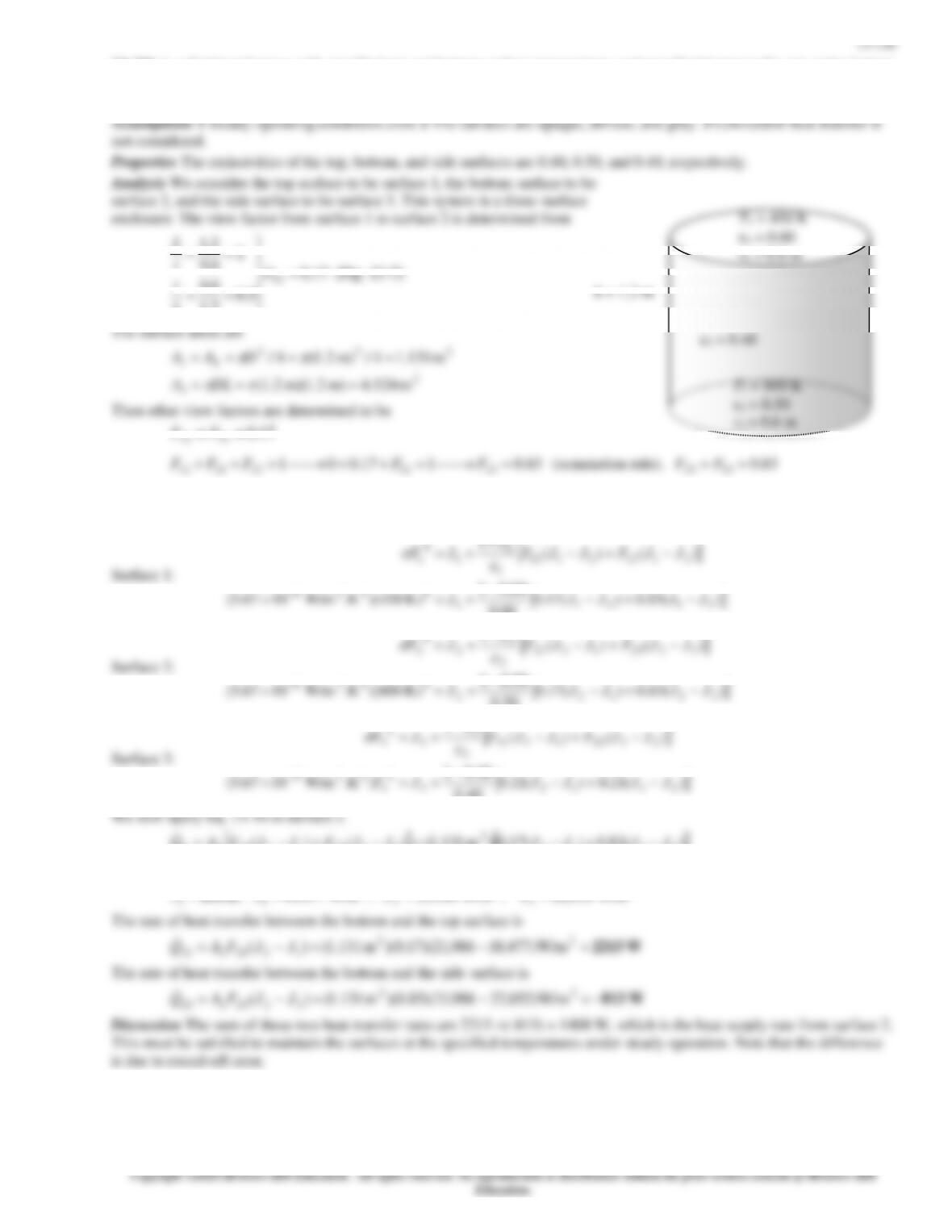
13-150 A cylindrical furnace with specified top and bottom surface temperatures and specified heat transfer rate at the bottom
surface is considered. The emissivity of the top surface and the net rates of heat transfer between the top and the bottom
surfaces, and between the bottom and the side surfaces are to be determined.
Assumptions 1 Steady operating conditions exist 2 The surfaces are opaque, diffuse, and gray. 3 Convection heat transfer is
not considered.
Properties The emissivity of the bottom surface is 0.90.
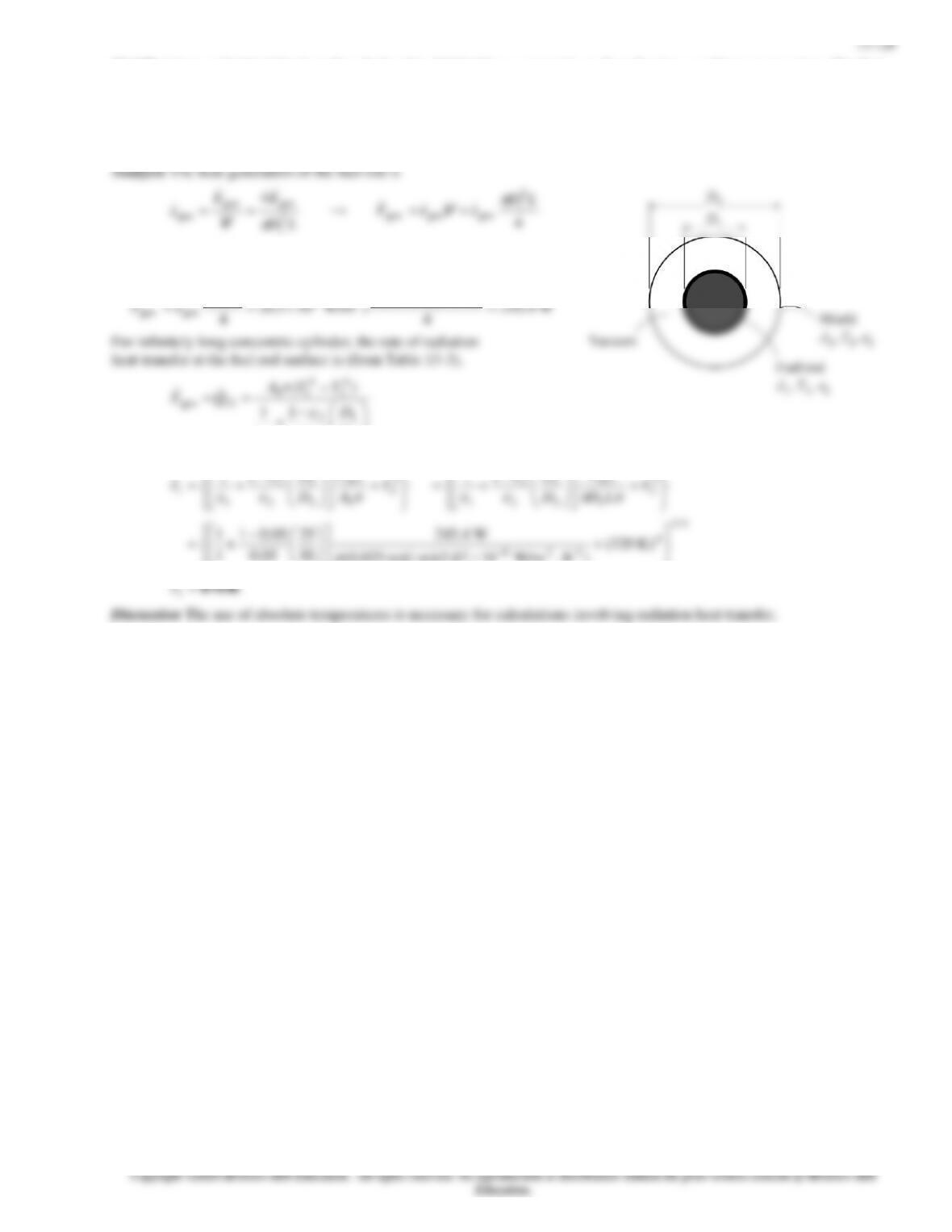
Analysis We consider the top surface to be surface 1, the base surface to be
surface 2, and the side surface to be surface 3. This system is a three-surface
Fig. 13-5
2.0
12 =F
. The view factor from the base or the top to the side surfaces
We now apply Eq. 13-35 to each surface
)()(
1
31132112
1
1
1
4
1
JJFJJFJT
−+−
−
+=
T1 = 700 K
1 = ?
2 = 0.90
3 m
13-132
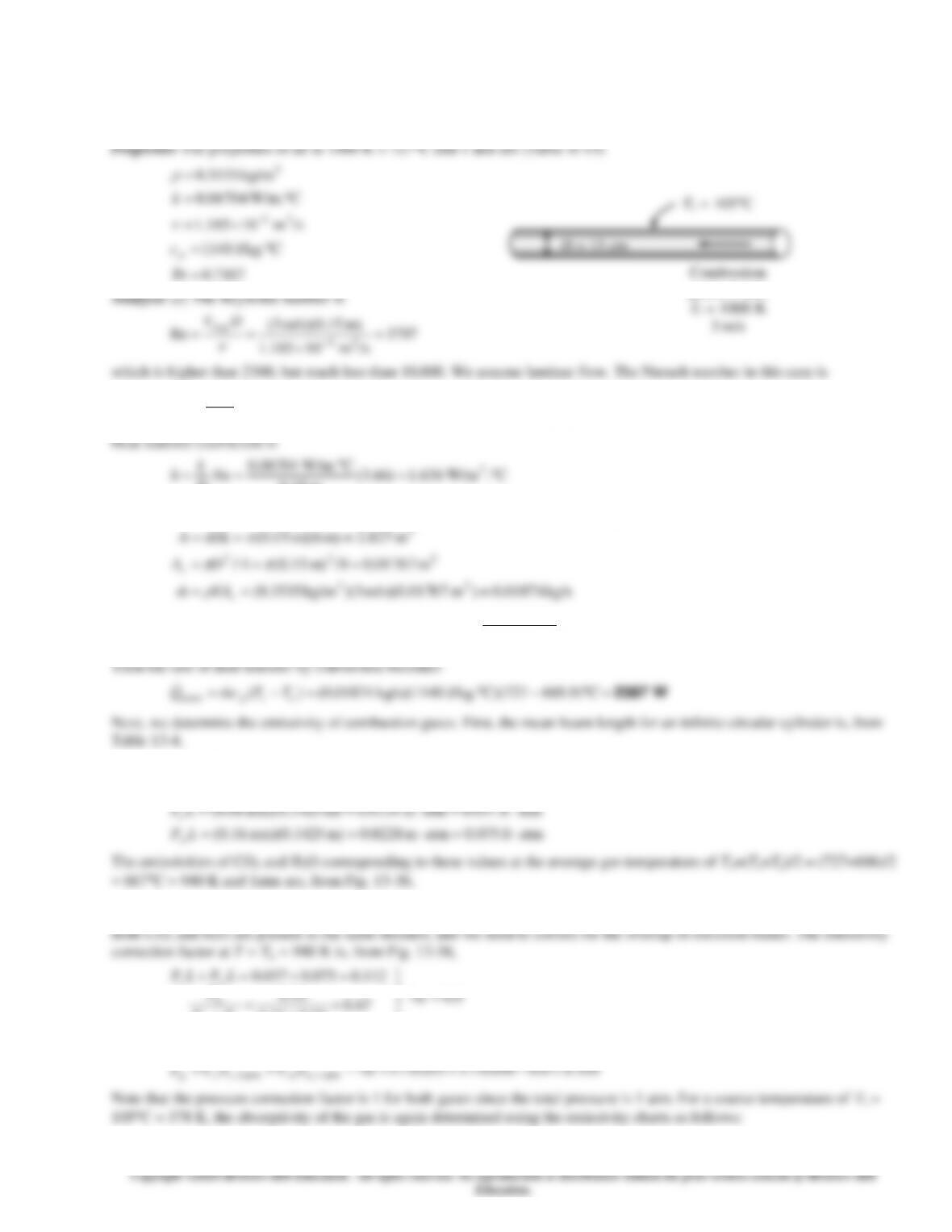
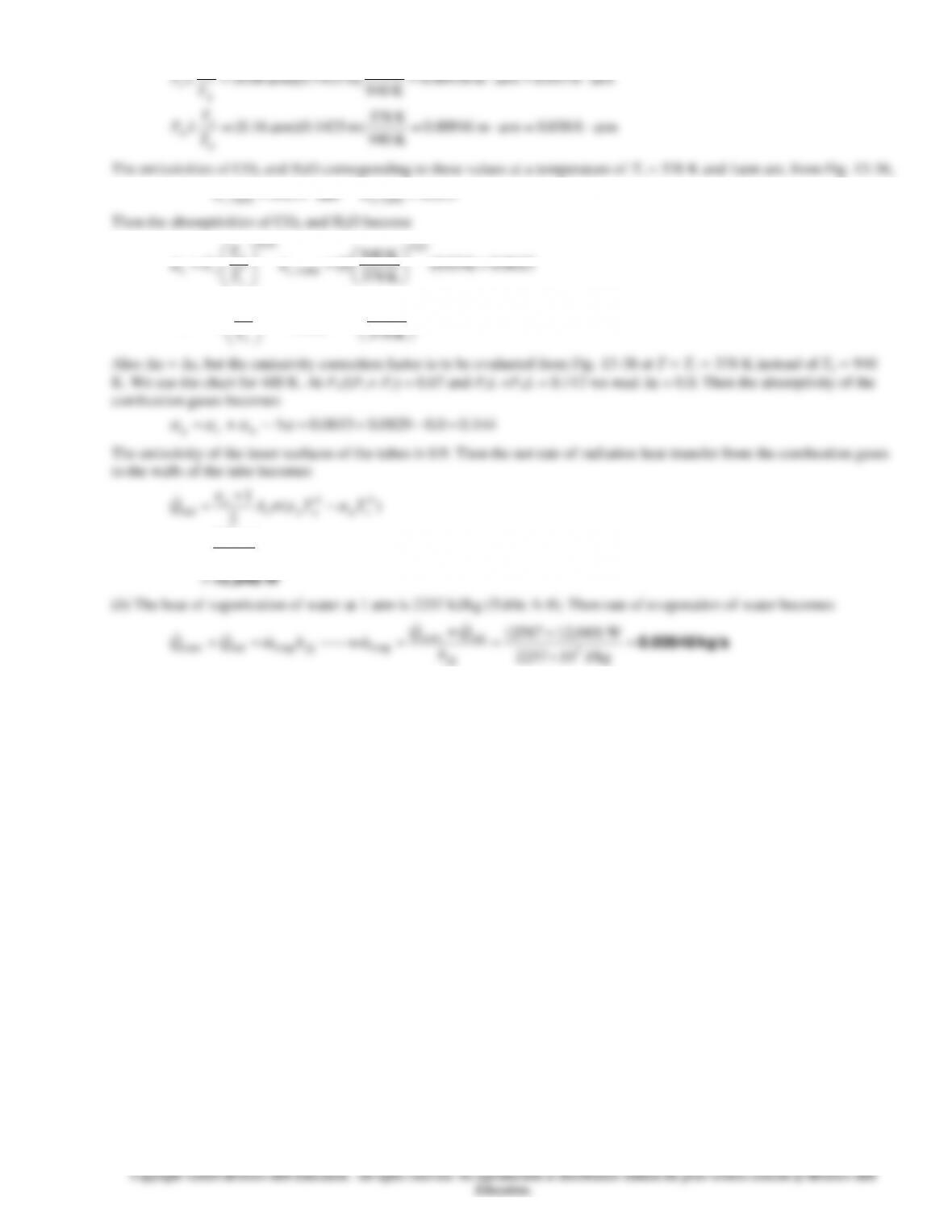
13-154 Combustion gases flow inside a tube in a boiler. The rates of heat transfer by convection and radiation and the rate of
evaporation of water are to be determined.
Assumptions 1 Steady operating conditions exist. 2 The inner surfaces of the duct are smooth. 3 Combustion gases are
assumed to have the properties of air, which is an ideal gas with constant properties.
66.3== k
hD
Nu h
13-133
atmft 0.030atmm 00916.0
K 940
K 378
m) 5atm)(0.142 16.0(
atmft 0.015atmm 00458.0
K 940
K 378
m) 5atm)(0.142 08.0(
===
===
g
s
w
g
s
c
T
T
LP
T
T
LP
The emissivities of CO2 and H2O corresponding to these values at a temperature of Ts = 378 K and 1atm are, from Fig. 13–36,
034.0
atm 1 , =
c
and
055.0
atm 1 , =
w
0829.0)055.0(
K 378
K 940
)1(
0615.0)034.0(
K 378
K 940
)1(
45.0
atm 1 ,
45.0
65.0
atm 1 ,
65.0
=
=
=
=
=
=
w
s
g
ww
c
s
g
cc
T
T
C
T
T
C