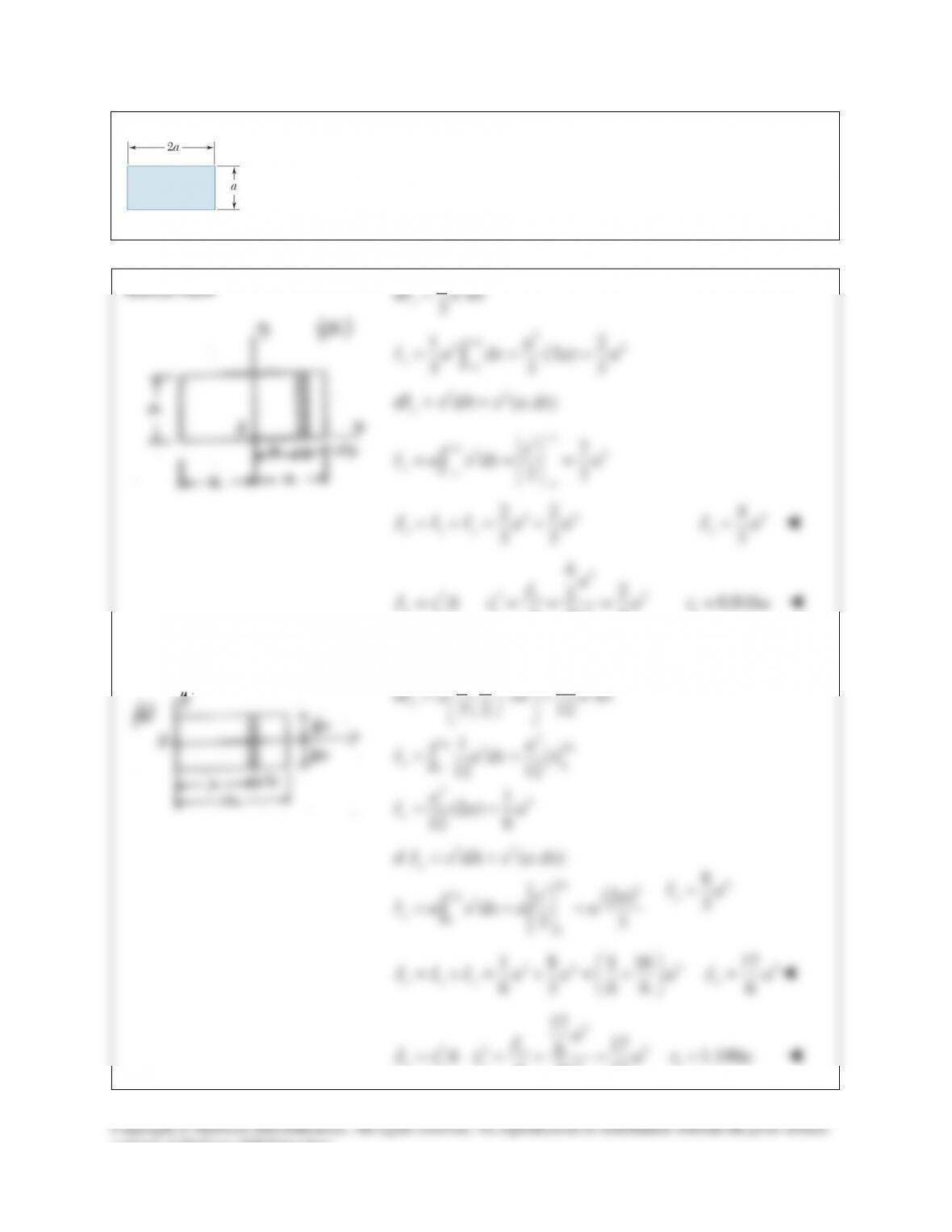
PROBLEM 7.17
Determine the polar moment of inertia and the polar radius of gyration
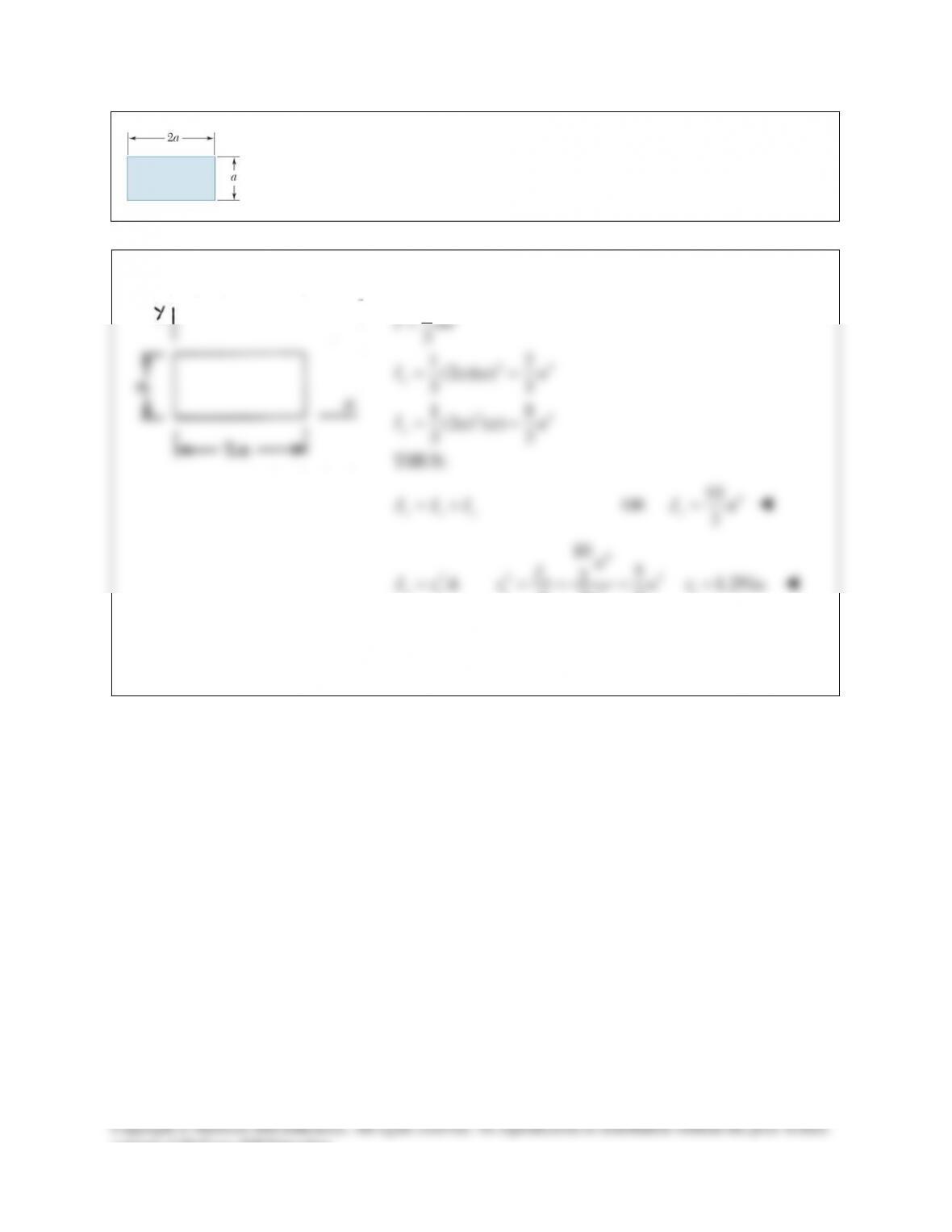
PROBLEM 7.18
Determine the polar moment of inertia and the polar radius of gyration
of the rectangle shown with respect to one of its corners.
SOLUTION
MOMENT OF INERTIA ABOUT THE BASE OF A
RECTANGLE
3
34
34
1
3
12
(2 )( )
33
18
(2 ) ( )
33
THUS:
x
y
I bh
I aa a
I aa a
=
= =
= =
oxy
JII= +
OR
4
10
3
o
Ja=
4
22 2
2
10 5
3
23
o
oo o
a
J
J rA r a
Aa
= = = =
1.291
o
ra=
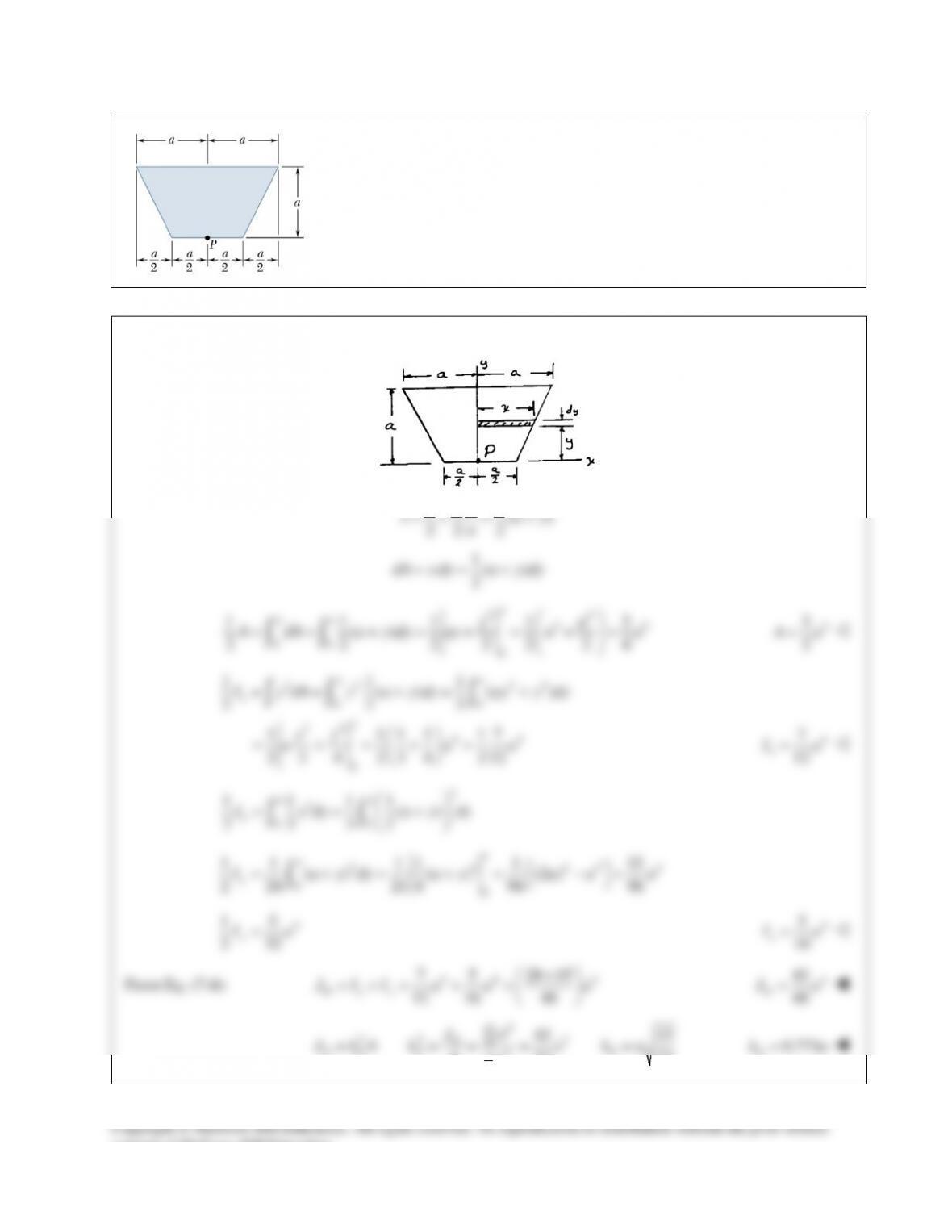
PROBLEM 7.19
Determine the polar moment of inertia and the polar radius of gyration of the
shaded area shown with respect to Point P.
SOLUTION
1()
22 2
a ay
x ay
a
=+=+
1()
2
dA xdy a y dy= = +
22
22
00 0
1 11 1 3
()
2 2 2 2 2 24
a
aa ya
A dA a y dy ay a a
= = + = + = +=
∫∫
2
3
2
Aa=
2 2 23
00
34 44
0
1 11
() ( )
2 22
1 1 1 1 17
2 3 4 2 3 4 2 12
aa
x
a
I y dA y a y dy ay y dy
yy
a aa
= = += +
= +=+ =
∫∫ ∫
4
7
12
x
Ia=
3
3
00
1 1 11
()
2 3 32
aa
y
I x dy a y dy
= = +
∫∫
3 4 44 4
00
1 1 1 1 1 15
() () (2)
2 24 24 4 96 96
a
a
y
I aydy ay a a a
= + = + = −=
∫
4
15
2 32
y
Ia=
4
5
16
y
Ia=
From Eq. (7.4):
44 4
7 5 28 15
12 16 48
Oxy
J II a a a
+
=+= + =
4
43
48
O
Ja=
4
43
22 2
48 2
3
2
43 43
72 72
O
OO O O
a
J
J kA k a k a
Aa
= = = = =
0.773
O
ka=
consent of McGraw–Hill Education.
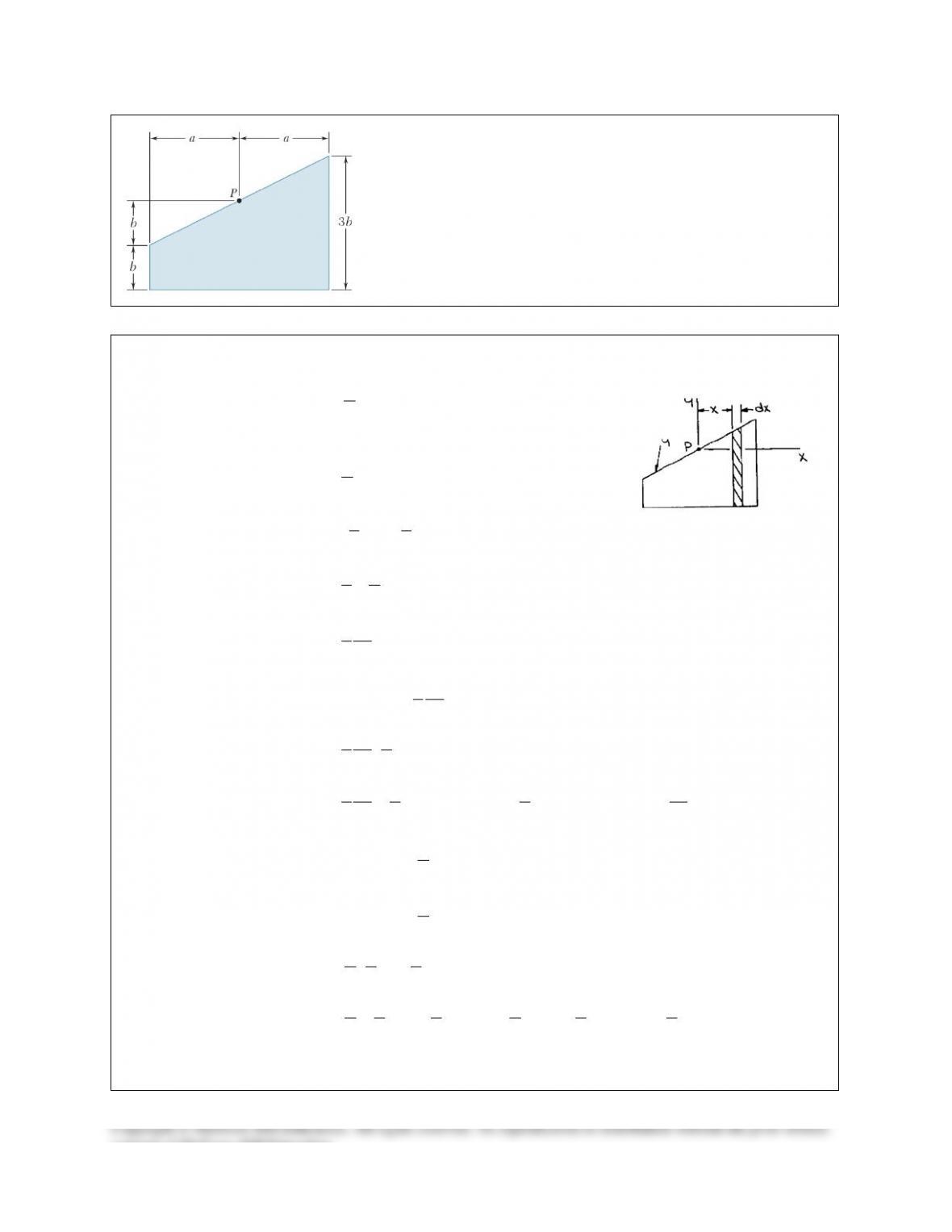
PROBLEM 7.20
Determine the polar moment of inertia and the polar radius of
gyration of the shaded area shown with respect to Point P.
SOLUTION
By observation
b
yx
a
=
First note
( 2)
( 2)
dA y b dx
bx a dx
a
= +
= +
Now
33
top bottom
33
333
3
11
33
1(2)
3
1( 8)
3
x
dI y y dx
bx b dx
a
bx a dx
a
= −
= −−
= +
Then
323
3
343
3
343 43 3
3
1( 8)
3
118
34
1 1 1 16
() 8 () ( ) 8 ( )
34 4 3
a
xx
a
a
a
b
I dI x a dx
a
bx ax
a
baaa aaa ab
a
−
−
= = +
= +
= + − −+ − =
∫∫
Also
22
( 2)
y
b
dI x dA x x a dx
a
= = +
Then
2
43
4 3 4 33
( 2)
12
43
12 1 2 4
() () ( ) ( )
43 4 3 3
a
yy
a
a
a
b
I dI x x a dx
a
bx ax
a
baaa aaa ab
a
−
−
= = +
= +
= + − −+ − =
∫∫
consent of McGraw–Hill Education.
SOLUTION Continued
Now
33
16 4
33
Pxy
J I I ab a b=+= +
22
4( 4)
3
P
J ab a b= +
and
22
4
231
2
( 4)
(2 )(3 ) (2 )(2 )
P
P
ab a b
J
kA ab ab
+
= = −
22
1( 4)
3ab= +
or
22
4
3
Pab
k+
=
consent of McGraw–Hill Education.
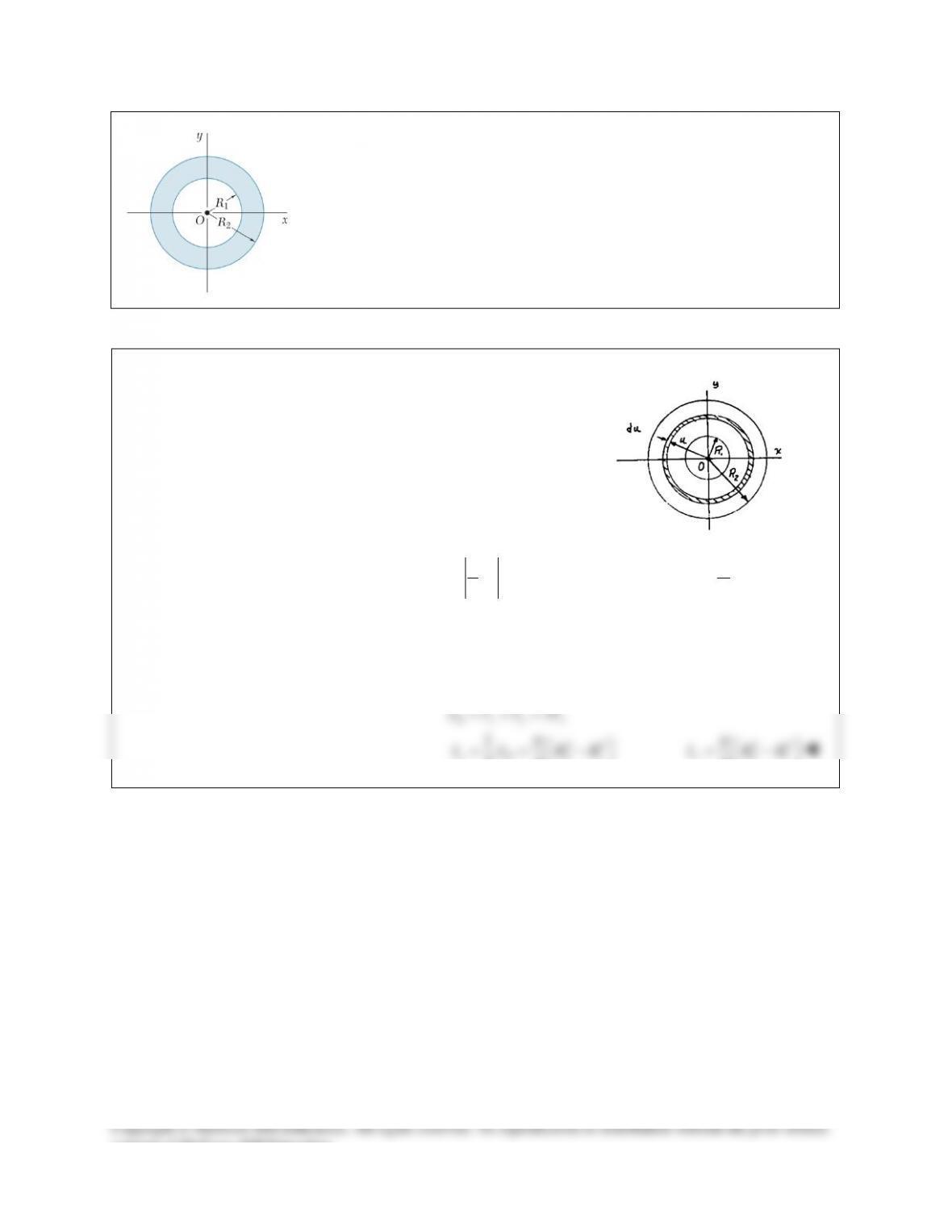
PROBLEM 7.21
(
a
) Determine by direct integration the polar moment of inertia of the annular area
shown with respect to Point
O. (b) Using the result of Part a, determine the
moment of inertia of the given area with respect to the
x axis.
SOLUTION
(
a)
2dA u du
π
=
22
3
(2 )
2
O
dJ u dA u u du
u du
π
π
= =
=
2
1
2
1
3
4
2
1
24
R
OOR
R
R
J dJ u du
u
π
π
= =
=
∫∫
44
21
2
O
J RR
π
= −
(
b) From Eq. (9.4): (Note by symmetry.)
xy
II=
44
21
2
1
24
Oxy x
xO
J II I
I J RR
π
=+=
= = −
44
21
4
x
I RR
π
= −
consent of McGraw–Hill Education.
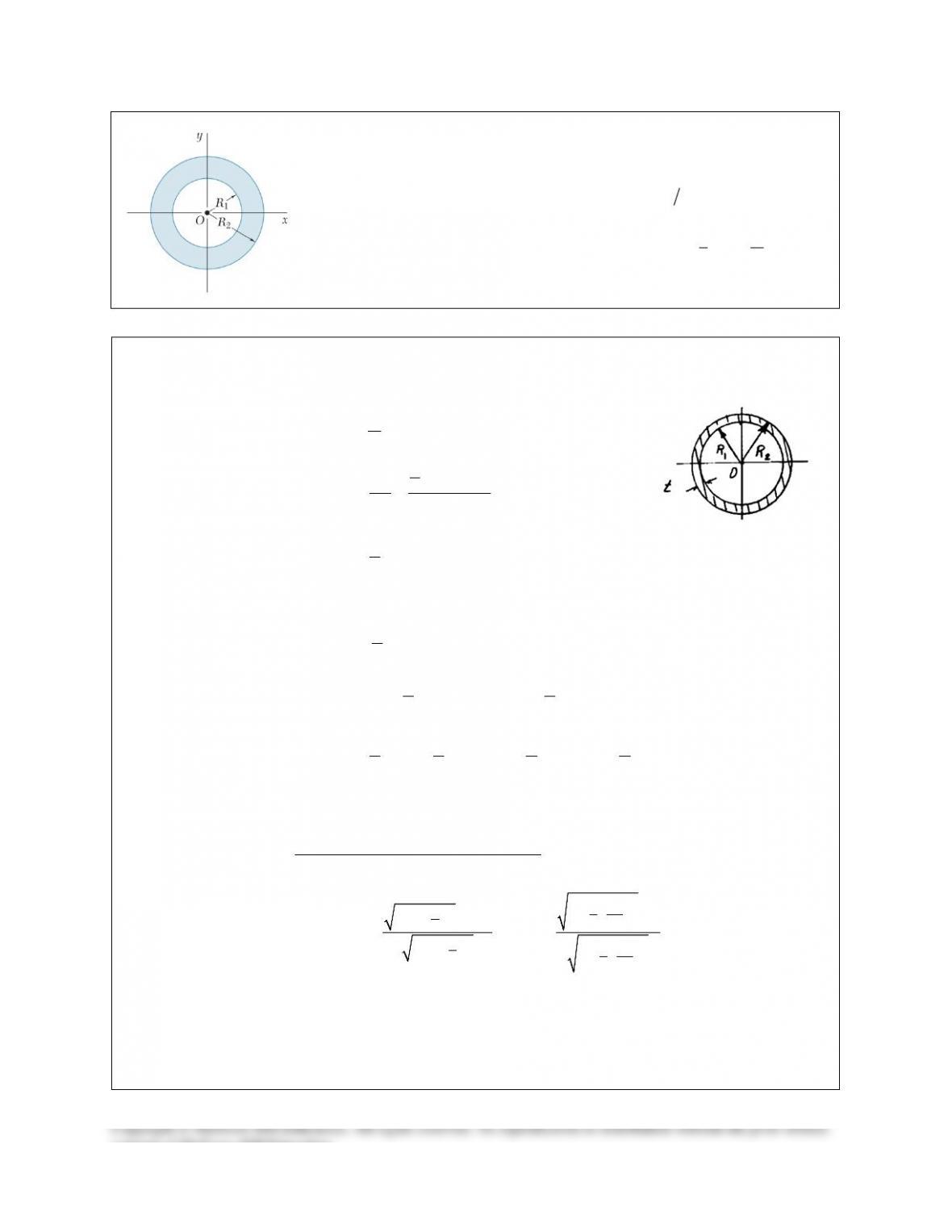
PROBLEM 7.22
(a) Show that the polar radius of gyration kO of the annular area shown is
approximately equal to the mean radius
12
( )2
m
R RR= +
for small values of
the thickness
21
.tR R
= −
(b) Determine the percentage error introduced by
using Rm in place of kO for the following values of t/Rm: 1,
1
2
, and
1
10
.
SOLUTION
(a) From Problem 9.23:
44
21
2
O
J RR
π
= −
( )
44
21
2
2
22
21
O
O
RR
J
kARR
π
π
−
= = −
2 22
21
1
2
O
k RR
= +
Thickness:
21
tR R= −
Mean radius:
12
1()
2
m
R RR
= +
Thus,
12
11
and
22
mm
RR t RR t=−=+
22
2 22
11 1 1
22 2 4
Om m m
k Rt Rt Rt
= + +− =+
For t small compared to
:
m
R
22
Om
kR≈
Om
kR≈
(b)
(exact value) (approximation value)
Percentage error 100
(exact value)
−
=
( )
( )
2
1
22
14
4
22 2
11
44
11
P.E. (100) 100
1
m
m
t
R
mm
t
mR
R tR
Rt
+−
+−
=−=−
++
consent of McGraw–Hill Education.
SOLUTION Continued
t
1
4
11
+−
PROBLEM 7.23
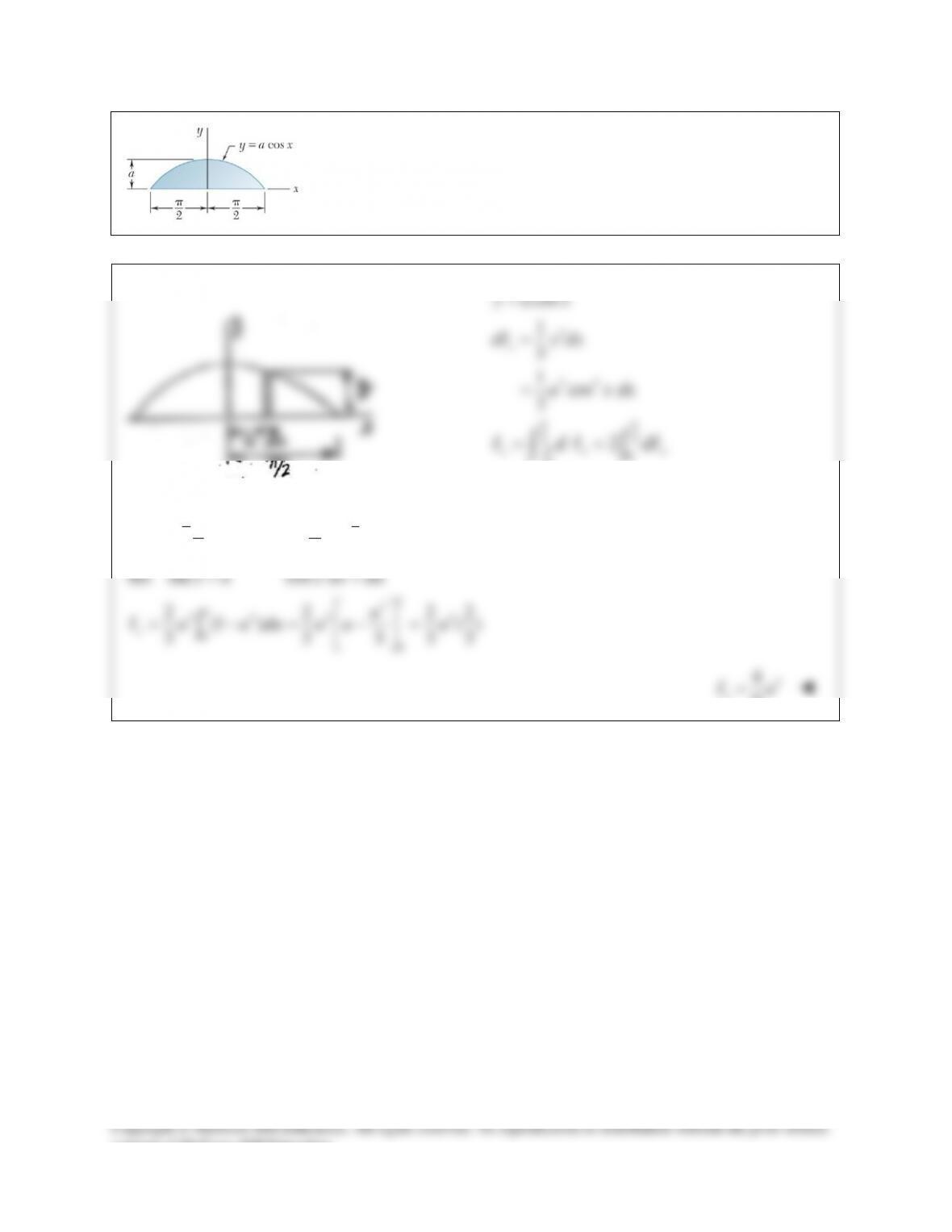
Determine the moment of inertia of the shaded area with respect to the x–
axis.
SOLUTION
3
33
22
0
2
cos
1
3
1
cos
3
2
x
x xx
ya x
dI y dx
a x dx
I d I dI
ππ
π
−
=
=
=
= =
∫∫
33 3
22
00
1
3
1
32 3 3
00
12
2 cos (1 sin )cos
33
Set sin cos
2 2 22
(1 ) ( )
3 3 3 33
x
x
I a x dx a x x dx
x u x dx du
u
I a u du a u a
ππ
= = −
= =
= − = −=
∫∫
∫
3
4
9
x
Ia=
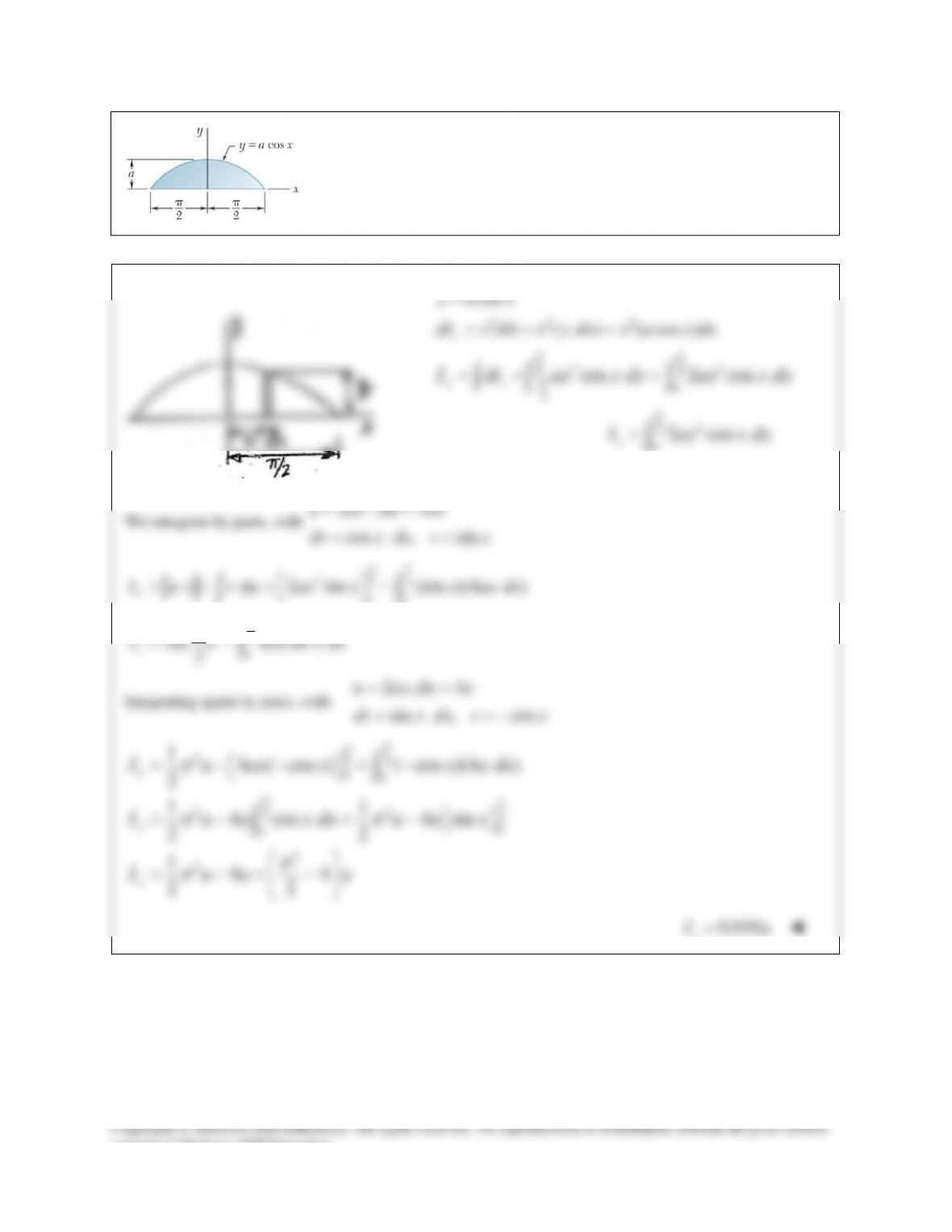
PROBLEM 7.24
Determine the moment of inertia of the shaded area with respect to the y-
axis.
SOLUTION
22 2
22
2
22
0
2
2
0
cos
( ) ( cos )
cos 2 cos
2 cos
y
y
y
y
ya x
dI x dA x y dx x a x dx
dI
I ax x dx ax x dx
I ax x dx
ππ
π
π
−
=
= = =
=
= =
=
∫∫∫
∫
We integrate by parts, with
2
2, 4
cos , sin
u ax du ax
dv x dx v x
= =
= =
[ ]
22
2
0
2 sin (sin )(4 )
yo
I u v v du ax x x ax dx
π
π
=−= −
∫∫
22
0
2 ( ) 4 sin
2
y
I a ax x dx
π
π
= − ∫
Integrating again by parts, with
2, 4
sin , cos
u ax du a
dv x dx v x
= =
= = −
22
2
00
22
22
0
0
2
2
14 ( cos ) ( cos )(4 )
2
11
4 cos 4 sin
22
144
22
y
y
y
I a ax x x a dx
I aa xdx aa x
I aa a
π
π
ππ
π
ππ
π
π
= − − +−
=−=−
= −= −
∫
∫
0.935
y
Ia=
PROBLEM 7.18
Determine the polar moment of inertia and the polar radius of gyration
of the rectangle shown with respect to one of its corners.
SOLUTION
MOMENT OF INERTIA ABOUT THE BASE OF A
RECTANGLE
3
34
34
1
3
12
(2 )( )
33
18
(2 ) ( )
33
THUS:
x
y
I bh
I aa a
I aa a
=
= =
= =
oxy
JII= +
OR
4
10
3
o
Ja=
4
22 2
2
10 5
3
23
o
oo o
a
J
J rA r a
Aa
= = = =
1.291
o
ra=
PROBLEM 7.19
Determine the polar moment of inertia and the polar radius of gyration of the
shaded area shown with respect to Point P.
SOLUTION
1()
22 2
a ay
x ay
a
=+=+
1()
2
dA xdy a y dy= = +
22
22
00 0
1 11 1 3
()
2 2 2 2 2 24
a
aa ya
A dA a y dy ay a a
= = + = + = +=
∫∫
2
3
2
Aa=
2 2 23
00
34 44
0
1 11
() ( )
2 22
1 1 1 1 17
2 3 4 2 3 4 2 12
aa
x
a
I y dA y a y dy ay y dy
yy
a aa
= = += +
= +=+ =
∫∫ ∫
4
7
12
x
Ia=
3
3
00
1 1 11
()
2 3 32
aa
y
I x dy a y dy
= = +
∫∫
3 4 44 4
00
1 1 1 1 1 15
() () (2)
2 24 24 4 96 96
a
a
y
I aydy ay a a a
= + = + = −=
∫
4
15
2 32
y
Ia=
4
5
16
y
Ia=
From Eq. (7.4):
44 4
7 5 28 15
12 16 48
Oxy
J II a a a
+
=+= + =
4
43
48
O
Ja=
4
43
22 2
48 2
3
2
43 43
72 72
O
OO O O
a
J
J kA k a k a
Aa
= = = = =
0.773
O
ka=
consent of McGraw–Hill Education.
PROBLEM 7.20
Determine the polar moment of inertia and the polar radius of
gyration of the shaded area shown with respect to Point P.
SOLUTION
By observation
b
yx
a
=
First note
( 2)
( 2)
dA y b dx
bx a dx
a
= +
= +
Now
33
top bottom
33
333
3
11
33
1(2)
3
1( 8)
3
x
dI y y dx
bx b dx
a
bx a dx
a
= −
= −−
= +
Then
323
3
343
3
343 43 3
3
1( 8)
3
118
34
1 1 1 16
() 8 () ( ) 8 ( )
34 4 3
a
xx
a
a
a
b
I dI x a dx
a
bx ax
a
baaa aaa ab
a
−
−
= = +
= +
= + − −+ − =
∫∫
Also
22
( 2)
y
b
dI x dA x x a dx
a
= = +
Then
2
43
4 3 4 33
( 2)
12
43
12 1 2 4
() () ( ) ( )
43 4 3 3
a
yy
a
a
a
b
I dI x x a dx
a
bx ax
a
baaa aaa ab
a
−
−
= = +
= +
= + − −+ − =
∫∫
consent of McGraw–Hill Education.
SOLUTION Continued
Now
33
16 4
33
Pxy
J I I ab a b=+= +
22
4( 4)
3
P
J ab a b= +
and
22
4
231
2
( 4)
(2 )(3 ) (2 )(2 )
P
P
ab a b
J
kA ab ab
+
= = −
22
1( 4)
3ab= +
or
22
4
3
Pab
k+
=
consent of McGraw–Hill Education.
PROBLEM 7.21
(
a
) Determine by direct integration the polar moment of inertia of the annular area
shown with respect to Point
O. (b) Using the result of Part a, determine the
moment of inertia of the given area with respect to the
x axis.
SOLUTION
(
a)
2dA u du
π
=
22
3
(2 )
2
O
dJ u dA u u du
u du
π
π
= =
=
2
1
2
1
3
4
2
1
24
R
OOR
R
R
J dJ u du
u
π
π
= =
=
∫∫
44
21
2
O
J RR
π
= −
(
b) From Eq. (9.4): (Note by symmetry.)
xy
II=
44
21
2
1
24
Oxy x
xO
J II I
I J RR
π
=+=
= = −
44
21
4
x
I RR
π
= −
consent of McGraw–Hill Education.
PROBLEM 7.22
(a) Show that the polar radius of gyration kO of the annular area shown is
approximately equal to the mean radius
12
( )2
m
R RR= +
for small values of
the thickness
21
.tR R
= −
(b) Determine the percentage error introduced by
using Rm in place of kO for the following values of t/Rm: 1,
1
2
, and
1
10
.
SOLUTION
(a) From Problem 9.23:
44
21
2
O
J RR
π
= −
( )
44
21
2
2
22
21
O
O
RR
J
kARR
π
π
−
= = −
2 22
21
1
2
O
k RR
= +
Thickness:
21
tR R= −
Mean radius:
12
1()
2
m
R RR
= +
Thus,
12
11
and
22
mm
RR t RR t=−=+
22
2 22
11 1 1
22 2 4
Om m m
k Rt Rt Rt
= + +− =+
For t small compared to
:
m
R
22
Om
kR≈
Om
kR≈
(b)
(exact value) (approximation value)
Percentage error 100
(exact value)
−
=
( )
( )
2
1
22
14
4
22 2
11
44
11
P.E. (100) 100
1
m
m
t
R
mm
t
mR
R tR
Rt
+−
+−
=−=−
++
consent of McGraw–Hill Education.
SOLUTION Continued
t
1
4
11
+−
PROBLEM 7.23
Determine the moment of inertia of the shaded area with respect to the x–
axis.
SOLUTION
3
33
22
0
2
cos
1
3
1
cos
3
2
x
x xx
ya x
dI y dx
a x dx
I d I dI
ππ
π
−
=
=
=
= =
∫∫
33 3
22
00
1
3
1
32 3 3
00
12
2 cos (1 sin )cos
33
Set sin cos
2 2 22
(1 ) ( )
3 3 3 33
x
x
I a x dx a x x dx
x u x dx du
u
I a u du a u a
ππ
= = −
= =
= − = −=
∫∫
∫
3
4
9
x
Ia=
PROBLEM 7.24
Determine the moment of inertia of the shaded area with respect to the y-
axis.
SOLUTION
22 2
22
2
22
0
2
2
0
cos
( ) ( cos )
cos 2 cos
2 cos
y
y
y
y
ya x
dI x dA x y dx x a x dx
dI
I ax x dx ax x dx
I ax x dx
ππ
π
π
−
=
= = =
=
= =
=
∫∫∫
∫
We integrate by parts, with
2
2, 4
cos , sin
u ax du ax
dv x dx v x
= =
= =
[ ]
22
2
0
2 sin (sin )(4 )
yo
I u v v du ax x x ax dx
π
π
=−= −
∫∫
22
0
2 ( ) 4 sin
2
y
I a ax x dx
π
π
= − ∫
Integrating again by parts, with
2, 4
sin , cos
u ax du a
dv x dx v x
= =
= = −
22
2
00
22
22
0
0
2
2
14 ( cos ) ( cos )(4 )
2
11
4 cos 4 sin
22
144
22
y
y
y
I a ax x x a dx
I aa xdx aa x
I aa a
π
π
ππ
π
ππ
π
π
= − − +−
=−=−
= −= −
∫
∫
0.935
y
Ia=