consent of McGraw–Hill Education.
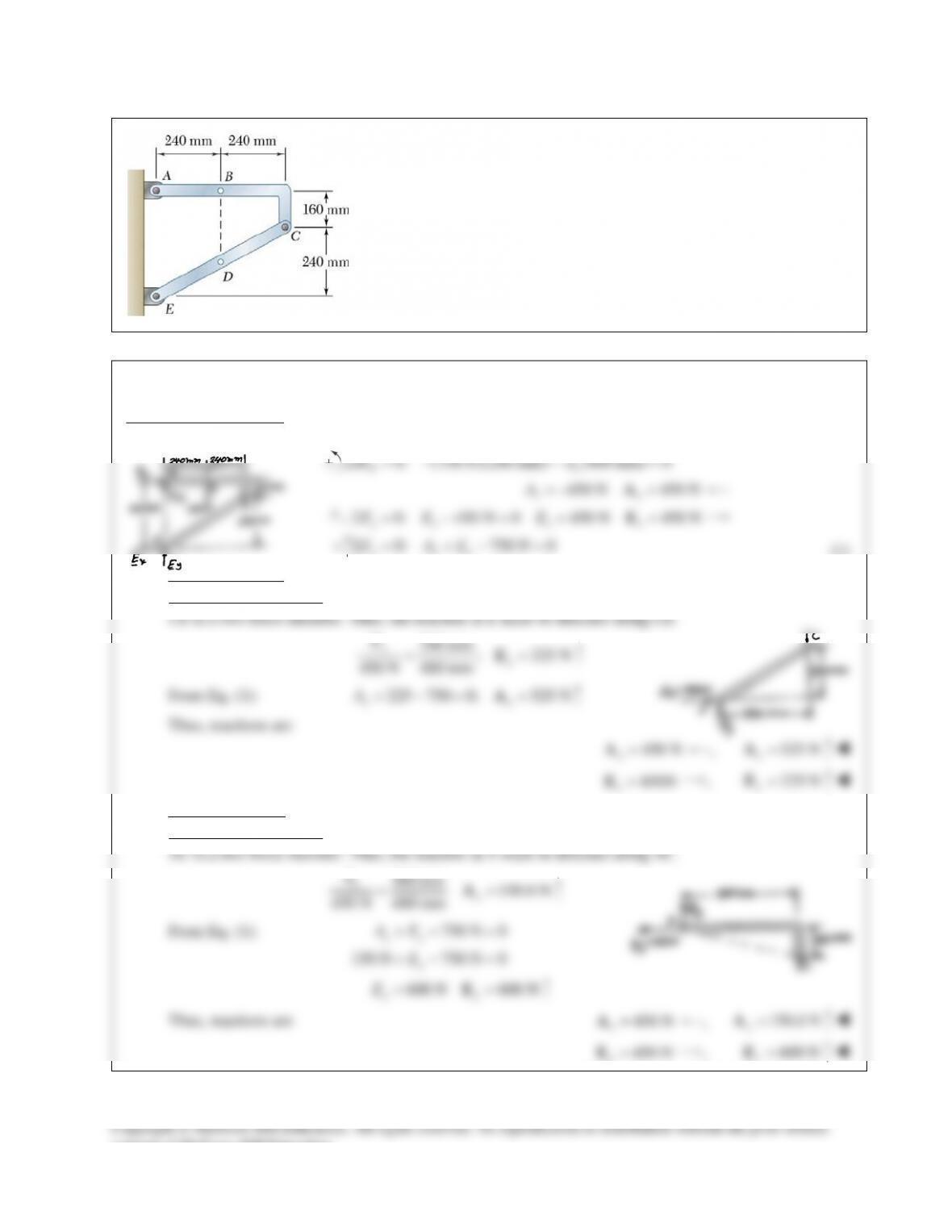
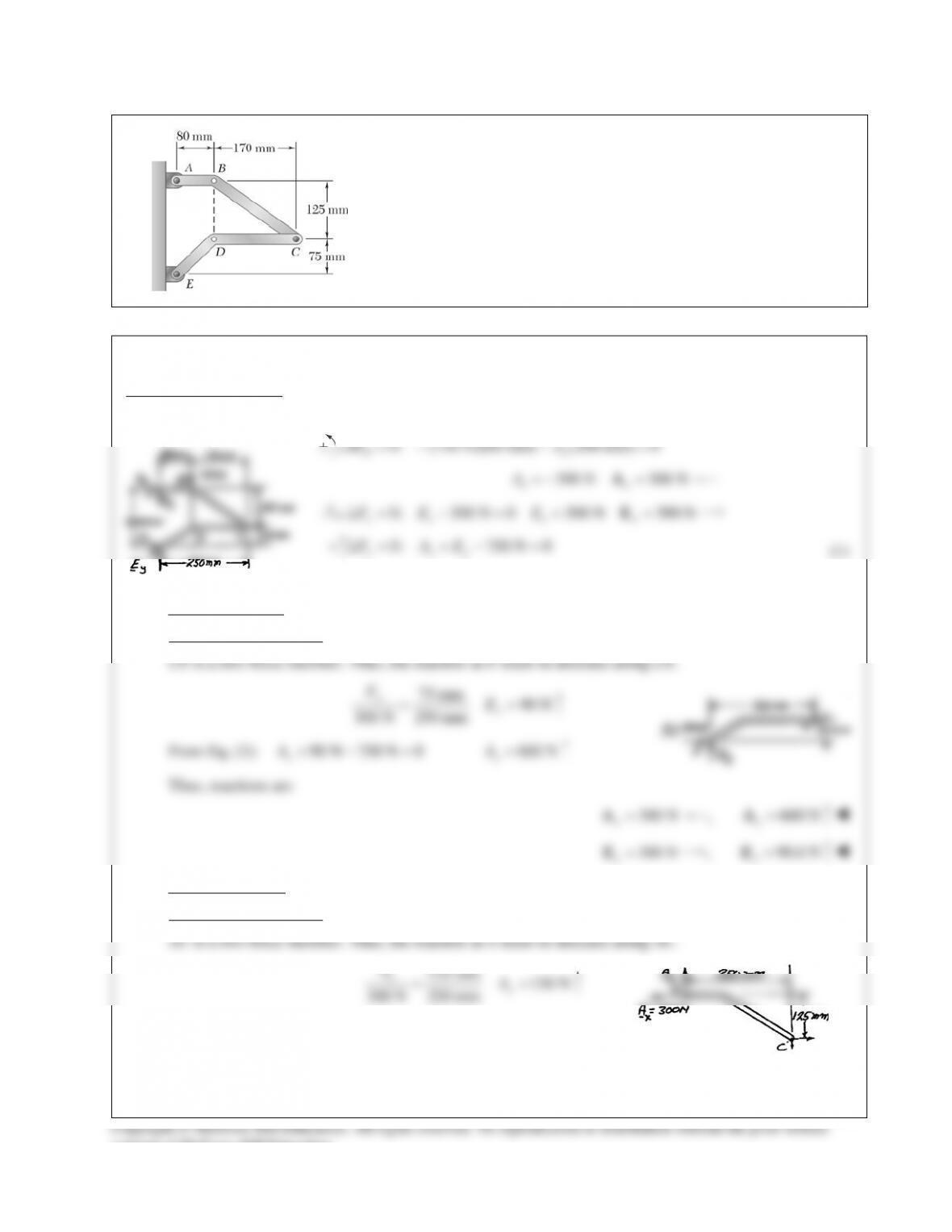
PROBLEM 6.56
Determine the components of the reactions at A and E if a 750–N force
directed vertically downward is applied (a) at B, (b) at D.
SOLUTION
Free–body: Entire frame:
The following analysis is valid for both parts (a) and (b) since position of load on its line of action is immaterial.
0: (750 N)(240 mm) (400 mm) 0
Ex
MAΣ= − − =
450 N 450 N
xx
A=−=A
0: 450 N 0 450 N 450 N
xx x x
FE EΣ= − = = =E
0: 750 N 0
y yy
F AEΣ= + − =
(1)
(a) Load applied at B.
Free body: Member CE:
240 mm ; 225 N
450 N 480 mm
yy
E= =E
From Eq. (1):
225 750 0; 525 N
yy
A+−= =A
Thus, reactions are
450 N
x
=
A
,
525 N
y=A
450N
x
=
E
,
225 N
y=E
(b) Load applied at D.
Free body: Member AC:
160 mm 150.0 N
450 N 480 mm
yy
A= =A
From Eq. (1):
750 N 0
150 N 750 N 0
yy
y
AE
E
+− =
+− =
600 N 600 N
yy
E= =E
Thus, reactions are
450 N
x
=A
,
150.0 N
y
=A
450 N
x=E
,
600 N
y=E
consent of McGraw–Hill Education.
SOLUTION Continued
From Eq. (1):
750 N 0
150 N 750 N 0
yy
y
AE
E
+− =
+− =
600 N 600 N
yy
E= =E
Thus, reactions are
300 N
x=A
,
150.0 N
y=A
300 N
x=E
,
600 N
y=E
consent of McGraw–Hill Education.
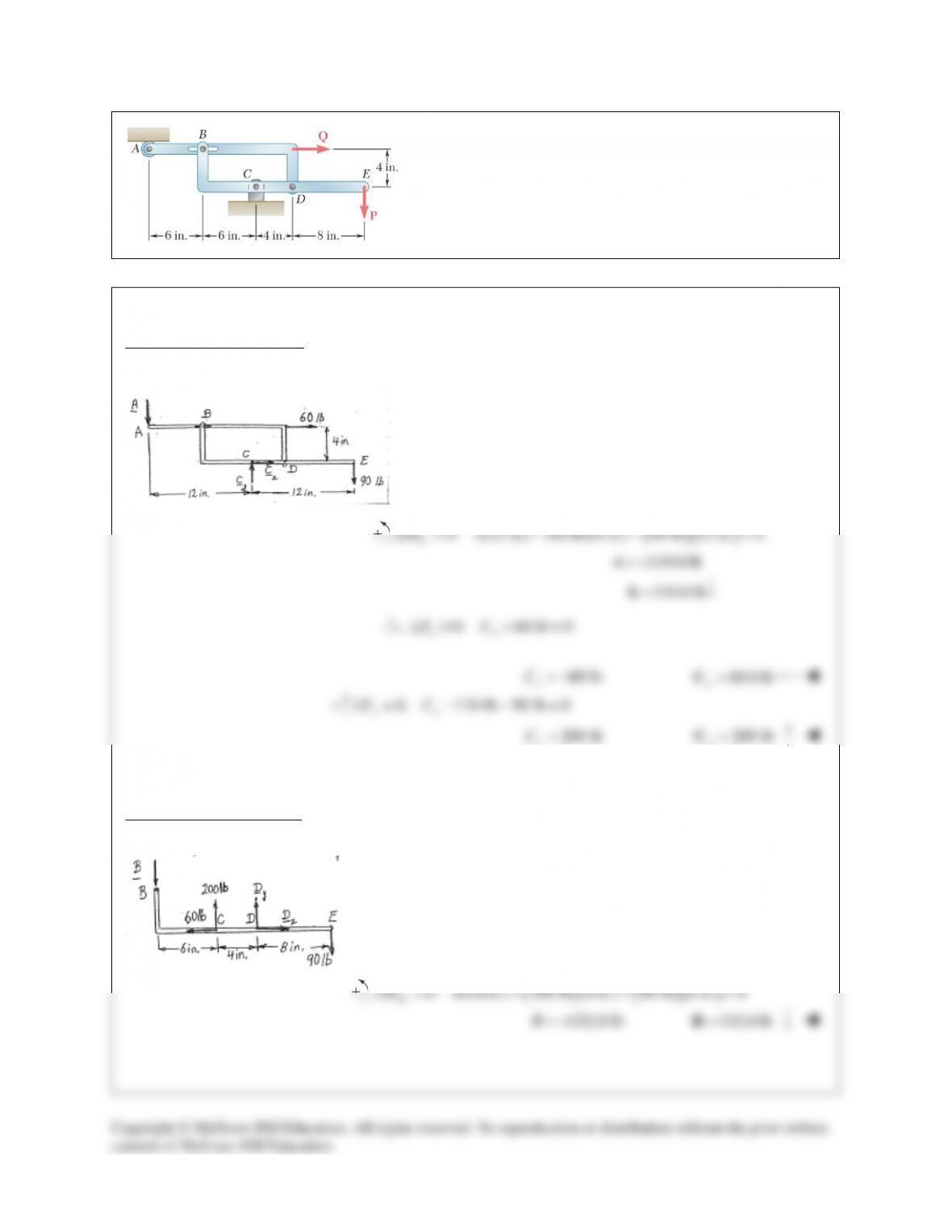
PROBLEM 6.57
Knowing that P = 90 lb and Q = 60 lb, determine the
components of all forces acting on member BCDE of the
assembly shown.
SOLUTION
Free body: Entire assembly:
Free body: Member BCDE:
( )( )
0: (12 in.) (60 lb)(4 in.) 90 lb 12 in. 0
C
MAΣ= − − =
110.0 lbA= +
110.0 lb=A
0: 60 lb 0
xx
FCΣ= + =
60 lb
x
C= −
60.0 lb
x=C
0: 110 lb 90 lb 0
yy
FCΣ= − − =
200 lb
y
C=
200 lb
y=C
( ) ( )( )
0: (10 in.) 200 lb (4 in.) 90 lb 8 in. 0
D
MBΣ= − − =
152.0 lbB= +
152.0 lb=B
Copyright © McGraw–Hill Education. All rights reserved. No reproduction or distribution without the prior written
consent of McGraw–Hill Education.
SOLUTION Continued
60.0 lb
x
=D
0: 60 lb 0
xx
FD
Σ= − =
60.0 lb
x
D=
0: 200 lb 152 lb 90 lb 0
yy
FDΣ= + − − =
42.0 lb
y
D= +
42.0 lb
y
=D
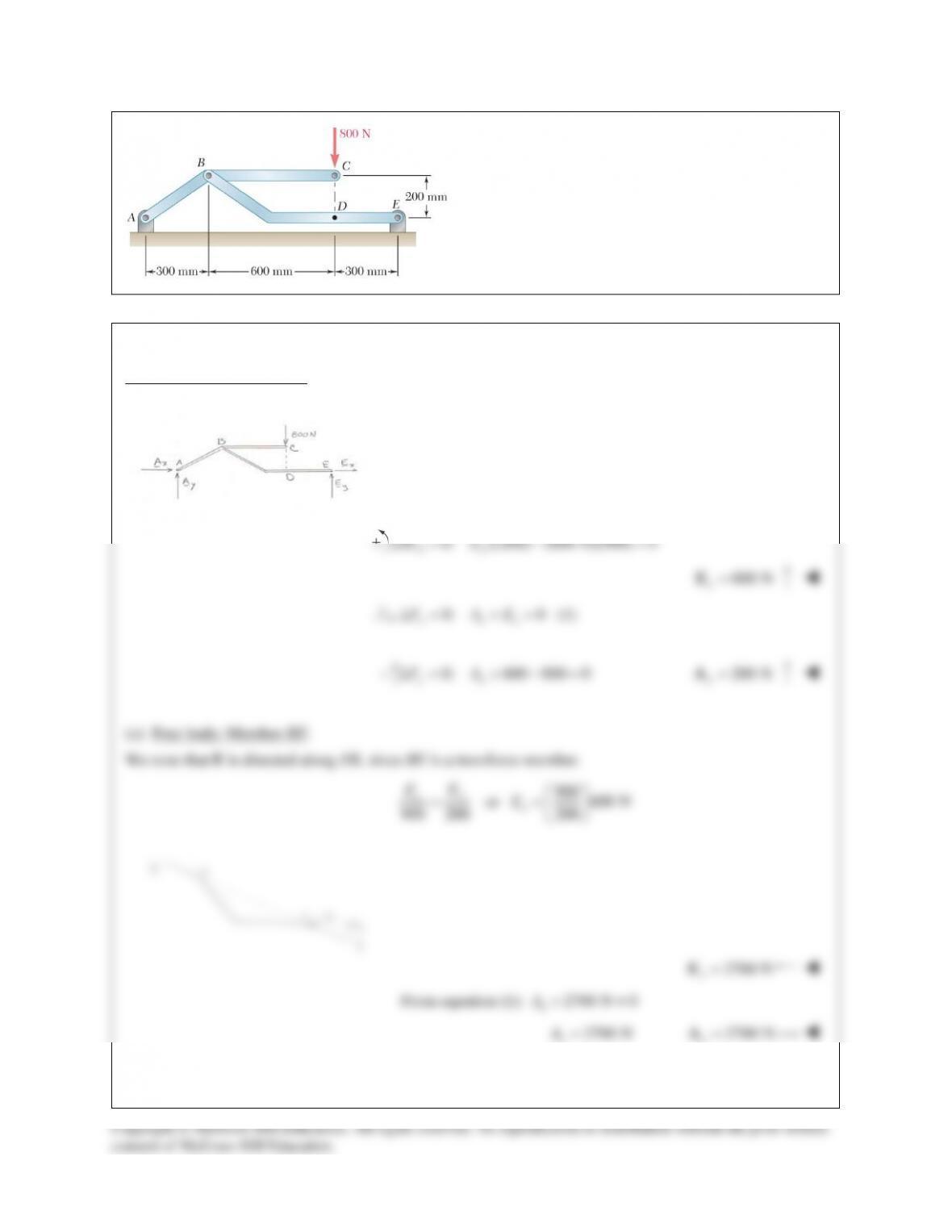
PROBLEM 6.58
Determine the components of the reactions at A and
E, (a) if the 800–N load is applied as shown, (b) if
the 800–N load is moved along its line of action and
is applied at point D.
SOLUTION
Free body: Entire assembly. The analysis is valid for either (a) or (b), since position of the 800–N force
on its line of action is immaterial.
0: (1200) (800 N)(900) 0
Ay
MEΣ= − =
600 N
y=E
0: 0 (1)
x xx
F AE
Σ= + =
0: 600 800 0
yy
FAΣ= + − =
200 N
y=A
(a) Free body: Member BE:
We note that E is directed along EB, since BE is a two–force member.
900
or 600 N
900 200 200
y
xx
E
EE
= =
2700 N
x
=E
From equation (1): 2700 N 0
x
A+=
2700 N
x
A=
2700 N
x
=A
SOLUTION Continued
(b) Free body: Member ABC:
We note that A is directed along AB, since ABC is a two–force member.
300
or 200 N
300 200 200
y
xx
A
AA
= =
300 N
x
=A
From equation (1): 300 N 0
x
E+=
300 N
x
E=
300 N
x
=
E
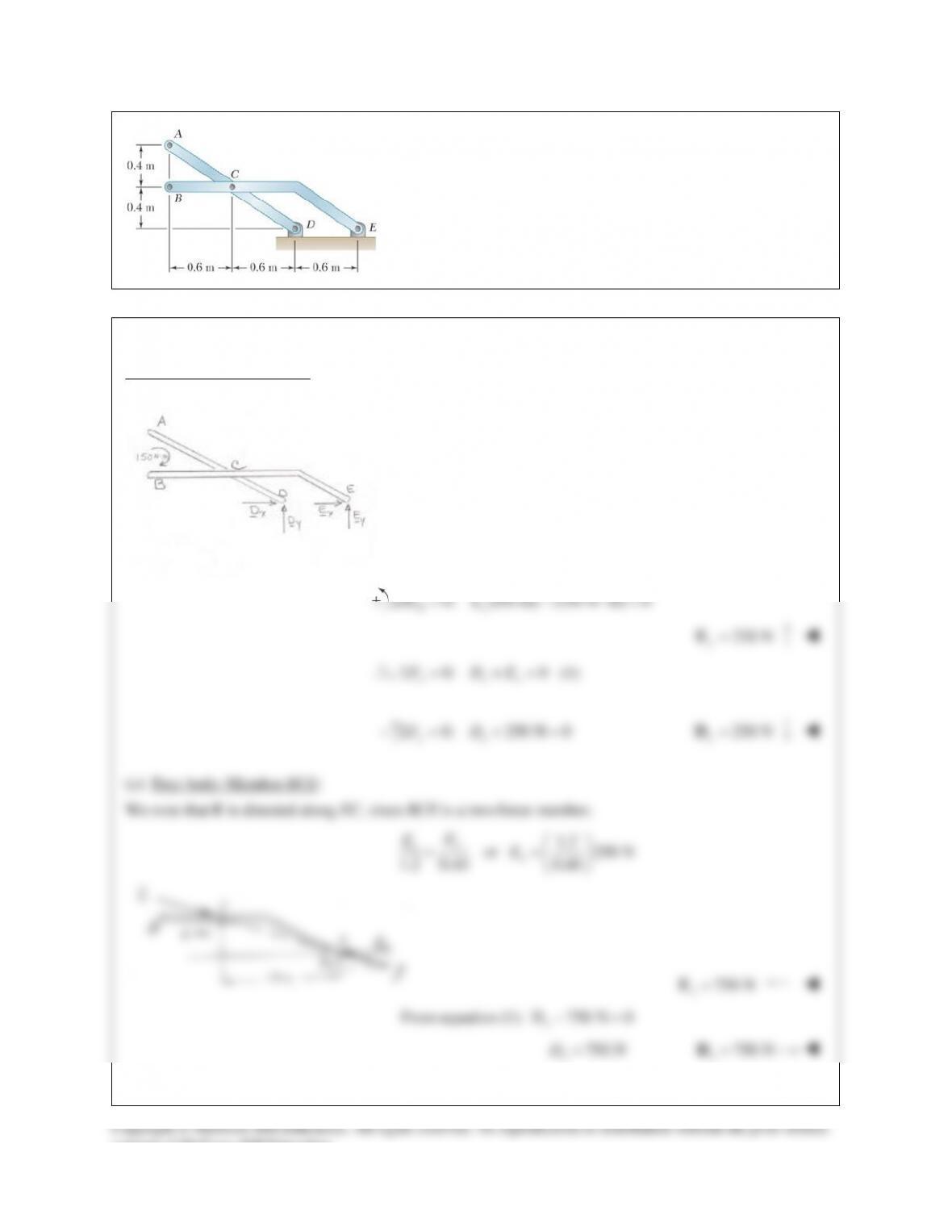
PROBLEM 6.59
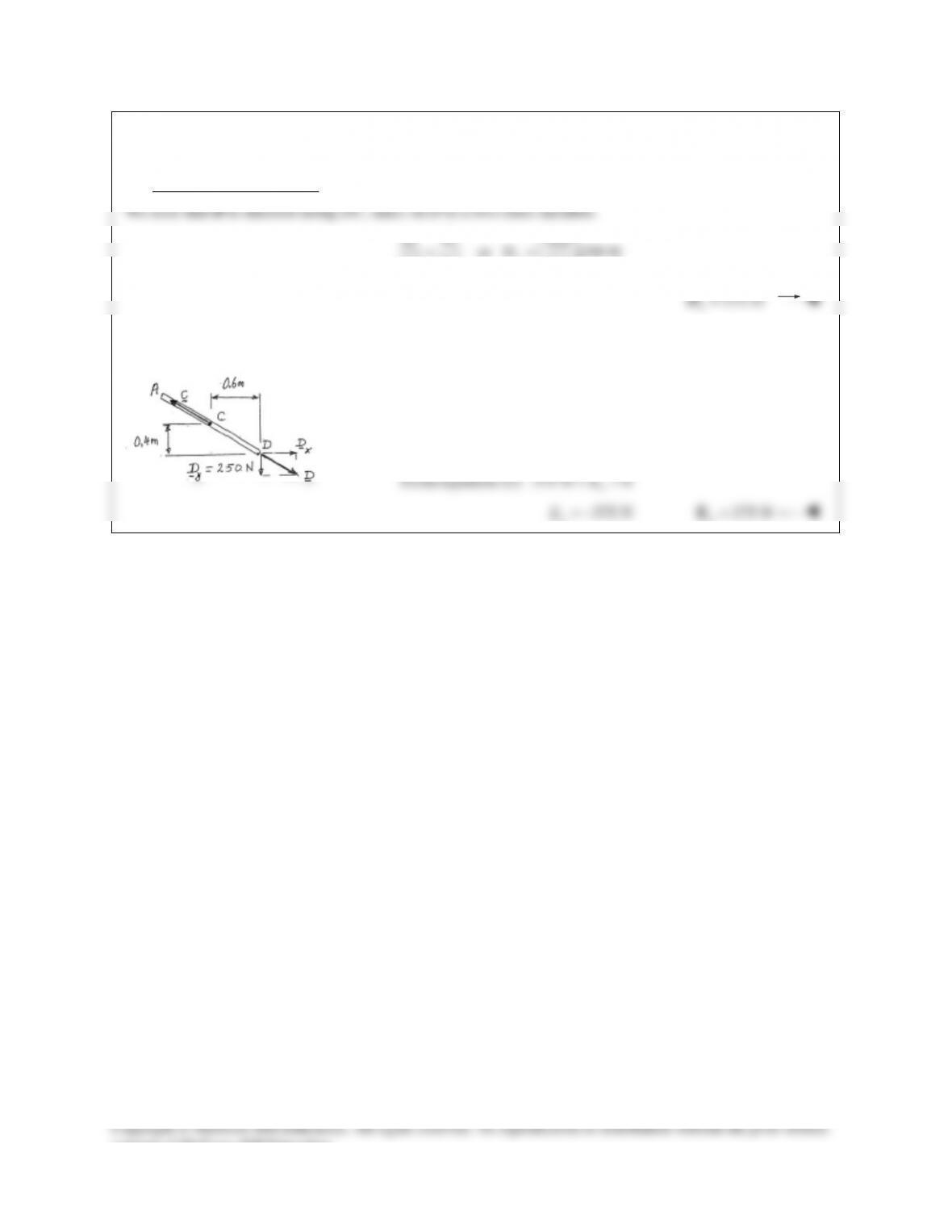
Determine the components of the reactions at D and E if the
frame is loaded by a clockwise couple of magnitude 150 N∙m
applied (a) at A, (b) at B.
SOLUTION
Free body: Entire assembly. The analysis is valid for either (a) or (b), since position of the couple is
immaterial.
0: (0.6 m) (150 N m) 0
Dy
MEΣ = − ⋅=
250 N
y=E
0: 0 (1)
x xx
F DEΣ= + =
0: 250 N 0
yy
FDΣ= + =
250 N
y=D
(a) Free body: Member BCE:
We note that E is directed along EC, since BCE is a two–force member.
1.2
or 250 N
1.2 0.40 0.40
y
xx
E
EE
= =
750 N
x=E
From equation (1): D 750 N 0
x
−=
750 N
x
D=
750 N
x=D
consent of McGraw–Hill Education.
SOLUTION Continued
(b) Free body: Member ACD:
0.6
or D 250 N
0.6 0.4 0.4
y
xx
D
D
= =
375 N
x
=
D
From equation (1): 375 N 0
x
E
+=
375 N
x
E= −
375 N
x
=E
consent of McGraw–Hill Education.
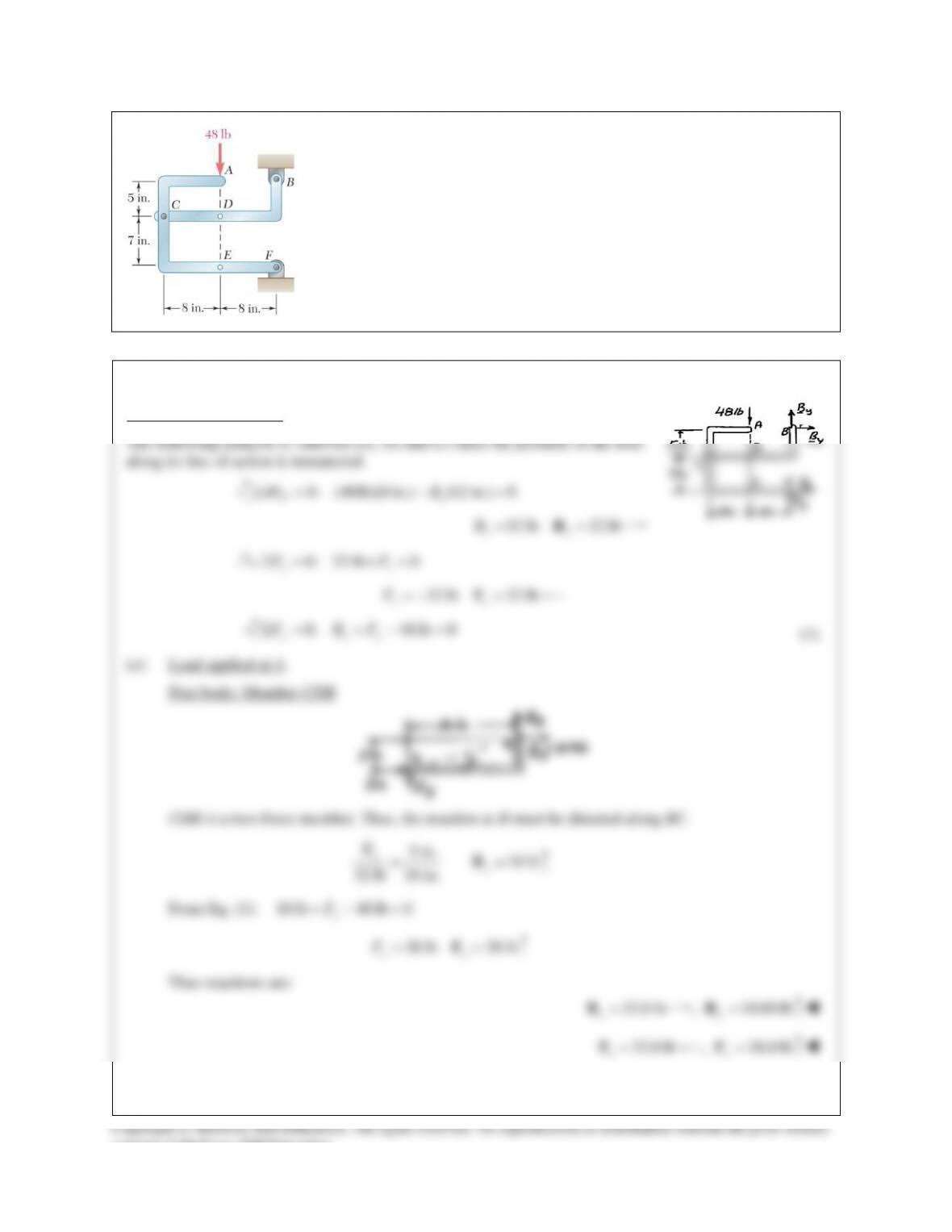
PROBLEM 6.60
The 48–lb load can be moved along the line of action shown and applied at
A, D, or E. Determine the components of the reactions at B and F if the
48-lb load is applied (a) at A, (b) at D, (c) at E.
SOLUTION
Free body: Entire frame
PROBLEM 6.56
Determine the components of the reactions at A and E if a 750–N force
directed vertically downward is applied (a) at B, (b) at D.
SOLUTION
Free–body: Entire frame:
The following analysis is valid for both parts (a) and (b) since position of load on its line of action is immaterial.
0: (750 N)(240 mm) (400 mm) 0
Ex
MAΣ= − − =
450 N 450 N
xx
A=−=A
0: 450 N 0 450 N 450 N
xx x x
FE EΣ= − = = =E
0: 750 N 0
y yy
F AEΣ= + − =
(1)
(a) Load applied at B.
Free body: Member CE:
240 mm ; 225 N
450 N 480 mm
yy
E= =E
From Eq. (1):
225 750 0; 525 N
yy
A+−= =A
Thus, reactions are
450 N
x
=
A
,
525 N
y=A
450N
x
=
E
,
225 N
y=E
(b) Load applied at D.
Free body: Member AC:
160 mm 150.0 N
450 N 480 mm
yy
A= =A
From Eq. (1):
750 N 0
150 N 750 N 0
yy
y
AE
E
+− =
+− =
600 N 600 N
yy
E= =E
Thus, reactions are
450 N
x
=A
,
150.0 N
y
=A
450 N
x=E
,
600 N
y=E
consent of McGraw–Hill Education.
SOLUTION Continued
From Eq. (1):
750 N 0
150 N 750 N 0
yy
y
AE
E
+− =
+− =
600 N 600 N
yy
E= =E
Thus, reactions are
300 N
x=A
,
150.0 N
y=A
300 N
x=E
,
600 N
y=E
consent of McGraw–Hill Education.
PROBLEM 6.57
Knowing that P = 90 lb and Q = 60 lb, determine the
components of all forces acting on member BCDE of the
assembly shown.
SOLUTION
Free body: Entire assembly:
Free body: Member BCDE:
( )( )
0: (12 in.) (60 lb)(4 in.) 90 lb 12 in. 0
C
MAΣ= − − =
110.0 lbA= +
110.0 lb=A
0: 60 lb 0
xx
FCΣ= + =
60 lb
x
C= −
60.0 lb
x=C
0: 110 lb 90 lb 0
yy
FCΣ= − − =
200 lb
y
C=
200 lb
y=C
( ) ( )( )
0: (10 in.) 200 lb (4 in.) 90 lb 8 in. 0
D
MBΣ= − − =
152.0 lbB= +
152.0 lb=B
Copyright © McGraw–Hill Education. All rights reserved. No reproduction or distribution without the prior written
consent of McGraw–Hill Education.
SOLUTION Continued
60.0 lb
x
=D
0: 60 lb 0
xx
FD
Σ= − =
60.0 lb
x
D=
0: 200 lb 152 lb 90 lb 0
yy
FDΣ= + − − =
42.0 lb
y
D= +
42.0 lb
y
=D
PROBLEM 6.58
Determine the components of the reactions at A and
E, (a) if the 800–N load is applied as shown, (b) if
the 800–N load is moved along its line of action and
is applied at point D.
SOLUTION
Free body: Entire assembly. The analysis is valid for either (a) or (b), since position of the 800–N force
on its line of action is immaterial.
0: (1200) (800 N)(900) 0
Ay
MEΣ= − =
600 N
y=E
0: 0 (1)
x xx
F AE
Σ= + =
0: 600 800 0
yy
FAΣ= + − =
200 N
y=A
(a) Free body: Member BE:
We note that E is directed along EB, since BE is a two–force member.
900
or 600 N
900 200 200
y
xx
E
EE
= =
2700 N
x
=E
From equation (1): 2700 N 0
x
A+=
2700 N
x
A=
2700 N
x
=A
SOLUTION Continued
(b) Free body: Member ABC:
We note that A is directed along AB, since ABC is a two–force member.
300
or 200 N
300 200 200
y
xx
A
AA
= =
300 N
x
=A
From equation (1): 300 N 0
x
E+=
300 N
x
E=
300 N
x
=
E
PROBLEM 6.59
Determine the components of the reactions at D and E if the
frame is loaded by a clockwise couple of magnitude 150 N∙m
applied (a) at A, (b) at B.
SOLUTION
Free body: Entire assembly. The analysis is valid for either (a) or (b), since position of the couple is
immaterial.
0: (0.6 m) (150 N m) 0
Dy
MEΣ = − ⋅=
250 N
y=E
0: 0 (1)
x xx
F DEΣ= + =
0: 250 N 0
yy
FDΣ= + =
250 N
y=D
(a) Free body: Member BCE:
We note that E is directed along EC, since BCE is a two–force member.
1.2
or 250 N
1.2 0.40 0.40
y
xx
E
EE
= =
750 N
x=E
From equation (1): D 750 N 0
x
−=
750 N
x
D=
750 N
x=D
consent of McGraw–Hill Education.
SOLUTION Continued
(b) Free body: Member ACD:
0.6
or D 250 N
0.6 0.4 0.4
y
xx
D
D
= =
375 N
x
=
D
From equation (1): 375 N 0
x
E
+=
375 N
x
E= −
375 N
x
=E
consent of McGraw–Hill Education.
PROBLEM 6.60
The 48–lb load can be moved along the line of action shown and applied at
A, D, or E. Determine the components of the reactions at B and F if the
48-lb load is applied (a) at A, (b) at D, (c) at E.
SOLUTION
Free body: Entire frame