
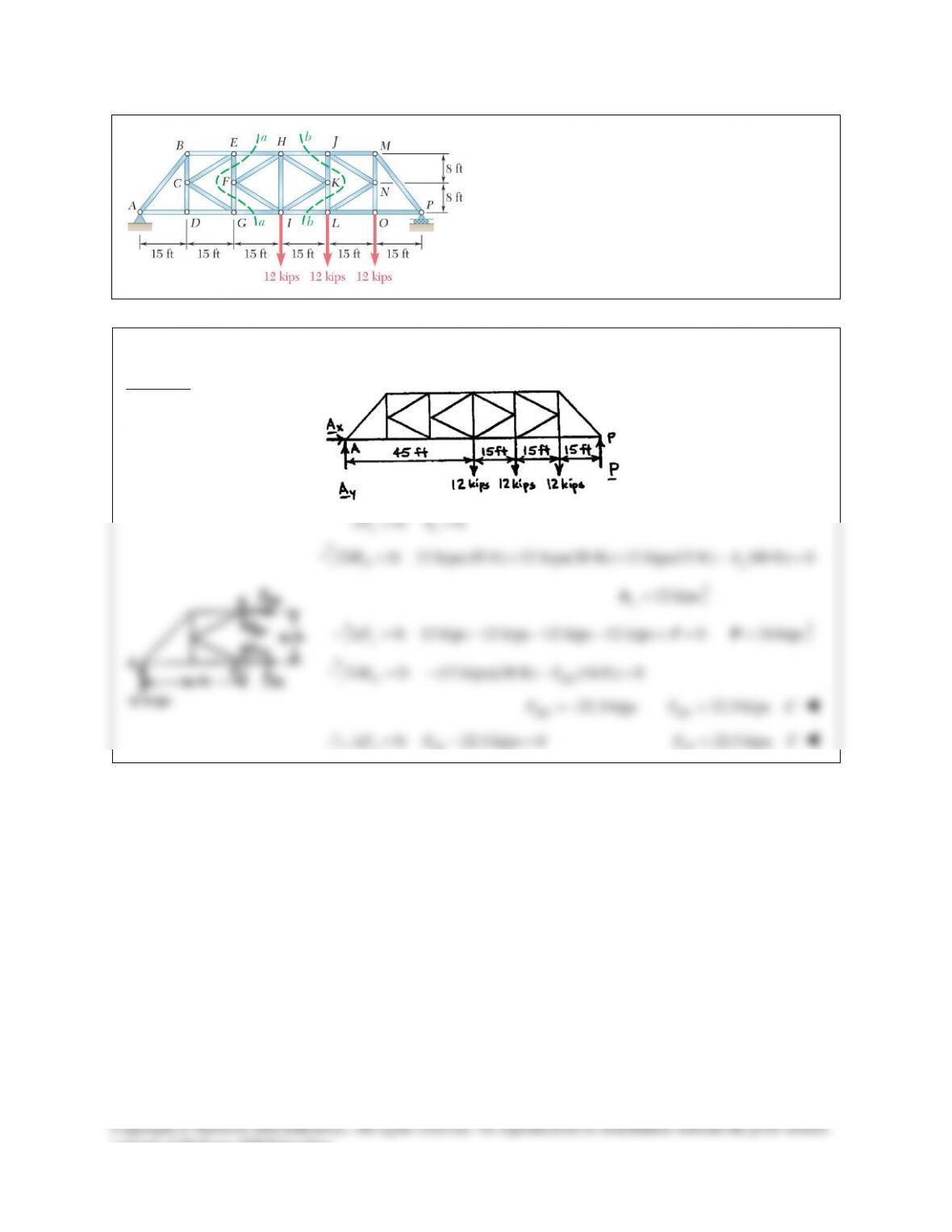
PROBLEM 6.99
Determine the force in members EH and GI of the
truss shown. (Hint: Use section aa.)
SOLUTION
Reactions:
0: 0
xx
FAΣ= =
0: 12 kips(45 ft) 12 kips(30 ft) 12 kips(15 ft) (90 ft) 0
Py
MAΣ= + + − =
12 kips
y=A
0: 12 kips 12 kips 12 kips 12 kips 0
y
FPΣ= −−−+=
24 kips=P
0: (12 kips)(30 ft) (16 ft) 0
G EH
MFΣ=− − =
22.5 kips
EH
F= −
22.5 kips
EH
FC=
0: 22.5 kips 0
x GI
FFΣ= − =
22.5 kips
GI
FT=
consent of McGraw–Hill Education.
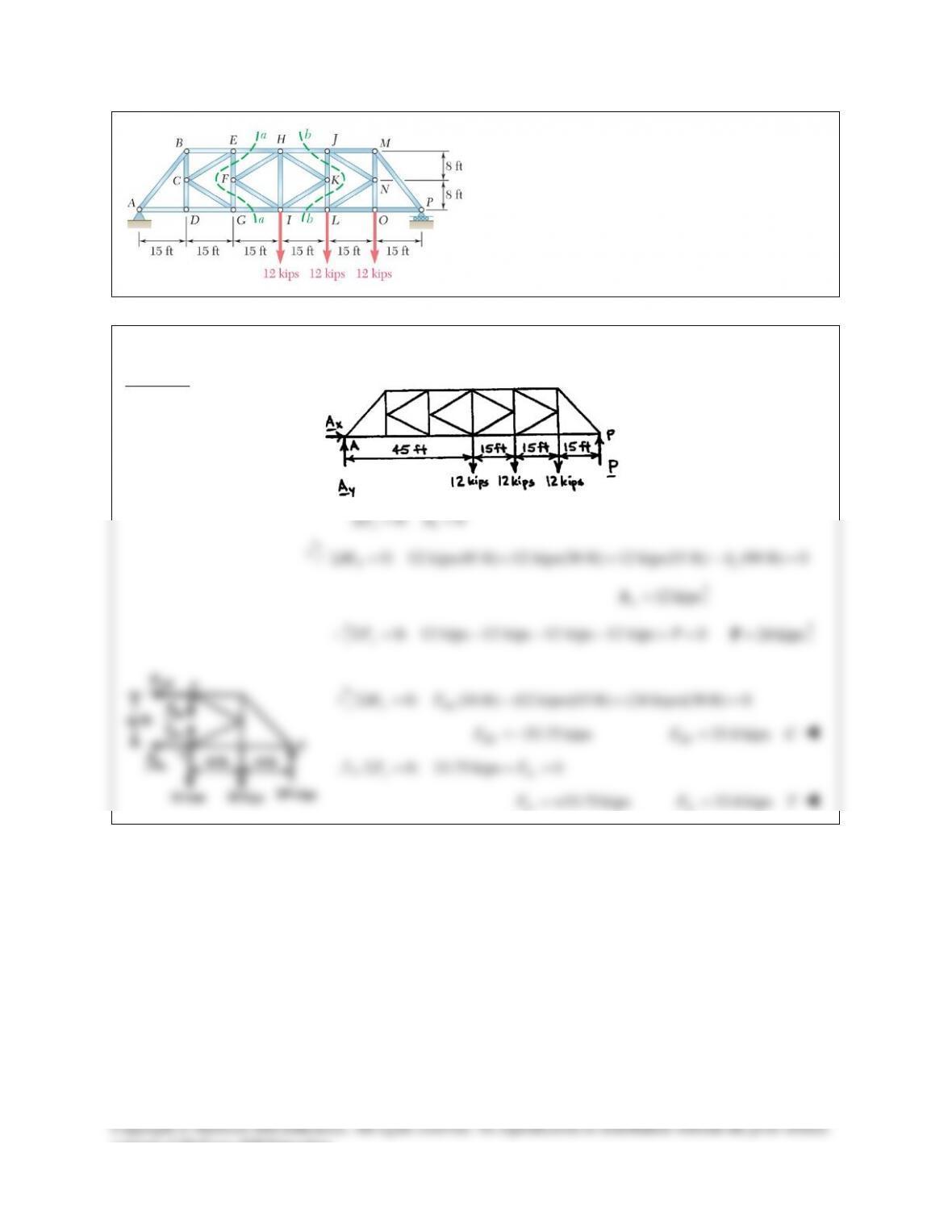
PROBLEM 6.100
Determine the force in members HJ and IL of the
truss shown. (Hint: Use section bb.)
SOLUTION
Reactions:
0: 0
xx
FAΣ= =
0: 12 kips(45 ft) 12 kips(30 ft) 12 kips(15 ft) (90 ft) 0
Py
MAΣ= + + − =
12 kips
y=A
0: 12 kips 12 kips 12 kips 12 kips 0
y
FPΣ= −−−+=
24 kips=P
0: (16 ft) (12 kips)(15 ft) (24 kips)(30 ft) 0
L HJ
MFΣ= − + =
33.75 kips
HJ
F= −
33.8 kips
HJ
FC=
0: 33.75 kips 0
x IL
FFΣ= − =
33.75 kips
IL
F= +
33.8 kips
IL
FT=
consent of McGraw–Hill Education.

PROBLEM 6.101
The low–bed trailer shown is designed so that the
rear end of the bed can be lowered to ground level
in order to facilitate the loading of equipment or
wrecked vehicles. A 1400–kg vehicle has been
hauled to the position shown by a winch; the
trailer is then returned to a traveling position
where α = 0 and both AB and BE are horizontal.
Considering only the weight of the disabled
automobile, determine the force that must be
exerted by the hydraulic cylinder to maintain a
position with α = 0.
SOLUTION
Free Body: Trailer & Car
W = (1400 kg)(9.81 m/s2) = 13.734 kN
α =0
0: (6 m) (13.734 kN)(3.5 m) 0
A
ME
=−=
∑
E = +8.012 kN E =8.012 kN
consent of McGraw–Hill Education.

PROBLEM 6.102
The axis of the three–hinge arch ABC is a
parabola with the vertex at B. Knowing that
P = 112 kN and Q = 140 kN, determine (a) the
components of the reaction at A, (b) the
components of the force exerted at B on
segment AB.
SOLUTION
Free body: Segment AB:
(1)
0.75 (Eq. 1): (2)
Free body: Segment BC:
(3)
Add Eqs. (2) and (3):
(4)
From Eq. (1):
(5)
given that
(a) Reaction at A.
Considering again AB as a free body,
0: (3.2 m) (8 m) (5 m) 0
Ax y
MB B PΣ= − − =
(2.4 m) (6 m) (3.75 m) 0
xy
B BP−− =
0: (1.8 m) (6 m) (3 m) 0
Cx y
MB B QΣ= + − =
4.2 3.75 3 0
x
B PQ− −=
(3.75 3 )/4.2
x
B PQ= +
3.2
(3.75 3 ) 8 5 0
4.2
y
PQ B P+ − −=
( 9 9.6 )/33.6
y
B PQ=−+
112 kN and 140 kN.PQ= =
0: 0; 200 kN
x xx xx
F AB ABΣ= − = = =
200 kN
x
=A
0: 0
y yy
F A PBΣ = −− =
112 kN 10 kN 0
y
A− −=
122 kN
y
A= +
122.0 kN
y=A
consent of McGraw–Hill Education.

SOLUTION Continued
(b) Force exerted at B on AB.
From Eq. (4):
From Eq. (5):
(3.75 112 3 140)/4.2 200 kN
x
B= × +× =
200 kN
x
=B
( 9 112 9.6 140)/33.6 10 kN
y
B=−× + × =+
10.00 kN
y
=B
consent of McGraw–Hill Education.
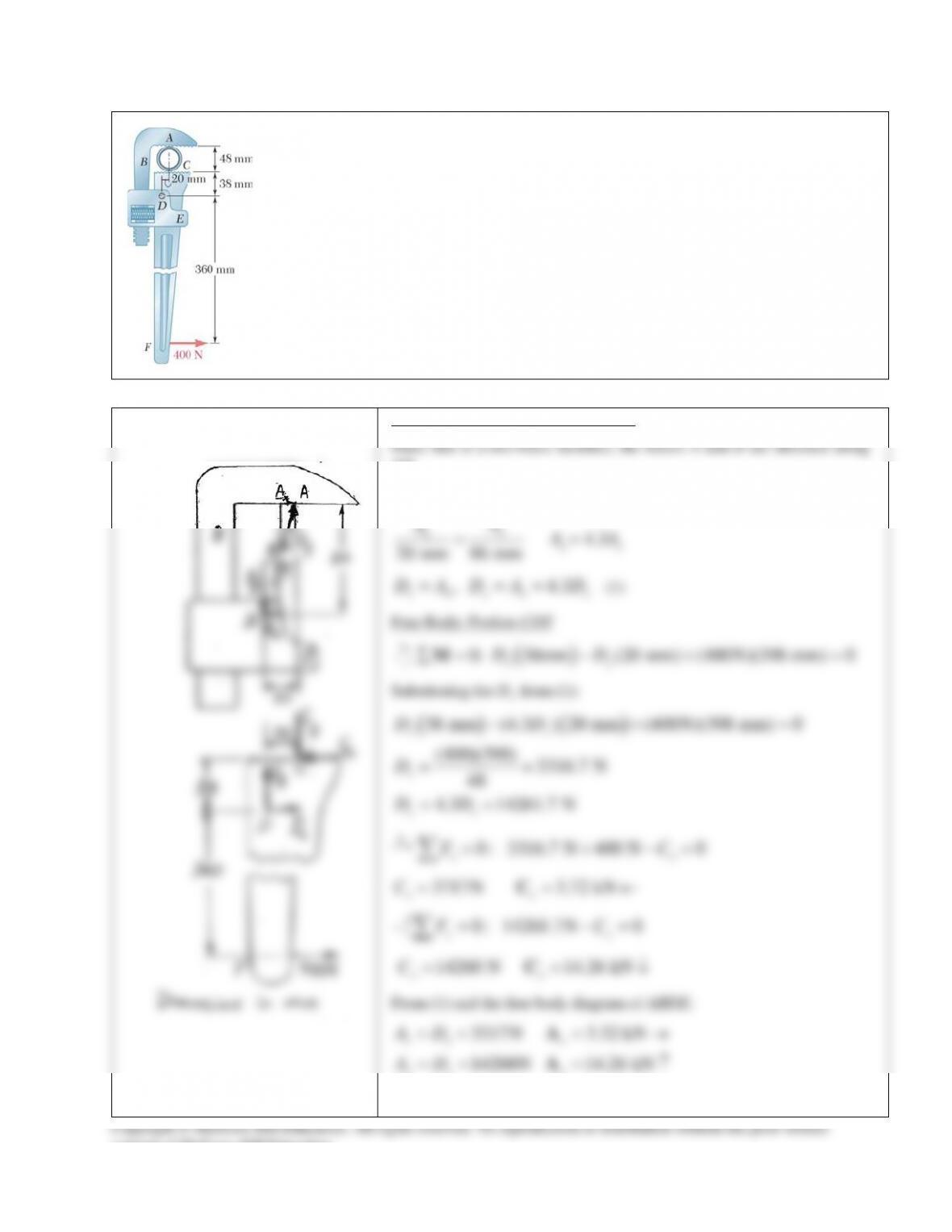
PROBLEM 6.103
A 48–mm–diameter pipe is gripped by Stillson wrench shown.
Portions AB and DE of the wrench are rigidly attached to each other
and portion CF is connected by a pin at D. Assuming that no
slipping occurs between the pipe and the wrench, determine the
components of the forces exerted on the pipe at A and C.
SOLUTION
Free Body: Portion ABDE of Wrench
AD.
We have
= 4.3
20 mm 86 mm
y
xyx
A
AAA=
, 4.3
xxyy x
D AD A D= = =
(1)
Free Body: Portion CDF
( )
0: 38mm (20 mm) (400N)(398 mm) 0
xy
DD∑= − + =M
Substituting for Dy from (1):
( ) ( )
38 mm (4.3 ) 20 mm (400N)(398 mm) 0
(400)(398) 3316.7 N
48
4.3 14261.7 N
xx
x
yx
DD
D
DD
−+ =
= =
= =
0: 3316.7 N 400 N 0
xx
FC= + −=
∑
3717N 3.72 kN
xx
C= = ←C
0: 14261.7N 0
yy
FC= −=
∑
14260 N 14.26 kN
yy
C= = ↓C
From (1) and the free body diagram of ABDE:
3317N 3.32 kN
14260N 14.26 kN
xx x
yy y
AD
AD
= = = →
= = = ↑
A
A
consent of McGraw–Hill Education.

SOLUTION Continued
above:
3.32 kN , 14.26 kN
xy
= ←= ↓AA
3.72 kN , 14.26 kN
xy
= →= ↑CC
reactions R and M as shown.
consent of McGraw–Hill Education.
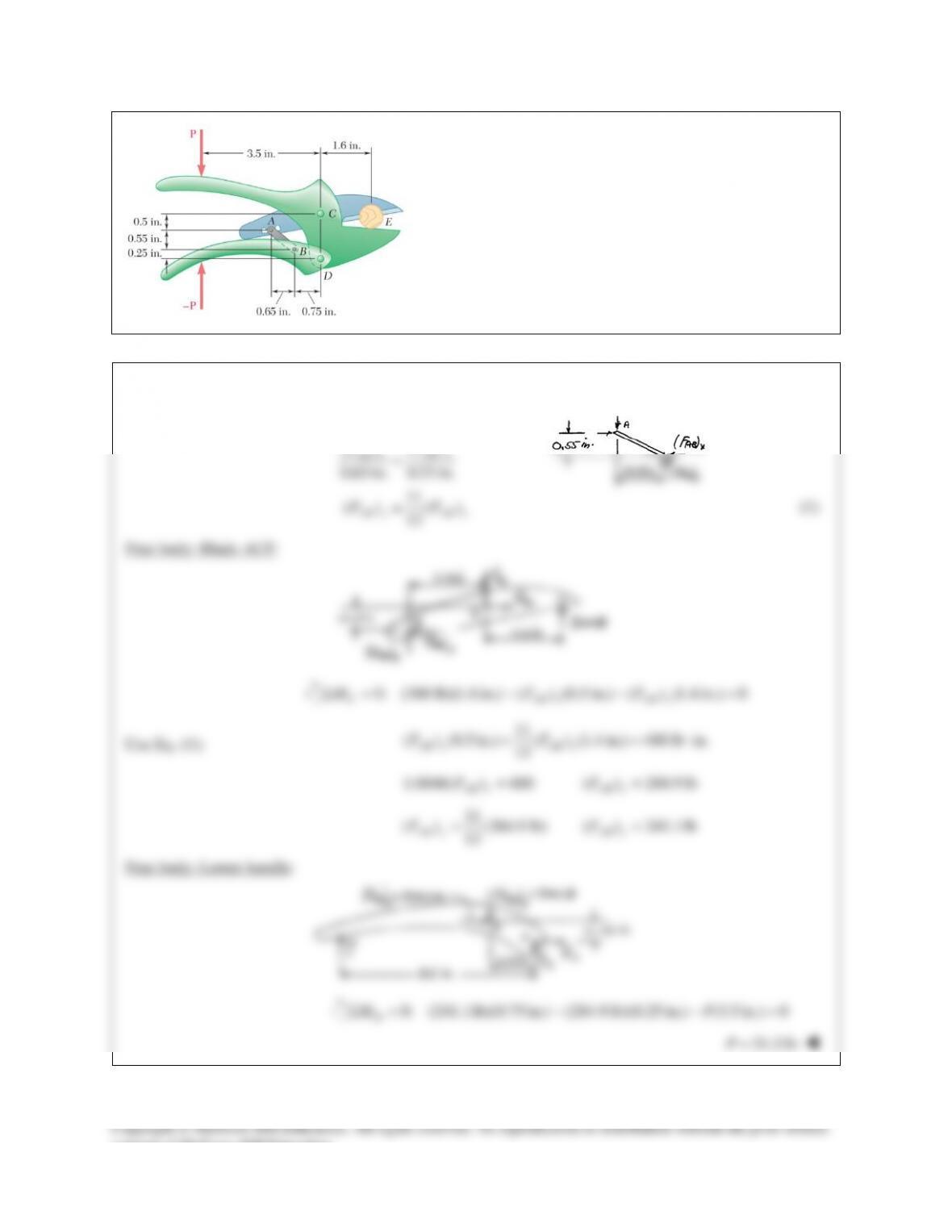
PROBLEM 6.104
The compound–lever pruning shears shown can be
adjusted by placing pin A at various ratchet positions on
blade ACE. Knowing that 300–lb vertical forces are
required to complete the pruning of a small branch,
determine the magnitude P of the forces that must be
applied to the handles when the shears are adjusted as
shown.
SOLUTION
We note that AB is a two–force member.
()
()
0.65 in. 0.55 in.
11
() ()
13
AB y
AB x
AB y AB x
F
F
FF
=
=
(1)
Free body: Blade ACE:
0: (300 lb)(1.6 in.) ( ) (0.5 in.) ( ) (1.4 in.) 0
C AB x AB y
M FFΣ= − − =
Use Eq. (1):
11
( ) (0.5 in.) ( ) (1.4 in.) 480 lb in.
13
AB x AB x
FF+=⋅
1.6846( ) 480
AB x
F=
( ) 284.9 lb
AB x
F=
11
( ) (284.9 lb)
13
AB y
F=
( ) 241.1lb
AB y
F=
Free body: Lower handle:
0: (241.1lb)(0.75 in.) (284.9 lb)(0.25 in.) (3.5 in.) 0
D
MPΣ= − − =
31.3 lbP=
consent of McGraw–Hill Education.

PROBLEM 6.105
A log weighing 800 lb is lifted by a pair of tongs as shown.
Determine the forces exerted at E and F on tong DEF.
SOLUTION
consent of McGraw–Hill Education.
PROBLEM 6.99
Determine the force in members EH and GI of the
truss shown. (Hint: Use section aa.)
SOLUTION
Reactions:
0: 0
xx
FAΣ= =
0: 12 kips(45 ft) 12 kips(30 ft) 12 kips(15 ft) (90 ft) 0
Py
MAΣ= + + − =
12 kips
y=A
0: 12 kips 12 kips 12 kips 12 kips 0
y
FPΣ= −−−+=
24 kips=P
0: (12 kips)(30 ft) (16 ft) 0
G EH
MFΣ=− − =
22.5 kips
EH
F= −
22.5 kips
EH
FC=
0: 22.5 kips 0
x GI
FFΣ= − =
22.5 kips
GI
FT=
consent of McGraw–Hill Education.
PROBLEM 6.100
Determine the force in members HJ and IL of the
truss shown. (Hint: Use section bb.)
SOLUTION
Reactions:
0: 0
xx
FAΣ= =
0: 12 kips(45 ft) 12 kips(30 ft) 12 kips(15 ft) (90 ft) 0
Py
MAΣ= + + − =
12 kips
y=A
0: 12 kips 12 kips 12 kips 12 kips 0
y
FPΣ= −−−+=
24 kips=P
0: (16 ft) (12 kips)(15 ft) (24 kips)(30 ft) 0
L HJ
MFΣ= − + =
33.75 kips
HJ
F= −
33.8 kips
HJ
FC=
0: 33.75 kips 0
x IL
FFΣ= − =
33.75 kips
IL
F= +
33.8 kips
IL
FT=
consent of McGraw–Hill Education.
PROBLEM 6.101
The low–bed trailer shown is designed so that the
rear end of the bed can be lowered to ground level
in order to facilitate the loading of equipment or
wrecked vehicles. A 1400–kg vehicle has been
hauled to the position shown by a winch; the
trailer is then returned to a traveling position
where α = 0 and both AB and BE are horizontal.
Considering only the weight of the disabled
automobile, determine the force that must be
exerted by the hydraulic cylinder to maintain a
position with α = 0.
SOLUTION
Free Body: Trailer & Car
W = (1400 kg)(9.81 m/s2) = 13.734 kN
α =0
0: (6 m) (13.734 kN)(3.5 m) 0
A
ME
=−=
∑
E = +8.012 kN E =8.012 kN
consent of McGraw–Hill Education.
PROBLEM 6.102
The axis of the three–hinge arch ABC is a
parabola with the vertex at B. Knowing that
P = 112 kN and Q = 140 kN, determine (a) the
components of the reaction at A, (b) the
components of the force exerted at B on
segment AB.
SOLUTION
Free body: Segment AB:
(1)
0.75 (Eq. 1): (2)
Free body: Segment BC:
(3)
Add Eqs. (2) and (3):
(4)
From Eq. (1):
(5)
given that
(a) Reaction at A.
Considering again AB as a free body,
0: (3.2 m) (8 m) (5 m) 0
Ax y
MB B PΣ= − − =
(2.4 m) (6 m) (3.75 m) 0
xy
B BP−− =
0: (1.8 m) (6 m) (3 m) 0
Cx y
MB B QΣ= + − =
4.2 3.75 3 0
x
B PQ− −=
(3.75 3 )/4.2
x
B PQ= +
3.2
(3.75 3 ) 8 5 0
4.2
y
PQ B P+ − −=
( 9 9.6 )/33.6
y
B PQ=−+
112 kN and 140 kN.PQ= =
0: 0; 200 kN
x xx xx
F AB ABΣ= − = = =
200 kN
x
=A
0: 0
y yy
F A PBΣ = −− =
112 kN 10 kN 0
y
A− −=
122 kN
y
A= +
122.0 kN
y=A
consent of McGraw–Hill Education.
SOLUTION Continued
(b) Force exerted at B on AB.
From Eq. (4):
From Eq. (5):
(3.75 112 3 140)/4.2 200 kN
x
B= × +× =
200 kN
x
=B
( 9 112 9.6 140)/33.6 10 kN
y
B=−× + × =+
10.00 kN
y
=B
consent of McGraw–Hill Education.
PROBLEM 6.103
A 48–mm–diameter pipe is gripped by Stillson wrench shown.
Portions AB and DE of the wrench are rigidly attached to each other
and portion CF is connected by a pin at D. Assuming that no
slipping occurs between the pipe and the wrench, determine the
components of the forces exerted on the pipe at A and C.
SOLUTION
Free Body: Portion ABDE of Wrench
AD.
We have
= 4.3
20 mm 86 mm
y
xyx
A
AAA=
, 4.3
xxyy x
D AD A D= = =
(1)
Free Body: Portion CDF
( )
0: 38mm (20 mm) (400N)(398 mm) 0
xy
DD∑= − + =M
Substituting for Dy from (1):
( ) ( )
38 mm (4.3 ) 20 mm (400N)(398 mm) 0
(400)(398) 3316.7 N
48
4.3 14261.7 N
xx
x
yx
DD
D
DD
−+ =
= =
= =
0: 3316.7 N 400 N 0
xx
FC= + −=
∑
3717N 3.72 kN
xx
C= = ←C
0: 14261.7N 0
yy
FC= −=
∑
14260 N 14.26 kN
yy
C= = ↓C
From (1) and the free body diagram of ABDE:
3317N 3.32 kN
14260N 14.26 kN
xx x
yy y
AD
AD
= = = →
= = = ↑
A
A
consent of McGraw–Hill Education.
SOLUTION Continued
above:
3.32 kN , 14.26 kN
xy
= ←= ↓AA
3.72 kN , 14.26 kN
xy
= →= ↑CC
reactions R and M as shown.
consent of McGraw–Hill Education.
PROBLEM 6.104
The compound–lever pruning shears shown can be
adjusted by placing pin A at various ratchet positions on
blade ACE. Knowing that 300–lb vertical forces are
required to complete the pruning of a small branch,
determine the magnitude P of the forces that must be
applied to the handles when the shears are adjusted as
shown.
SOLUTION
We note that AB is a two–force member.
()
()
0.65 in. 0.55 in.
11
() ()
13
AB y
AB x
AB y AB x
F
F
FF
=
=
(1)
Free body: Blade ACE:
0: (300 lb)(1.6 in.) ( ) (0.5 in.) ( ) (1.4 in.) 0
C AB x AB y
M FFΣ= − − =
Use Eq. (1):
11
( ) (0.5 in.) ( ) (1.4 in.) 480 lb in.
13
AB x AB x
FF+=⋅
1.6846( ) 480
AB x
F=
( ) 284.9 lb
AB x
F=
11
( ) (284.9 lb)
13
AB y
F=
( ) 241.1lb
AB y
F=
Free body: Lower handle:
0: (241.1lb)(0.75 in.) (284.9 lb)(0.25 in.) (3.5 in.) 0
D
MPΣ= − − =
31.3 lbP=
consent of McGraw–Hill Education.
PROBLEM 6.105
A log weighing 800 lb is lifted by a pair of tongs as shown.
Determine the forces exerted at E and F on tong DEF.
SOLUTION
consent of McGraw–Hill Education.