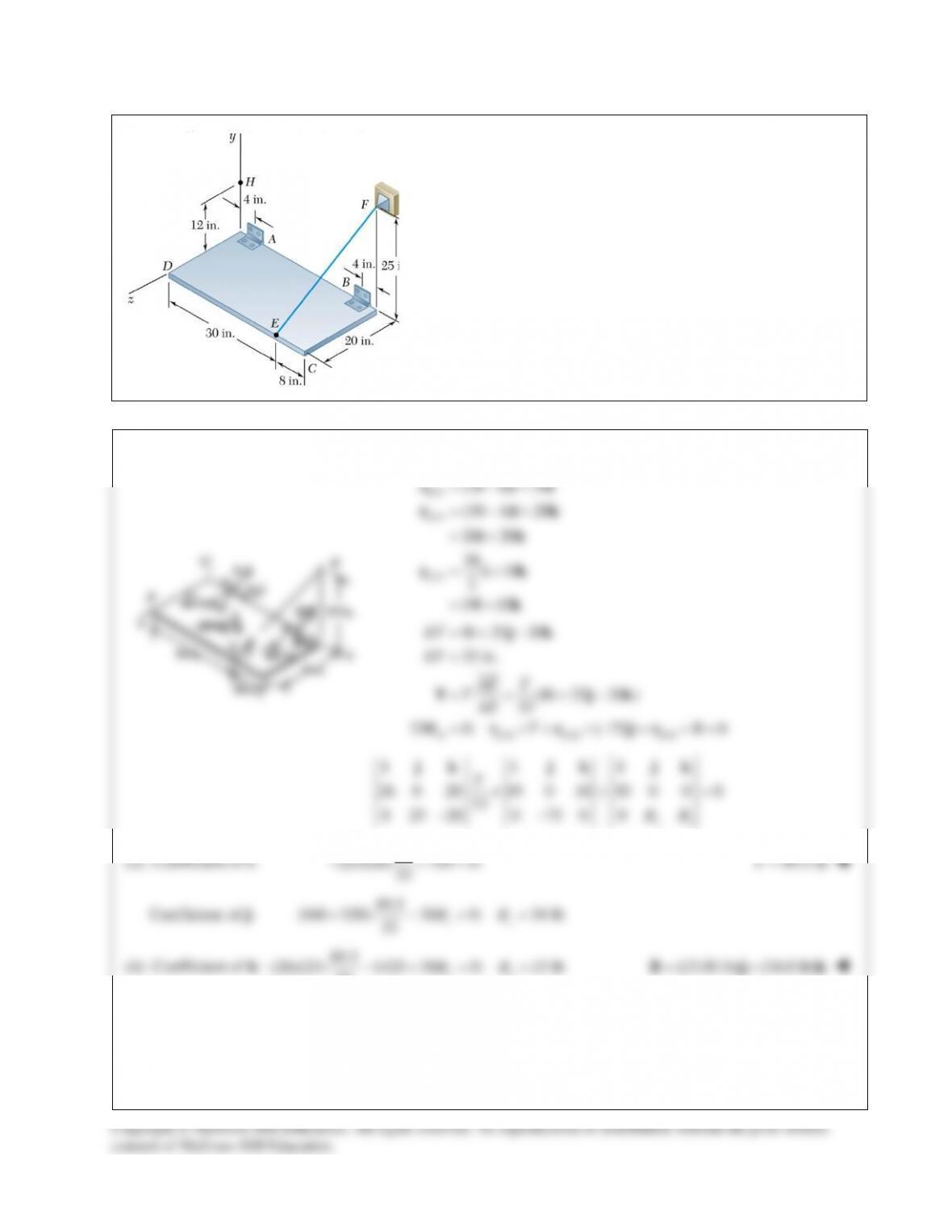
PROBLEM 4.67
The rectangular plate shown weighs 75 lb and is held in the
position shown by hinges at A and B and by cable EF. Assuming
that the hinge at B does not exert any axial thrust, determine
(a) the tension in the cable, (b) the reactions at A and B.
SOLUTION
/
/
/
// /
(38 8) 30
(30 4) 20
26 20
38 10
2
19 10
8 25 20
33 in.
(8 25 20 )
33
0: ( 75 ) 0
BA
EA
GA
A EA GA BA
EF
EF
AE T
TAE TB
= −=
= −+
= +
= +
= +
=+−
=
= = +−
Σ = × + ×− + × =
r ii
r ik
ik
r ik
ik
ijk
T ijk
M r r jr
FFF
FFF
26 0 20 19 0 10 30 0 0 0
33
8 25 20 0 75 0 0
yz
T
BB
++=
−−
i j k i jk i jk
(a) Coefficient of i:
(25)(20) 750 0:
33
T
− +=
49.5 lbT=
Coefficient of j:
49.5
(160 520) 30 0: 34 lb
33
zz
BB
+ −= =
(b) Coefficient of k:
49.5
(26)(25) 1425 30 0: 15 lb
yy
BB−+ = =
(15.00 lb) (34.0 lb)= +B jk
SOLUTION Continued
0: (75 lb) 0Σ= + + − =F ABT j
Coefficient of i:
8(49.5) 0 12.00 lb
33
xx
AA+==−
Coefficient of j:
25
15 (49.5) 75 0 22.5 lb
33
yy
AA++ −= =
Coefficient of k:
20
34 (49.5) 0 4.00 lb
33
zz
AA+− = =−
(12.00 lb) (22.5 lb) (4.00 lb)=− +−A ijk
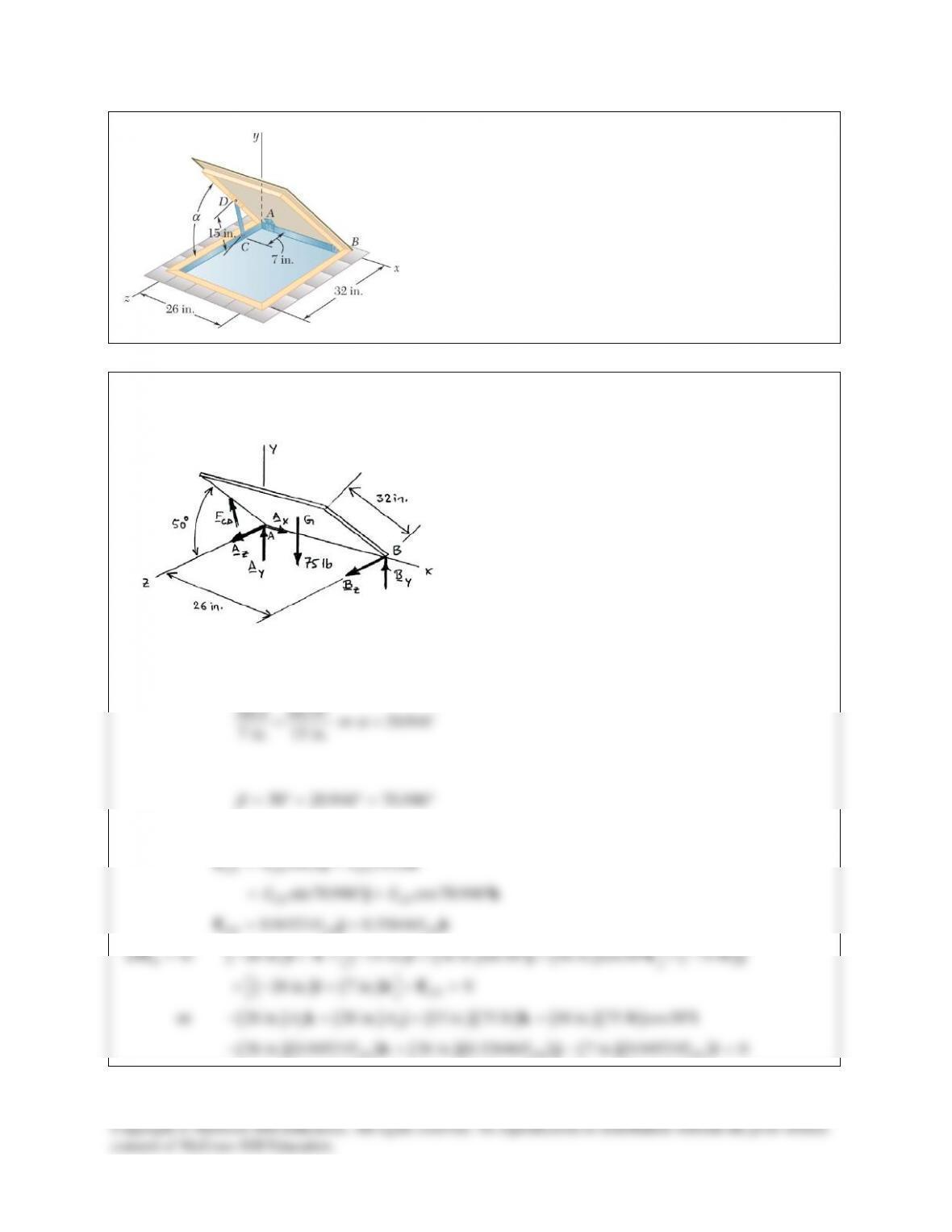
PROBLEM 4.68
The lid of a roof scuttle weighs 75 lb. It is hinged at corners
A and B and maintained in the desired position by a rod CD
pivoted at C; a pin at end D of the rod fits into one of several
holes drilled in the edge of the lid. For the position shown,
determine (a) the magnitude of the force exerted by rod CD,
(b) the reactions at the hinges. Assume that the hinge at B
does not exert any axial thrust.
SOLUTION
Free–Body Diagram:
Geometry:
Using triangle ACD and the law of sines
sin sin50 or 20.946
7 in. 15 in.
αα
= =
20.946 70.946
β
= 50° + ° = °
Expressing
CD
F
in terms of its rectangular coordinates:
sin cos
CD CD CD
FF
ββ
= +F jk
sin70.946 cos70.946
CD CD
FF= °+ °jk
0.94521 0.32646
CD CD CD
FF= +F jk
( ) ( ) ( ) ( ) ( )
0: 26 in. 13 in. 16 in. sin50 16 in. cos50 75 lb
B
Σ = − × + − + °+ ° ×−
M iA i j k j
( ) ( )
26 in. 7 in. 0
CD
+− + × =
i kF
or
( ) ( ) ( )( ) ( )( )
26 in. 26 in. 13 in. 75 lb 16 in. 75 lb cos50
yz
AA−++ + °kj k i
( )
( )
( )
( )
( )
( )
26 in. 0.94521 26 in. 0.32646 7 in. 0.94521 0
CD CD CD
F FF− + −=k ji
SOLUTION Continued
(a) Setting the coefficients of the unit vectors to zero:
( ) ( )
( )
( )
: 75 lb 16 in. cos50 0.94521 7 in. 0
CD
F
°− =
i
116.6 lb
CD
F=
(b)
0: 0
xx
FAΣ= =
( ) ( ) ( )( ) ( )
: 0.94521 116.580 lb 26 in. 75 lb 13 in. 26 in. 0
y
A
− + −=
k
72.693 lb
y
A= −
( ) ( ) ( )
: 0.32646 116.580 lb 26 in. 26 in. 0
z
A
+=
j
38.059 lb
z
A= −
( )
0: 72.693 lb 0.94521 116.580 lb 75 lb 0
yy
FBΣ= − + − + =
37.500 lb
y
B=
( )
0: 38.059 lb 0.32646 116.580 lb 0
zz
FBΣ= − + + =
0
z
B=
Therefore:
( ) ( )
72.7 lb 38.1 lb=−−A jk
( )
37.5 lb=Bj
PROBLEM 4.69
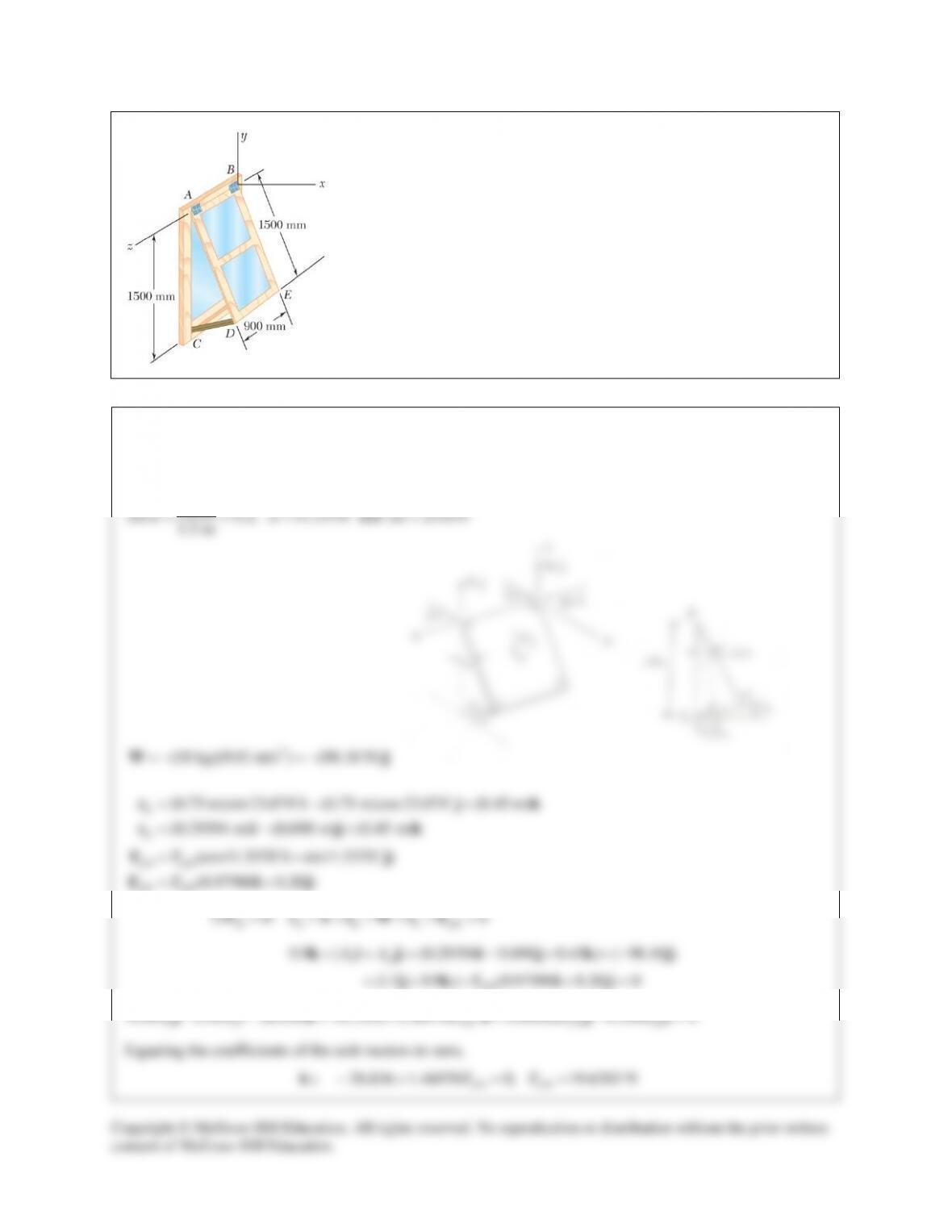
A 10–kg storm window measuring 900 × 1500 mm is held by hinges at
A and B. In the position shown, it is held away from the side of the
house by a 600–mm stick CD. Assuming that the hinge at A does not
exert any axial thrust, determine the magnitude of the force exerted by
the stick and the components of the reactions at A and B.
SOLUTION
Free–Body Diagram: Since CD is a two–force member,
CD
F
is directed along CD and triangle ACD is isosceles. We have
0.3 m
sin 0.2; 11.5370 and 2 23.074
1.5 m
aa a
= = = =
2
(10 kg)(9.81 m/s ) (98.10 N)=−=−Wj
(0.75 m)sin 23.074 (0.75 m)cos23.074 (0.45 m)
(0.29394 m) (0.690 m) (0.45 m)
(cos11.5370 sin11.5370 )
(0.97980 0.20 )
G
G
CD CD
CD CD
F
F
=−+
= −+
= +
= +
r i jk
r i jk
F ij
F ij
0: 0
B A G C CD
MΣ = ×+ × + × =r Ar Wr F
0.9 ( ) (0.29394 0.690 0.45 ) ( 98.10 )
(1.5 0.9 ) (0.97980 0.20 ) 0
xy
CD
AA
F
× + + − + ×−
++ × + =
k ij i j k j
jk i j
0.90 0.90 28.836 44.145 1.46970 0.88182 0.180 0
x y CD CD CD
AA F F F−− ++ + − =jik i k j i
Equating the coefficients of the unit vectors to zero,
28.836 1.46970 0; 19.6203 N
CD CD
FF−+ = =k:
Copyright © McGraw–Hill Education. All rights reserved. No reproduction or distribution without the prior written
consent of McGraw–Hill Education.

PROBLEM 4.70
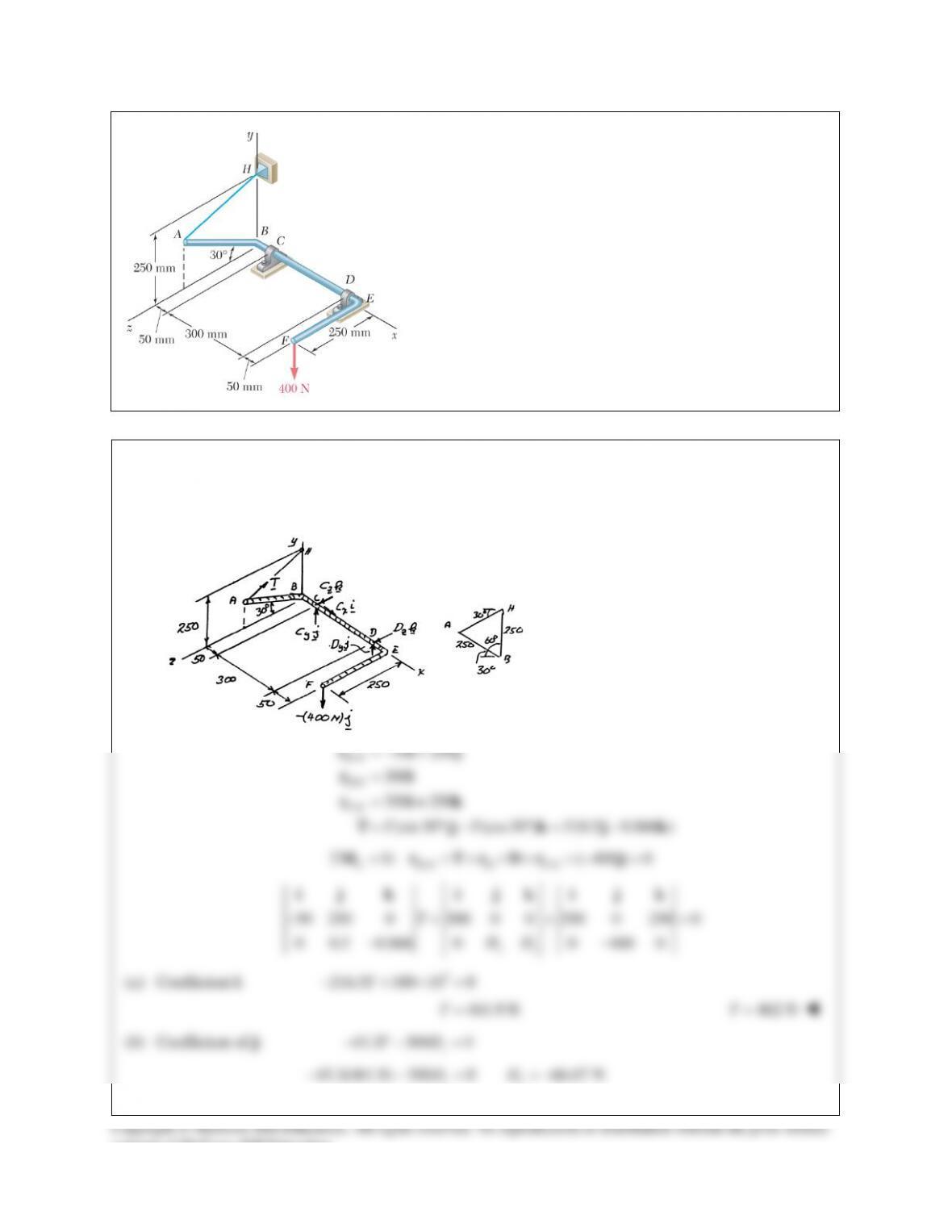
The bent rod ABEF is supported by bearings at C and D and
by wire AH. Knowing that portion AB of the rod is 250 mm
long, determine (a) the tension in wire AH, (b) the reactions
at C and D. Assume that the bearing at D does not exert any
axial thrust.
SOLUTION
Free–Body Diagram:
ABH∆
is equilateral.
Dimensions in mm
/
/
/
50 250
300
350 250
(sin30 ) (cos30 ) (0.5 0.866 )
HC
DC
FC
TT T
=−+
=
= +
= °− ° = −
r ij
ri
r ik
T j k jk
//
0: ( 400 ) 0
C HC D FC
Σ = × + × + ×− =M r Tr Dr j
50 250 0 300 0 0 350 0 250 0
0 0.5 0.866 0 0 400 0
yz
T
DD
− ++ =
−−
i j k i jk i j k
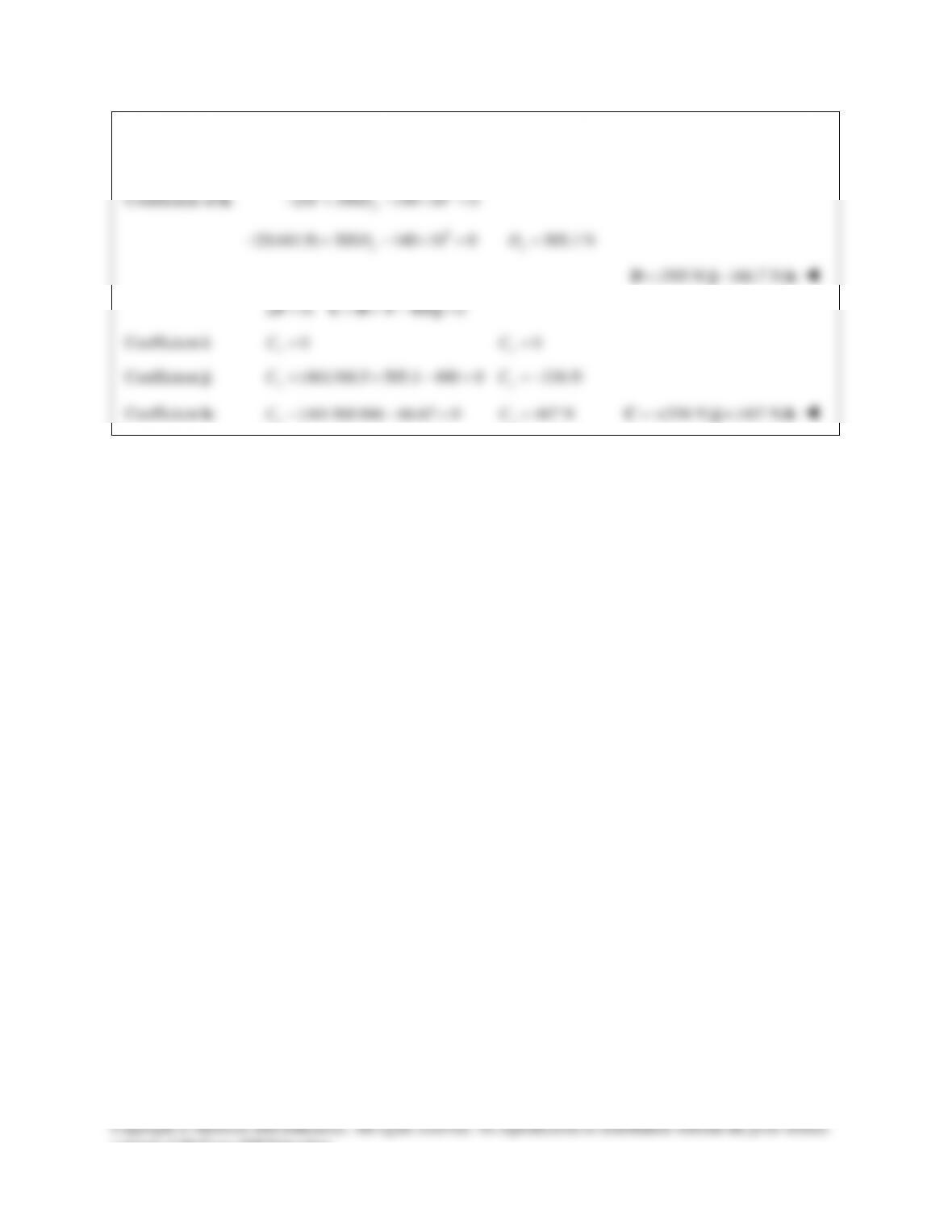
(a) Coefficient i:
3
216.5 100 10 0T− +×=
461.9 NT=
462 NT=
(b) Coefficient of j:
43.3 300 0
z
TD−− =
43.3(461.9) 300 0 66.67 N
zz
DD− −= =−
SOLUTION Continued
Coefficient of k:
3
25 300 140 10 0
y
TD−+ −×=
3
25(461.9) 300 140 10 0 505.1 N
yy
DD− + −×= =
(505 N) (66.7 N)= −Djk
0: 400 0Σ= + + − =F CDT j
Coefficient i:
0
x
C=
0
x
C=
Coefficient j:
(461.9)0.5 505.1 400 0 336 N
yy
CC+ + −= =−
Coefficient k:
(461.9)0.866 66.67 0
z
C− −=
467 N
z
C=
(336 N) (467 N)=−+C jk
consent of McGraw–Hill Education.
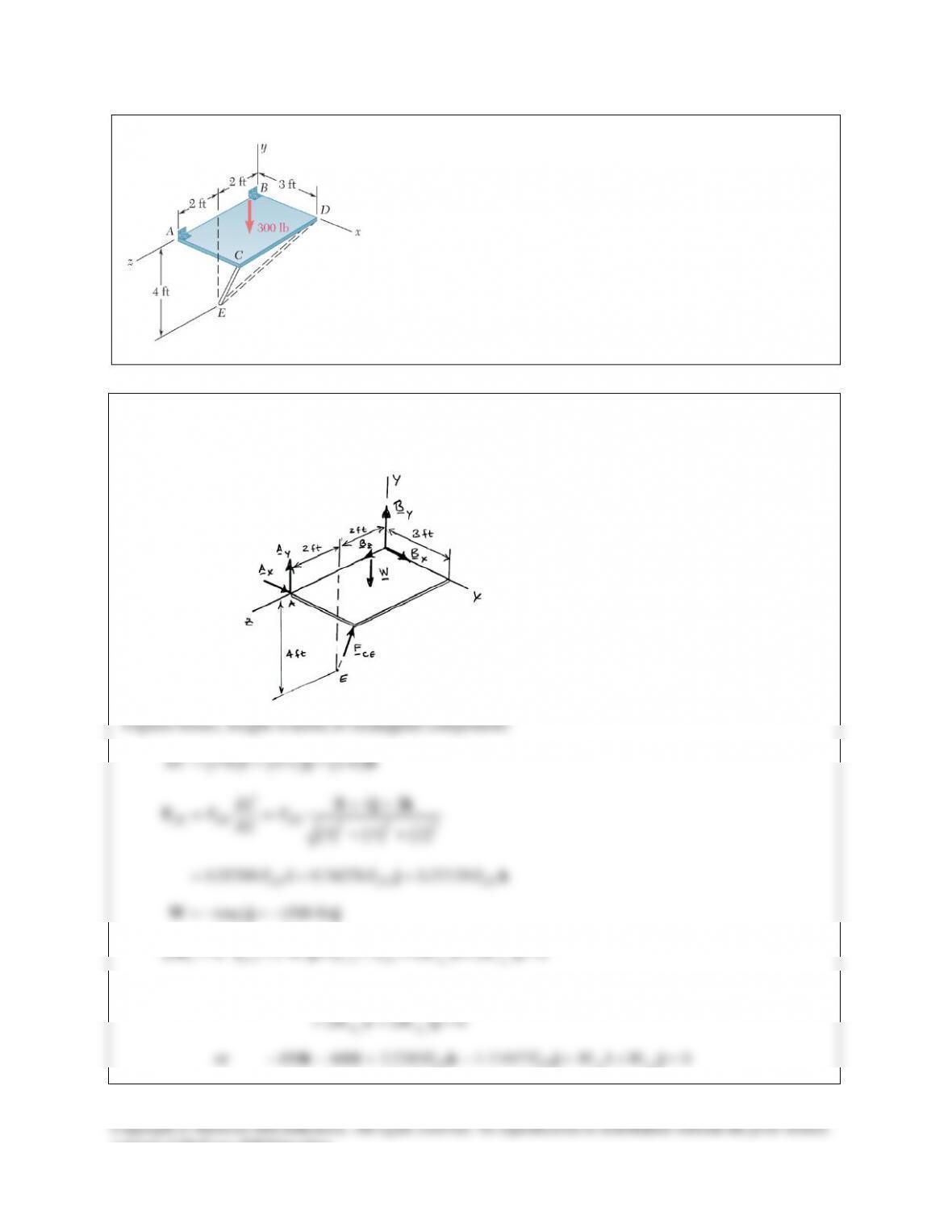
PROBLEM 4.71
Solve Prob. 4.65, assuming that the hinge at B has been removed
and that the hinge at A can exert an axial thrust, as well as couples
about axes parallel to the x and y axes.
PROBLEM 4.65 The horizontal platform ABCD weighs 60 lb
and supports a 240–lb load at its center. The platform is normally
held in position by hinges at A and B and by braces CE and DE. If
brace DE is removed, determine the reactions at the hinges and
the force exerted by the remaining brace CE. The hinge at A does
not exert any axial thrust.
SOLUTION
Free–Body Diagram:
0
xyz
BBB= = =
( ) ( ) ( )
3 ft 4 ft 2 ftEC =++ijk
C
( ) ( ) ( )
222
342
342
CE CE CE
EC
FF
EC
++
= =
++
ijk
F
C
0.55709 0.74278 0.37139
CE CE CE
FFF=++
ijk
( ) (300 lb)mg=−=−Wj j
//
0: ( ) ( ) ( ) 0
xy
A G A C A CE A A
W FM MΣ = ×− + × + + =M r jr i j
0: (1.5 2 ) ( 300 ) 3 (0.55709 0.74278 0.37139 )
( )( )0
xy
A CE
AA
F
MM
Σ = − ×− + × + +
++=
M ik j i i j k
ij
or
450 600 2.2283 1.11417 0
xy
CE CE A A
F FMM−−+ − + + =ki k j i j
consent of McGraw–Hill Education.
PROBLEM 4.67
The rectangular plate shown weighs 75 lb and is held in the
position shown by hinges at A and B and by cable EF. Assuming
that the hinge at B does not exert any axial thrust, determine
(a) the tension in the cable, (b) the reactions at A and B.
SOLUTION
/
/
/
// /
(38 8) 30
(30 4) 20
26 20
38 10
2
19 10
8 25 20
33 in.
(8 25 20 )
33
0: ( 75 ) 0
BA
EA
GA
A EA GA BA
EF
EF
AE T
TAE TB
= −=
= −+
= +
= +
= +
=+−
=
= = +−
Σ = × + ×− + × =
r ii
r ik
ik
r ik
ik
ijk
T ijk
M r r jr
FFF
FFF
26 0 20 19 0 10 30 0 0 0
33
8 25 20 0 75 0 0
yz
T
BB
++=
−−
i j k i jk i jk
(a) Coefficient of i:
(25)(20) 750 0:
33
T
− +=
49.5 lbT=
Coefficient of j:
49.5
(160 520) 30 0: 34 lb
33
zz
BB
+ −= =
(b) Coefficient of k:
49.5
(26)(25) 1425 30 0: 15 lb
yy
BB−+ = =
(15.00 lb) (34.0 lb)= +B jk
SOLUTION Continued
0: (75 lb) 0Σ= + + − =F ABT j
Coefficient of i:
8(49.5) 0 12.00 lb
33
xx
AA+==−
Coefficient of j:
25
15 (49.5) 75 0 22.5 lb
33
yy
AA++ −= =
Coefficient of k:
20
34 (49.5) 0 4.00 lb
33
zz
AA+− = =−
(12.00 lb) (22.5 lb) (4.00 lb)=− +−A ijk
PROBLEM 4.68
The lid of a roof scuttle weighs 75 lb. It is hinged at corners
A and B and maintained in the desired position by a rod CD
pivoted at C; a pin at end D of the rod fits into one of several
holes drilled in the edge of the lid. For the position shown,
determine (a) the magnitude of the force exerted by rod CD,
(b) the reactions at the hinges. Assume that the hinge at B
does not exert any axial thrust.
SOLUTION
Free–Body Diagram:
Geometry:
Using triangle ACD and the law of sines
sin sin50 or 20.946
7 in. 15 in.
αα
= =
20.946 70.946
β
= 50° + ° = °
Expressing
CD
F
in terms of its rectangular coordinates:
sin cos
CD CD CD
FF
ββ
= +F jk
sin70.946 cos70.946
CD CD
FF= °+ °jk
0.94521 0.32646
CD CD CD
FF= +F jk
( ) ( ) ( ) ( ) ( )
0: 26 in. 13 in. 16 in. sin50 16 in. cos50 75 lb
B
Σ = − × + − + °+ ° ×−
M iA i j k j
( ) ( )
26 in. 7 in. 0
CD
+− + × =
i kF
or
( ) ( ) ( )( ) ( )( )
26 in. 26 in. 13 in. 75 lb 16 in. 75 lb cos50
yz
AA−++ + °kj k i
( )
( )
( )
( )
( )
( )
26 in. 0.94521 26 in. 0.32646 7 in. 0.94521 0
CD CD CD
F FF− + −=k ji
SOLUTION Continued
(a) Setting the coefficients of the unit vectors to zero:
( ) ( )
( )
( )
: 75 lb 16 in. cos50 0.94521 7 in. 0
CD
F
°− =
i
116.6 lb
CD
F=
(b)
0: 0
xx
FAΣ= =
( ) ( ) ( )( ) ( )
: 0.94521 116.580 lb 26 in. 75 lb 13 in. 26 in. 0
y
A
− + −=
k
72.693 lb
y
A= −
( ) ( ) ( )
: 0.32646 116.580 lb 26 in. 26 in. 0
z
A
+=
j
38.059 lb
z
A= −
( )
0: 72.693 lb 0.94521 116.580 lb 75 lb 0
yy
FBΣ= − + − + =
37.500 lb
y
B=
( )
0: 38.059 lb 0.32646 116.580 lb 0
zz
FBΣ= − + + =
0
z
B=
Therefore:
( ) ( )
72.7 lb 38.1 lb=−−A jk
( )
37.5 lb=Bj
PROBLEM 4.69
A 10–kg storm window measuring 900 × 1500 mm is held by hinges at
A and B. In the position shown, it is held away from the side of the
house by a 600–mm stick CD. Assuming that the hinge at A does not
exert any axial thrust, determine the magnitude of the force exerted by
the stick and the components of the reactions at A and B.
SOLUTION
Free–Body Diagram: Since CD is a two–force member,
CD
F
is directed along CD and triangle ACD is isosceles. We have
0.3 m
sin 0.2; 11.5370 and 2 23.074
1.5 m
aa a
= = = =
2
(10 kg)(9.81 m/s ) (98.10 N)=−=−Wj
(0.75 m)sin 23.074 (0.75 m)cos23.074 (0.45 m)
(0.29394 m) (0.690 m) (0.45 m)
(cos11.5370 sin11.5370 )
(0.97980 0.20 )
G
G
CD CD
CD CD
F
F
=−+
= −+
= +
= +
r i jk
r i jk
F ij
F ij
0: 0
B A G C CD
MΣ = ×+ × + × =r Ar Wr F
0.9 ( ) (0.29394 0.690 0.45 ) ( 98.10 )
(1.5 0.9 ) (0.97980 0.20 ) 0
xy
CD
AA
F
× + + − + ×−
++ × + =
k ij i j k j
jk i j
0.90 0.90 28.836 44.145 1.46970 0.88182 0.180 0
x y CD CD CD
AA F F F−− ++ + − =jik i k j i
Equating the coefficients of the unit vectors to zero,
28.836 1.46970 0; 19.6203 N
CD CD
FF−+ = =k:
Copyright © McGraw–Hill Education. All rights reserved. No reproduction or distribution without the prior written
consent of McGraw–Hill Education.
PROBLEM 4.70
The bent rod ABEF is supported by bearings at C and D and
by wire AH. Knowing that portion AB of the rod is 250 mm
long, determine (a) the tension in wire AH, (b) the reactions
at C and D. Assume that the bearing at D does not exert any
axial thrust.
SOLUTION
Free–Body Diagram:
ABH∆
is equilateral.
Dimensions in mm
/
/
/
50 250
300
350 250
(sin30 ) (cos30 ) (0.5 0.866 )
HC
DC
FC
TT T
=−+
=
= +
= °− ° = −
r ij
ri
r ik
T j k jk
//
0: ( 400 ) 0
C HC D FC
Σ = × + × + ×− =M r Tr Dr j
50 250 0 300 0 0 350 0 250 0
0 0.5 0.866 0 0 400 0
yz
T
DD
− ++ =
−−
i j k i jk i j k
(a) Coefficient i:
3
216.5 100 10 0T− +×=
461.9 NT=
462 NT=
(b) Coefficient of j:
43.3 300 0
z
TD−− =
43.3(461.9) 300 0 66.67 N
zz
DD− −= =−
SOLUTION Continued
Coefficient of k:
3
25 300 140 10 0
y
TD−+ −×=
3
25(461.9) 300 140 10 0 505.1 N
yy
DD− + −×= =
(505 N) (66.7 N)= −Djk
0: 400 0Σ= + + − =F CDT j
Coefficient i:
0
x
C=
0
x
C=
Coefficient j:
(461.9)0.5 505.1 400 0 336 N
yy
CC+ + −= =−
Coefficient k:
(461.9)0.866 66.67 0
z
C− −=
467 N
z
C=
(336 N) (467 N)=−+C jk
consent of McGraw–Hill Education.
PROBLEM 4.71
Solve Prob. 4.65, assuming that the hinge at B has been removed
and that the hinge at A can exert an axial thrust, as well as couples
about axes parallel to the x and y axes.
PROBLEM 4.65 The horizontal platform ABCD weighs 60 lb
and supports a 240–lb load at its center. The platform is normally
held in position by hinges at A and B and by braces CE and DE. If
brace DE is removed, determine the reactions at the hinges and
the force exerted by the remaining brace CE. The hinge at A does
not exert any axial thrust.
SOLUTION
Free–Body Diagram:
0
xyz
BBB= = =
( ) ( ) ( )
3 ft 4 ft 2 ftEC =++ijk
C
( ) ( ) ( )
222
342
342
CE CE CE
EC
FF
EC
++
= =
++
ijk
F
C
0.55709 0.74278 0.37139
CE CE CE
FFF=++
ijk
( ) (300 lb)mg=−=−Wj j
//
0: ( ) ( ) ( ) 0
xy
A G A C A CE A A
W FM MΣ = ×− + × + + =M r jr i j
0: (1.5 2 ) ( 300 ) 3 (0.55709 0.74278 0.37139 )
( )( )0
xy
A CE
AA
F
MM
Σ = − ×− + × + +
++=
M ik j i i j k
ij
or
450 600 2.2283 1.11417 0
xy
CE CE A A
F FMM−−+ − + + =ki k j i j
consent of McGraw–Hill Education.