PROBLEM 3.69
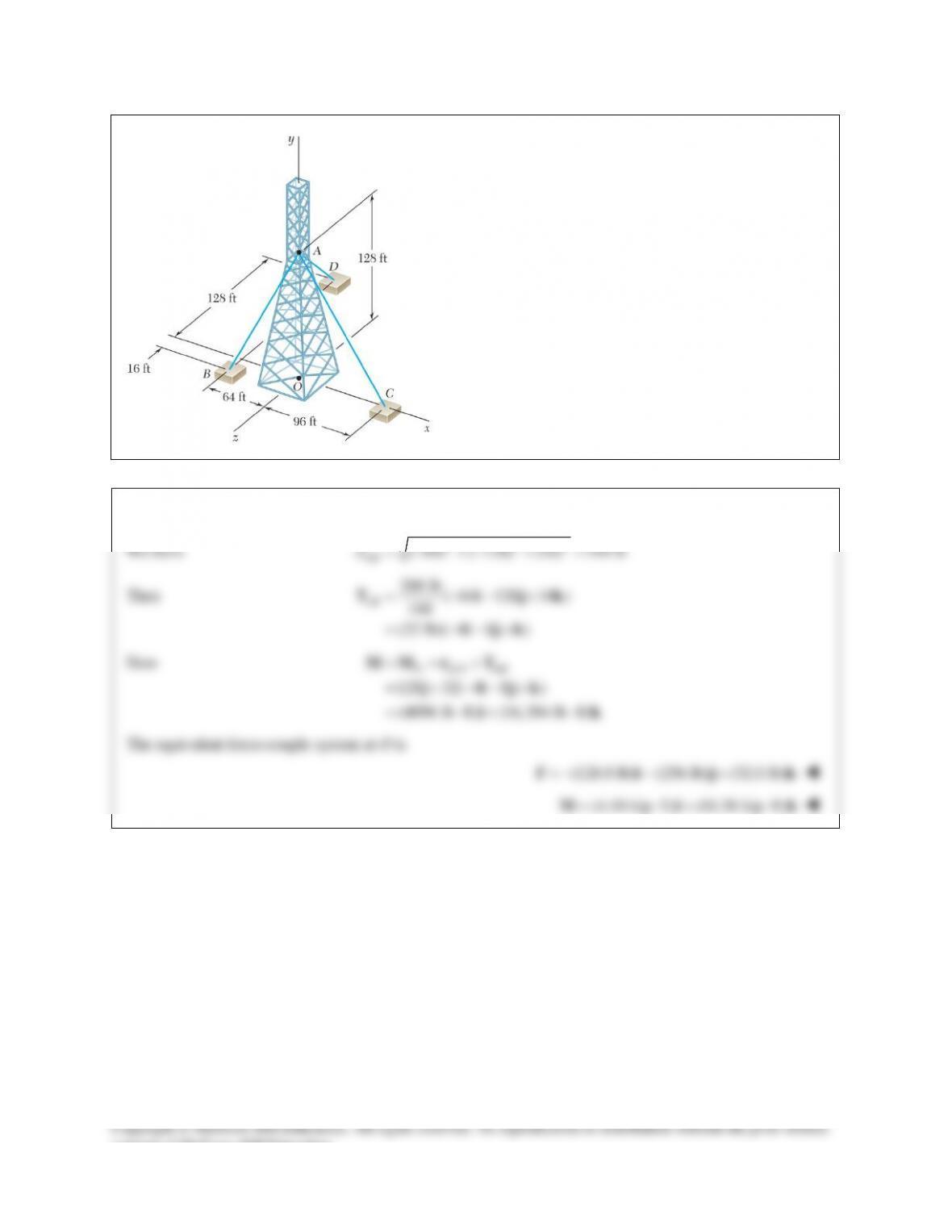
An antenna is guyed by three cables as shown.
Knowing that the tension in cable AD is 270 lb, replace
the force exerted at A by cable AD with an equivalent
force–couple system at the center O of the base of the
antenna.
SOLUTION
We have
222
( 64) ( 128) ( 128)
192 ft
AD
d= − +− +−
=
Then
270 lb ( 64 128 128 )
192
(90 lb)( 2 2 )
AD
= −− +
= −− −
T ijk
ijk
Now
/
128 90( 2 2 )
(23,040 lb ft) (11,520 lb ft)
O A O AD
= = ×
= × −− −
=− ⋅+ ⋅
MM r T
j ijk
ik
The equivalent force–couple system at O is
(90.0 lb) (180.0 lb) (180.0 lb)=−− −F ijk
(23.0 kip ft) (11.52 kip ft)=− ⋅+ ⋅M ik
consent of McGraw–Hill Education.
PROBLEM 3.70
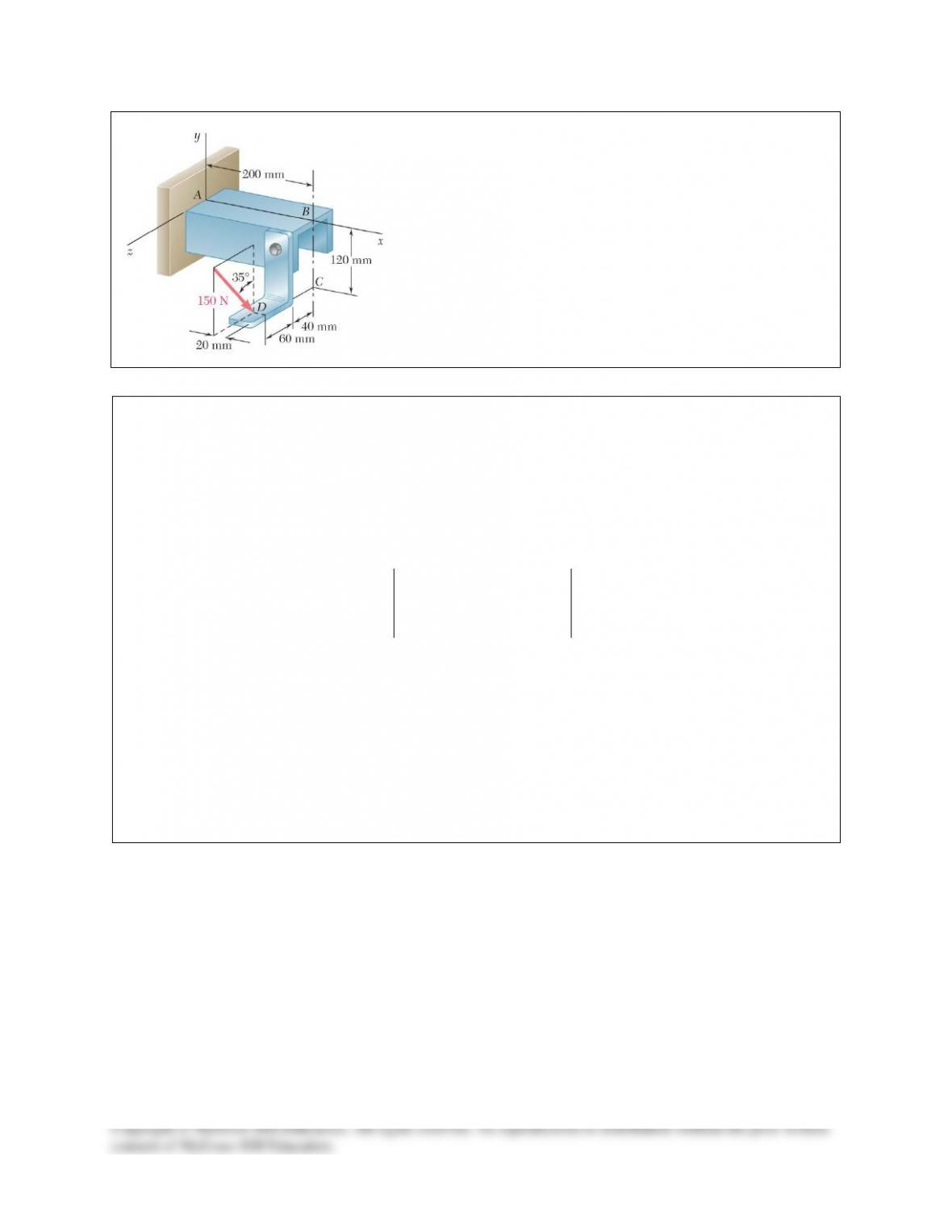
Replace the 150–N force with an equivalent force-couple
system at A.
SOLUTION
Equivalence requires
: (150 N)( cos 35 sin 35 )
(122.873 N) (86.036 N)
Σ = − °− °
=−−
FF j k
jk
/
:
A DA
Σ=×M Mr F
where
/
(0.18 m) (0.12 m) (0.1 m)
DA
=−+r i jk
Then
0.18 0.12 0.1 N m
0 122.873 86.036
[( 0.12)( 86.036) (0.1)( 122.873)]
[ (0.18)( 86.036)]
[(0.18)( 122.873)]
(22.6 N m) (15.49 N m) (22.1 N m)
=−⋅
−−
=−− −−
+− −
+−
= ⋅+ ⋅− ⋅
ij k
M
i
j
k
i jk
The equivalent force–couple system at A is
(122.9 N) (86.0 N)=−−F jk
(22.6 N m) (15.49 N m) (22.1 N m)= ⋅+ ⋅− ⋅M i jk
PROBLEM 3.71
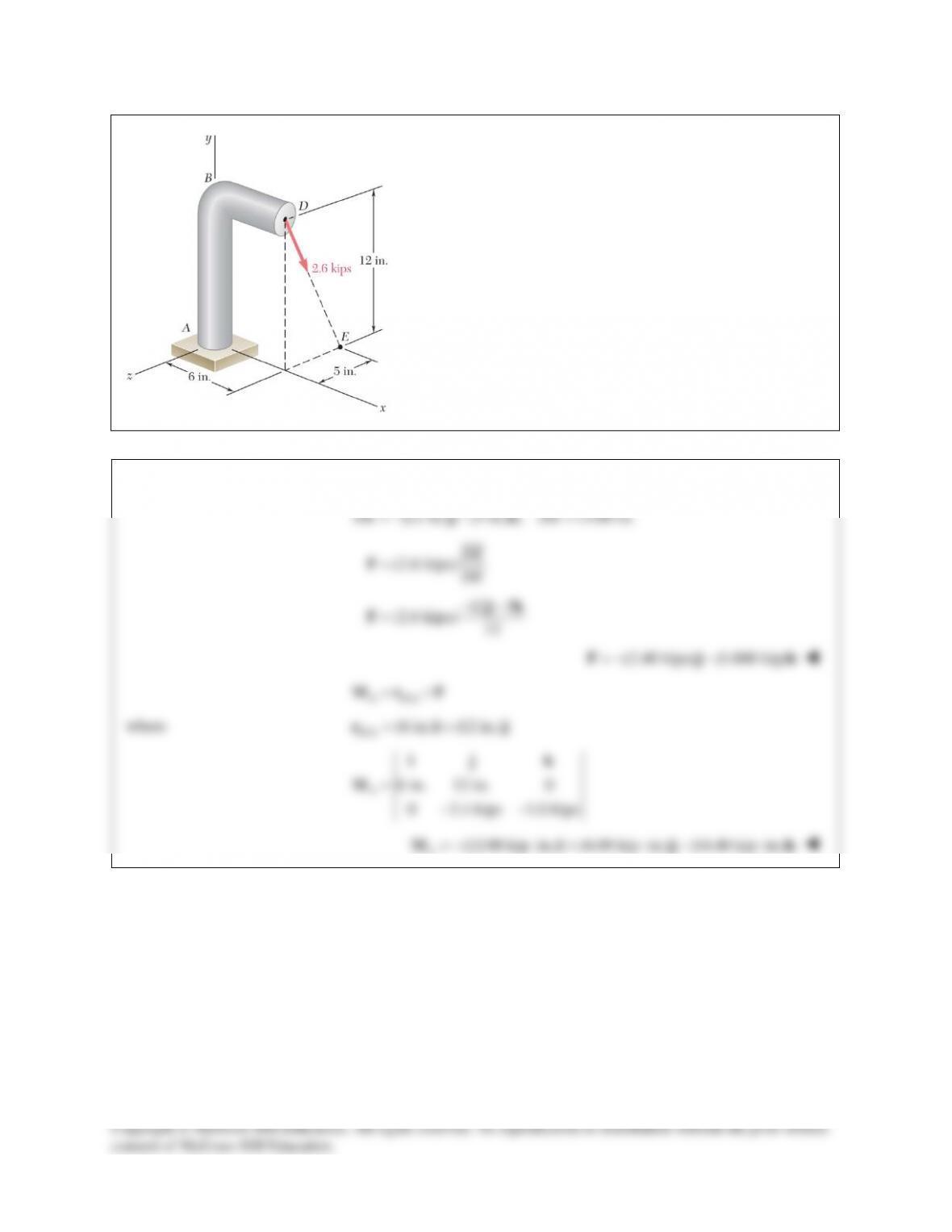
A 2.6–kip force is applied at Point D of the cast iron post
shown. Replace that force with an equivalent force-couple
system at the center A of the base section.
SOLUTION
(12 in.) (5 in.) ; 13.00 in.DE DE=−− =jk
(2.6 kips) DE
DE
=F
12 5
(2.6 kips) 13
−−
=jk
F
(2.40 kips) (1.000 kip)=−−F jk
/A DA
= ×
Mr F
where
/
(6 in.) (12 in.)
DA
= +r ij
6 in. 12 in. 0
0 2.4 kips 1.0 kips
A
=
−−
ij k
M
(12.00 kip in.) (6.00 kip in.) (14.40 kip in.)
A
=− ⋅+ ⋅− ⋅M ij k
PROBLEM 3.72
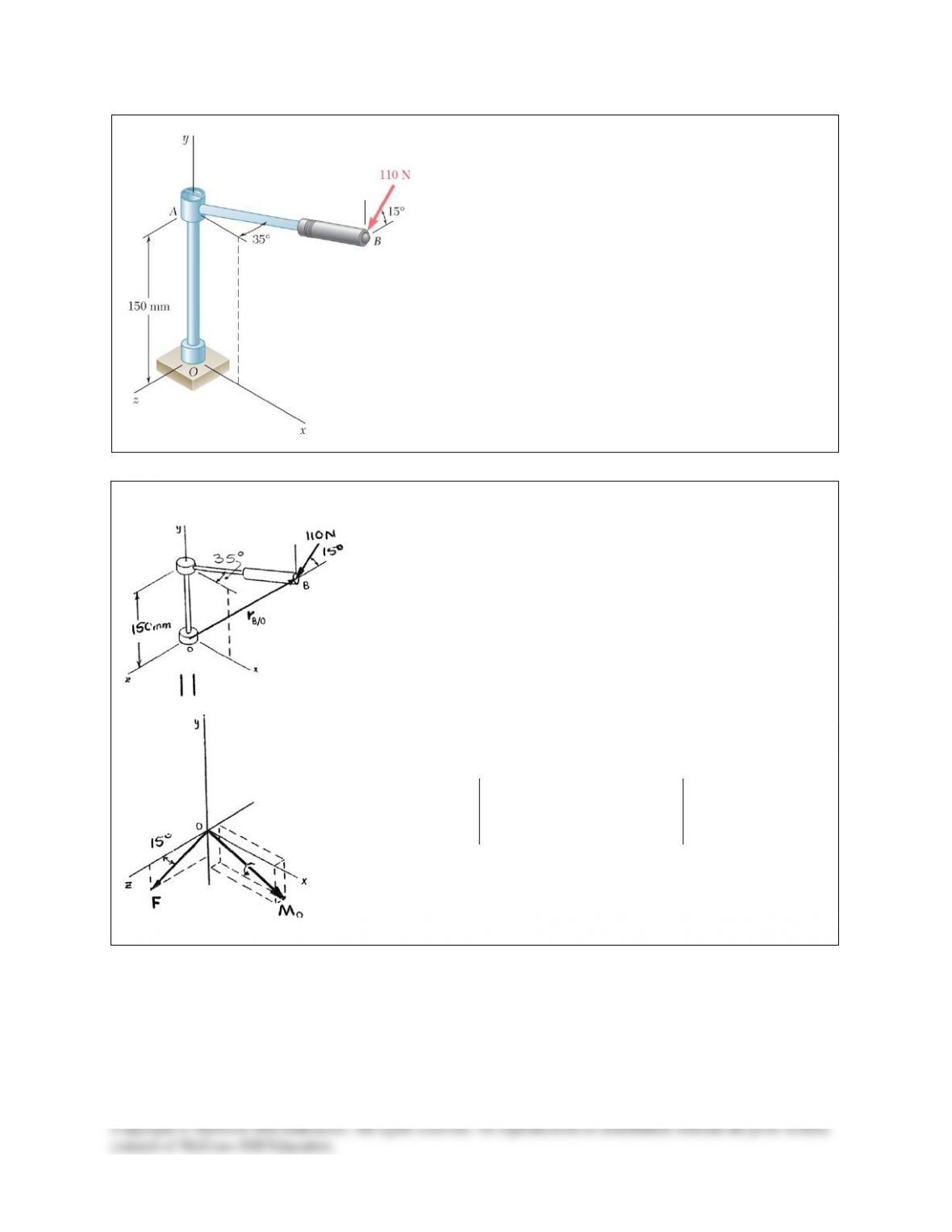
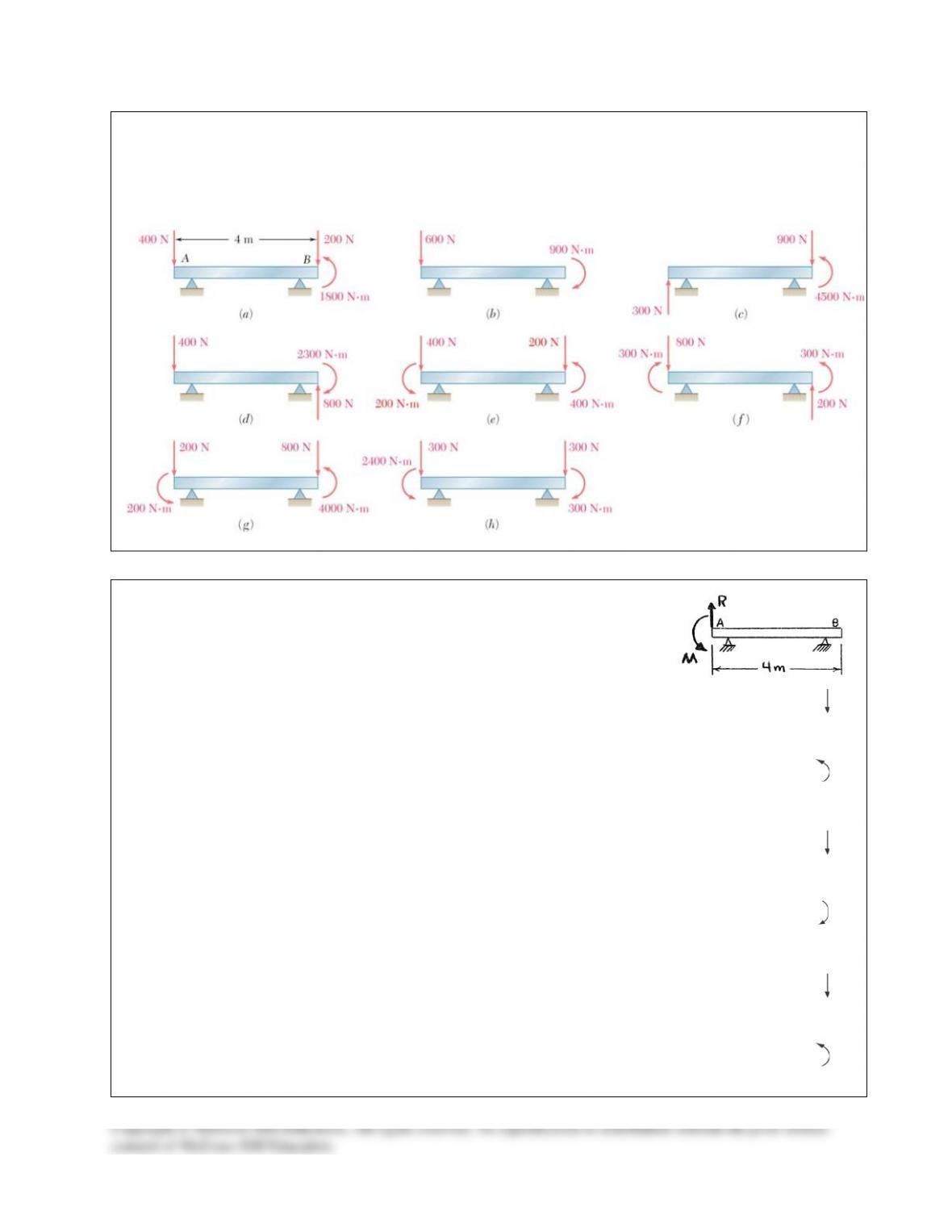
A 110–N force acting in a vertical plane parallel to the yz–
plane is applied to the 220–mm–long horizontal handle AB
of a socket wrench. Replace the force with an equivalent
force–couple system at the origin O of the coordinate
system.
SOLUTION
We have
:
B
Σ=FP F
where
110 N[ (sin15 ) (cos15 ) ]
(28.470 N) (106.252 N)
B
= − °+ °
=−+
P jk
jk
or (28.5 N) (106.3 N)=−+F jk
We have
/
:
O BO B O
MΣ ×=r PM
where
/[(0.22cos35 ) (0.15) (0.22sin35 ) ] m
(0.180213 m) (0.15 m) (0.126187 m)
BO = °+ − °
= +−
r ij k
ij k
0.180213 0.15 0.126187 N m
0 28.5 106.3
O
⋅=
−
i jk
M
[(12.3487) (19.1566) (5.1361) ] N m
O
= −− ⋅M i jk
or (12.35 N m) (19.16 N m) (5.13 N m)
O
= ⋅− ⋅− ⋅M i jk
PROBLEM 3.73
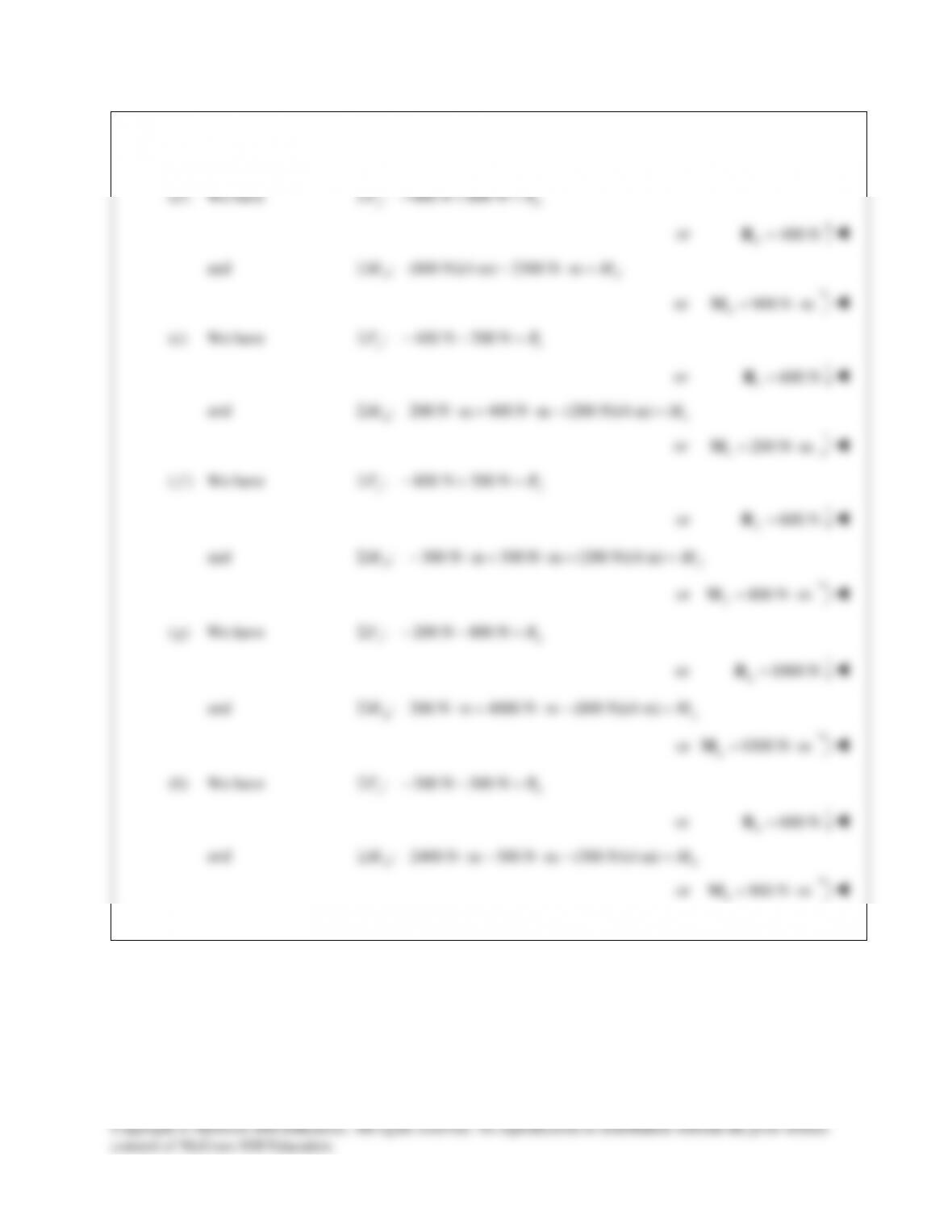
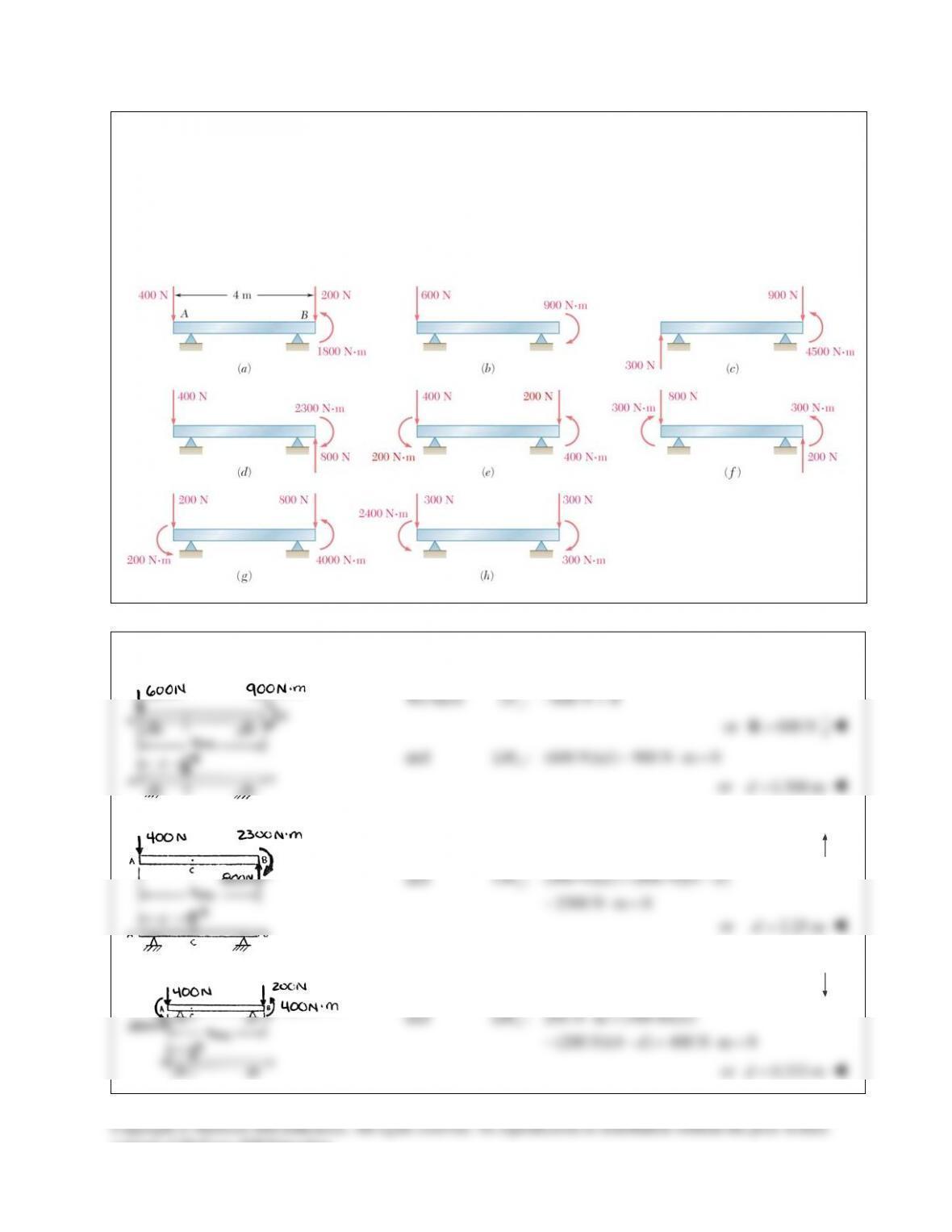
A 4-m-long beam is subjected to a variety of loadings. (a) Replace each loading with an equivalent force–
couple system at end A of the beam. (b) Which of the loadings are equivalent?
SOLUTION
(a) (a) We have
: 400 N 200 N
ya
FRΣ− − =
or
600 N
a=R
and
: 1800 N m (200 N)(4 m)
Aa
MMΣ ⋅− =
or
1000 N m
a
= ⋅M
(b) We have
: 600 N
yb
FRΣ− =
or
600 N
b=R
and
: 900 N m
Ab
MMΣ − ⋅=
or
900 N m
b
= ⋅M
(c) We have
: 300 N 900 N
yc
FRΣ −=
or
600 N
c=R
and
: 4500 N m (900 N)(4 m)
Ac
MMΣ ⋅− =
or
900 N m
c= ⋅M
SOLUTION Continued
(d) We have
: 400 N 800 N
yd
FRΣ− + =
or
400 N
d
=
R
and
: (800 N)(4 m) 2300 N m
Ad
MMΣ − ⋅=
or
900 N m
d
= ⋅M
(e) We have
: 400 N 200 N
ye
FRΣ− − =
or
600 N
e=R
and
: 200 N m 400 N m (200 N)(4 m)
Ae
MMΣ ⋅+ ⋅− =
or
200 N m
e= ⋅M
( f ) We have
: 800 N 200 N
yf
FRΣ− + =
or
600 N
f=R
and
: 300 N m 300 N m (200 N)(4 m)
Af
MMΣ − ⋅+ ⋅+ =
or
800 N m
f= ⋅M
(g) We have
: 200 N 800 N
yg
FRΣ− − =
or
1000 N
g=R
and
: 200 N m 4000 N m (800 N)(4 m)
Ag
MMΣ ⋅+ ⋅− =
or
1000 N m
g= ⋅M
(h) We have
: 300 N 300 N
yh
FRΣ− − =
or
600 N
h
=R
and
: 2400 N m 300 N m (300 N)(4 m)
Ah
MMΣ ⋅− ⋅− =
or
900 N m
h= ⋅M
(b) Therefore, loadings (c) and (h) are equivalent.
PROBLEM 3.74
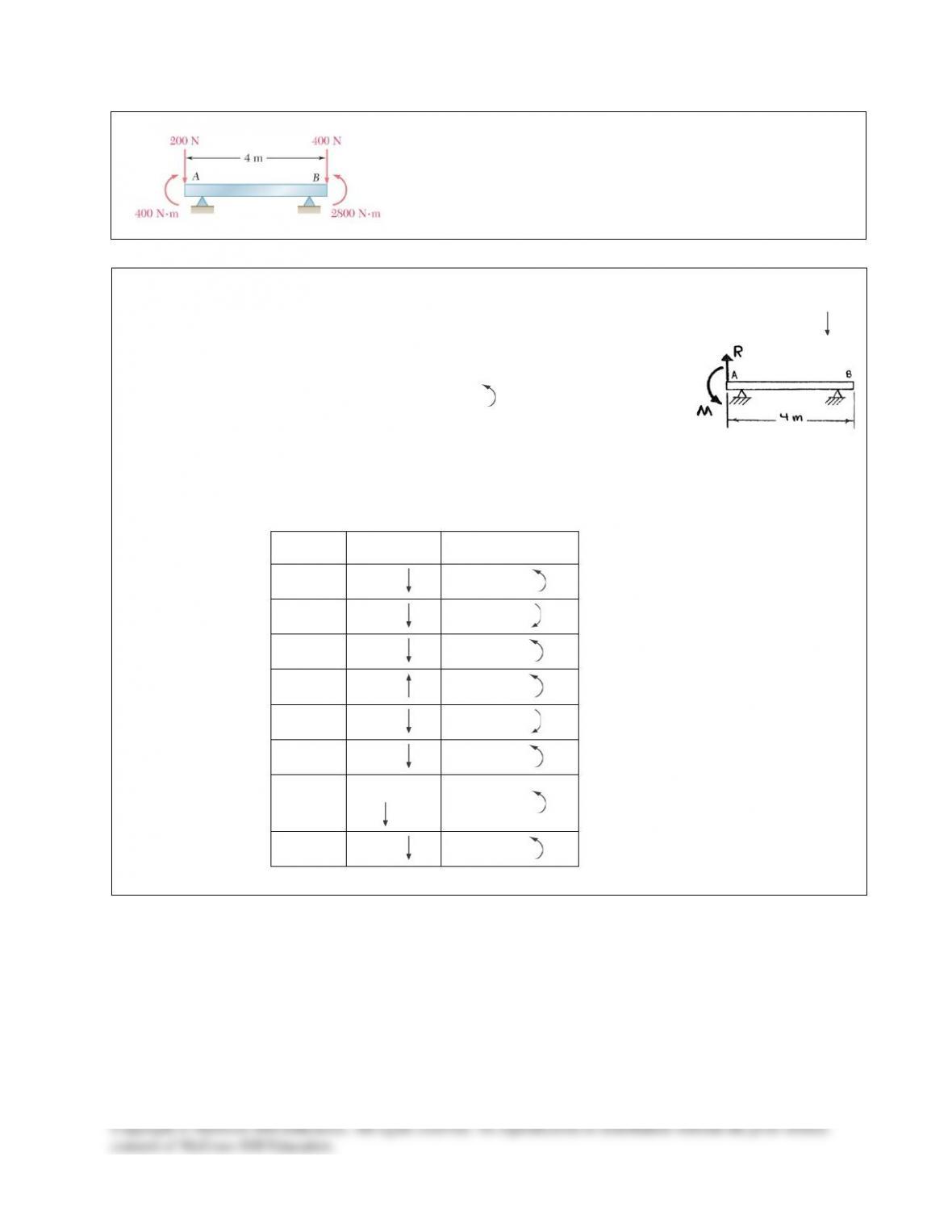
A 4-m-long beam is loaded as shown. Determine the loading of
Problem 3.73 which is equivalent to this loading.
SOLUTION
We have
: 200 N 400 N
yRΣ− − =F
or
600 N=R
and
: 400 N m 2800 N m (400 N)(4 m)
A
MMΣ − ⋅+ ⋅− =
or
800 N m= ⋅M
Equivalent to case ( f ) of Problem 3.73
Problem 3.73 Equivalent force–couples at A
Case R M
(a)
600 N
1000 N m⋅
(b)
600 N
900 N m⋅
(c)
600 N
900 N m⋅
(d)
400 N
900 N m⋅
(e)
600 N
200 N m⋅
(f )
600 N
800 N m⋅
(g)
1000 N
1000 N m⋅
(h)
600 N
900 N m⋅
PROBLEM 3.75
Determine the single equivalent force and the distance from Point A to its line of action for the beam and
loading of (a) Problem 3.73b, (b) Problem 3.73d, (c) Problem 3.73e.
PROBLEM 3.73 A 4-m-long beam is subjected to a variety of loadings. (a) Replace each loading with an
equivalent force–couple system at end A of the beam. (b) Which of the loadings are equivalent?
SOLUTION
(a) For equivalent single force at distance d from A
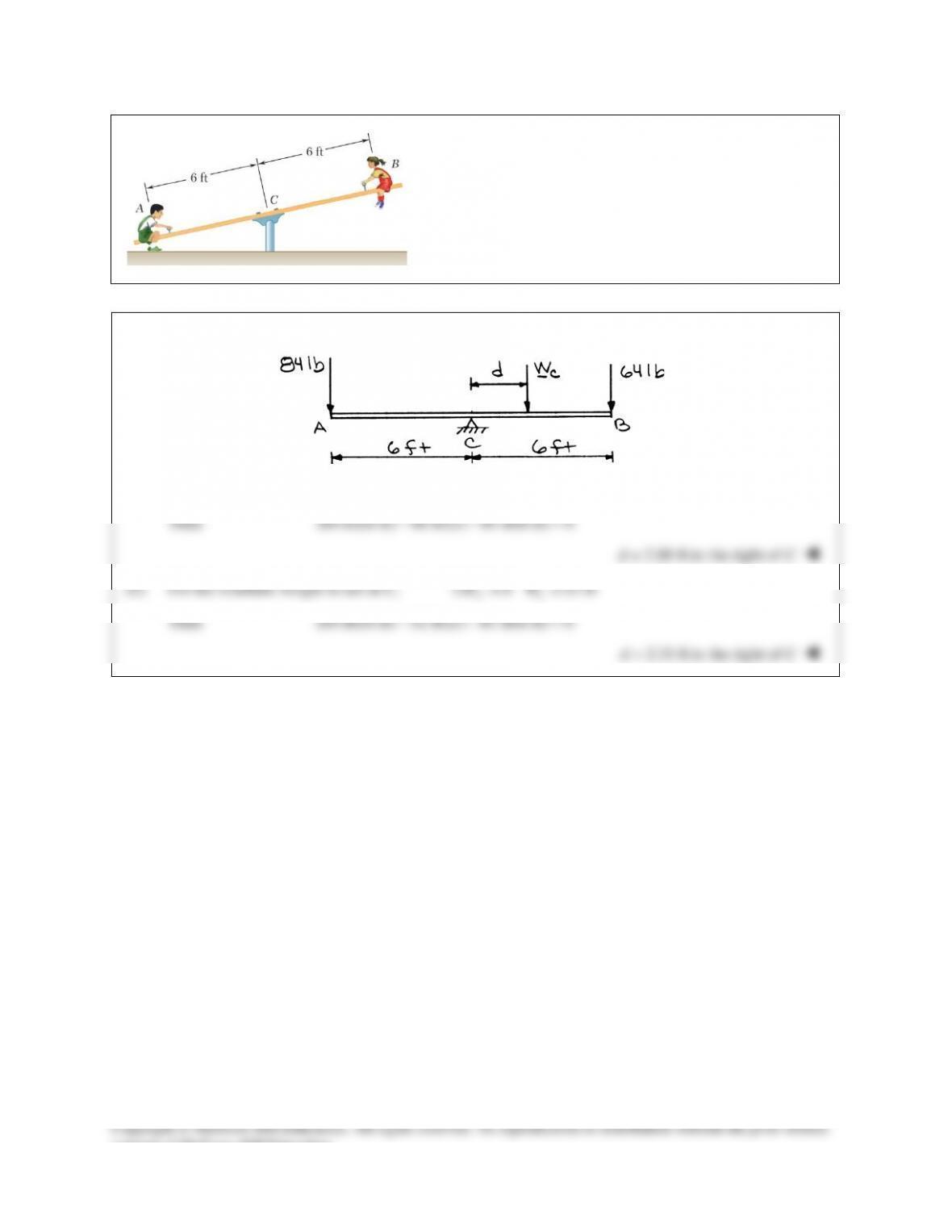
PROBLEM 3.76
The weights of two children sitting at ends A and B of a
seesaw are 84 lb and 64 lb, respectively. Where should a
third child sit so that the resultant of the weights of the
three children will pass through C if she weighs (a) 60 lb,
(b) 52 lb.
SOLUTION
(a) For the resultant weight to act at C,
0 60 lb
CC
MWΣ= =
Then
(84 lb)(6 ft) 60 lb( ) 64 lb(6 ft) 0d−− =
2.00 ft to the right of dC=
CC
Then
(84 lb)(6 ft) 52 lb( ) 64 lb(6 ft) 0d−− =
2.31 ft to the right of dC=
consent of McGraw–Hill Education.
PROBLEM 3.69
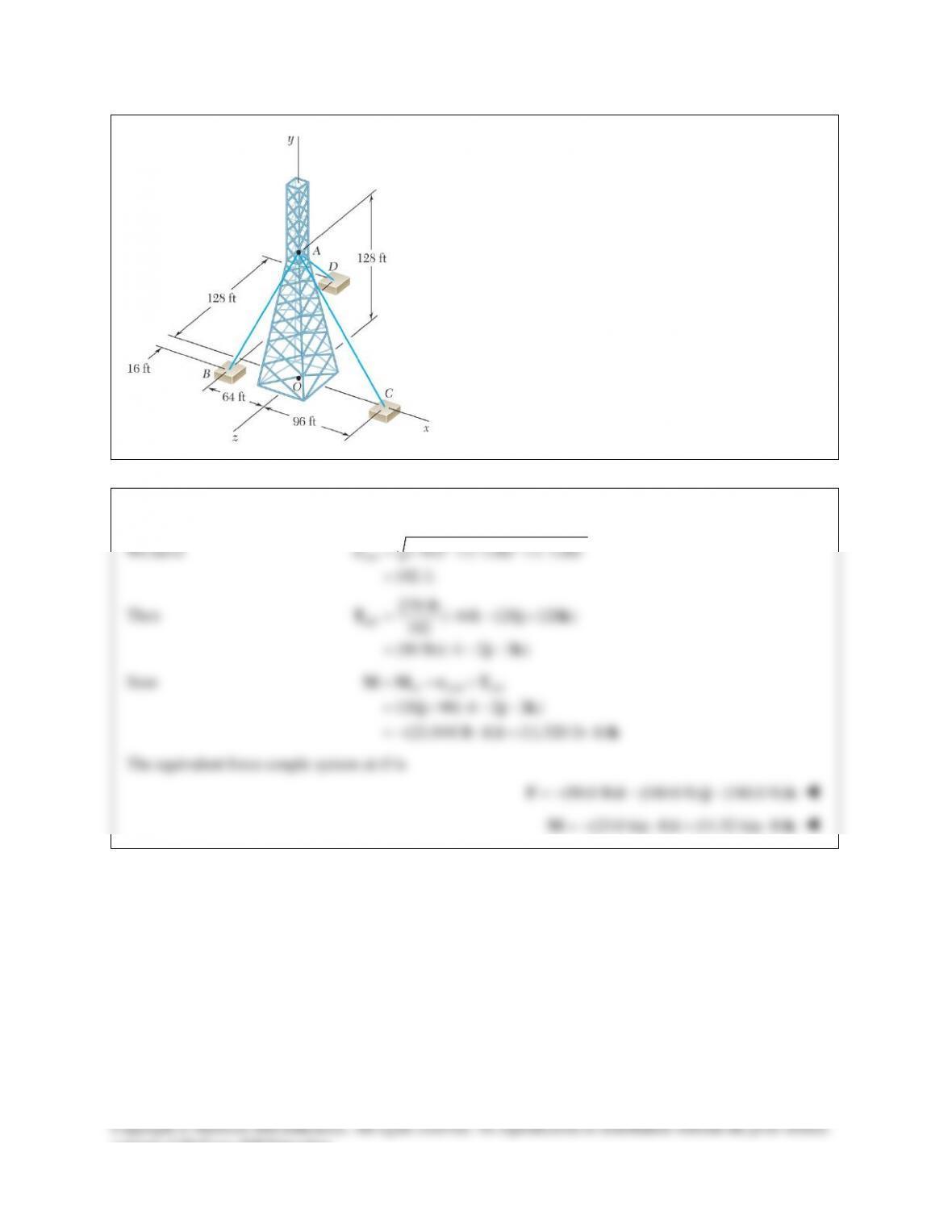
An antenna is guyed by three cables as shown.
Knowing that the tension in cable AD is 270 lb, replace
the force exerted at A by cable AD with an equivalent
force–couple system at the center O of the base of the
antenna.
SOLUTION
We have
222
( 64) ( 128) ( 128)
192 ft
AD
d= − +− +−
=
Then
270 lb ( 64 128 128 )
192
(90 lb)( 2 2 )
AD
= −− +
= −− −
T ijk
ijk
Now
/
128 90( 2 2 )
(23,040 lb ft) (11,520 lb ft)
O A O AD
= = ×
= × −− −
=− ⋅+ ⋅
MM r T
j ijk
ik
The equivalent force–couple system at O is
(90.0 lb) (180.0 lb) (180.0 lb)=−− −F ijk
(23.0 kip ft) (11.52 kip ft)=− ⋅+ ⋅M ik
consent of McGraw–Hill Education.
PROBLEM 3.70
Replace the 150–N force with an equivalent force-couple
system at A.
SOLUTION
Equivalence requires
: (150 N)( cos 35 sin 35 )
(122.873 N) (86.036 N)
Σ = − °− °
=−−
FF j k
jk
/
:
A DA
Σ=×M Mr F
where
/
(0.18 m) (0.12 m) (0.1 m)
DA
=−+r i jk
Then
0.18 0.12 0.1 N m
0 122.873 86.036
[( 0.12)( 86.036) (0.1)( 122.873)]
[ (0.18)( 86.036)]
[(0.18)( 122.873)]
(22.6 N m) (15.49 N m) (22.1 N m)
=−⋅
−−
=−− −−
+− −
+−
= ⋅+ ⋅− ⋅
ij k
M
i
j
k
i jk
The equivalent force–couple system at A is
(122.9 N) (86.0 N)=−−F jk
(22.6 N m) (15.49 N m) (22.1 N m)= ⋅+ ⋅− ⋅M i jk
PROBLEM 3.71
A 2.6–kip force is applied at Point D of the cast iron post
shown. Replace that force with an equivalent force-couple
system at the center A of the base section.
SOLUTION
(12 in.) (5 in.) ; 13.00 in.DE DE=−− =jk
(2.6 kips) DE
DE
=F
12 5
(2.6 kips) 13
−−
=jk
F
(2.40 kips) (1.000 kip)=−−F jk
/A DA
= ×
Mr F
where
/
(6 in.) (12 in.)
DA
= +r ij
6 in. 12 in. 0
0 2.4 kips 1.0 kips
A
=
−−
ij k
M
(12.00 kip in.) (6.00 kip in.) (14.40 kip in.)
A
=− ⋅+ ⋅− ⋅M ij k
PROBLEM 3.72
A 110–N force acting in a vertical plane parallel to the yz–
plane is applied to the 220–mm–long horizontal handle AB
of a socket wrench. Replace the force with an equivalent
force–couple system at the origin O of the coordinate
system.
SOLUTION
We have
:
B
Σ=FP F
where
110 N[ (sin15 ) (cos15 ) ]
(28.470 N) (106.252 N)
B
= − °+ °
=−+
P jk
jk
or (28.5 N) (106.3 N)=−+F jk
We have
/
:
O BO B O
MΣ ×=r PM
where
/[(0.22cos35 ) (0.15) (0.22sin35 ) ] m
(0.180213 m) (0.15 m) (0.126187 m)
BO = °+ − °
= +−
r ij k
ij k
0.180213 0.15 0.126187 N m
0 28.5 106.3
O
⋅=
−
i jk
M
[(12.3487) (19.1566) (5.1361) ] N m
O
= −− ⋅M i jk
or (12.35 N m) (19.16 N m) (5.13 N m)
O
= ⋅− ⋅− ⋅M i jk
PROBLEM 3.73
A 4-m-long beam is subjected to a variety of loadings. (a) Replace each loading with an equivalent force–
couple system at end A of the beam. (b) Which of the loadings are equivalent?
SOLUTION
(a) (a) We have
: 400 N 200 N
ya
FRΣ− − =
or
600 N
a=R
and
: 1800 N m (200 N)(4 m)
Aa
MMΣ ⋅− =
or
1000 N m
a
= ⋅M
(b) We have
: 600 N
yb
FRΣ− =
or
600 N
b=R
and
: 900 N m
Ab
MMΣ − ⋅=
or
900 N m
b
= ⋅M
(c) We have
: 300 N 900 N
yc
FRΣ −=
or
600 N
c=R
and
: 4500 N m (900 N)(4 m)
Ac
MMΣ ⋅− =
or
900 N m
c= ⋅M
SOLUTION Continued
(d) We have
: 400 N 800 N
yd
FRΣ− + =
or
400 N
d
=
R
and
: (800 N)(4 m) 2300 N m
Ad
MMΣ − ⋅=
or
900 N m
d
= ⋅M
(e) We have
: 400 N 200 N
ye
FRΣ− − =
or
600 N
e=R
and
: 200 N m 400 N m (200 N)(4 m)
Ae
MMΣ ⋅+ ⋅− =
or
200 N m
e= ⋅M
( f ) We have
: 800 N 200 N
yf
FRΣ− + =
or
600 N
f=R
and
: 300 N m 300 N m (200 N)(4 m)
Af
MMΣ − ⋅+ ⋅+ =
or
800 N m
f= ⋅M
(g) We have
: 200 N 800 N
yg
FRΣ− − =
or
1000 N
g=R
and
: 200 N m 4000 N m (800 N)(4 m)
Ag
MMΣ ⋅+ ⋅− =
or
1000 N m
g= ⋅M
(h) We have
: 300 N 300 N
yh
FRΣ− − =
or
600 N
h
=R
and
: 2400 N m 300 N m (300 N)(4 m)
Ah
MMΣ ⋅− ⋅− =
or
900 N m
h= ⋅M
(b) Therefore, loadings (c) and (h) are equivalent.
PROBLEM 3.74
A 4-m-long beam is loaded as shown. Determine the loading of
Problem 3.73 which is equivalent to this loading.
SOLUTION
We have
: 200 N 400 N
yRΣ− − =F
or
600 N=R
and
: 400 N m 2800 N m (400 N)(4 m)
A
MMΣ − ⋅+ ⋅− =
or
800 N m= ⋅M
Equivalent to case ( f ) of Problem 3.73
Problem 3.73 Equivalent force–couples at A
Case R M
(a)
600 N
1000 N m⋅
(b)
600 N
900 N m⋅
(c)
600 N
900 N m⋅
(d)
400 N
900 N m⋅
(e)
600 N
200 N m⋅
(f )
600 N
800 N m⋅
(g)
1000 N
1000 N m⋅
(h)
600 N
900 N m⋅
PROBLEM 3.75
Determine the single equivalent force and the distance from Point A to its line of action for the beam and
loading of (a) Problem 3.73b, (b) Problem 3.73d, (c) Problem 3.73e.
PROBLEM 3.73 A 4-m-long beam is subjected to a variety of loadings. (a) Replace each loading with an
equivalent force–couple system at end A of the beam. (b) Which of the loadings are equivalent?
SOLUTION
(a) For equivalent single force at distance d from A
PROBLEM 3.76
The weights of two children sitting at ends A and B of a
seesaw are 84 lb and 64 lb, respectively. Where should a
third child sit so that the resultant of the weights of the
three children will pass through C if she weighs (a) 60 lb,
(b) 52 lb.
SOLUTION
(a) For the resultant weight to act at C,
0 60 lb
CC
MWΣ= =
Then
(84 lb)(6 ft) 60 lb( ) 64 lb(6 ft) 0d−− =
2.00 ft to the right of dC=
CC
Then
(84 lb)(6 ft) 52 lb( ) 64 lb(6 ft) 0d−− =
2.31 ft to the right of dC=
consent of McGraw–Hill Education.