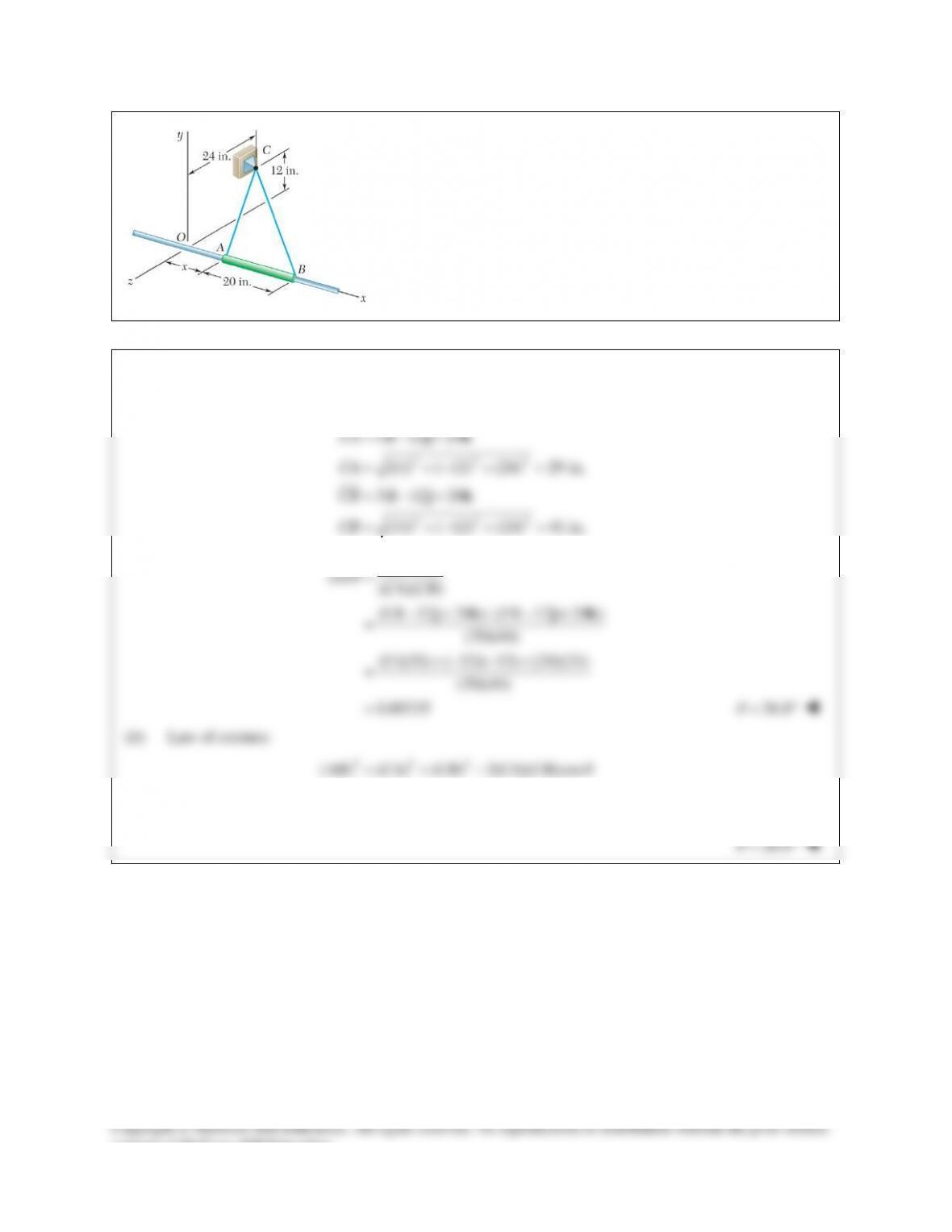
PROBLEM 3.31
The 20–in. tube AB can slide along a horizontal rod. The ends A
and B of the tube are connected by elastic cords to the fixed point
C. For the position corresponding to x = 11 in., determine the
angle formed by the two cords (a) using Eq. (3.30), (b) applying
the law of cosines to triangle ABC.
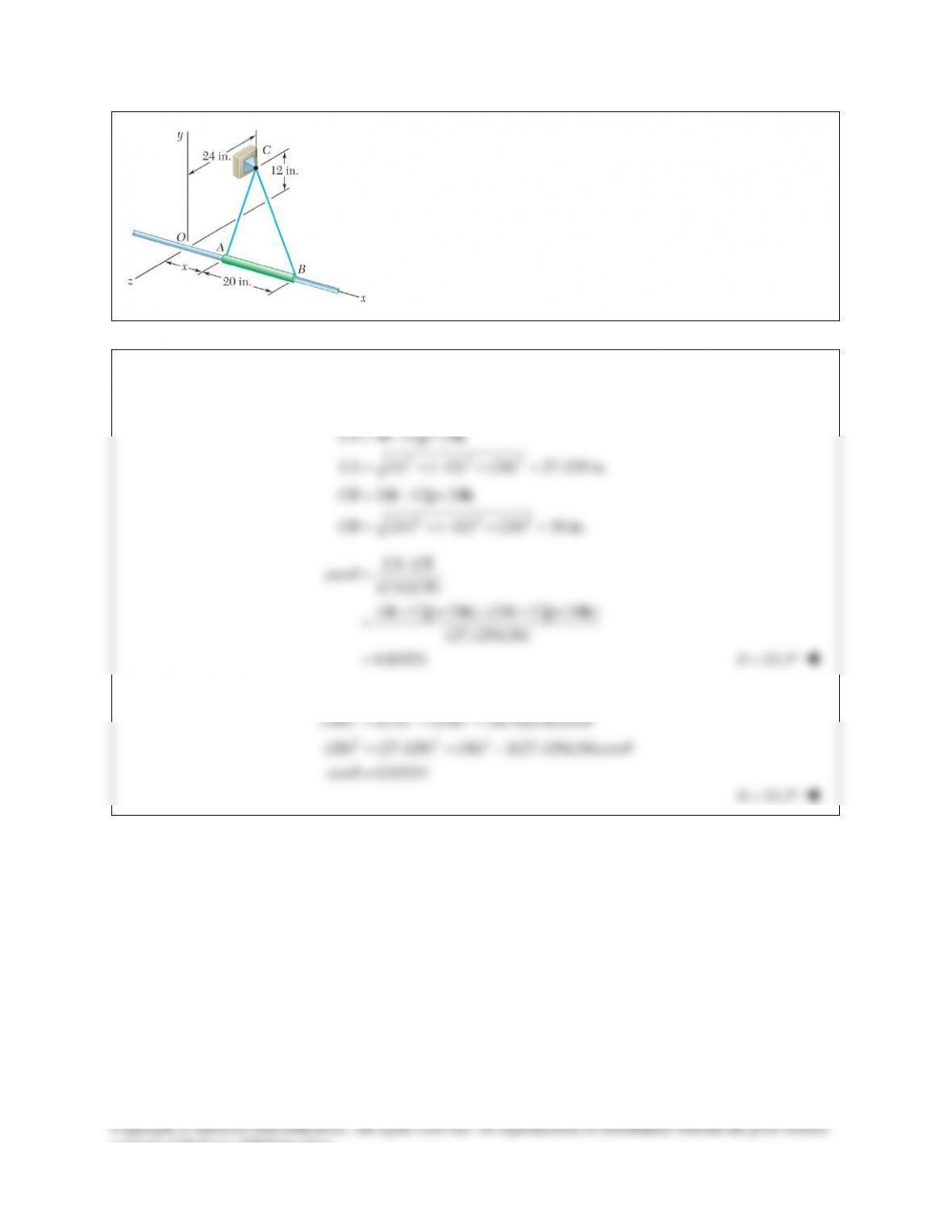
PROBLEM 3.32
Solve Prob. 3.31 for the position corresponding to x = 4 in.
PROBLEM 3.31 The 20–in. tube AB can slide along a horizontal
rod. The ends A and B of the tube are connected by elastic cords
to the fixed point C. For the position corresponding to x = 11 in.,
determine the angle formed by the two cords (a) using Eq. (3.30),
(b) applying the law of cosines to triangle ABC.
SOLUTION
(a) Using Eq. (3.30):
2 22
2 22
4 12 24
(4) ( 12) (24) 27.129 in.
24 12 24
(24) ( 12) (24) 36 in.
CA
CA
CB
CB
=−+
= +− + =
=−+
= +− + =
ijk
ijk
cos ( )( )
(4 12 24 ) (24 12 24 )
(27.129)(36)
0.83551
CA CB
CA CB
θ
⋅
=
−+ ⋅ −+
=
=
ijk ijk
33.3
θ
= °
(b) Law of cosines:
222
2 22
( ) ( ) ( ) 2( )( )cos
(20) (27.129) (36) 2(27.129)(36)cos
cos 0.83551
AB CA CB CA CB
θ
θ
θ
=+−
= +−
=
33.3
θ
= °
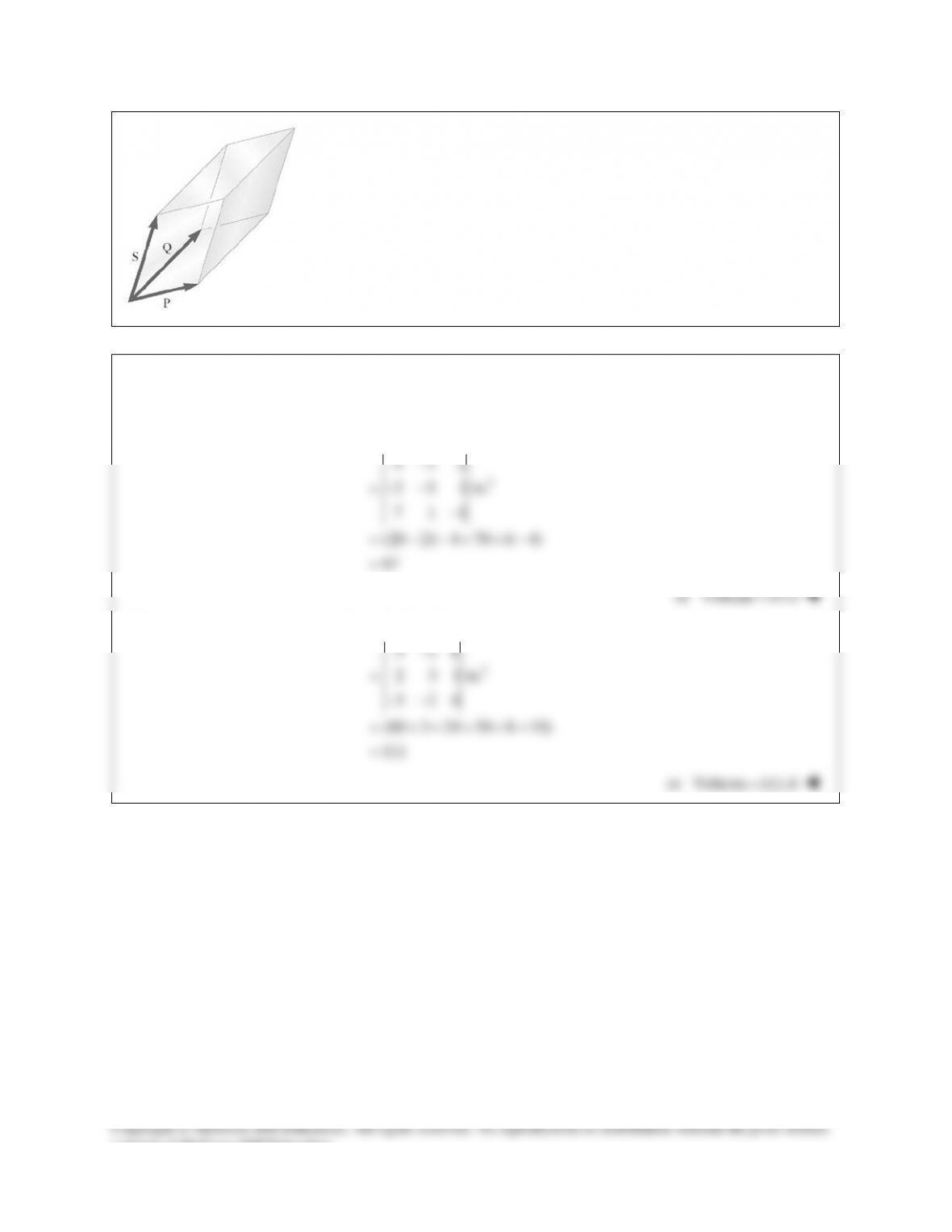
PROBLEM 3.33
Determine the volume of the parallelepiped of Fig. 3.25 when
(a) P = 4i − 3j + 2k, Q = −2i − 5j + k, and S = 7i + j − k,
(b) P = 5i − j + 6k, Q = 2i + 3j + k, and S = −3i − 2j + 4k.
SOLUTION
Volume of a parallelepiped is found using the mixed triple product.
(a)
3
Vol. ( )
432
2 5 1 in.
711
(20 21 4 70 6 4)
67
=⋅×
−
=−−
−
= − −+ +−
=
PQS
PROBLEM 3.34
Given the vectors P = 3i – j + k, Q = 4i + Qyj – 2k, and S = 2i – 2j + 2k, determine the
value of Qy for which the three vectors are coplanar.
SOLUTION
If P, Q, and S are coplanar, then P must be perpendicular to
( ).×QS
( )0⋅×=PQS
(or, the volume of a parallelepiped defined by P, Q, and S is zero).
Then
3 11
4Q 2 0
2 22
y
−
−=
−
or
6 4 8 2 8 12 0
yy
QQ+−− +− =
2
y
Q=
consent of McGraw–Hill Education.
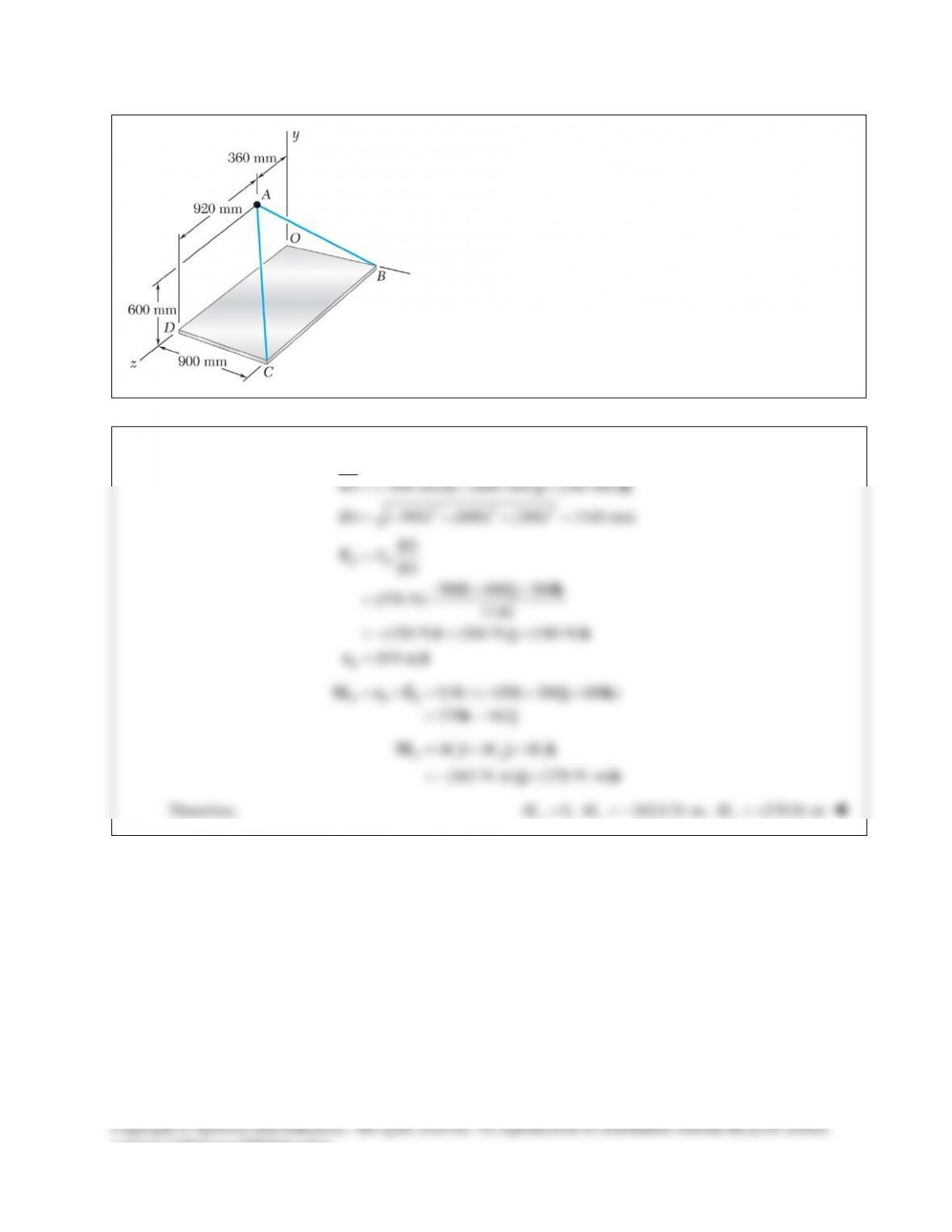
PROBLEM 3.35
Knowing that the tension in cable AB is 570 N, determine the
moment about each of the coordinate axes of the force exerted
on the plate at B.
SOLUTION
222
( 900 mm) (600 mm) (360 mm)
( 900) (600) (360) 1140 mm
900 600 360
(570 N) 1140
(450 N) (300 N) (180 N)
(0.9 m)
BB
B
BA
BA
BA
FBA
=−+ +
=−+ + =
=
−+ +
=
=−+ +
=
ijk
F
ijk
i jk
ri
F F F
0.9 ( 450 300 180 )
OBB
= × = ×− + +M rF i i j k
270 162= −kj
(162 N m) (270 N m)
Ox y z
MMM=++
=− ⋅+ ⋅
M i jk
jk
Therefore,
0, 162.0 N m, 270 N m
xy z
MM M= =− ⋅ =+⋅
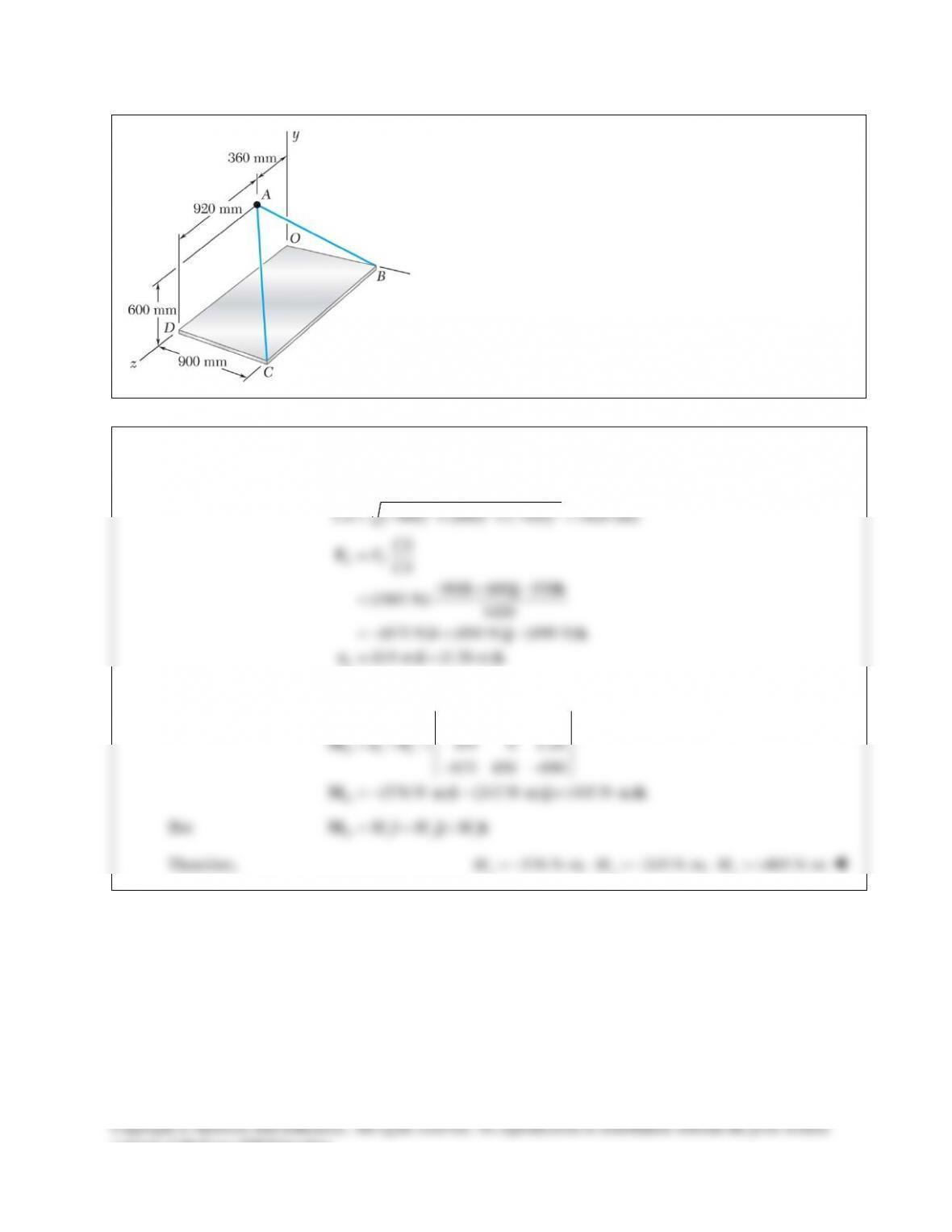
PROBLEM 3.36
Knowing that the tension in cable AC is 1065 N, determine the
moment about each of the coordinate axes of the force exerted
on the plate at C.
SOLUTION
22 2
( 900 mm) (600 mm) ( 920 mm)
( 900) (600) ( 920) 1420 mm
900 600 920
(1065 N) 1420
(675 N) (450 N) (690 N)
(0.9 m) (1.28 m)
CC
C
CA
CA
CA
FCA
=− + +−
= − + +− =
=
−+ −
=
=−+ −
= +
ij k
F
i jk
i jk
r ik
F F F
F F F
Using Eq. (3.19):
0.9 0 1.28
675 450 690
(576 N m) (243 N m) (405 N m)
OCC
O
=×=
−−
=− ⋅− ⋅+ ⋅
ijk
M rF
M ijk
But
Ox y z
MMM=++M i jk
Therefore,
576 N m, 243 N m, 405 N m
xyz
MMM=−⋅ =−⋅ =+⋅
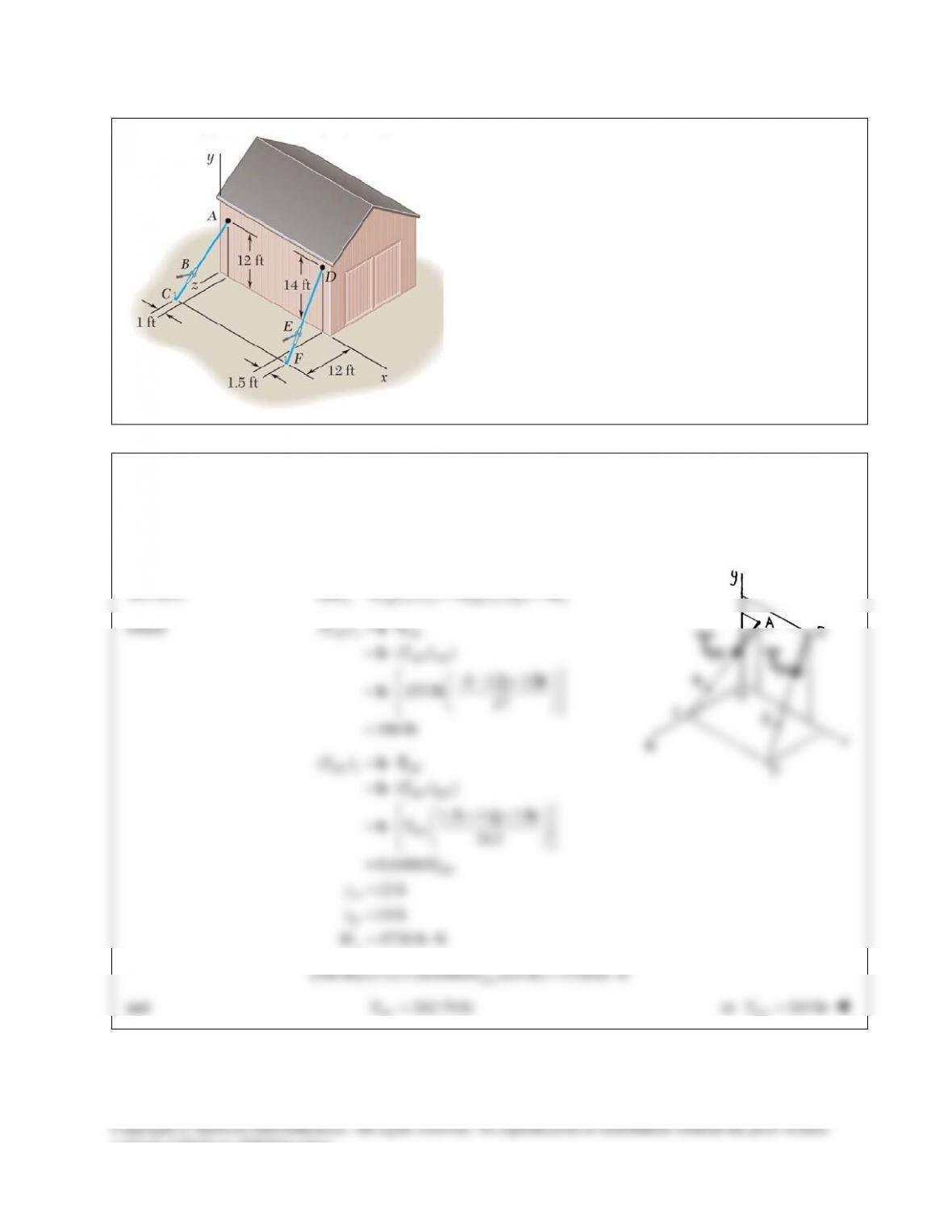
PROBLEM 3.37
A farmer uses cables and winch pullers B and E to plumb
one side of a small barn. If it is known that the sum of the
moments about the x–axis of the forces exerted by the
cables on the barn at Points A and D is equal to 4728 lb ⋅ ft,
determine the magnitude of TDE when TAB = 255 lb.
SOLUTION
The moment about the x–axis due to the two cable forces can be found using the z components of each
force acting at their intersection with the xy plane (A and D). The x components of the forces are parallel to
the x–axis, and the y components of the forces intersect the x–axis. Therefore, neither the x or y components
produce a moment about the x–axis.
We have
: ( )( ) ( )( )
x AB z A DE z D x
MT y T yMΣ +=
where
()
()
12 12
255 lb 17
180 lb
AB z AB
AB AB
T
T
l
= ⋅
= ⋅
−− +
= ⋅
=
kT
k
ijk
k
()
()
1.5 14 12
18.5
0.64865
12 ft
14 ft
4728 lb ft
DE z DE
DE DE
DE
DE
A
D
x
T
T
T
T
y
y
M
l
= ⋅
= ⋅
−+
= ⋅
=
=
=
= ⋅
kT
k
ijk
k
(180 lb)(12 ft) (0.64865 )(14 ft) 4728 lb ft
DE
T
+=⋅
and
282.79 lb
DE
T=
or
283 lb
DE
T=
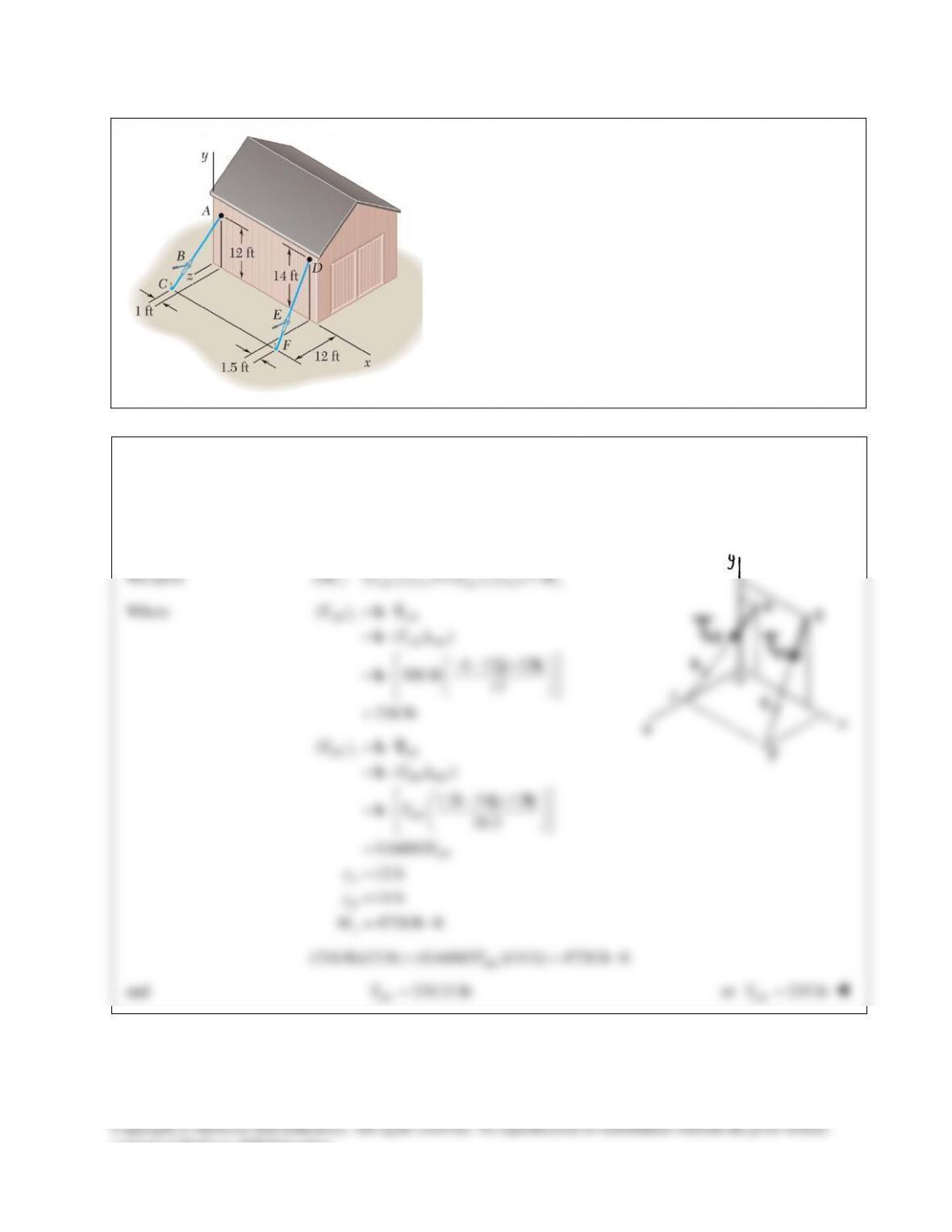
PROBLEM 3.38
Solve Problem 3.37 when the tension in cable AB is 306 lb.
PROBLEM 3.37 A farmer uses cables and winch pullers B
and E to plumb one side of a small barn. If it is known that the
sum of the moments about the x–axis of the forces exerted by
the cables on the barn at Points A and D is equal to 4728 lb ⋅ ft,
determine the magnitude of TDE when TAB = 255 lb.
SOLUTION
The moment about the x–axis due to the two cable forces can be found using the z components of each force
acting at the intersection with the xy plane (A and D). The x components of the forces are parallel to the x-axis,
and the y components of the forces intersect the x–axis. Therefore, neither the x or y components produce a
moment about the x–axis.
We have
: ( )( ) ( )( )
x AB z A DE z D x
MT y T yMΣ +=
Where
()
()
12 12
306 lb 17
216 lb
AB z AB
AB AB
T
T
= ⋅
= ⋅
−− +
= ⋅
=
kT
kλ
ijk
k
()
()
1.5 14 12
18.5
0.64865
12 ft
14 ft
4728 lb ft
DE z DE
DE DE
DE
DE
A
D
x
T
T
T
T
y
y
M
= ⋅
= ⋅
−+
= ⋅
=
=
=
= ⋅
kT
kλ
ijk
k
(216 lb)(12 ft) (0.64865 )(14 ft) 4728 lb ft
DE
T
+=⋅
and
235.21lb
DE
T=
or
235 lb
DE
T=
consent of McGraw–Hill Education.
PROBLEM 3.39
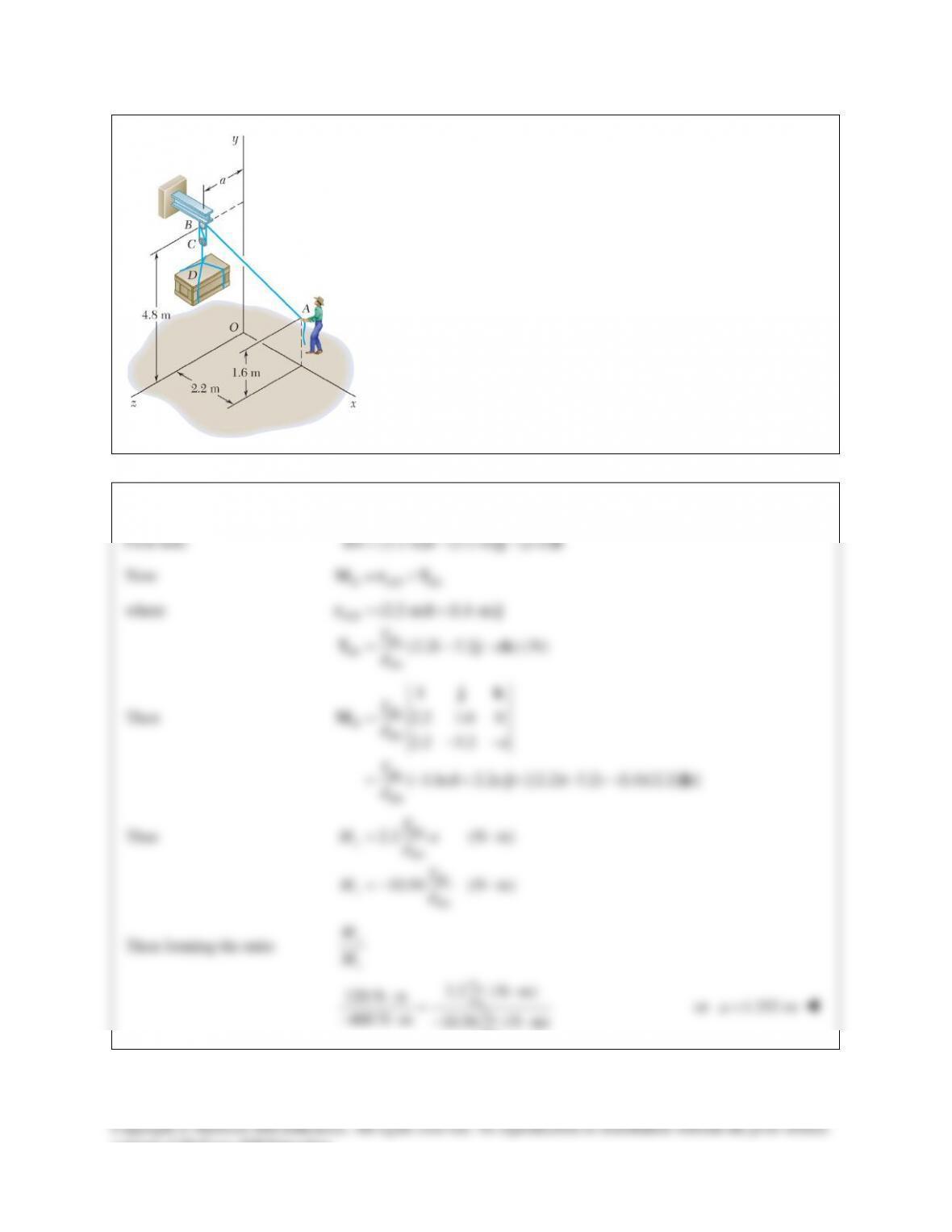
To lift a heavy crate, a man uses a block and tackle attached to the
bottom of an I–beam at hook B. Knowing that the moments about
the y and the z axes of the force exerted at B by portion AB of the
rope are, respectively, 120 N ⋅ m and −460 N ⋅ m, determine the
distance a.
SOLUTION
First note
(2.2 m) (3.2 m) ( m)BA a=−−i jk
Now
/D A D BA
= ×
Mr T
where
/
(2.2 m) (1.6 m)
(2.2 3.2 ) (N)
AD
BA
BA BA
Ta
d
= +
= −−
r ij
T i jk
Then
2.2 1.6 0
2.2 3.2
{ 1.6 2.2 [(2.2)( 3.2) (1.6)(2.2)] }
BA
DBA
BA
BA
T
da
Taa
d
=
−−
= − + + −−
i jk
M
ij k
Thus
2.2 (N m)
10.56 (N m)
BA
yBA
BA
zBA
T
Ma
d
T
Md
= ⋅
=−⋅
Then forming the ratio
y
z
M
M
2.2 (N m)
120 N m
460 N m 10.56 (N m)
BA
BA
BA
BA
T
d
T
d
⋅
⋅=
−⋅
−⋅
or
1.252 ma=
consent of McGraw–Hill Education.
PROBLEM 3.40
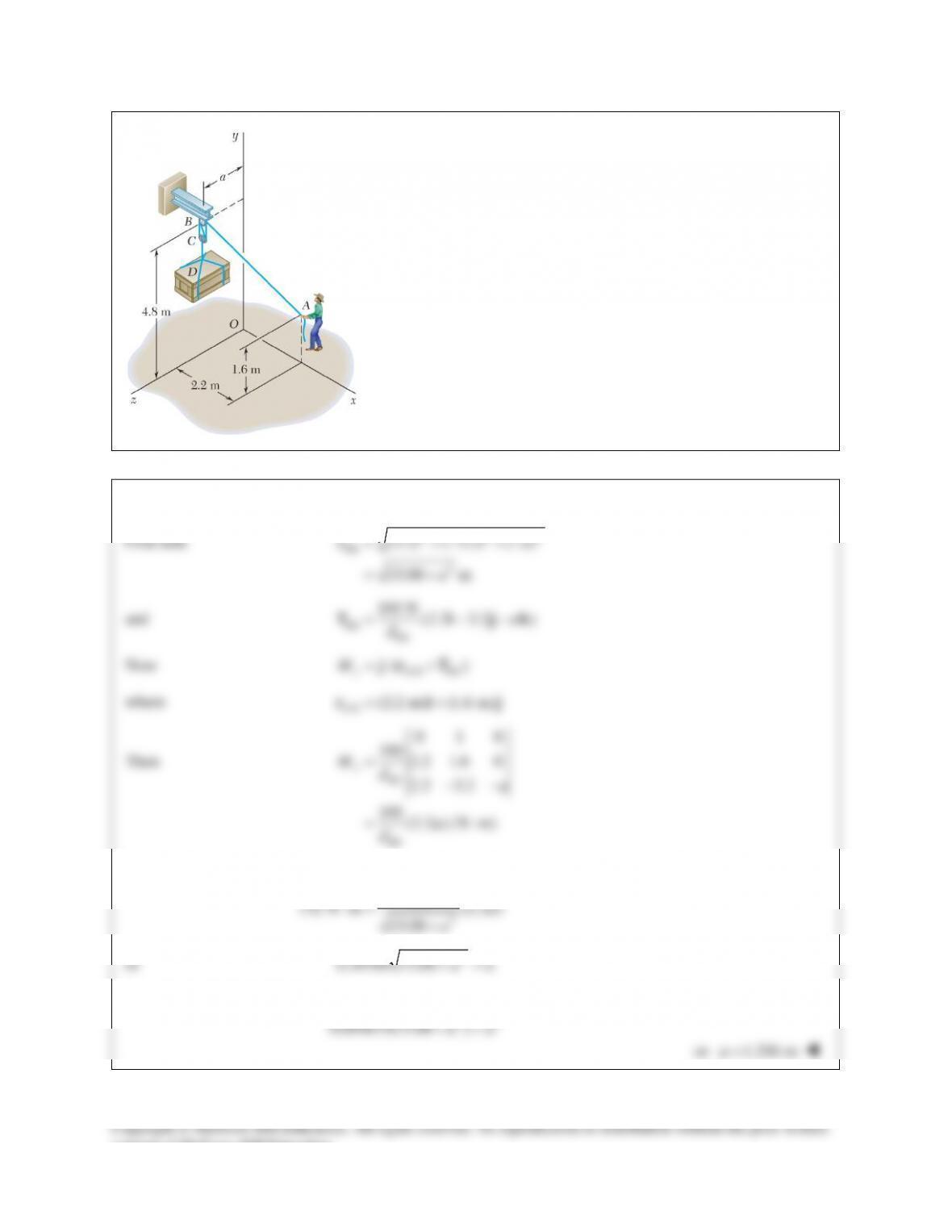
To lift a heavy crate, a man uses a block and tackle attached to the
bottom of an I–beam at hook B. Knowing that the man applies a
195-N force to end A of the rope and that the moment of that force
about the y axis is 132 N ⋅ m, determine the distance a.
SOLUTION
First note
2 22
2
(2.2) ( 3.2) ( )
15.08 m
BA
da
a
= +− +−
= +
and
195 N (2.2 3.2 )
BA BA
a
d
= −−T i jk
Now
/
()
y A D BA
M=⋅×jr T
where
/0 (2.2 m) (1.6 m)
A= +r ij
Then
010
195 2.2 1.6 0
2.2 3.2
195 (2.2 ) (N m)
yBA
BA
Mda
a
d
=
−−
= ⋅
Substituting for My and dBA
2
195
132 N m (2.2 )
15.08 a
a
⋅= +
or
2
0.30769 15.08 aa+=
Squaring both sides of the equation
22
0.094675(15.08 )aa+=
or
1.256 ma=
consent of McGraw–Hill Education.
PROBLEM 3.32
Solve Prob. 3.31 for the position corresponding to x = 4 in.
PROBLEM 3.31 The 20–in. tube AB can slide along a horizontal
rod. The ends A and B of the tube are connected by elastic cords
to the fixed point C. For the position corresponding to x = 11 in.,
determine the angle formed by the two cords (a) using Eq. (3.30),
(b) applying the law of cosines to triangle ABC.
SOLUTION
(a) Using Eq. (3.30):
2 22
2 22
4 12 24
(4) ( 12) (24) 27.129 in.
24 12 24
(24) ( 12) (24) 36 in.
CA
CA
CB
CB
=−+
= +− + =
=−+
= +− + =
ijk
ijk
cos ( )( )
(4 12 24 ) (24 12 24 )
(27.129)(36)
0.83551
CA CB
CA CB
θ
⋅
=
−+ ⋅ −+
=
=
ijk ijk
33.3
θ
= °
(b) Law of cosines:
222
2 22
( ) ( ) ( ) 2( )( )cos
(20) (27.129) (36) 2(27.129)(36)cos
cos 0.83551
AB CA CB CA CB
θ
θ
θ
=+−
= +−
=
33.3
θ
= °
PROBLEM 3.33
Determine the volume of the parallelepiped of Fig. 3.25 when
(a) P = 4i − 3j + 2k, Q = −2i − 5j + k, and S = 7i + j − k,
(b) P = 5i − j + 6k, Q = 2i + 3j + k, and S = −3i − 2j + 4k.
SOLUTION
Volume of a parallelepiped is found using the mixed triple product.
(a)
3
Vol. ( )
432
2 5 1 in.
711
(20 21 4 70 6 4)
67
=⋅×
−
=−−
−
= − −+ +−
=
PQS
PROBLEM 3.34
Given the vectors P = 3i – j + k, Q = 4i + Qyj – 2k, and S = 2i – 2j + 2k, determine the
value of Qy for which the three vectors are coplanar.
SOLUTION
If P, Q, and S are coplanar, then P must be perpendicular to
( ).×QS
( )0⋅×=PQS
(or, the volume of a parallelepiped defined by P, Q, and S is zero).
Then
3 11
4Q 2 0
2 22
y
−
−=
−
or
6 4 8 2 8 12 0
yy
QQ+−− +− =
2
y
Q=
consent of McGraw–Hill Education.
PROBLEM 3.35
Knowing that the tension in cable AB is 570 N, determine the
moment about each of the coordinate axes of the force exerted
on the plate at B.
SOLUTION
222
( 900 mm) (600 mm) (360 mm)
( 900) (600) (360) 1140 mm
900 600 360
(570 N) 1140
(450 N) (300 N) (180 N)
(0.9 m)
BB
B
BA
BA
BA
FBA
=−+ +
=−+ + =
=
−+ +
=
=−+ +
=
ijk
F
ijk
i jk
ri
F F F
0.9 ( 450 300 180 )
OBB
= × = ×− + +M rF i i j k
270 162= −kj
(162 N m) (270 N m)
Ox y z
MMM=++
=− ⋅+ ⋅
M i jk
jk
Therefore,
0, 162.0 N m, 270 N m
xy z
MM M= =− ⋅ =+⋅
PROBLEM 3.36
Knowing that the tension in cable AC is 1065 N, determine the
moment about each of the coordinate axes of the force exerted
on the plate at C.
SOLUTION
22 2
( 900 mm) (600 mm) ( 920 mm)
( 900) (600) ( 920) 1420 mm
900 600 920
(1065 N) 1420
(675 N) (450 N) (690 N)
(0.9 m) (1.28 m)
CC
C
CA
CA
CA
FCA
=− + +−
= − + +− =
=
−+ −
=
=−+ −
= +
ij k
F
i jk
i jk
r ik
F F F
F F F
Using Eq. (3.19):
0.9 0 1.28
675 450 690
(576 N m) (243 N m) (405 N m)
OCC
O
=×=
−−
=− ⋅− ⋅+ ⋅
ijk
M rF
M ijk
But
Ox y z
MMM=++M i jk
Therefore,
576 N m, 243 N m, 405 N m
xyz
MMM=−⋅ =−⋅ =+⋅
PROBLEM 3.37
A farmer uses cables and winch pullers B and E to plumb
one side of a small barn. If it is known that the sum of the
moments about the x–axis of the forces exerted by the
cables on the barn at Points A and D is equal to 4728 lb ⋅ ft,
determine the magnitude of TDE when TAB = 255 lb.
SOLUTION
The moment about the x–axis due to the two cable forces can be found using the z components of each
force acting at their intersection with the xy plane (A and D). The x components of the forces are parallel to
the x–axis, and the y components of the forces intersect the x–axis. Therefore, neither the x or y components
produce a moment about the x–axis.
We have
: ( )( ) ( )( )
x AB z A DE z D x
MT y T yMΣ +=
where
()
()
12 12
255 lb 17
180 lb
AB z AB
AB AB
T
T
l
= ⋅
= ⋅
−− +
= ⋅
=
kT
k
ijk
k
()
()
1.5 14 12
18.5
0.64865
12 ft
14 ft
4728 lb ft
DE z DE
DE DE
DE
DE
A
D
x
T
T
T
T
y
y
M
l
= ⋅
= ⋅
−+
= ⋅
=
=
=
= ⋅
kT
k
ijk
k
(180 lb)(12 ft) (0.64865 )(14 ft) 4728 lb ft
DE
T
+=⋅
and
282.79 lb
DE
T=
or
283 lb
DE
T=
PROBLEM 3.38
Solve Problem 3.37 when the tension in cable AB is 306 lb.
PROBLEM 3.37 A farmer uses cables and winch pullers B
and E to plumb one side of a small barn. If it is known that the
sum of the moments about the x–axis of the forces exerted by
the cables on the barn at Points A and D is equal to 4728 lb ⋅ ft,
determine the magnitude of TDE when TAB = 255 lb.
SOLUTION
The moment about the x–axis due to the two cable forces can be found using the z components of each force
acting at the intersection with the xy plane (A and D). The x components of the forces are parallel to the x-axis,
and the y components of the forces intersect the x–axis. Therefore, neither the x or y components produce a
moment about the x–axis.
We have
: ( )( ) ( )( )
x AB z A DE z D x
MT y T yMΣ +=
Where
()
()
12 12
306 lb 17
216 lb
AB z AB
AB AB
T
T
= ⋅
= ⋅
−− +
= ⋅
=
kT
kλ
ijk
k
()
()
1.5 14 12
18.5
0.64865
12 ft
14 ft
4728 lb ft
DE z DE
DE DE
DE
DE
A
D
x
T
T
T
T
y
y
M
= ⋅
= ⋅
−+
= ⋅
=
=
=
= ⋅
kT
kλ
ijk
k
(216 lb)(12 ft) (0.64865 )(14 ft) 4728 lb ft
DE
T
+=⋅
and
235.21lb
DE
T=
or
235 lb
DE
T=
consent of McGraw–Hill Education.
PROBLEM 3.39
To lift a heavy crate, a man uses a block and tackle attached to the
bottom of an I–beam at hook B. Knowing that the moments about
the y and the z axes of the force exerted at B by portion AB of the
rope are, respectively, 120 N ⋅ m and −460 N ⋅ m, determine the
distance a.
SOLUTION
First note
(2.2 m) (3.2 m) ( m)BA a=−−i jk
Now
/D A D BA
= ×
Mr T
where
/
(2.2 m) (1.6 m)
(2.2 3.2 ) (N)
AD
BA
BA BA
Ta
d
= +
= −−
r ij
T i jk
Then
2.2 1.6 0
2.2 3.2
{ 1.6 2.2 [(2.2)( 3.2) (1.6)(2.2)] }
BA
DBA
BA
BA
T
da
Taa
d
=
−−
= − + + −−
i jk
M
ij k
Thus
2.2 (N m)
10.56 (N m)
BA
yBA
BA
zBA
T
Ma
d
T
Md
= ⋅
=−⋅
Then forming the ratio
y
z
M
M
2.2 (N m)
120 N m
460 N m 10.56 (N m)
BA
BA
BA
BA
T
d
T
d
⋅
⋅=
−⋅
−⋅
or
1.252 ma=
consent of McGraw–Hill Education.
PROBLEM 3.40
To lift a heavy crate, a man uses a block and tackle attached to the
bottom of an I–beam at hook B. Knowing that the man applies a
195-N force to end A of the rope and that the moment of that force
about the y axis is 132 N ⋅ m, determine the distance a.
SOLUTION
First note
2 22
2
(2.2) ( 3.2) ( )
15.08 m
BA
da
a
= +− +−
= +
and
195 N (2.2 3.2 )
BA BA
a
d
= −−T i jk
Now
/
()
y A D BA
M=⋅×jr T
where
/0 (2.2 m) (1.6 m)
A= +r ij
Then
010
195 2.2 1.6 0
2.2 3.2
195 (2.2 ) (N m)
yBA
BA
Mda
a
d
=
−−
= ⋅
Substituting for My and dBA
2
195
132 N m (2.2 )
15.08 a
a
⋅= +
or
2
0.30769 15.08 aa+=
Squaring both sides of the equation
22
0.094675(15.08 )aa+=
or
1.256 ma=
consent of McGraw–Hill Education.