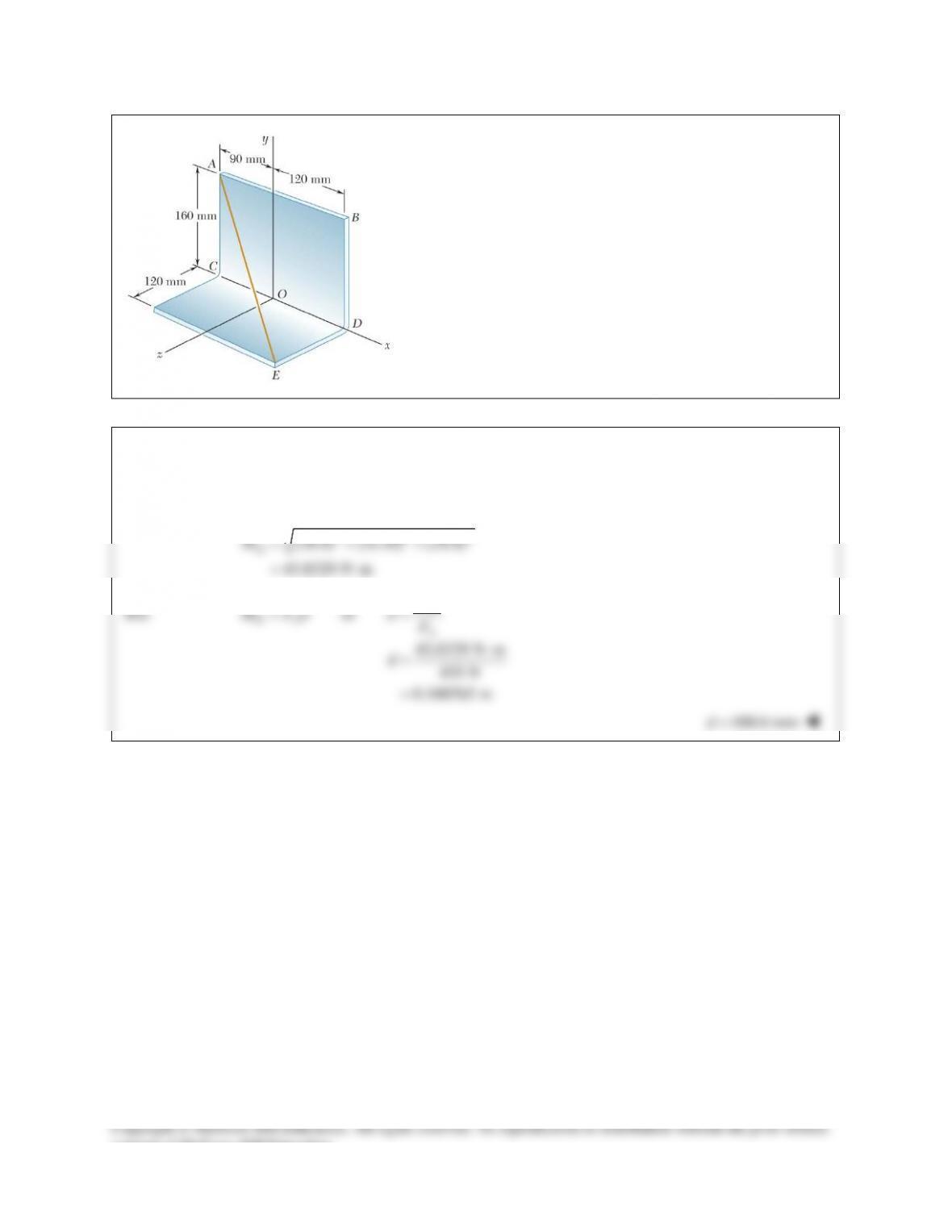
PROBLEM 3.22
In Prob. 3.16, determine the perpendicular distance from point
O to wire AE.
PROBLEM 3.16 The wire AE is stretched between the
corners A and E of a bent plate. Knowing that the tension in
the wire is 435 N, determine the moment about O of the force
exerted by the wire (a) on corner A, (b) on corner E.
SOLUTION
From the solution to Prob. 3.16
2 22
(28.8 N m) (16.20 N m) (28.8 N m)
(28.8) (16.20) (28.8)
43.8329 N m
O
O
M
= ⋅+ ⋅− ⋅
= ++
= ⋅
M i jk
But
or O
OA A
M
M Fd d F
= =
43.8329 N m
435 N
0.100765 m
d⋅
=
=
100.8 mmd=
consent of McGraw–Hill Education.
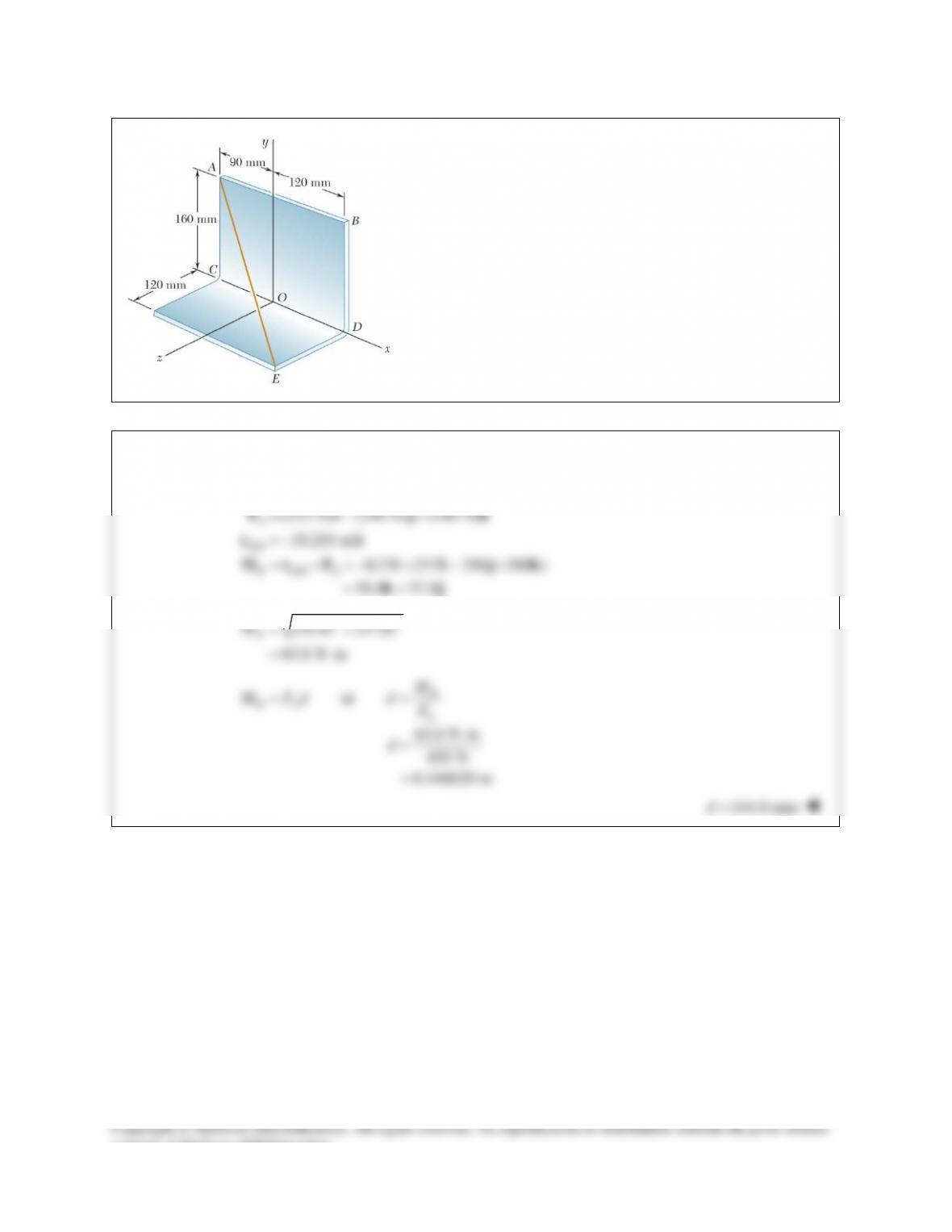
PROBLEM 3.23
In Prob. 3.16, determine the perpendicular distance from point
B to wire AE.
PROBLEM 3.16 The wire AE is stretched between the
corners A and E of a bent plate. Knowing that the tension in
the wire is 435 N, determine the moment about O of the force
exerted by the wire (a) on corner A, (b) on corner E.
SOLUTION
From the solution to Prob. 3.16
/
/
(315 N) (240 N) (180 N)
(0.210 m)
0.21 (315 240 180 )
A
AB
B AB A
=−+
= −
= ×=− × − +
F i jk
ri
Mr F i i j k
50.4 37.8= +kj
22
(50.4) (37.8)
63.0 N m
B
M= +
= ⋅
or B
BA A
M
M Fd d F
= =
63.0 N m
435 N
0.144829 m
d⋅
=
=
144.8 mmd=
consent of McGraw–Hill Education.
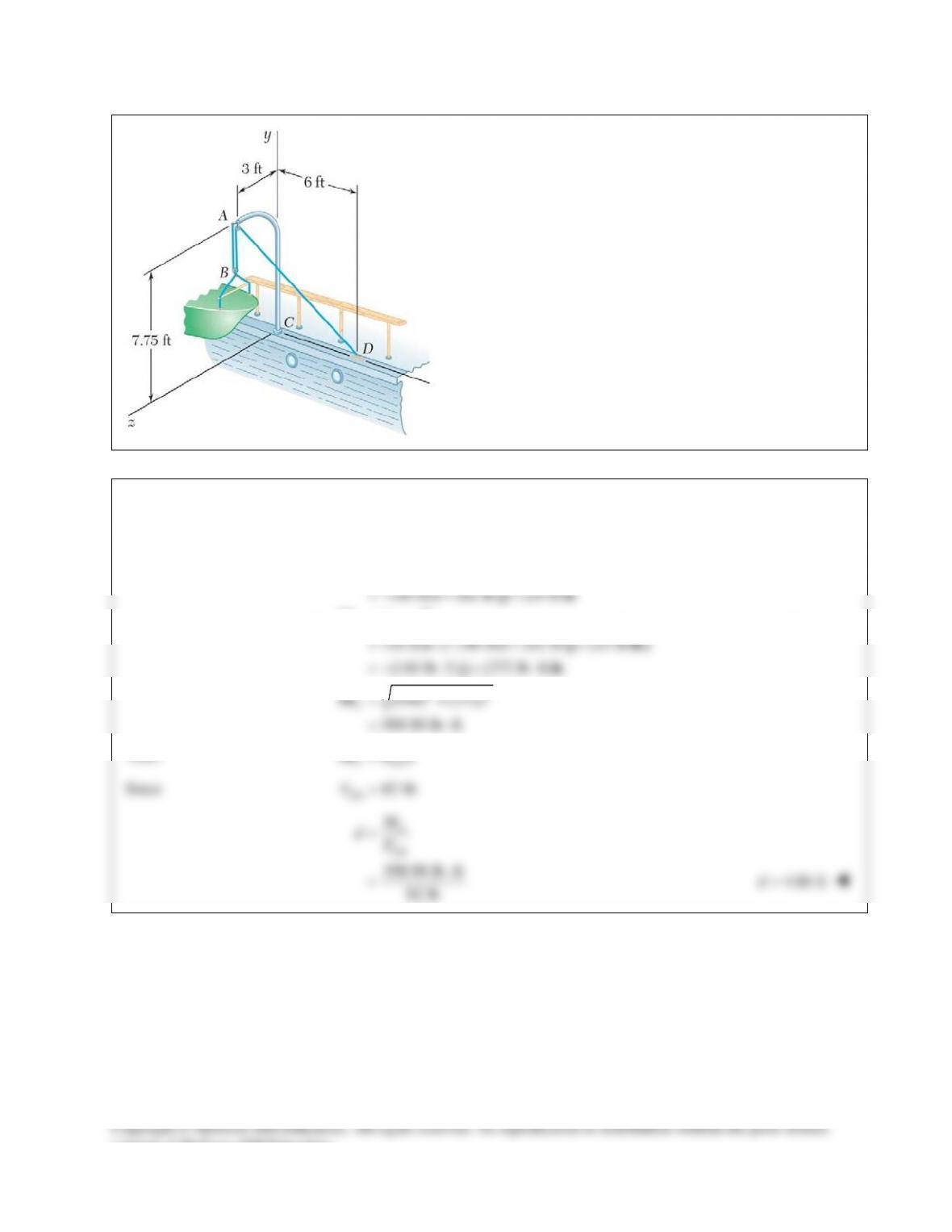
PROBLEM 3.24
In Problem 3.20, determine the perpendicular distance from
point C to portion AD of the line ABAD.
PROBLEM 3.20 A small boat hangs from two davits, one of
which is shown in the figure. The tension in line ABAD is
82 lb. Determine the moment about C of the resultant force
RA exerted on the davit at A.
SOLUTION
First compute the moment about C of the force
DA
F
exerted by the line on D:
From Problem 3.20:
/
22
(48 lb) (62 lb) (24 lb)
(6 ft) [ (48 lb) (62 lb) (24 lb) ]
(144 lb ft) (372 lb ft)
(144) (372)
398.90 lb ft
DA AD
C D C DA
C
= −
=−+ +
= ×
=+ ×− + +
=− ⋅+ ⋅
= +
= ⋅
FF
ijk
Mr F
i ijk
jk
M
Then
C DAd=MF
Since
82 lb
DA
F=
398.90 lb ft
82 lb
C
DA
M
dF
=
⋅
=
4.86 ftd=
PROBLEM 3.25
Given the vectors P = 3i − j + 2k, Q = 4i + 5j − 3k, and S = −2i + 3j − k, compute the scalar products P · Q,
P · S, and Q · S.
SOLUTION
(3 2 ) (4 5 3 )
(3)(4) ( 1)(5) (2)( 3)
1256
⋅ = −+ ⋅ + −
= +− + −
= −−
PQ i j k i j k
1⋅=+PQ
(3 2 ) ( 2 3 )
(3)( 2) ( 1)(3) (2)( 1)
632
⋅ = − + ⋅− + −
= − +− + −
=−− −
PS i j k i j k
11⋅=−PS
(453)(23 )
(4)( 2) (5)(3) ( 3)( 1)
8 15 3
⋅ = + − ⋅− + −
= − + +− −
=−+ +
QS i j k i j k
10⋅=+QS
consent of McGraw–Hill Education.
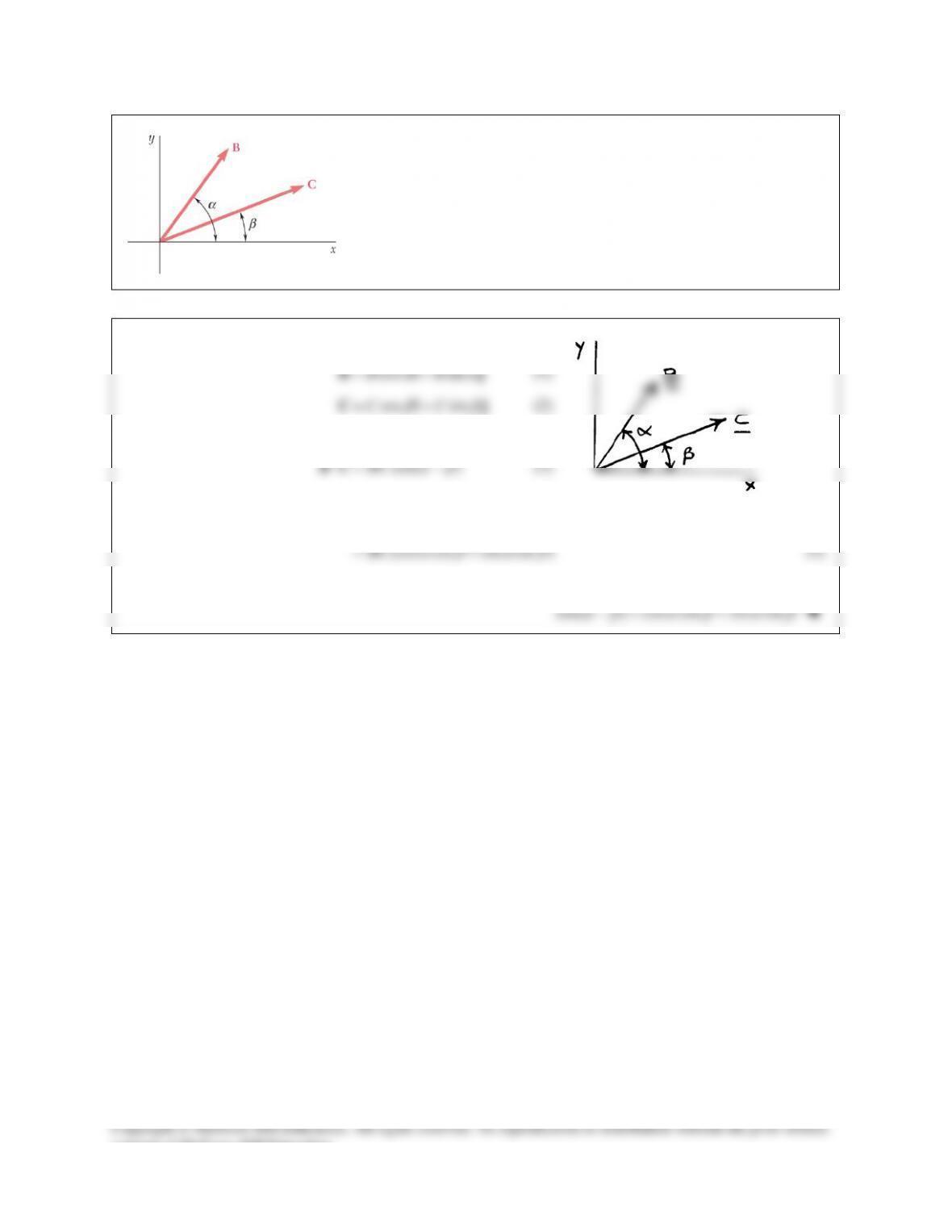
PROBLEM 3.26
Form the scalar product B · C and use the result obtained to prove the
identity
cos (α − β) = cos α cos β + sin α sin β .
SOLUTION
cos sinBB
αα
= +Bij
(1)
cos sinCC
ββ
= +Cij
(2)
By definition:
cos( )BC
αβ
⋅= −BC
(3)
From (1) and (2):
( cos sin ) ( cos sin )
(cos cos sin sin )
BBCC
BC
αα β β
αβ αβ
⋅= + ⋅ +
= +
BC i j i j
(4)
Equating the right-hand members of (3) and (4),
cos( ) cos cos sin sin
αβ α β α β
−= +
consent of McGraw–Hill Education.
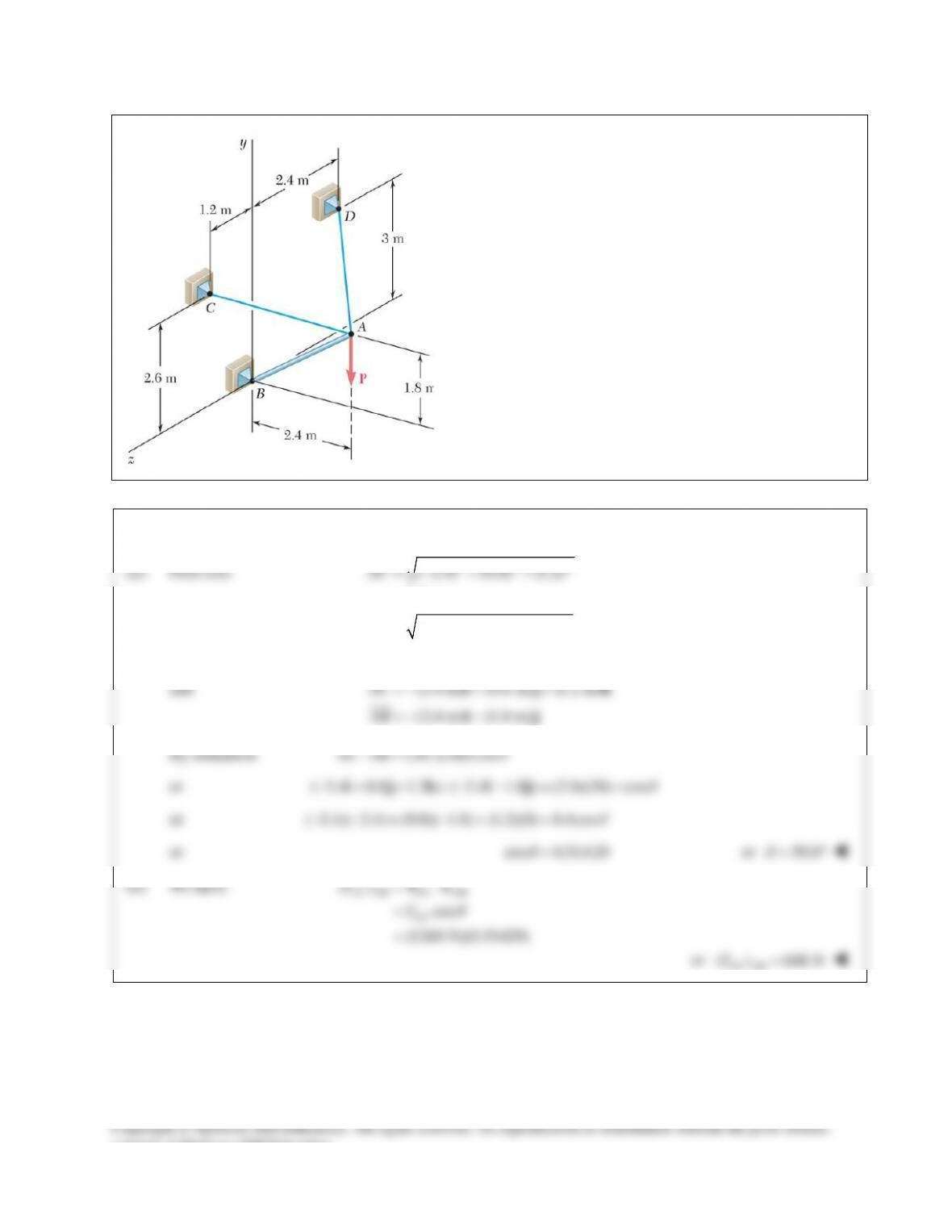
PROBLEM 3.27
Knowing that the tension in cable AC is 1260 N, determine
(a) the angle between cable AC and the boom AB, (b) the
projection on AB of the force exerted by cable AC at Point A.
SOLUTION
(a) First note
222
2 22
( 2.4) (0.8) (1.2)
2.8 m
( 2.4) ( 1.8) (0)
3.0 m
AC
AB
=−+ +
=
= − +− +
=
and
(2.4 m) (0.8 m) (1.2 m)
(2.4 m) (1.8 m)
AC
AB
=−+ +
=−−
i jk
ij
C
C
By definition
( )( )cosAC AB AC AB
θ
⋅=
C C
or
( 2.4 0.8 1.2 ) ( 2.4 1.8 ) (2.8)(30) cos
θ
−+ + ⋅−− = ×i jk ij
or
( 2.4)( 2.4) (0.8)( 1.8) (1.2)(0) 8.4cos
θ
− −+ −+ =
or
cos 0.51429
θ
=
or
59.0
θ
= °
(b) We have
()
cos
(1260 N)(0.51429)
AC AB AC AB
AC
T
T
θ
= ⋅
=
=
Tλ
or
( ) 648 N
AC AB
T=
consent of McGraw–Hill Education.
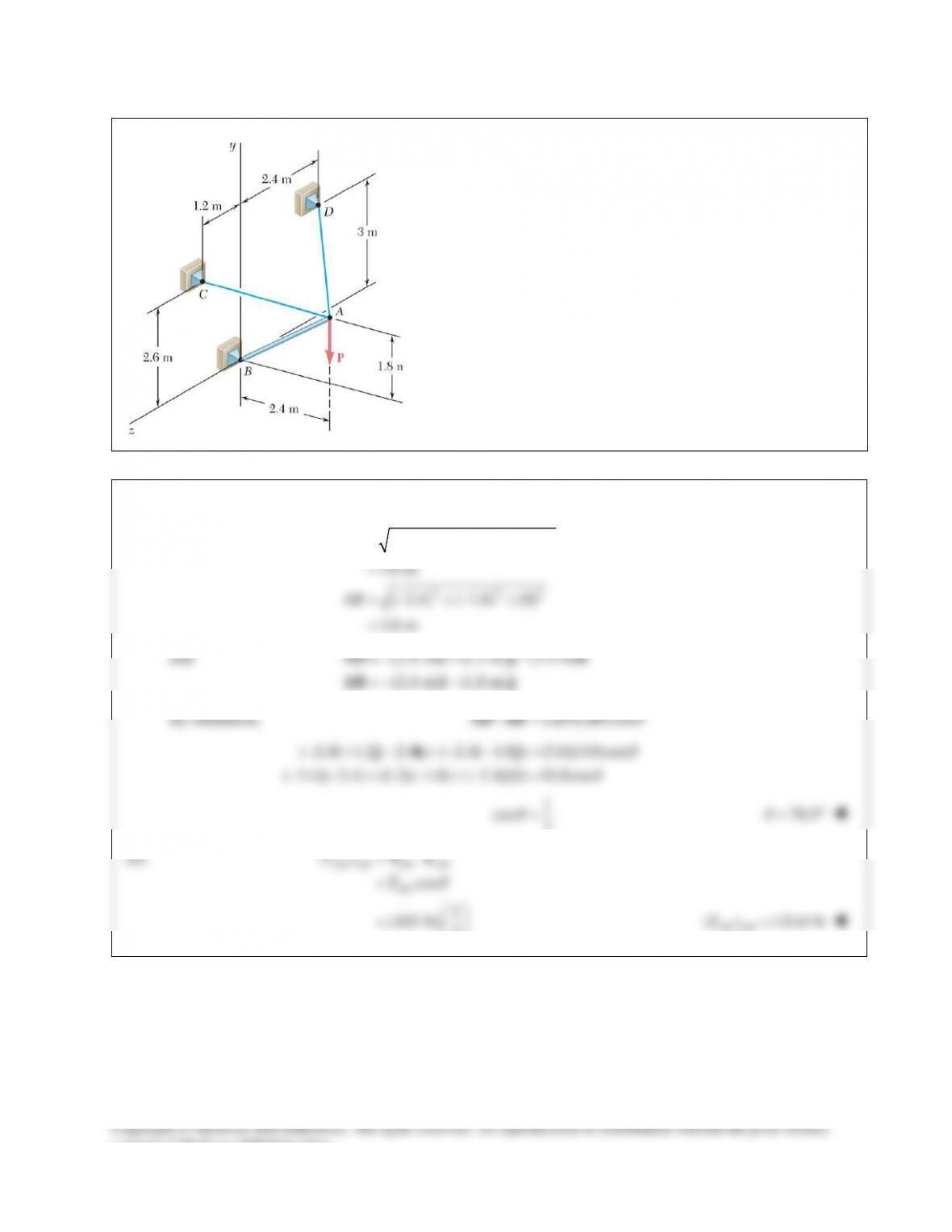
PROBLEM 3.28
Knowing that the tension in cable AD is 405 N, determine (a) the
angle between cable AD and the boom AB, (b) the projection on
AB of the force exerted by cable AD at Point A.
SOLUTION
(a) First note
22 2
2 22
( 2.4) (1.2) ( 2.4)
3.6 m
( 2.4) ( 1.8) (0)
3.0 m
AD
AB
= − + +−
=
= − +− +
=
and
(2.4 m) (1.2 m) (2.4 m)
(2.4 m) (1.8 m)
=−+ −
=−−
AD i j k
AB i j
By definition,
( )( )cosAD AB
θ
⋅=
AD AB
( 2.4 1.2 2.4 ) ( 2.4 1.8 ) (3.6)(3.0)cos
( 2.4)( 2.4) (1.2)( 1.8) ( 2.4)(0) 10.8cos
θ
θ
−+ − ⋅−− =
− − + − +− =
ijk ij
1
cos 3
θ
=
70.5
θ
= °
(b)
()
cos
AD AB AD AB
AD
T
T
θ
= ⋅
=
Tλ
1
(405 N) 3
=
( ) 135.0 N
AD AB
T=
consent of McGraw–Hill Education.
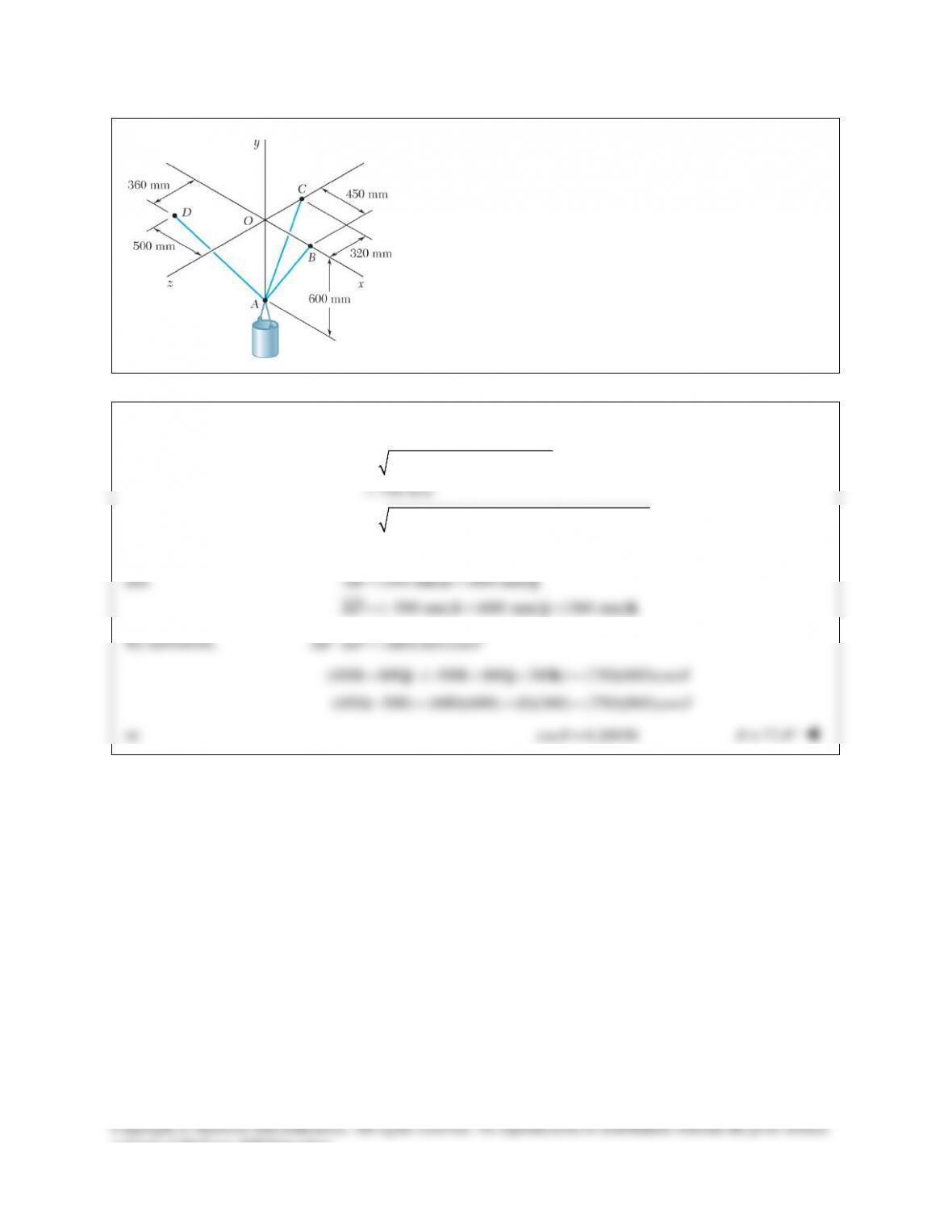
PROBLEM 3.29
Three cables are used to support a container as shown.
Determine the angle formed by cables AB and AD.
SOLUTION
First note:
22
222
(450 mm) (600 mm)
750 mm
( 500 mm) (600 mm) (360 mm)
860 mm
AB
AD
= +
=
=−+ +
=
and
(450 mm) (600 mm)
( 500 mm) (600 mm) (360 mm)
AB
AD
= +
=−+ +
ij
ijk
By definition,
( )( )cosAB AD AB AD
θ
⋅=
(450 600 ) ( 500 600 360 ) (750)(860)cos
θ
+ ⋅− + + =ij ijk
(450)( 500) (600)(600) (0)(360) (750)(860)cos
θ
−+ + =
or
cos 0.20930
θ
=
77.9
θ
= °
consent of McGraw–Hill Education.
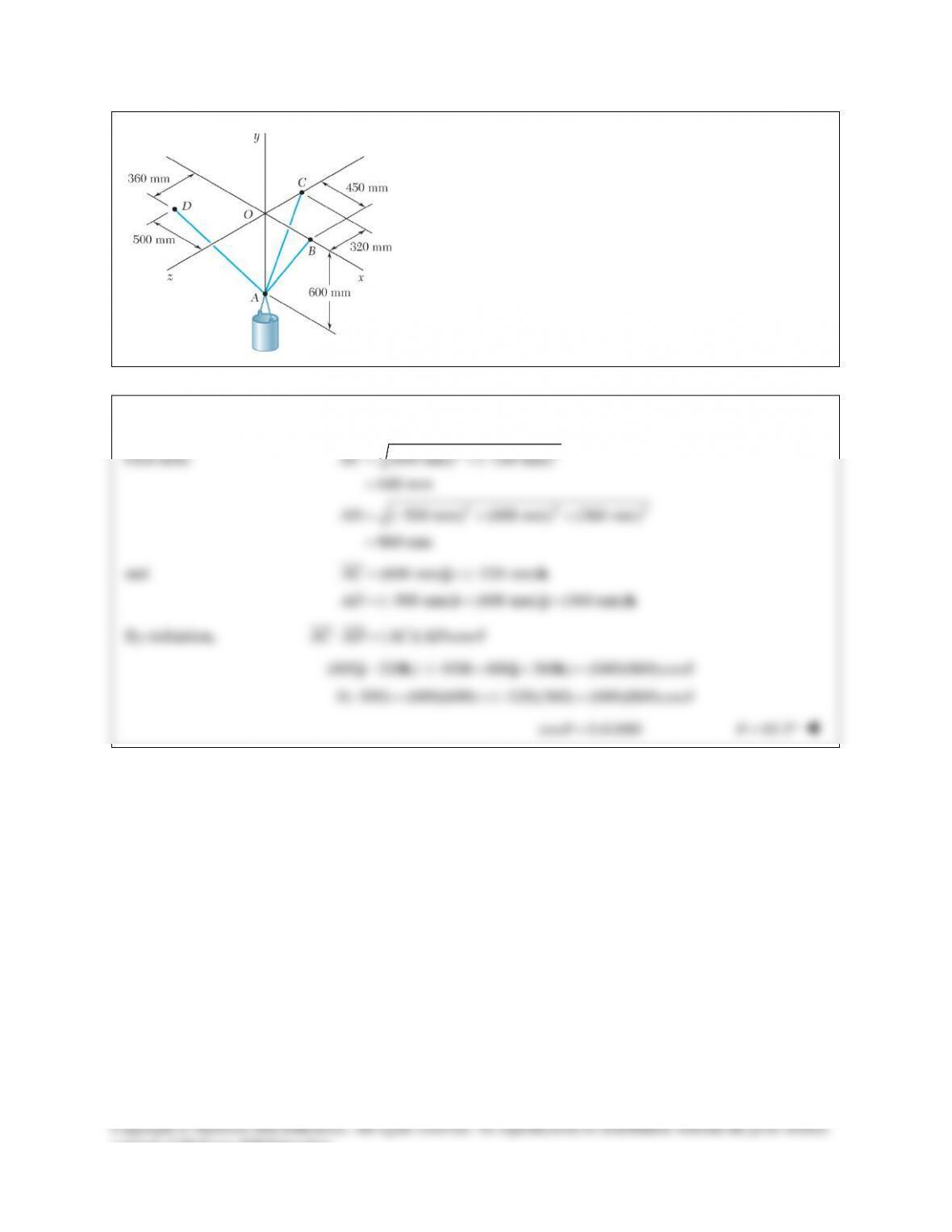
PROBLEM 3.30
Three cables are used to support a container as shown.
Determine the angle formed by cables AC and AD.
SOLUTION
First note:
22
222
(600 mm) ( 320 mm)
680 mm
( 500 mm) (600 mm) (360 mm)
860 mm
AC
AD
= +−
=
=−+ +
=
and
(600 mm) ( 320 mm)
( 500 mm) (600 mm) (360 mm)
AC
AD
= +−
=−+ +
jk
ijk
By definition,
( )( )cos
AC AD AC AD
θ
⋅=
(600 320 ) ( 500 600 360 ) (680)(860)cos
θ
− ⋅− + + =jk i jk
0( 500) (600)(600) ( 320)(360) (680)(860)cos
θ
− + +− =
cos 0.41860
θ
=
65.3
θ
= °
PROBLEM 3.22
In Prob. 3.16, determine the perpendicular distance from point
O to wire AE.
PROBLEM 3.16 The wire AE is stretched between the
corners A and E of a bent plate. Knowing that the tension in
the wire is 435 N, determine the moment about O of the force
exerted by the wire (a) on corner A, (b) on corner E.
SOLUTION
From the solution to Prob. 3.16
2 22
(28.8 N m) (16.20 N m) (28.8 N m)
(28.8) (16.20) (28.8)
43.8329 N m
O
O
M
= ⋅+ ⋅− ⋅
= ++
= ⋅
M i jk
But
or O
OA A
M
M Fd d F
= =
43.8329 N m
435 N
0.100765 m
d⋅
=
=
100.8 mmd=
consent of McGraw–Hill Education.
PROBLEM 3.23
In Prob. 3.16, determine the perpendicular distance from point
B to wire AE.
PROBLEM 3.16 The wire AE is stretched between the
corners A and E of a bent plate. Knowing that the tension in
the wire is 435 N, determine the moment about O of the force
exerted by the wire (a) on corner A, (b) on corner E.
SOLUTION
From the solution to Prob. 3.16
/
/
(315 N) (240 N) (180 N)
(0.210 m)
0.21 (315 240 180 )
A
AB
B AB A
=−+
= −
= ×=− × − +
F i jk
ri
Mr F i i j k
50.4 37.8= +kj
22
(50.4) (37.8)
63.0 N m
B
M= +
= ⋅
or B
BA A
M
M Fd d F
= =
63.0 N m
435 N
0.144829 m
d⋅
=
=
144.8 mmd=
consent of McGraw–Hill Education.
PROBLEM 3.24
In Problem 3.20, determine the perpendicular distance from
point C to portion AD of the line ABAD.
PROBLEM 3.20 A small boat hangs from two davits, one of
which is shown in the figure. The tension in line ABAD is
82 lb. Determine the moment about C of the resultant force
RA exerted on the davit at A.
SOLUTION
First compute the moment about C of the force
DA
F
exerted by the line on D:
From Problem 3.20:
/
22
(48 lb) (62 lb) (24 lb)
(6 ft) [ (48 lb) (62 lb) (24 lb) ]
(144 lb ft) (372 lb ft)
(144) (372)
398.90 lb ft
DA AD
C D C DA
C
= −
=−+ +
= ×
=+ ×− + +
=− ⋅+ ⋅
= +
= ⋅
FF
ijk
Mr F
i ijk
jk
M
Then
C DAd=MF
Since
82 lb
DA
F=
398.90 lb ft
82 lb
C
DA
M
dF
=
⋅
=
4.86 ftd=
PROBLEM 3.25
Given the vectors P = 3i − j + 2k, Q = 4i + 5j − 3k, and S = −2i + 3j − k, compute the scalar products P · Q,
P · S, and Q · S.
SOLUTION
(3 2 ) (4 5 3 )
(3)(4) ( 1)(5) (2)( 3)
1256
⋅ = −+ ⋅ + −
= +− + −
= −−
PQ i j k i j k
1⋅=+PQ
(3 2 ) ( 2 3 )
(3)( 2) ( 1)(3) (2)( 1)
632
⋅ = − + ⋅− + −
= − +− + −
=−− −
PS i j k i j k
11⋅=−PS
(453)(23 )
(4)( 2) (5)(3) ( 3)( 1)
8 15 3
⋅ = + − ⋅− + −
= − + +− −
=−+ +
QS i j k i j k
10⋅=+QS
consent of McGraw–Hill Education.
PROBLEM 3.26
Form the scalar product B · C and use the result obtained to prove the
identity
cos (α − β) = cos α cos β + sin α sin β .
SOLUTION
cos sinBB
αα
= +Bij
(1)
cos sinCC
ββ
= +Cij
(2)
By definition:
cos( )BC
αβ
⋅= −BC
(3)
From (1) and (2):
( cos sin ) ( cos sin )
(cos cos sin sin )
BBCC
BC
αα β β
αβ αβ
⋅= + ⋅ +
= +
BC i j i j
(4)
Equating the right-hand members of (3) and (4),
cos( ) cos cos sin sin
αβ α β α β
−= +
consent of McGraw–Hill Education.
PROBLEM 3.27
Knowing that the tension in cable AC is 1260 N, determine
(a) the angle between cable AC and the boom AB, (b) the
projection on AB of the force exerted by cable AC at Point A.
SOLUTION
(a) First note
222
2 22
( 2.4) (0.8) (1.2)
2.8 m
( 2.4) ( 1.8) (0)
3.0 m
AC
AB
=−+ +
=
= − +− +
=
and
(2.4 m) (0.8 m) (1.2 m)
(2.4 m) (1.8 m)
AC
AB
=−+ +
=−−
i jk
ij
C
C
By definition
( )( )cosAC AB AC AB
θ
⋅=
C C
or
( 2.4 0.8 1.2 ) ( 2.4 1.8 ) (2.8)(30) cos
θ
−+ + ⋅−− = ×i jk ij
or
( 2.4)( 2.4) (0.8)( 1.8) (1.2)(0) 8.4cos
θ
− −+ −+ =
or
cos 0.51429
θ
=
or
59.0
θ
= °
(b) We have
()
cos
(1260 N)(0.51429)
AC AB AC AB
AC
T
T
θ
= ⋅
=
=
Tλ
or
( ) 648 N
AC AB
T=
consent of McGraw–Hill Education.
PROBLEM 3.28
Knowing that the tension in cable AD is 405 N, determine (a) the
angle between cable AD and the boom AB, (b) the projection on
AB of the force exerted by cable AD at Point A.
SOLUTION
(a) First note
22 2
2 22
( 2.4) (1.2) ( 2.4)
3.6 m
( 2.4) ( 1.8) (0)
3.0 m
AD
AB
= − + +−
=
= − +− +
=
and
(2.4 m) (1.2 m) (2.4 m)
(2.4 m) (1.8 m)
=−+ −
=−−
AD i j k
AB i j
By definition,
( )( )cosAD AB
θ
⋅=
AD AB
( 2.4 1.2 2.4 ) ( 2.4 1.8 ) (3.6)(3.0)cos
( 2.4)( 2.4) (1.2)( 1.8) ( 2.4)(0) 10.8cos
θ
θ
−+ − ⋅−− =
− − + − +− =
ijk ij
1
cos 3
θ
=
70.5
θ
= °
(b)
()
cos
AD AB AD AB
AD
T
T
θ
= ⋅
=
Tλ
1
(405 N) 3
=
( ) 135.0 N
AD AB
T=
consent of McGraw–Hill Education.
PROBLEM 3.29
Three cables are used to support a container as shown.
Determine the angle formed by cables AB and AD.
SOLUTION
First note:
22
222
(450 mm) (600 mm)
750 mm
( 500 mm) (600 mm) (360 mm)
860 mm
AB
AD
= +
=
=−+ +
=
and
(450 mm) (600 mm)
( 500 mm) (600 mm) (360 mm)
AB
AD
= +
=−+ +
ij
ijk
By definition,
( )( )cosAB AD AB AD
θ
⋅=
(450 600 ) ( 500 600 360 ) (750)(860)cos
θ
+ ⋅− + + =ij ijk
(450)( 500) (600)(600) (0)(360) (750)(860)cos
θ
−+ + =
or
cos 0.20930
θ
=
77.9
θ
= °
consent of McGraw–Hill Education.
PROBLEM 3.30
Three cables are used to support a container as shown.
Determine the angle formed by cables AC and AD.
SOLUTION
First note:
22
222
(600 mm) ( 320 mm)
680 mm
( 500 mm) (600 mm) (360 mm)
860 mm
AC
AD
= +−
=
=−+ +
=
and
(600 mm) ( 320 mm)
( 500 mm) (600 mm) (360 mm)
AC
AD
= +−
=−+ +
jk
ijk
By definition,
( )( )cos
AC AD AC AD
θ
⋅=
(600 320 ) ( 500 600 360 ) (680)(860)cos
θ
− ⋅− + + =jk i jk
0( 500) (600)(600) ( 320)(360) (680)(860)cos
θ
− + +− =
cos 0.41860
θ
=
65.3
θ
= °