Problem 6.52
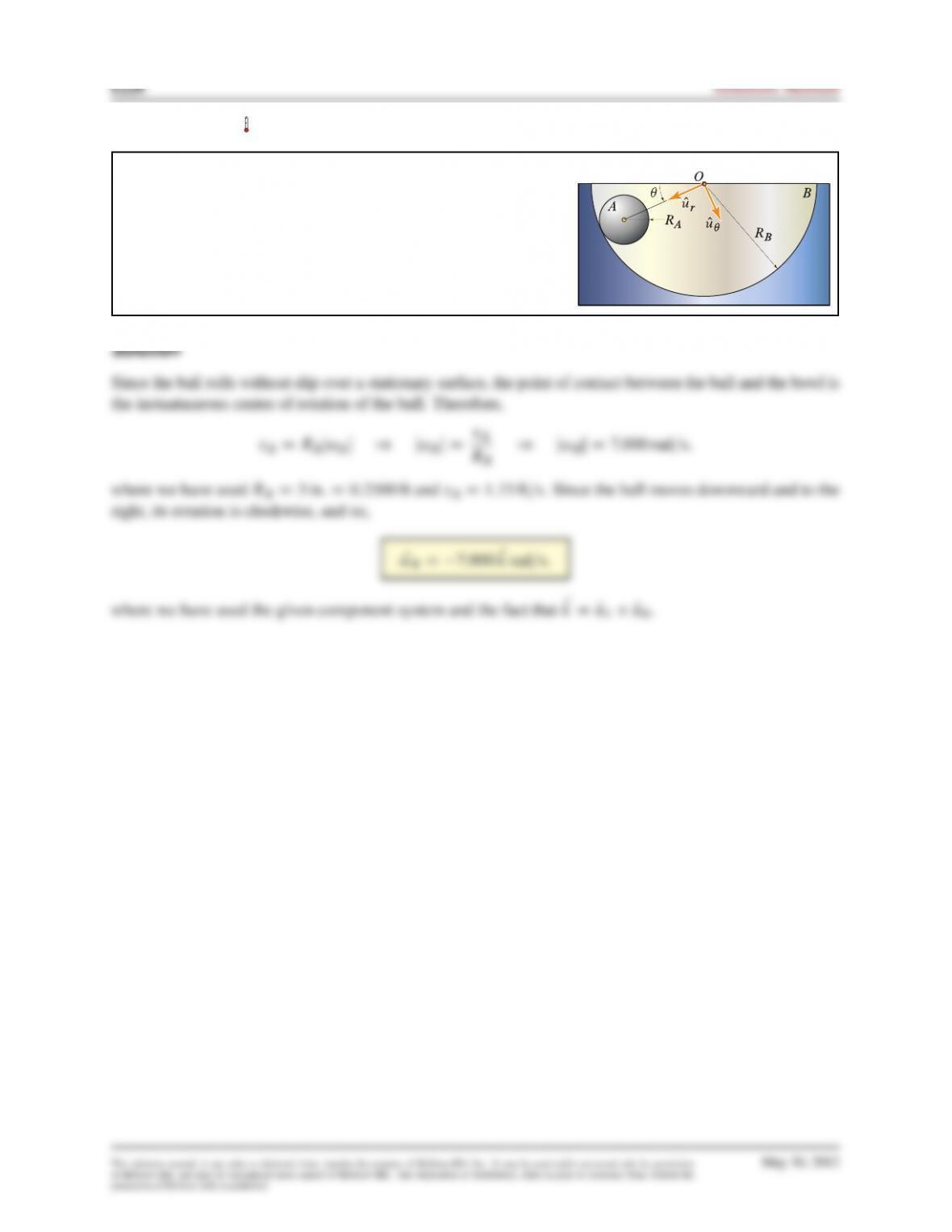
A ball of radius
RAD3in:
is rolling without slip in a stationary
spherical bowl of radius
RBD8in:
Assume that the ball’s mo-
tion is planar. Express your answers using the component system
shown.
If the speed of the center of the ball is
vAD1:75 ft=s
and if
the ball is moving down and to the right, determine the angular
velocity of the ball.
of McGraw-Hill, and must be surrendered upon request of McGraw-Hill. Any duplication or distribution, either in print or electronic form, without the
permission of McGraw-Hill, is prohibited.
Dynamics 2e 1221
Problem 6.53
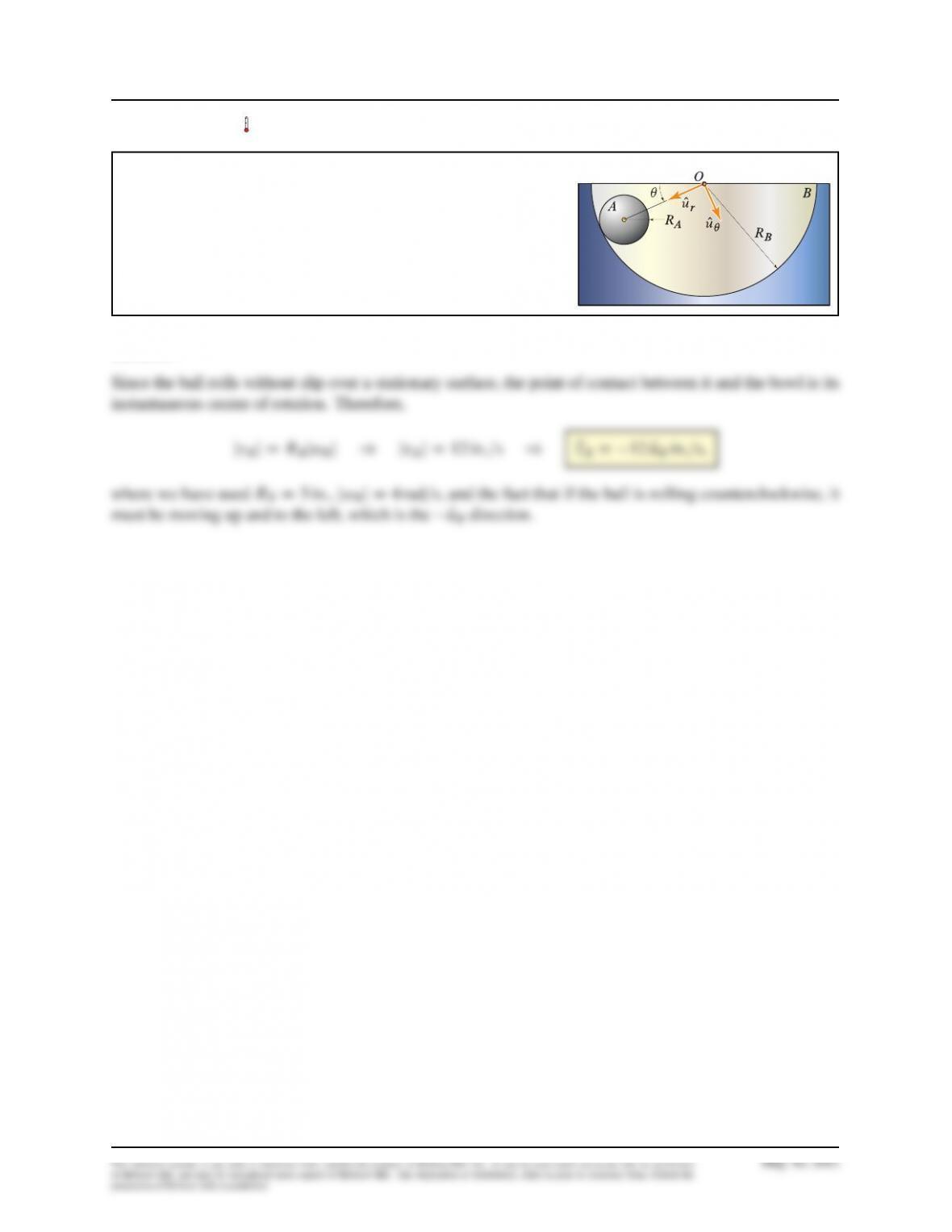
A ball of radius
RAD3in:
is rolling without slip in a stationary
spherical bowl of radius
RBD8in:
Assume that the ball’s mo-
tion is planar. Express your answers using the component system
shown.
If the angular speed of the ball
j!Aj D 4rad=s
is counterclock-
wise, determine the velocity of the center of the ball.
Solution
of McGraw-Hill, and must be surrendered upon request of McGraw-Hill. Any duplication or distribution, either in print or electronic form, without the
permission of McGraw-Hill, is prohibited.
Problem 6.54
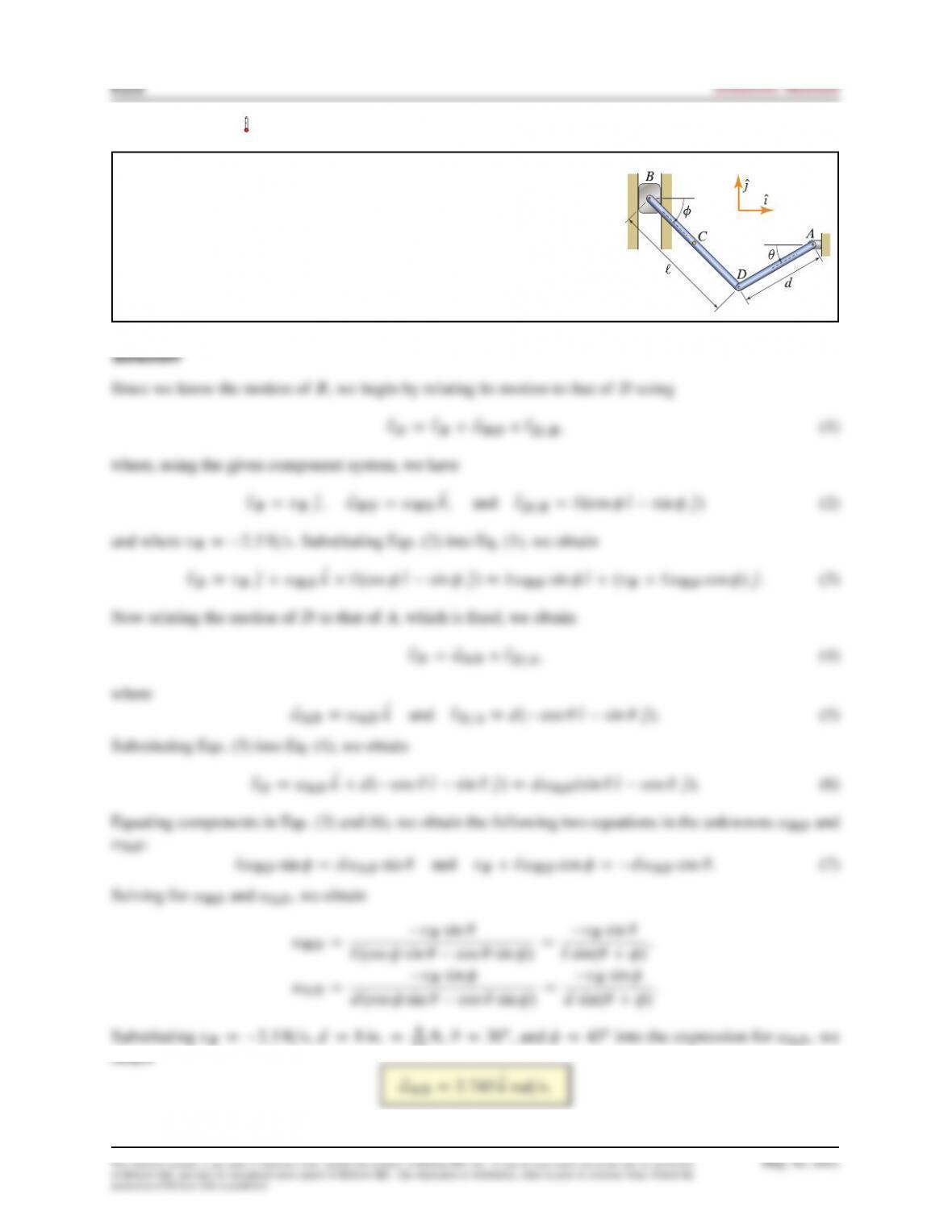
In the mechanism shown, the block
B
is constrained to move vertically
and is attached to the bar
BD
. The point
A
on the bar
AD
is fixed.
Express all your answers in the component system shown.
At the instant shown, the block
B
is moving downward at
2:5 ft=s
,
D45ı
, and
D30ı
. If
`D12 in:
and
dD8in:
, determine the
angular velocity of bar AD at this instant.
of McGraw-Hill, and must be surrendered upon request of McGraw-Hill. Any duplication or distribution, either in print or electronic form, without the
permission of McGraw-Hill, is prohibited.
Dynamics 2e 1223
Problem 6.55
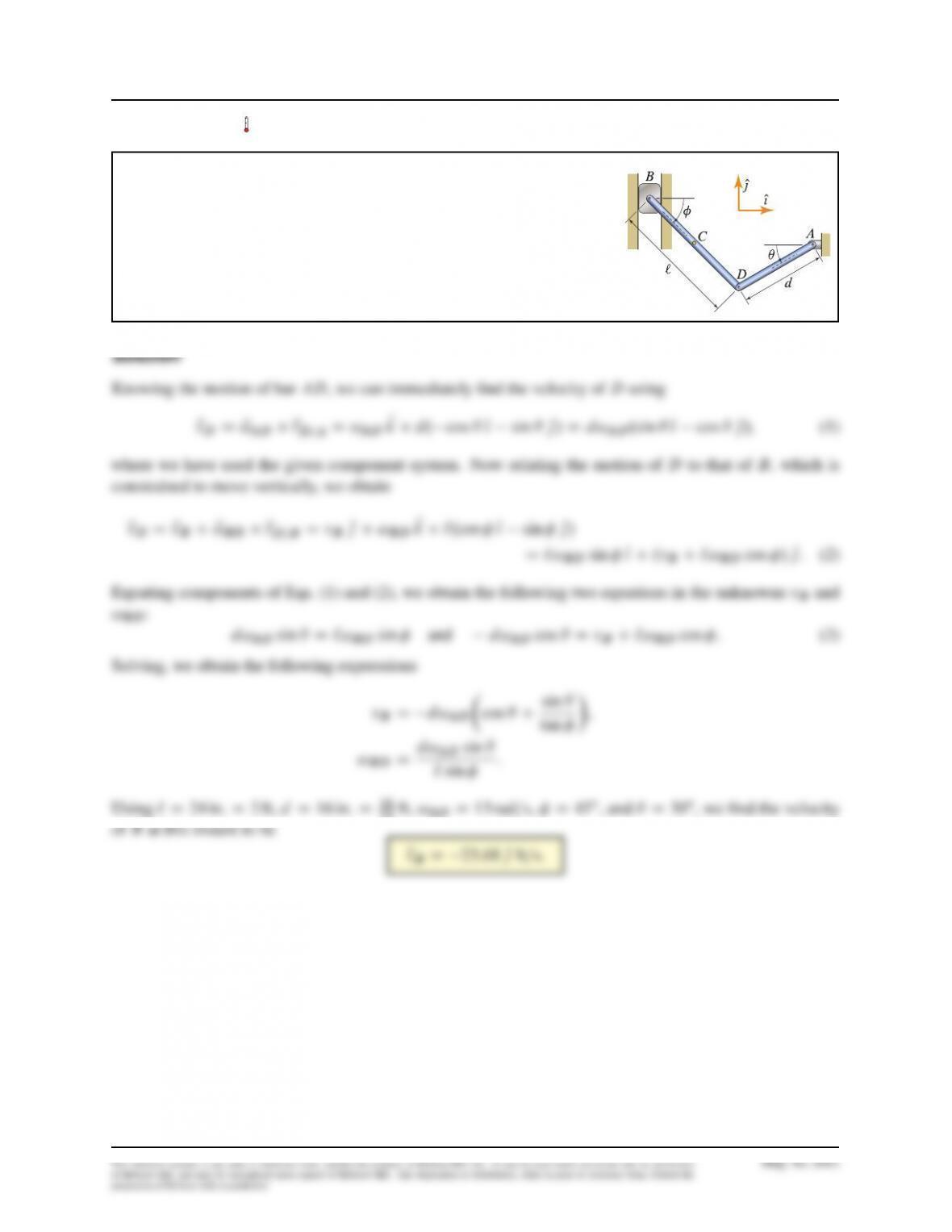
In the mechanism shown, the block
B
is constrained to move vertically
and is attached to the bar
BD
. The point
A
on the bar
AD
is fixed.
Express all your answers in the component system shown.
At the instant shown, bar
AD
is rotating counterclockwise at the
angular speed
!AD D13 rad=s
,
D45ı
, and
D30ı
. If
`D24 in:
and
dD16 in:, determine the velocity of the block Bat this instant.
of McGraw-Hill, and must be surrendered upon request of McGraw-Hill. Any duplication or distribution, either in print or electronic form, without the
permission of McGraw-Hill, is prohibited.
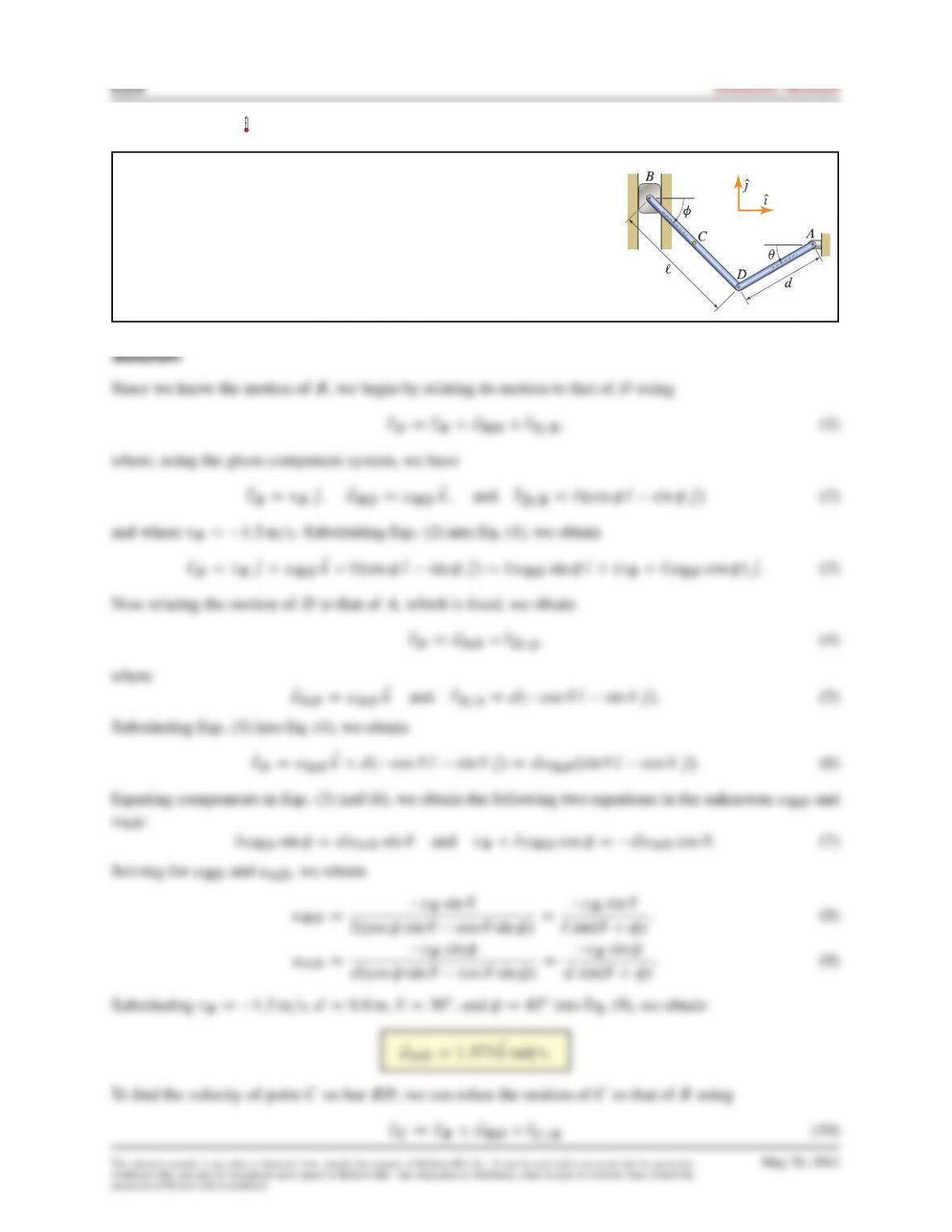
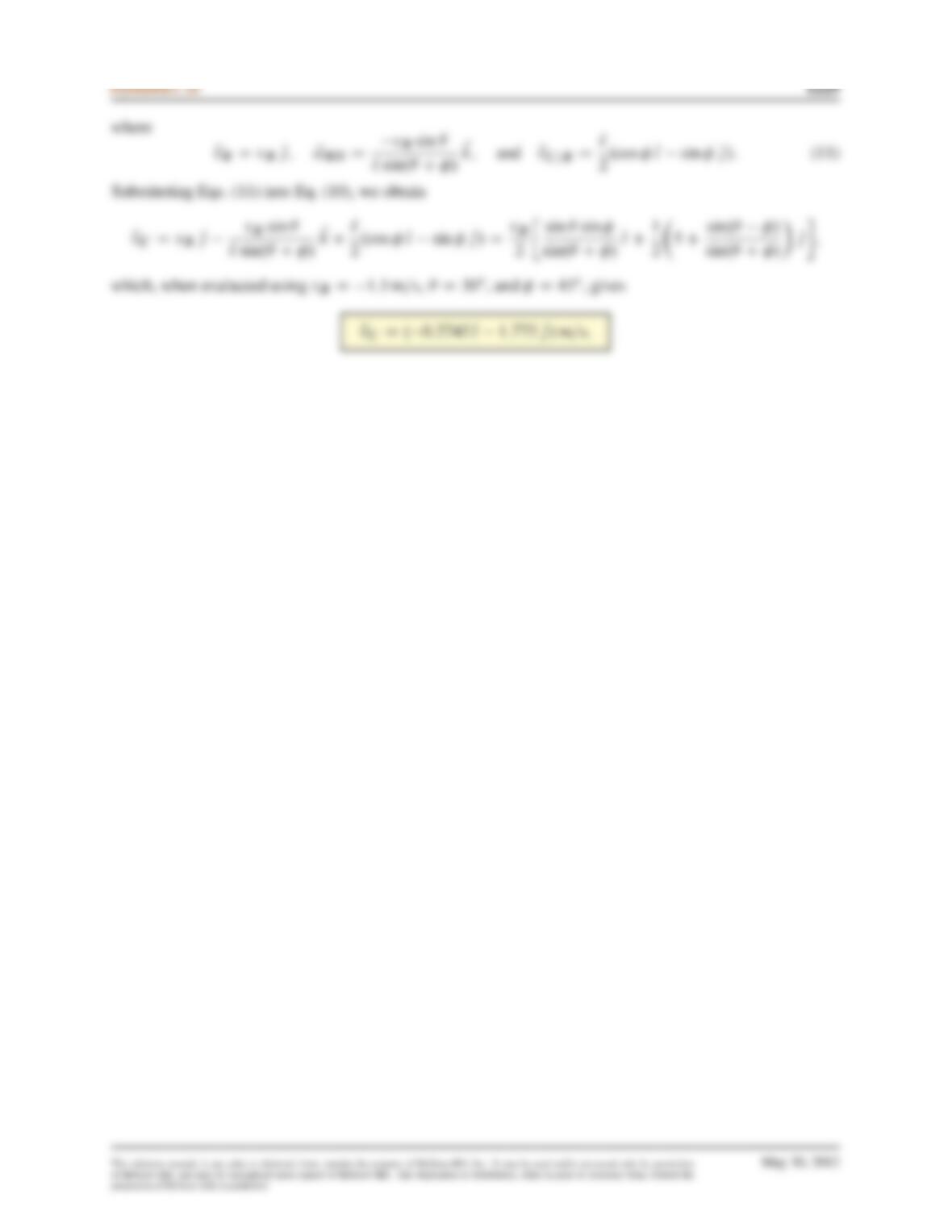
Problem 6.56
In the mechanism shown, the block
B
is constrained to move vertically
and is attached to the bar
BD
. The point
A
on the bar
AD
is fixed.
Express all your answers in the component system shown.
At the instant shown, the block
B
is moving downward at
1:5 m=s
,
D45ı
, and
D30ı
. If
`D1:2
m and
dD0:8
m, determine the
angular velocity of bar AD and the velocity of point Cat this instant.
of McGraw-Hill, and must be surrendered upon request of McGraw-Hill. Any duplication or distribution, either in print or electronic form, without the
permission of McGraw-Hill, is prohibited.
of McGraw-Hill, and must be surrendered upon request of McGraw-Hill. Any duplication or distribution, either in print or electronic form, without the
permission of McGraw-Hill, is prohibited.
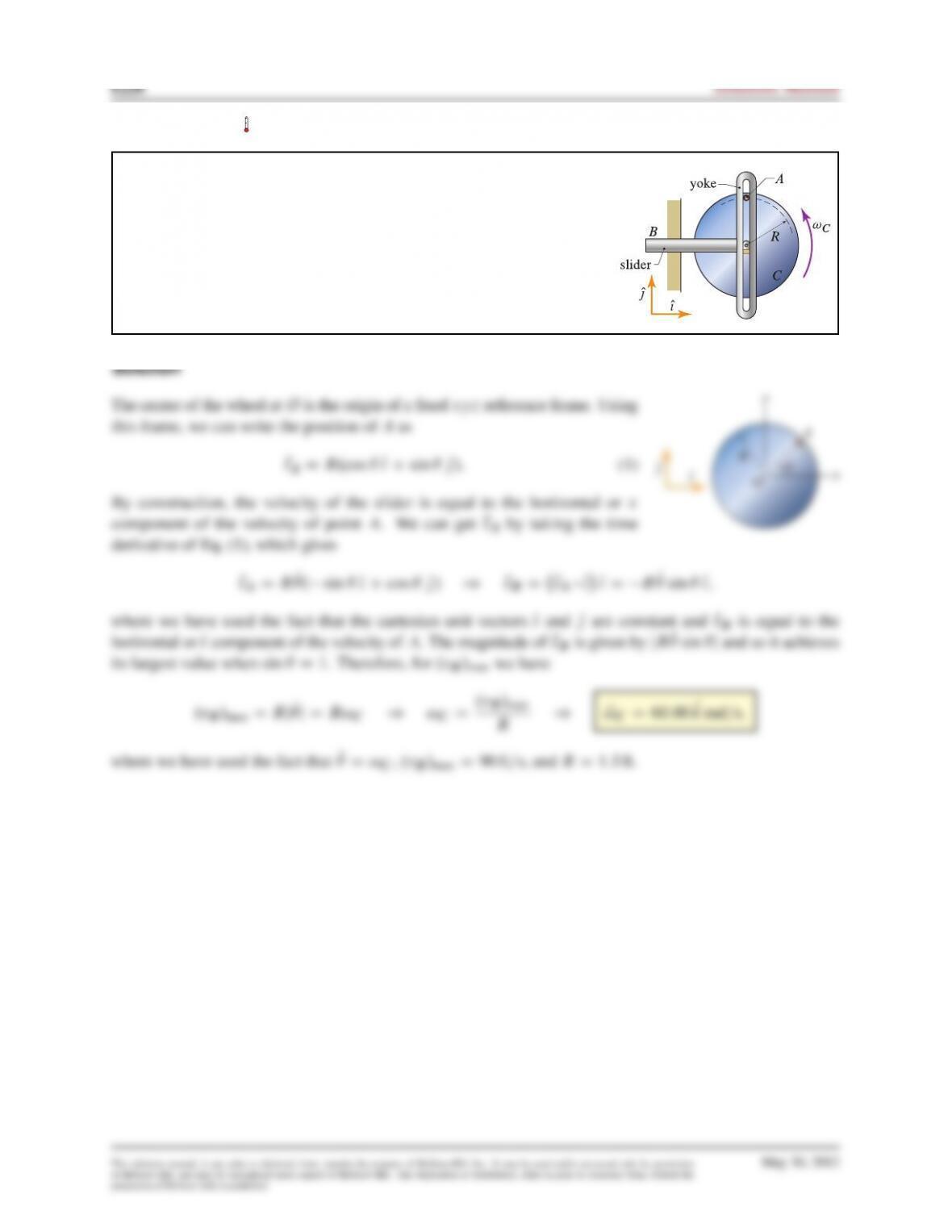
Problem 6.57
One way to convert rotational motion into linear motion and vice versa is
with the use of a mechanism called a Scotch yoke, which consists of a
crank
C
that is connected to a slider
B
by a pin
A
. The pin rotates with
the crank while sliding within the yoke, which, in turn, rigidly translates
with the slider. This mechanism has been used, for example, to control
the opening and closing of valves in pipelines. Letting the radius of the
crank be
RD1:5 ft
, determine the angular velocity
!C
of the crank so
that the maximum speed of the slider is vBD90 ft=s.
of McGraw-Hill, and must be surrendered upon request of McGraw-Hill. Any duplication or distribution, either in print or electronic form, without the
permission of McGraw-Hill, is prohibited.
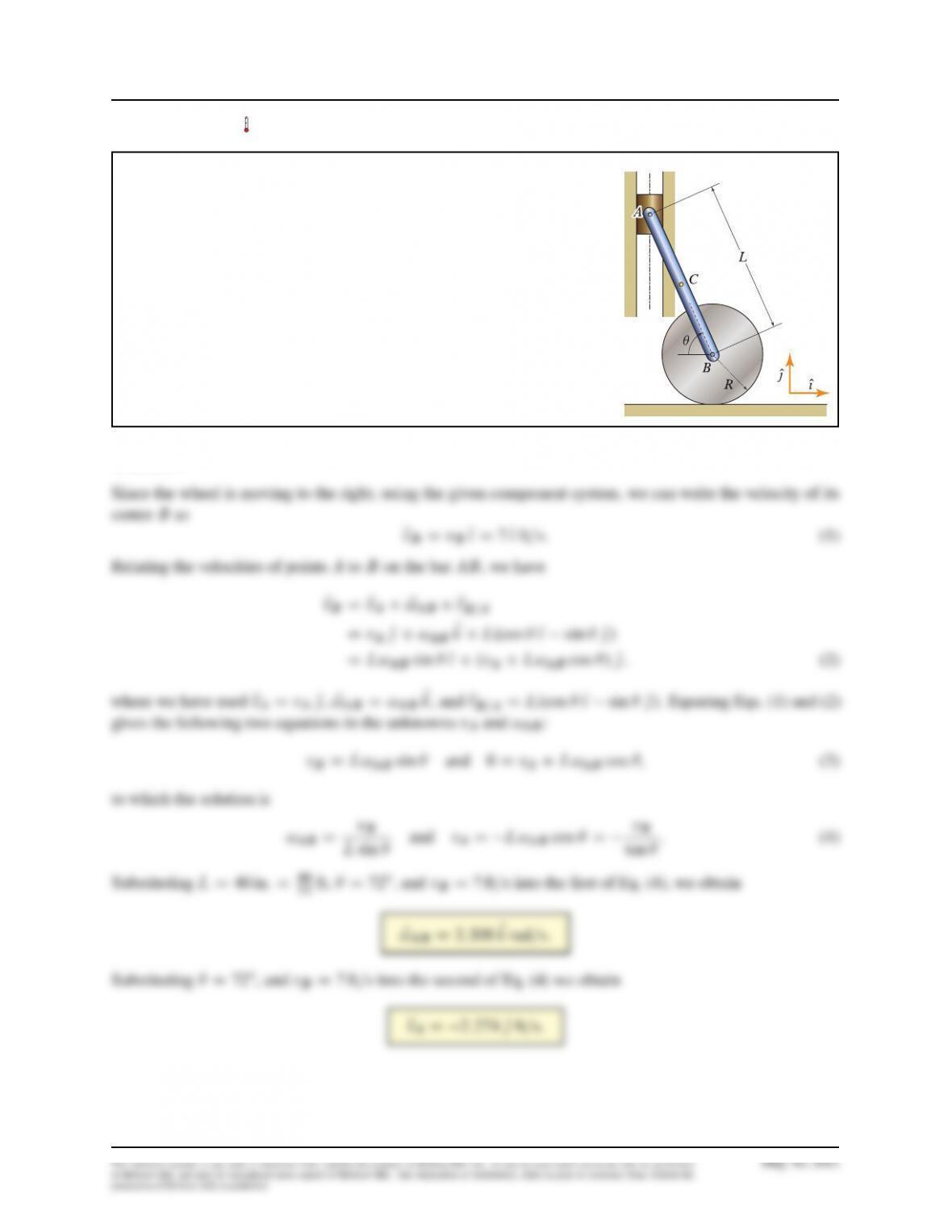
Dynamics 2e 1227
Problem 6.58
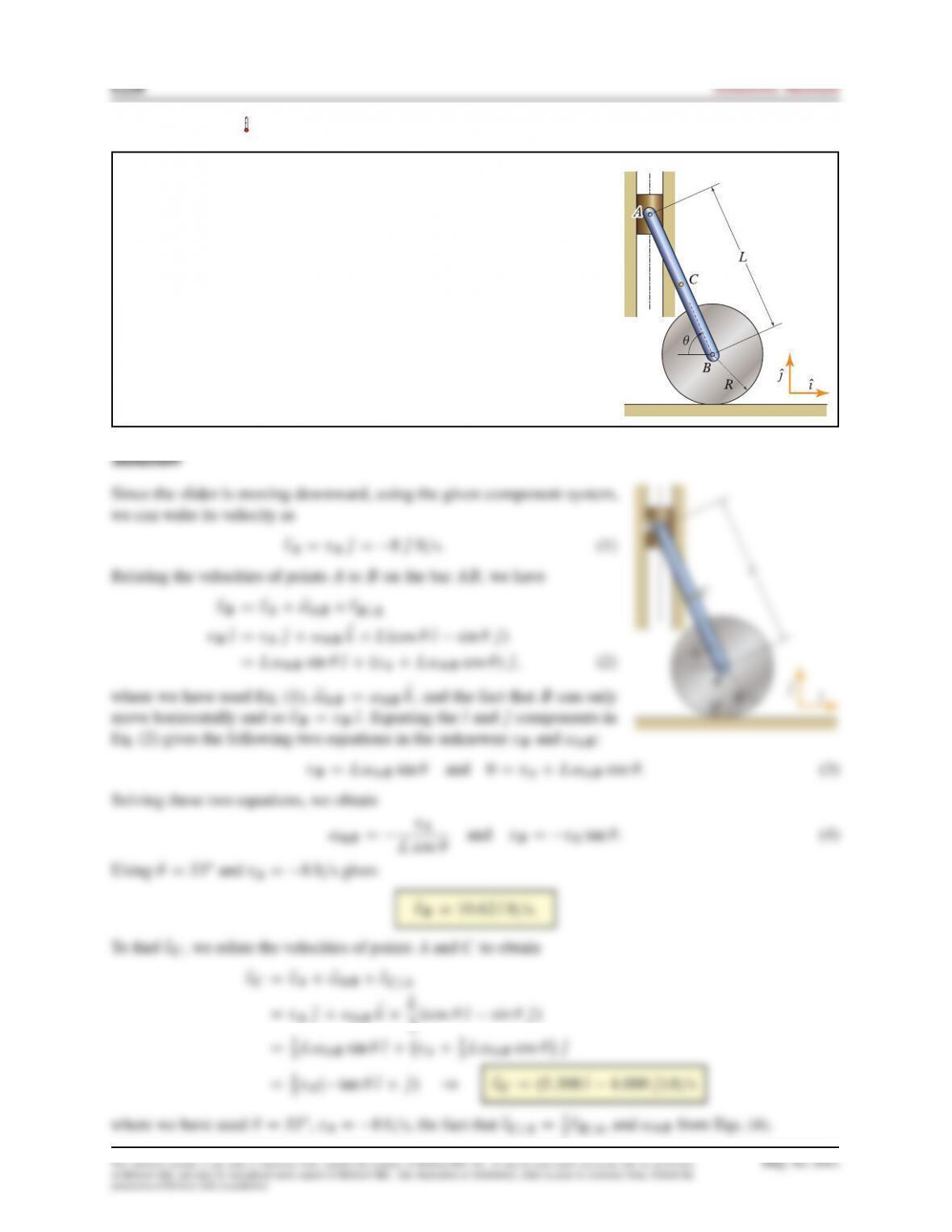
The system shown consists of a wheel of radius
RD14 in:
rolling on a
horizontal surface. A bar
AB
of length
LD40 in:
is pin-connected to the
center of the wheel and to a slider
A
that is constrained to move along a
vertical guide. Point Cis the bar’s midpoint.
If, when
D72ı
, the wheel is moving to the right so that
vBD7ft=s
,
determine the angular velocity of the bar, as well as the velocity of the
slider A.
Solution
of McGraw-Hill, and must be surrendered upon request of McGraw-Hill. Any duplication or distribution, either in print or electronic form, without the
permission of McGraw-Hill, is prohibited.
Problem 6.59
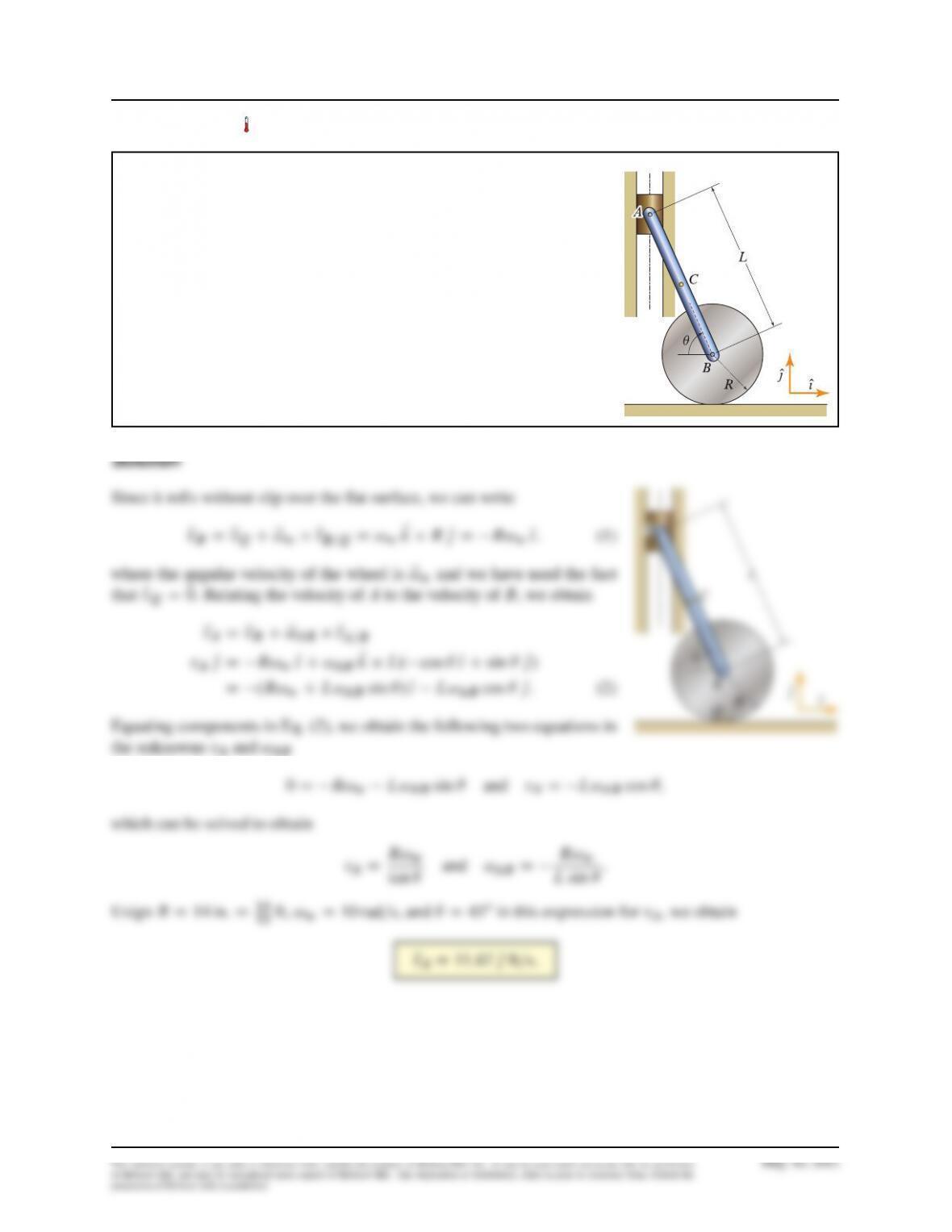
The system shown consists of a wheel of radius
RD14 in:
rolling on a
horizontal surface. A bar
AB
of length
LD40 in:
is pin-connected to the
center of the wheel and to a slider
A
that is constrained to move along a
vertical guide. Point Cis the bar’s midpoint.
If, when
D53ı
, the slider is moving downward with a speed
vAD8ft=s, determine the velocity of points Band C.
of McGraw-Hill, and must be surrendered upon request of McGraw-Hill. Any duplication or distribution, either in print or electronic form, without the
permission of McGraw-Hill, is prohibited.
Dynamics 2e 1229
Problem 6.60
The system shown consists of a wheel of radius
RD14 in:
rolling on a
horizontal surface. A bar
AB
of length
LD40 in:
is pin-connected to the
center of the wheel and to a slider
A
that is constrained to move along a
vertical guide. Point Cis the bar’s midpoint.
If the wheel rolls without slip with a constant counterclockwise an-
gular velocity of
10 rad=s
, determine the velocity of the slider
A
when
D45ı.
of McGraw-Hill, and must be surrendered upon request of McGraw-Hill. Any duplication or distribution, either in print or electronic form, without the
permission of McGraw-Hill, is prohibited.