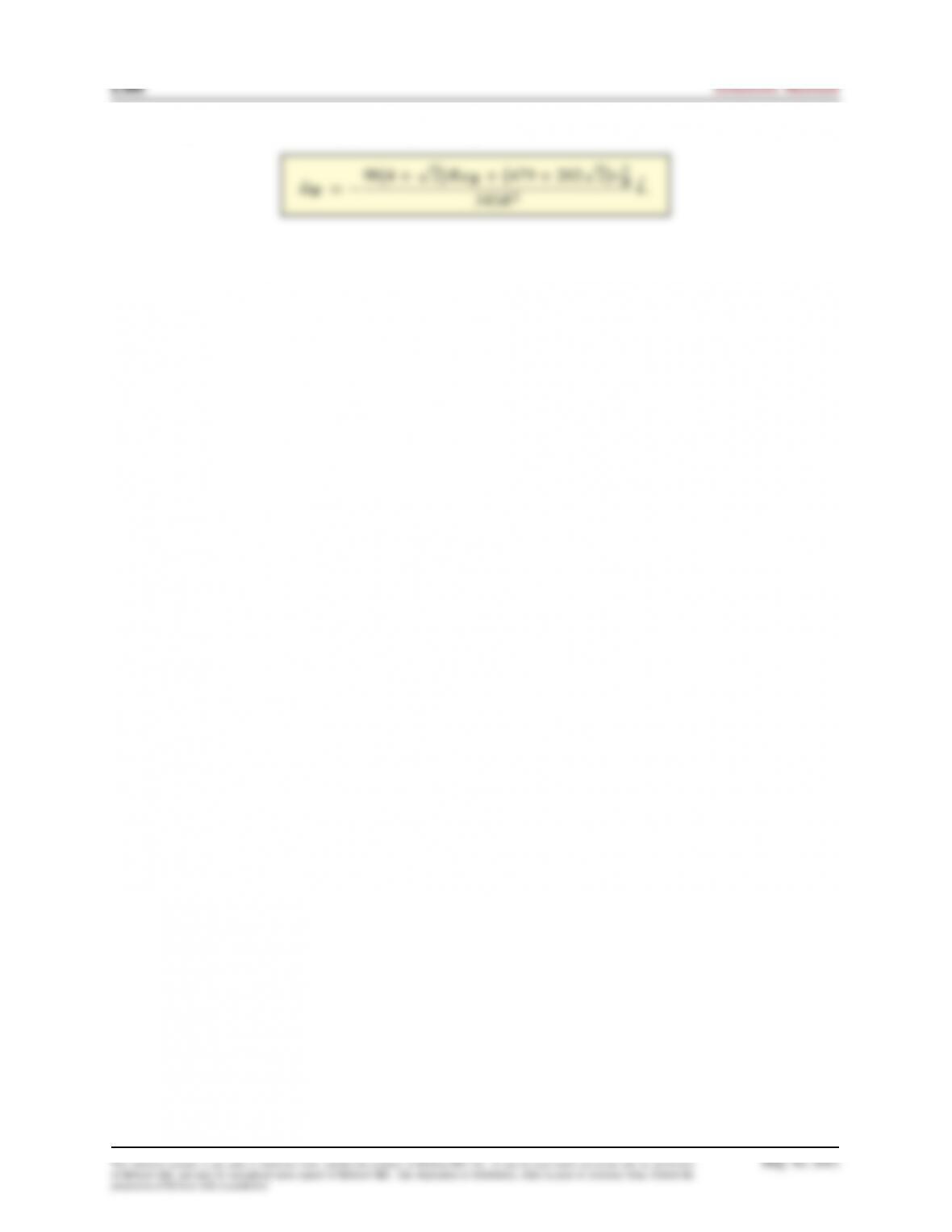
Substituting in the solutions for !AB and !W, the angular acceleration of the wheel becomes
B
of McGraw-Hill, and must be surrendered upon request of McGraw-Hill. Any duplication or distribution, either in print or electronic form, without the
permission of McGraw-Hill, is prohibited.
Dynamics 2e 1301
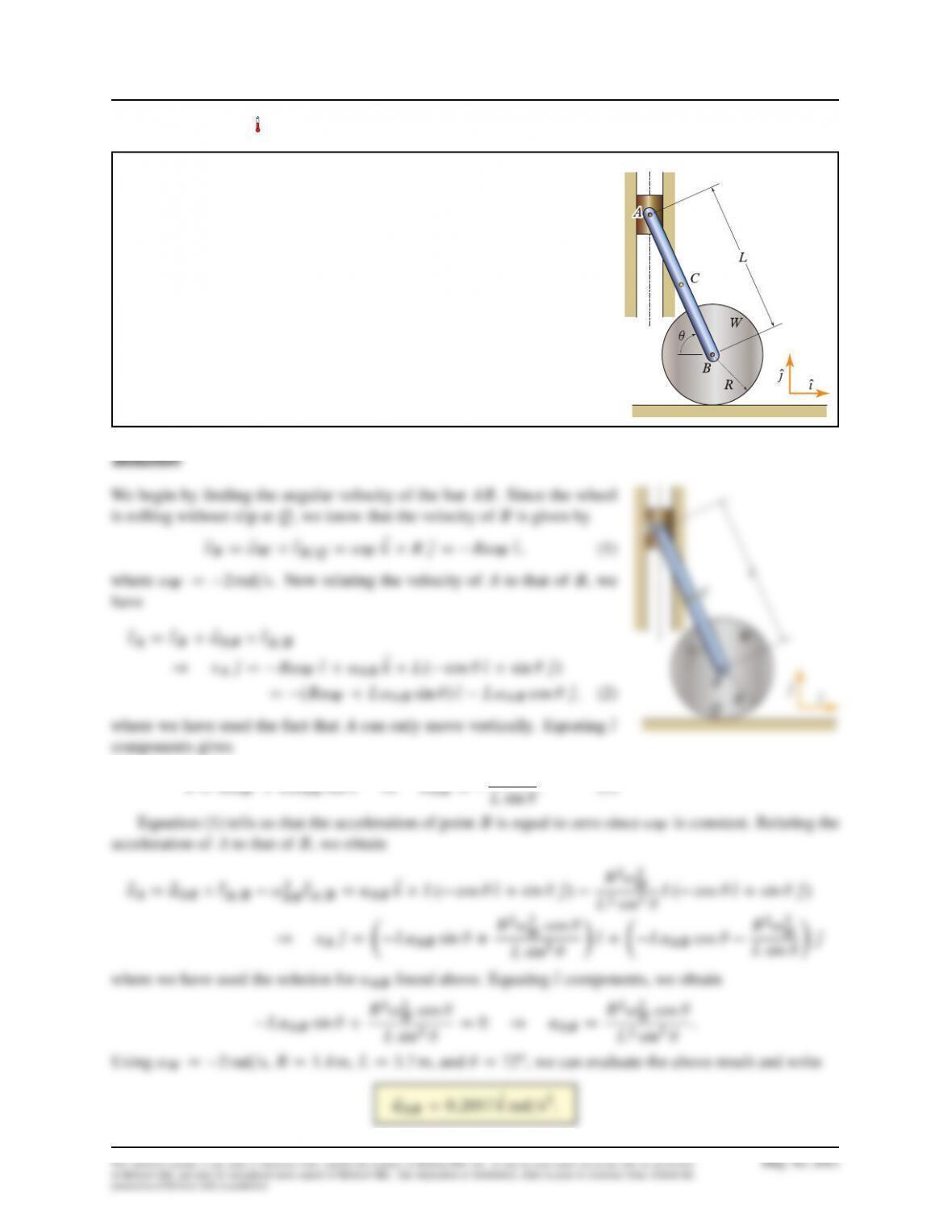
Problem 6.112
The wheel
W
of radius
RD1:4
m rolls without slip on a horizontal
surface. A bar AB of length LD3:7 m is pin-connected to the center of
the wheel and to a slider
A
constrained to move along a vertical guide.
Point Cis the bar’s midpoint.
If the wheel is rolling clockwise with a constant angular speed of
2rad=s, determine the angular acceleration of the bar when D72ı.
of McGraw-Hill, and must be surrendered upon request of McGraw-Hill. Any duplication or distribution, either in print or electronic form, without the
permission of McGraw-Hill, is prohibited.
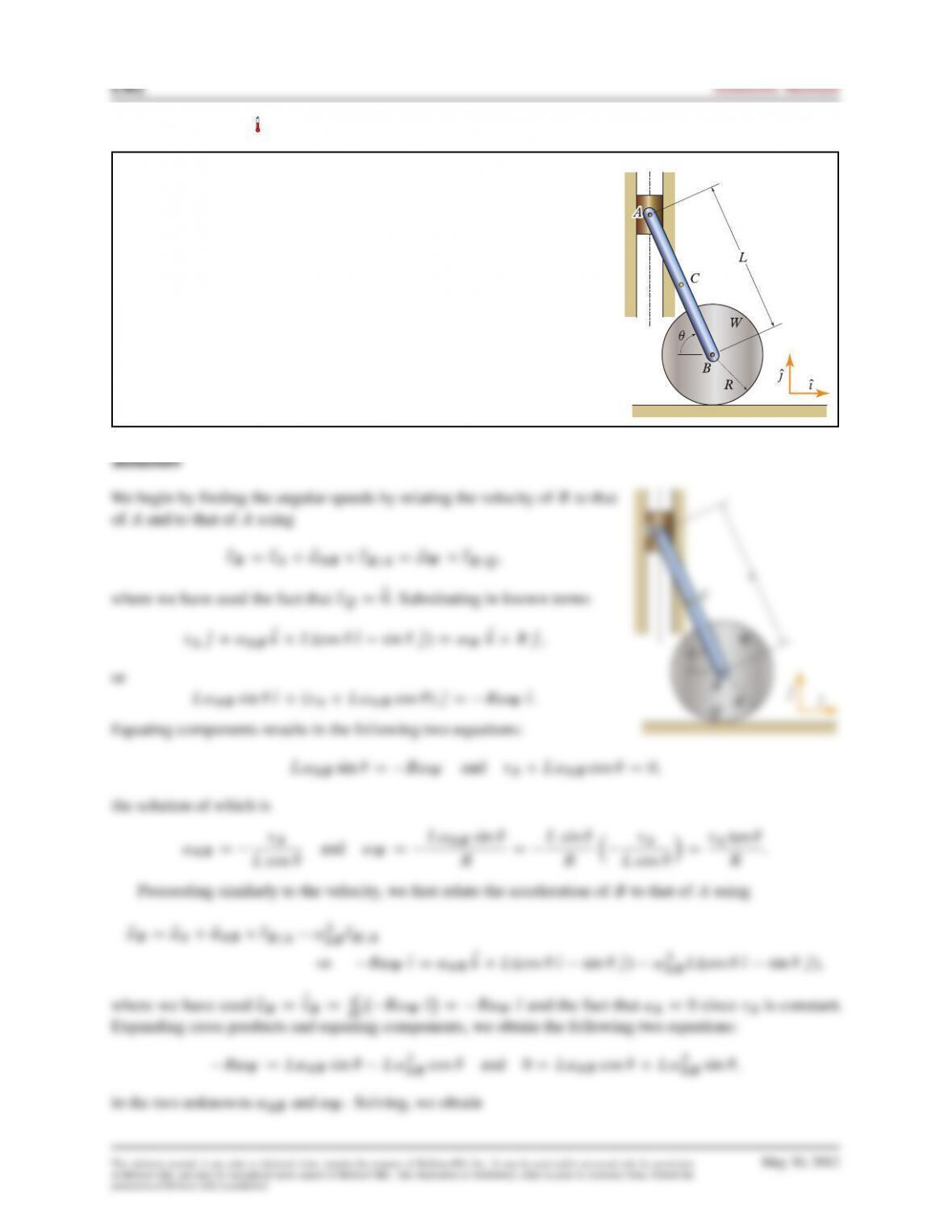
Problem 6.113
The wheel
W
of radius
RD1:4
m rolls without slip on a horizontal
surface. A bar AB of length LD3:7 m is pin-connected to the center of
the wheel and to a slider
A
constrained to move along a vertical guide.
Point Cis the bar’s midpoint.
If the slider
A
is moving downward with a constant speed
3m=s
,
determine the angular acceleration of the wheel when D53ı.
of McGraw-Hill, and must be surrendered upon request of McGraw-Hill. Any duplication or distribution, either in print or electronic form, without the
permission of McGraw-Hill, is prohibited.
of McGraw-Hill, and must be surrendered upon request of McGraw-Hill. Any duplication or distribution, either in print or electronic form, without the
permission of McGraw-Hill, is prohibited.
Problem 6.114
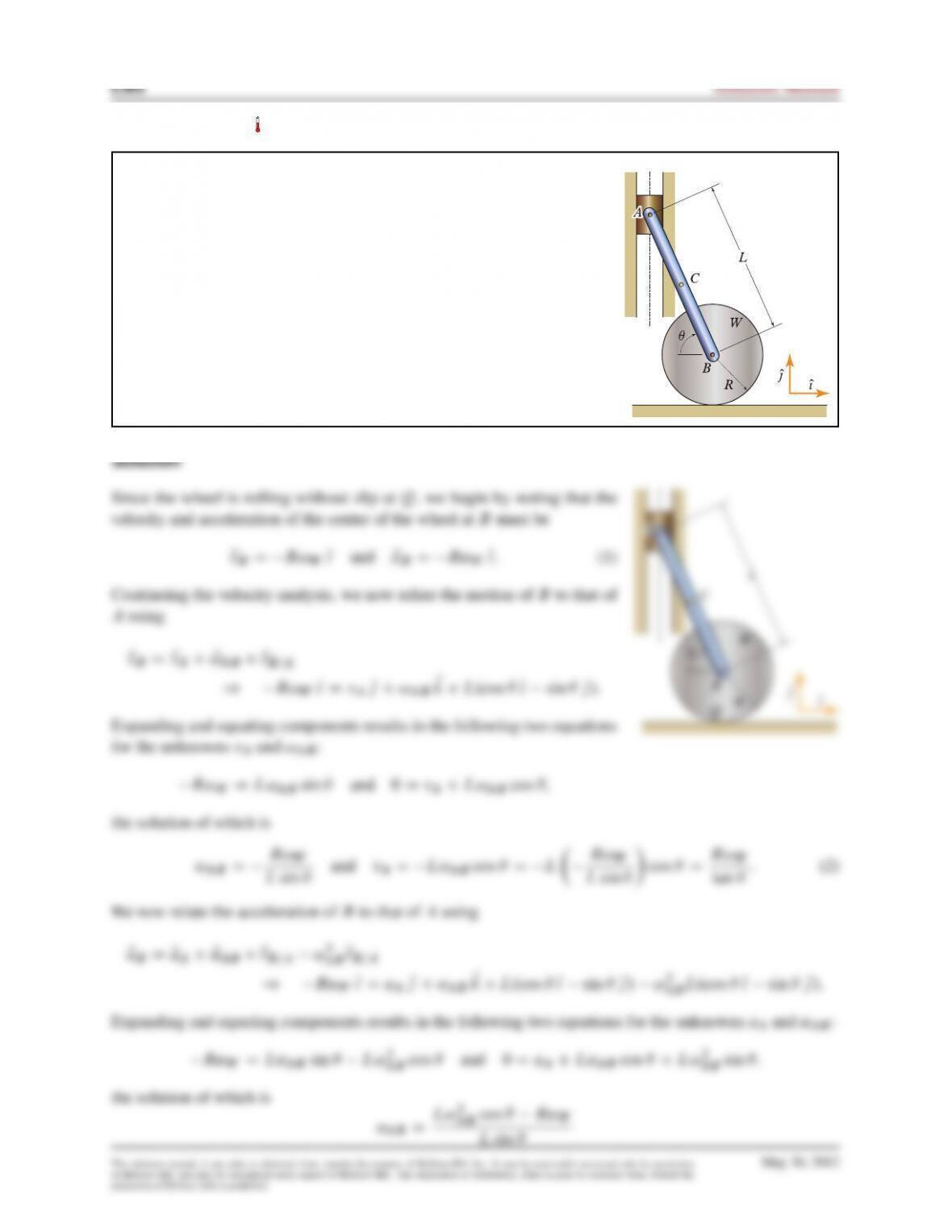
The wheel
W
of radius
RD1:4
m rolls without slip on a horizontal
surface. A bar AB of length LD3:7 m is pin-connected to the center of
the wheel and to a slider
A
constrained to move along a vertical guide.
Point Cis the bar’s midpoint.
Determine the general relation expressing the acceleration of the slider
A
as a function of
,
L
,
R
, the angular velocity of the wheel
!W
, and the
angular acceleration of the wheel ˛W.
of McGraw-Hill, and must be surrendered upon request of McGraw-Hill. Any duplication or distribution, either in print or electronic form, without the
permission of McGraw-Hill, is prohibited.
of McGraw-Hill, and must be surrendered upon request of McGraw-Hill. Any duplication or distribution, either in print or electronic form, without the
permission of McGraw-Hill, is prohibited.
Problem 6.115
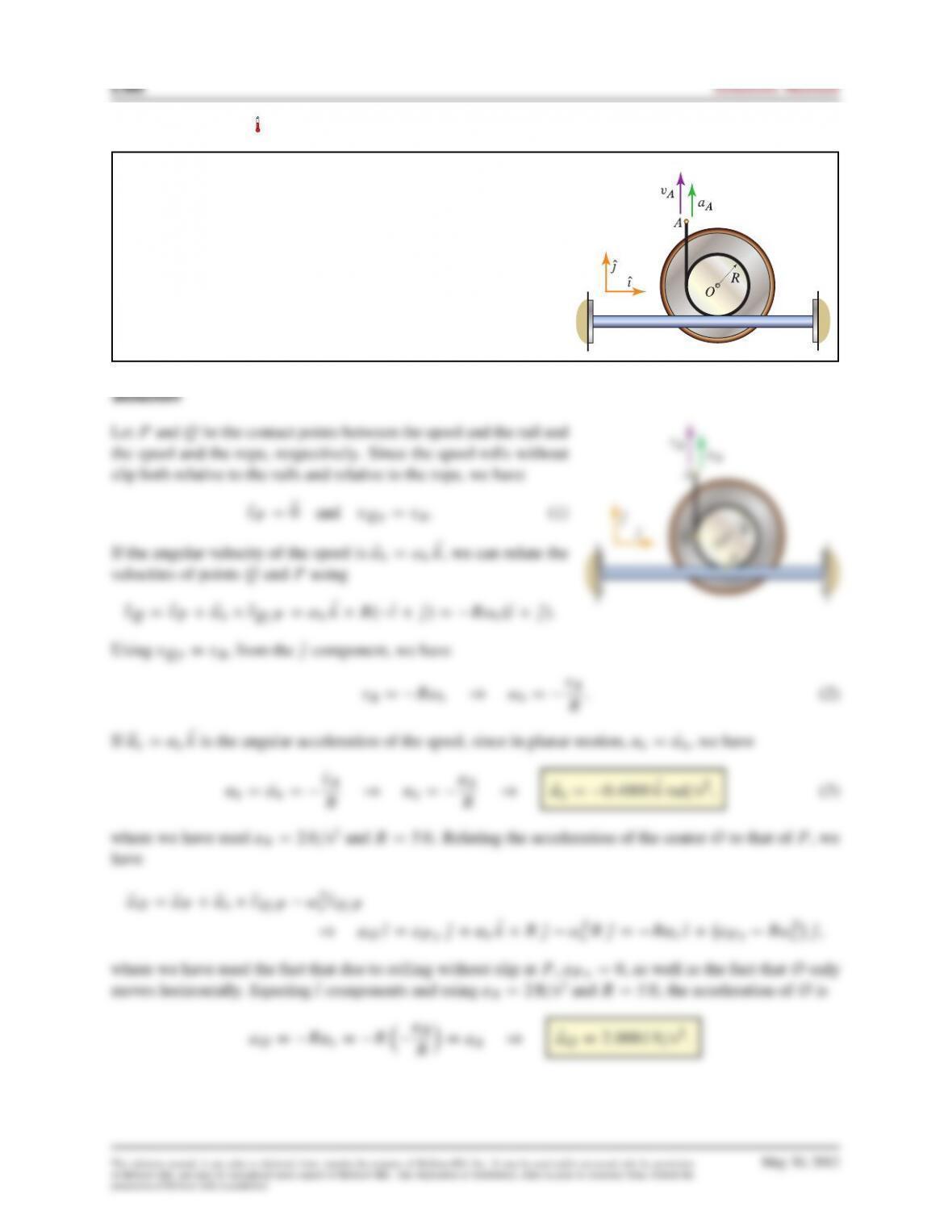
A spool with inner radius
RD5ft
is made to roll without slip over
a horizontal rail as shown. If the cable on the spool is unwound
in such a way that the free or vertical portion of cable remains
perpendicular to the rail, determine the angular acceleration of the
spool and the acceleration of the spool’s center
O
. The vertical
component of the velocity of point
A
is
vAD12 ft=s
, and the
vertical component of its acceleration is aAD2ft=s2.
of McGraw-Hill, and must be surrendered upon request of McGraw-Hill. Any duplication or distribution, either in print or electronic form, without the
permission of McGraw-Hill, is prohibited.
Dynamics 2e 1307
Problem 6.116
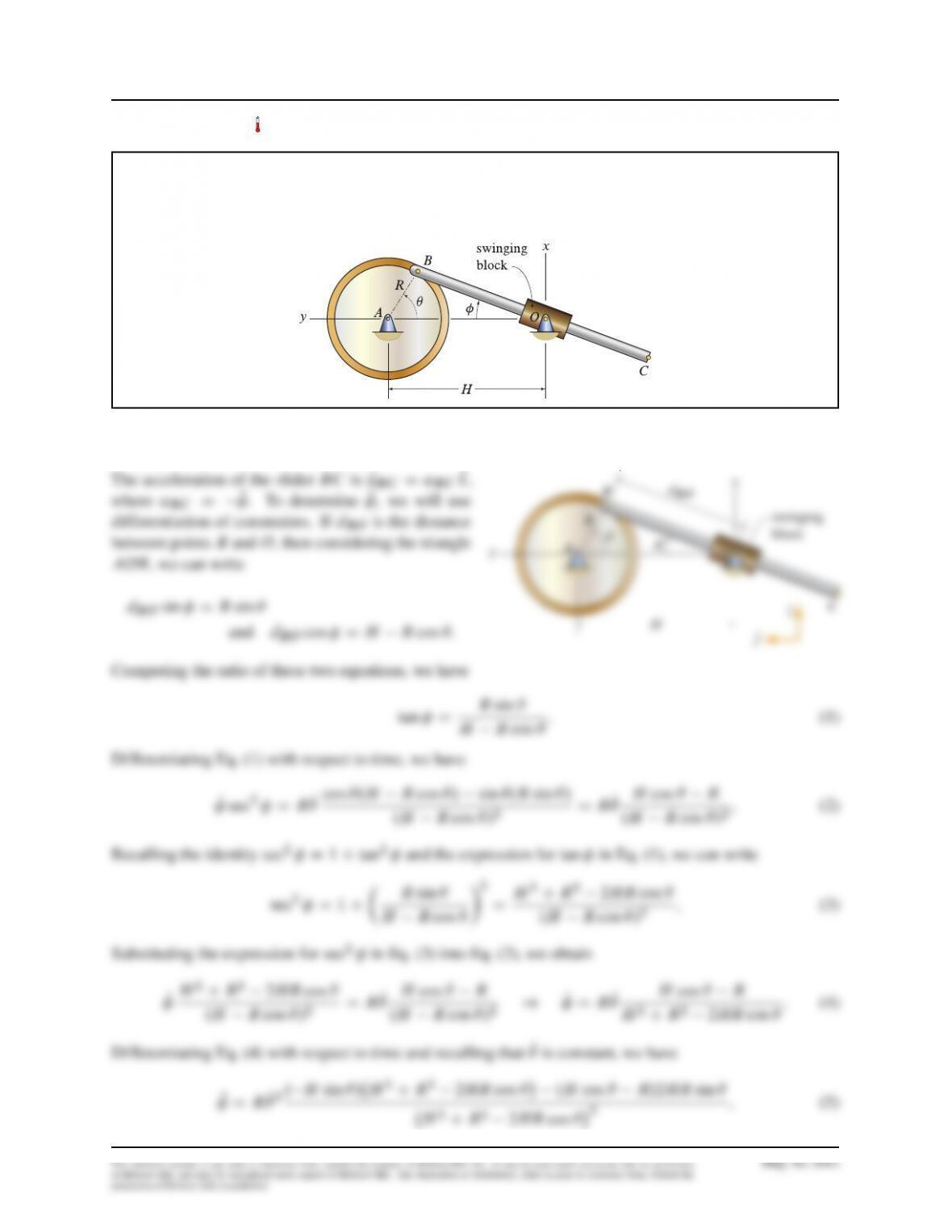
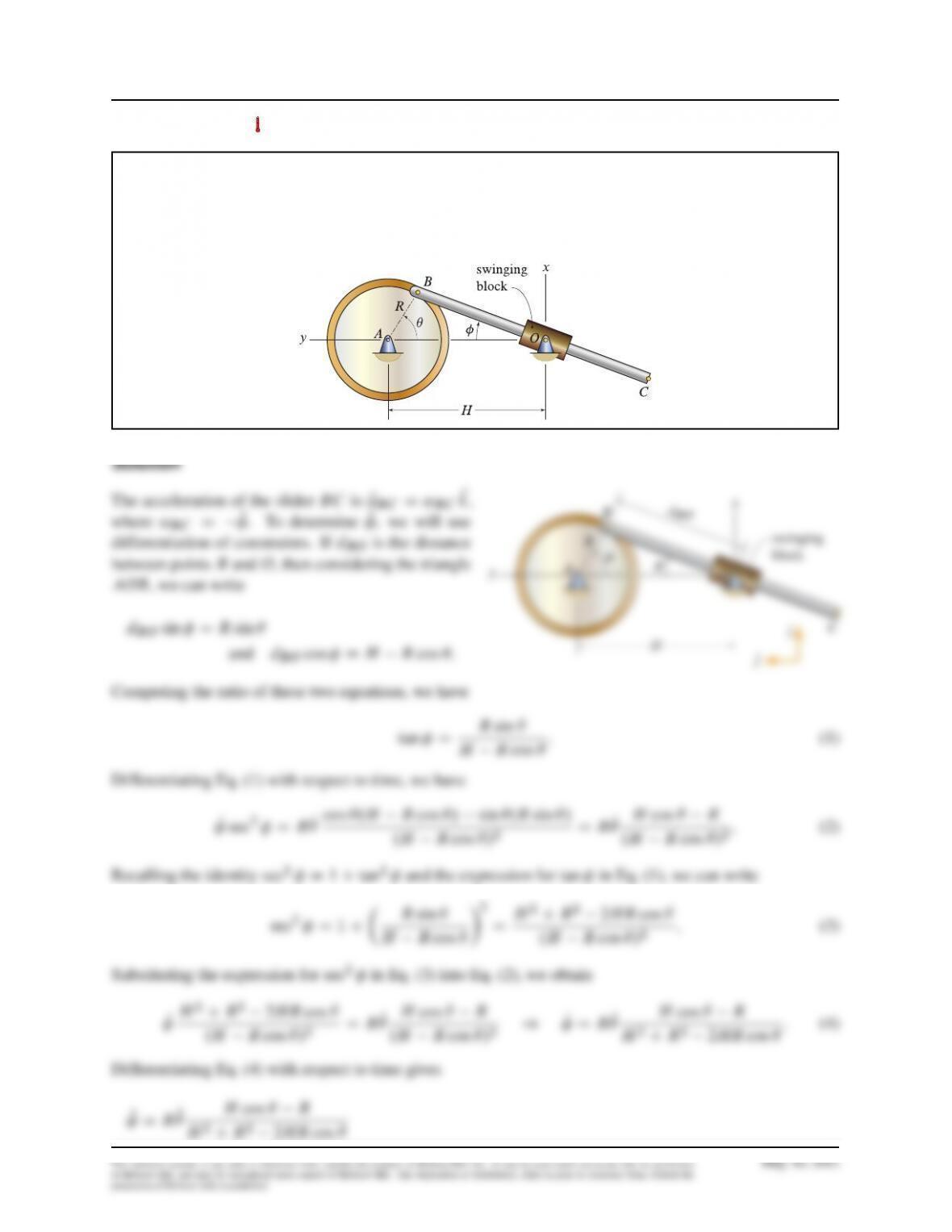
For the slider-crank mechanism shown, let
RD0:75
m and
HD2
m, and let the length of bar
BC
be
LBC D3:25 m.
Assume that
P
D50 rad=sDconstant
and compute the angular acceleration of the slider for
D27ı
.
Solution
of McGraw-Hill, and must be surrendered upon request of McGraw-Hill. Any duplication or distribution, either in print or electronic form, without the
permission of McGraw-Hill, is prohibited.
which, upon expanding the products in the numerator, can be simplified to
2R2H2sin
of McGraw-Hill, and must be surrendered upon request of McGraw-Hill. Any duplication or distribution, either in print or electronic form, without the
permission of McGraw-Hill, is prohibited.
Dynamics 2e 1309
Problem 6.117
For the slider-crank mechanism shown, let
RD0:75
m and
HD2
m, and let the length of bar
BC
be
LBC D3:25 m.
Assume that, at the instant shown,
D27ı
,
P
D50 rad=s
, and
R
D15 rad=s2
. Compute the angular
acceleration of the slider at this instant, as well as the acceleration of point C.
of McGraw-Hill, and must be surrendered upon request of McGraw-Hill. Any duplication or distribution, either in print or electronic form, without the
permission of McGraw-Hill, is prohibited.