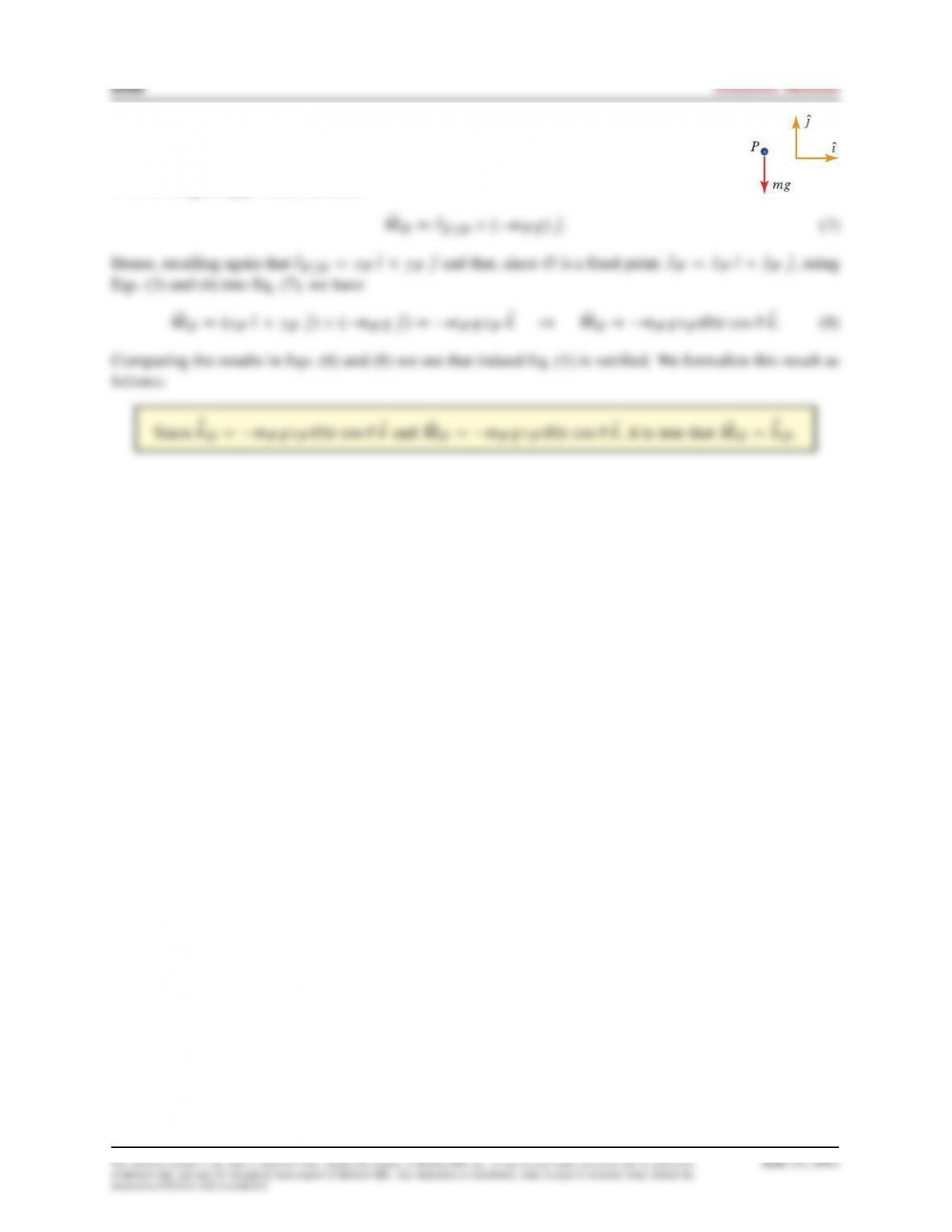
We now proceed to compute the moment of the forces acting on
P
with respect to
O
.
Referring to the FBD to the right, consistently with the calculation carried out so far, we treat
this problem as a projectile problem and therefore we assume that the only force acting on
Pis its weight mPg. Then, we have
of McGraw-Hill, and must be surrendered upon request of McGraw-Hill. Any duplication or distribution, either in print or electronic form, without the
permission of McGraw-Hill, is prohibited.
Dynamics 2e 1041
Problem 5.124
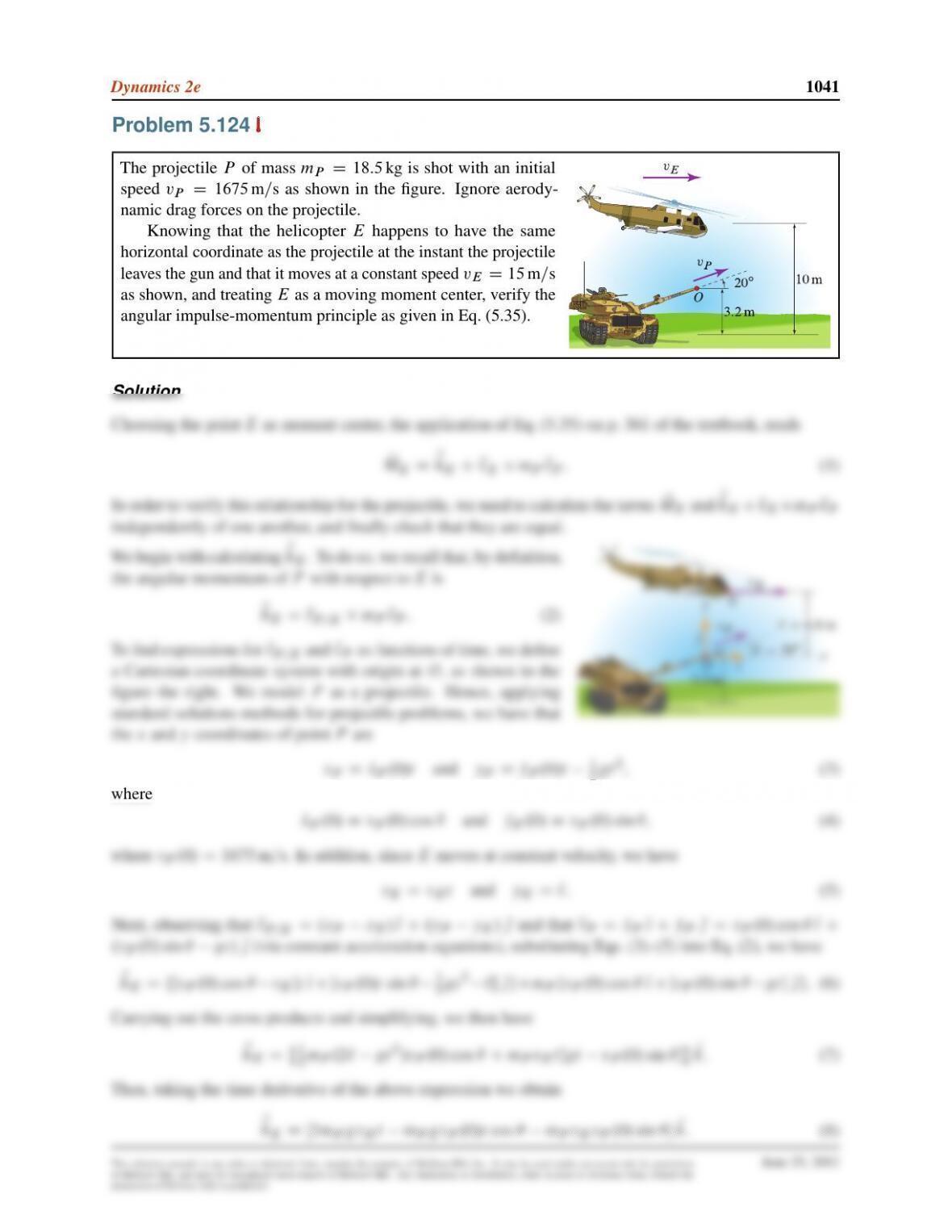
The projectile
P
of mass
mPD18:5 kg
is shot with an initial
speed
vPD1675 m=s
as shown in the figure. Ignore aerody-
namic drag forces on the projectile.
Knowing that the helicopter
E
happens to have the same
horizontal coordinate as the projectile at the instant the projectile
leaves the gun and that it moves at a constant speed
vED15 m=s
as shown, and treating
E
as a moving moment center, verify the
angular impulse-momentum principle as given in Eq. (5.35).
Solution
Choosing the point Eas moment center, the application of Eq. (5.35) on p. 361 of the textbook, reads
Next, we calculate the term
EvE⇥mPEvP
. Recalling that
EvPDPxPO{CPyPO|
and
EvEDPxEO{CPyEO|
, using
the kinematics relations in Eqs. (4) and (5), we have
of McGraw-Hill, and must be surrendered upon request of McGraw-Hill. Any duplication or distribution, either in print or electronic form, without the
permission of McGraw-Hill, is prohibited.
Dynamics 2e 1043
Problem 5.125
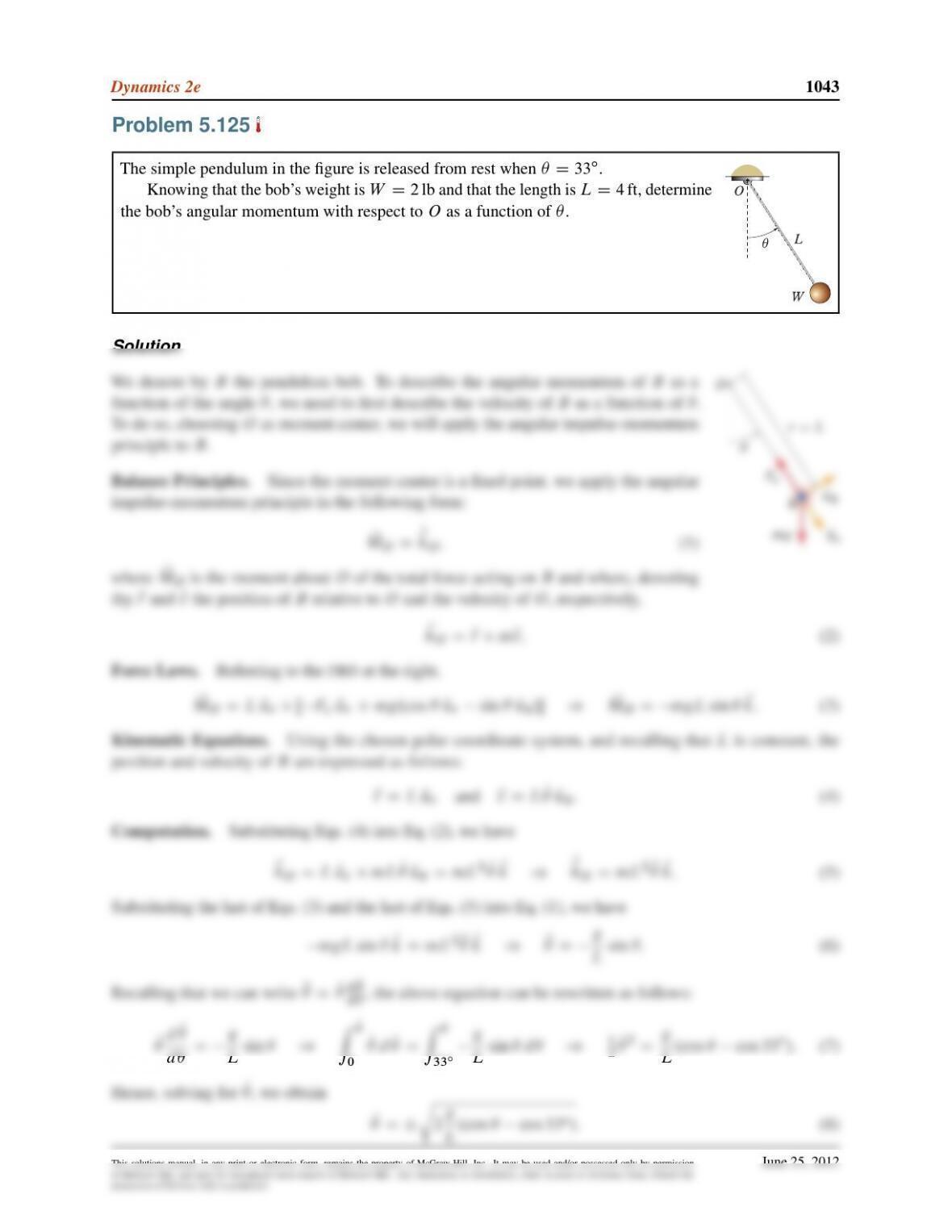
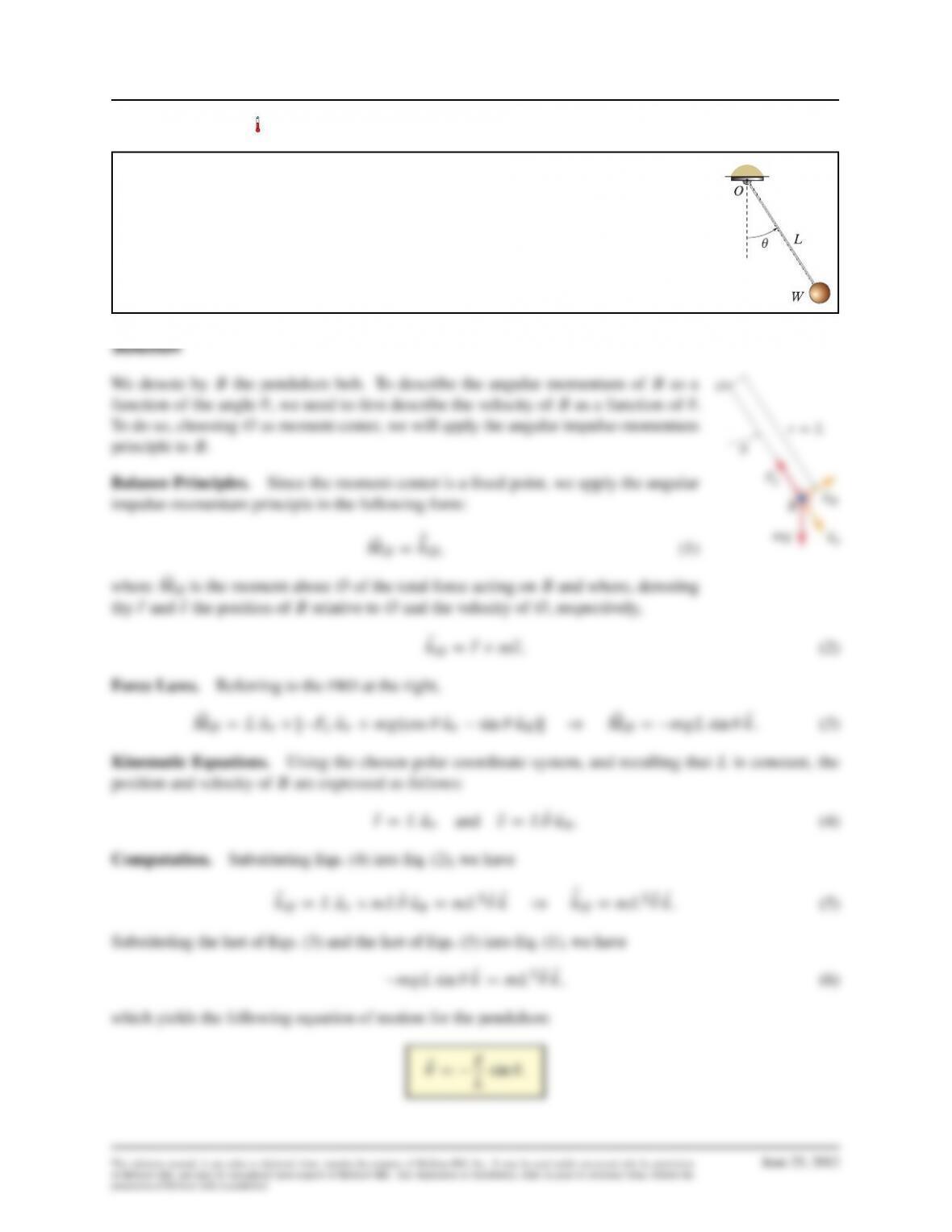
The simple pendulum in the figure is released from rest when ✓D33ı.
Knowing that the bob’s weight is
WD2lb
and that the length is
LD4ft
, determine
the bob’s angular momentum with respect to Oas a function of ✓.
Solution
Hence, solving for P
✓, we obtain
P
✓D˙
r2g
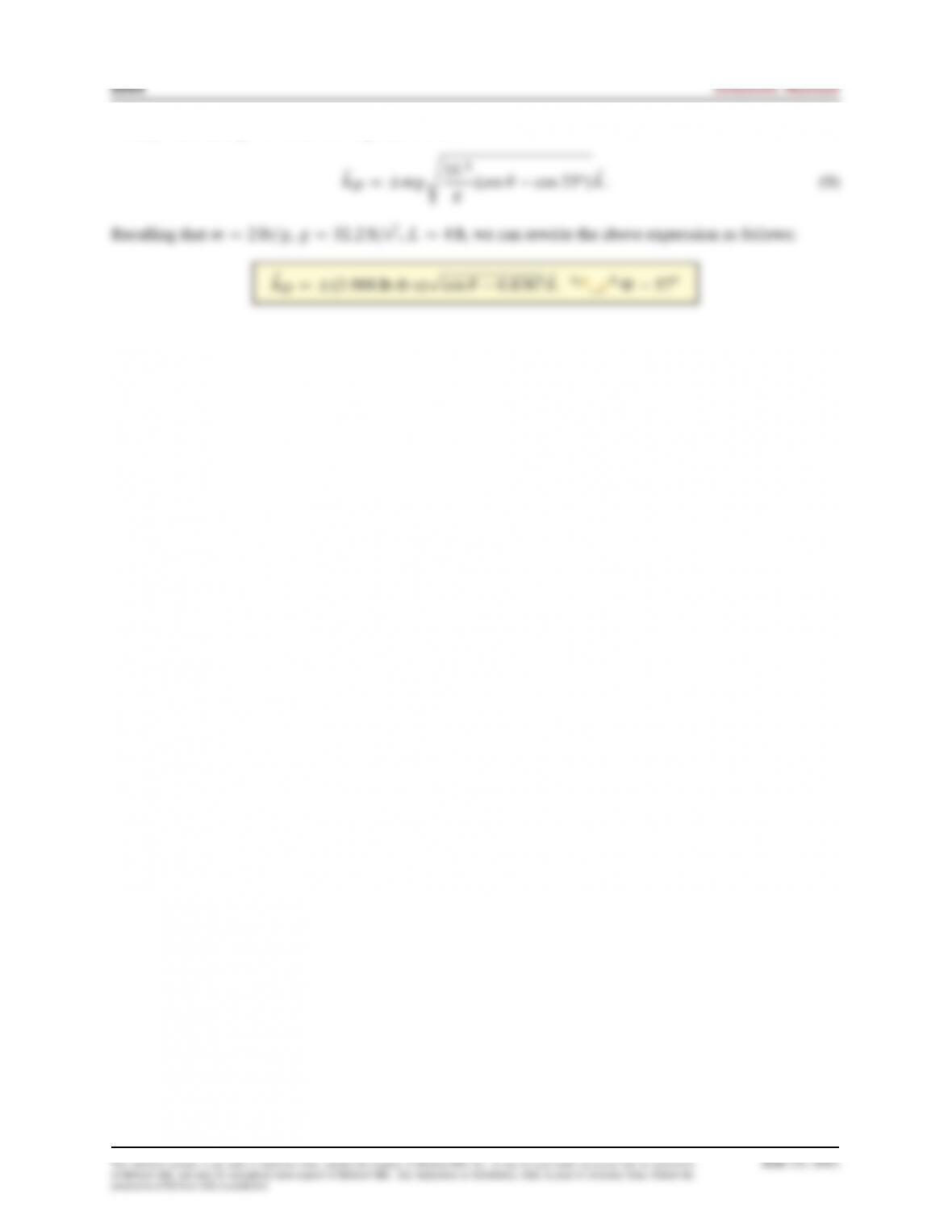
Finally, substituting this result into Eq. (2), we have
of McGraw-Hill, and must be surrendered upon request of McGraw-Hill. Any duplication or distribution, either in print or electronic form, without the
permission of McGraw-Hill, is prohibited.
Dynamics 2e 1045
Problem 5.126
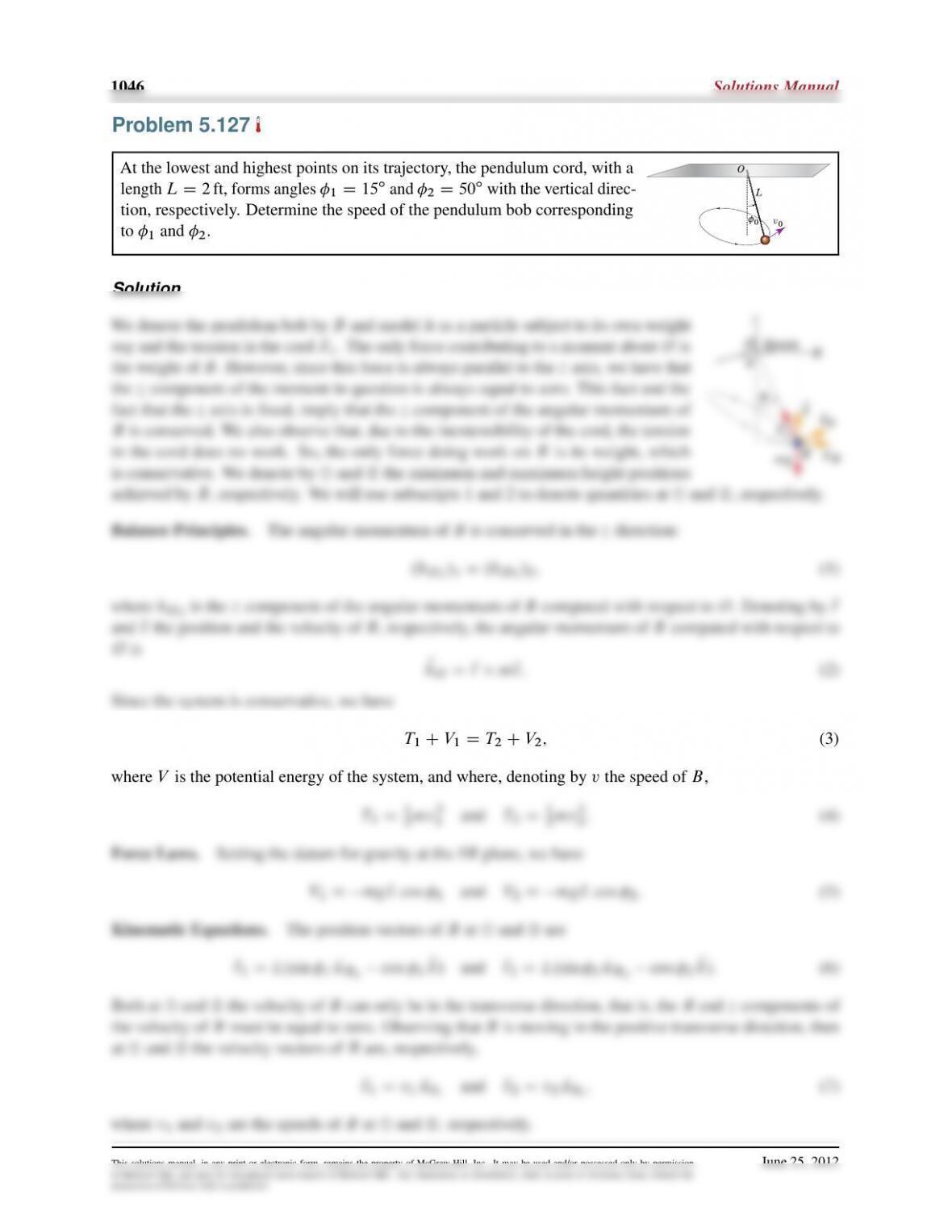
The simple pendulum in the figure is released from rest when ✓D33ı.
Use the angular impulse-momentum principle in Eq. (5.36) to determine the equations
of motion of the pendulum bob.
of McGraw-Hill, and must be surrendered upon request of McGraw-Hill. Any duplication or distribution, either in print or electronic form, without the
permission of McGraw-Hill, is prohibited.
1046 Solutions Manual
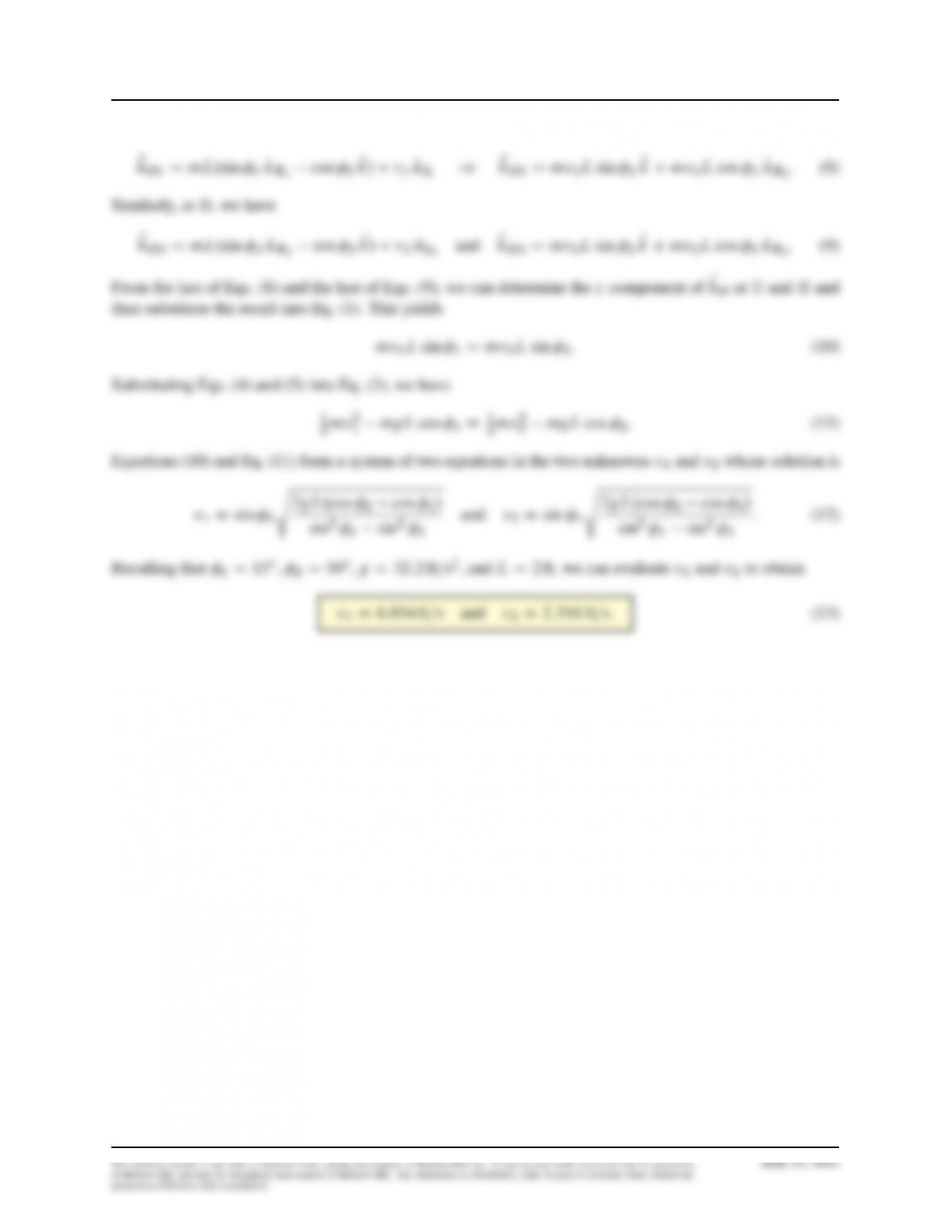
At the lowest and highest points on its trajectory, the pendulum cord, with a
length
LD2ft
, forms angles
1D15ı
and
2D50ı
with the vertical direc-
tion, respectively. Determine the speed of the pendulum bob corresponding
to 1and 2.
Solution
where Vis the potential energy of the system, and where, denoting by vthe speed of B,
T1D1
2mv2
1and T2D1
2mv2
2:(4)
Dynamics 2e 1047
Computation. Using Eq. (2) along with Eqs. (6) and (7), at ¿, we have
of McGraw-Hill, and must be surrendered upon request of McGraw-Hill. Any duplication or distribution, either in print or electronic form, without the
permission of McGraw-Hill, is prohibited.
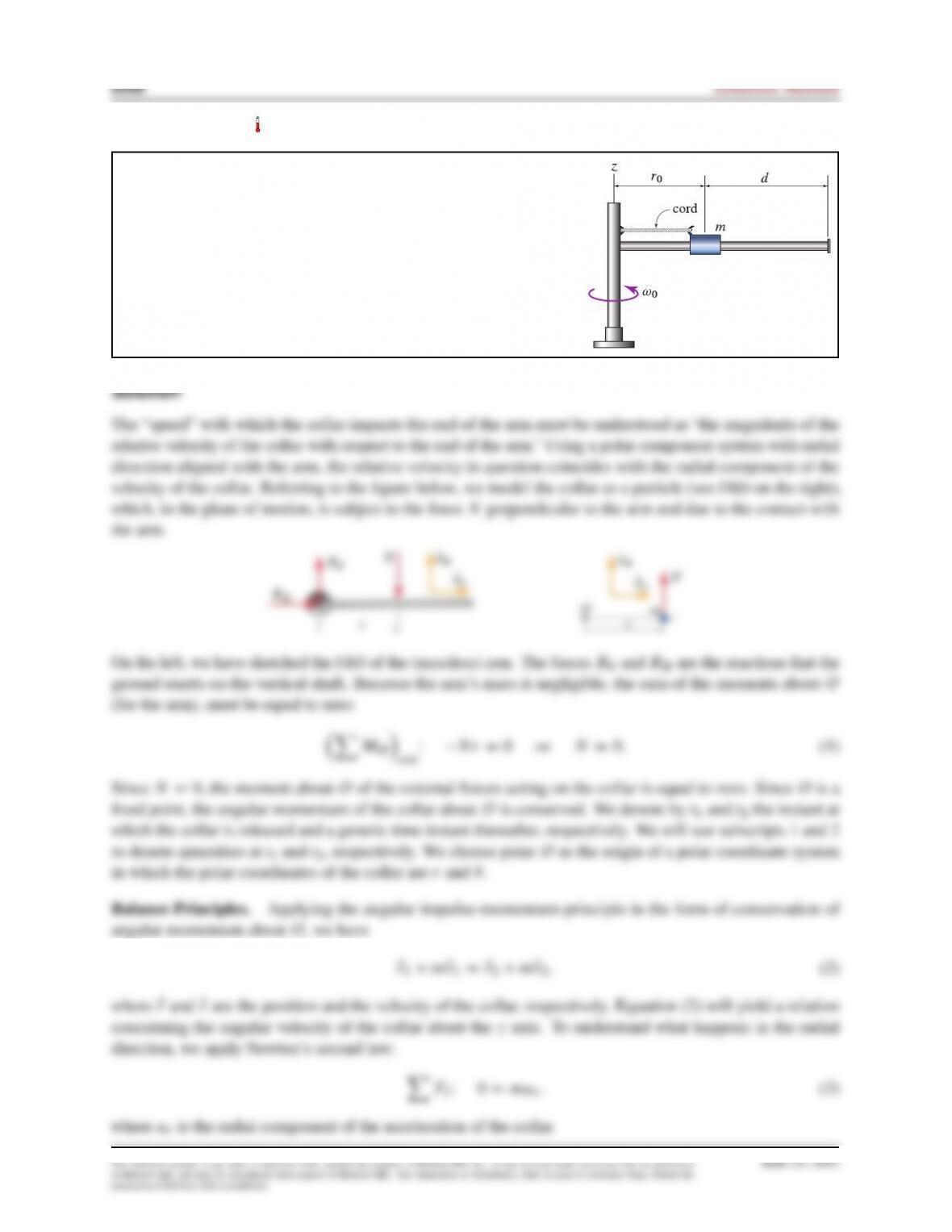
Problem 5.128
A collar with mass
mD2kg
is mounted on a rotating arm of
negligible mass that is initially rotating with an angular velocity
!0D1rad=s
. The collar’s initial distance from the
´
axis is
r0D
0:5
m and
dD1
m. At some point, the restraint keeping the collar
in place is removed so that the collar is allowed to slide. Assume
that the friction between the arm and the collar is negligible.
If no external forces and moments are applied to the system,
with what speed relative to the arm will the collar impact the end of
the arm?
of McGraw-Hill, and must be surrendered upon request of McGraw-Hill. Any duplication or distribution, either in print or electronic form, without the
permission of McGraw-Hill, is prohibited.
Dynamics 2e 1049
Force Laws. All forces are accounted for on the FBD.
Kinematic Equations.
For the position and velocity vectors needed in the conservation of angular momen-
01
01
where the last of Eqs. (8) accounts for the fact that
Pr>0
from the time of release to the time of impact.
of McGraw-Hill, and must be surrendered upon request of McGraw-Hill. Any duplication or distribution, either in print or electronic form, without the
permission of McGraw-Hill, is prohibited.