406 Solutions Manual
Chapter 3 Solutions
Problem 3.1
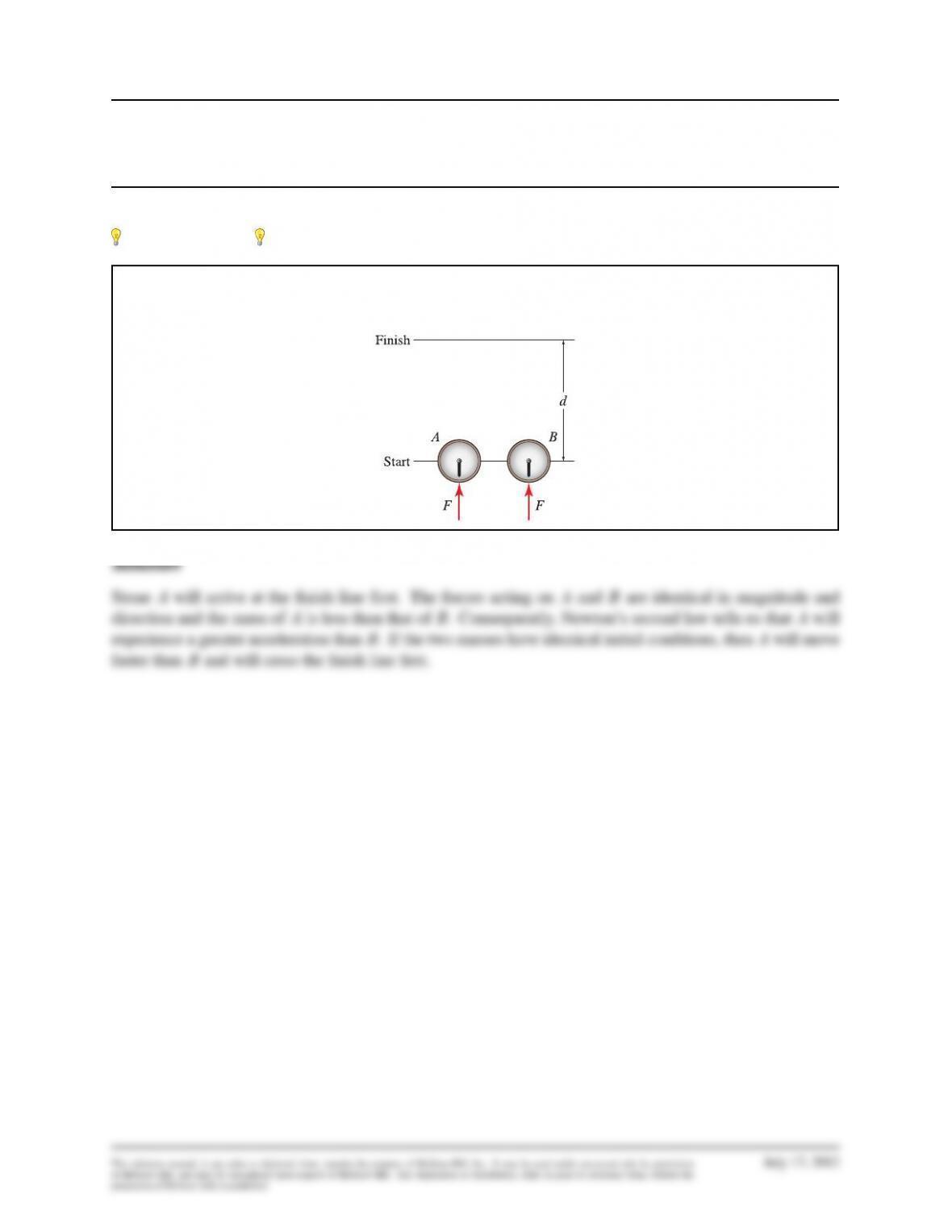
Two curling stones
A
and
B
, with masses
m
and
4m
, respectively, and initially at rest on the start line, are
pushed by two identical forces Fover the distance d. Which stone arrives first to the finish line?
of McGraw-Hill, and must be surrendered upon request of McGraw-Hill. Any duplication or distribution, either in print or electronic form, without the
permission of McGraw-Hill, is prohibited.
Dynamics 2e 407
Problem 3.2
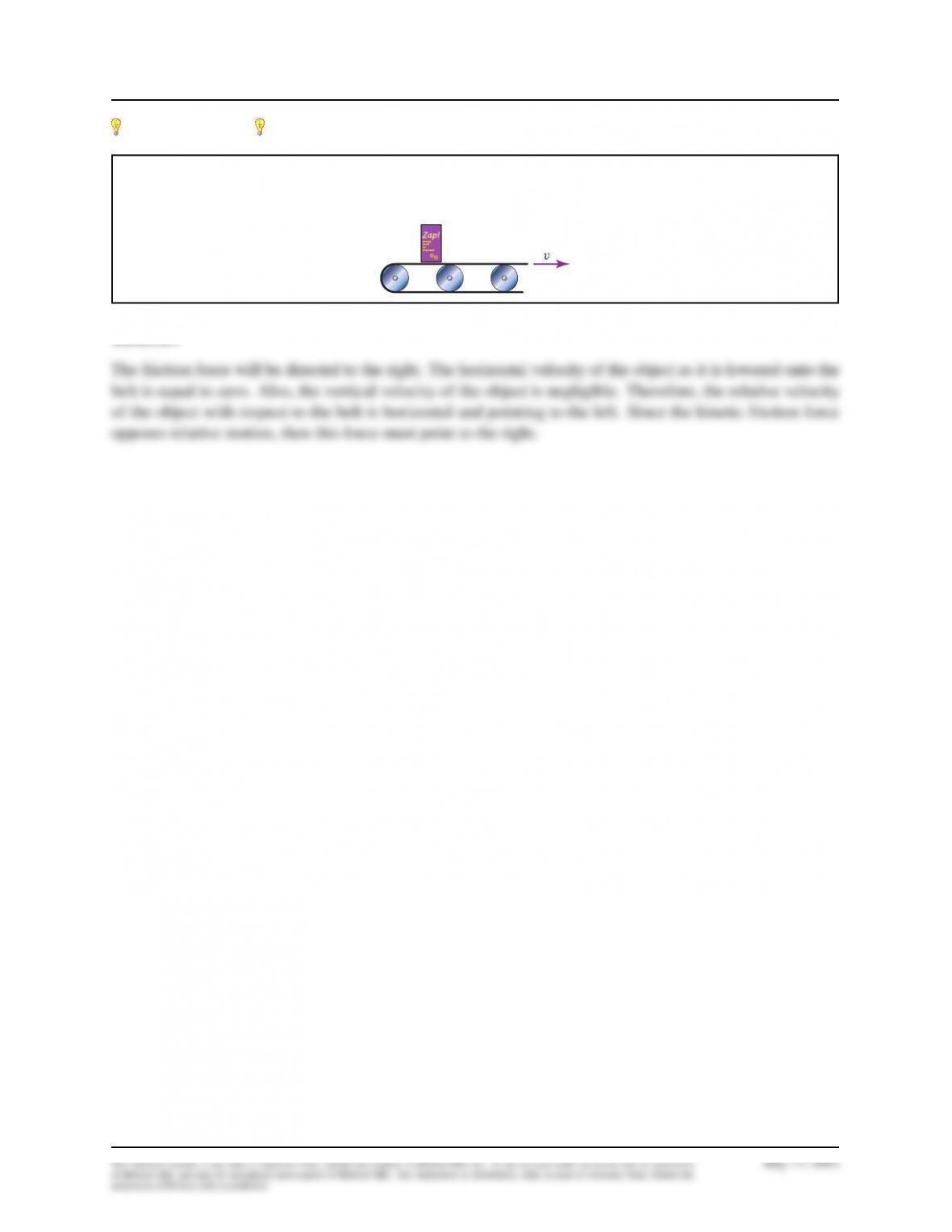
An object is lowered very slowly onto a conveyor belt that is moving to the right. What is the direction of
the friction force acting on the object at the instant the object touches the belt?
of McGraw-Hill, and must be surrendered upon request of McGraw-Hill. Any duplication or distribution, either in print or electronic form, without the
permission of McGraw-Hill, is prohibited.
408 Solutions Manual
Problem 3.3
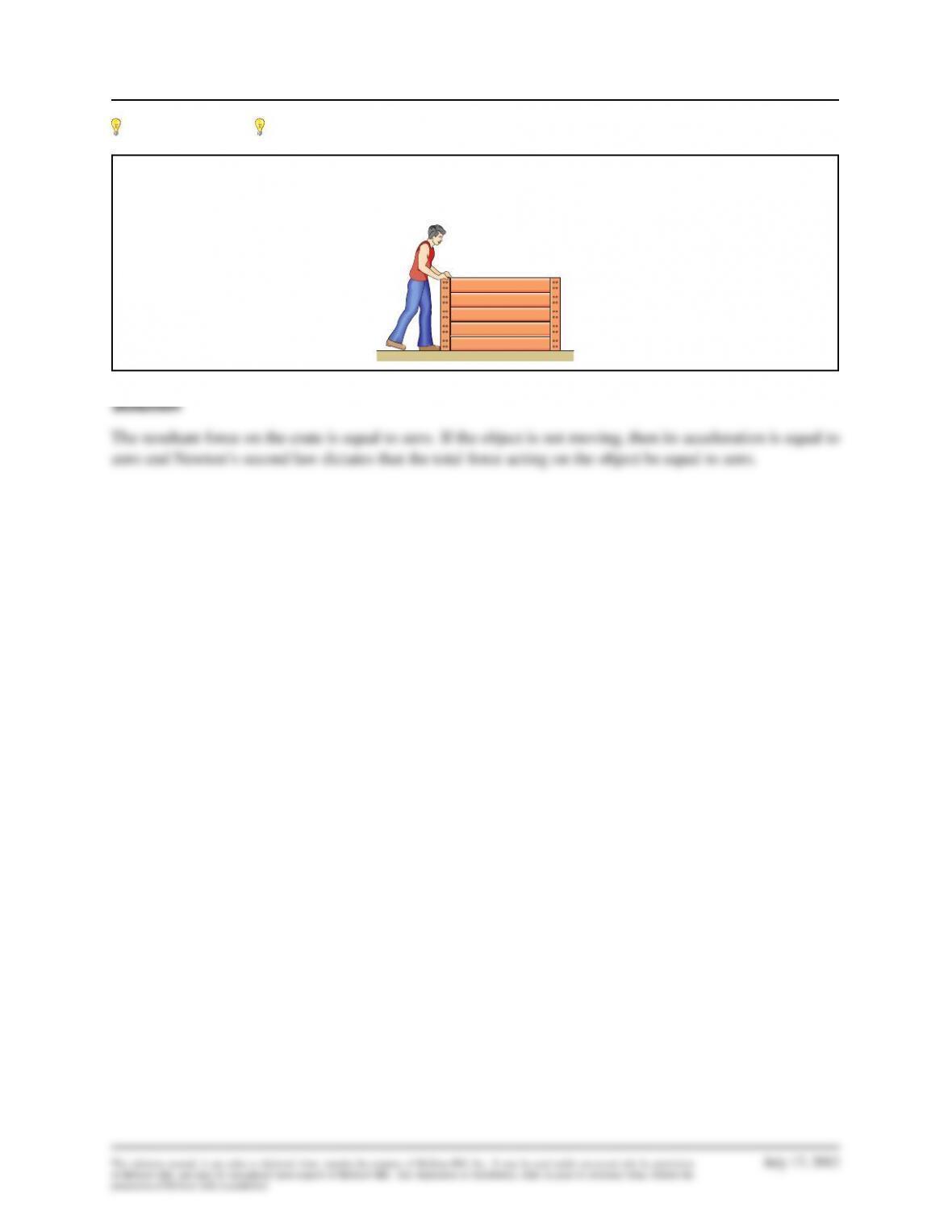
A person is trying to move a heavy crate by pushing on it. While the person is pushing, what is the resultant
force acting on the crate if the crate does not move?
of McGraw-Hill, and must be surrendered upon request of McGraw-Hill. Any duplication or distribution, either in print or electronic form, without the
permission of McGraw-Hill, is prohibited.
Dynamics 2e 409
Problem 3.4
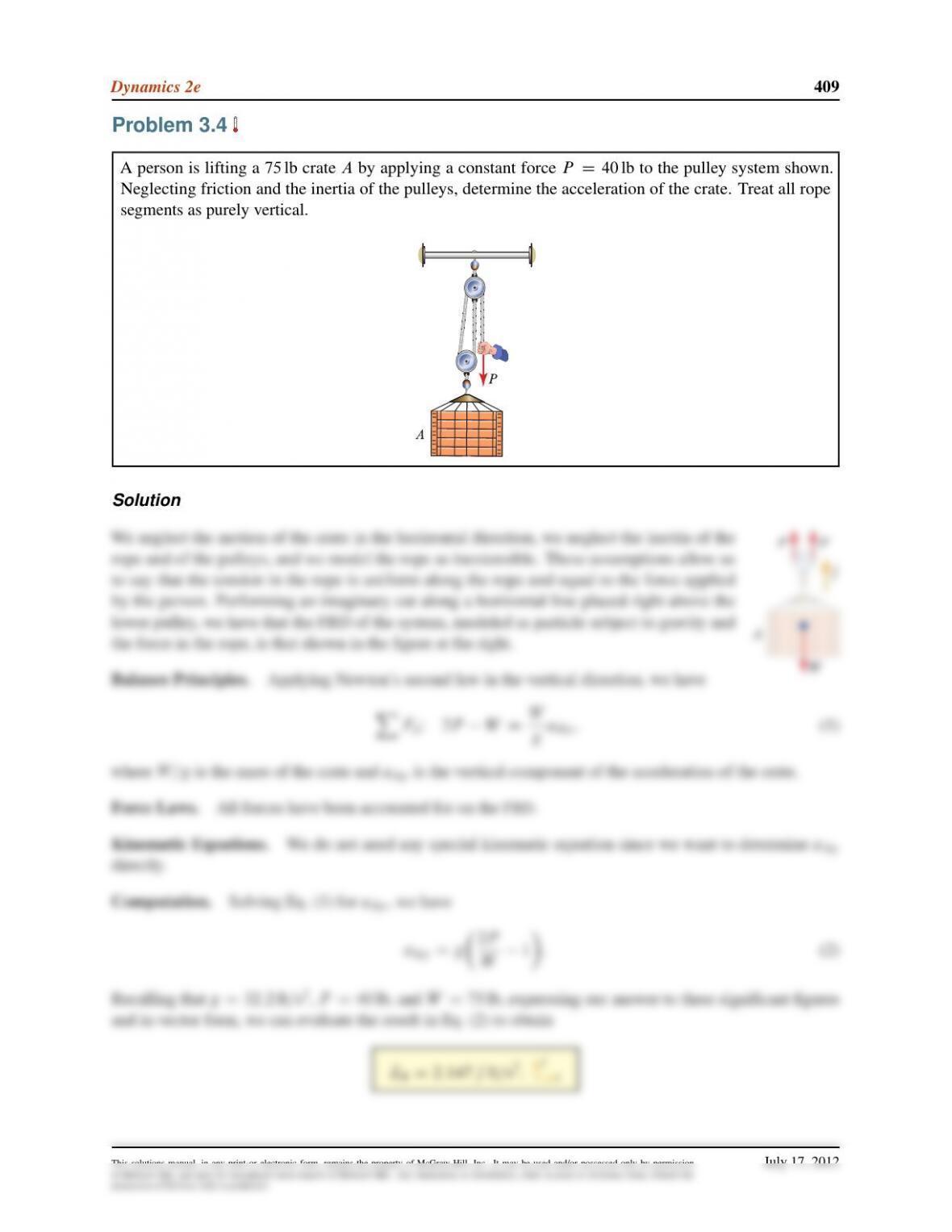
A person is lifting a
75 lb
crate
A
by applying a constant force
PD40 lb
to the pulley system shown.
Neglecting friction and the inertia of the pulleys, determine the acceleration of the crate. Treat all rope
segments as purely vertical.
Solution
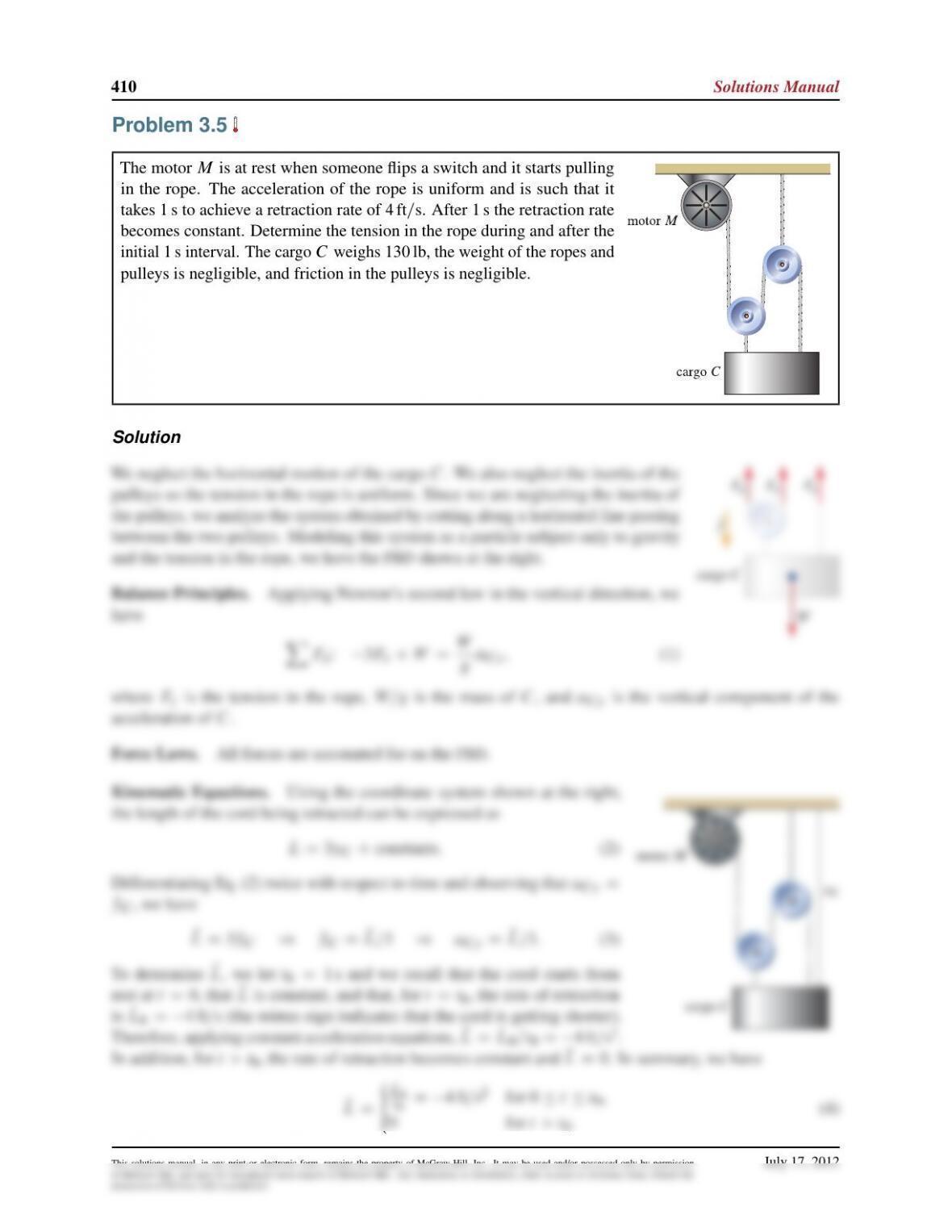
We neglect the motion of the crate in the horizontal direction, we neglect the inertia of the
rope and of the pulleys, and we model the rope as inextensible. These assumptions allow us
410 Solutions Manual
Problem 3.5
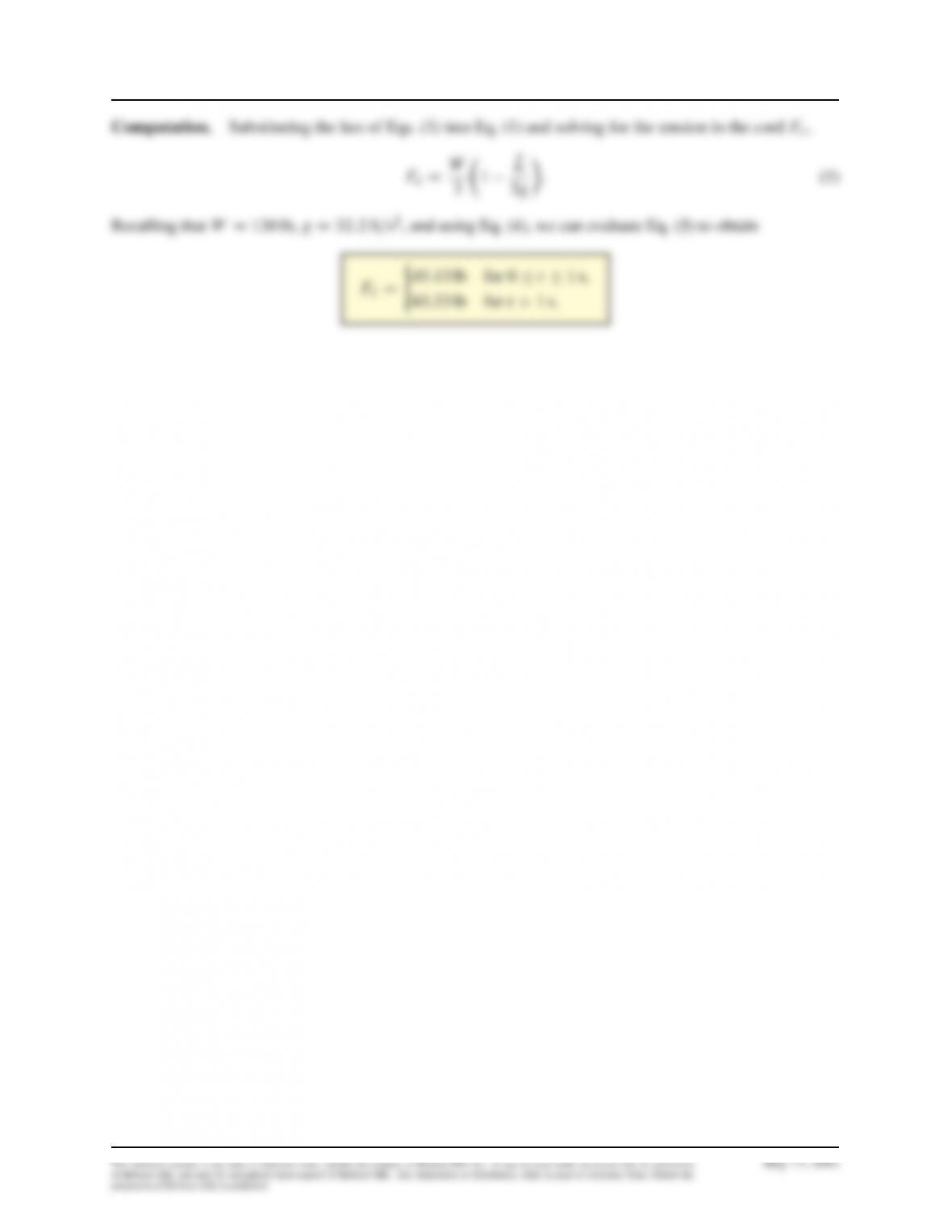
The motor
M
is at rest when someone flips a switch and it starts pulling
in the rope. The acceleration of the rope is uniform and is such that it
takes
1
s to achieve a retraction rate of
4ft=s
. After
1
s the retraction rate
becomes constant. Determine the tension in the rope during and after the
initial
1
s interval. The cargo
C
weighs
130 lb
, the weight of the ropes and
pulleys is negligible, and friction in the pulleys is negligible.
Solution
We neglect the horizontal motion of the cargo
C
. We also neglect the inertia of the
pulleys so the tension in the rope is uniform. Since we are neglecting the inertia of
Dynamics 2e 411
of McGraw-Hill, and must be surrendered upon request of McGraw-Hill. Any duplication or distribution, either in print or electronic form, without the
permission of McGraw-Hill, is prohibited.
412 Solutions Manual
Problem 3.6
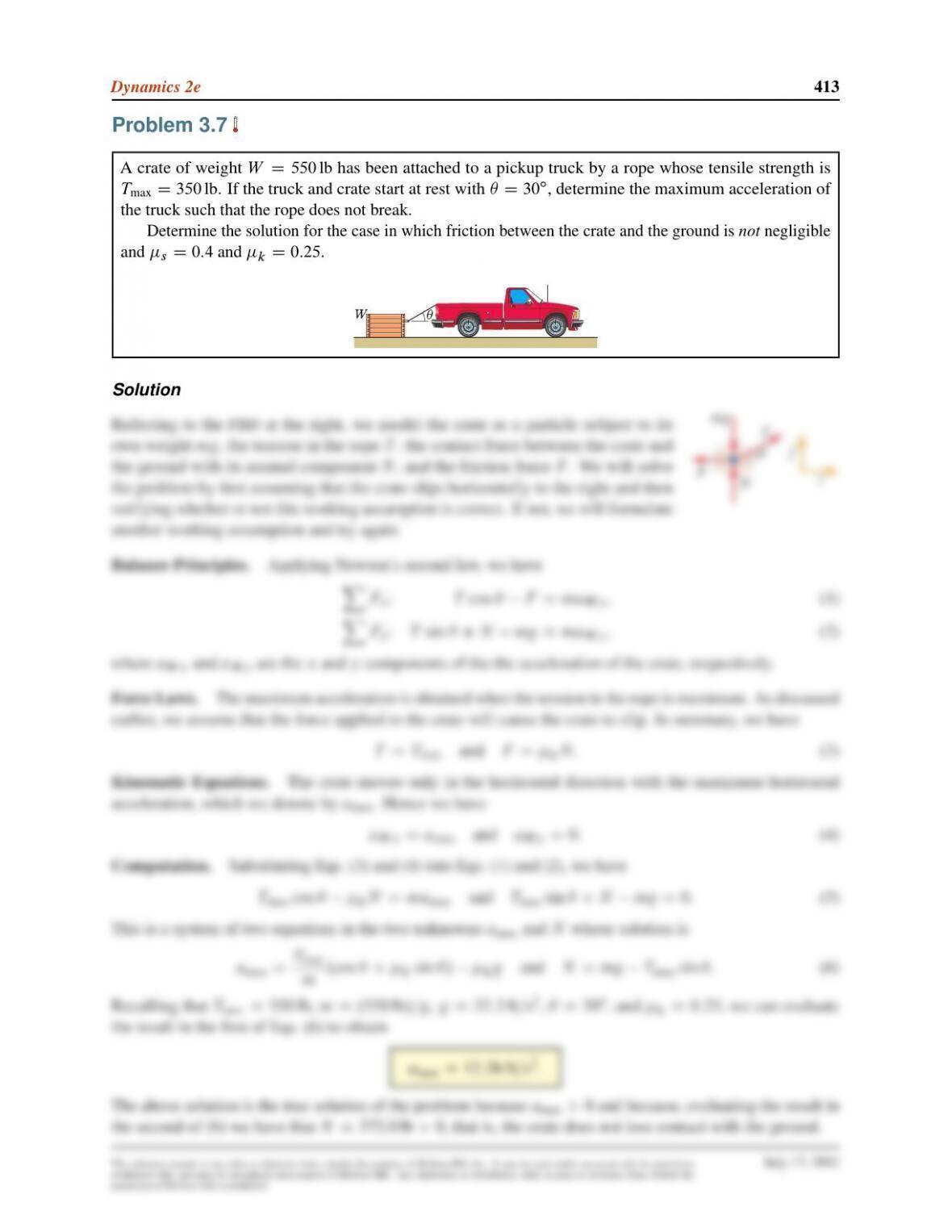
A crate of weight
WD550 lb
has been attached to a pickup truck by a rope whose tensile strength is
Tmax D350 lb
. If the truck and crate start at rest with
✓D30ı
, determine the maximum acceleration of
the truck such that the rope does not break.
Determine the solution for the case in which friction between the crate and the ground is negligible.
Solution
Dynamics 2e 413
Problem 3.7
A crate of weight
WD550 lb
has been attached to a pickup truck by a rope whose tensile strength is
Tmax D350 lb
. If the truck and crate start at rest with
✓D30ı
, determine the maximum acceleration of
the truck such that the rope does not break.
Determine the solution for the case in which friction between the crate and the ground is not negligible
and sD0:4 and kD0:25.
Solution
Referring to the FBD at the right, we model the crate as a particle subject to its
own weight
mg
, the tension in the rope
T
, the contact force between the crate and
414 Solutions Manual
Problem 3.8
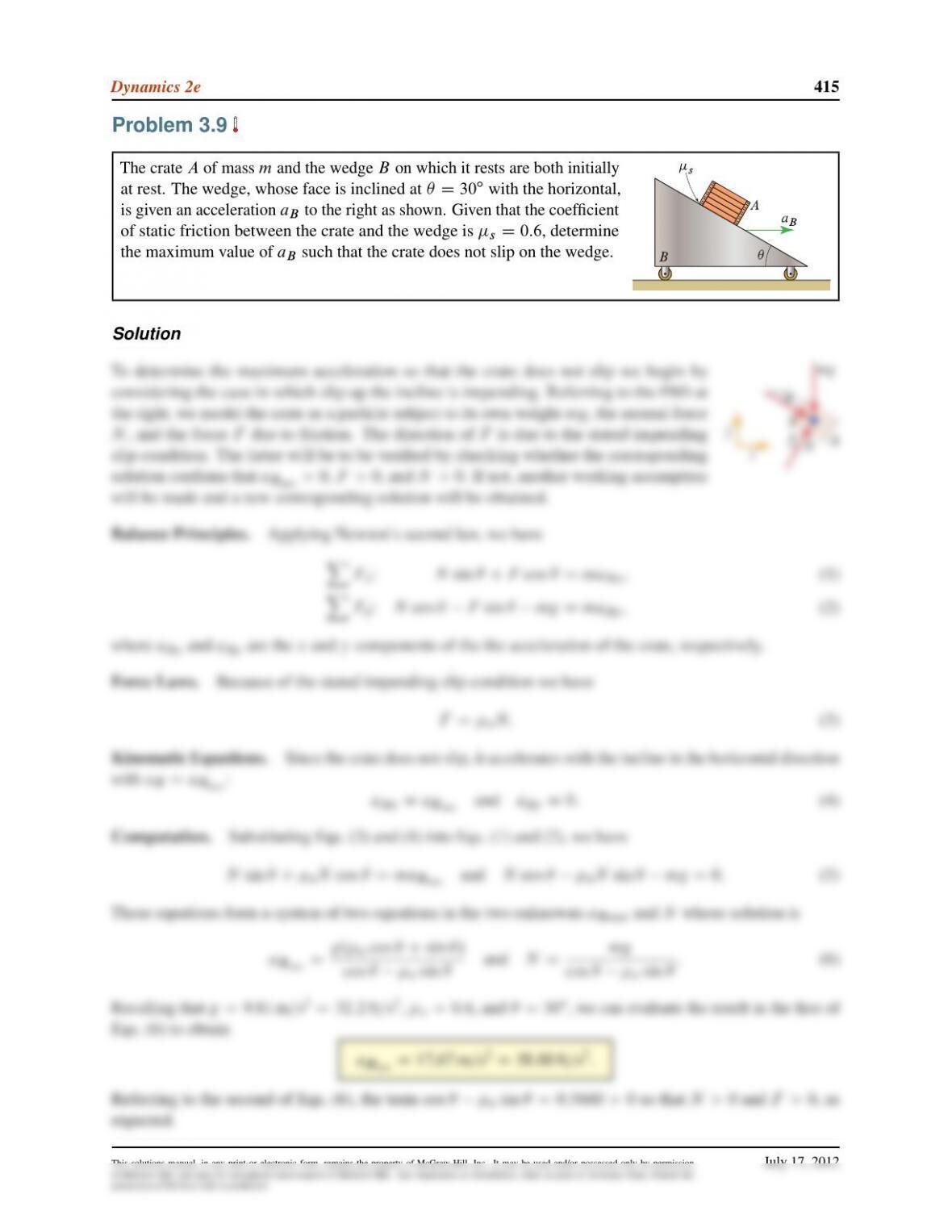
The crate
A
of mass
m
and the wedge
B
on which it rests are both initially
at rest. The wedge, whose face is inclined at
✓D30ı
with the horizontal,
is given an acceleration
aB
to the left as shown. Given that the coefficient
of static friction between the crate and the wedge is
sD0:6
, determine
the maximum value of aBsuch that the crate does not slip on the wedge.
Solution
Dynamics 2e 415
Problem 3.9
The crate
A
of mass
m
and the wedge
B
on which it rests are both initially
at rest. The wedge, whose face is inclined at
✓D30ı
with the horizontal,
is given an acceleration
aB
to the right as shown. Given that the coefficient
of static friction between the crate and the wedge is
sD0:6
, determine
the maximum value of aBsuch that the crate does not slip on the wedge.
Solution
To determine the maximum acceleration so that the crate does not slip we begin by
considering the case in which slip up the incline is impending. Referring to the FBD at