Dynamics 2e 2159
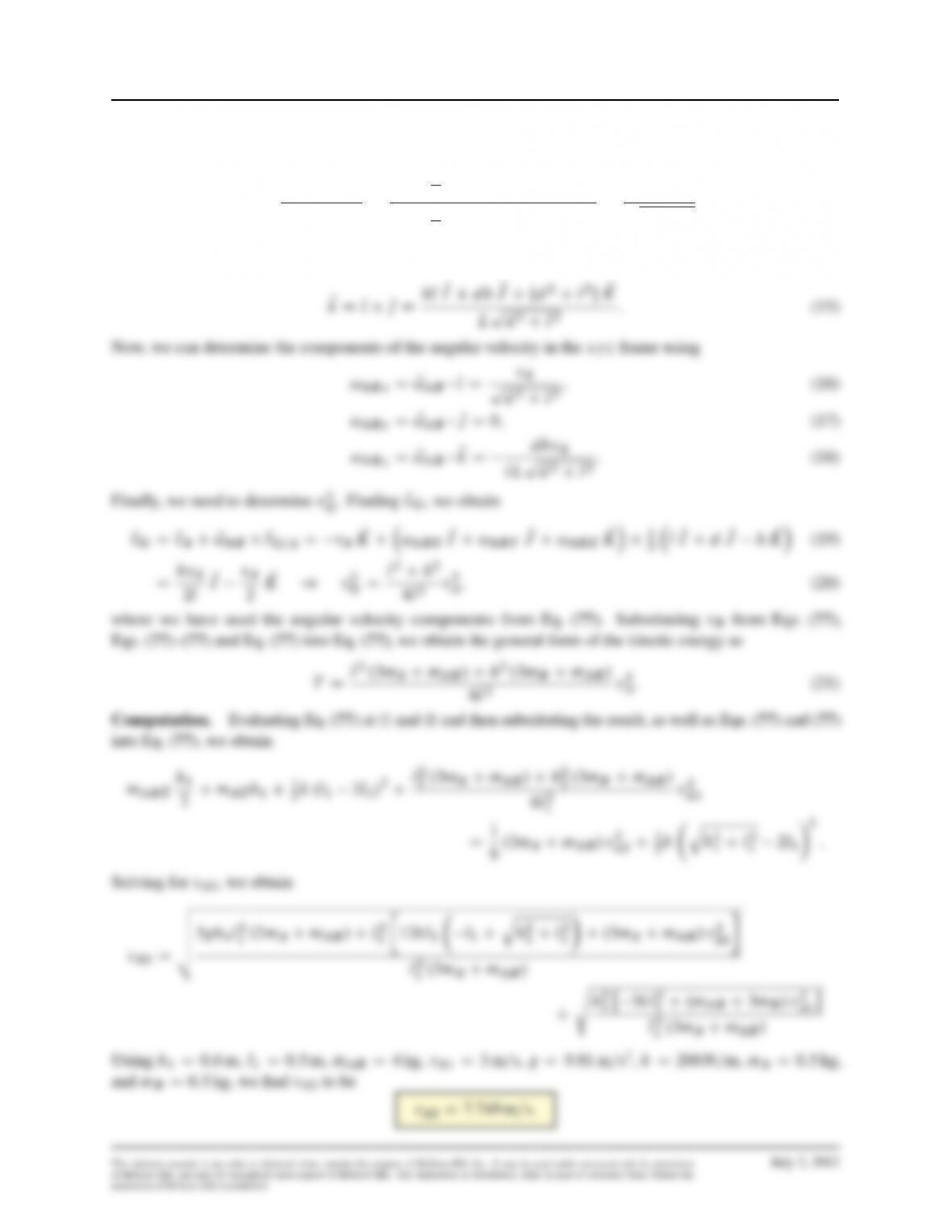
we are viewing the bar
AB
in the plane of the angle
ˇ
, the spring force
Fs
has a component
.Fs/k
in that
plane and a component
.Fs/?
perpendicular to that plane. Fortunately, the work of
Fs
is readily computed
using its potential energy function.
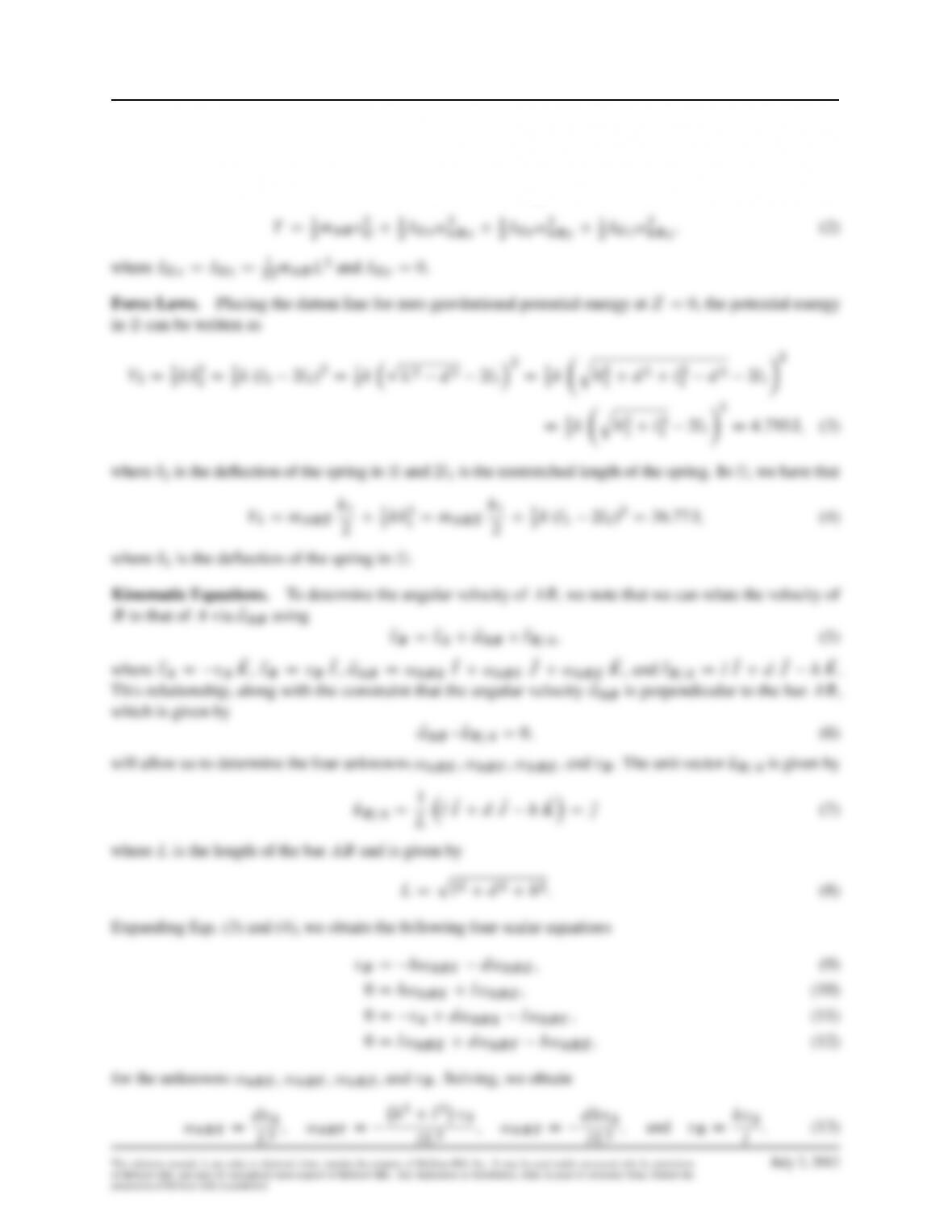
With all of this in mind, we can now write the kinetic energy of the bar AB as
of McGraw-Hill, and must be surrendered upon request of McGraw-Hill. Any duplication or distribution, either in print or electronic form, without the
permission of McGraw-Hill, is prohibited.
2160 Solutions Manual
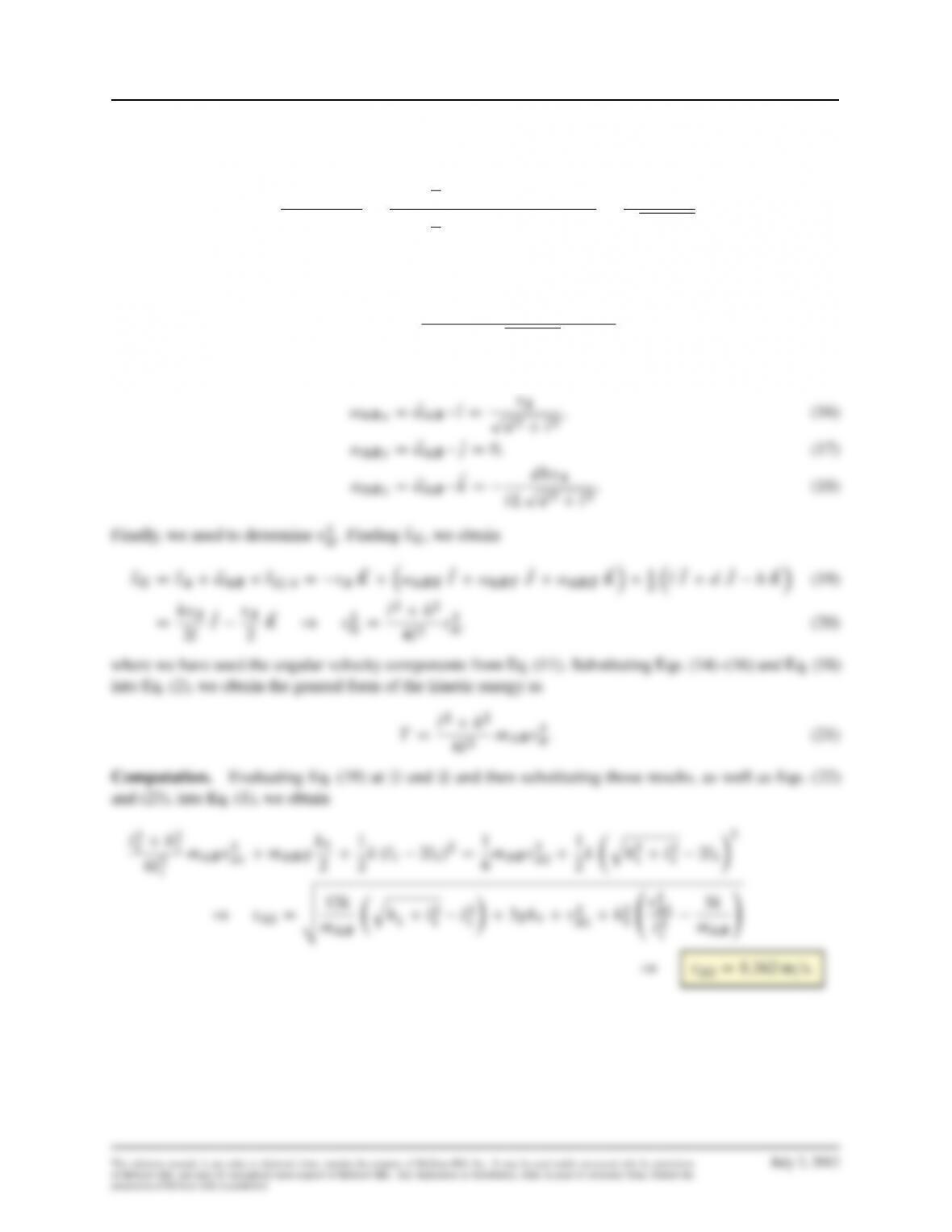
To obtain the components of
E!AB
in the
xy´
frame, we can dot
E!AB
with each of the unit vectors in the
xy´
system in turn. We already know that O|is given by Eq. (5) and we can find O{using
O{DO
K⇥OuA=B
ˇˇˇO
K⇥OuA=B ˇˇˇDO
K⇥1
L⇣lO
IdO
JChO
K⌘
ˇˇˇO
K⇥1
L⇣lO
IdO
JChO
K⌘ˇˇˇDdO
IlO
J
pd2Cl2:(14)
The unit vector O
kcan be found using its definition
O
kDO{⇥O|Dhl O
ICdh O
JCd2Cl2O
K
Lpd2Cl2:(15)
Now, we can determine the components of the angular velocity in the xy´ frame using
of McGraw-Hill, and must be surrendered upon request of McGraw-Hill. Any duplication or distribution, either in print or electronic form, without the
permission of McGraw-Hill, is prohibited.
of McGraw-Hill, and must be surrendered upon request of McGraw-Hill. Any duplication or distribution, either in print or electronic form, without the
permission of McGraw-Hill, is prohibited.
2162 Solutions Manual
constraint force system in the first FBD don’t do any work, the equivalent constraint force system in the
second FBD can’t do any work either.
With all of this in mind, we can now write the kinetic energy of the system as
TD1
2mAB v2
GC1
2IGx!2
ABx C1
2IGy !2
ABy C1
2IG´!2
AB´ C1
2mAv2
AC1
2mBv2
B;(2)
where IGx DIG´ D1
12 mAB L2and IGy D0.
Force Laws.
Placing the datum line for zero gravitational potential energy at
ZD0
, we can conclude that
in ¡
V2D0: (3)
In ¿, we have that
V1DmAB gh1
2CmAgh1:(4)
of McGraw-Hill, and must be surrendered upon request of McGraw-Hill. Any duplication or distribution, either in print or electronic form, without the
permission of McGraw-Hill, is prohibited.
Dynamics 2e 2163
The unit vector O
kcan be found using its definition
O
kDO{⇥O|Dhl O
ICdh O
JCd2Cl2O
K
Lpd2Cl2:(15)
Now, we can determine the components of the angular velocity in the xy´ frame using
This solutions manual, in any print or electronic form, remains the property of McGraw-Hill, Inc. It may be used and/or possessed only by permission
of McGraw-Hill, and must be surrendered upon request of McGraw-Hill. Any duplication or distribution, either in print or electronic form, without the
permission of McGraw-Hill, is prohibited.
July 2, 2012
2164 Solutions Manual
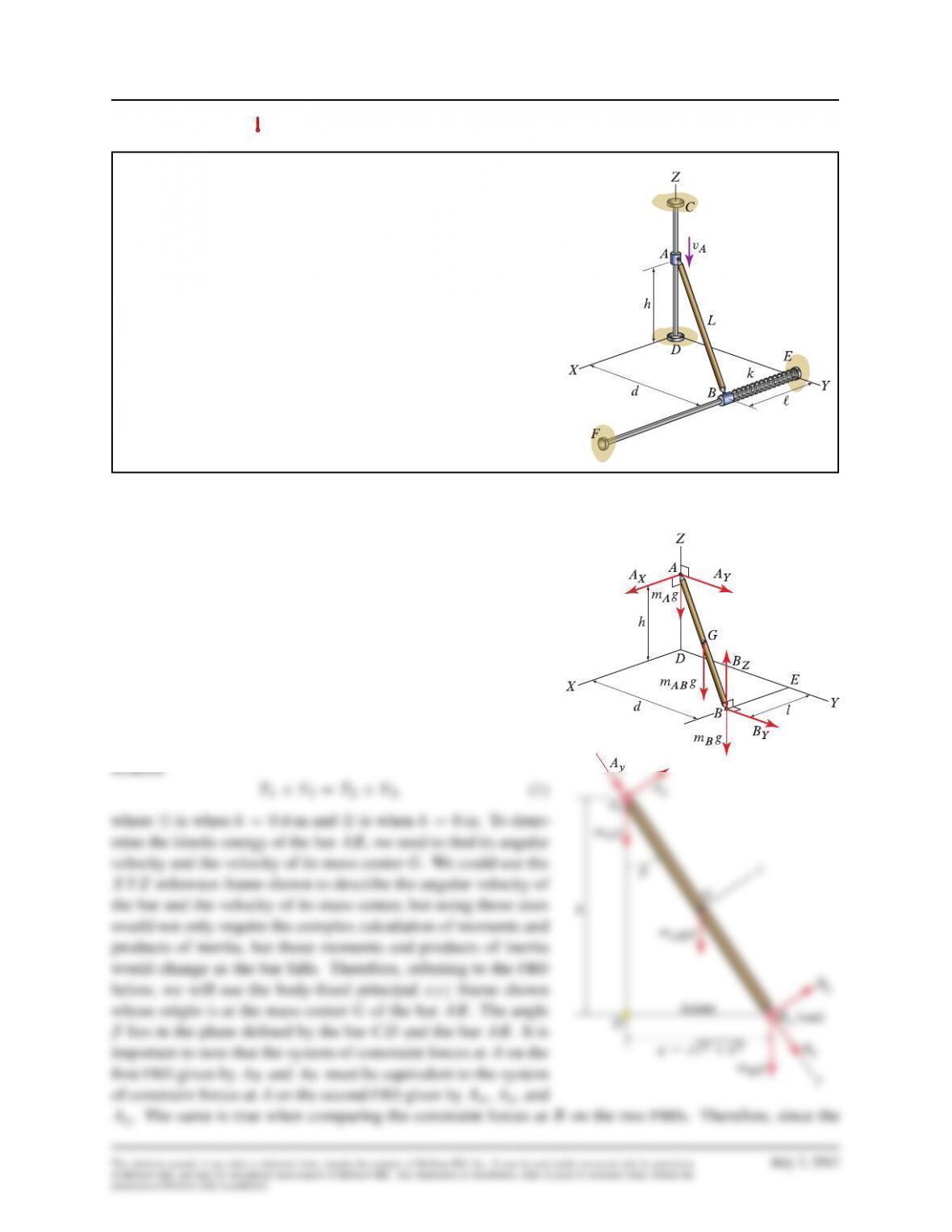
Problem 10.47
When
h1D0:6
m,
`1D0:5
m, and
dD0:9
m, collar
A
is
moving downward at speed
vA1 D3m=s
. The uniform thin
bar
AB
has mass
mAB D4kg
and length
L
and is attached
to collars
A
and
B
with ball-and-socket joints. Collars
A
and
B
slide smoothly on rods
CD
and
EF
, respectively, and collar
B
is attached to the stop at
E
by a linear elastic spring with
constant
kD200 N=m
and unstretched length
2`1
. Neglect the
dimensions of the collars and assume that the angular velocity of
the rod AB is such that AB does not spin about its axis.
Assuming that the mass of collar
A
is
mAD0:5 kg
and the
mass of collar
B
is
mBD0:5 kg
, determine the speed of the
collar Awhen it reaches D.
Solution
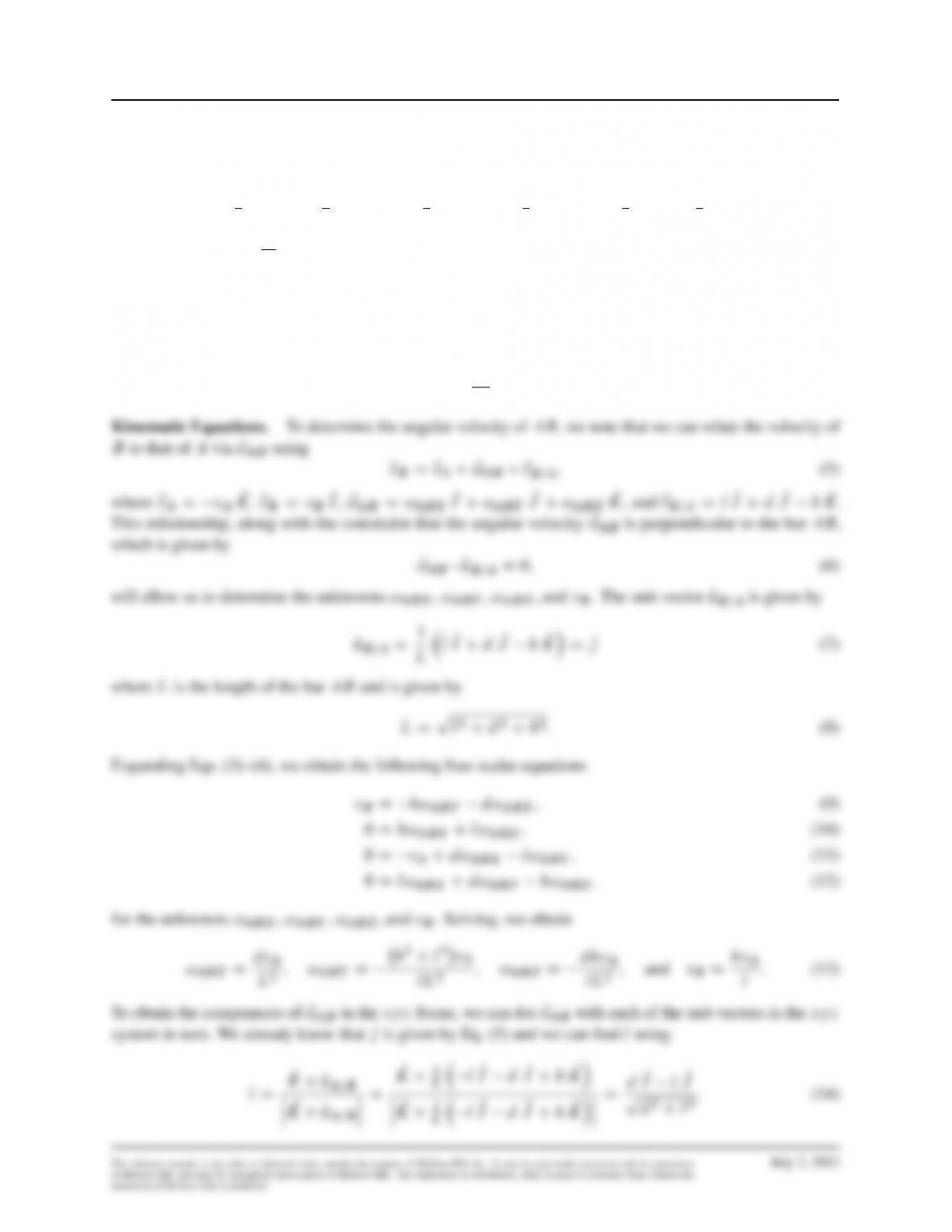
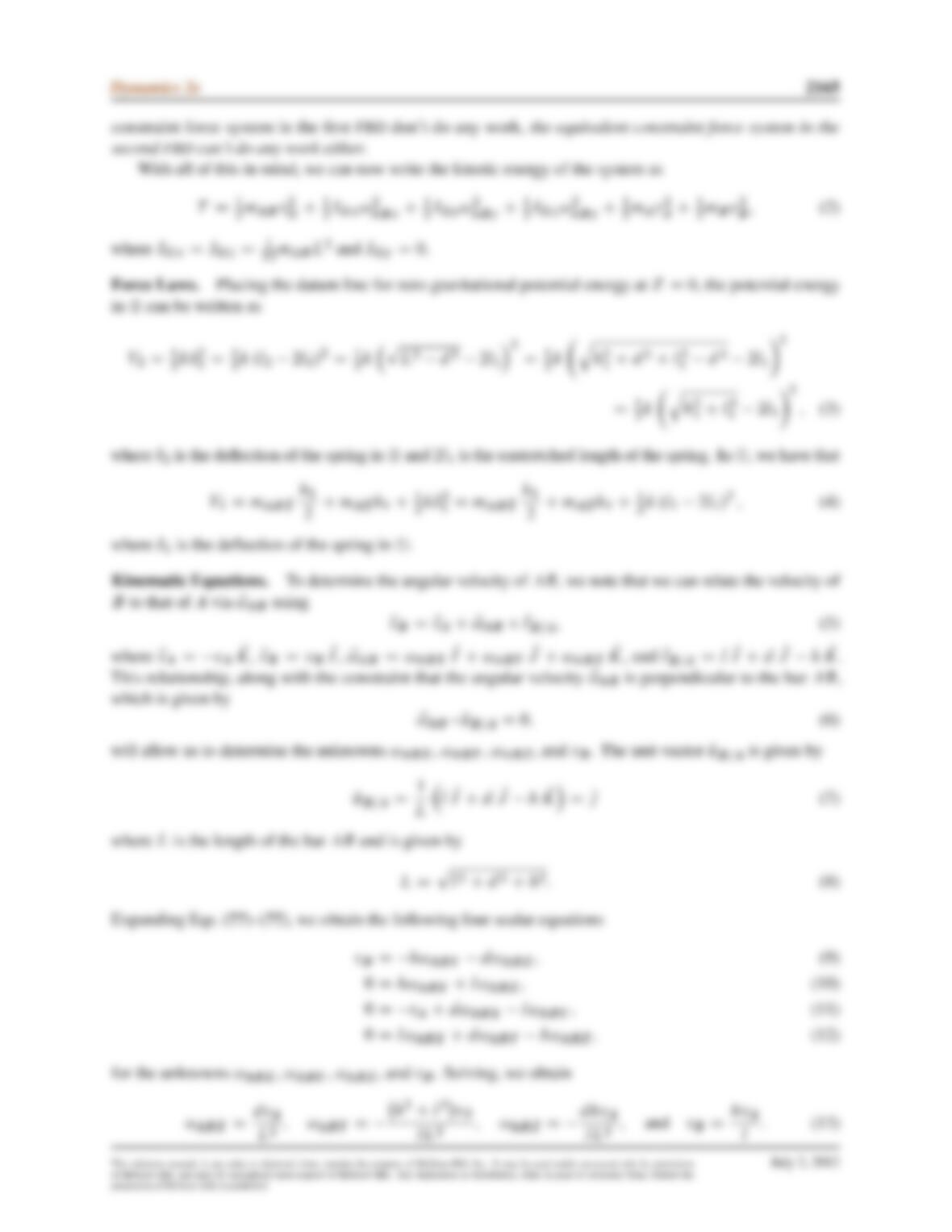
Referring to the FBD at the right, we see that the constraint forces
AX
and
AY
on the bar at
A
and
BY
and
BZ
on the bar at
B
do
not do any work since they are perpendicular to the motion of
those points. In addition, the weight force
mBg
does no work
since the motion of
B
is perpendicular to that force. Therefore,
the only forces that do work on the bar as it falls is the weight
force
mAB g
acting at its mass center and the weight force
mAg
acting at A.
Balance Principles.
Since all forces that do work are conser–
vative, we can say that energy is conserved and can apply the
of McGraw-Hill, and must be surrendered upon request of McGraw-Hill. Any duplication or distribution, either in print or electronic form, without the
permission of McGraw-Hill, is prohibited.
of McGraw-Hill, and must be surrendered upon request of McGraw-Hill. Any duplication or distribution, either in print or electronic form, without the
permission of McGraw-Hill, is prohibited.
2166 Solutions Manual
To obtain the components of
E!AB
in the
xy´
frame, we can dot
E!AB
with each of the unit vectors in the
xy´
system in turn. We already know that O|is given by Eq. (??) and we can find O{using
O{DO
K⇥OuA=B
ˇˇˇO
K⇥OuA=B ˇˇˇDO
K⇥1
L⇣lO
IdO
JChO
K⌘
ˇˇˇO
K⇥1
L⇣lO
IdO
JChO
K⌘ˇˇˇDdO
IlO
J
pd2Cl2:(14)
The unit vector O
kcan be found using its definition
ICdh O
JCd2Cl2O
K
of McGraw-Hill, and must be surrendered upon request of McGraw-Hill. Any duplication or distribution, either in print or electronic form, without the
permission of McGraw-Hill, is prohibited.
Dynamics 2e 2167
2168 Solutions Manual
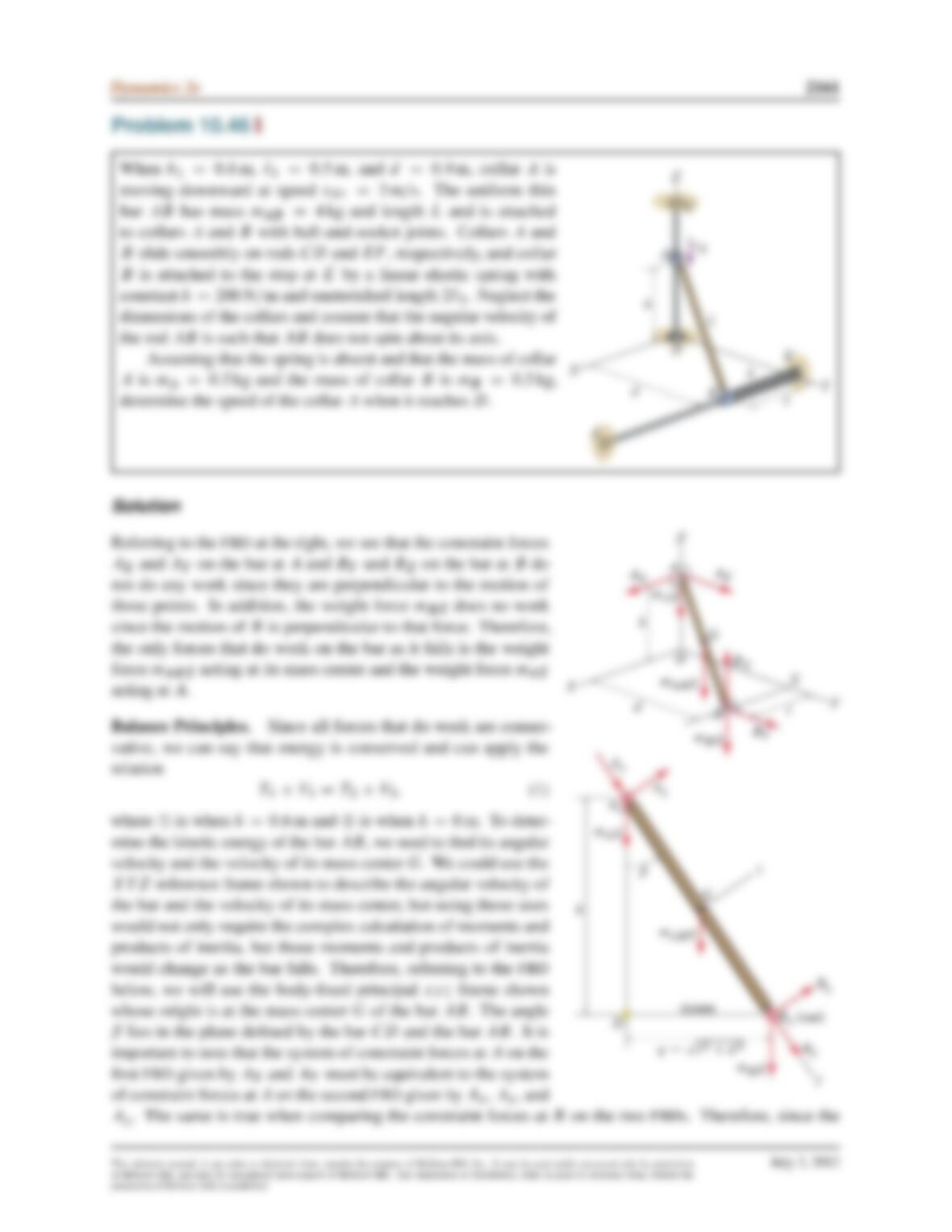
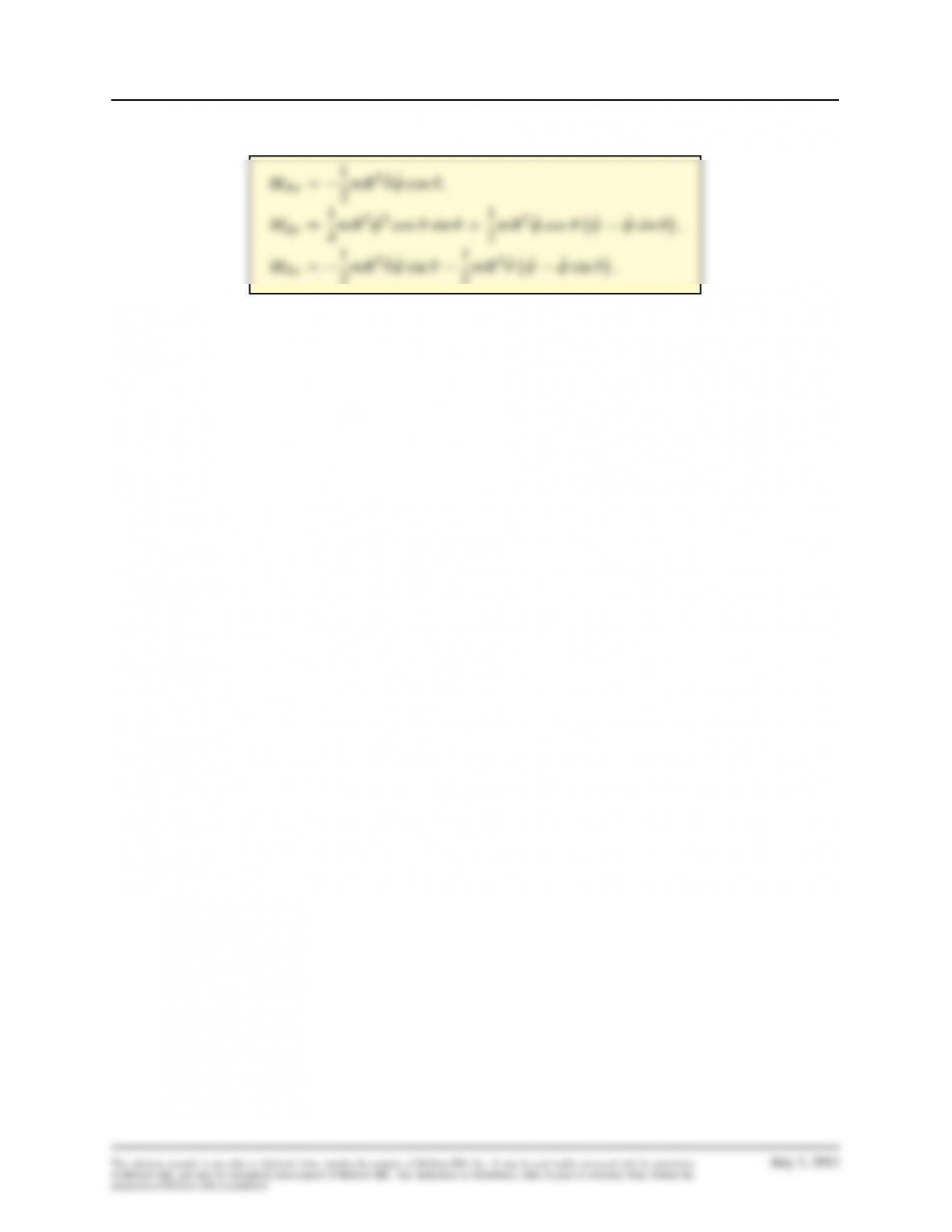
Computation. Substituting Eqs. (??)–(??) into Eqs. (1)–(3), we obtain
of McGraw-Hill, and must be surrendered upon request of McGraw-Hill. Any duplication or distribution, either in print or electronic form, without the
permission of McGraw-Hill, is prohibited.