Statics 2e 403
Vector expressions for the forces appearing in the FBD may be written as
E
WD2kg 9:81 m=s2.O{/;(6)
E
FEF DFEF cos 20ıO{sin 20ıO|;(7)
EnC
0:7500 O{C0:4330 O|0:4330 O
k
Problem 3.106
Follow the suggestions made in the footnote of Example 3.8 on p. 173 to write vector expressions for
E
R1
and
E
R2
. Then determine the magnitude of these, and weight
E
W
, by applying
PE
FDE
0
. Show that the
magnitude of E
Wand the vector sum E
R1CE
R2agree with the results reported in Example 3.8.
Problem 3.107
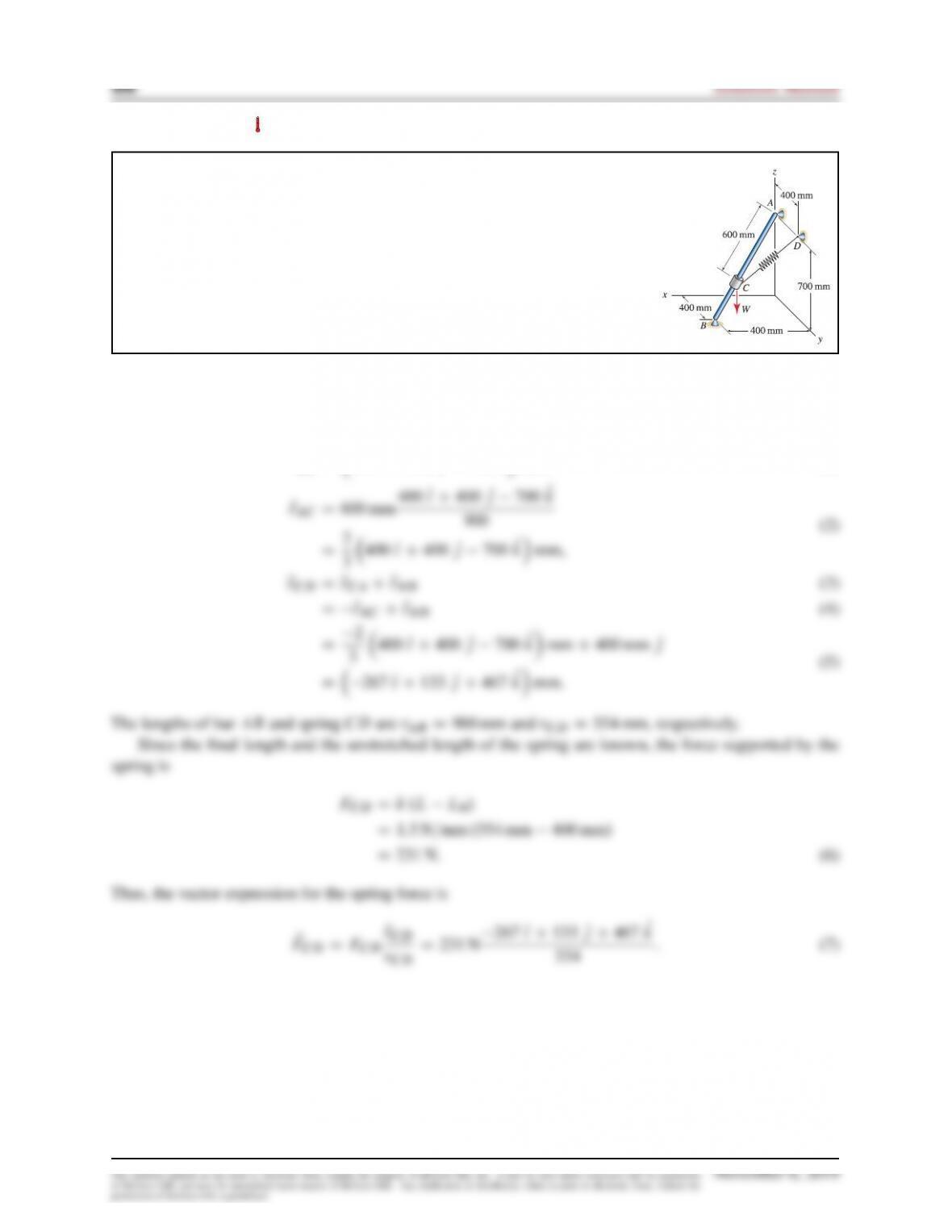
Rod
AB
is fixed in space. Spring
CD
has stiffness
1:5 N=mm
and an un-
stretched length of
400 mm
. If there is no friction between the collar and rod,
determine the weight of the collar
W
that produces the equilibrium configura-
tion shown, and the reaction between the collar and rod AB.
Solution
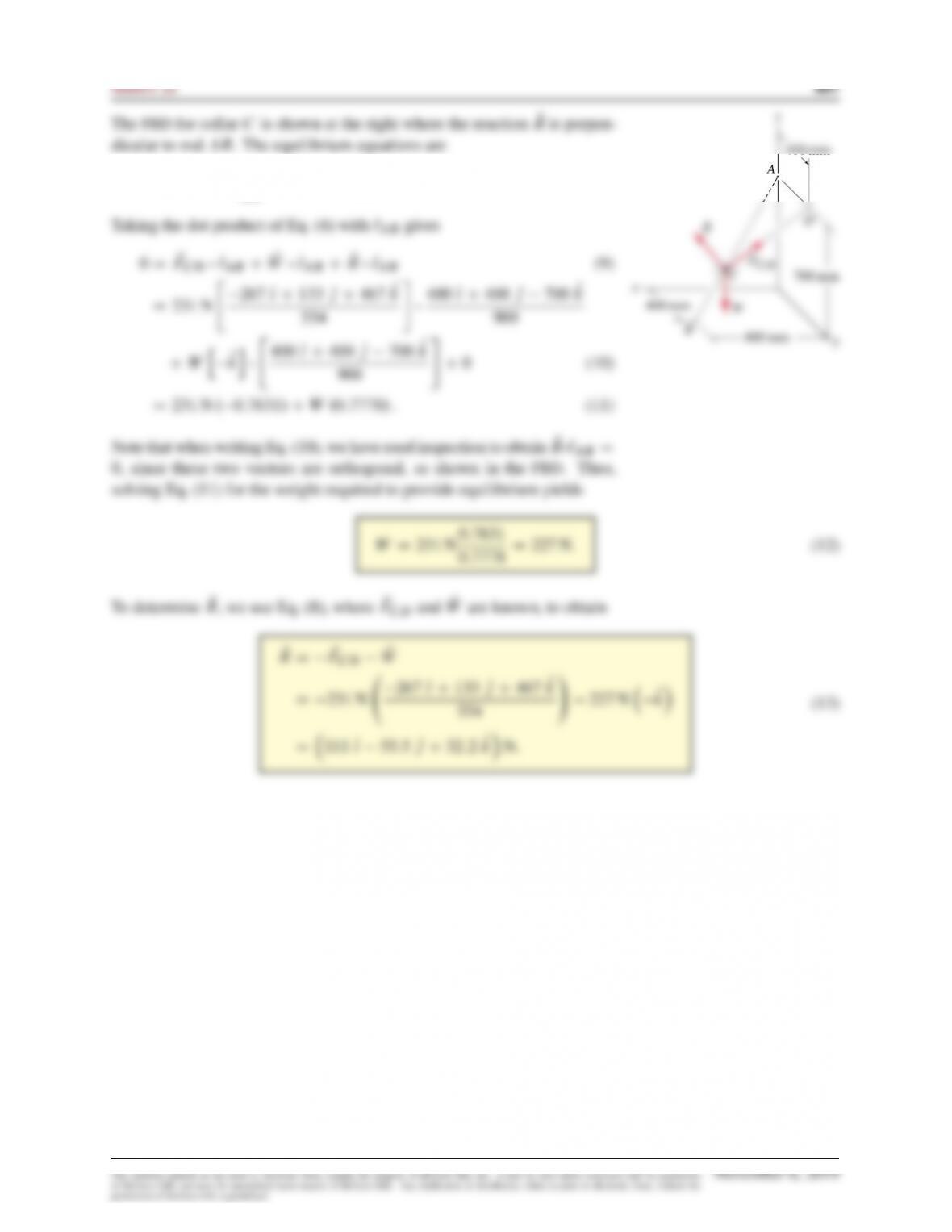
Various position vectors are needed as follows
ErAB D400 O{C400 O|700 O
kmm;(1)
k
XE
FDE
0WE
FCD CE
WCE
RD0: (8)
Problem 3.108
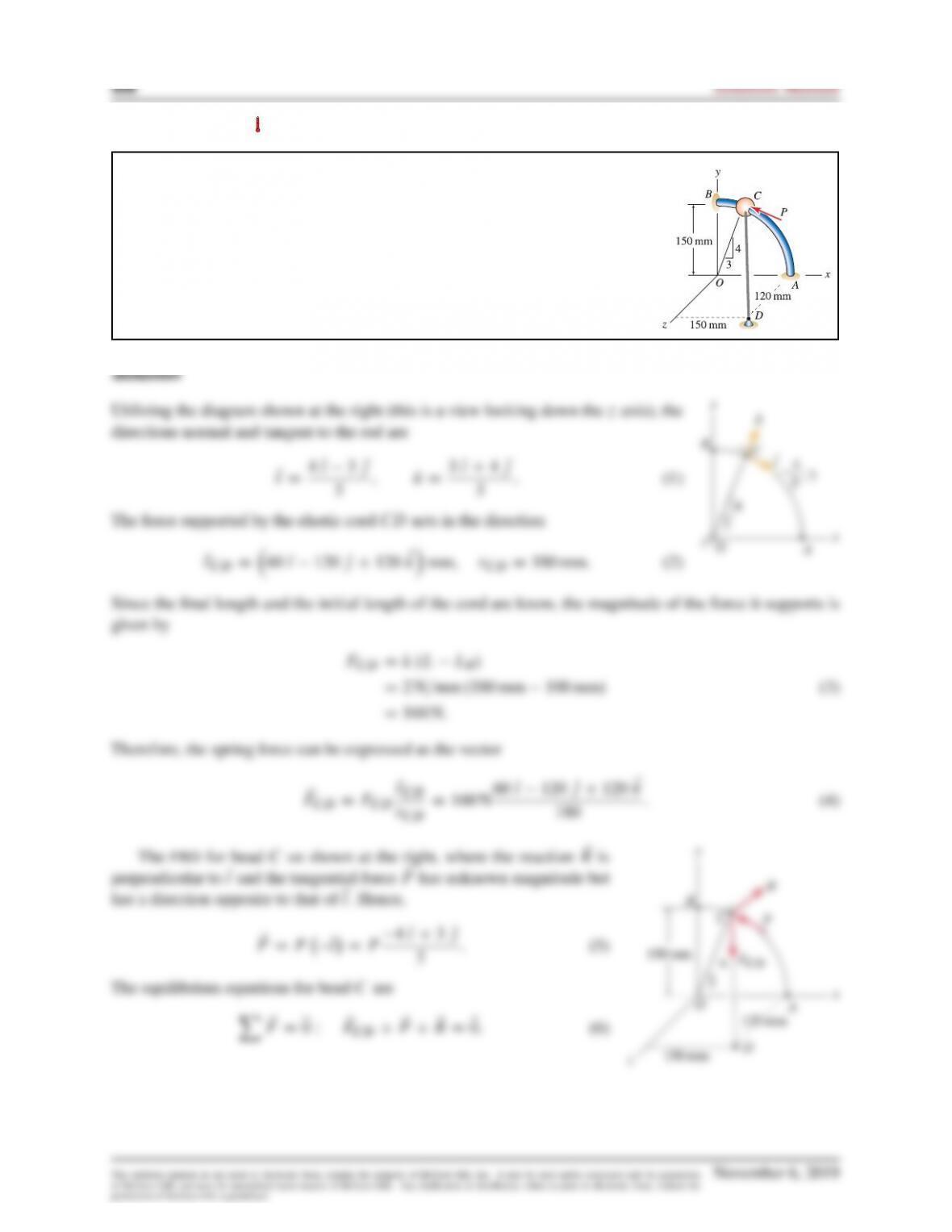
The structure consists of a quarter-circular rod
AB
with
150 mm
radius that
is fixed in the
xy
plane. An elastic cord
CD
has stiffness
kD2N=mm
and
100 mm
unstretched length. Bead
C
has negligible weight, slides without
friction on the rod, and is subjected to a force of magnitude
P
that lies in the
xy
plane and is tangent to the curved rod
AB
in the position shown. Determine
the value of
P
needed for equilibrium in the position shown and the reaction
between the bead and curved rod AB.
Statics 2e 409
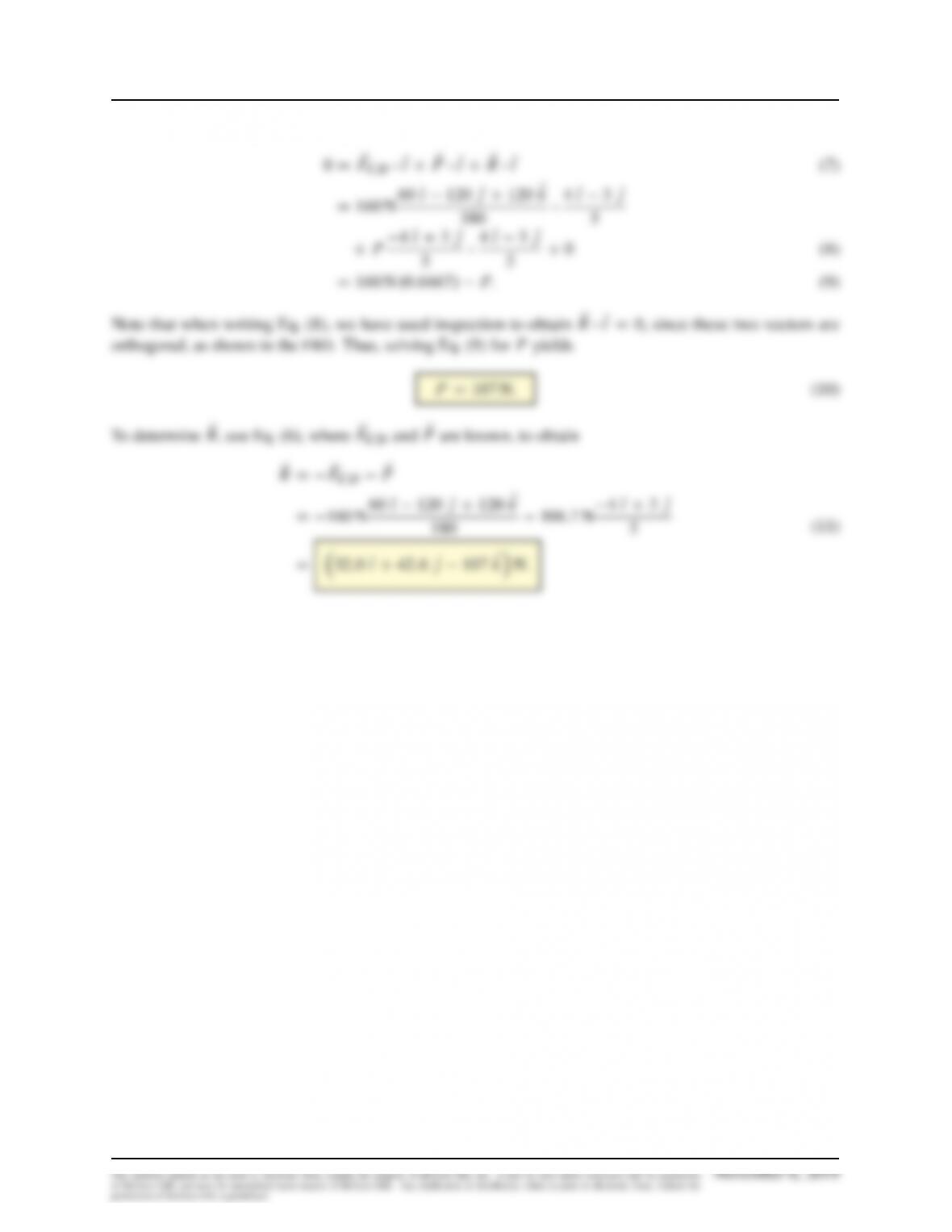
We then take the dot product of Eq. (6) with O
tto obtain
Problem 3.109
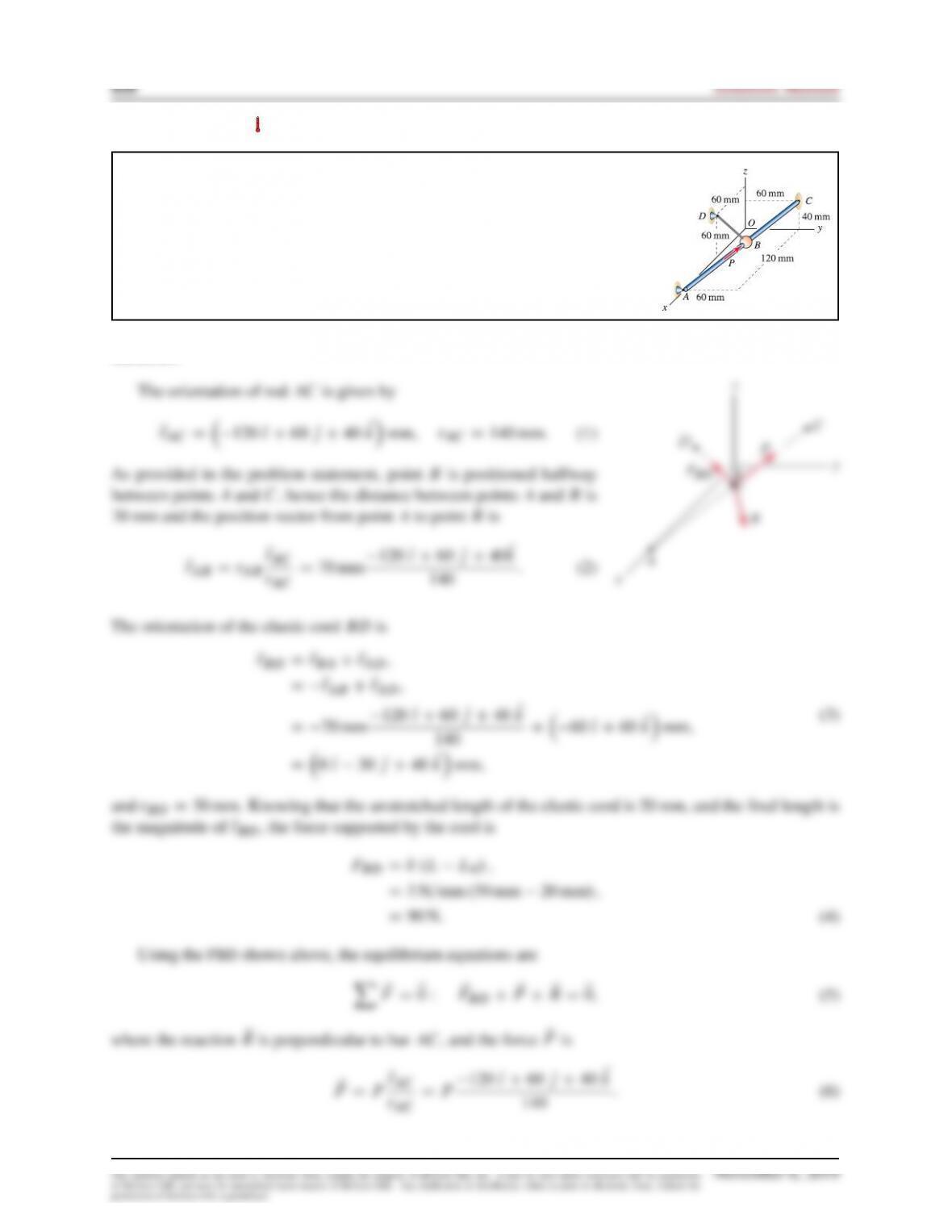
Bead
B
has negligible weight and slides without friction on rigid fixed bar
AC
.
An elastic cord
BD
has spring constant
kD3N=mm
and
20 mm
unstretched
length, and bead
B
has a force of magnitude
P
in direction
BC
. If bead
B
is
positioned halfway between points
A
and
C
, determine the value of
P
needed
for equilibrium, and the reaction between bead Band rod AC .
Solution
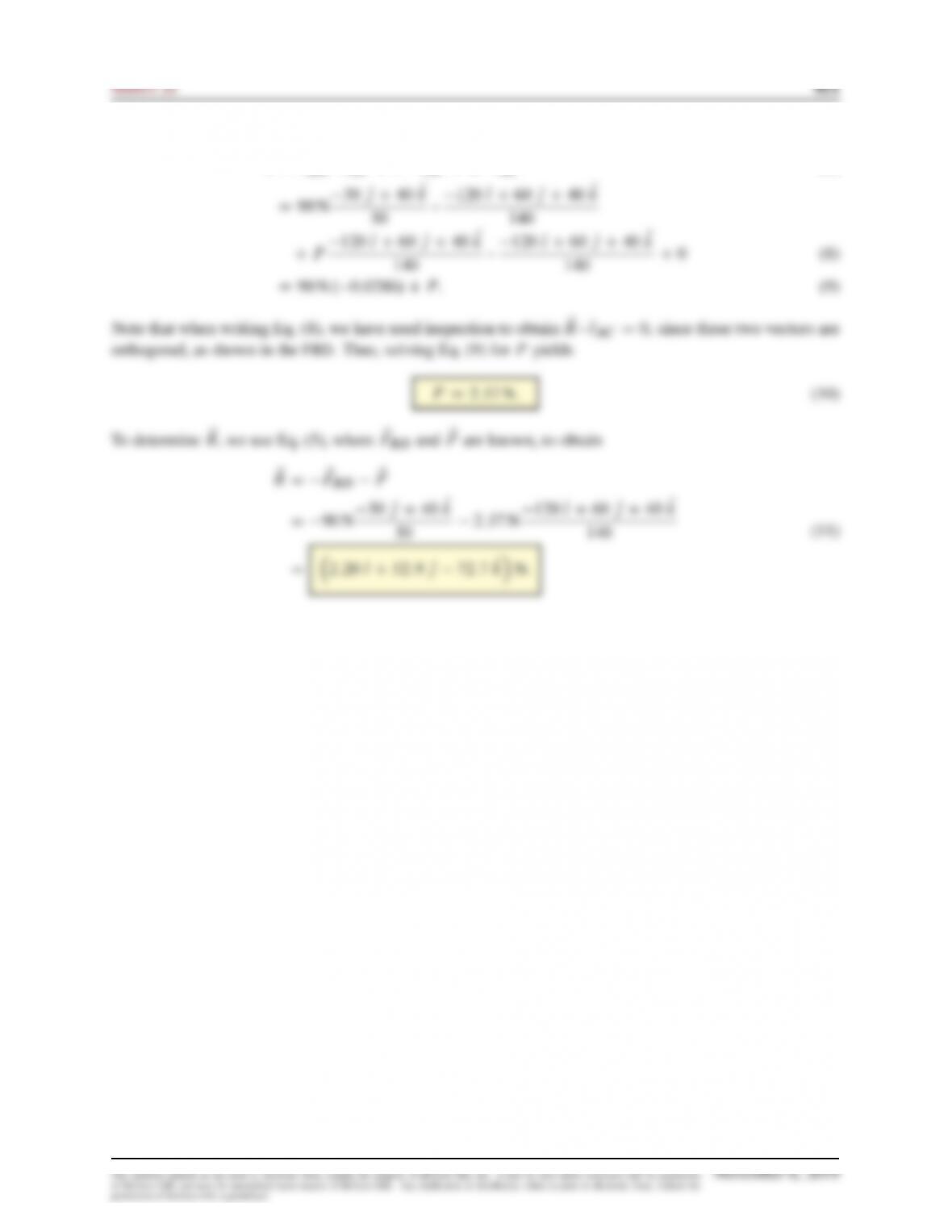
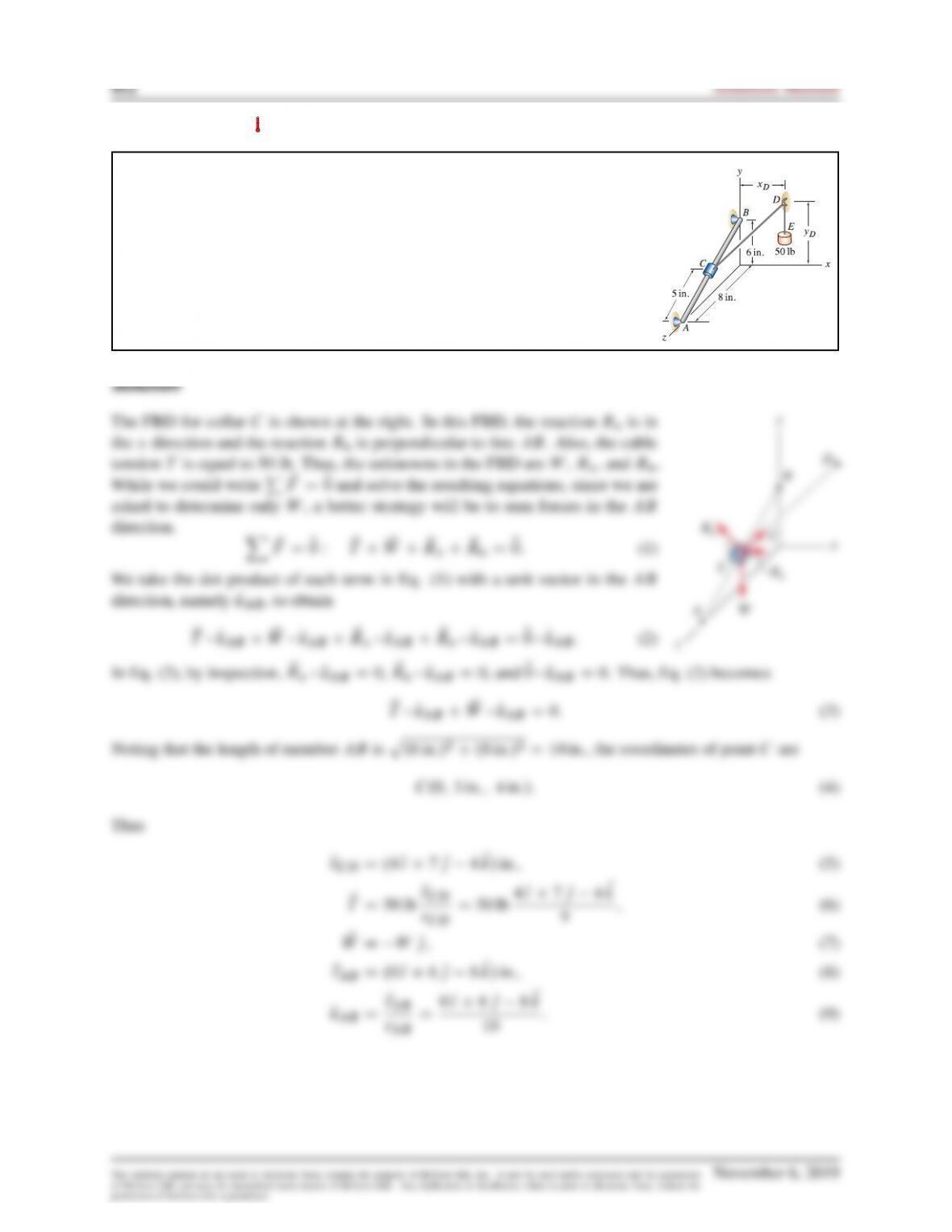
Taking the dot product of Eq. (5) with OrAC gives
0DE
FBD OrAC CE
POrAC CE
ROrAC (7)
k
120 O{C60 O|C40 O
k
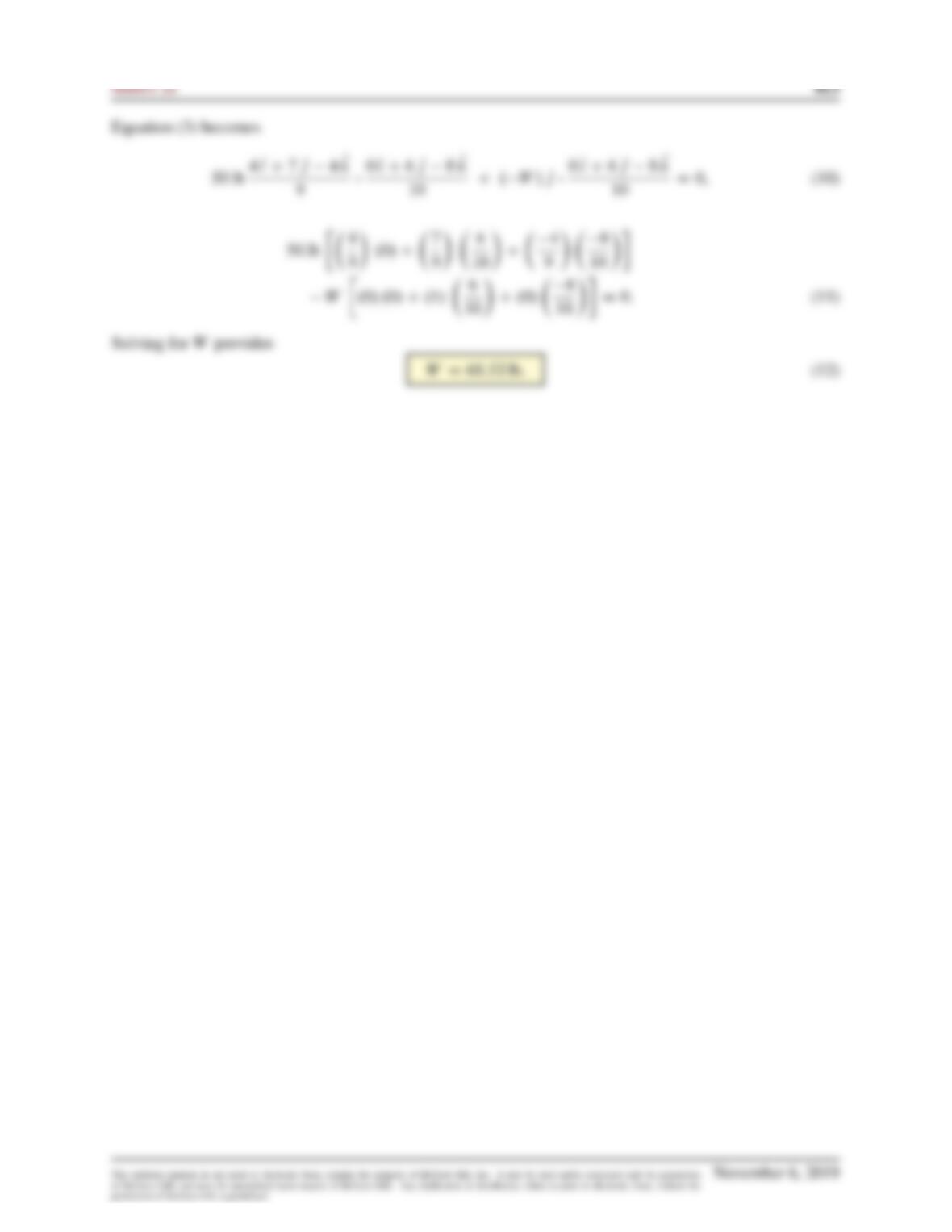
Problem 3.110
The collar at
C
slides on a frictionless bar
AB
, which is fixed in space. Cable
CDE
passes around a frictionless ring at
D
. For the values of
xD
and
yD
given
below, determine the weight collar
C
must have if the system is in equilibrium.
xDD4in:and yDD10 in:
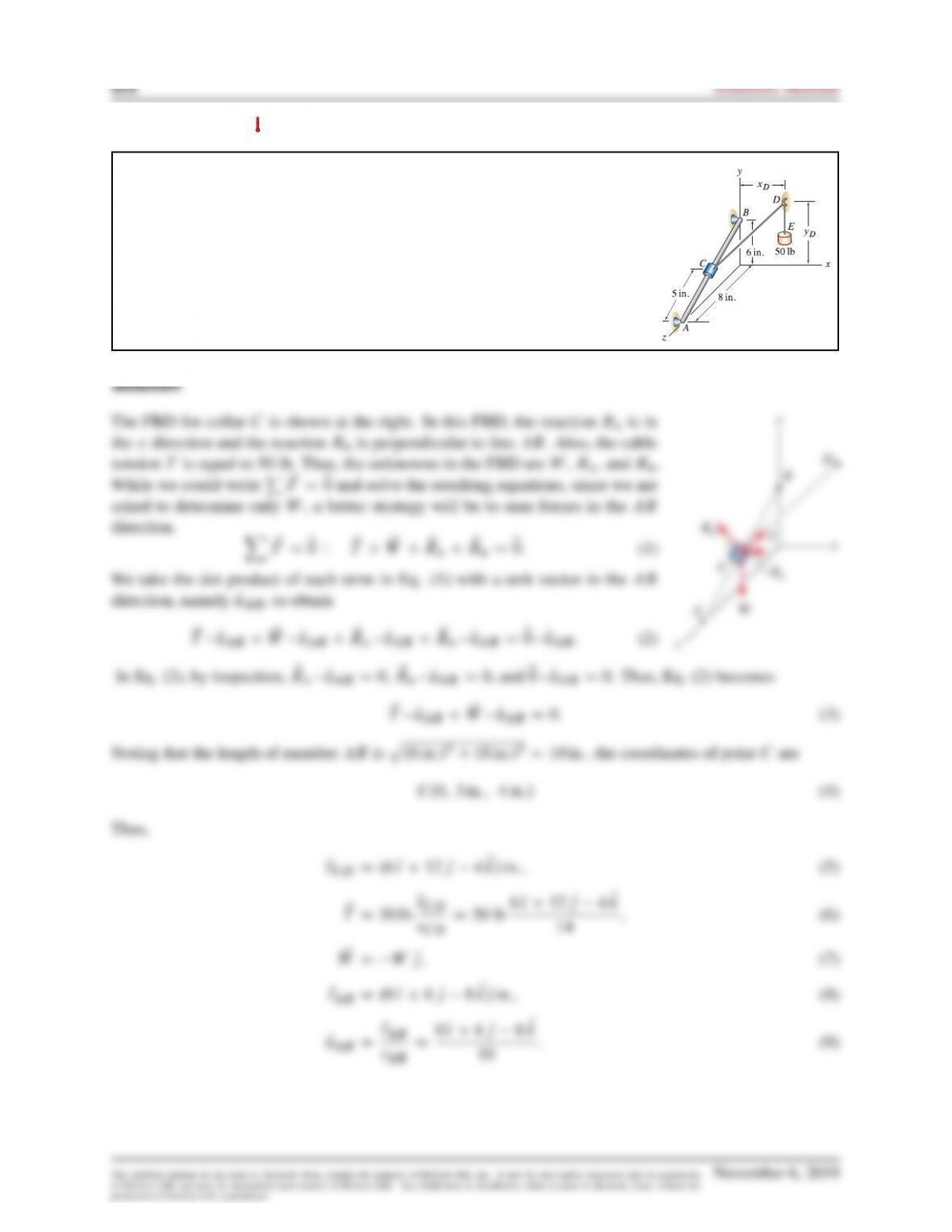
Problem 3.111
The collar at
C
slides on a frictionless bar
AB
, which is fixed in space. Cable
CDE
passes around a frictionless ring at
D
. For the values of
xD
and
yD
given
below, determine the weight collar
C
must have if the system is in equilibrium.
xDD6in:and yDD15 in:
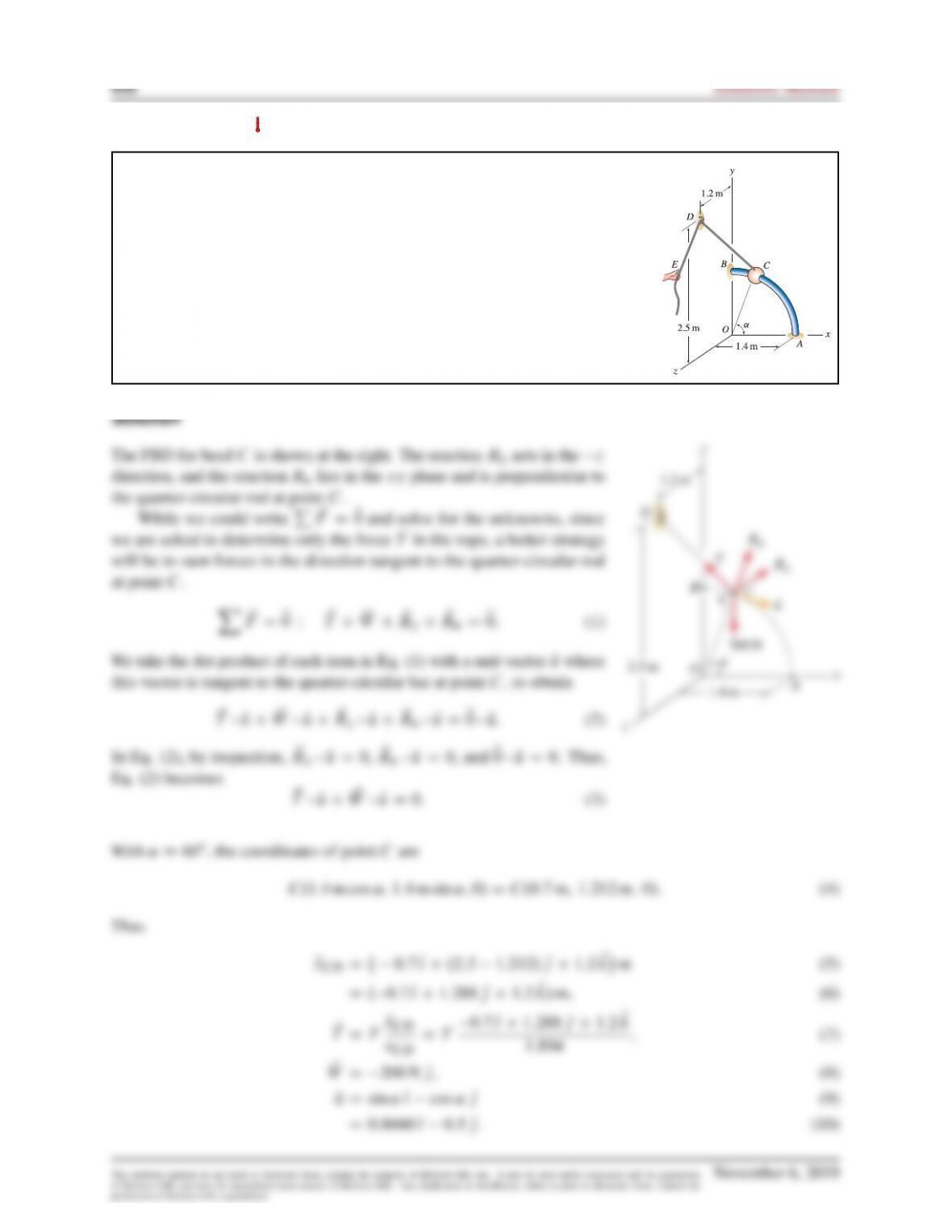
Problem 3.112
The bead
C
weighs
200
N and slides without friction on the quarter-circular
bar
AB
with
1:4
m radius. The position of the bead is controlled by rope
CDE
,
which passes through a frictionless ring at point D.
If the bead is in equilibrium with
˛D60ı
, determine the force in the rope.
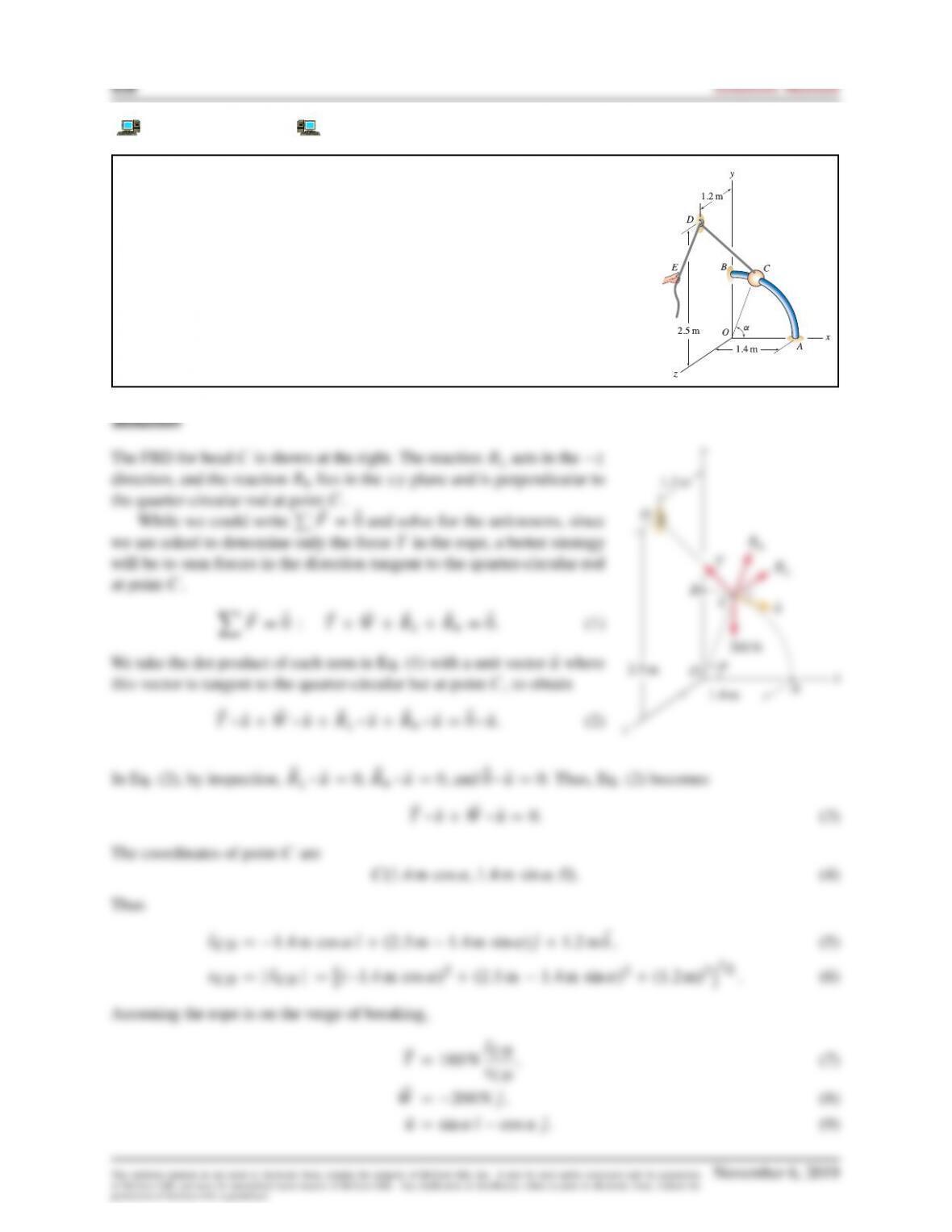
Problem 3.113
The bead
C
weighs
200
N and slides without friction on the quarter-circular
bar
AB
with
1:4
m radius. The position of the bead is controlled by rope
CDE
,
which passes through a frictionless ring at point D.
Rope
CDE
has
180
N breaking strength, and the collar
C
starts at the
position
˛D90ı
. If the collar is slowly lowered, determine the value of
˛
at
which the rope will break.
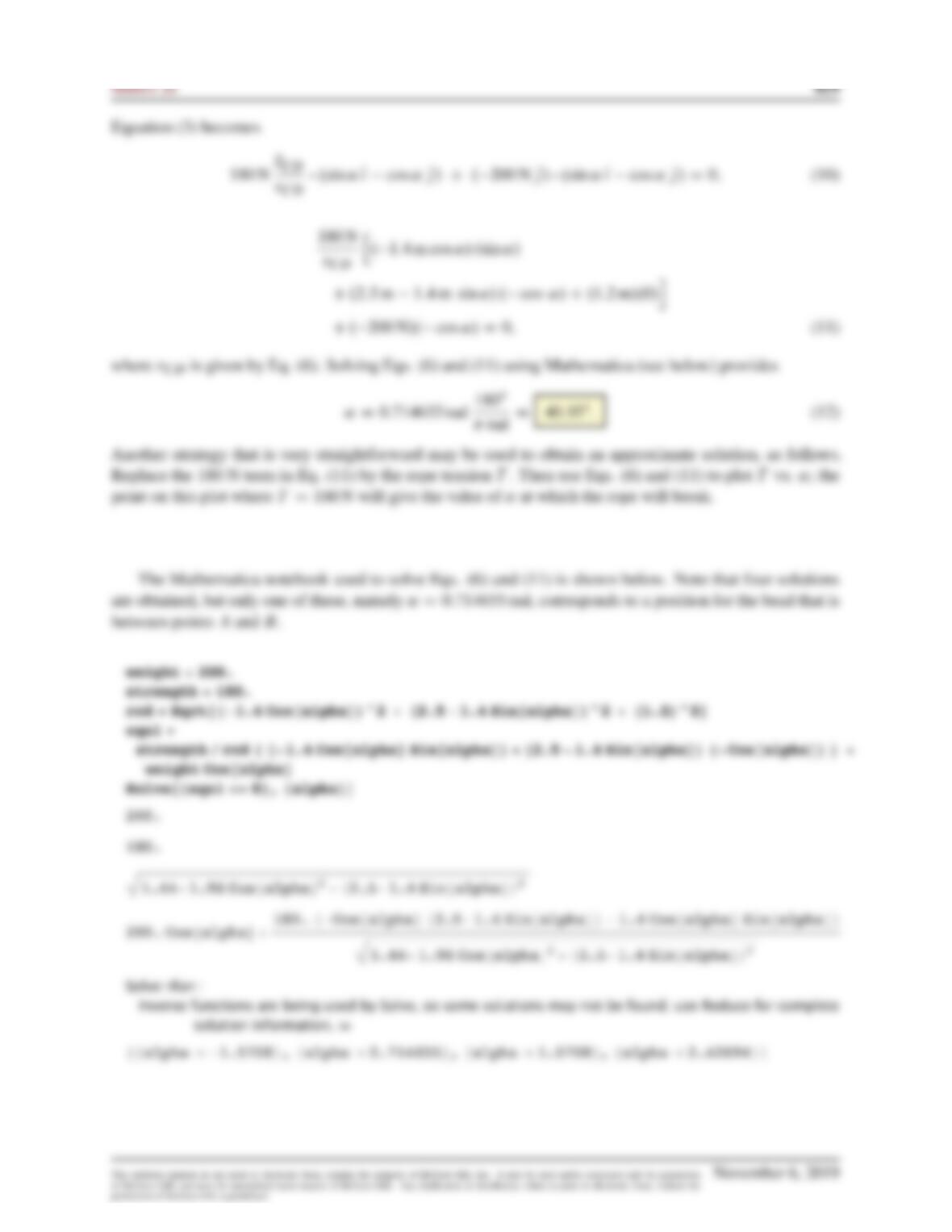
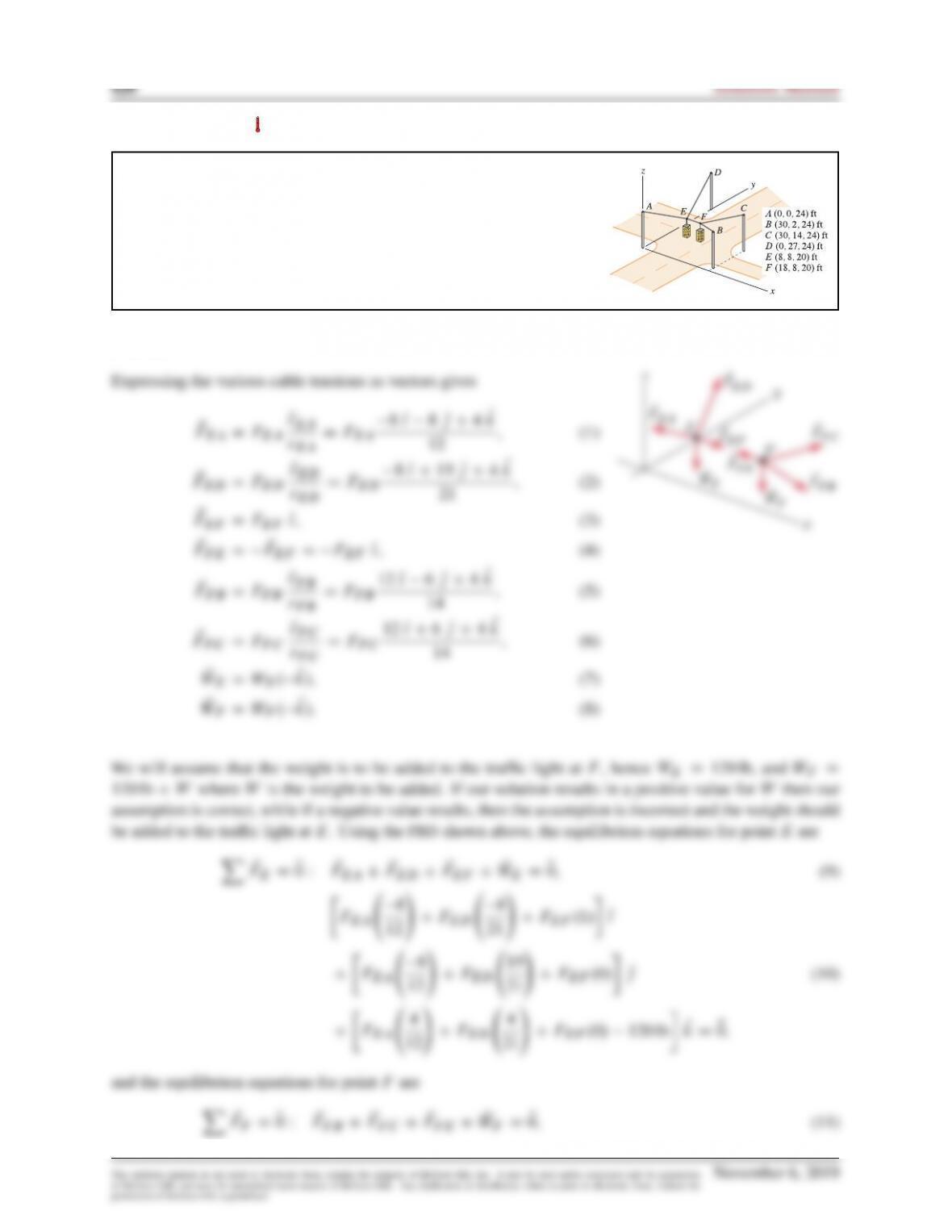
Problem 3.114
Two identical traffic lights each weighing
120 lb
are to be suspended
by cables over an intersection. For points
E
and
F
to have the coordi-
nates shown, it is necessary to add an additional weight to one of the
lights. Determine the additional weight needed, the light to which it
should be added, and forces in each cable. Remark: The system of equa-
tions can be solved manually, but solution by calculator or computer is
recommended.
Solution

Problem 3.115
Consider a problem involving cables and bars only. For the conditions listed below, is the solution obtained
from PE
FDE
0using geometry of the structure before loads are applied approximate or exact? Explain.
(a) Cables are modeled as inextensible, and bars are modeled as rigid.
(b) Cables and bars are modeled as linear elastic springs.
Note: Concept problems are about explanations, not computations.
Solution