1
Solutions to end–of–chapter problems
Engineering Economy, 7th edition
Leland Blank and Anthony Tarquin
Chapter 9
Benefit/Cost Analysis and Public Sector Economics
9.1 Disbenefits are negative consequences that occur to the public and, therefore, are included
9.2 eBay – private; farmer’s market – private; state police department – public; car racing
9.3 Large initial investment – public; park user fees – public; short life projects – private;
9.4 (a) Disbenefit (e) Benefit
9.5 In a DBOMF contract arrangement, the contractor is responsible for managing the cash flow
1. Plant manager: sales revenues, customers
9.8 B = 900,000(1.5) – 900,000 = $450,000
C = 300,000 + 25,000(P/A,6%,20)
2
= 0.01
9.10 B = 90,000
D = 10,000
9.11 B = $820,000
D = $400,000
9.12 First convert all cash flows to AW values
B = 30,800,000(A/F,7%,20)
= 30,800,000(0.02439)
9.13 B/C = [10,000/0.10]/[50,000 + 50,000(P/F,10%,2)]
3
9.14 (a) PI does not include disbenefits. NCF are savings plus benefits.
PW of NCF = 20,000 + 30,000(P/F,10%,5) + 2000(P/A,10%,20)
= 20,000 + 30,000(0.6209) + 2000(8.5136)
9.15 Must find n so that one of missing values can be calculated. Use first cost.
100,000 = 259,370(P/F,10%,n)
4
9.16 Let P = first cost
1.4 = 560,000/AWP
9.17 B = 175,000,000(P/A,8%,5)
= 175,000,000(3.9927)
9.18 P is the initial investment. To obtain modified B/C = 1.0, solve for AW of P; then find P.
9.19 (a) Use an AW basis
B = $340,000
5
9.20 Use annual worth, since most of the cash flows are in annual dollars.
(a) Conventional B/C ratio
B = 300,000(0.06) + 100,000
9.21 Convert annual benefits, designated as A in years 6 through infinity, to an A value in years
1 through 5. Let B indicate $ billion.
1.0 = (B – D)/C
9.22 B = 30(4,000,000) = $120 million per year
C = 20,000(100,000)(A/P,10%,15)
6
9.23 B = 8,200,000 + 13,000(460) = $14,180,000 per year
9.24 B = 20,000 + 30,000(P/F,6%,5)
9.26 In $ million units,
PW of net savings = 1.2(P/A,8%,5) + 2.5(P/A,8%,5)(P/F,8%,5)
7
9.27 In $1000 units,
PW of NCF = 5(P/A,10%,6) + 2(P/G,10%,6)
9.30 MS vs. DN: B = (150,000,000)(3.00/1000)
9.31 East vs. DN: (B-D)East = 990,000 – 120,000 = $870,000 per year
9.32 Proposal 1 vs. DN: B = 530,000
D = 300,000
Proposal 2 vs. DN: B = 650,000
D = 195,000
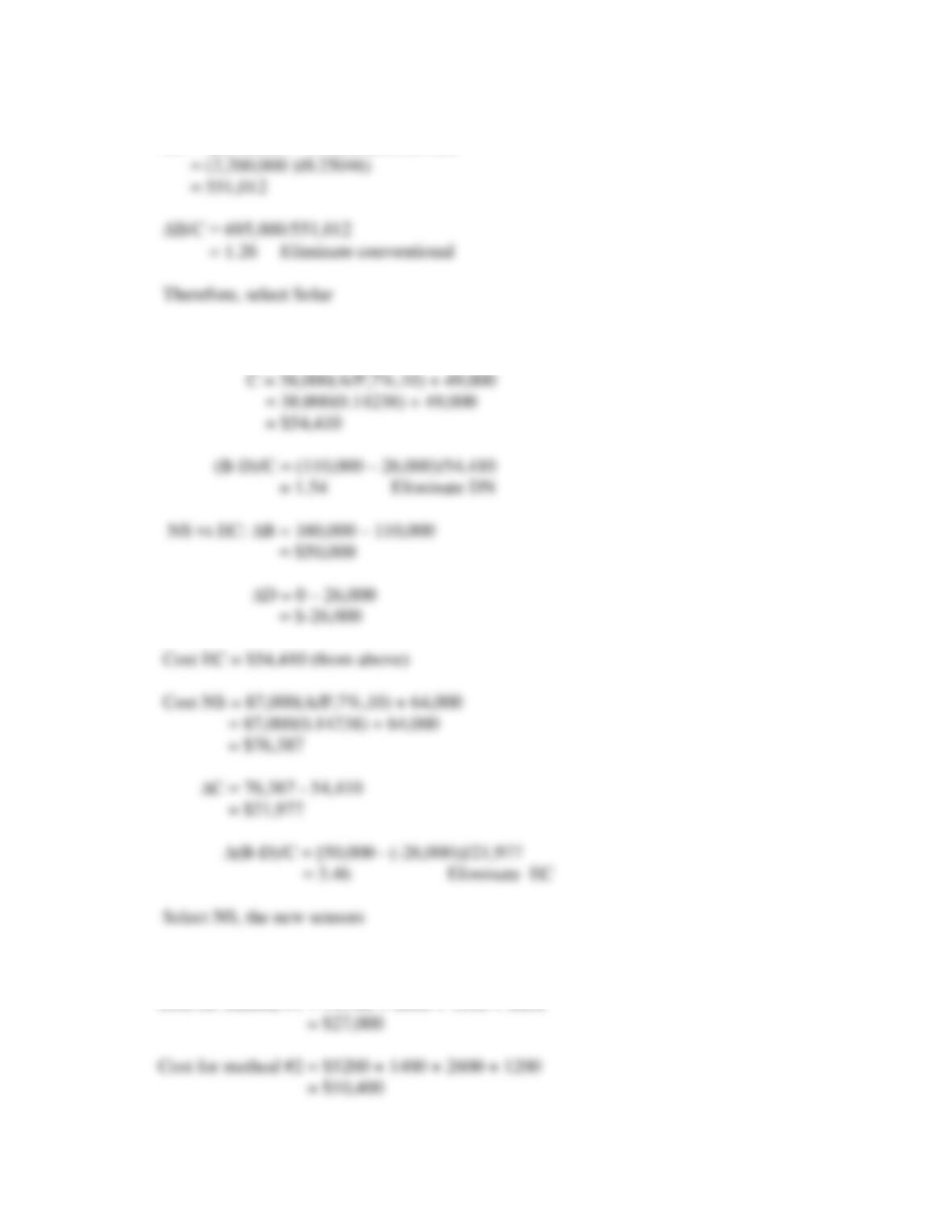
9.33 Both are cost alternatives; DN is not considered and solar is the challenger. Difference in
annual cost is a benefit to solar.
9
ΔC = (2,500,000 – 300,000)(A/P,8%,5)
9.34 EC vs DN: B = $110,000 per year
D = $26,000 per year
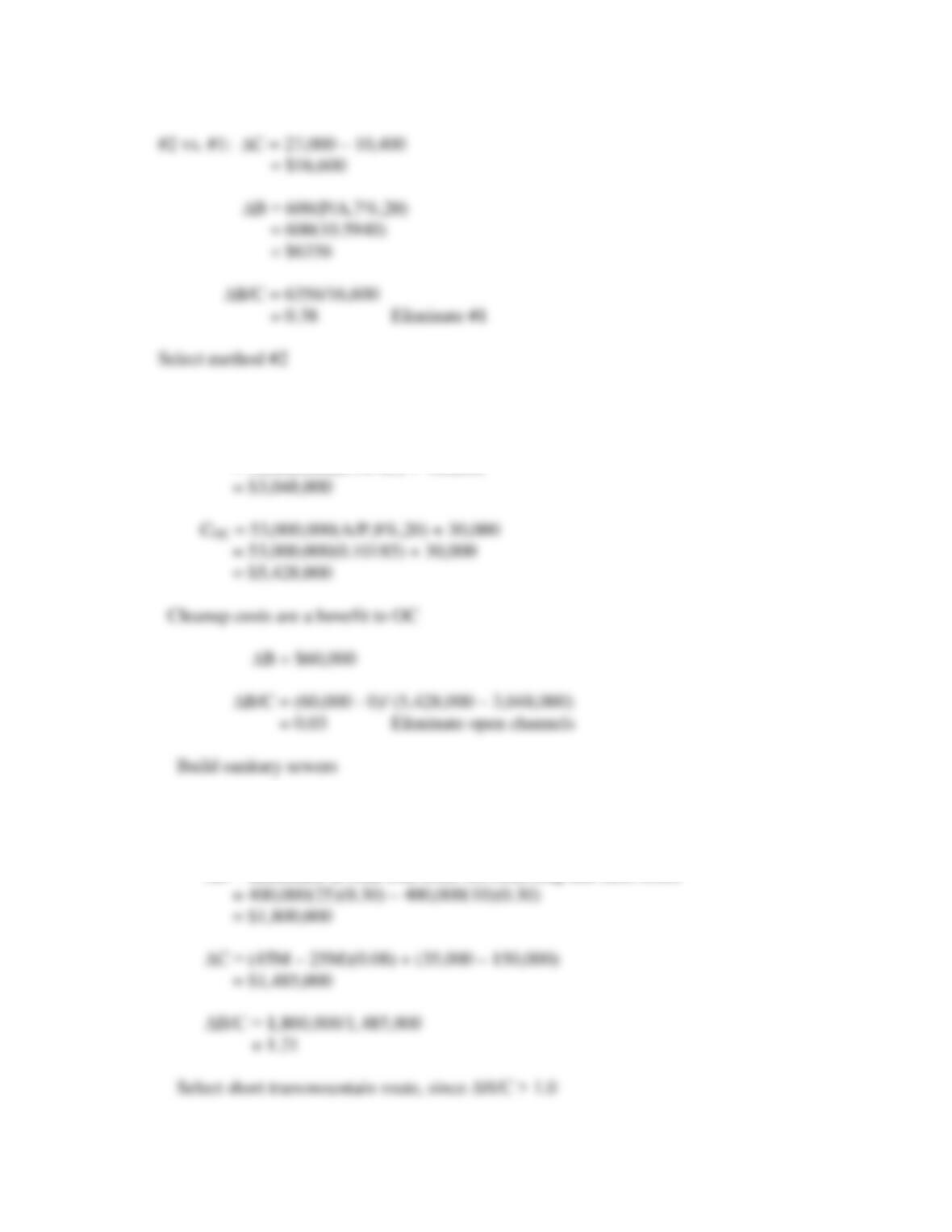
9.35 Both are cost alternatives; no comparison to DN.
Cost for method #1 = 14,100 + 6000 + 4300 + 2600
10
9.36 Alternatives involve only costs; DN is not an option. Calculate AW of total costs.
CSS = 26,000,000(A/P,8%,20) + 400,000
= 26,000,000(0.10185) + 400,000
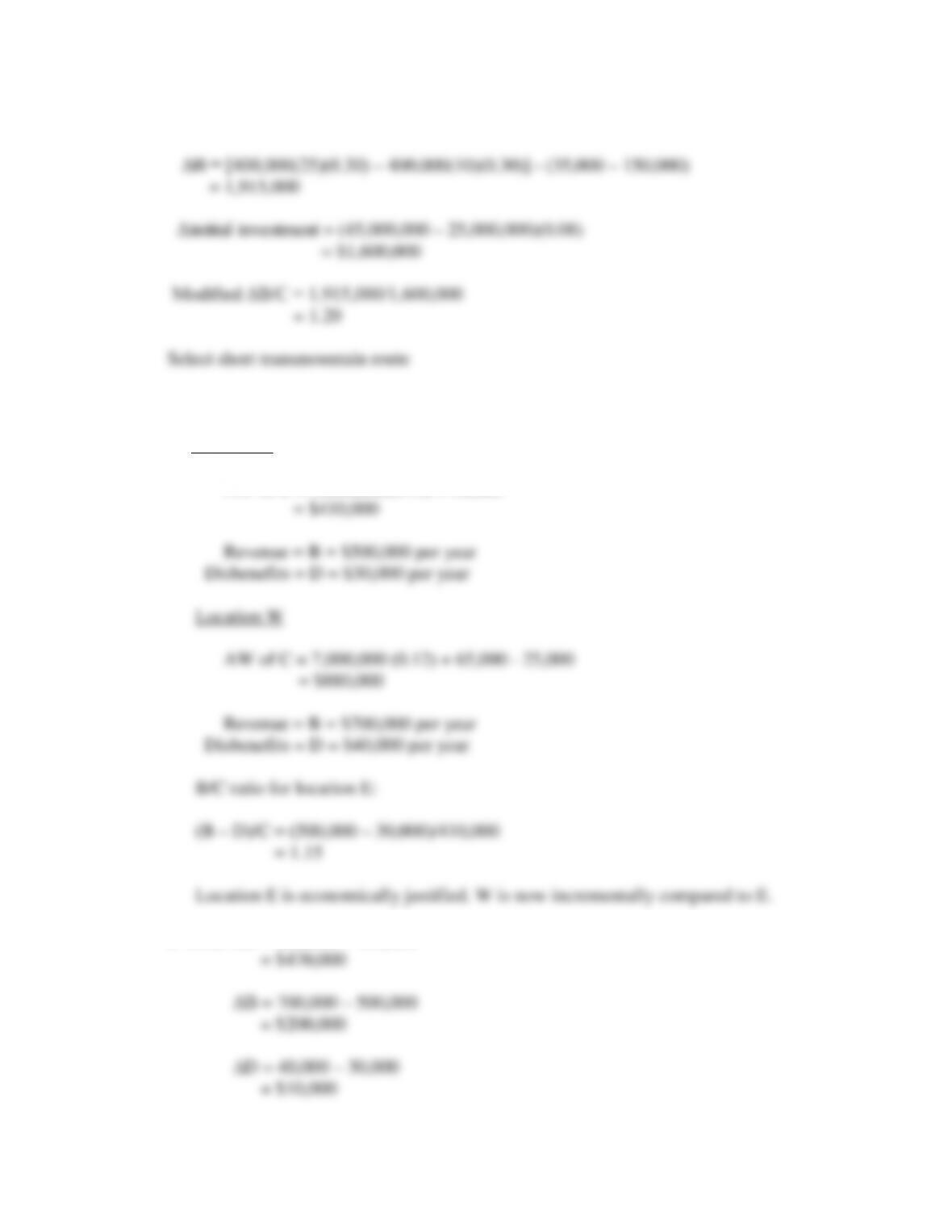
9.37 (a) All cash flows are costs; DN is not an option. Incremental analysis is necessary. Benefits
are defined by road usage cost difference. Short route has larger initial cost.
ΔB = difference in road user costs between long and short route
11
(b) Modified ∆B/C = (∆B – ∆annual costs)/∆initial investment
9.38 (a) Revenue alternatives; compare location E to DN
Location E
AW of C = 3,000,000(0.12) + 50,000
W vs. E: ΔC = 880,000 – 410,000