
1
Solutions to end–of–chapter problems
Engineering Economy, 7th edition
Leland Blank and Anthony Tarquin
Chapter 8
Rate of Return Analysis: Multiple Alternatives
8.1 The rate of return on the incremental cash flow column represents the rate of return on the
He must include the first and third alternatives in an incremental analysis.
8.4 (a) The increment of investment between the alternatives is less than 12%.
8.5 (a) The ROR on the increment is less than the MARR.
8.6 Cannot determine which one should be selected because even though it is known that the
= 26.2%
8.8 30,000(0.15) + (100,000 – 30,000)(RORZ2
) = 100,000(0.30)
8.10 (a) year 0: Incremental CF0
= -73,000 – (-12,000)
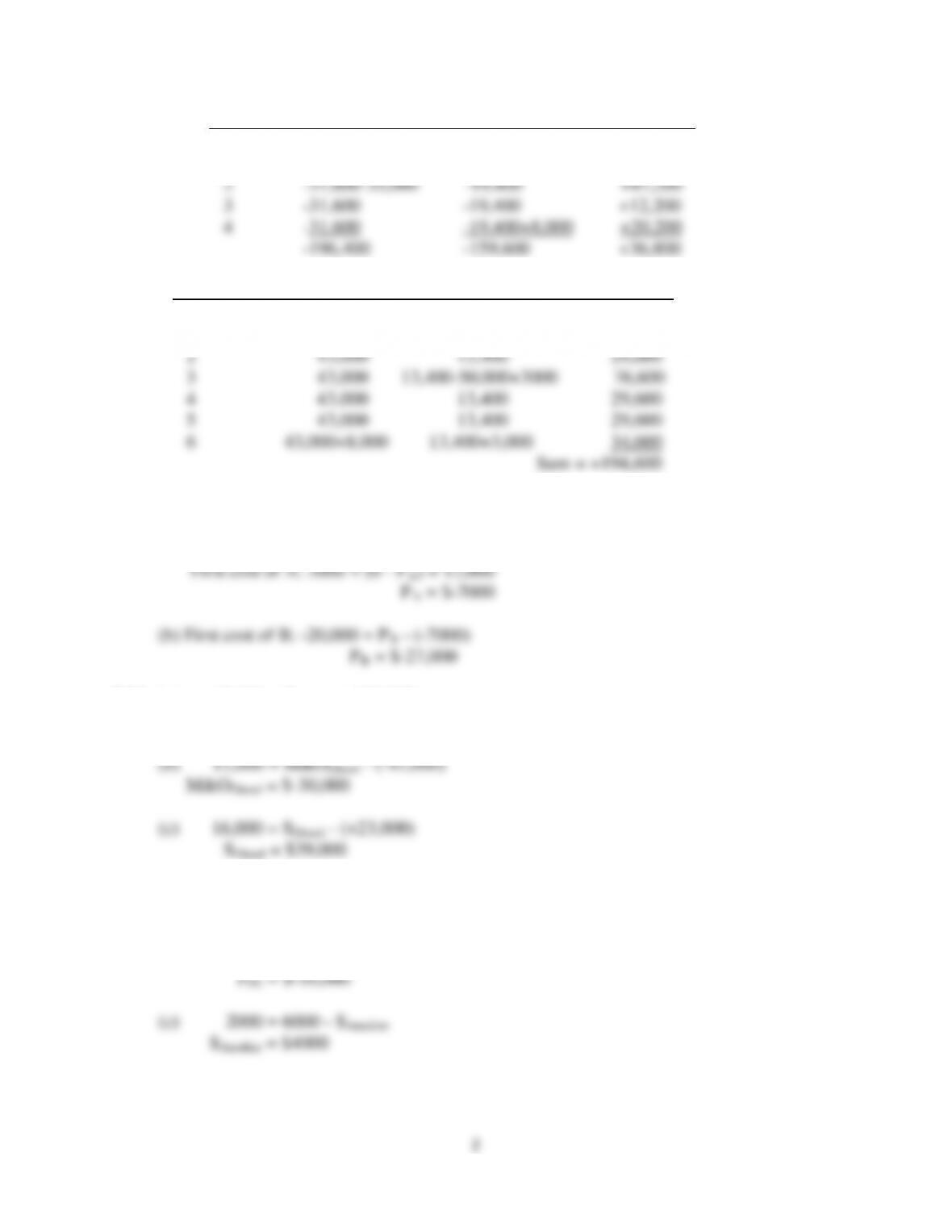
8.11 0 -35,000 -90,000 -55,000
Year X Y Y – X__
1 -31,600 -19,400 +12,200
-196,400 -159,600 +36,800
8.12 Year Alternative Q Alternative P Q – P__
0 -85,000 -50,000 -35,000
1 43,000 13,400 29,600
8.13 (a) Year 3 CF represents the first cost of A plus the incremental difference in their
annual costs. Let PA
be the first cost of A.
8.14 (a) -40,000 = PDiesel – (-150,000)
PDiesel = $-190,000
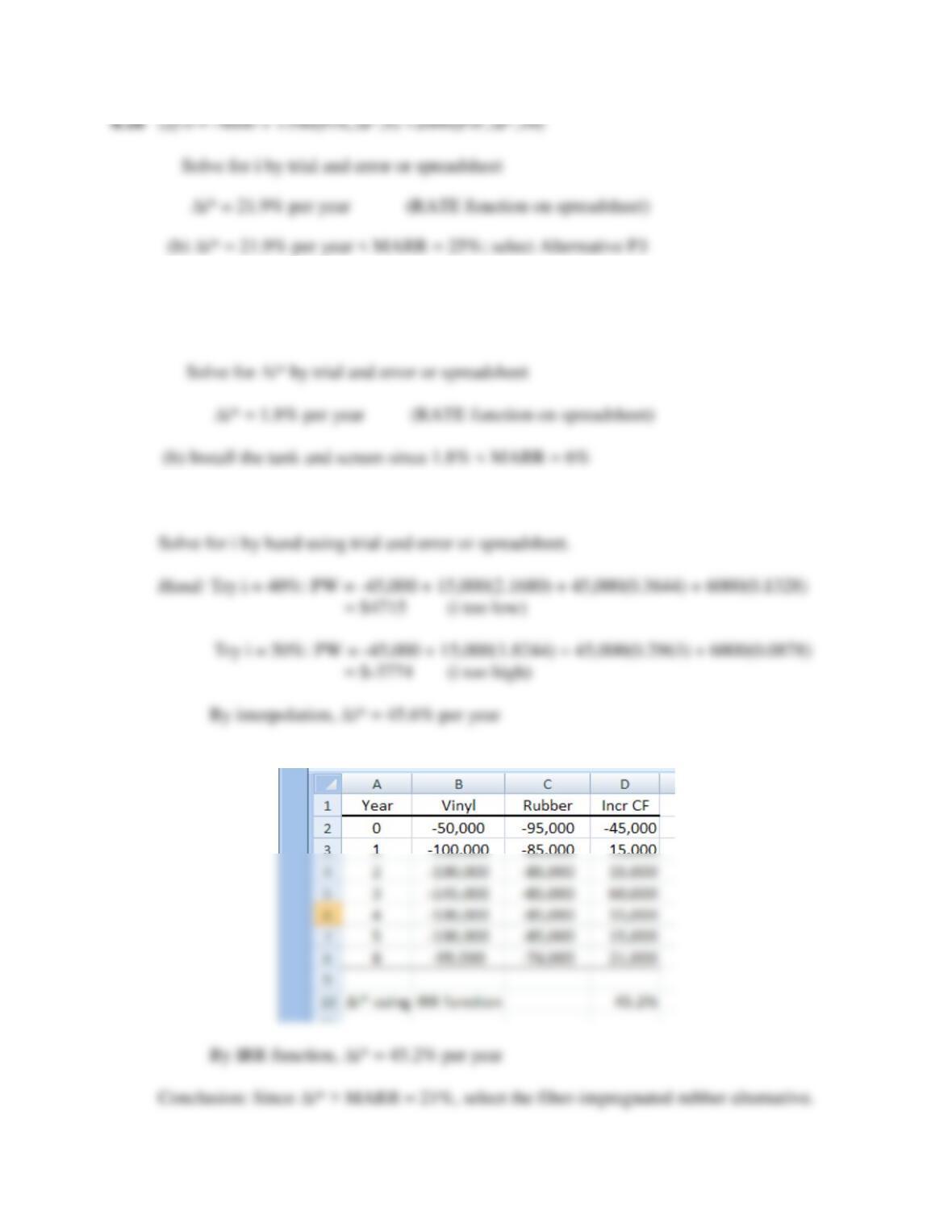
8.15 (a) –14,000 = –65,000 – PAnodize
PAnodize = $-51,000
(b) 5000 = PPC – (-21,000)
3
8.17 (a) The incremental ROR equation is:
0 = – 770,000 + 43,000(P/A, ∆i*,20) + 77,000(P/F, ∆i*,20)
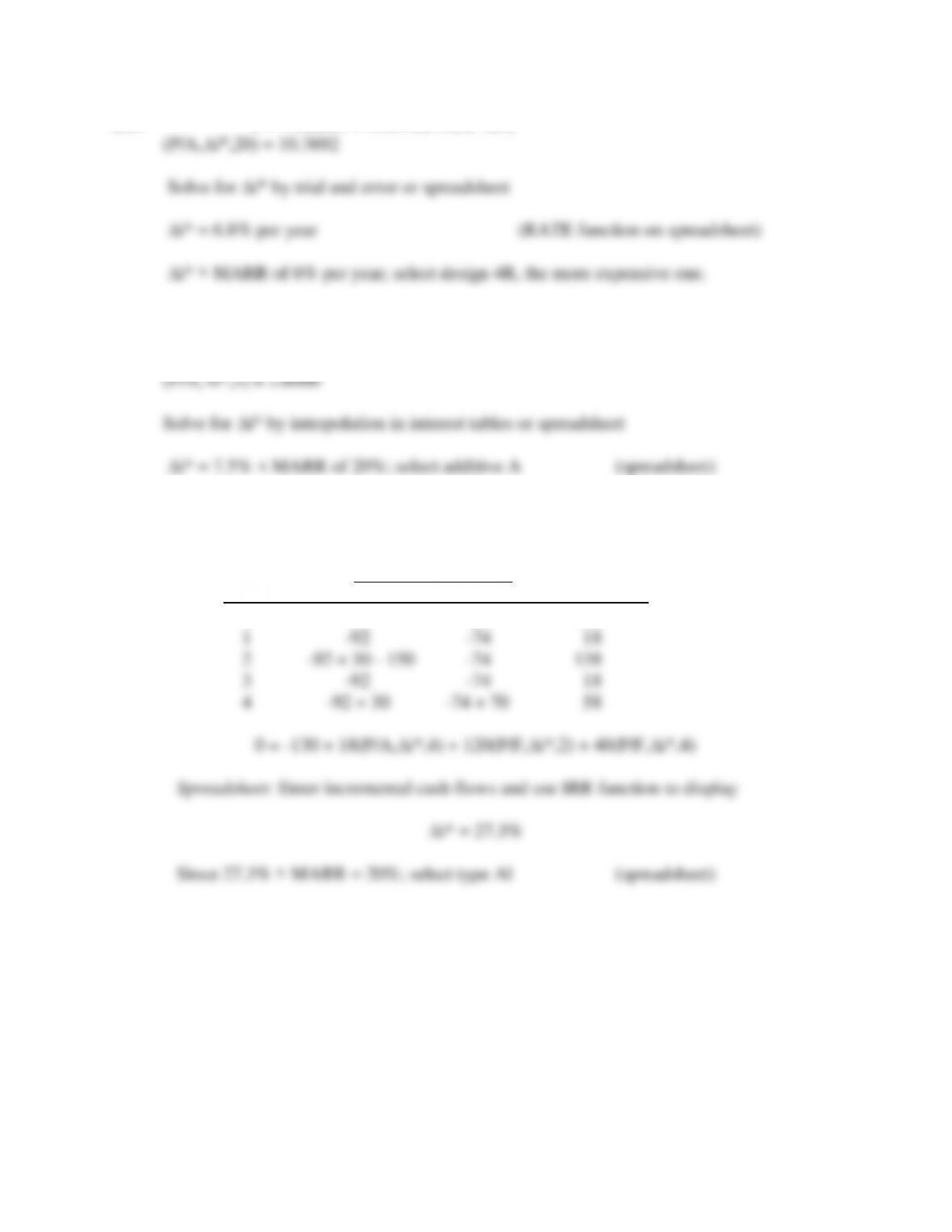
8.18 0 = -45,000 + 15,000(P/A,∆i*,6) + 45,000(P/F,∆i*,3) + 6000(P/F,∆i*,6)
Spreadsheet:
4
8.19 0 = -700,000 + 65,000(P/A,∆i*,20)
8.20 Write rate of return equation for increment between B and A.
0 = -65,000 + 25,000(P/A,∆i*,3)
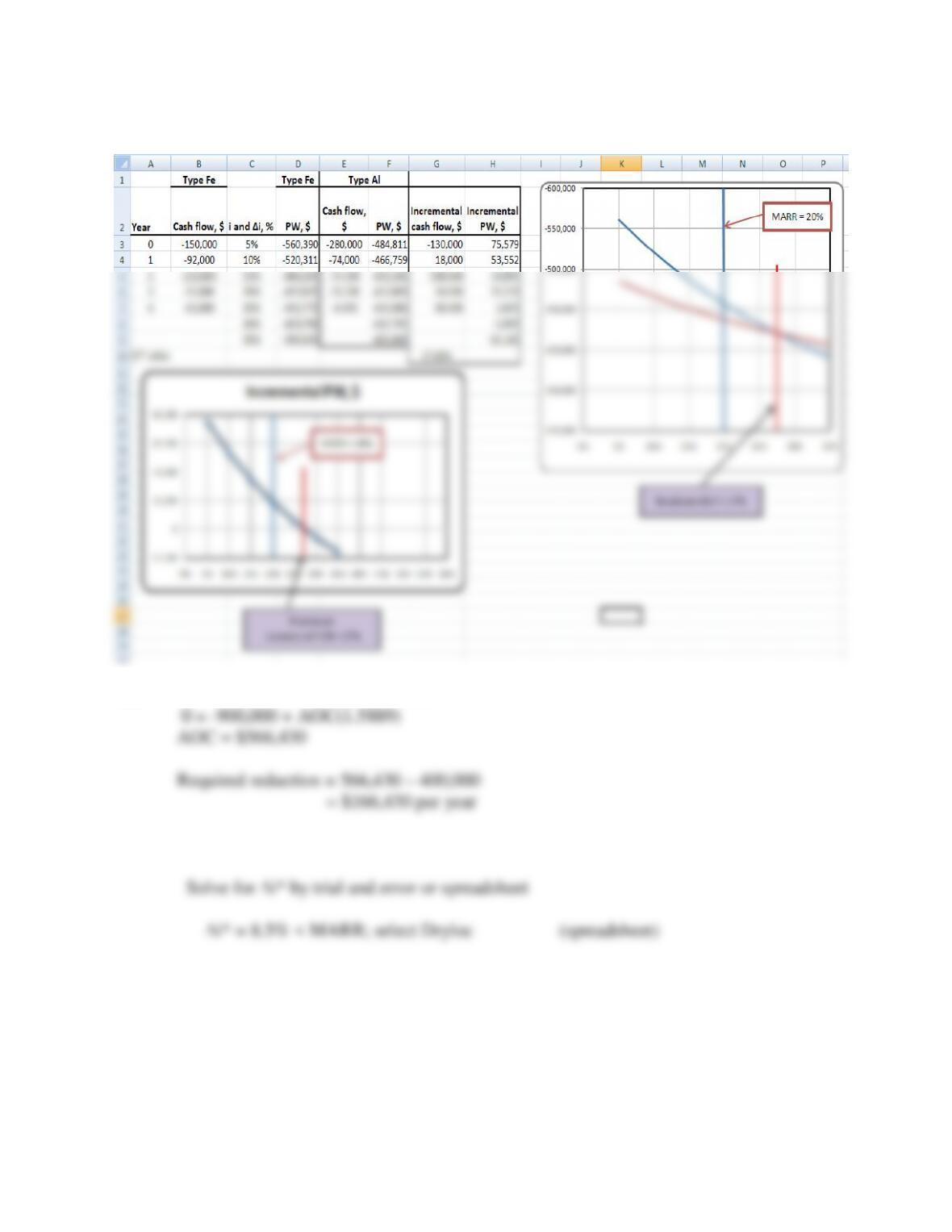
8.21 (a) Construct tabulation to get incremental cash flow.
Incremental
Cash flows, $1000 cash flow, $1000
Year Type Fe Type Al (Al – Fe)___
0 -150 -280 -130
5
(b) and (c) Plots are developed using i and ∆i values. Decision is the same to select Al.
8.22 0 = -900,000 + AOC(P/A,40%,3)
8.23 (a) 0 = -56,000(A/P,∆i*,9) + 8900 + (12,000 – 8900)(A/F,∆i*,9)
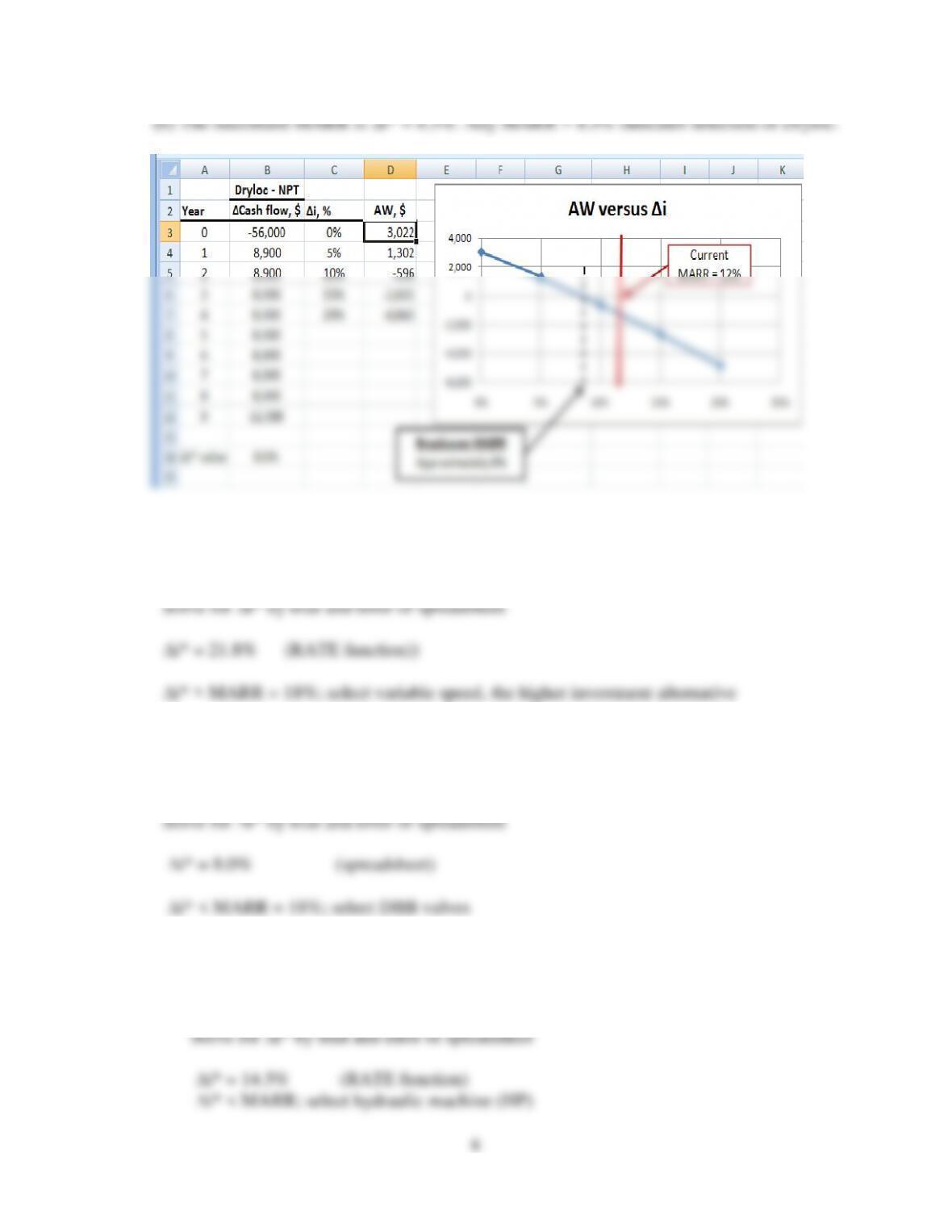
8.24 Variable speed has the larger initial investment.
0 = -25,000(A/P, ∆i*,6) + 4000 + 40,000(A/F, ∆i*,6)
8.25 Find ROR for incremental cash flow over LCM of 4 years.
0 = -31,000(A/P,∆i*,4) – 5000 + 40,000(P/F,∆i*,2)(A/P,∆i*,4) + 18,000(A/F,∆i*,4)
8.26 (a) EMT has a larger initial investment than HP
0 = -200,000(A/P, ∆i*,5) + 50,000 + 60,000(A/F, ∆i*,5)
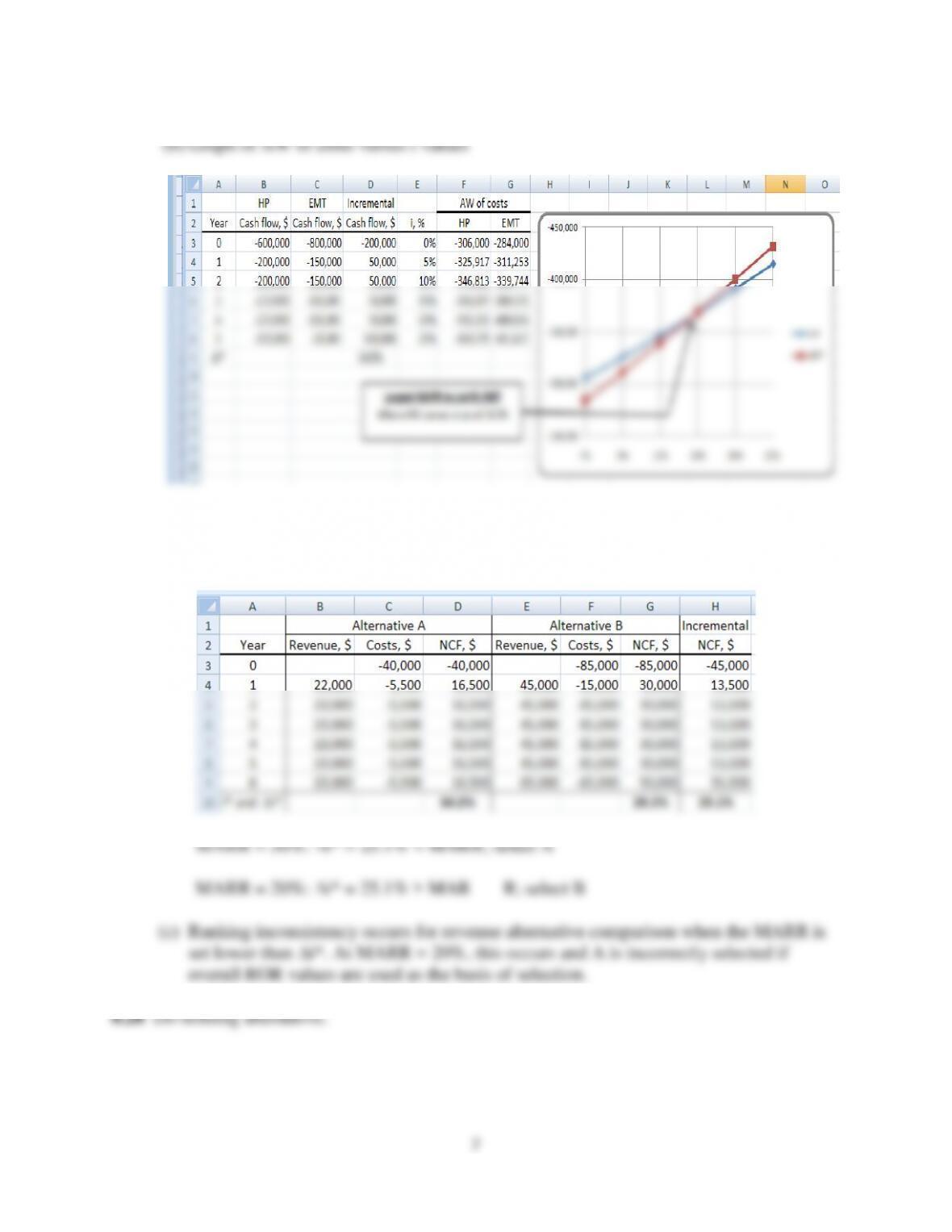
8.27 (a) He used overall i* values rather than incremental i* values.
(b) Determine ∆i* and compare to each MARR.
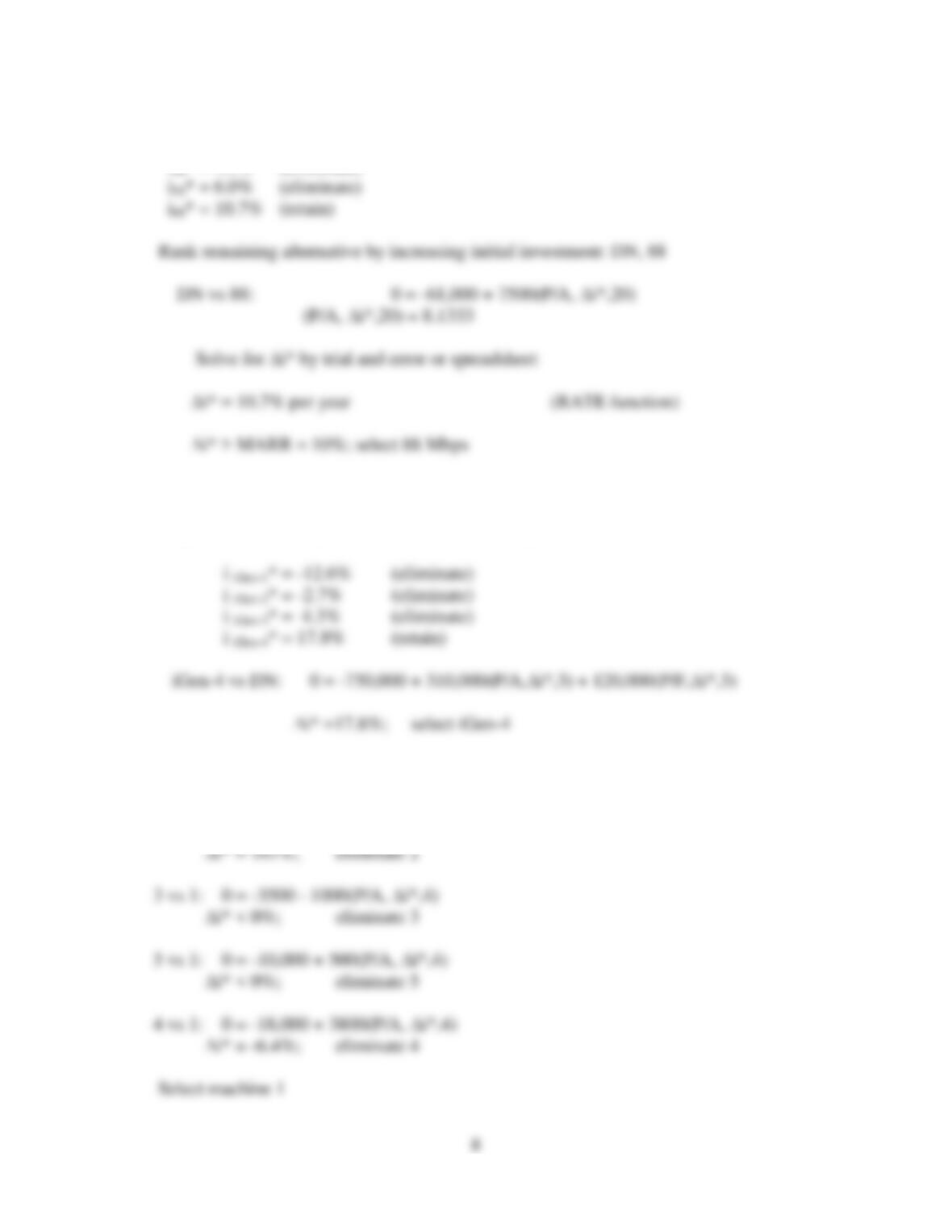
8.29 Revenue alternatives; calculate overall ROR first and compare to MARR =10%.
i44* = 4.2% (eliminate)
8.30 Revenue alternatives; calculate overall ROR first and compare to MARR =15%. Then rank
remaining alternatives according to increasing initial investment (including DN) and
compare incrementally. ROR values determined by RATE function.
8.31 Cost alternatives. Rank alternatives according to increasing initial investment and compare
incrementally: 2, 1, 3, 5, 4. ∆i* values determined by RATE function on a spreadsheet.
1 vs 2: 0 = -2000 + 3300(P/A, ∆i*,4)
8.32 Rank alternatives according to increasing initial investment (including DN) and
compare incrementally: DN, D, A, C, E, B
(a) DN vs D: ∆i* = 11% < MARR eliminate D
DN vs A: ∆i* = 10% < MARR eliminate A
8.33 (a) None have an overall ROR ≥ to MARR; select Do-nothing
(b) Retain B, D and E since their overall ROR > MARR
8.34 Ranking: DN, D, A, C, E, B. Use ∆i* = ∆A/∆P as the incremental measure; MARR is
14.9%.
D vs. DN: ∆i* = 16.7%; eliminate DN, keep D
10
8.35 (a) Rank alternatives: E,D,C,B,A; eliminate E,D and A because overall ROR < MARR
C vs. B: ∆i* = 14%; eliminate B; select alternative C
8.37 (a) Select projects A and B
8.43 Year A B B – A
0 -10,000 -14,000 -4000
1 +2500 +4000 +1500

11
12
Solution to Case Studies, Chapter 8
Sometimes, there is not a definitive answer to a case study exercise. Here are example responses.
ROR ANALYSIS WITH ESTIMATED LIVES THAT VARY
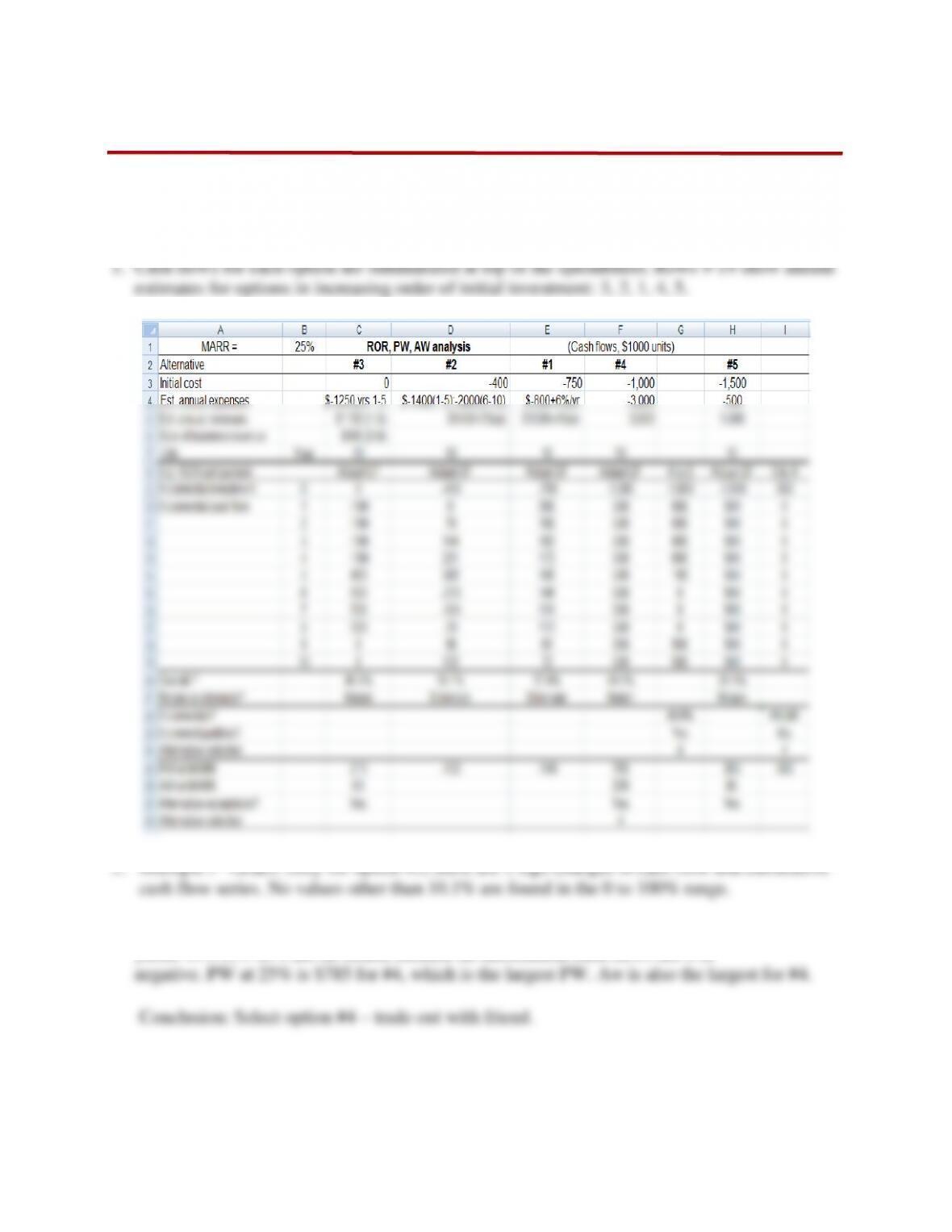
2. #1 (n = 3) is eliminated. It has i* < MARR = 12%. Perform an incremental analysis of #1 (n
= 4) and #2 (n = 5). Column H shows ∆i* = 19.5%. Now perform an incremental comparison
3. PW at 2000% > $0.05. ∆i* is infinity, as shown in cell K45, where an error for IRR(K4:K44)
is indicated.
Some rows hidden
13
Solution to Case Studies, Chapter 8
Sometimes, there is not a definitive answer to a case study exercise. Here are example responses.
HOW A NEW ENGINEERING GRADUATE CAN HELP HIS FATHER
3. Do incremental ROR analysis after removing #1 and #2. See row 22. 4-to-3 comparison
yields 49.9%, 5–to–4 has no return because all incremental cash flows are 0 or
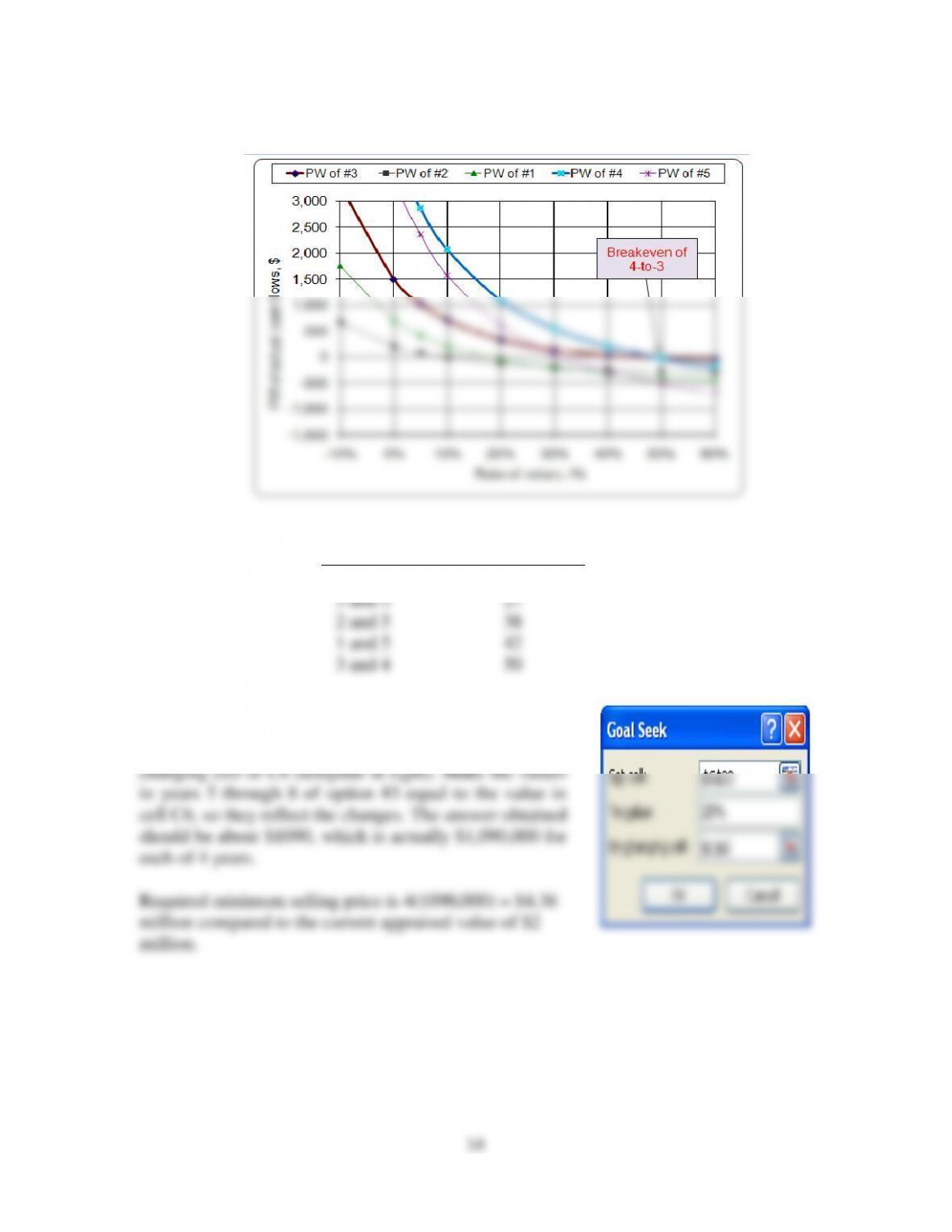
4. PW vs. i charts for all 5 options are on the spreadsheet.
Options Approximate
compared breakeven____
1 and 2 26%
5. Force the breakeven rate of return between options #4
and #3 to be equal to MARR = 25%. Use trial and error
or Goal Seek with a target cell of G22 to equal 25% and