1
Solutions to end–of–chapter problems
Engineering Economy, 7th edition
Leland Blank and Anthony Tarquin
Chapter 5
Present Worth Analysis
5.1 Mutually exclusive alternatives accomplish the same thing. Therefore, only one is to be
5.2 (a) The do-nothing alternative means that the status-quo should be maintained. That is, If
none of the alternatives under consideration are economically attractive, all of them
5.3 (a) Number of alternatives = 24 = 16
5.6 Equal service can be satisfied by using a specified planning period or by using the
5.7 PWIn–house = -30 + (14 – 5)(P/A,10%,5) + 2(P/F,10%,5)
5.8 PWA = -42,000 – 28,000(P/A,10%,4)
2
PWB = -51,000 – 17,000(P/A,10%,4)
(b) Let first cost of Y be XY. Set PWY = -46,308
5.10 Find Pg for each stock and select higher one.
PgA = 30,000{1 – [(1 + 0.06)/(1 + 0.08)]5}/(0.08 – 0.06)
5.11 PWA = -952,000 – 1,300,000 – 126,000(P/A,6%,50)
5.12 PWNo drains = -1500(P/A,4%,12)
5.13 PW250 = -155,000 – 3000(P/A,10%,30)
5.14 PWGaseous = -8000 – (650 + 800)(P/A,10%,5)
5.16 In $ million units,
PWLand = -215 – 22(P/A,15%,50) – 30(P/F,15%,25)
4
5.18 PWA = -5,000,000 – 5,500,000(P/A,10%,10)
5.19 (a) PWX = -250,000 – 60,000(P/A,10%,6) – 180,000(P/F,10%,3) + 70,000(P/F,10%,6)
(b) Spreadsheet solution
5.20 Set the PWS relation equal to $-33.16, and solve for the first cost XS ( a positive number)
with repurchase in year 5. In $1 million units,
5.21 PW1 = -26,000 – 5000(P/A,10%,6) – 26,000(P/F,10%,3)
5.22 Compare PW of costs over 30 years.
PWPlastic = -(0.90)(110)(43,560) – [(0.90)(110)(43,560) + 500,000](P/F,8%,15)
6
5.23 (a) PWFan X = -130,000 – 290(P/A,8%,50)
5.24 (a) PWLand = -130,000 – 95,000(P/A,10%,6) – 105,000(P/F,10%,3) + 25,000(P/F,10%,6)
5.25 (a) Use LCM of 12 years and select L.
5.26 FWX = -80,000(F/P,15%,3) – 30,000(F/A,15%,3) + 40,000
5.27 FWT = -750,000(F/P,12%,4) – 60,000(F/A,12%,4) – 670,000(F/P,12%,2) + 80,000
5.28 FWP = -23,000(F/P,8%,6) – 4000(F/A,8%,6) – 20,000(F/P,8%,3) + 3000
5.29 FWK = -1,600,000(F/P,12%,8) – 70,000(F/A,12%,8) – 1,200,000(F/P,12%,4) + 400,000
5.30 FWOld = -1,300,000(F/P,10%,5) – 100,000,000(F/P,10%,4)
8
5.32 (a) CC = -10,000(A/F,3%,5)/0.03
5.33 CC = -300,000 – 35,000/0.12 – 75,000(A/F,12%,5)/0.12
5.34 Use C to identify the contractor option.
(a) CCC = -5 million/0.12 = $-41.67 million
Between the three options, select the contractor
(b) Find Pg and A of the geometric gradient (g = 2%), then CC.
9
5.35 For M, first find AW and then divide by i to find CC.
AWM = -150,000(A/P,10%,5) – 50,000 + 8000(A/F,10%,5)
5.36 CC = -1000/0.10 – 5000(A/F,10%,4)/0.10
5.37 CC = (-40,000/0.08)(P/F,8%,11)
5.38 CC = -150,000 – 5000/0.06 – 20,000(P/F,6%,2)
5.43 FWP = -23,000(F/P,8%,6) -20,000(F/P,8%,3) – 4,000(F/A,8%,6) + 3000
5.44 CC = -50,000 – 10,000(P/A,10%,15) – (20,000/0.10)(P/F,10%,15)
10
5.45 CC = (-40,000/0.10)(P/F,10%,4)
5.50 PWY = -95,000 – 15,000(P/A,10%,4) + 30,000(P/F,10%,4)
5.51 CC = -10,000 – [10,000(A/F,10%,5)]/0.10
5.52 CC = -10,000 – 5000(P/A,10%,5) – (1000/0.10)(P/F,10%,5)
11
Solution to Case Study, Chapter 5
There is not always a definitive answer to case study exercises. Here are example responses
COMPARING SOCIAL SECURITY BENEFITS
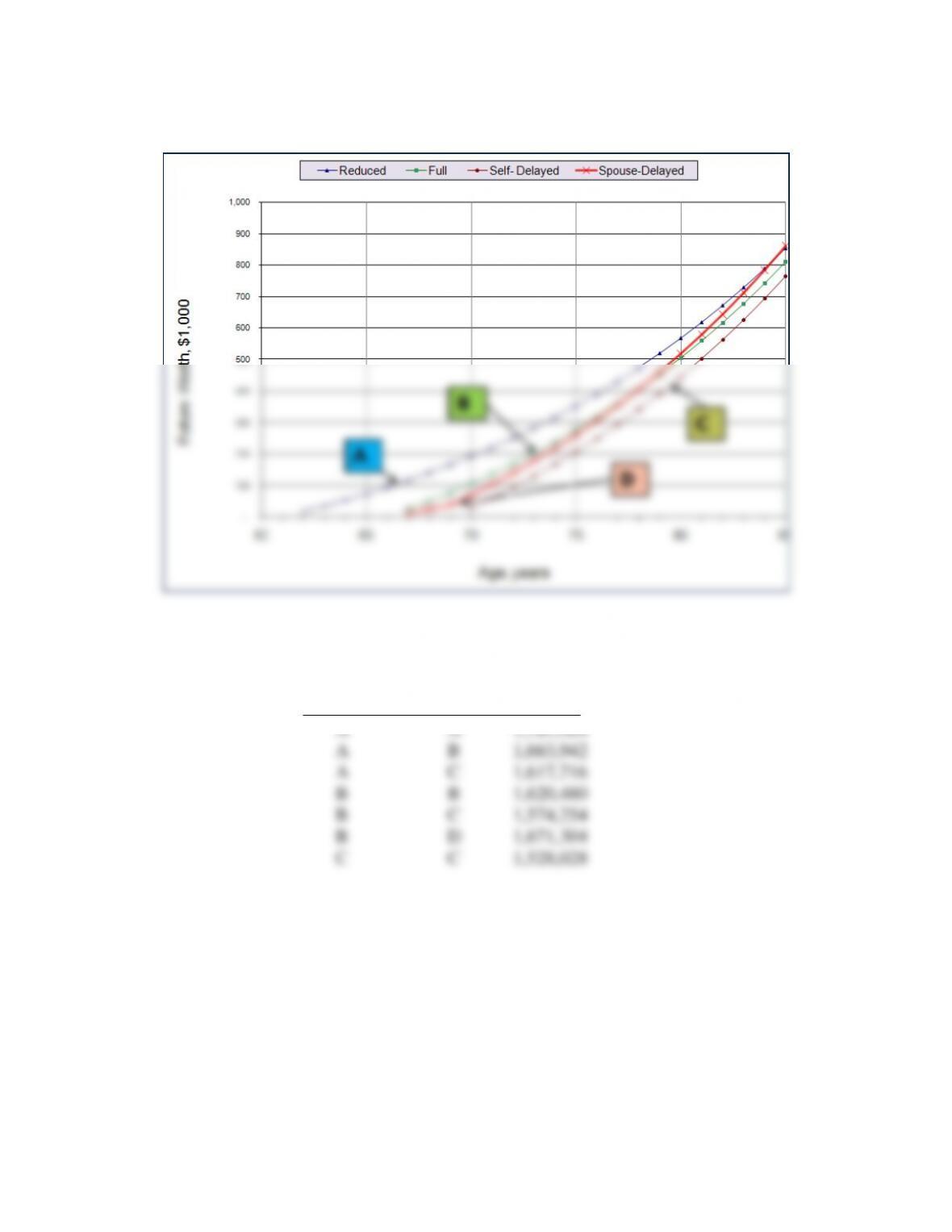
1. Total payments are shown in row 30 of the spreadsheet.
2. Future worth values at 6% per year are shown in row 29.
12
3. Plots of FW values by year are shown in the (x-y scatter) graph below.
4. Develop all feasible plans for the couple and use the summed FW values to determine which
is the largest.
Spouse #1 Spouse #2 FW, $