1
Solutions to end–of–chapter problems
Engineering Economy, 7th edition
Leland Blank and Anthony Tarquin
Chapter 4
Nominal and Effective Interest Rates
4.7 1% per month = nominal 12% per year
3% per quarter = nominal 6% per six months
4.10 Hand solution: i = (1 + 0.14/12)12 -1
4.11 (a) Use Equation [4.4]
2
4.13 Hand solution: i = (1 + 0.21/3)3 – 1
4.14 8% per 6 months = 0.08/6 = 0.0133 per month
4.15 (a) Use equation [4.4] for effective rate per month
4.16 (a) Interest rate per month = (10/200)(100%) = 5%
4.17 0.21/m = (1 + 0.2271)1/m – 1
4.18 (a) Interest rate per week = (10/100)(100%) = 10%
4.19 (a) PP = one month; CP = six months
3
4.22 F = 260,000(F/P,3%,12)
4.23 P = 1,700,000(P/F,1.5%,36)
4.24 P = 6(190,000)(P/F,7%,4)
4.25 F = 5000(F/P,2%,48) + 7000(F/P,2%,28)
4.26 In $1 million units,
28 = 12(F/P,3%,16) + x(F/P,3%,12)
4.27 P = 21,000(P/F,5%,4) + 24,000(P/F,5%,6) + 10,000(P/F,5%,10)
4.28 P = 2,000,000(P/A,4%,20)
4.29 A = 7,000,000(A/P,6%,10)
4.30 926 = A(P/A,0.75%,60)
4.32 First find savings at end of year 2011; use amount as an annual series for 10 years.
4.33 A0% = 3199/12
4.34 A = 28(F/A,1.5%,24)(A/P,1.5%,240)
4.35 (a) Interest in payment = 5000(0.02) = $100
4.36 (a) Find the effective interest rate per month and calculate F after 12 months.
5
4.37 300 = A(P/A,1.5%,12) + [375 -10(12)](P/F,1.5%,12)
4.38 F = 285,000(F/P,2%,60)
4.39 F = 3,600,000(F/P,6%,16)
4.40 First find F in year 5, then convert to A in years 1 through 5 using the effective annual i.
4.41 i = (1 + 0.12/12)12 – 1
6
4.43 i = (1 + 0.10/4)4 – 1 = 10.38% per year
4.44 A per quarter = 3(1000) = $3000
4.45 Chemical cost = 11(30) = $3300 per month
4.46 A = 3000(3) = $9000 per quarter
4.47 A per 6 months = 900(6) = $5400 semiannually
4.48 Hand: r = 0.012(12) = 0.144 per year
4.49 r = (0.016)(3) = 0.048% per quarter
4.50 0.013 = er – 1
7
4.53 i = e0.10 – 1
4.55 Hand solution: F = 140,000(F/A,8%,3)(F/P,10%,2) + 140,000(F/A,10%,2)
8
4.57 (a) P = 100(P/A,10%,5) + 160(P/A,14%,3)(P/F,10%,5)
4.62 0.1268 = (1 + r/12)12 – 1
4.63 i = (1 + 0.02)6 – 1
9
4.67 PP < CP; assume no interperiod compounding
4.72 A = 500,000(A/F,7%,12)
10
Solution to Case Study, Chapter 4
There are not always definitive answers to case studies. The following are examples only.
IS OWNING A HOME A NET GAIN OR NET LOSS OVER TIME?
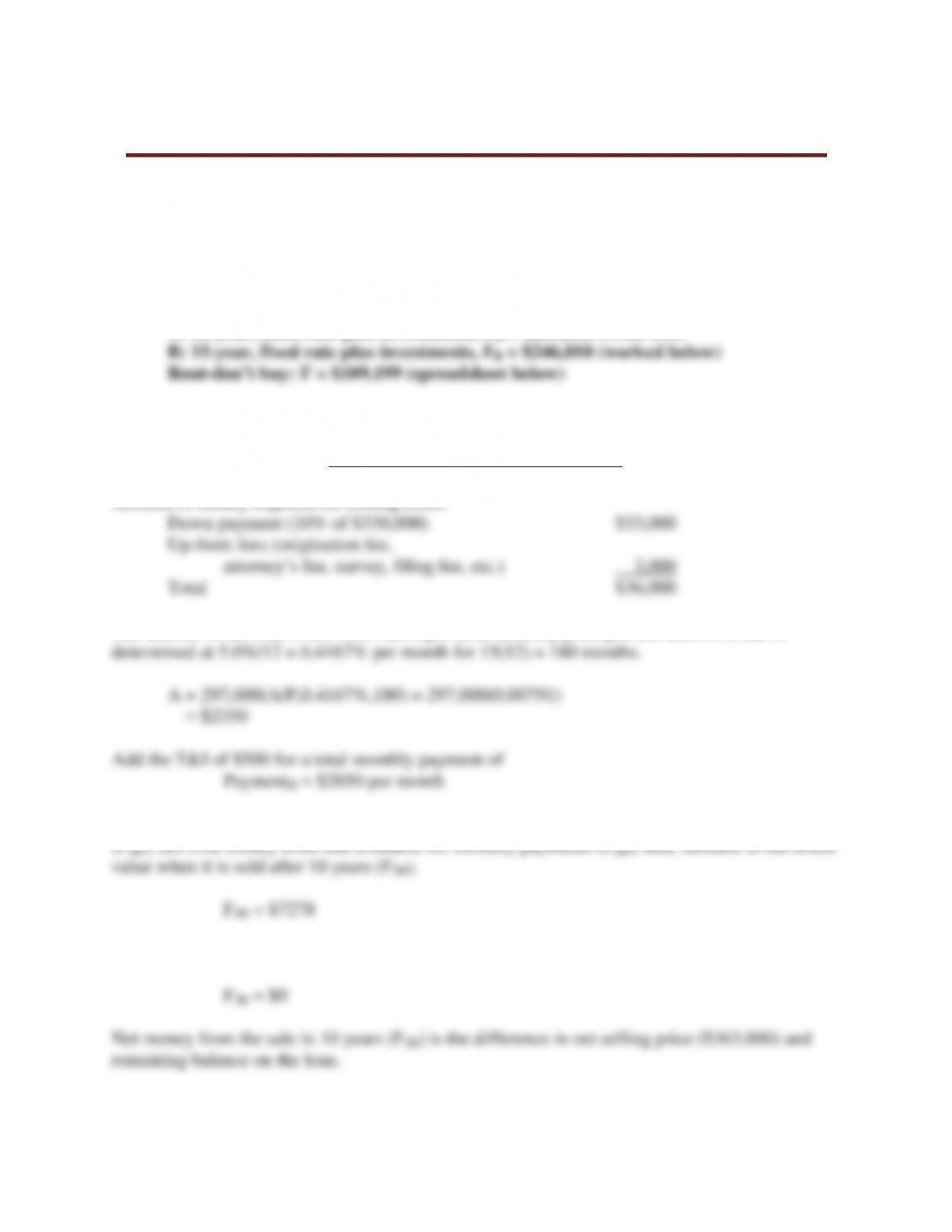
1. Summary of future worth values if sold at $363,000:
A: 30–year, fixed rate plus investments, FA = $243,246 (from text)
Conclusion: Select the 15-year loan
Plan B analysis: 15–year fixed rate loan
The amount of the loan is $297,000 and equivalent monthly principal and interest (P&I) is
The future worth of plan B is the sum of remainder of the $40,000 available for the closing costs
No money is available each month to invest after the mortgage payment of $2850. Therefore,
11
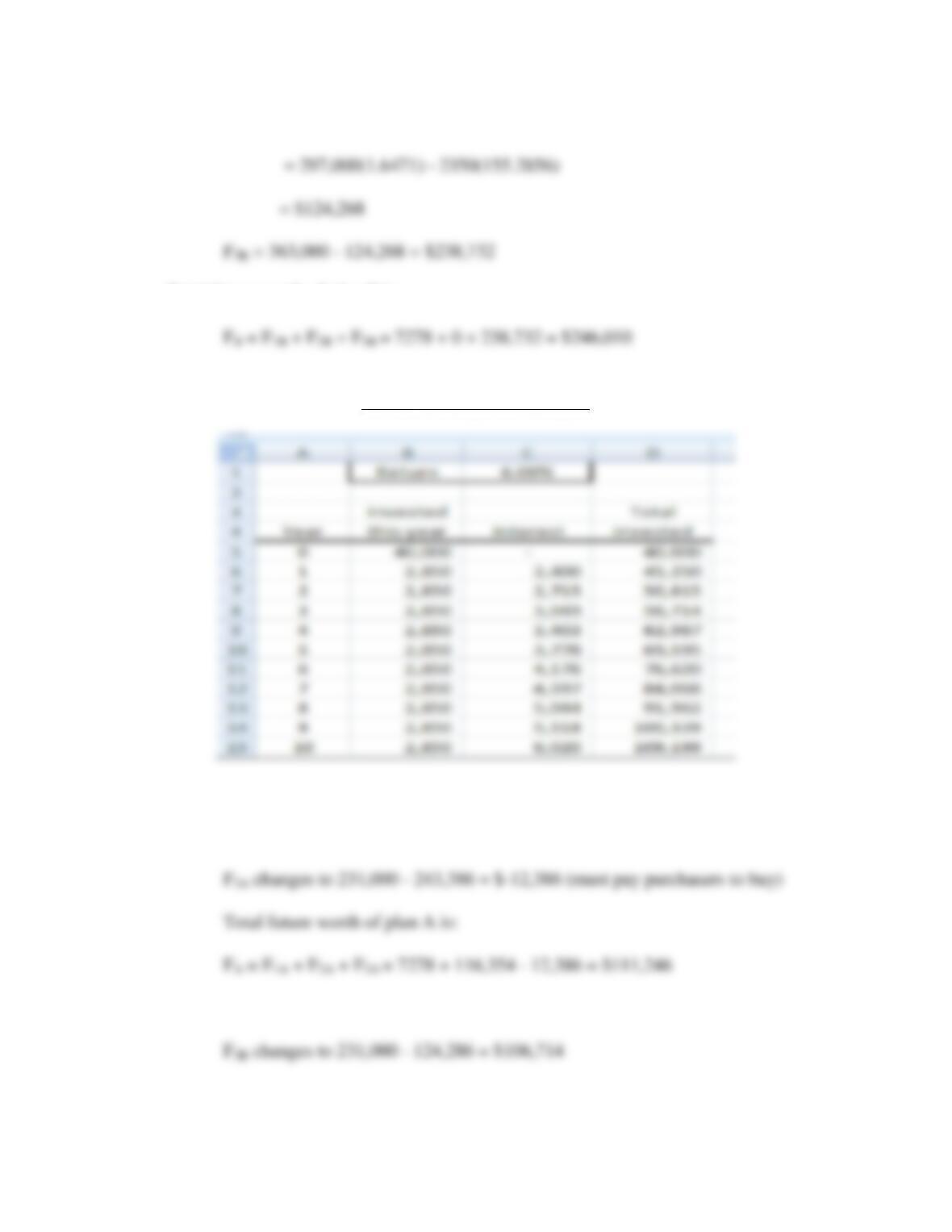
Loan balance = 297,000(F/P,0.4167%,120) – 2350(F/A,0.4167%,120)
Total future worth of plan B is:
Rent-Don’t Buy Plan Analysis
2. Summary of future worth values if sold at $231,000:
A: 30–year, fixed rate plus investments, FA = $111,246
B: 15-year, fixed rate plus investments, FB = $114,010

12