1
Solutions to end–of–chapter problems
Engineering Economy, 7th edition
Leland Blank and Anthony Tarquin
Chapter 3
Combining Factors and Spreadsheet Functions
3.2 P = 260,000(P/A,10%,3) + 190,000(P/A,10%,2)(P/F,10%,3)
3.3 (a) P = -120(P/F,12%,1) – 100(P/F,12%,2) – 40(P/F,12%,3) + 50(P/A,12%,2)(P/F,12%,3)
3.4
P = 22,000(P/A,8%,8)(P/F,8%,2)
3.5 P = 200(P/A,10%,3)(P/F,10%,1) + 90(P/A,10%,3)(P/F,10%,5)
3.6 Discount amount = 1.56 – 1.28 = $0.28/1000 g
3.7 P = 105,000 + 350 + 350(P/A,10%,30)
3.8 P = (20 – 8) + (20 – 8)(P/A,10%,3) + (30 – 12)(P/A,10%,5)(P/F,10%,3)
3.9 2,000,000 = x(P/F,10%,1) + 2x(P/F,10%,2) + 4x(P/F,10%,3) + 8x(P/F,10%,4)
3.10 A = 300,000 + (465,000 – 300,000)(F/A,10%,5)(A/F,10%,9)
3.11 (a) 2,000,000 = 25,000(F/P,10%,20) + A(F/A,10%,20)
3.12 (a) A = 16,000(A/P,10%,5) + 52,000 + (58,000 – 52,000)(P/F,10%,1)(A/P,10%5)
3.14 (a) 300 = 200(A/P,10%,7) + 200(P/A,10%,3)(A/P,10%,7) + x(P/F,10%,4)(A/P,10%,7)
3
3.15 Amount owed after first payment = 10,000,000(F/P,9%,1) – 2,000,000
3.16 A = [6000(P/F,10%,1) + 9000(P/F,10%,3) + 10,000(P/F,10%,6)](A/P,10%,7)
3.17 Find P0 and then convert to A. In $1000 units,
3.18 A = -2500(A/P,10%,10) + (700 – 200)(P/A,10%,4)(A/P,10%,10)
3.19 A = 1000 + [100,000 + 50,000(P/A,10%,5)](A/P,10%,20)
3.20 Payment amount is an A for 10 years in years 0 through 9.
3.21 360,000 = 55,000(F/P,8%,5) + 90,000(F/P,8%,3) + A(F/A,8%,3)
3.22 F = [100(F/A,10%,7) + (300 – 100)(F/A,10%,2)](F/P,10%,2)
3.25 (a) First calculate P and then convert to F.
3.26 Move all cash flows to year 8 and set equal to $500. Then solve for x.
3.27 -70,000 = -x(F/A,10%,5)(F/P,10%,3) – 2x(F/A,10%,3)
3.28 A = 50,000(A/F,15%,4)
5
3.29 Find F in year 5, subtract future worth of $42,000, and then use A/F factor.
F = 74,000(F/A,10%,5) – 42,000(F/P,10%,4)
3.30 A = 40,000(F/A,12%,3)(A/P,12%,5)
3.33 1,600,000 = Z + 2Z(P/F,10%,2) + 3Z(P/A,10%,3)(P/F,10%,2)
3.34 In $1 million units,
Amount owed at end of year 4 = 5(F/P,15%,4) – 0.80(1.5)(F/A,15%,3)
3.35 P = -50(P/F,10%,1) – 50(P/A,10%,7) )(P/F,10%,1) – 20(P/G,10%,7)(P/F,10%,1)
3.36 P = 13(P/A,12%,3) + [13(P/A,12%,7) + 3(P/G,12%,7)](P/F,12%,3)
3.37 First find P and then convert to A
P = 100,000(P/A,10%,4) + [100,000(P/A,10%,16) + 10,000(P/G,10%,16)](P/F,10%,4)
3.38 P = 90(P/A,15%,2) + [90(P/A,15%,8) – 5(P/G,15%,8)](P/F,15%,2)
3.39 (a) Hand solution
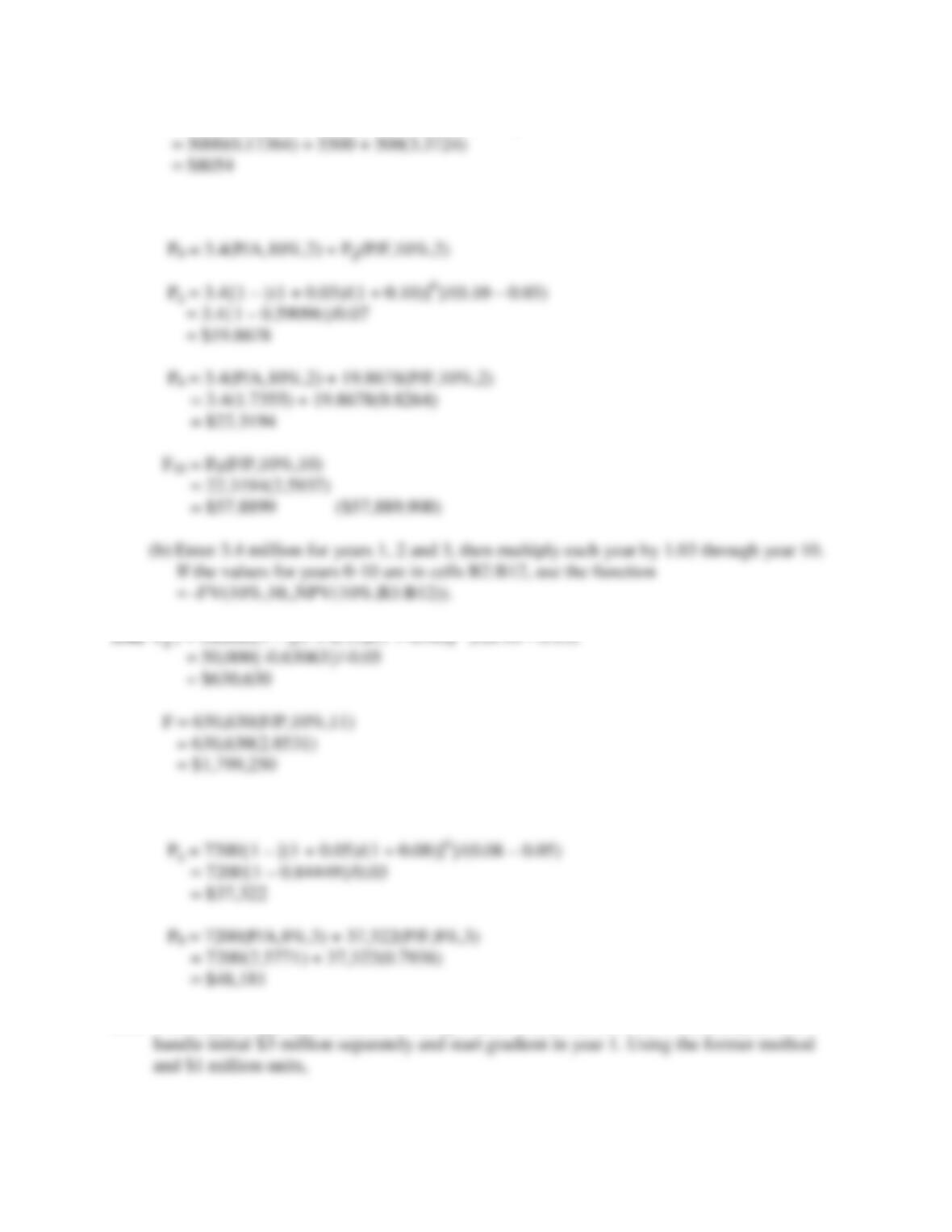
12,475,000(F/P,15%,2) = 250,000(P/A,15%,13) + G(P/G,15%,13)
7
3.40 A = 5000(A/P,10%,9) + 5500 + 500(A/G,10%,9)
3.41 (a) In $1 million units, find P0 then use F/P factor for 10 years.
3.43 P0 = 7200(P/A,8%,3) + Pg(P/F,8%,3)
3.44 Two ways to approach solution: Find Pg in year -1 and the move it forward to year 0; or
8
3.45 Pg-1 = 150,000(6/(1 + 0.10)
3.46 16,000 = [8000 + 8000(P/A,10%,4) – G(P/G,10%,4)](P/F,10%,1)
3.47 A = 850(A/P,10%,7) + 800 – 50(A/G,10%,7)
3.48 Find P in year 0, then use A/P factor for 9 years.
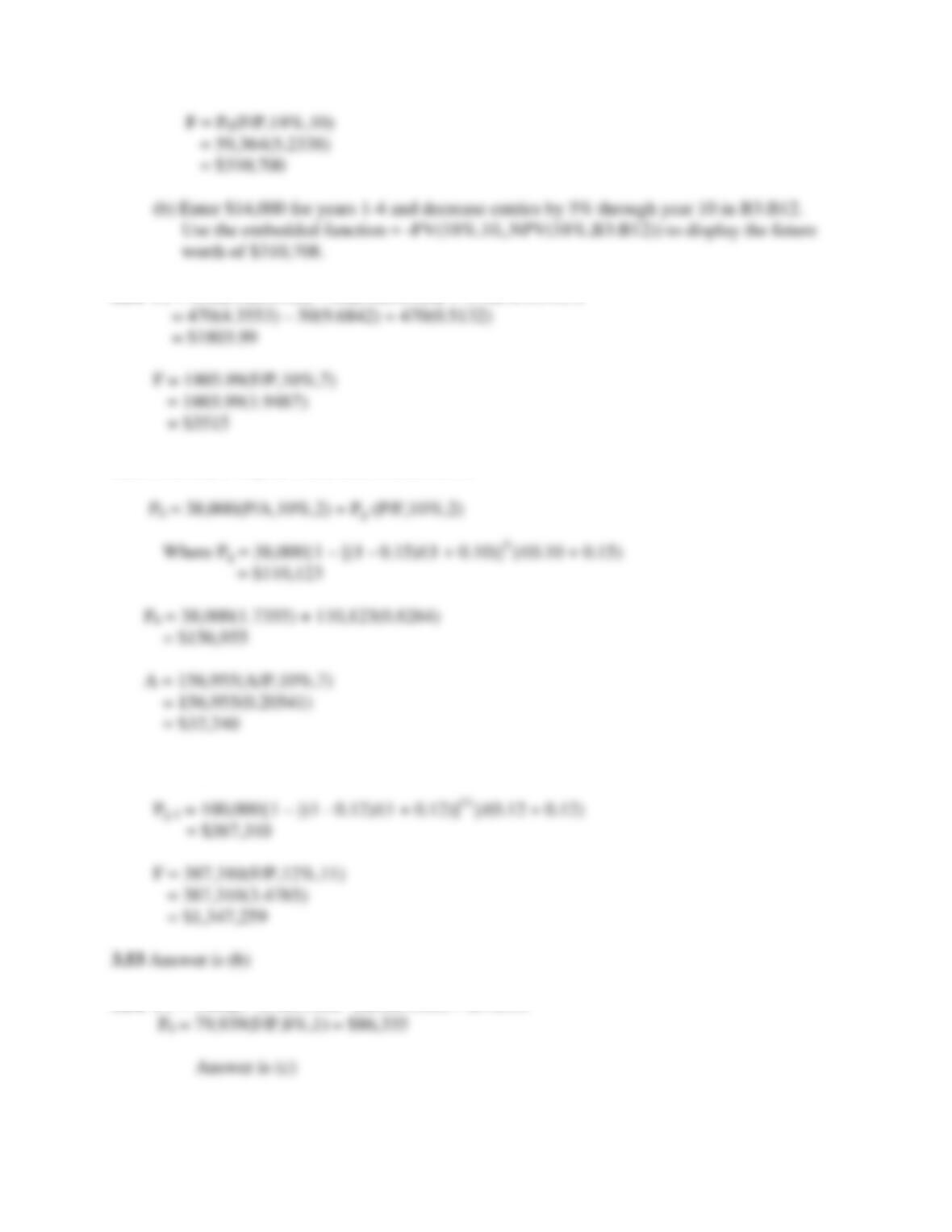
3.49 (a) P0 = 14,000(P/A,18%,3) + Pg (P/F,18%,3)
9
3.50 P1 = 470(P/A,10%,6) – 50(P/G,10%,6) + 470(P/F,10%,7)
3.51 First find P in year 0 and then convert to A.
3.52 Find Pg in year -1 and then move to year 10 with F/P factor.
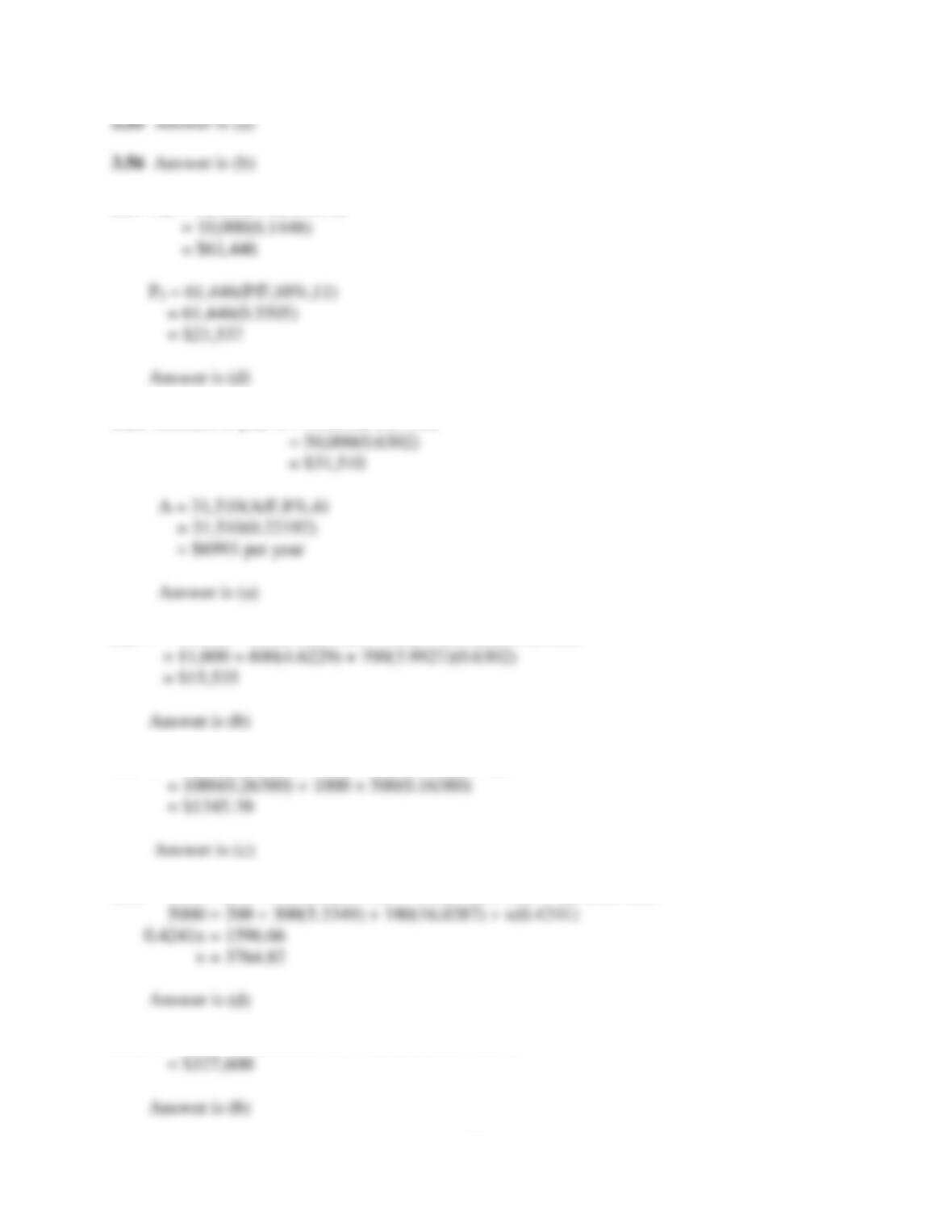
3.54 P-1 = 9000[1- (1.05/1.08)11]/(0.08-0.05) = $79,939
10
3.57 P14 = 10,000(P/A,10%,10)
3.58 Amount in year 6 = 50,000(P/F,8%,6)
3.59 P = 11,000 + 600(P/A,8%,6) + 700(P/A,8%,5)(P/F,8%,6)
3.60 A = 1000(A/P,10%,5) + 1000 + 500(A/F,10%,5)
3.61 5000 = 200 + 300(P/A,10%,8) + 100(P/G,10%,8) + x(P/F,10%,9)
3.62 A = 2,000,000(A/F,10%,5) = 2,000,000(0.16380)
11
Solution to Case Study, Chapter 3
There are not always definitive answers to case studies. The following are examples only.
Preserving Land for Public Use
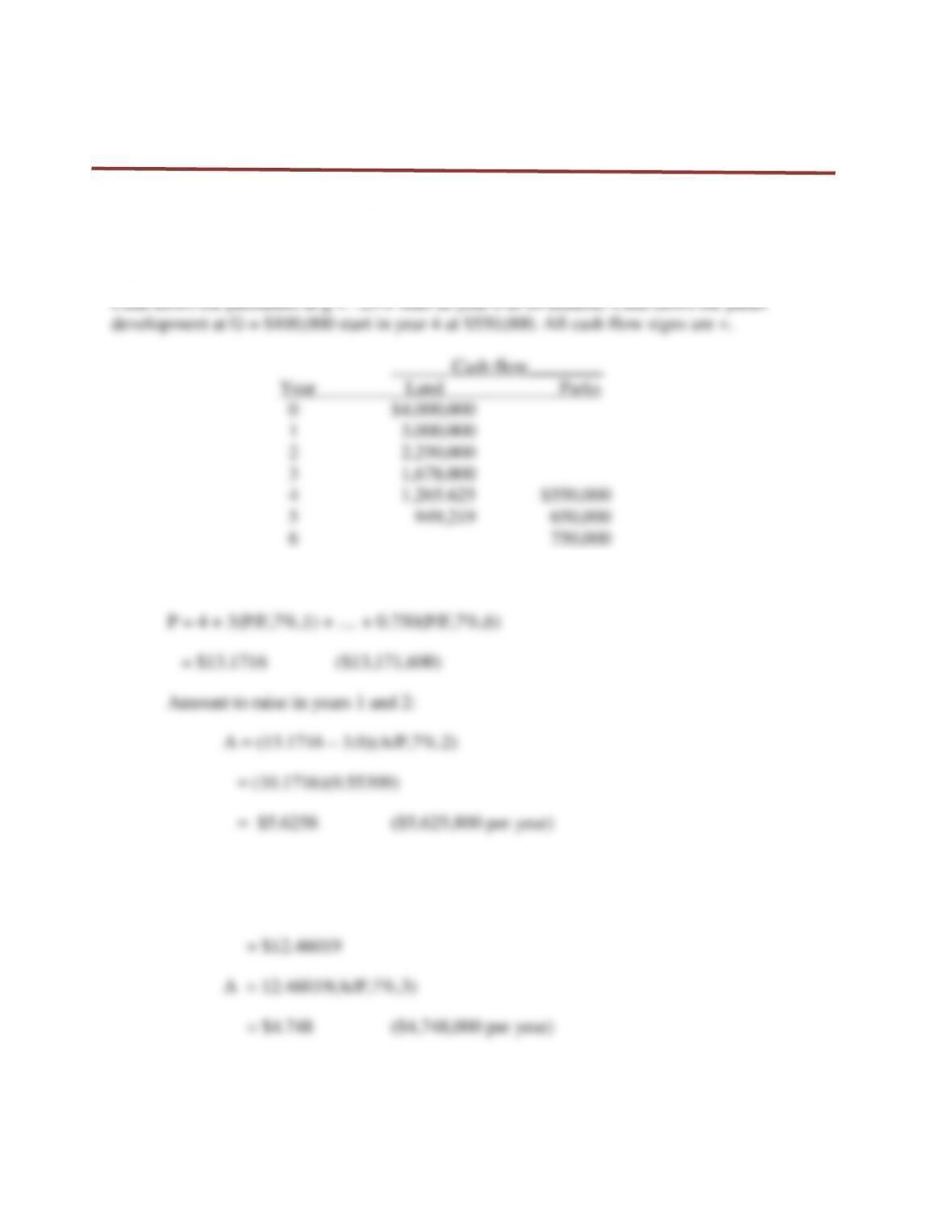
1. Find P. In $1 million units,
2. Find remaining project fund needs in year 3, then find the A for the next 3 years
F3 = (13.1716 – 3.0)(F/P,7%,3)