1
Solutions to end–of–chapter problems
Engineering Economy, 7th edition
Leland Blank and Anthony Tarquin
Chapter 17
After-Tax Economic Analysis
17.1 (a) Graduated rates: higher taxable incomes pay taxes at higher rates.
17.2 (a) Taxes = 22,250 + 0.39(150,000 – 100,000)
17.4 (a) Depreciation
(b) Net operating profit after taxes
(c) Taxable income
17.5 (a) Company 1
TI = Gross income – Expenses – Depreciation
2
17.6 Taxes on $250,000 = 22,250 + 0.39(150,000)
Use Eq. [17.4]
3
TI = 7.5 million – 4.3 million = $3.2 million
Taxes = 3,200,000(0.3968) = $1,269,760
17.8 (a) Federal taxes = 13,750 + 0.34(15,000) = $18,850 (using Table 17-1)
17.9 Without system: Taxes = 150,000(0.39) = $58,500
17.10 (a) Te = 0.06 + (1 – 0.06)(0.23) = 0.2762
17.12 NOPAT = GI – OE – D – taxes
4
17.13 CFBT = CFAT + taxes
17.14 CFAT = CFBT – (CFBT–D)Te
17.15 CFAT = GI – OE – P + S – (GI – OE –D)Te
17.16 Te = 0.065 + (1 – 0.065)(0.35) = 0.39225
17.17 CFBT = CFAT + taxes
GI – OE = CFAT + (GI – OE – D)(Te)
Year 1: GI1 = [2.5 million + 650,000(0.736) – 650,000(0.264)]/0.736
17.18 Estimate before–tax MARR by Equation [10.1]. Tabulate CFBT; calculate AW.
Before–tax MARR = 10%/(1– 0.35) = 15.4%. (All monetary values are in $1000 units.)
2
950
-150
800
3
600
-200
400
4
300
-250
700
750
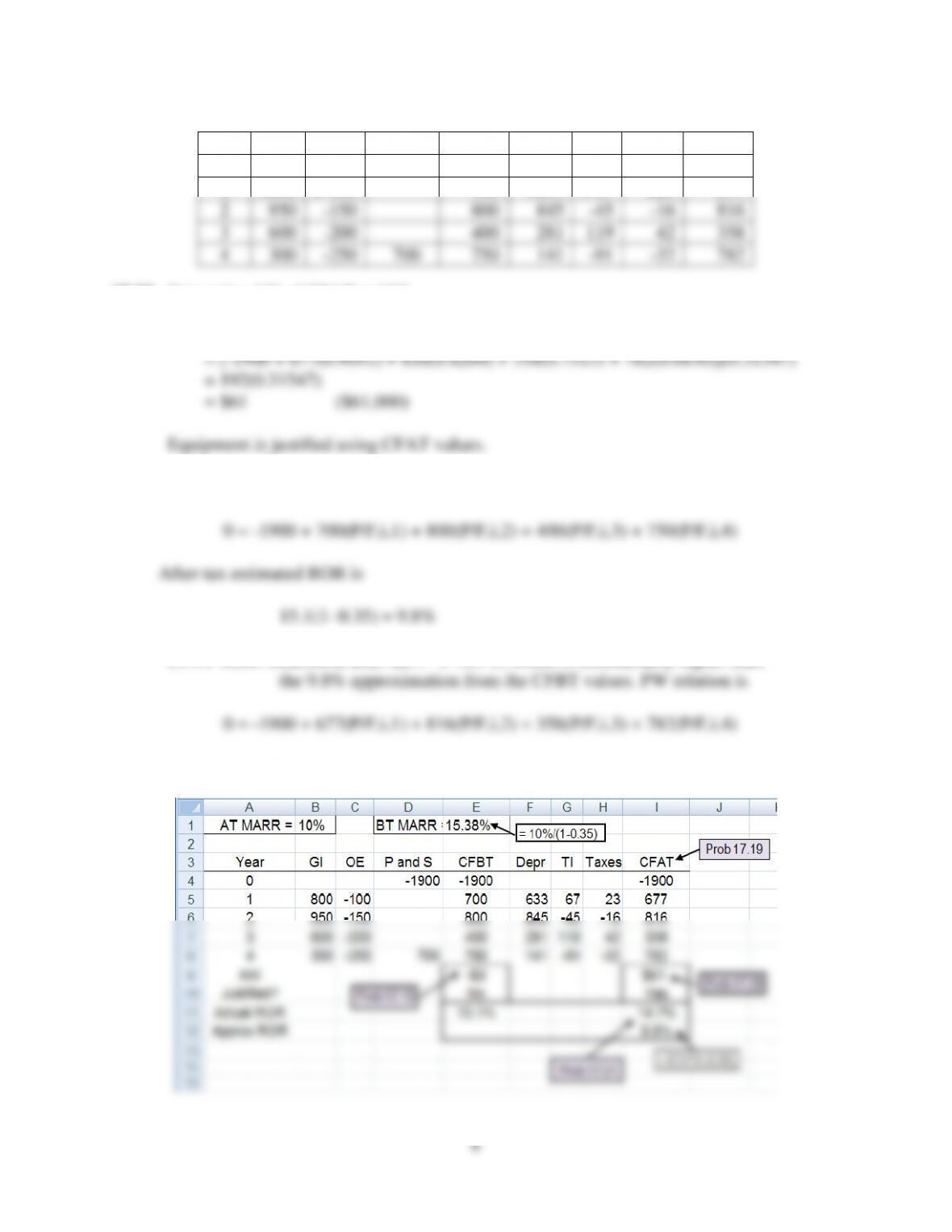
17.19 Determine MACRS depreciation, taxes and CFAT. Assume negative tax will
increase CFAT and AW. (All monetary values are in $1000 units.)
TI = GI – OE – D
Year
GI
OE
P and S
CFBT
0
$-1900
$-1900
1
$800
$-100
700
2
950
-150
800
845
3
600
-200
400
281
119
4
300
-250
700
750
141
17.20 Determine AW of CFAT at 10%.
AW = [-1900 + 677(P/F,10%,1) + … + 782(P/F,10%,4)](A/P,10%,4)
17.21 CFBT approximation: Determine before-tax i* = 15.1%. PW relation is
CFAT ROR: Determine after-tax i* = 14.7%, which is considerably higher than
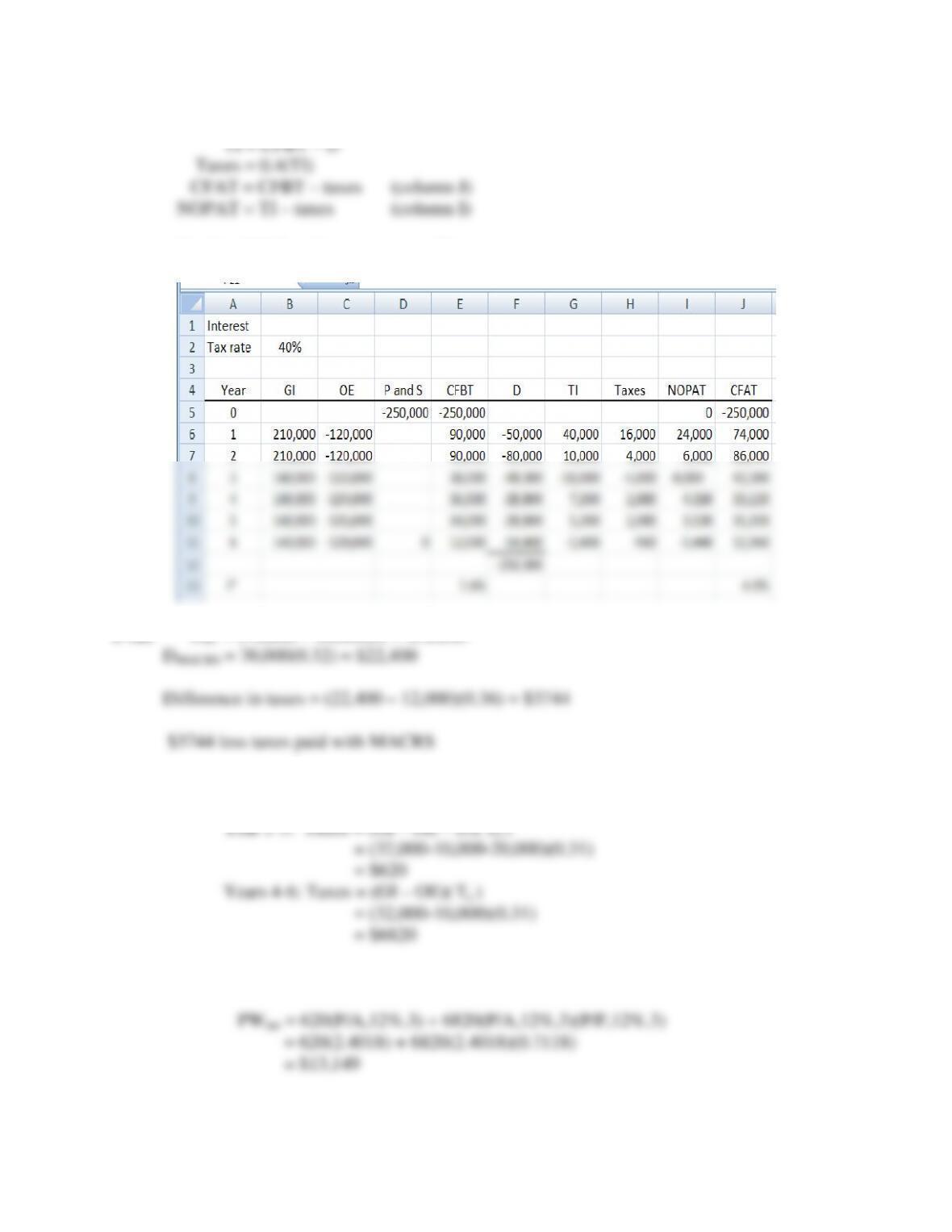
Spreadsheet solution for 17.18 to 17.21 follows.
Year
GI
OE
P and S
CFBT
D
TI
Taxes
CFAT
0
$-1900
$-1900
$-1900
1
$800
$-100
700
$633
$ 67
$23
677
7
17.22 CFBT = GI – OE – P + S (column E)
i* using IRR function (row 13)
17.23 DSL = (70,000 – 10,000)/5 = $12,000
17.24 Recovery over 3 years: SL depreciation is 60,000/3 = $20,000 per year
Total taxes = 3(620) + 3(6820) = $22,320
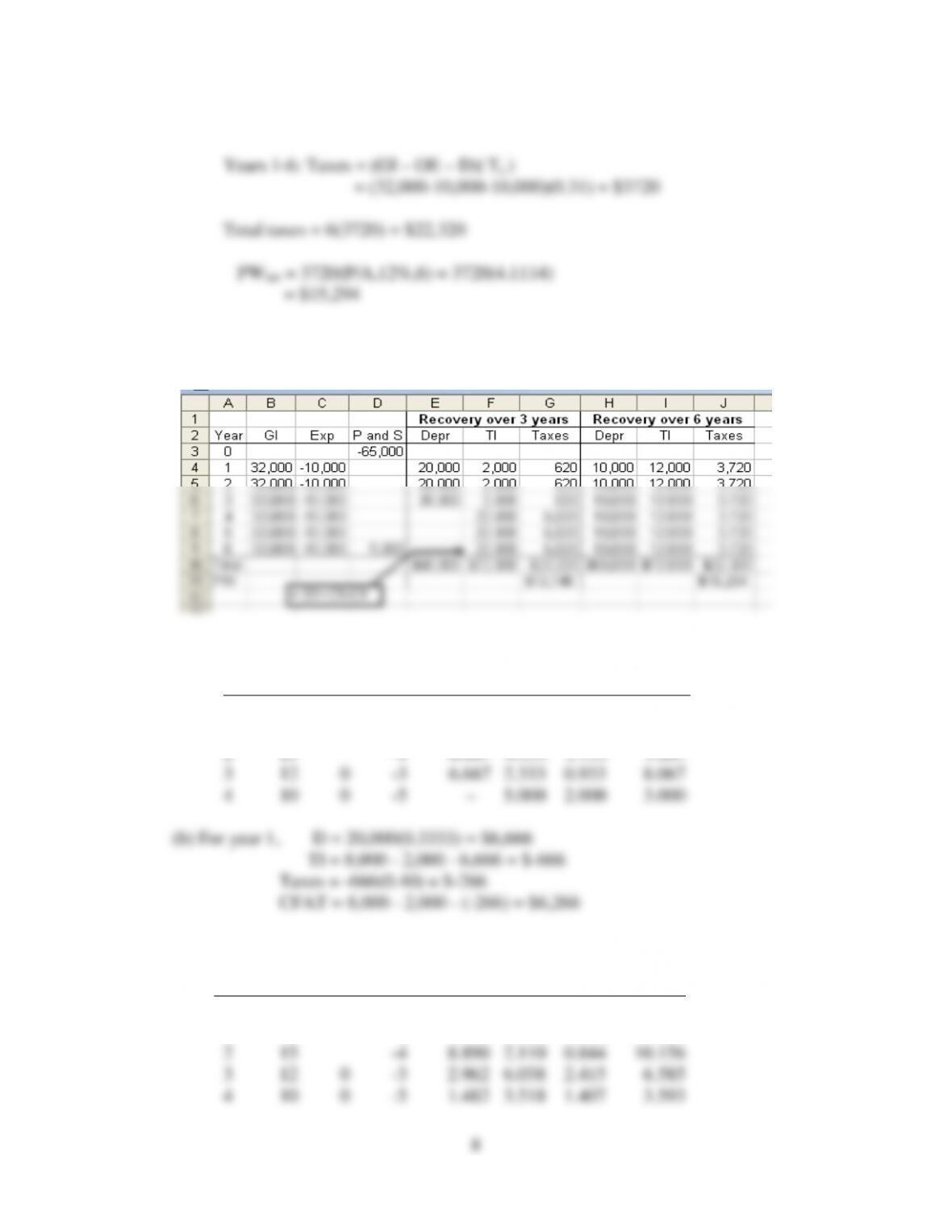
Recovery over 6 years: SL depreciation is 60,000/6 = $10,000 per year
Recovery in 3 years has a lower PWtax value; total taxes are the same for both.
Spreadsheet solution follows.
17.25 (a) D = (20,000 – 0)/3 = $6,667
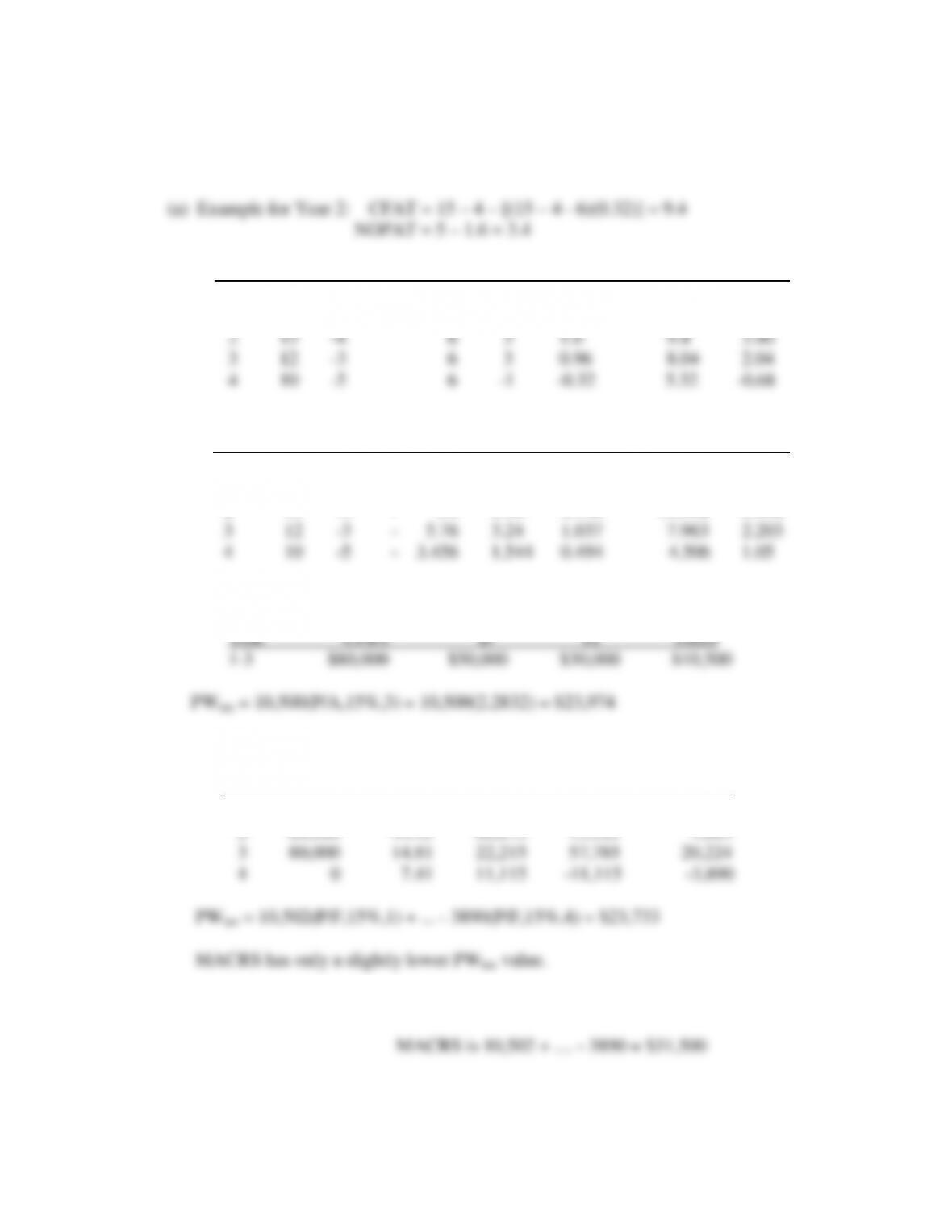
Year GI P OE D TI Taxes CFAT
0 – -20 – – – – -20.000
1 8 -2 6.667 -.666 -0.266 6.266
2 15 -4 6.667 4.333 1.733 9.267
In $1000 units
Year GI S OE D TI Taxes CFAT
0 – -20 – – – – -20.000
1 8 -2 6.666 -0.666 -0.266 6.266
9
17.26 CFAT = GI – OE – P + S – taxes
NOPAT = TI – taxes
Year GI OE P D TI Taxes CFAT NOPAT
0 – – -30 – – – -30.0
1 8 -2 6 0 0.0 6.0 0.00
(b) Year GI OE P D TI Taxes CFAT NOPAT
0 – – -30 – – – -30.0
1 8 -2 – 6 0 0.0 6.0 0.0
2 15 -4 – 9.6 1.40 0.448 10.552 0.952
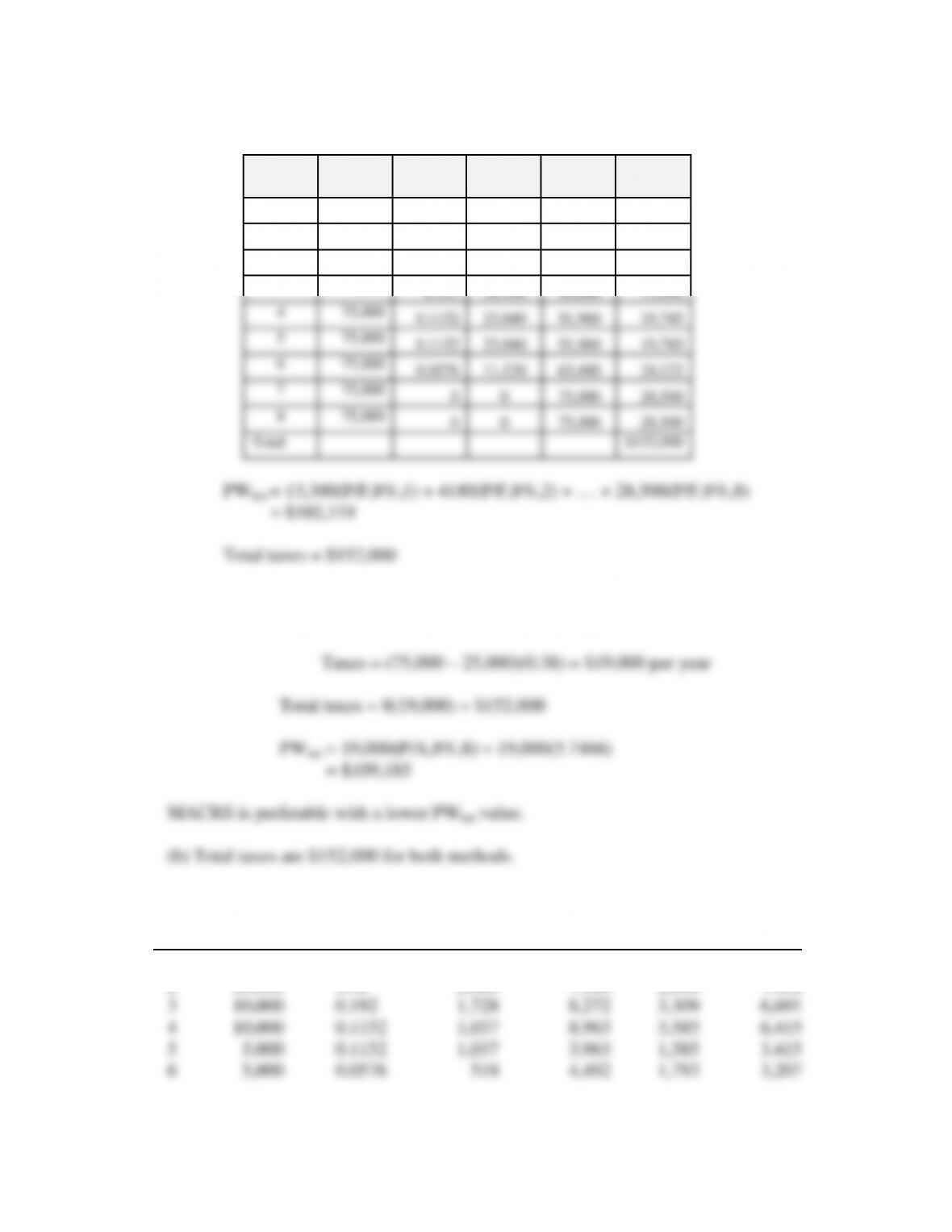
17.27 (a) For SL depreciation with n = 3 years, Dt = $50,000 per year, Taxes = TI(0.35)
For MACRS depreciation, use Table 16.2 rates.
Year CFBT d D TI Taxes__
1 $80,000 33.33% $49,995 $30,005 $10,502
(b) Total taxes are the same: SL is 3(10,500) = $31,500
10
17.28 (a) MACRS depreciation
Year
P and
CFBT
Rate
Depr
TI
Taxes
0
–200,000
1
75,000
0.2 40,000 35,000 13,300
2
75,000
0.32 64,000 11,000 4,180
3
75,000
0.192
38,400
36,600
13,908
4
75,000
0.1152
23,040
51,960
19,745
5
75,000
0.1152 23,040 51,960 19,745
6
75,000
7
75,000
0
0
75,000
28,500
8
75,000
0
0
75,000
28,500
Total
$152,000
PWtax = 13,300(P/F,8%,1) + 4180(P/F,8%,2) + … + 28,500(P/F,8%,8)
= $102,119
Total taxes = $152,000
Straight line depreciation
Depreciation is 200,000/8 = $25,000 per year
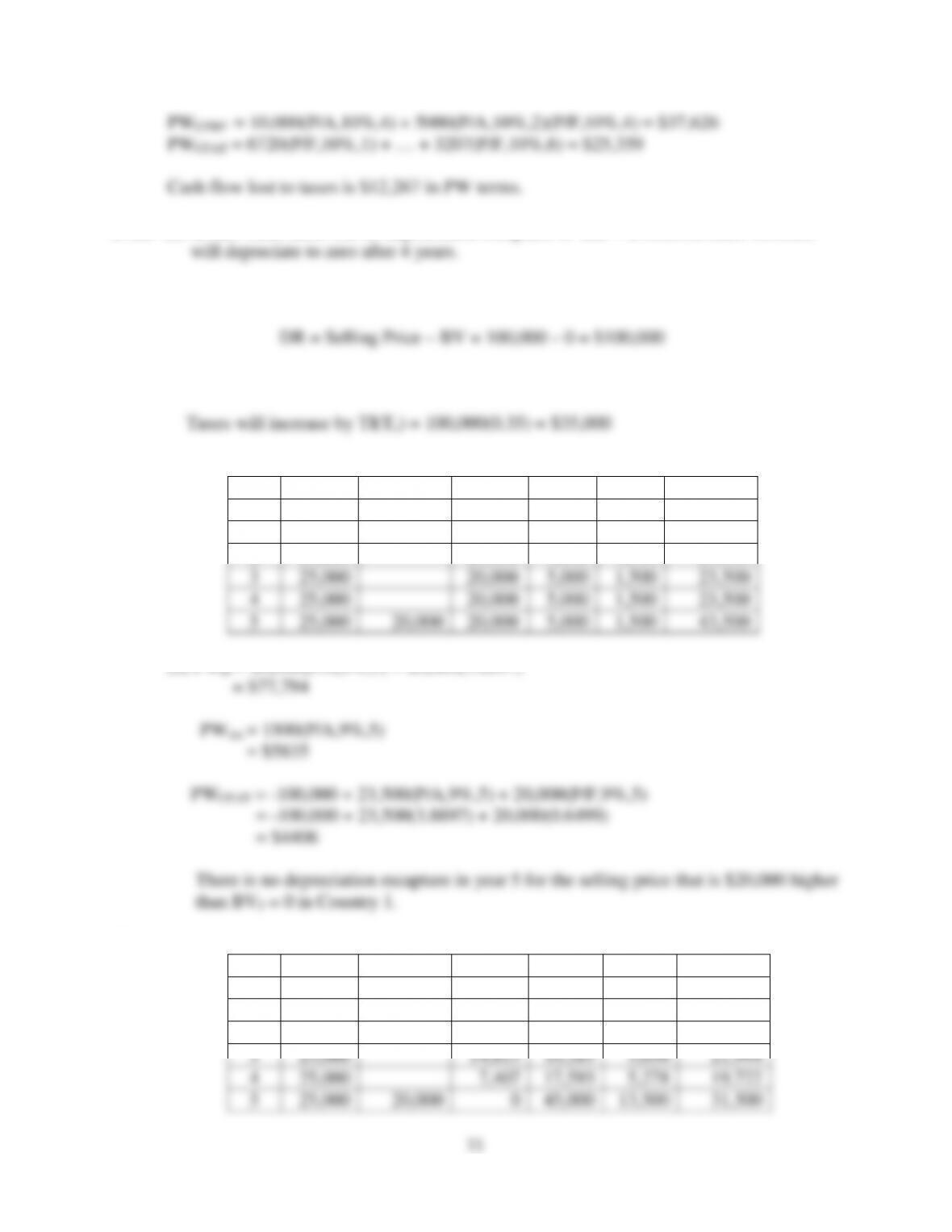
17.29 Find the difference between PW of CFBT and CFAT
Year CFBT d D TI Taxes CFAT
1 $10,000 0.20 $1,800 $8,200 $3,280 $6,720
2 10,000 0.32 2,880 7,120 2,848 7,152
17.30 (a) At sale time, there will be depreciation recapture of DR = $100,000, since MACRS
(b) TI will increase by the depreciation recapture of $100,000
DR is taxed as regular taxable income
17.31 (a)
Year
GI – OE
P and SP
D
TI
Taxes
CFAT
0
$-100,000
$-100,000
1
$25,000
$20,000
$5,000
$1,500
23,500
2
25,000
20,000
5,000
1,500
23,500
3
25,000
20,000
5,000
1,500
23,500
4
25,000
20,000
5,000
1,500
23,500
5
25,000
20,000
20,000
5,000
1,500
43,500
(b) PWD = 20,000(P/A,9%,5) = 20,000(3.8897)
17.32 (a)
Year
GI – OE
P and SP
D
TI
Taxes
CFAT
0
$-100,000
$-100,000
1
$25,000
$33,333
$-8,333
$-2,500
27,500
2
25,000
44,444
-19,444
-5,833
30,833
3
25,000
14,815
10,185
3,056
21,944
4
25,000
7,407
17,593
5,278
19,722
5
25,000
20,000
0
45,000
13,500
31,500
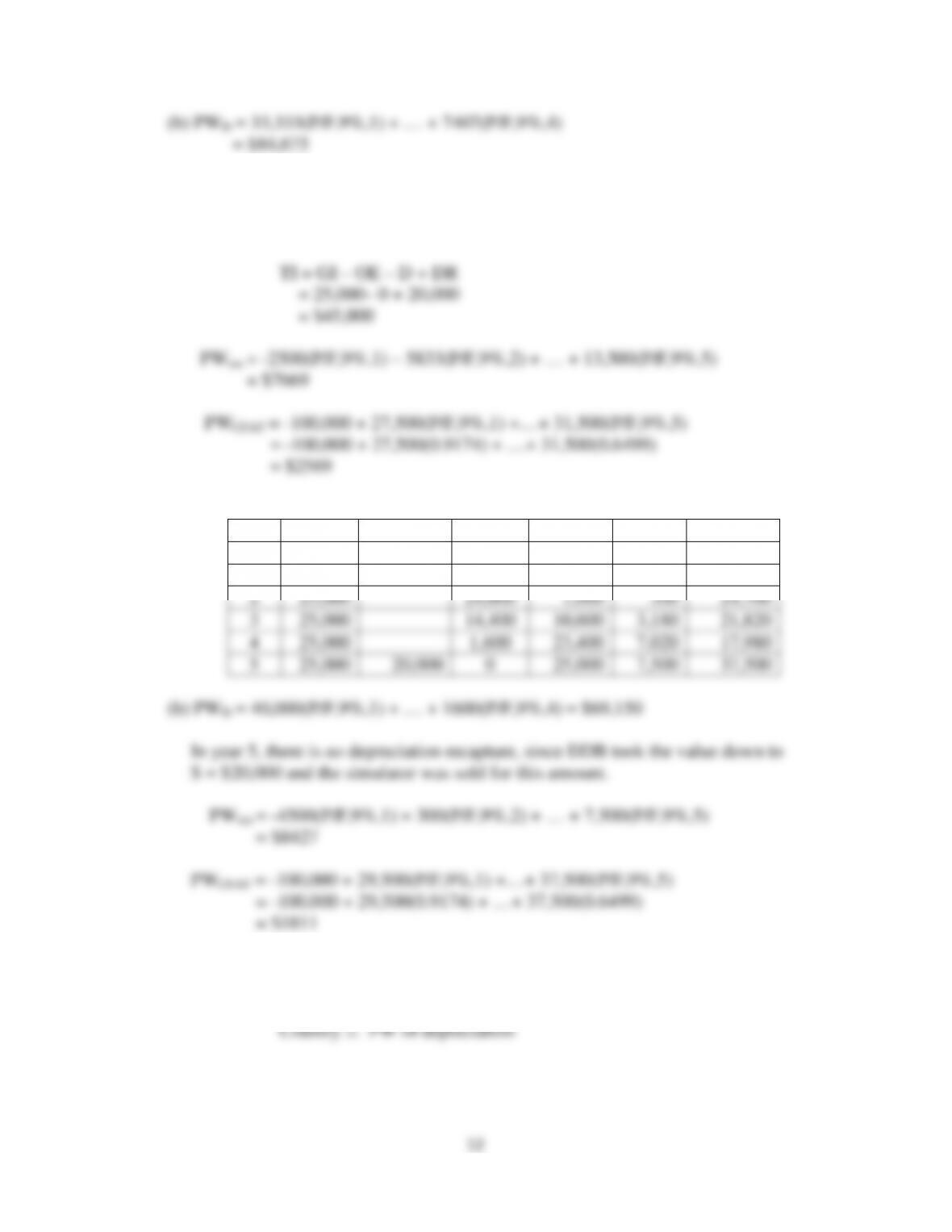
In year 5, there is depreciation recapture added to make TI larger
DR = SP-BV = 20,000-0 = $20,000 = S
17.33 (a)
Year
GI – OE
P and SP
D
TI
Taxes
CFAT
0
$-100,000
$-100,000
1
$25,000
$40,000
$-15,000
$-4,500
29,500
2
25,000
24,000
1,000
300
24,700
3
25,000
14,400
10,600
3,180
21,820
4
25,000
1,600
23,400
7,020
17,980
5
25,000
20,000
0
25,000
7,500
37,500
17.34 Spreadsheet solutions for problems 17.31-17.33 and this problem follow.
Best country selections:
Country 1: Total taxes, PW of taxes and CFAT
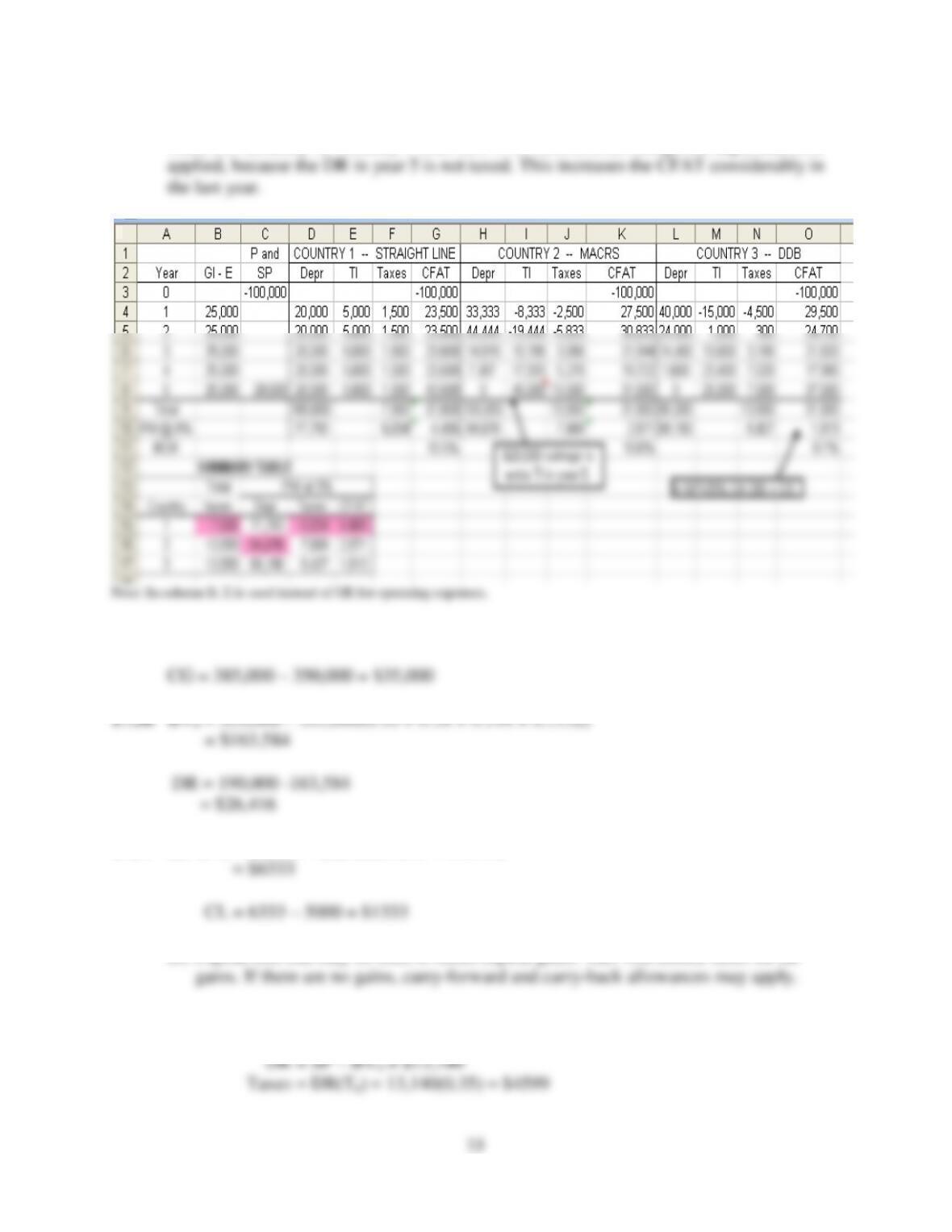
Highest PW of depreciation is selected, so MACRS (country 2) wins here. Taxes are best
when low (country 1). Country 1 wins on PW of CFAT, even though SL depreciation is
17.35 DR = 350,000 – 100,800 = $249,200
17.37 (a) BV2 = 28,500 – 28,500(0.3333 + 0.4445)
(b) Capital loss can only be used to offset capital gains. This will reduce taxes on the
17.38 (a) Selling price = 0.4(150,000) = $60,000
BV4 = 150,000(1 – 0.6876) = $46,860
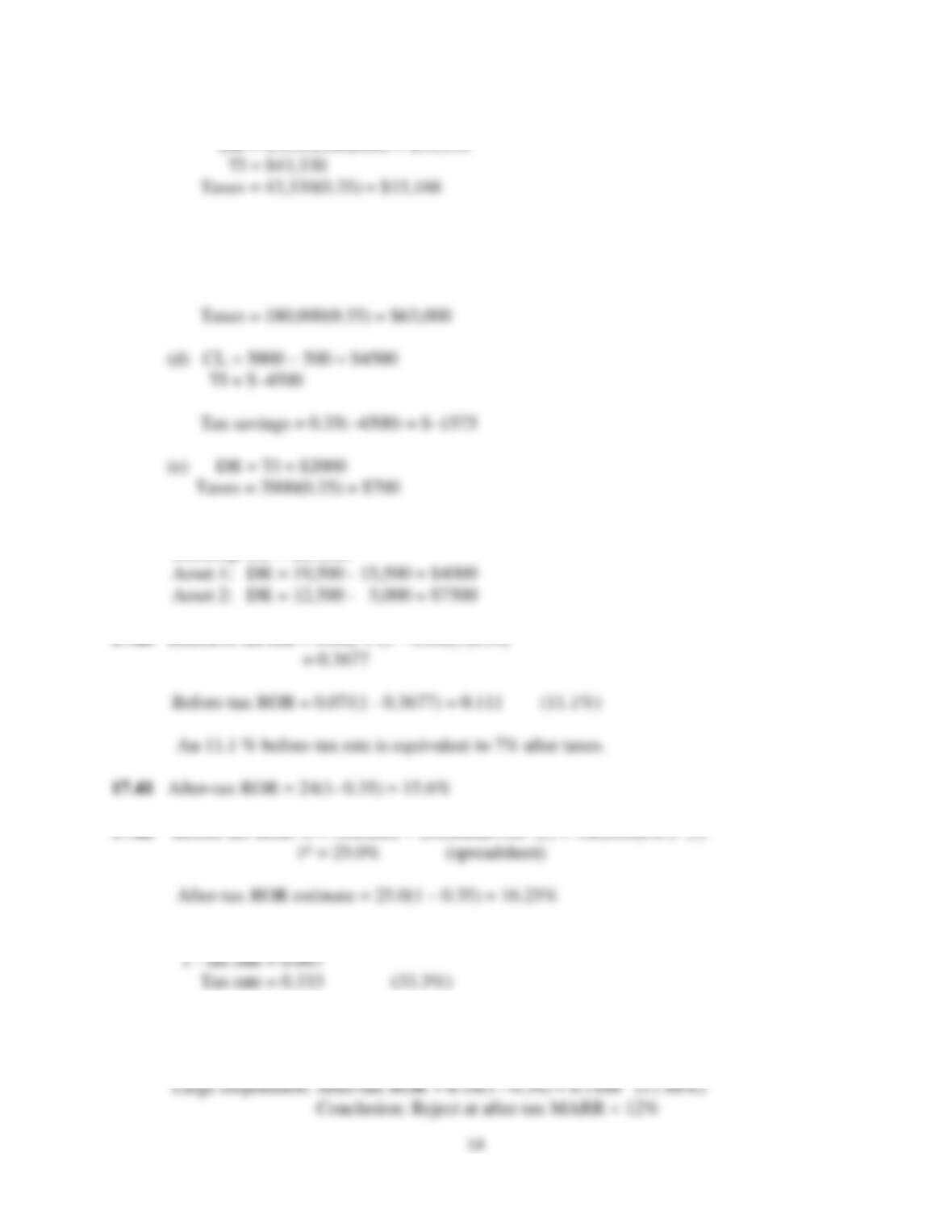
(b) CG = $10,000
DR = 0.3333(100,000) = $33,330
(c) Land does not depreciate, but gains are taxed
CG = TI = 0.10(1.8 million) = $180,000
17.39 Land: CG = $75,000
Building: CL = $25,000
17.40 Effective tax rate = 0.042 + (1 – 0.042) (0.34)
17.42 Before tax ROR: 0 = -500,000 + 230,000(P/A,i*,3) + 100,000(P/F,i*,3)
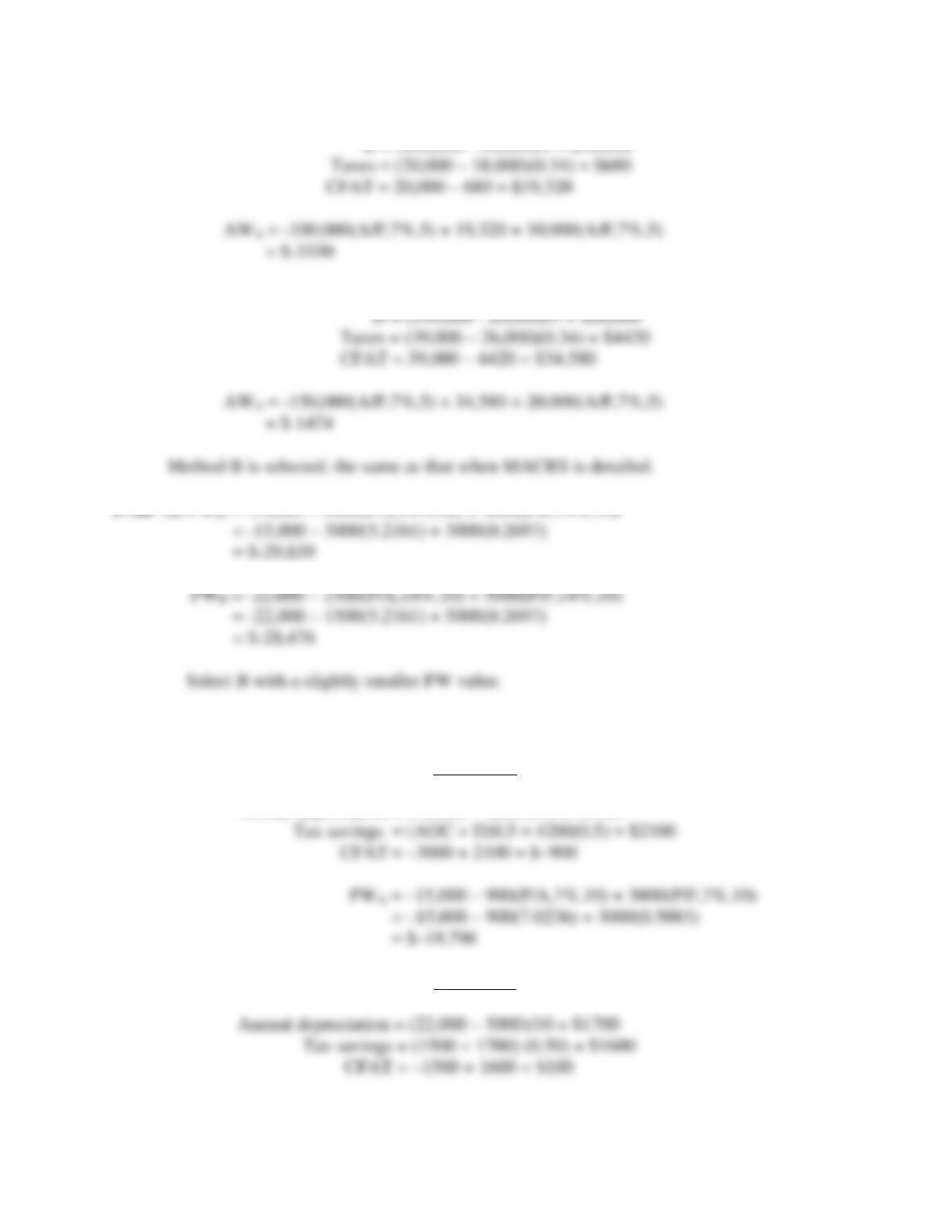
17.43 0.12 = 0.08/(1 – tax rate)
17.44 Small company: After-tax ROR = 0.18(1 – 0.28) = 0.1296 (12.96%)
Conclusion: Accept at after–tax MARR = 12%
15
17.45 Method A: Years 1-5: CFBT = 35,000 – 15,000 = 20,000
D = (100,000 – 10,000)/5 = $18,000
Method B: Years 1-5: CFBT = 45,000 – 6,000 = 39,000
(b) All costs generate tax savings.
Machine A
Annual depreciation = (15,000 – 3,000)/10 = $1200
Machine B
16
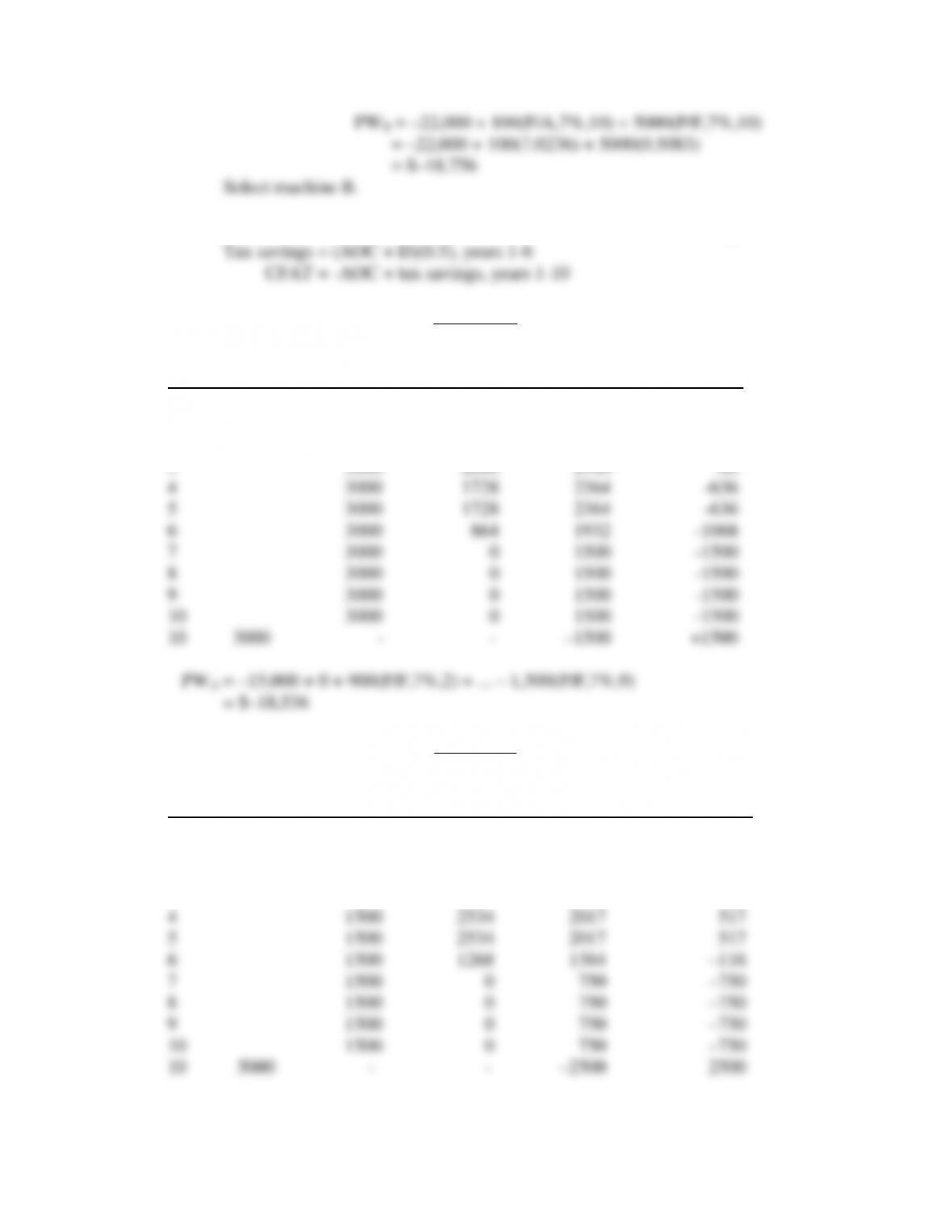
(c) MACRS with n = 5 and a DR in year 10, which is a tax, not a tax savings.
Machine A
Year 10 has a DR tax of 3,000(0.5) = $1500
Year P or S AOC Depr Tax savings CFAT
0 $–15,000 – – – $–15,000
1 $3000 $3000 $3000 0
2 3000 4800 3900 +900
3 3000 2880 2940 -60
Machine B
Year 10 has a DR tax of 5,000(0.5) = $2,500
Year P or S AOC Depr Tax savings CFAT
0 $–22,000 – – – $–22,000
1 $1500 $4400 $2950 1450
2 1500 7040 4270 2770
3 1500 4224 2862 1362