12
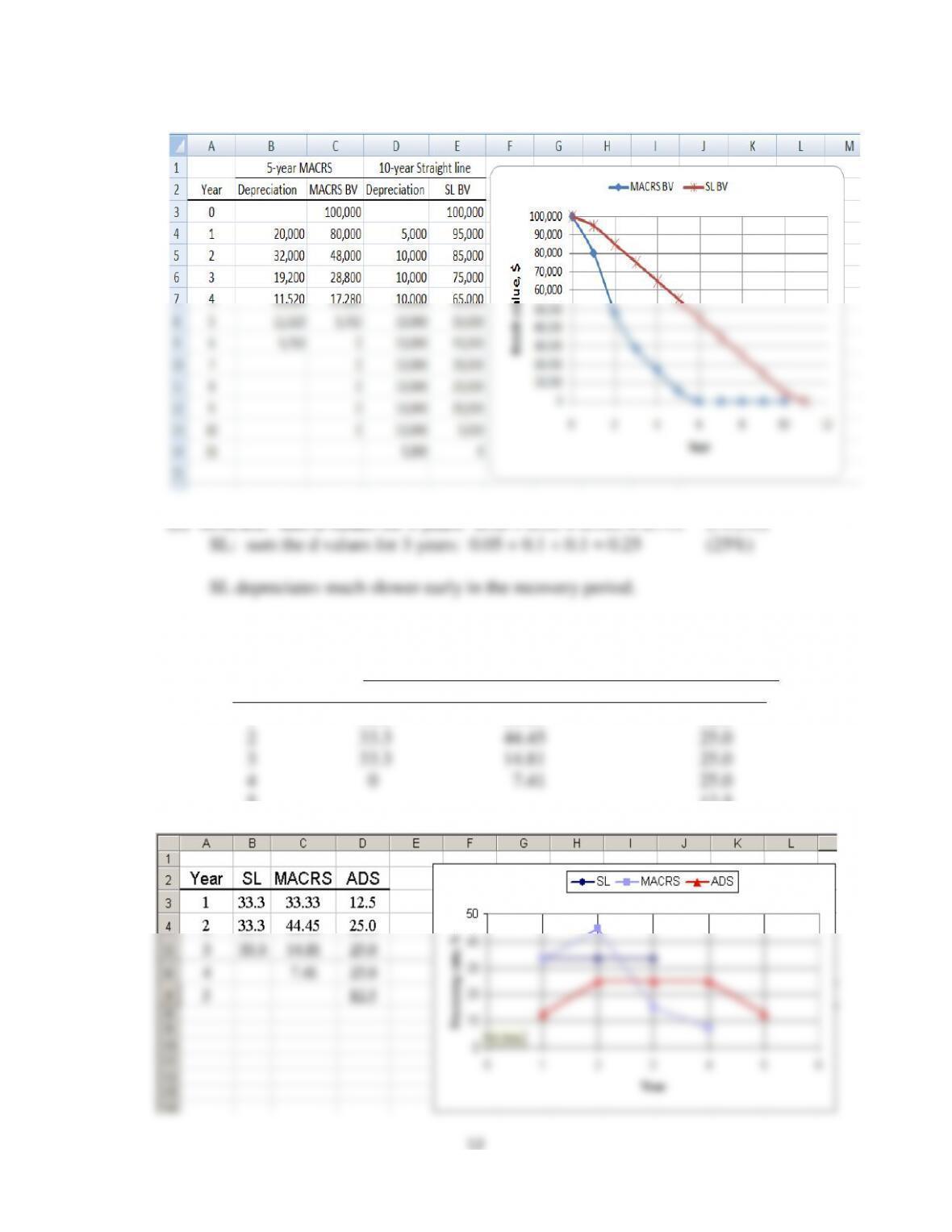
Spreadsheet solution
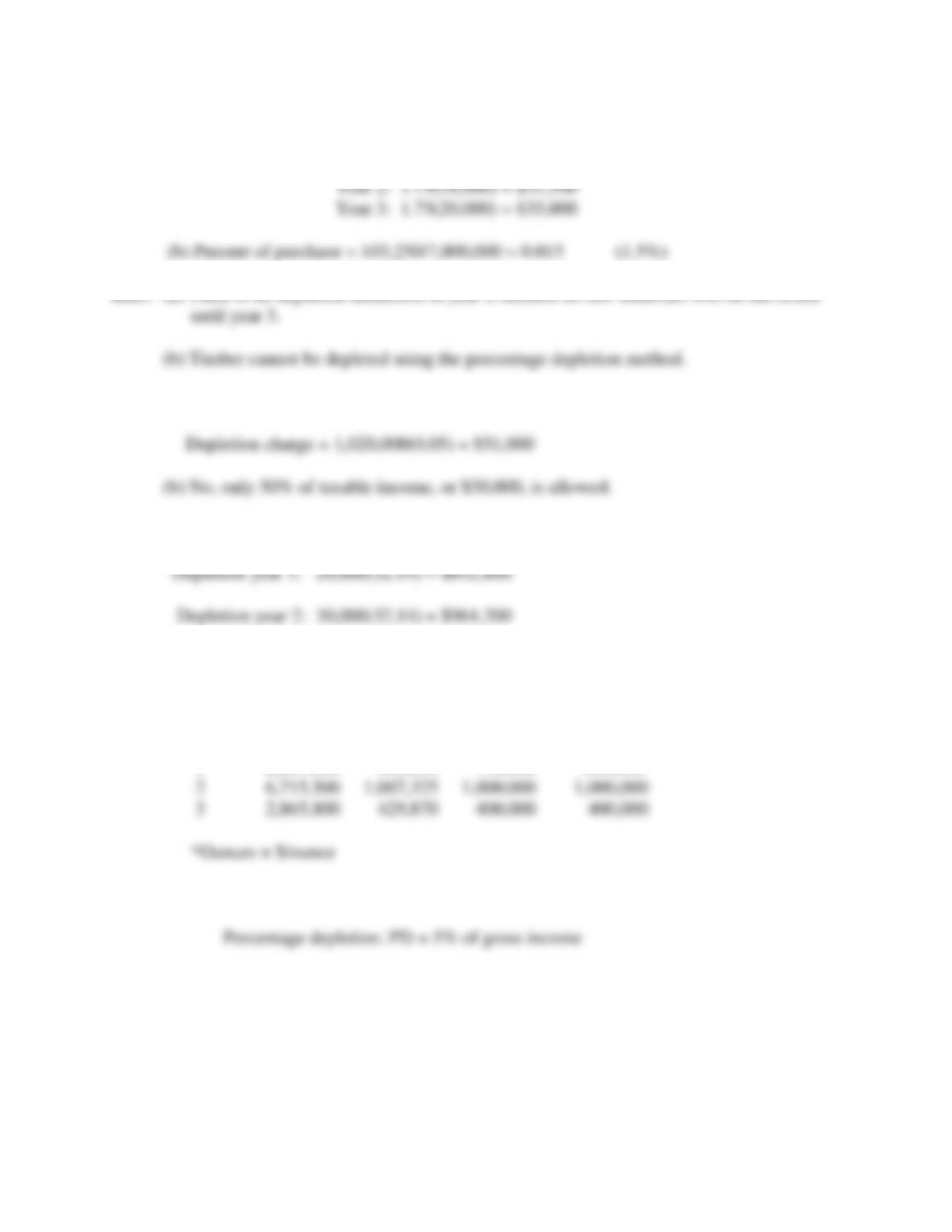
16.35 ADS recovery rates are d = ¼ = 0.25 except for years 1 and 5, which are 50% of this.
d values (%)______________________
Year SL MACRS ADS MACRS
1 33.3 33.33 12.5
5 12.5
13
16.36 (a) CDt = 7,000,000/4,000,000 = $1.75 per ton
Cost Allowance – Year 1: 1.75(21,000) = $36,750
16.38 (a) Income = 50,000(6) + 80,000(9) = $1,020,000
16.39 CDt = 9,000,000/280,000 = $32.14 per ton
16.40 Percentage depletion for gold is 15% of gross income, provided it does not exceed
50% of taxable income.
Gross* PDA 50% Allowed
Year Income at 15% of TI depletion
1 2,007,000 301,050 750,000 301,050
16.41 (a) Cost depletion: CDt = $3.2/2.5 million = $1.28 per ton
14
Tonnage Per-ton Gross income
for cost gross for percentage
Year depletion income depletion___
1 60,000 $30 $ 1,800,000
2 50,000 25 1,250,000
CDA at PDA at
Year $1.28 × tons 5% of GI Selected
1 $76,800 $90,000 PDA
(b) Total depletion is $490,500
(c) Undepleted investment after 3 years:
3.2 million – (90,000 + 64,000 + 101,500) = $2,944,500
15
16.44 D = (20,000 – 2000)/5
16.45 D3 = 40,000(0.144)
16.46 Depl = 10,000(150)(0.10)
16.47 3000 = (20,000 – S) /5
16.48 Salvage value does not enter in the calculation of depreciation in the DDB method.
16.49 BV = 100,000 – 100,000(0.10 + 0.18 + 0.144 + 0.1152) = $46,080
16.50 33,025 = B(0.192)
16.51 CDt = (70,000 – 20,000)/25,000 = $2.00 per tree
16.52 Total depreciation = first cost – BV after 3 years
16
Chapter 16 Appendix
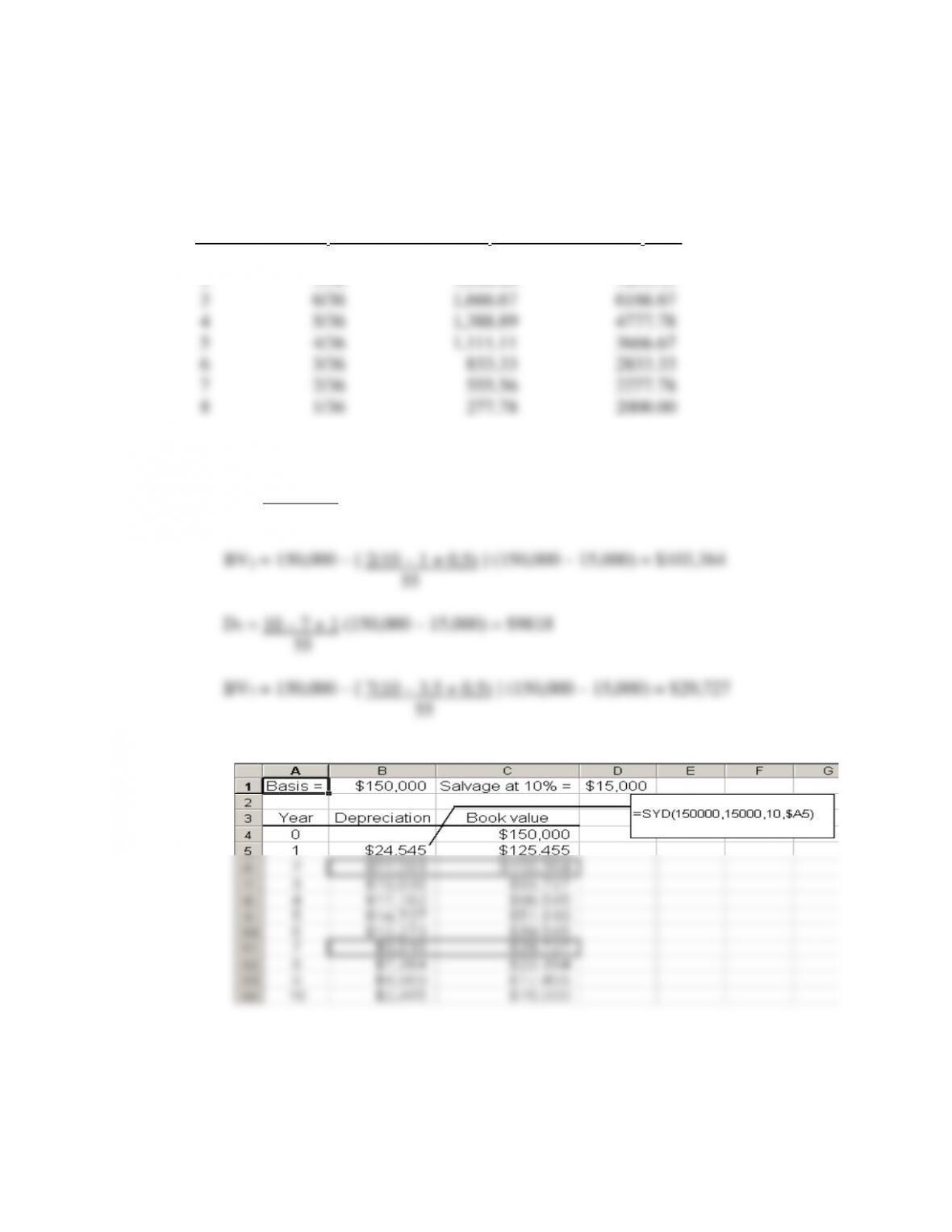
16A.1 The SUM = 36; use SYD rates for (B – S) = €10,000
t dt Dt, € BVt, €__
1 8/36 2,222.22 9777.78
2 7/36 1,944.44 7833.33
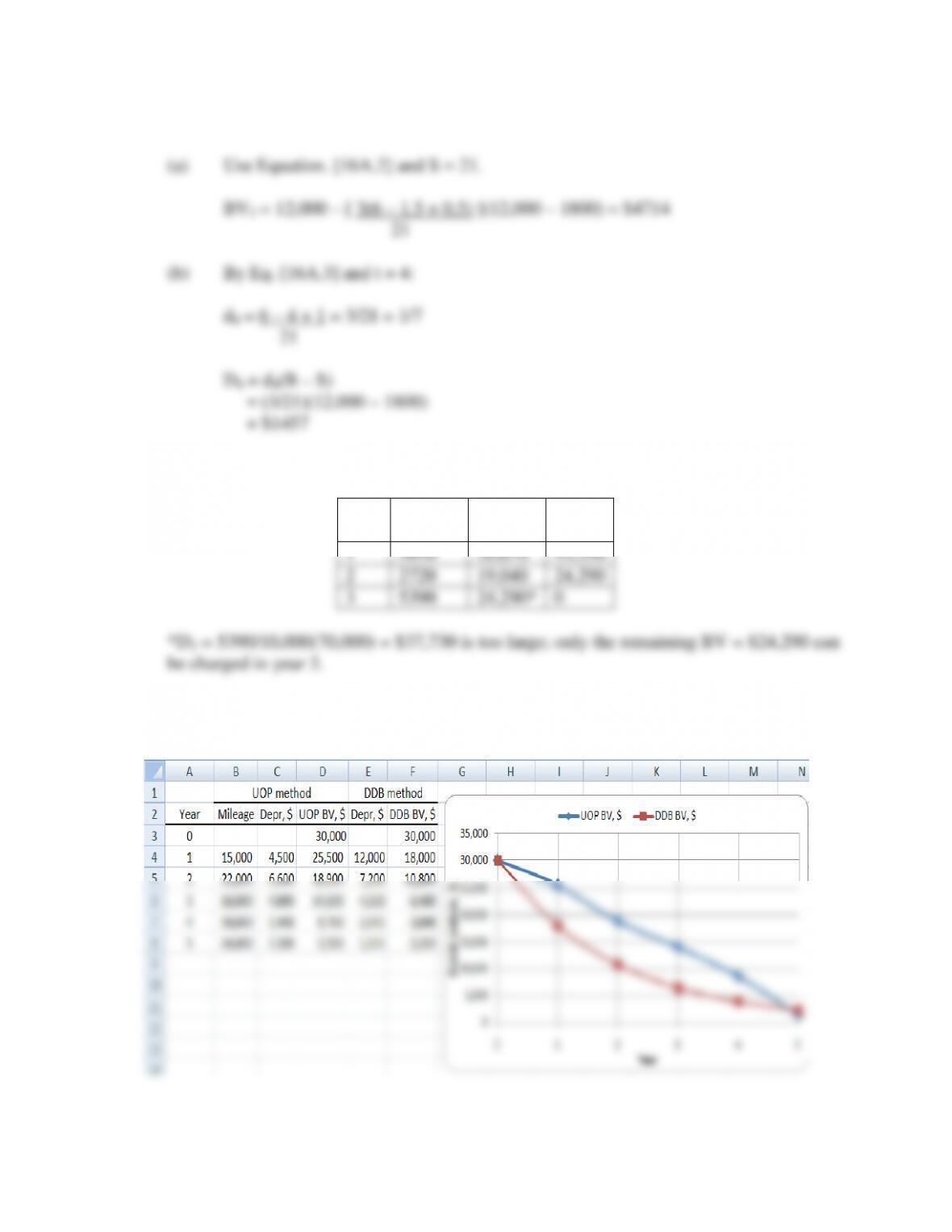
16A.2 (a) B = $150,000; n = 10; S = $15,000 and SUM = 55.
D2 = 10 – 2 + 1 (150,000 – 15,000) = $22,091
55
(b)
17
16A.3 B = $12,000; n = 6 and S = 0.15(12,000) = $1,800
16A.4 Dt = (tests per year t/10,000)(70,000)
Year
t
Number
of tests
Dt, $
BVt, $
1
3810
26,670
43,330
2
2720
19,040
24,290
3
5390
24,290*
0
*D3 = 5390/10,000(70,000) = $37,730 is too large; only the remaining BV = $24,290 can
be charged in year 3.
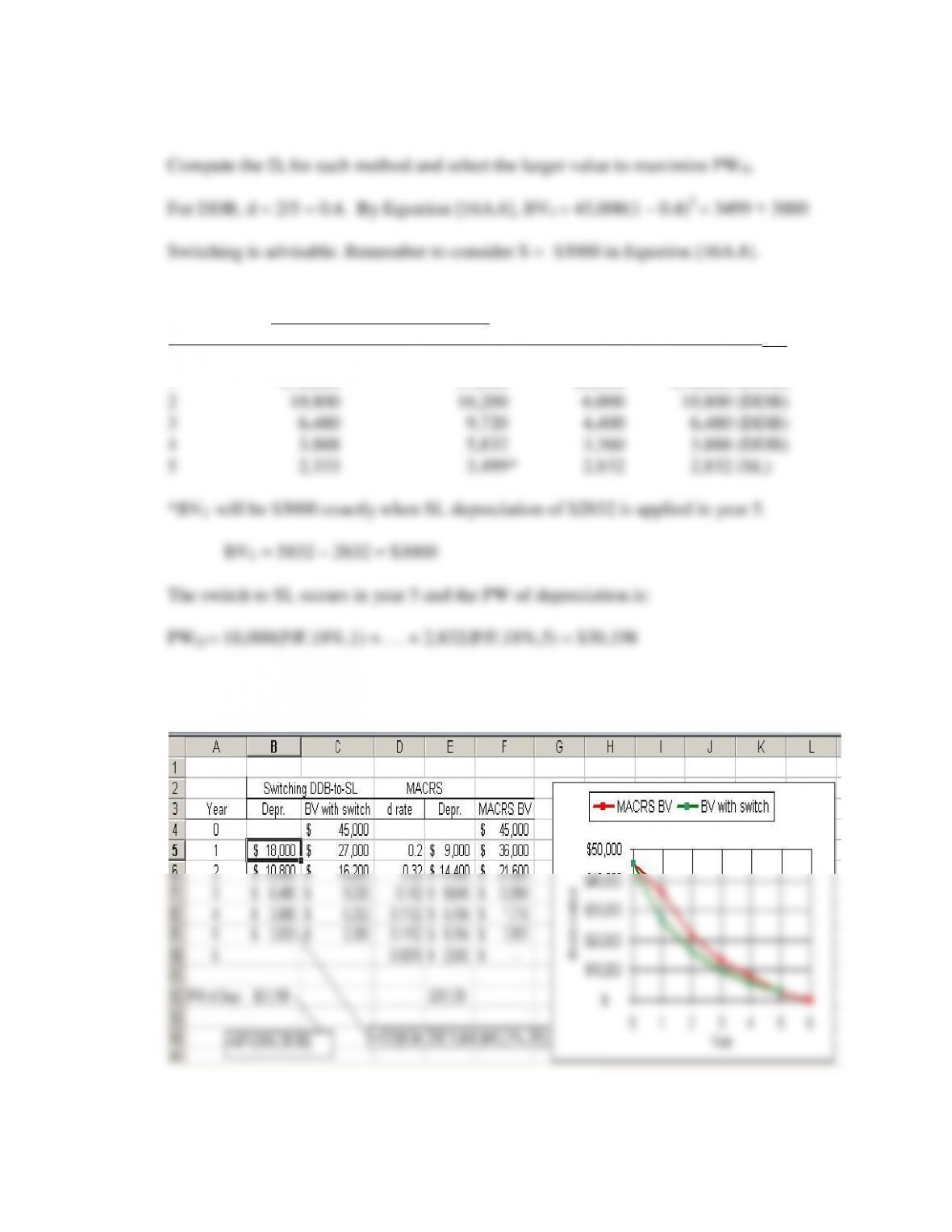
16A.5 Spreadsheet solution is shown using DDB function and Equation [16A.4] for UOP. DDB
method does depreciate faster, but UOP, in this case, did depreciate more of the first cost.
18
16A.6 B = $45,000 n = 5 S = $3000 i = 18%
Switching to
DDB Method SL method Larger
t Eq. [16A.7] BV Eq. [16A.8] Depreciation____
0 $45,000
1 $18,000 27,000 $8,400 $18,000 (DDB)
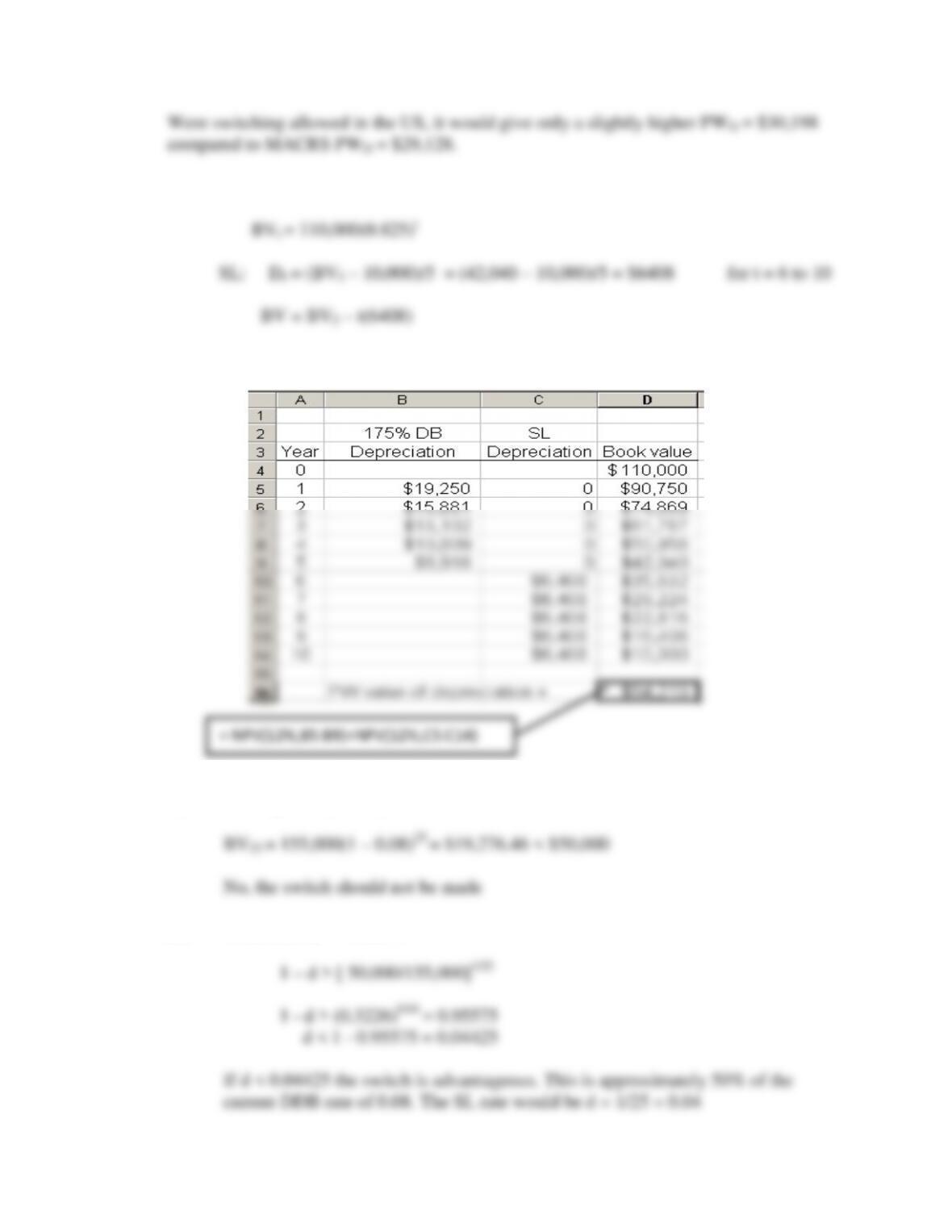
16A.7 Develop a spreadsheet for the DDB–to-SL switch using the VDB function (column B)
and MACRS rates or VDB function, plus PWD for both methods.
19
16A.8 175% DB: d = 1.75/10 = 0.175 for t = 1 to 5
PWD = $64,210 from Column D using the NPV function.
16A.9 (a) Use Equation [16A.6] for DDB with d = 2/25 = 0.08
(b) 155,000(1-d)25 > 50,000
1 – d > [ 50,000/155,000]1/25
1 – d > (0.3226)0.04 = 0.95575
d < 1 – 0.95575 = 0.04425
If d < 0.04425 the switch is advantageous. This is approximately 50% of the
current DDB rate of 0.08. The SL rate would be d = 1/25 = 0.04
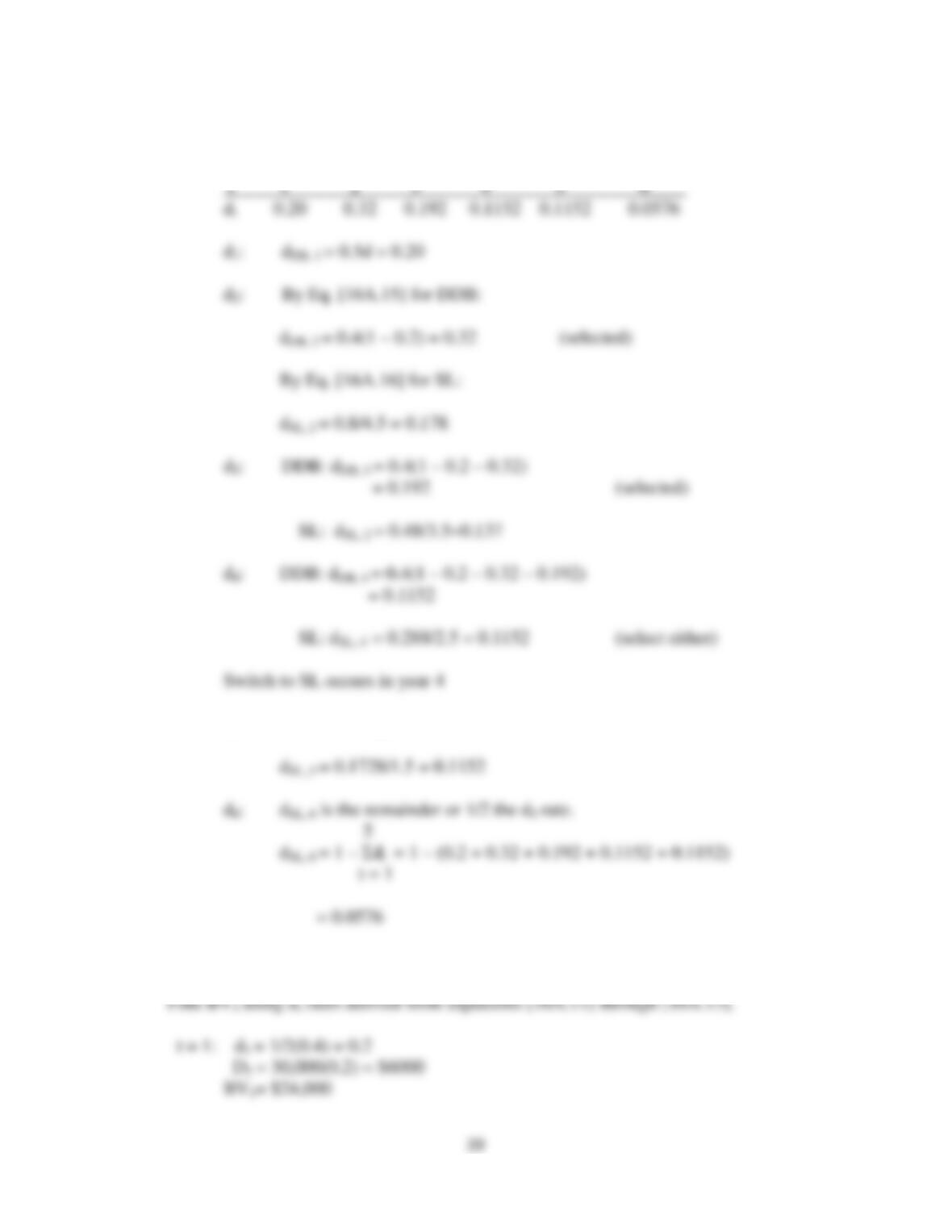
16A.10 Verify that the rates are the following with d = 0.40
d5: Use the SL rate n = 5
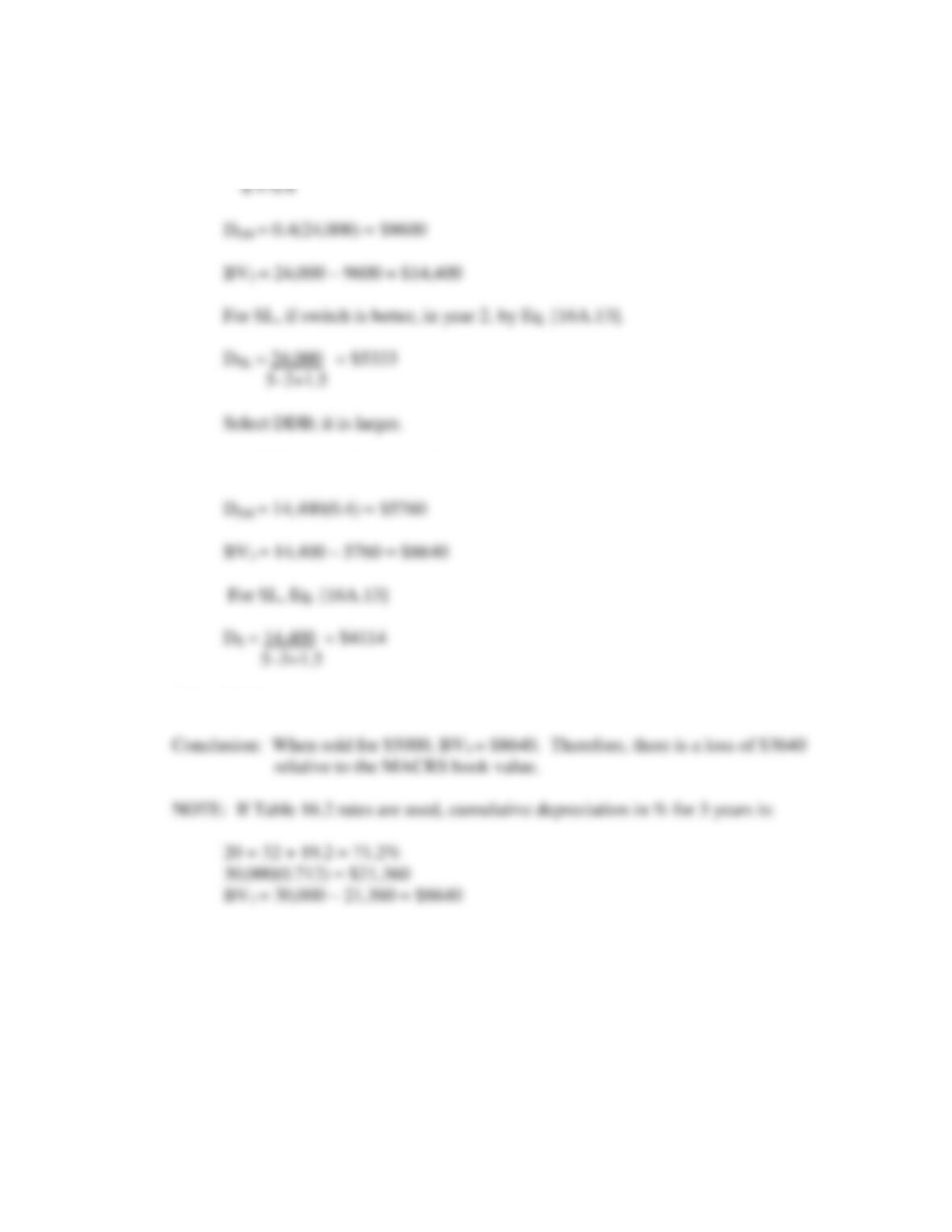
16A.11 B = $30,000 n = 5 years d = 0.40
21
t = 2: For DDB depreciation, use Eq. [16A.12]
t = 3: For DDB, apply Eq. [16A.12] again.
Select DDB.
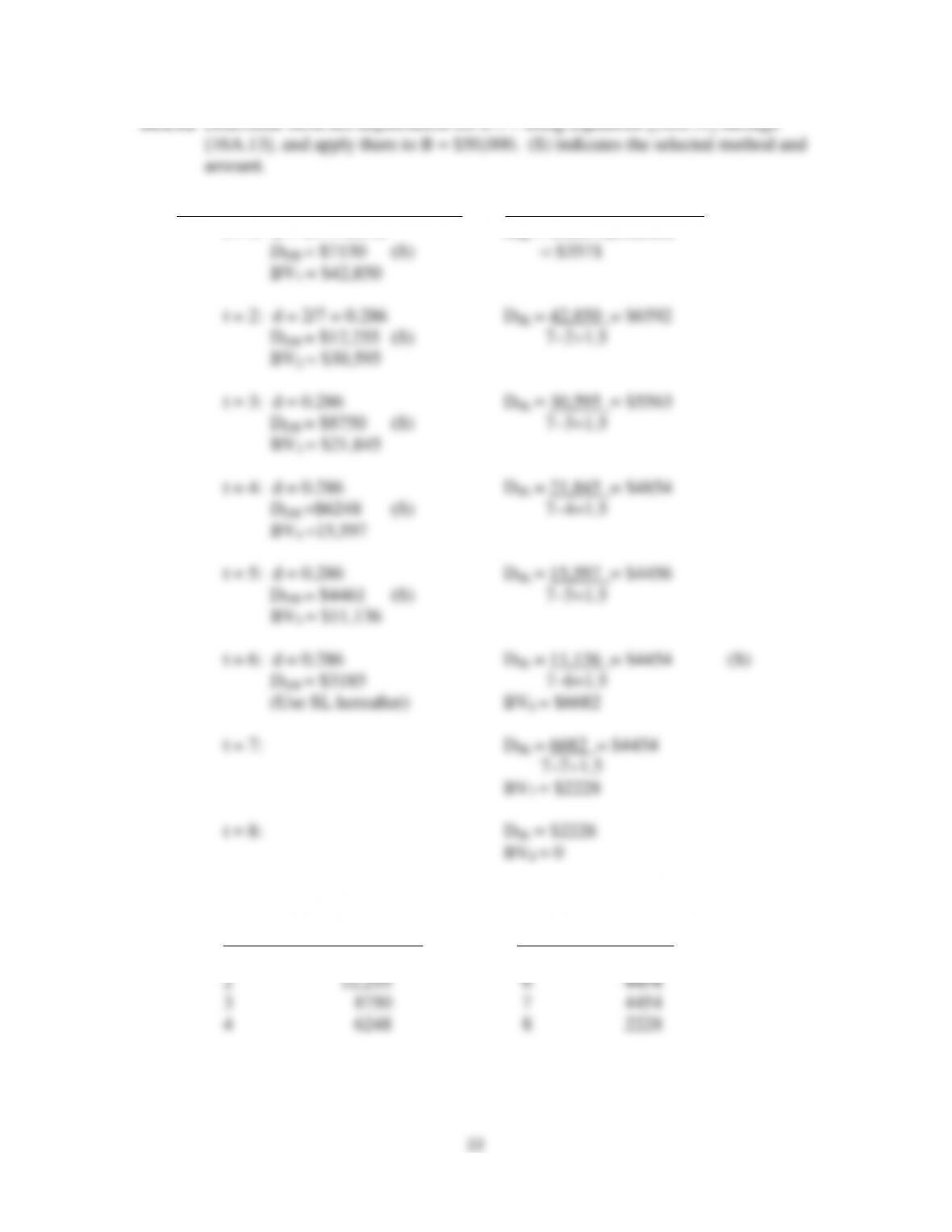
16A.12 Determine MACRS depreciation for n = 7 using Equations [16A.11] through
DDB SL___________
t = 1: d = 1/7 = 0.143 DSL = 0.5(1/7)(50,000)
The depreciation amounts sum to $50,000
Year Depr Year Depr__
1 $ 7150 5 $4461
23
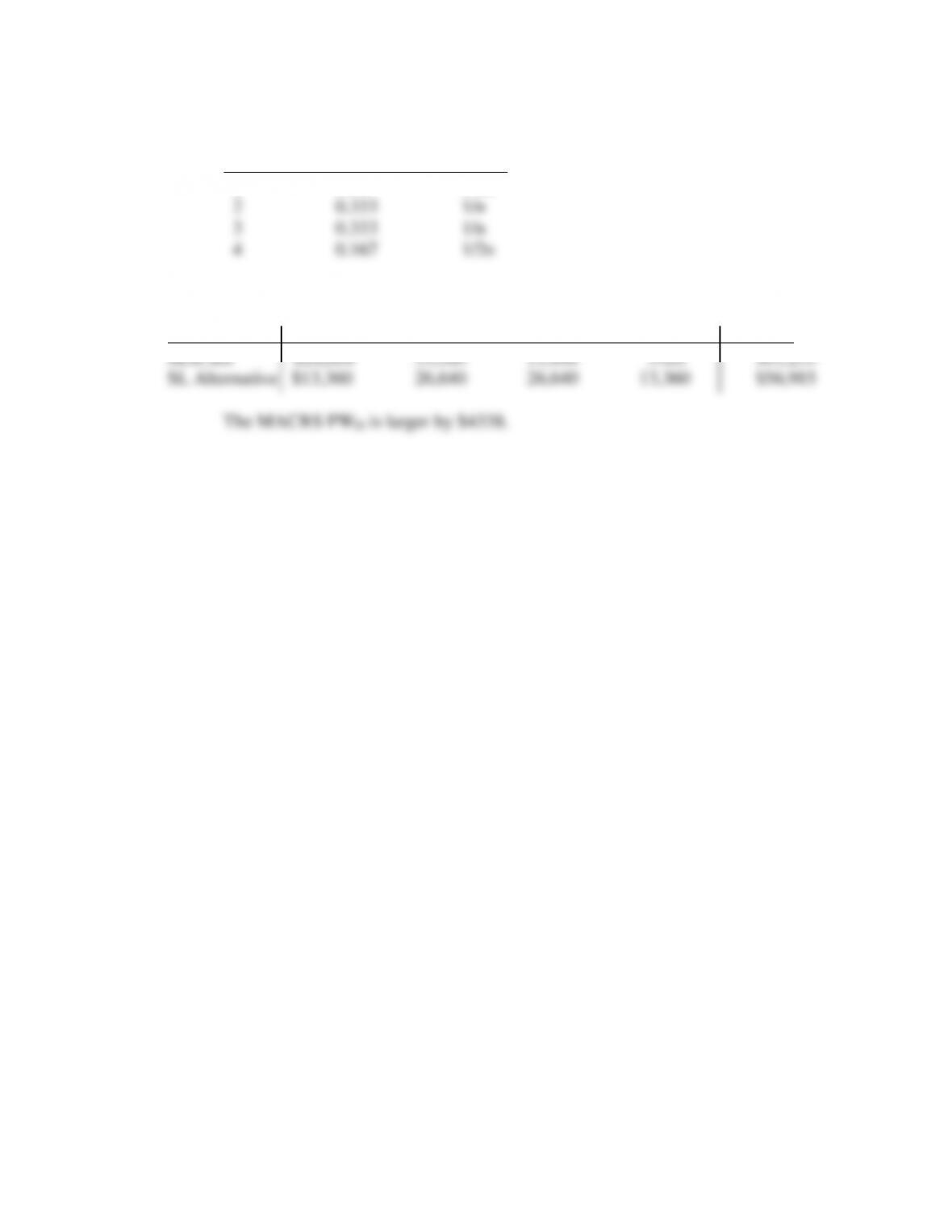
16A.13 (a) The SL rates with the half-year convention for n = 3 are:
Year d rate Formula
1 0.167 1/2n
(b)
t 1 2 3 4 PWD__