Solutions to end–of–chapter problems
Engineering Economy, 7th edition
Leland Blank and Anthony Tarquin
Chapter 15
Cost Estimation
15.2 Supplies: AOC Installation: FC
15.3 Calculate taxes (A), make bids (E), pay bonuses (A), determine profit or loss (A),
15.5 Project staff (D), Audit and legal (I), Utilities (I), Rent (I), Raw materials (D), Equipment
15.6 License plate (indirect), Drivers license (indirect), Gasoline (direct), Highway
toll fee (indirect, since it is usually an option to choose a non-toll route), Oil change
2
15.15 (a) Crew cost per day = 8[25.85 + 28.60 + 5(23.25) + 31.45] = $1617.20
15.16 (a) Cost = 120(21.31 + 5.00) = $3157
15.17 Cost in Texas = 10,500(800)(0.769)
15.18 From Table 15-3, index value in 2001 = 6343; index value in mid-2010 = 8837
15.19 To have index value of 100 in year 2000, must divide by 62.21.
15.20 (a) First find the compounded percentage increase p between 1995 and 2005.
7446 = 5471 (F/P,p,10)
3
15.21 At 1% per month, annual increase = (1 + 0.01)12 -1 = 12.68%
15.22 Let f = inflation rate
(a) f = (8837.38 – 8563.35)/8563.35 = 0.032
15.23 Cost = 194(1461.3/789.6)
15.26 96.55 = (Cost in 1913)(2708.51/100)
15.27 (a) 40,000 = 21,771(F/P,2.68%,n)
15.29 (a) Cost = 28,000[(125/200)0.69
4
15.30 C2 = 13,000(500/4)0.37
15.32 Use the six-tenths model; exponent = 0.60
15.33 1.52C1 = C1(68/30)x
15.34 Area of 12” pipe = π(1)2/4
15.35 Use Equation [15.4] and Table 15-3
15.37 Let C1 = cost in 1998; From Table 15-3, M & S index values are 1061.9 in
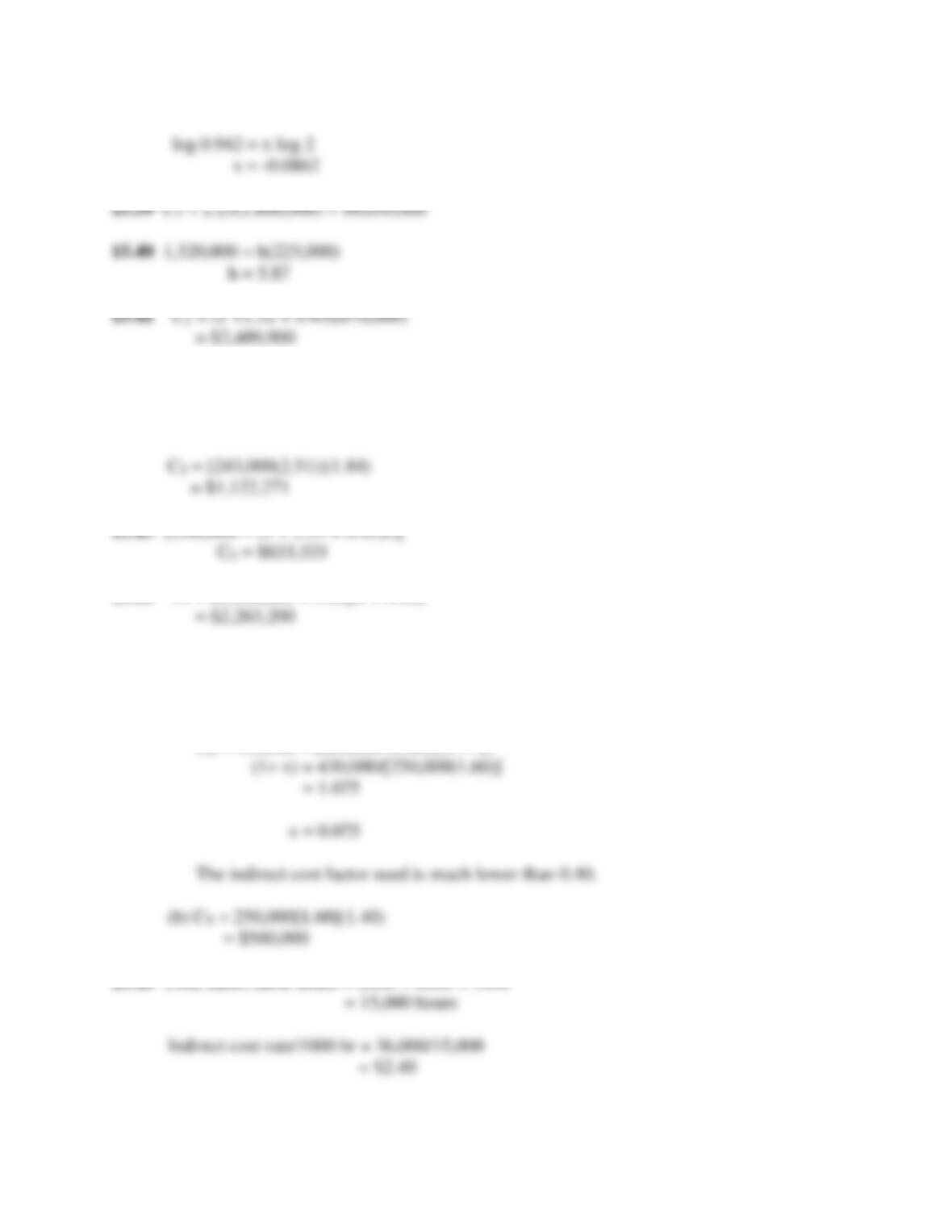
15.38 C2 = 0.942C1 = C1(2)x
5
15.42 First find direct cost; then multiply by indirect cost factor:
h = 1 + 1.28 + 0.23 = 2.51
15.44 CT = [400,000(1 + 3.1)][1 + 0.38]
15.45 (a) h = 1 + 0.30 + 0.30 = 1.60
Let x be the indirect cost factor
CT = 430,000 = [250,000 (1.60)] (1 + x)
15.46 Total direct labor hours = 2000 + 8000 + 5000
6
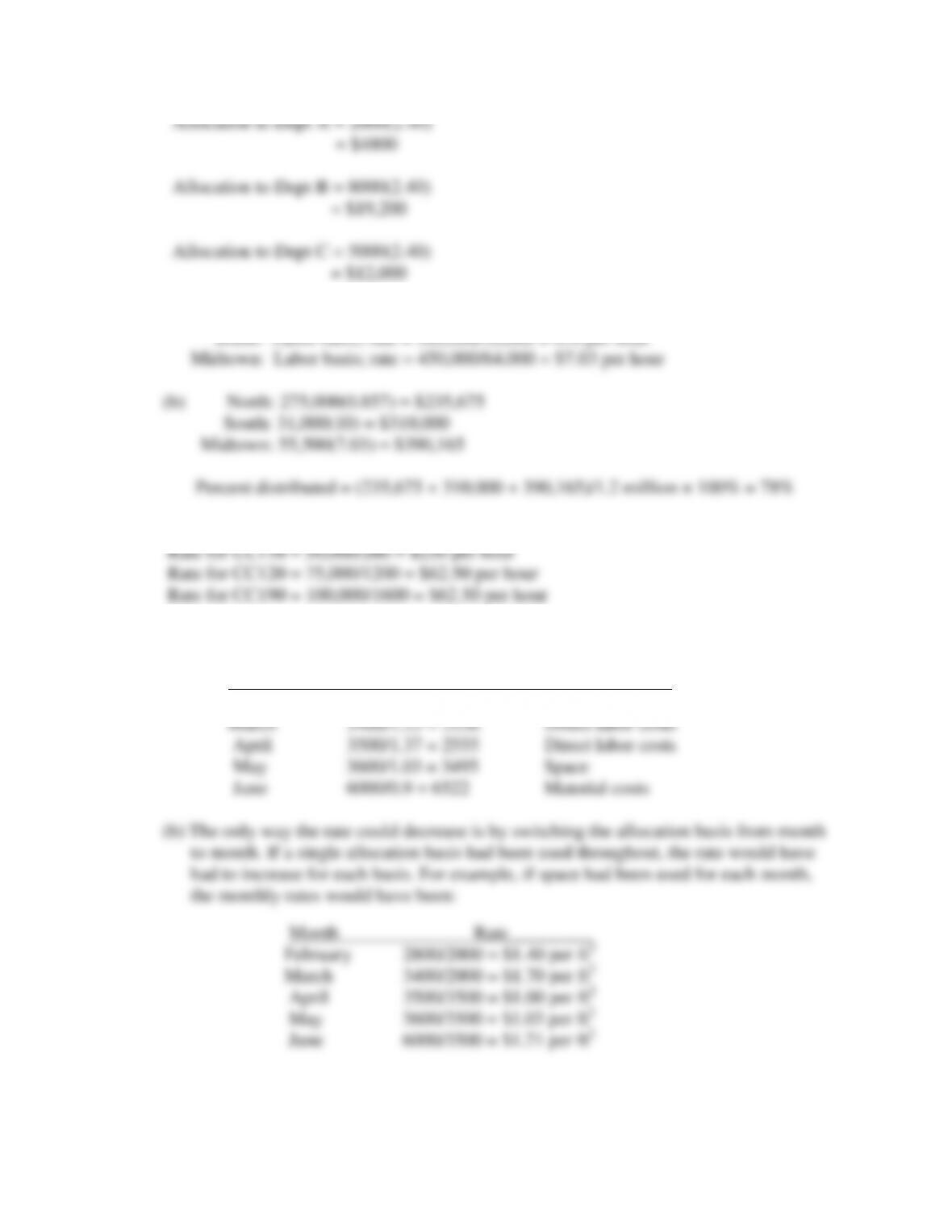
15.47 (a) North: Miles basis; rate = 300,000/350,000 = 0.857 per mile
South: Labor basis; rate = 200,000/20,000 = $10 per hour
15.48 Rate for CC100 = 25,000/800 = $31.25 per hour
15.49 (a) From Equation [15.8], estimated basis level = total costs allocated/rate
Month Basis Level Basis__________
February 2800/1.40 = 2000 Space
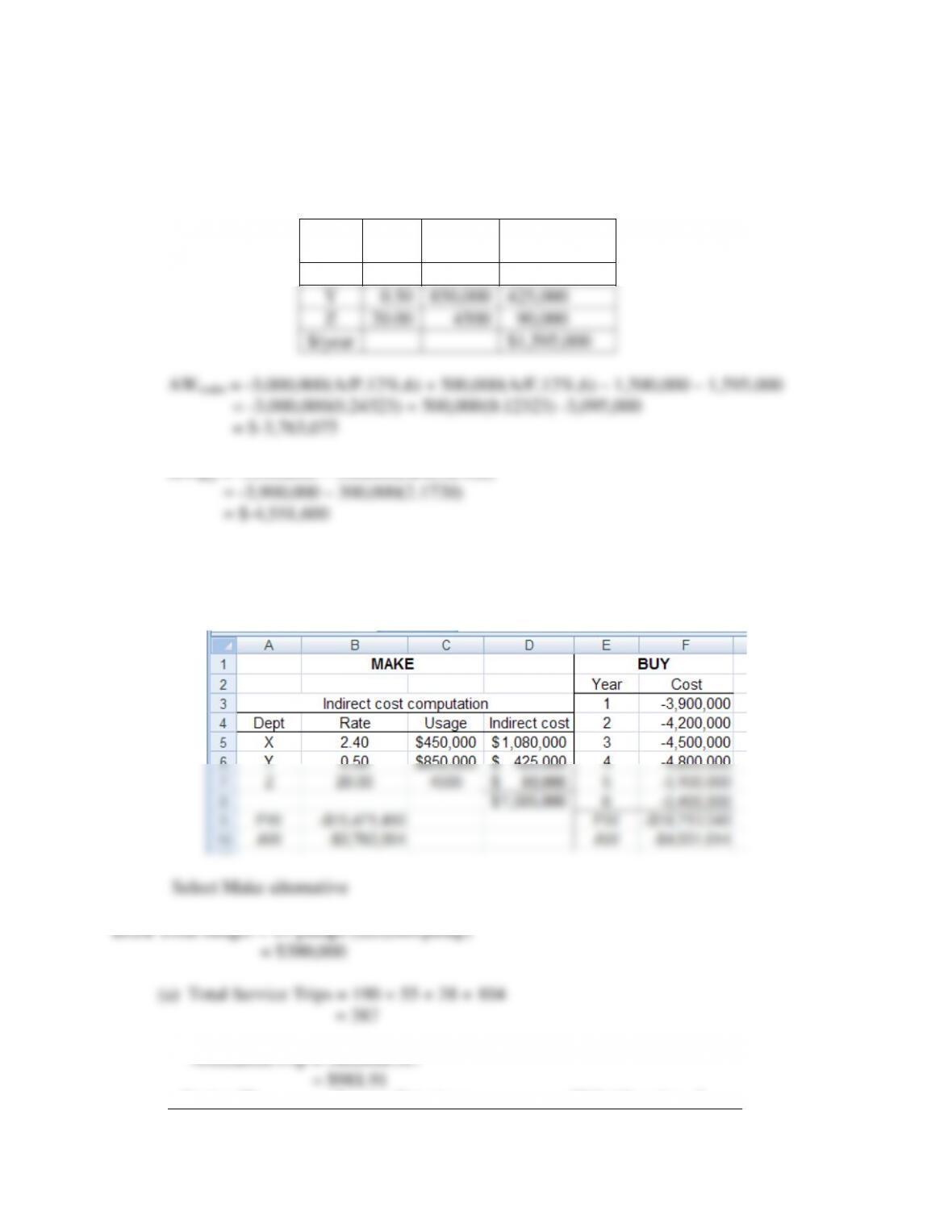
15.50 Determine AW for Make and Buy alternatives. Make has annual indirect costs.
7
Hand solution:
Make: Indirect cost computation
Dept
Rate
(1)
Usage
(2)
Annual cost
(3) = (1)(2)
X
$2.40
450,000
$1.08 million
Y
0.50
850,000
425,000
Z
20.00
4500
90,000
$/year
$1,595,000
AWbuy = -3,900,000 – 300,000(A/G,12%,6)
Select Make alternative
Spreadsheet solution:
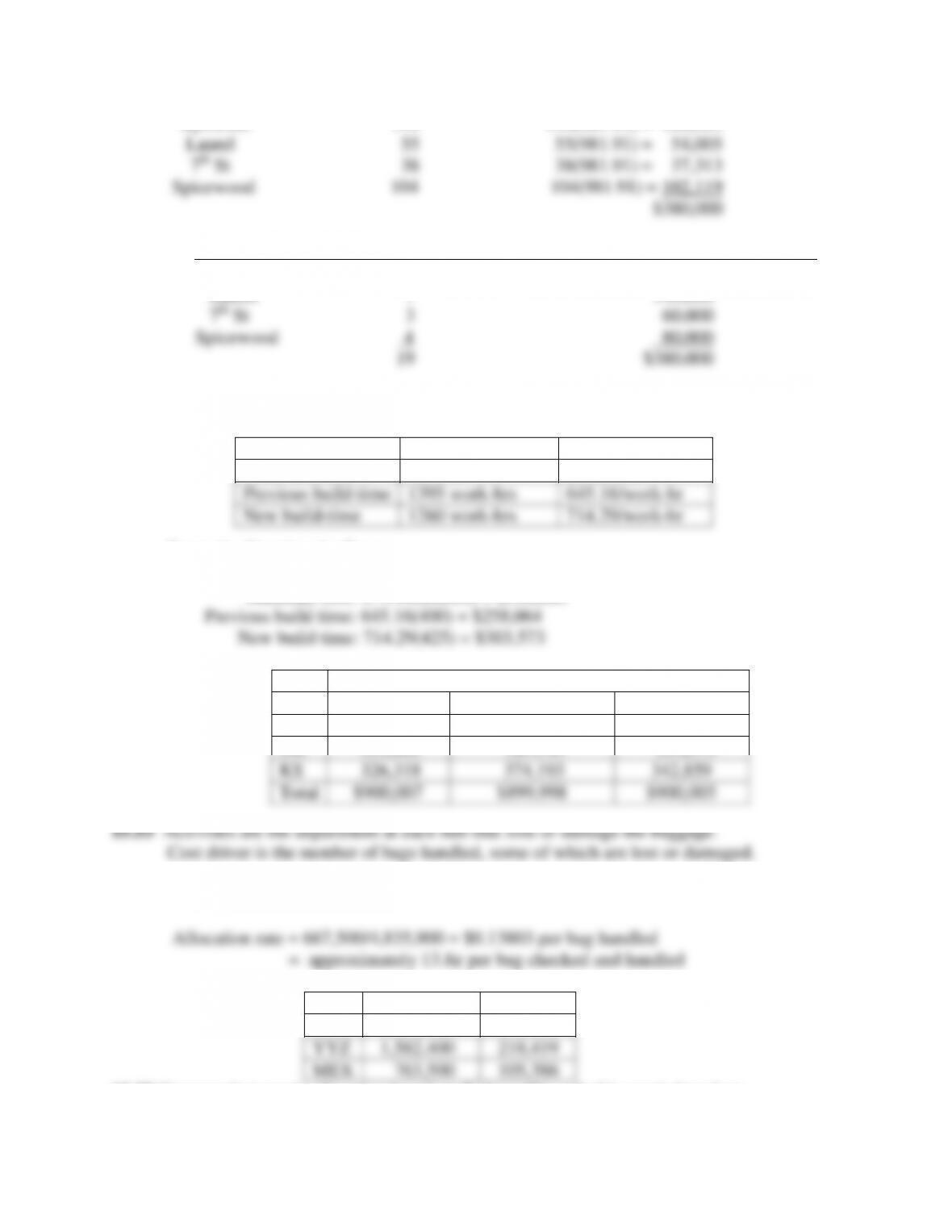
Station ID Service Trips/year IDC Allocation, $____
8
Sylvester 190 190(981.91) = 186,563
(b) Station ID Number of pumps Allocation at $20,000/pump____
Sylvester 5 100,000
Laurel 7 140,000
15.52 Determine the rates by basis, then distribute the $900,000.
Previous build-time
1395 work-hrs
645.16/work-hr
New build–time
1260 work-hrs
714.29/work-hr
Example allocation for Texas:
Materials cost: 17.544(20,000) = $350,880
Allocation by each basis
Materials cost
Previous build-time
New build–time
TX
$350,880
$258,064
$303,573
OK
222,809
267,741
253,573
KS
326,318
374,193
342,859
Total
$900,007
$899,998
$900,005
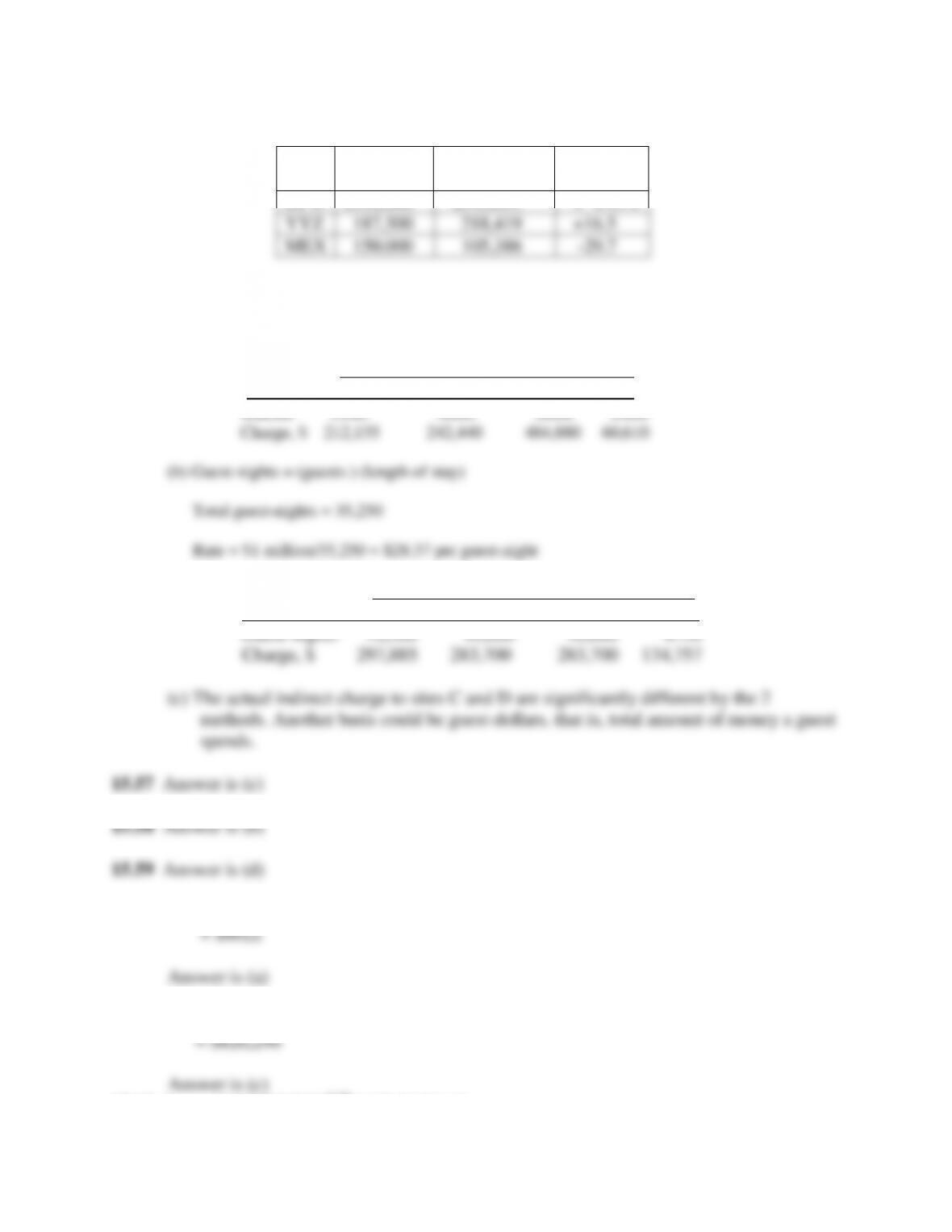
15.54 Total bags handled = 4,835,900
Bags handled
Allocation
DFW
2,490,000
$343,695
YYZ
1,582,400
218,419
MEX
763,500
105,386
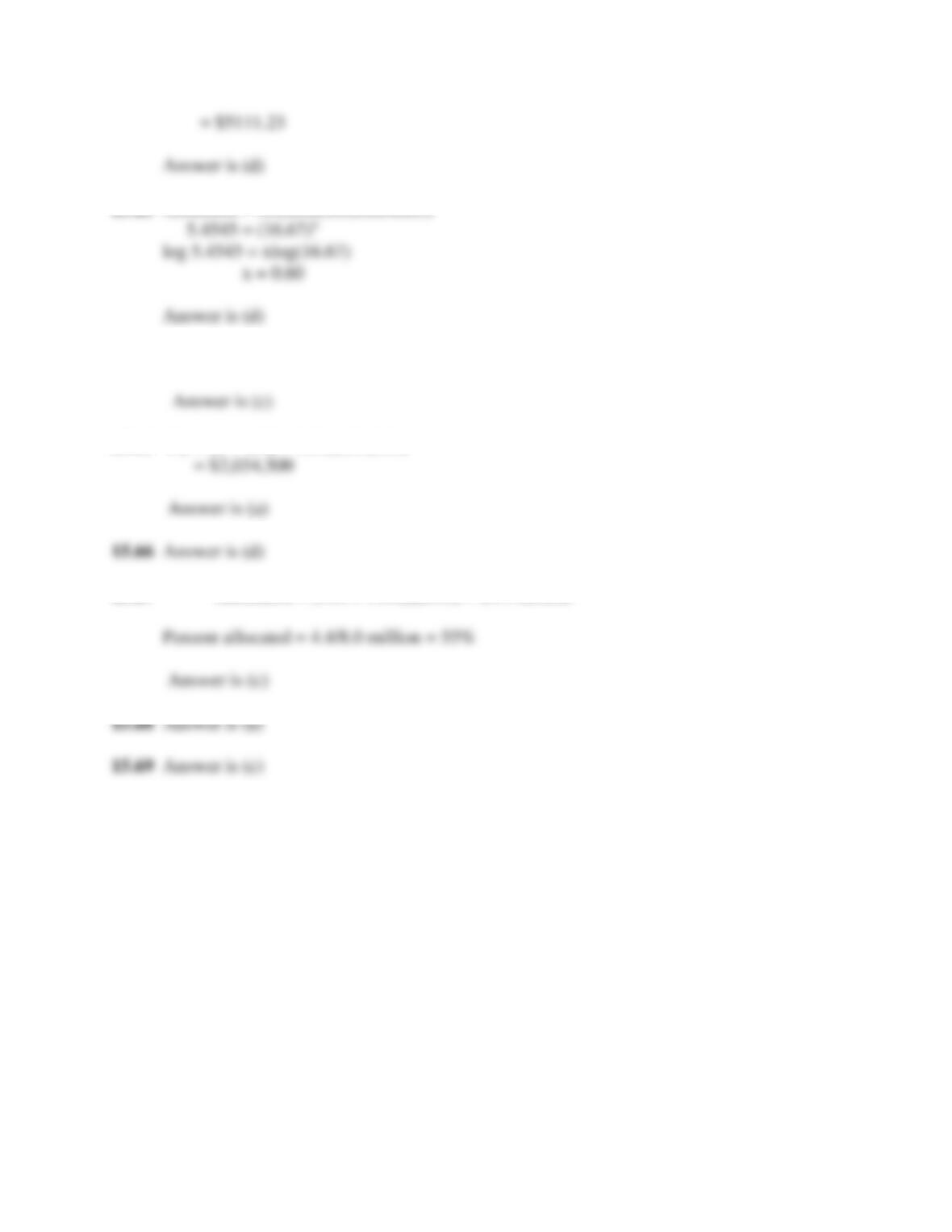
15.55 Compare last year’s allocation based on flight traffic with this year’s based on
Total usage
Rate
Materials cost
$51,300
$17.544/$
9
baggage traffic. Significant change took place, especially at MEX.
15.56 (a) Rate = $1 million/16,500 guests = $60.61 per guest
Charge = number of guests × rate
Site_____________
A B C D
Guests 3500 4000 8000 1000
Site_________________
A B C D__
15.60 Cost = 2100(200/50)0.76
15.61 Cost = 500,000(5542.16/3378.17)
15.62 Cost = 3000(500/250)0.32(1449.3/1061.9)
Last year;
flight basis
This year;
baggage basis
Percent
change
DFW
$330,000
$343,695
+ 4.15%
YYZ
187,500
218,419
+16.5
150,000
105,386
-29.7
10
15.63 3,000,000 = 550,000(100,000/6000)x
15.64 CT = 2.96(390,000) = $1,154,400
15.65 CT = (1 + 1.82 + 0.31)(650,000)
15.67 Allocation = (900 + 1300)(2000) = $4.4 million
11
Solution to First Case Study, Chapter 15
There is not always a definitive answer to case study exercises. Here are example responses
INDIRECT COST ANALYSIS OF MEDICAL EQUIPMENT
MANUFACTURING COSTS
1. DLH basis
Standard: rate = $1.67 million = $8.91/DLH
Premium: rate = $3.33 million = $26.64/DLH
(Note: un = unit)
Price,
IDC DLH IDC Direct Direct Total ~1.10 ×
Model rate hours allocation material Labor cost cost__
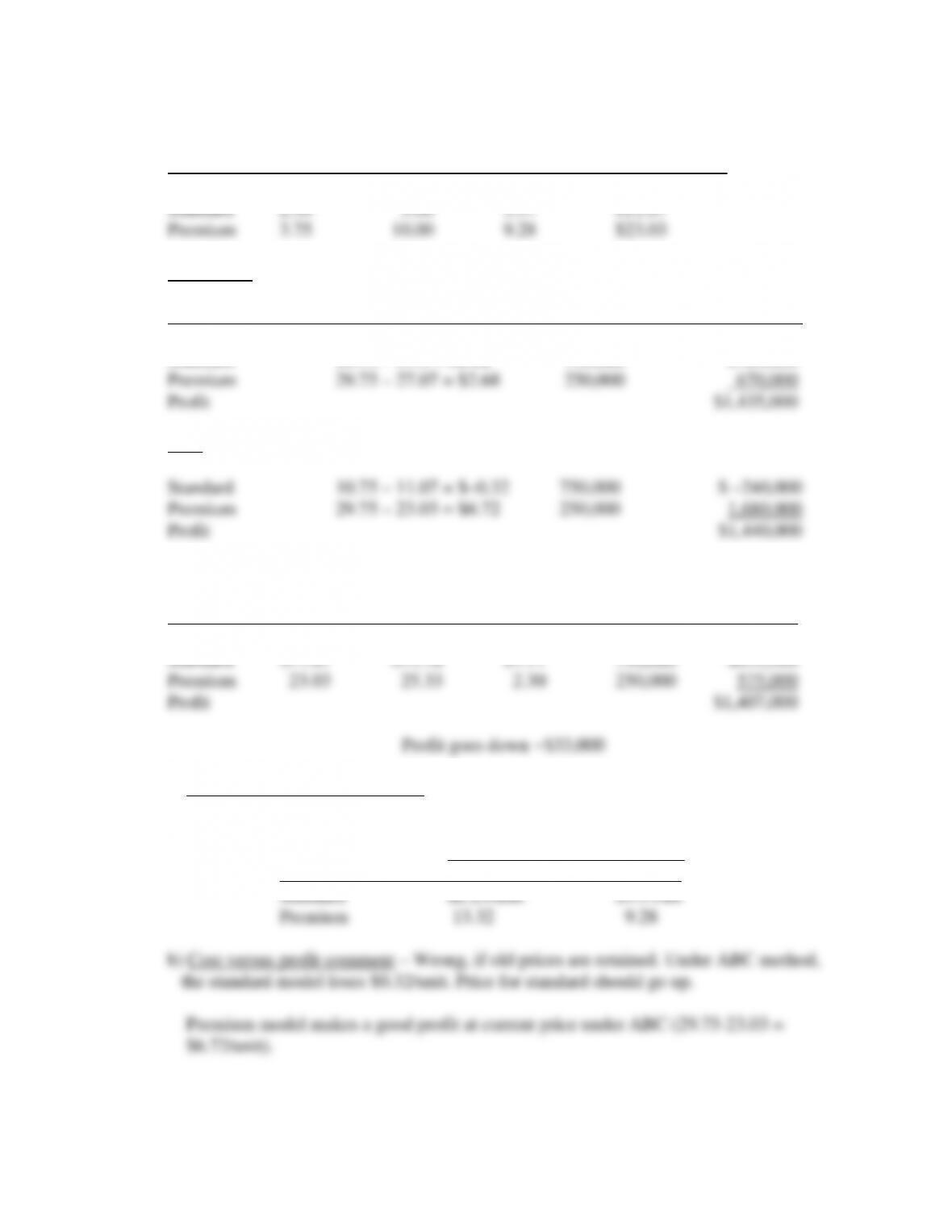
2. Cost Volume Total ABC
Activity Driver of driver cost/year IDC rate
Quality Inspections 20,000 $800,000 $40/inspection
Purchasing Orders 40,000 1,200,000 30/order
ABC allocation
_____Standard__________ ________Premium_________
Driver Volume×rate IDC allocation Volume×rate IDC allocation
Quality 8,000×40 $320,000 12,000×40 $480,000
12
Direct Direct IDC Total
Model material labor allocation cost
3. Traditional
Model Profit/unit Volume Profit__
Standard 10.75 – 9.73 = $1.02 750,000 $765,000
ABC
4. Price at Cost + 10%
Model Cost Price Profit/unit Volume Profit___
5. a) Prediction about IDC allocation – The manager was right on IDC allocation under
ABC, but totally wrong on traditional where the cost is ~ 1/3 and IDC is ~1/6.
_______Allocation__________
Model Traditional ABC___

13
c) Premium require more activities and operations comment
Wrong : Premium model is lower in cost driver volume for purchase orders and