1
Solutions to end–of–chapter problems
Engineering Economy, 7th edition
Leland Blank and Anthony Tarquin
Chapter 12
Independent Projects With Budget Limitation
12.1 Bundle: a collection of independent projects
12.2 Two assumptions are:
(1) The funds invested in every project will remain invested for the period of the longest
lived project, and
12.4 There are a total of 24 = 16 possible bundles. No bundle with X and Y are listed; 12 remain.
12.5 (a) There are a total of 25 = 32 possible bundles; only 5 are within a budget constraint of
$34,000.
Total PW of
Bundle Investment, $
P 6,000
M 11,000
2
12.6 There are 24 = 16 possible bundles. Considering the selection restrictions, the 9 viable
bundles are:
DN 4 34
12.7 There are 24 = 16 possible bundles. Considering the selection restriction and the $400
limitation, the viable bundles are:
Projects Investment
DN $ 0
12.8 Select the bundle with the highest positive PW value that do not violate the budget
(b) Of 24 = 16 bundles, list acceptable bundles and PW values. Select project 4 with highest
PW of $9600.
12.10 Sample calculations: PWI = -25,000 + 6000(P/A,15%,4) + 4000(P/F,15%,4)
= -25,000 + 6000(2.8550) + 4000(0.5718)
Bundle
Investment
PW
DN
0
0
2
$-25,000
$ 8,500
3
Bundle Proposals PW at 15%, $
1 I -5583
2 II -4877
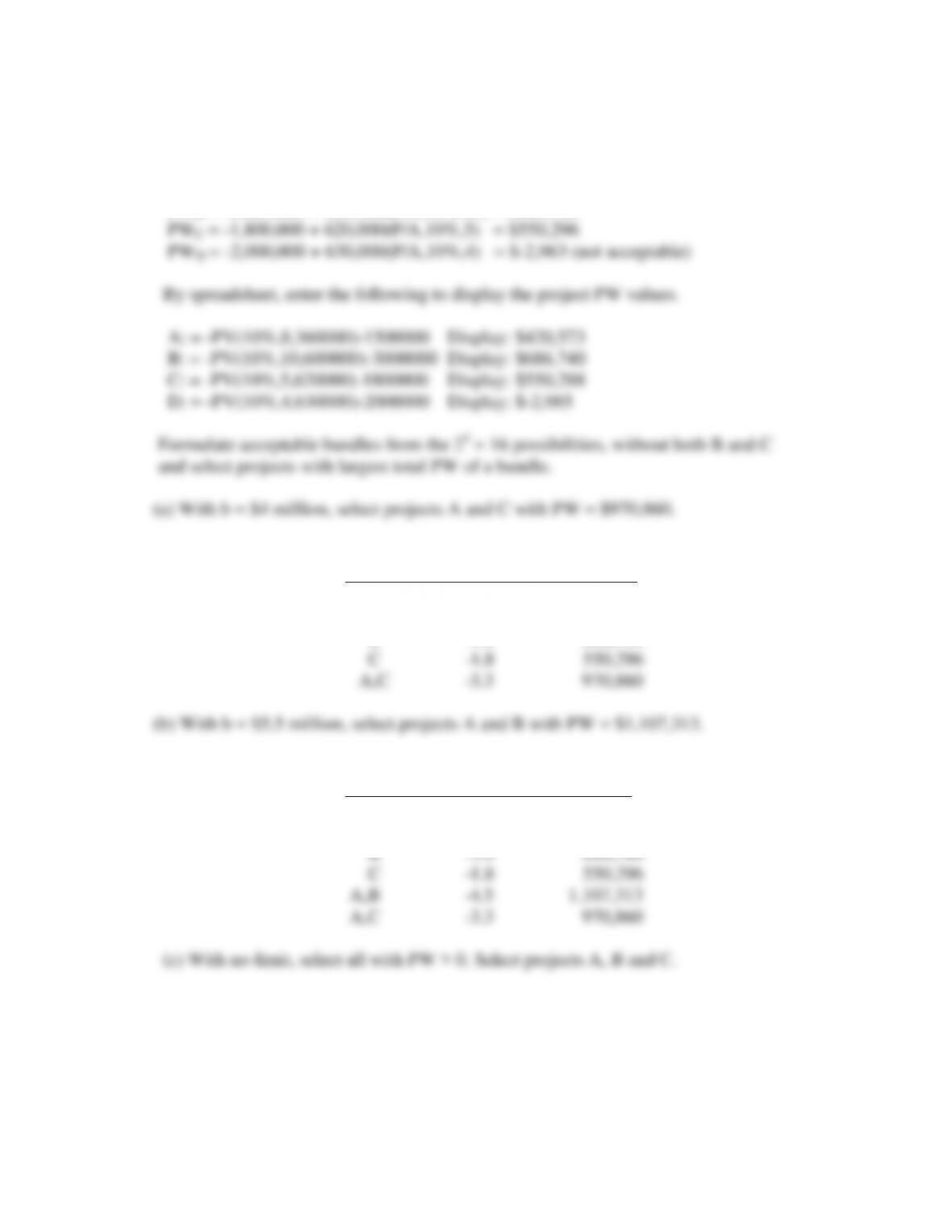
12.11 (a) Hand solution:
Sample calculation: PWA,B = -45,000 + 15,000(P/A,15%,4)
Bundle Proposals PW at 15%, $
1 A -5583
2 B +5695
(b) Spreadsheet solution: Same result; select B and C.
4
12.12 Determine the PW for each project.
PWA = -1,500,000 + 360,000(P/A,10%,8) = $420,564
PWB = -3,000,000 + 600,000(P/A,10%,10) = $686,760
Investment
Bundle $ Million PW, $
DN 0 0
A -1.5 420,564
B -3.0 686,760
Investment
Bundle $ Million PW, $
DN 0 0
A -1.5 420,564
5
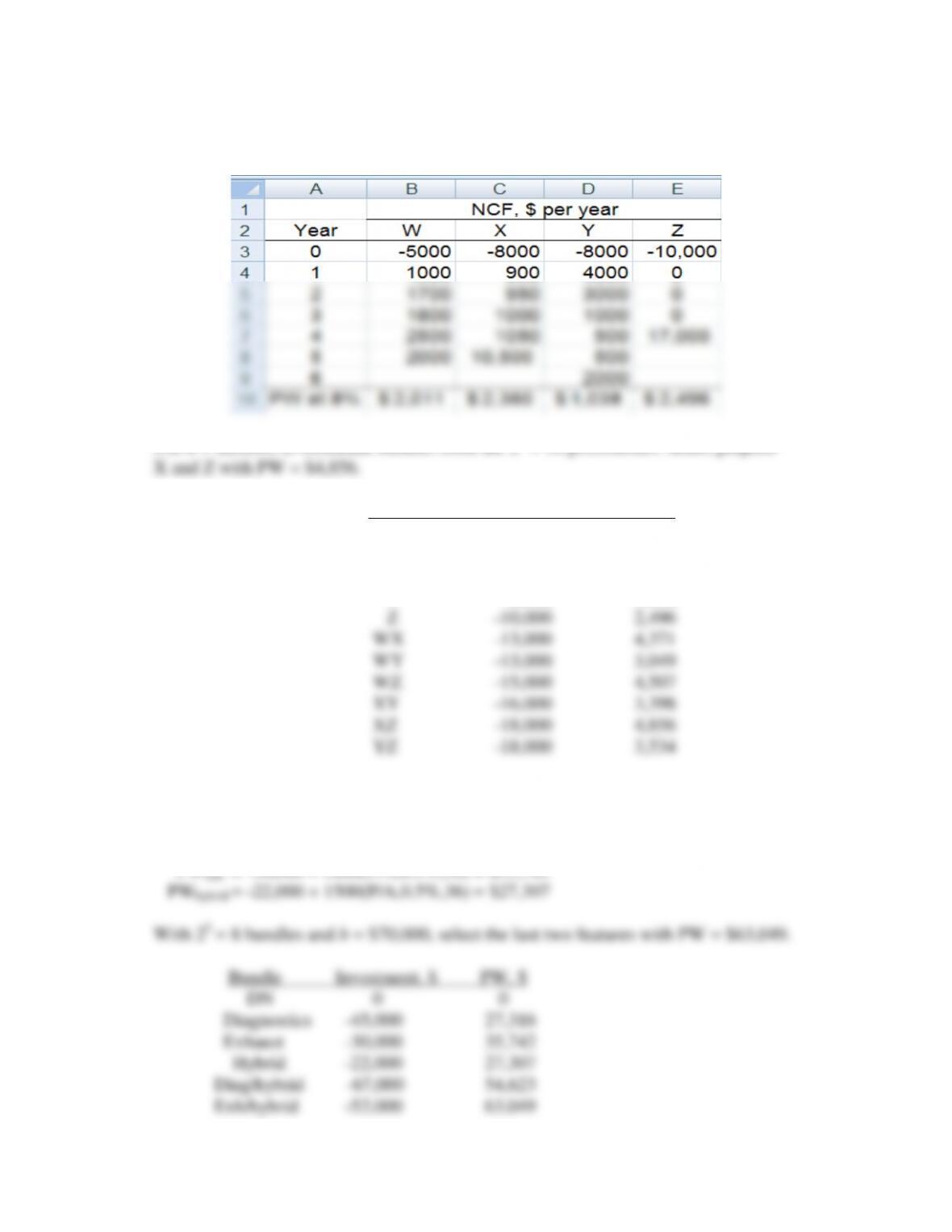
12.13 Hand calculate each project’s PW using P/F factors since all NCF are different each year.
Alternatively, use a spreadsheet.
Use b = $20,000 to formulate bundles from the 24 = 16 possibilities. Select projects
Bundle Investment, $ PW, $
DN 0 0
W -5,000 2,011
X -8,000 2,360
Y -8,000 1,038
12.14 Determine PW values at 0.5% per month by spreadsheet using the PV function
= -PV(0.5%,36,revenue) – cost, or by hand, as follows.
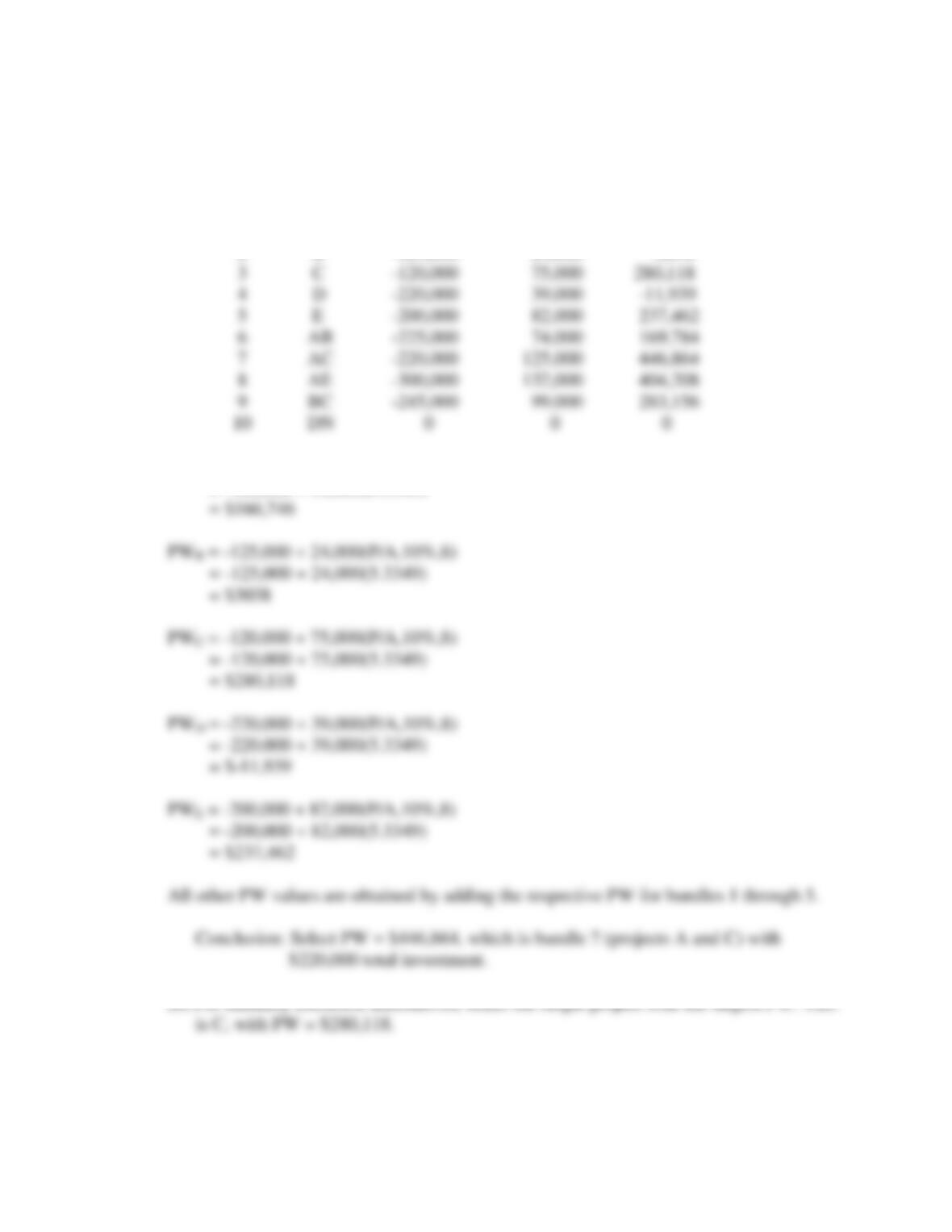
PWdiag = -45,000 + 2200(P/A,0.5%,36) = $27,316
PWexh = -30,000 + 2000(P/A,0.5%,36) = $35,742
6
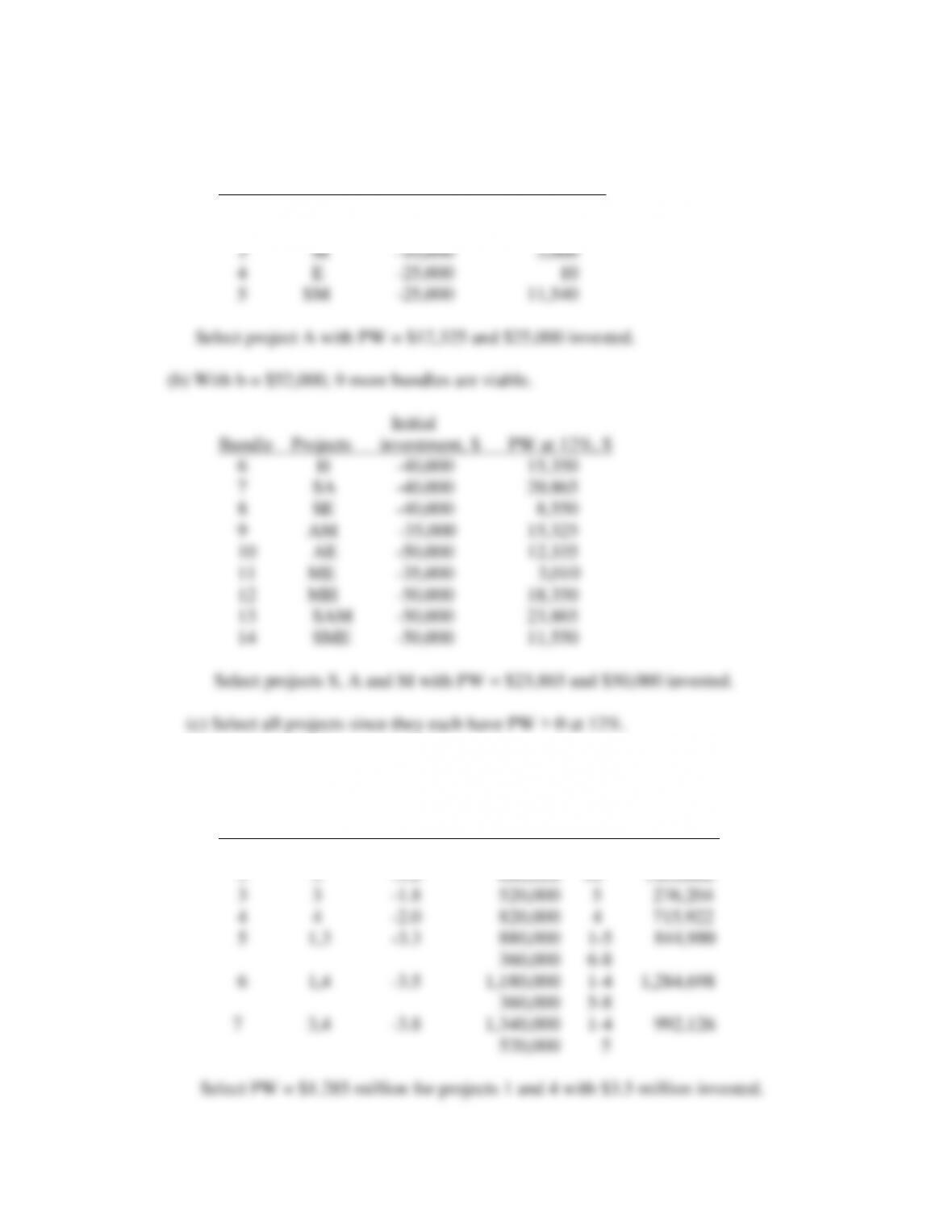
12.15 (a) Develop the bundles with up to $315,000 investment, and select the one with the
largest PW value.
Initial NCF,
Bundle Projects investment, $ $ per year PW at 10%, $
1 A -100,000 50,000 166,746
2 B -125,000 24,000 3,038
PWA = -100,000 + 50,000(P/A,10%,8)
= -100,000 + 50,000(5.3349)
(b) For mutually exclusive alternatives, select the single project with the largest PW. This
7
12.16 (a) For b = $30,000 only 5 bundles are viable of the 32 possibilities.
Initial
Bundle Projects investment, $ PW at 12%, $
1 S -15,000 8,540
2 A -25,000 12,325
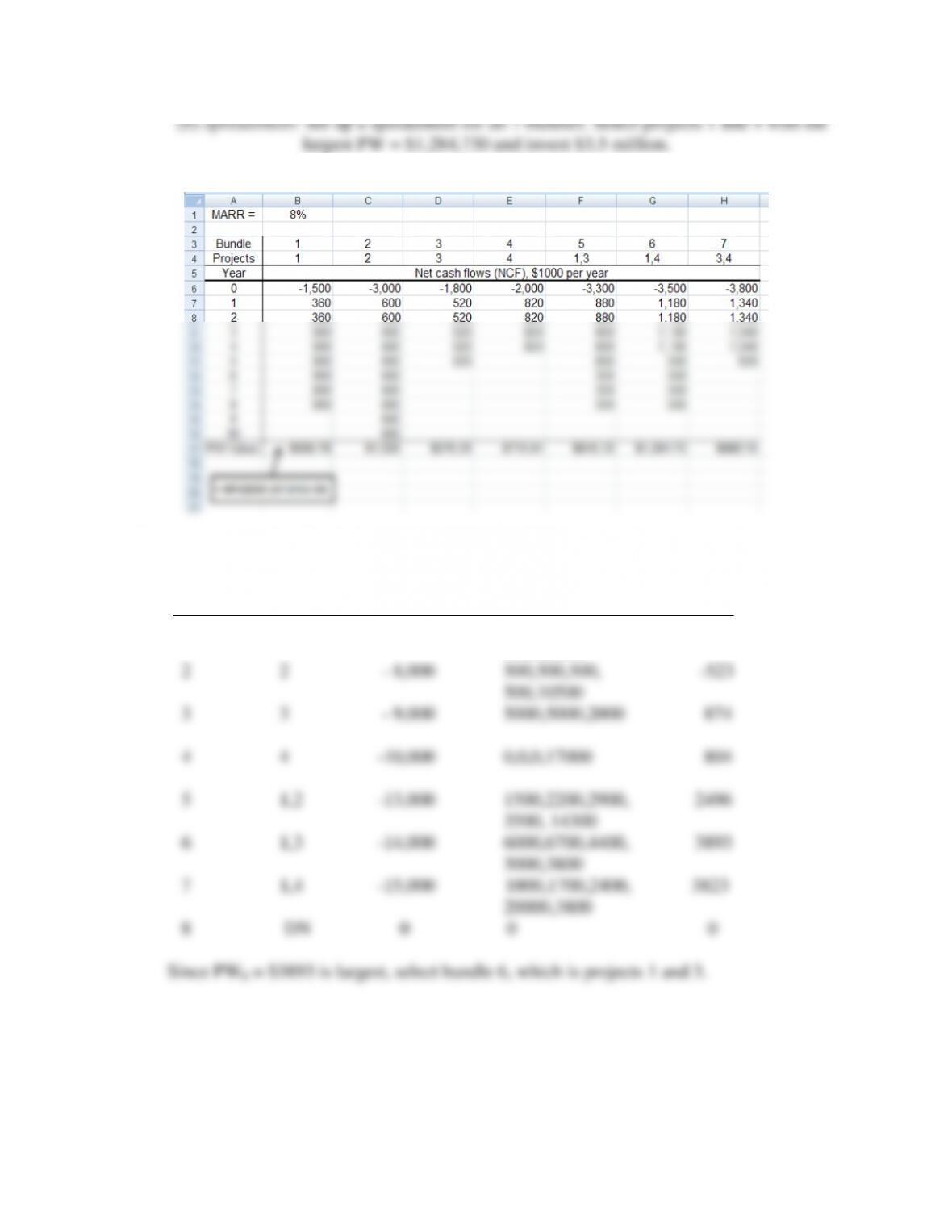
12.17 (a) Hand: The bundles and PW values are determined at MARR = 8% per year.
Initial NCF, Life, PW at
Bundle Projects Investment, $M $ per year years 8%, $__
1 1 -1.5 360,000 8 568,776
8
12.18 Budget limit b = $16,000 MARR = 12% per year
NCF for PW at
Bundle Projects Investment years 1-5, $ 12%, $_
1 1 $-5,000 1000,1700,2400, 3019
3000,3800
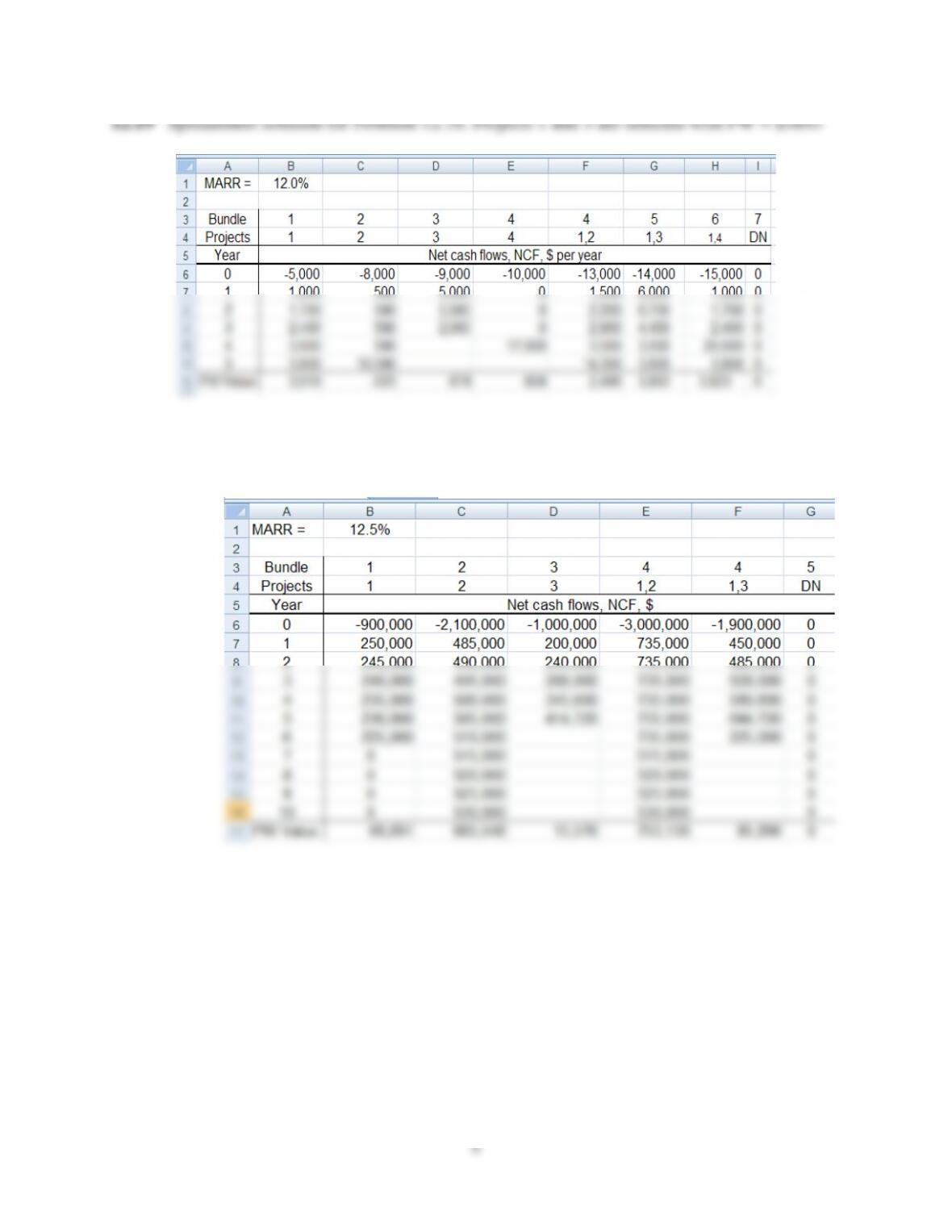
12.20 (a) Spreadsheet shows the solution. Select projects 1 and 2 for an investment of $3.0
million and PW = $753,139.
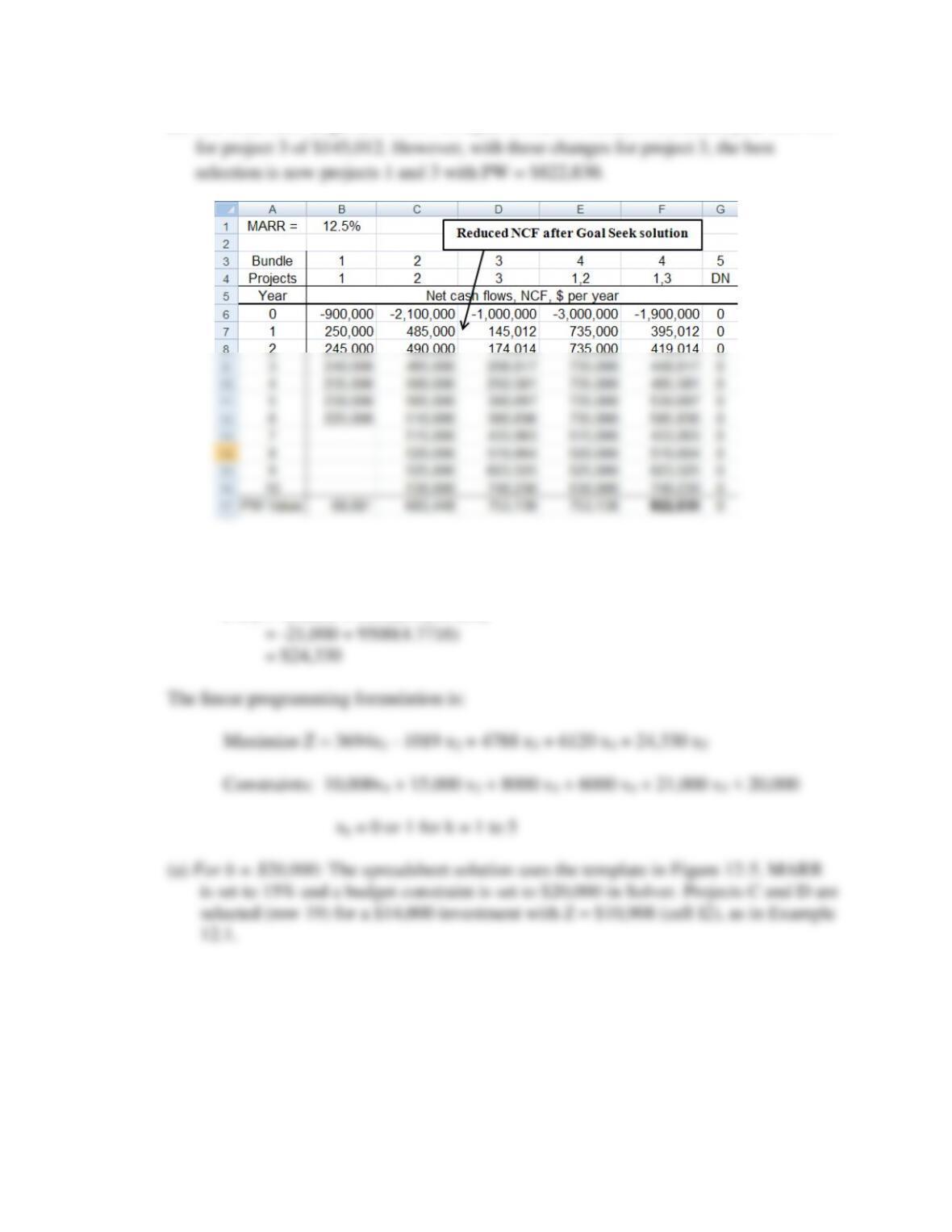
10
(b) The Goal Seek target cell is D17 to equal $753,139. Result is a reduced year-one NCF
12.21 To develop the 0-1 ILP formulation, first calculate PWE, since it was not included
in Table 12-2. All amounts are in $1000.
PWE = -21,000 + 9500(P/A,15%,9)
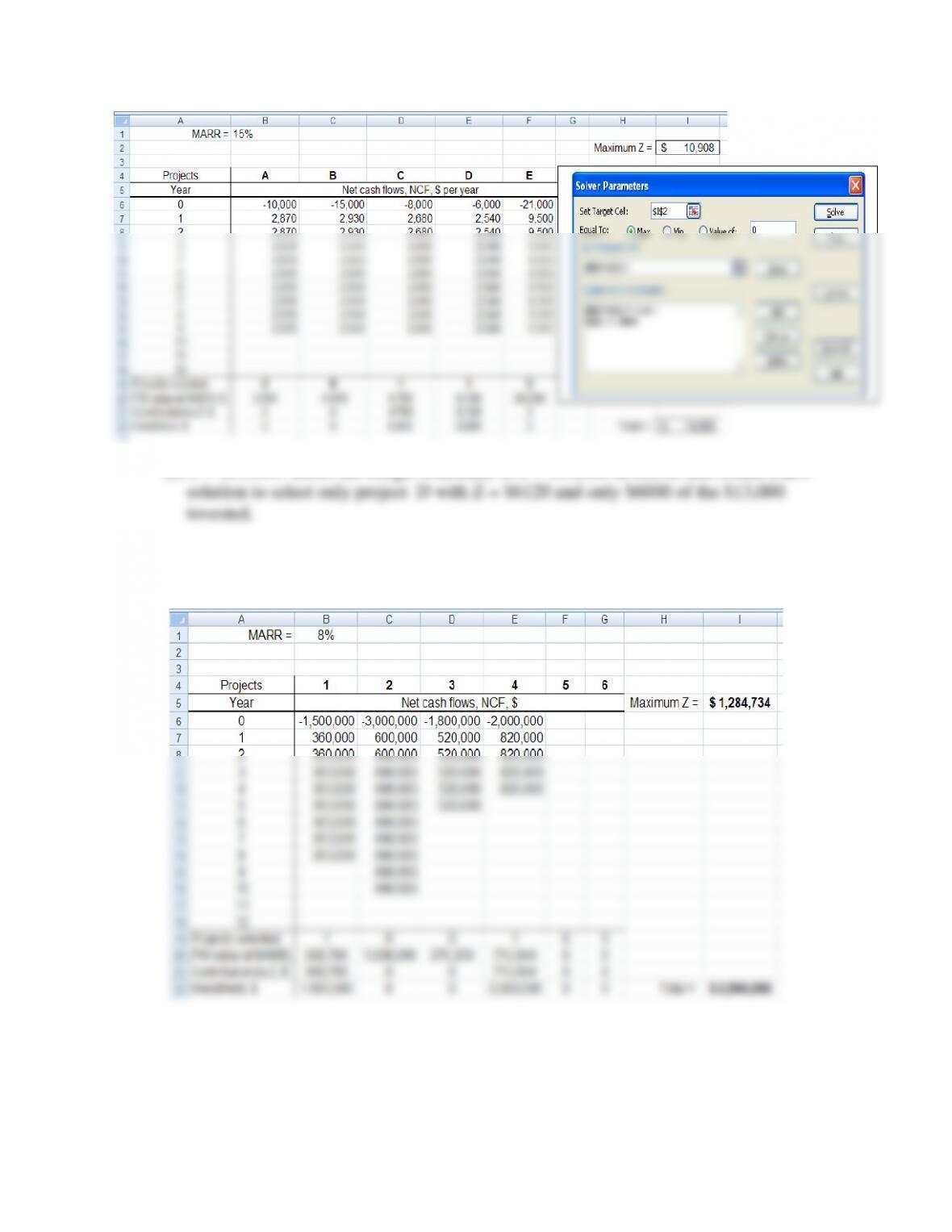
11
(b) b = $13,000: Reset the budget constraint to b = $13,000 in Solver and obtain a new
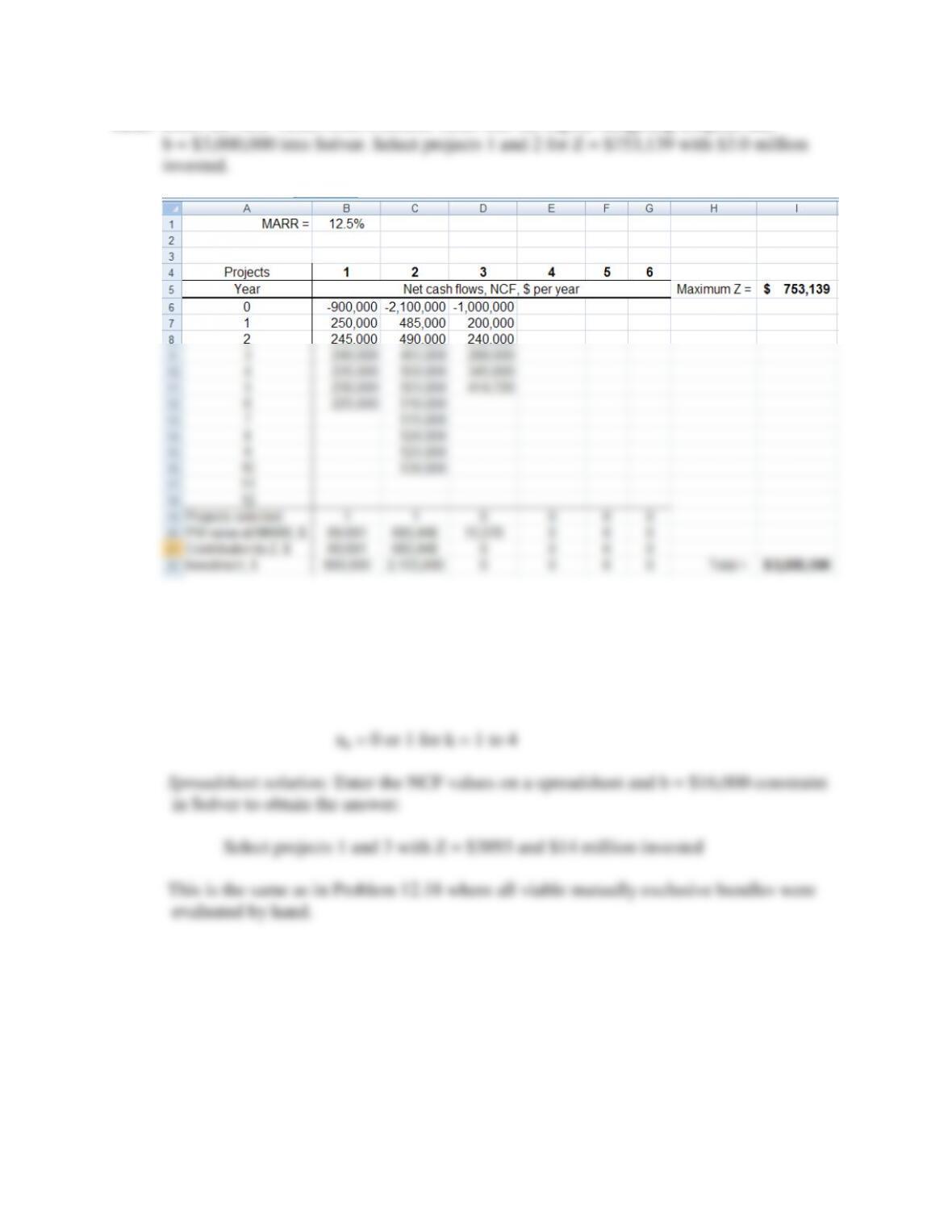
12.22 Use the capital budgeting problem template at 8% with an investment limit of $4 million.
Select projects 1 and 4 with $3.5 million invested and Z ≈ $1.285 million.
12
12.23 Enter the NCF values from Problem 12.20 into the capital budgeting template and
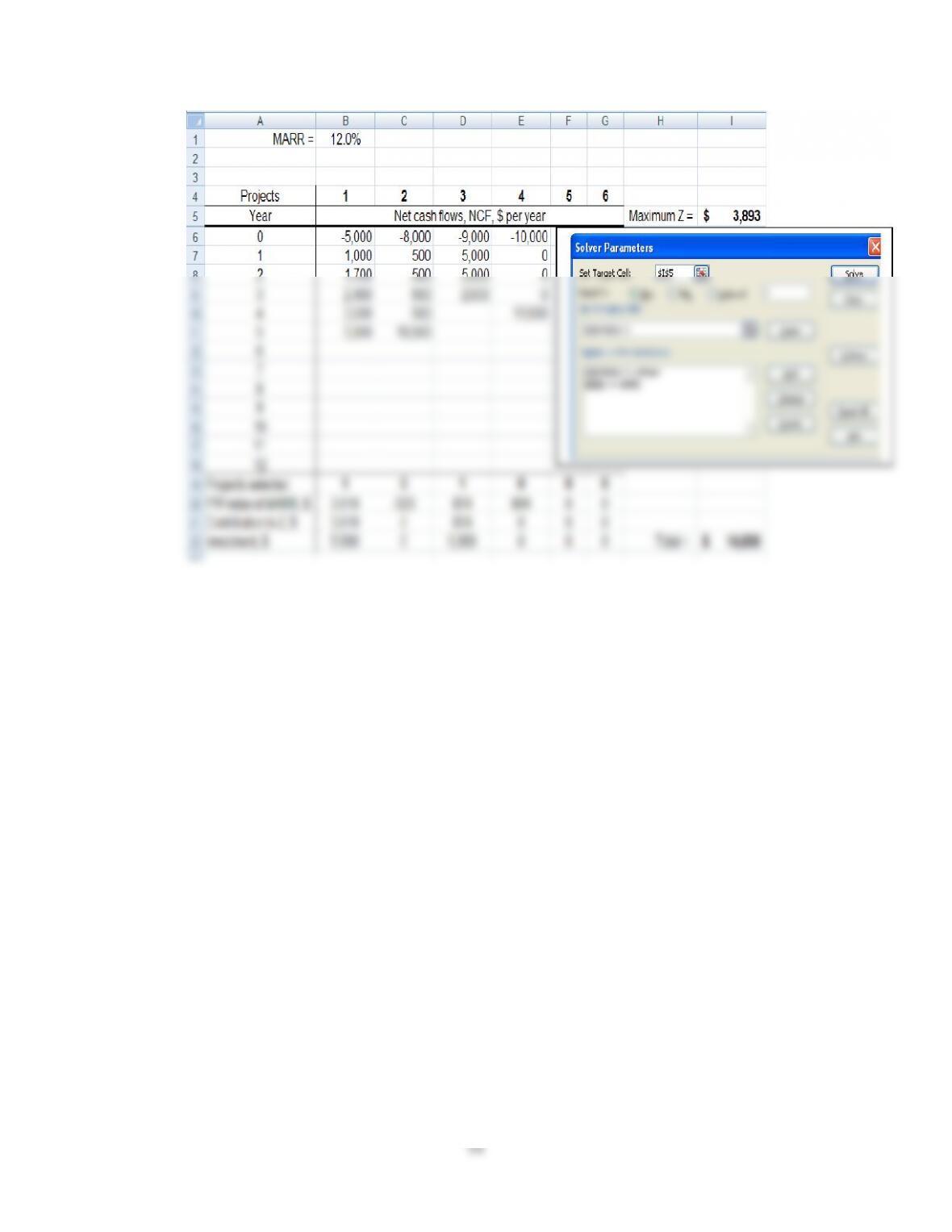
12.24 Linear programming model: In $1000 units,
Maximize Z = 3019x1 – 523 x2 + 874 x3 + 804 x4
Constraints: 5,000x1 + 8,000 x2 + 9000 x3 + 10000 x4 < 16,000
14
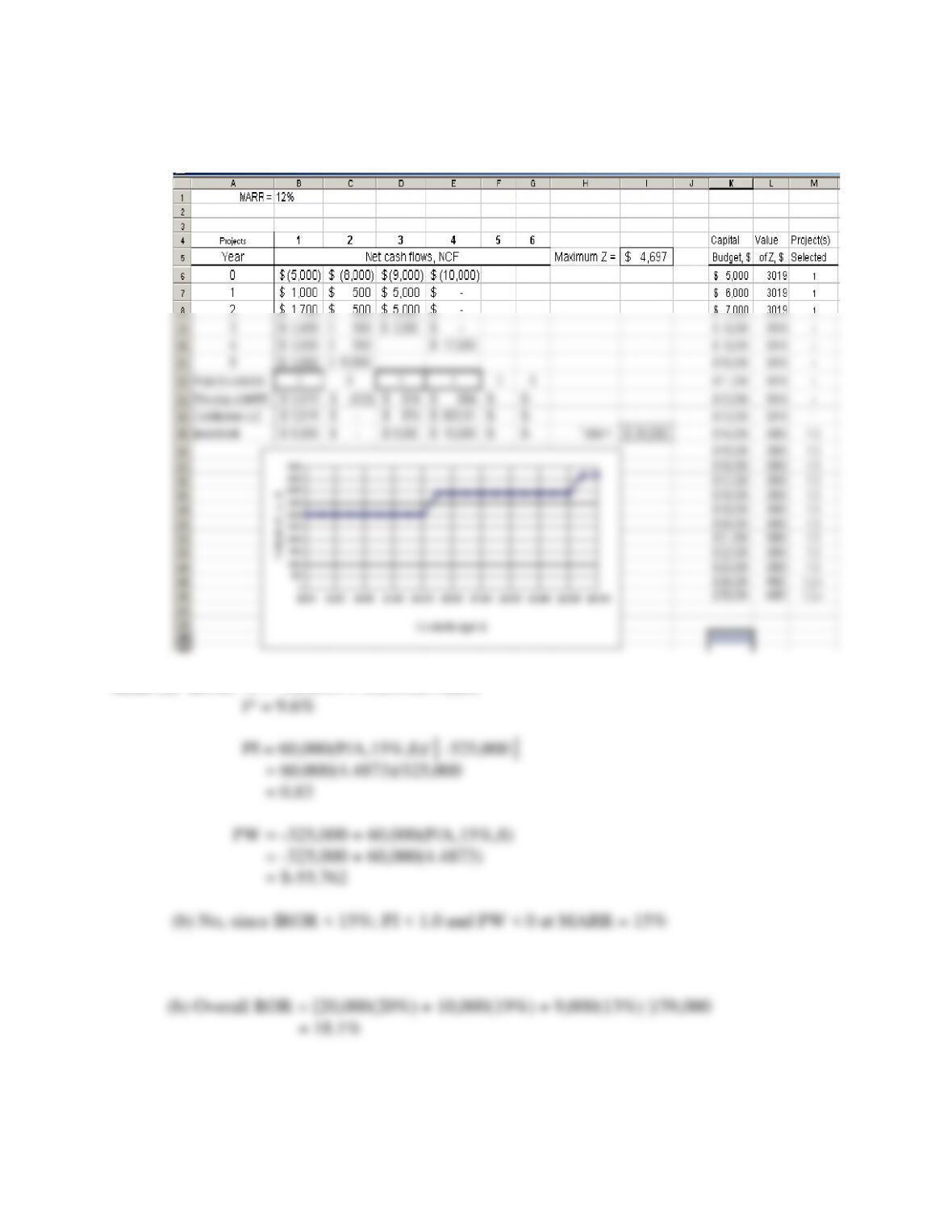
12.25 Build a spreadsheet and use Solver repeatedly at increasing values of b to find the
projects that maximize the value of Z. Develop a scatter chart.
12.26 (a) IROR: 0 = -325,000 + 60,000(P/A,i,8)
12.27 (a) Select projects A and B with a total of $30,000 investment
15
12.28 (a) Hand solution: Find IROR for each project, rank by decreasing IROR and then select
projects within budget constraint of $97,000. RATE function used to find i* values.
For L: 0 = -30,000 + 9000(P/A,i*,10)
i* = 27.3%
12.29 (a) Hand : Find ROR for each project and then select highest ones within budget
16
17
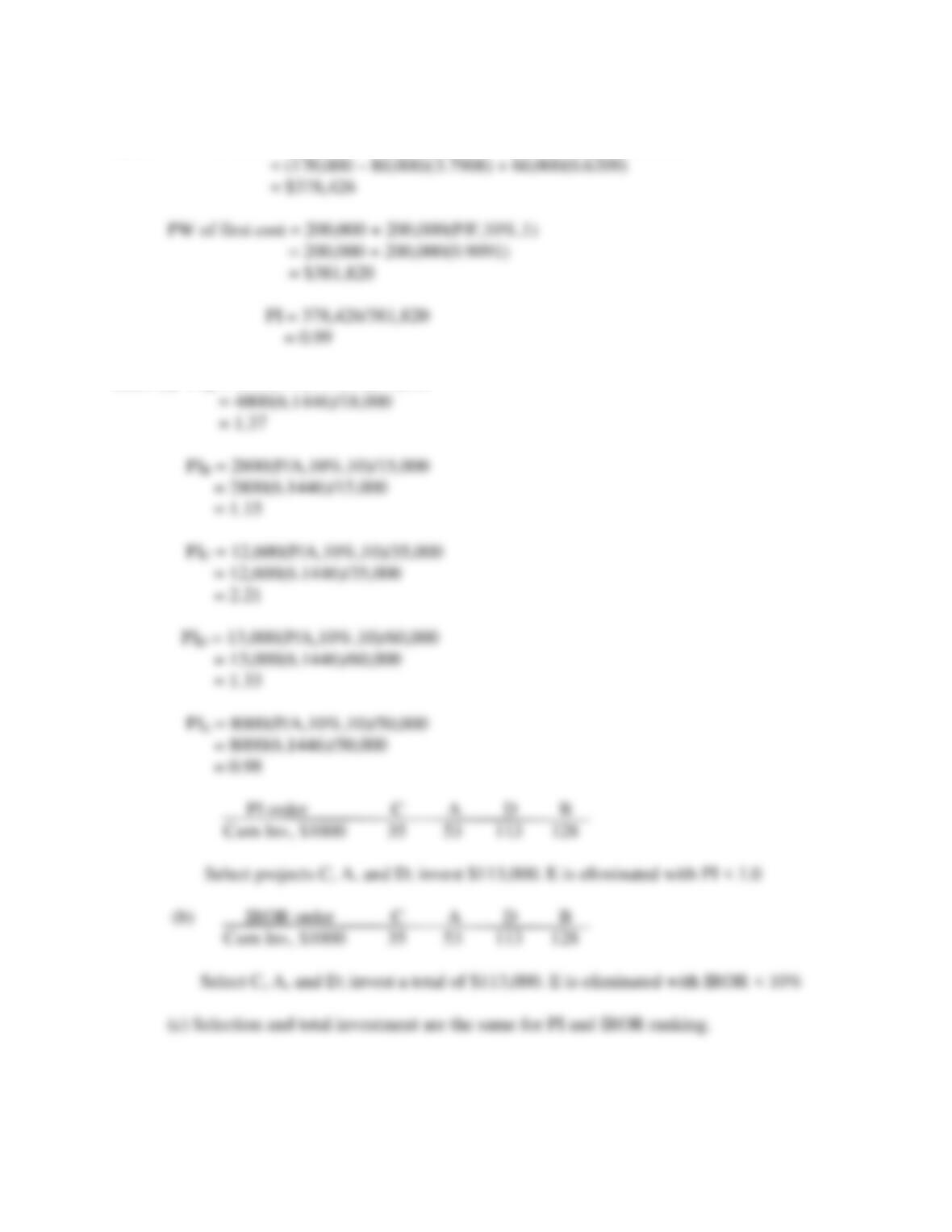
12.30 PW of NCF = (170,000 – 80,000)(P/A,10%,5) + 60,000(P/F,10%,5)
12.31 (a) PIA = 4000(P/A,10%,10)/18,000
18
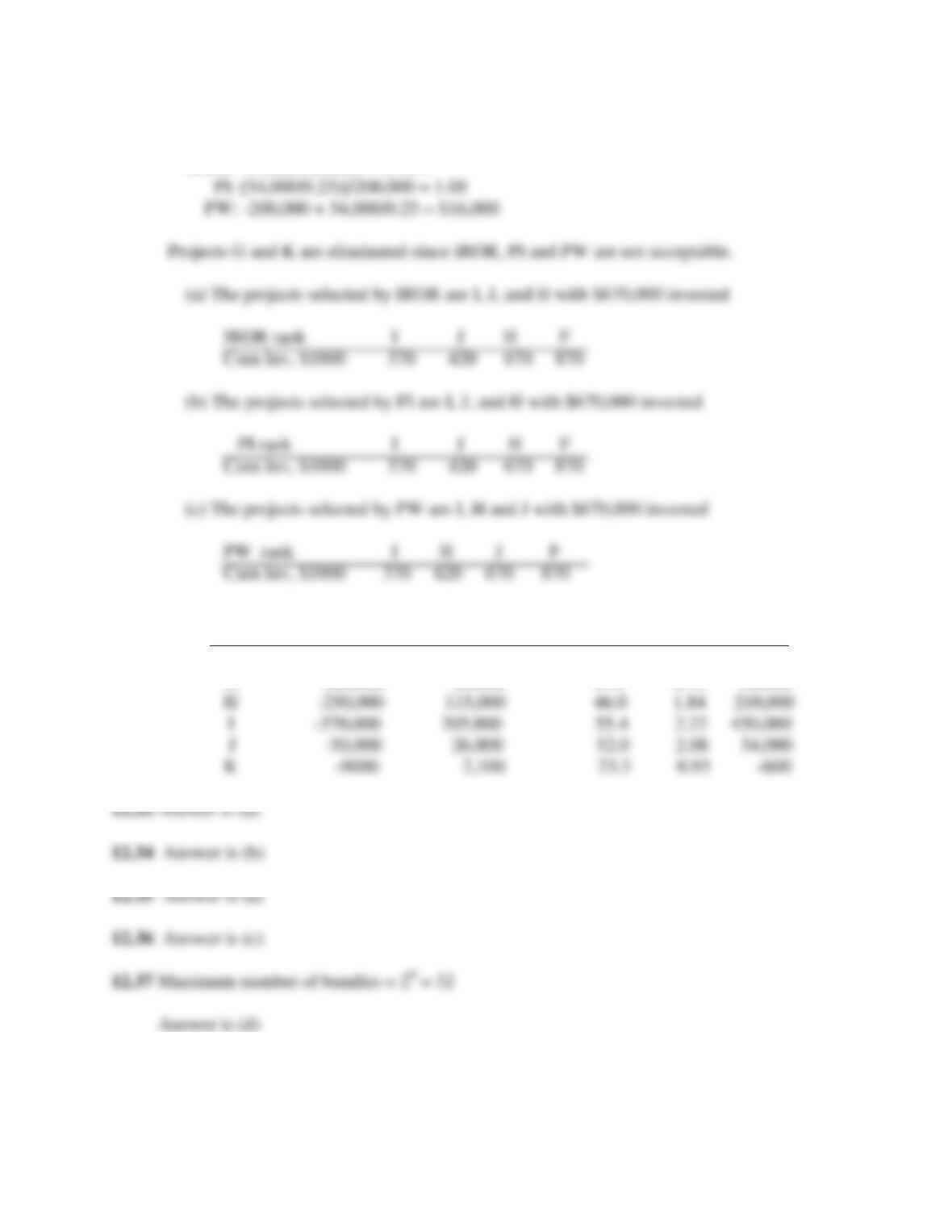
12.32 The IROR, PI, and PW values are shown below. Sample calculations for project F are:
IROR: 54,000/200,000 = 27.0%
First Annual Income,
F -200,000 54,000 27.0 1.08 16,000
Project Cost, $ $ per year IROR, % PI PW, $
G -120,000 21,000 17.5 0.70 -36,000
19
12.38 There are 5 possible bundles under the $25,000 limit: P,Q,R,S, and PR. Largest PW is for
12.40 PW of NCF = 10,000(P/A,10%,4)