1
Solutions to end–of–chapter problems
Engineering Economy, 7th edition
Leland Blank and Anthony Tarquin
Chapter 10
Project Financing and Non–economic Attributes
10.1 Risk – The higher the risk, the higher the MARR
Investment Opportunity – MARR may be lowered for “pet projects” or for company to
expand into target areas.
10.2 (a) Equity
(b) Equity
= 0.20 (20%)
10.4 (a) Effective tax rate = 0.07 + (0.93)(0.22) = 0.275
10.5 0.29 = after-tax return/(1 – 0.32)
10.6 ROR measure: Select projects A and E to total $13 million. Opportunity cost is ROR =
2
10.8 The debt portion of $18 million represents 45% of the total.
10.9 D-E mix: Debt = 12 + 20 = $32 million
10.10 (a) Business: all debt; D–E = 100 to 0
Engineering: all debt; D-E = 100 to 0
(b) Business: FW = 30,000(F/P,4%,1)
10.11 First Engineering: Fraction debt = 87/175 ≈ 50%
Midwest Development: Fraction debt = (175-62)/175 = 64.6%
10.12 Company’s equity = 50(0.40) = $20 million
10.13 Total financing = 3 + 4 + 6 = $13 million
10.14 (a) WACC1 = 0.5(9%) + 0.5(6%) = 7.5%
WACC2 = 0.2(9%) + 0.8(8%) = 8.2%
10.15 WACC = cost of debt capital + cost of equity capital
10.16 Solve for the cost of debt capital, x
WACC = 11.1% = 0.75(7%) + (1- 0.75)(x)
10.17 (a) Determine the after–tax cost of debt capital, Equation [10.4], and WACC
After–tax cost of debt capital = 10(1 – 0.36) = 6.4%
4
Interest charged to revenue for the project:
10.18 The lowest WACC value of 6.7% occurs at the debt fraction of 0.3 or $30,000 in loans.
This translates into funding $70,000 from their own funds.
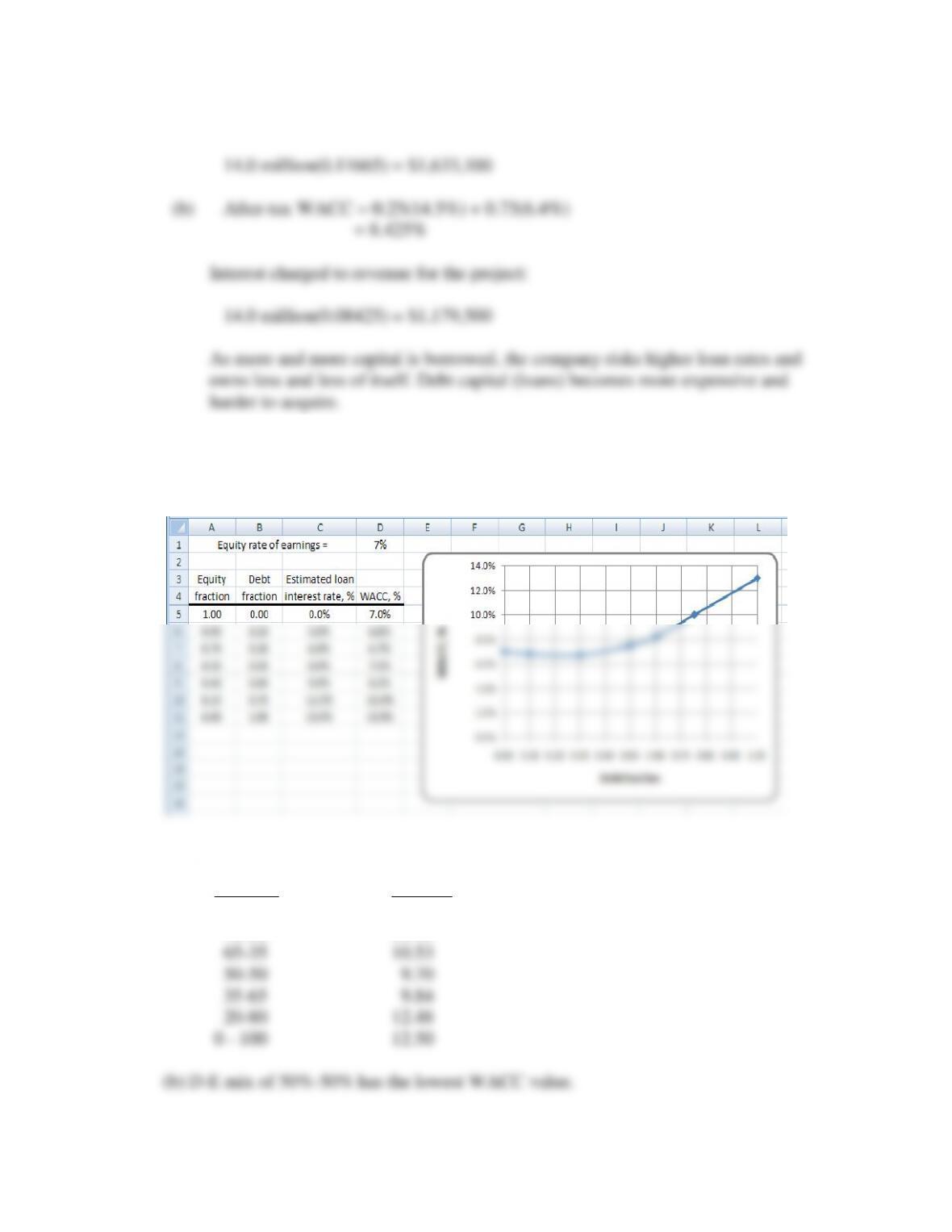
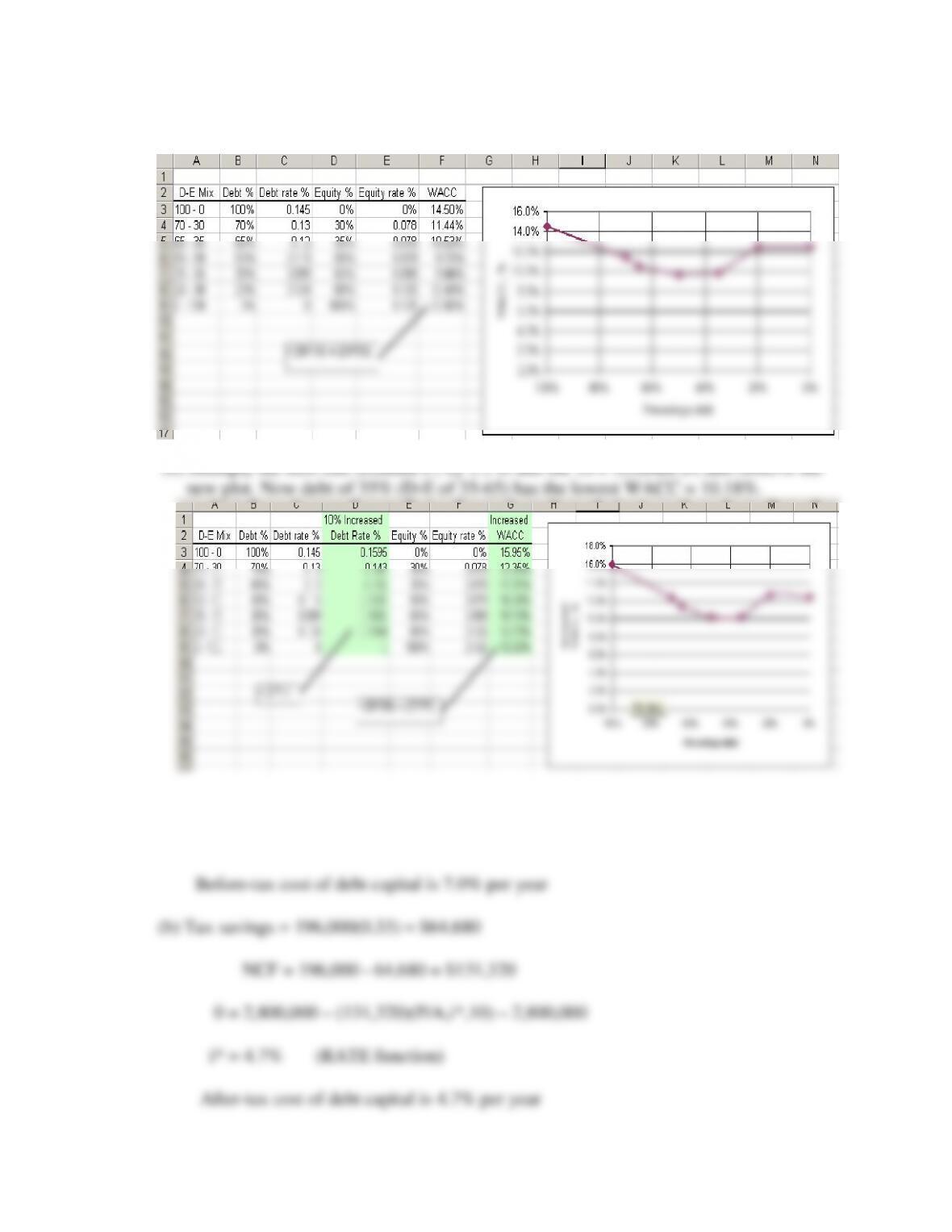
10.19 (a) Compute and plot WACC for each D-E mix. See plot in problem 10.20 below.
D-E mix WACC
100-0 14.50%
70-30 11.44
5
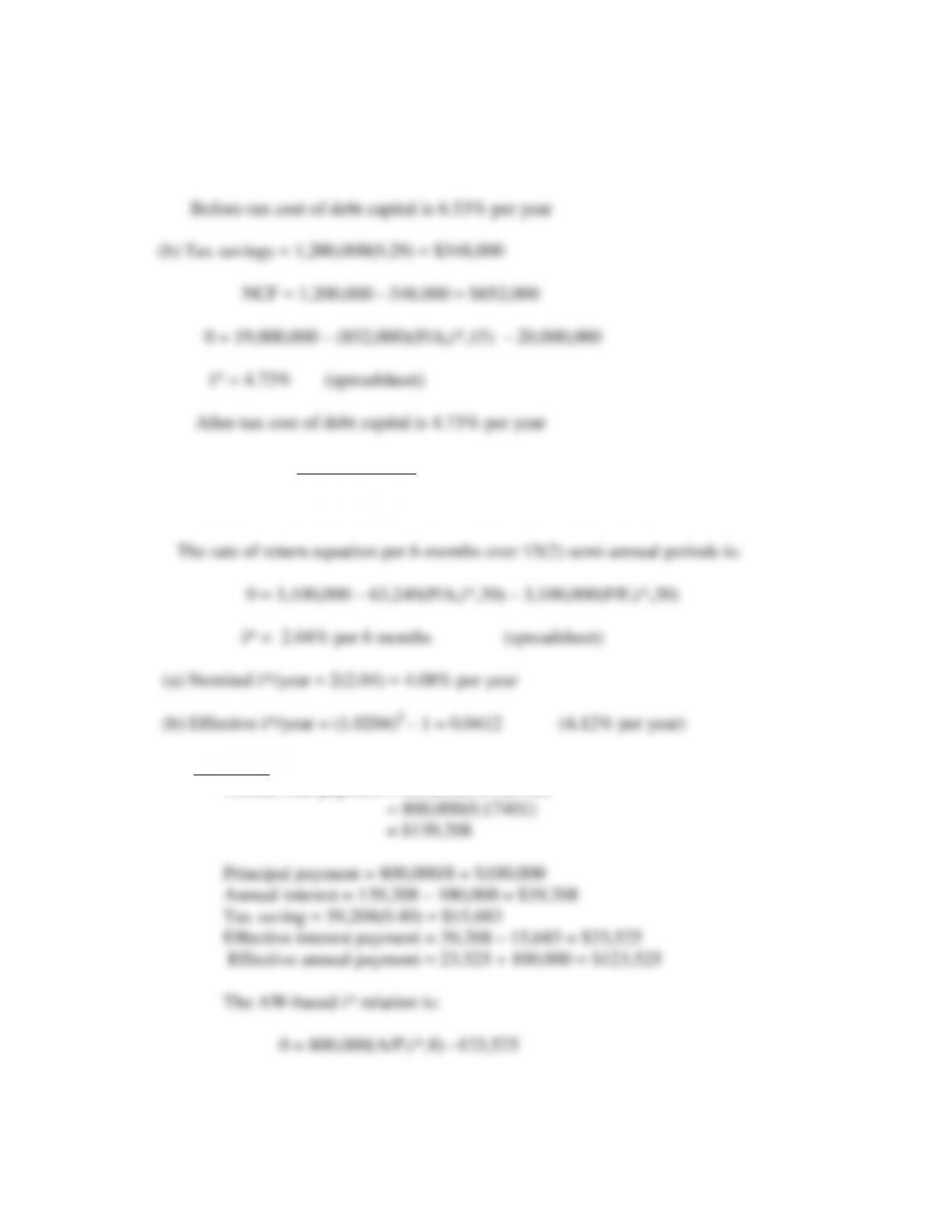
10.20 (a) The spreadsheet shows a 50% – 50% mix to have the lowest WACC at 9.70%.
(b) Multiply the debt rate (column C) by 1.1 to add the 10% (column D) and observe the
10.21 (a) 0 = 2,800,000 – 196,000(P/A,i*,10) – 2,800,000(P/F,i*,10)
i* = 7.0% (RATE function on spreadsheet)
6
10.22 (a) 0 = 19,000,000 – 1,200,000(P/A,i*,15) – 20,000,000(P/F,i*,15)
i* = 6.53% (spreadsheet)
10.23 Bond interest = 0.06(3,100,000) = $93,000 every 6 months
2
Dividend semi-annual net cash flow = $93,000(1 – 0.32) = $63,240
10.24 (a) Bank loan
Annual loan payment = 800,000(A/P,8%,8)
Bond issue
Annual bond dividend = 800,000(0.06) = $48,000
before taxes is the same as that after taxes.
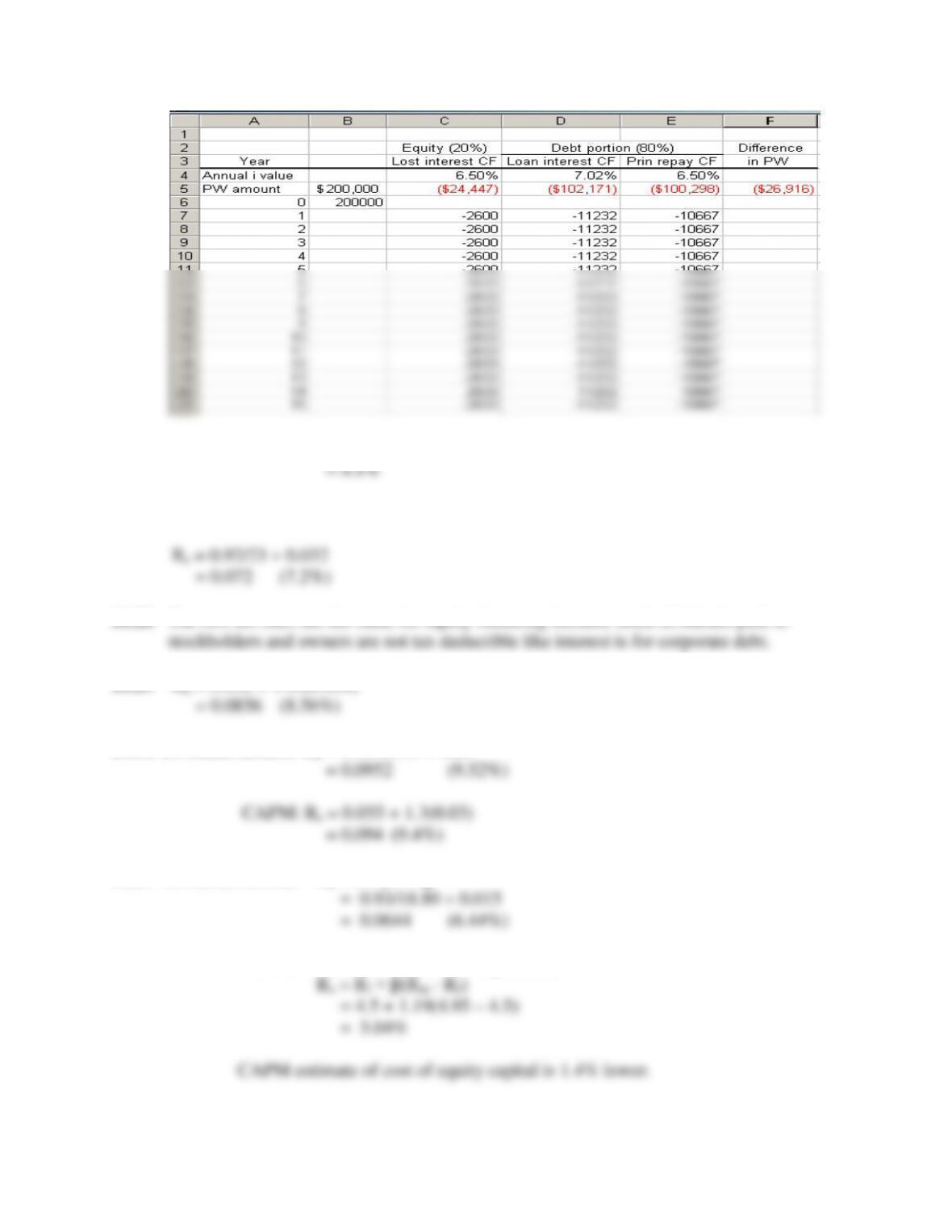
10.25 (a) Annual loan payment is the cost of the $160,000 debt capital. First, determine the
after–tax cost of debt capital.
Debt cost of capital: before–tax (1-Te) = 9%(1– 0.22) = 7.02%
(b) Equity cost of capital: 6.5% per year on $40,000 is $2600 annually.
(c) After-tax WACC = 0.2(6.5%) + 0.8(9%)(1-0.22)
8
10.26 Cost of equity capital = 10/(1 – 0.05)(130)
10.27 By Equation [10.7]
10.28 The two tax rates are the same for equity financing because stock dividends paid to
10.29 Re = 0.032 + 1.41(0.038)
10.30 Dividend method: Re = 0.75/11.50 + 0.03
10.31 Dividend method: Re = DV1/P + g
CAPM: (The return values are in percents)
10.32 Last year CAPM computation: Re = 4.0 + 1.10(5.1 – 4.0)
Equity costs slightly more in part because the company’s stock became more volatile
10.33 (a) Total equity and debt fund is $15 million.
(b) Debt capital gets a tax break; equity does not.
After-tax cost of debt = 9.8%(1- 0.32) = 6.664%
10.34 A large D–E mix over time is not healthy financially because this indicates that the
person owns too small of a percentage of his or her own assets (equity ownership) and is
10.35 If the D–E mix of the purchaser is too high after the buyout and large interest
payments (debt service) are required, the new company’s credit rating may be degraded.
10
10.36 (a) First find cost of equity capital using CAPM, which is the MARR
Re = 3.0 + 0.95(5.0) = 7.75%
10.37 100% equity financing
MARR = 7.5% is known. Determine PW at the MARR
PW = -250,000 + 30,000(P/A,7.5%,15)
= -250,000 + 30,000(8.82712)
60%-40% D-E financing
Loan principal = 250,000(0.60) = $150,000
Loan payment = 150,000(A/P,7%,15)
11
Calculate PW at the MARR on the basis of the committed equity capital.
PW = -100,000 + 13,531(P/A,7.2%,15)
10.38 (a) Find cost of equity capital using CAPM.
Re = 4% + 1.22(5%) = 10.1%
10.39 (a) Calculate the two WACC values for financing alternative 1 and 2
WACC1 = 0.4(9%) + 0.6(10%) = 9.6%
12
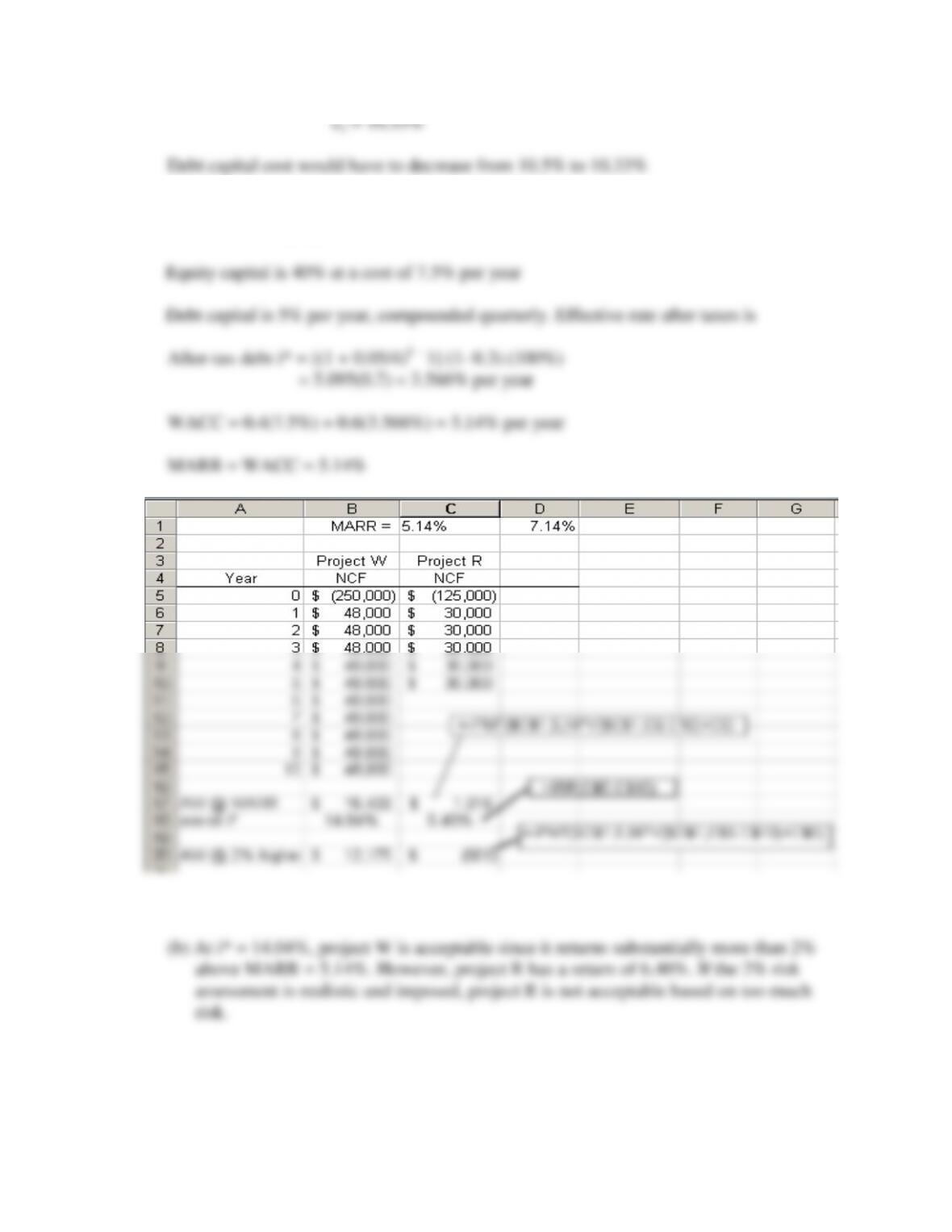
10.40 Two independent, revenue projects with different lives. Fastest solution is to find AW at
MARR for each project. Select all those with AW > 0. Find WACC first.
(a) At MARR = 5.14%, select both independent projects (row 17)
13
10.41 (a) Stan: Stock value increase: 0.10(20,000) = $2000
(b) Stan: Stock value decrease: –0.10(20,000) = $-2000
(c) Under high leverage situations, the gain or loss is multiplied by the leverage factor. If
the investment goes down a small amount, the high leverage loses much more than
10.43 Σsi = 60 + 40 + 80 + 30 + 20 = 230
W1 = 60/230 = 0.26
10.44 S = 1 + 2 + 3 +… + 10 = 10(11)/2 = 55
10.45 Ratings by attribute with 100 for most important.
Logic: F = 100
Attribute Importance Score
F 100
S 35
14
Attribute Wi
F 0.39
10.46 Ratings by attribute with 100 for most important.
Logic: #1 = 0.90(#5) = 0.90(100) = 90
#2 = 0.10(100) = 10
Attribute Importance
1 9
2 1
3 3
Attribute Wi______
1 9/33.8 = 0.27
2 1/33.8 = 0.03
15
10.47 Calculate Wi = importance score/sum and solve for Rj
Vice president
Attribute, Importance Vij values____
i score Wi 1 2 3__
1 20 0.10 5 7 10
Assistant vice president
Attribute, Importance Vij values____
i score Wi 1 2 3
1 100 0.50 25 35 50
Results are the same, even though the VP and Asst. VP rated opposite on factors 1 and 3.
10.48 (a) Select A since PWA is larger.
(b) Calculate Rj and use manager scores for attributes.
Wi = Importance score
Sum
Attribute, Importance Rj_______
i by manager Wi A B__
1 80 0.48 0.48 0.43
2 35 0.21 0.07 0.21
16
310 0.71 0.94
10.53 Equity = 41/71 = 57.7%
10.54 WACC = 5/10(13.7) + 2/10(8.9) + 3/10(7.8)
10.55 Before–tax ROR = after–tax ROR/(1– Te)
10.56 Historical WACC = 0.5(11%) + 0.5(9%) = 10%
17
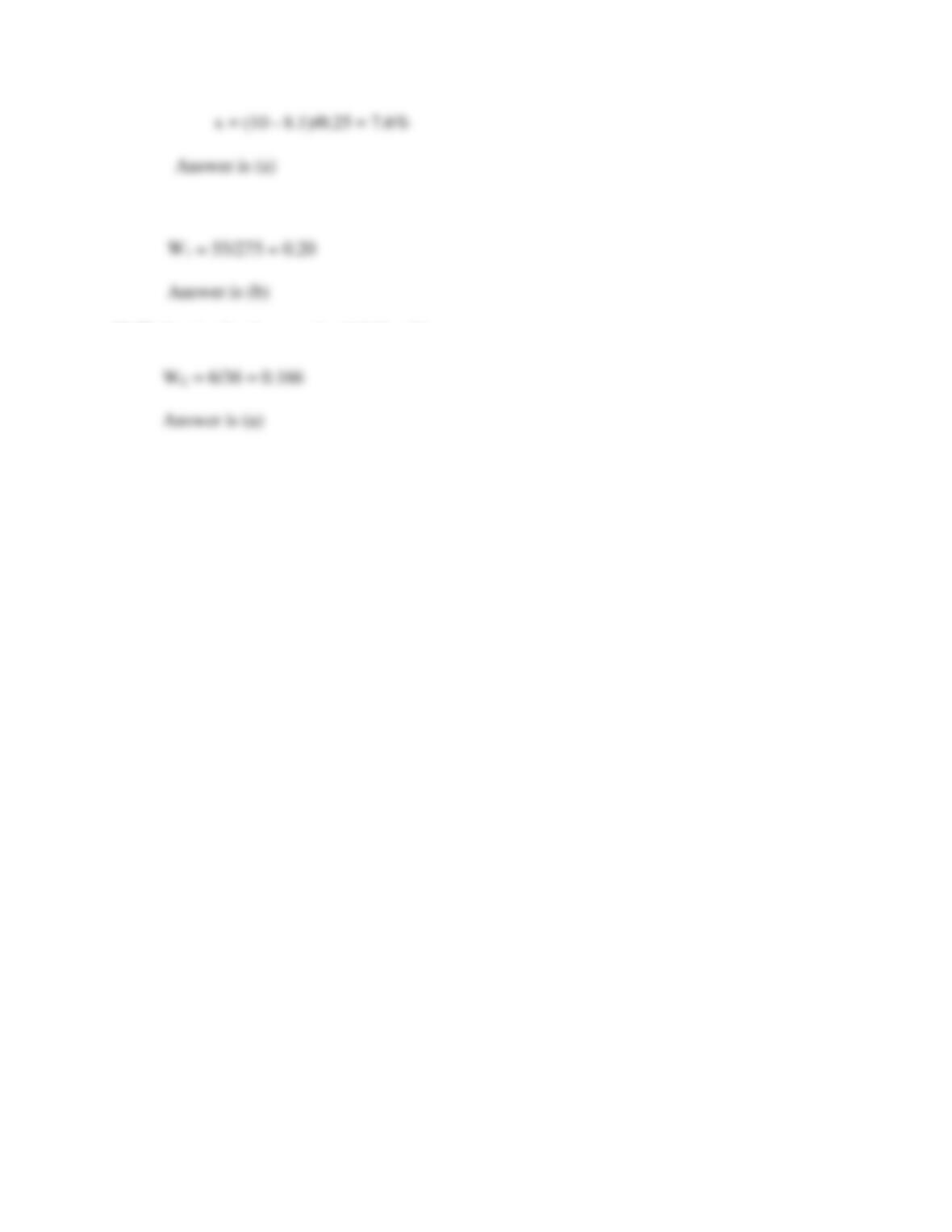
10.57 Σsi = 55 + 45 + 85 + 30 + 60 = 275
10.58 S = 1 + 2 + 3 +… + 8 = 8(9)/2 = 36
Solution to Case Study, Chapter 10
There is not always a definitive answer to case study exercises. Here are example responses
WHICH IS BETTER – DEBT OF EQUITY FINANCING?
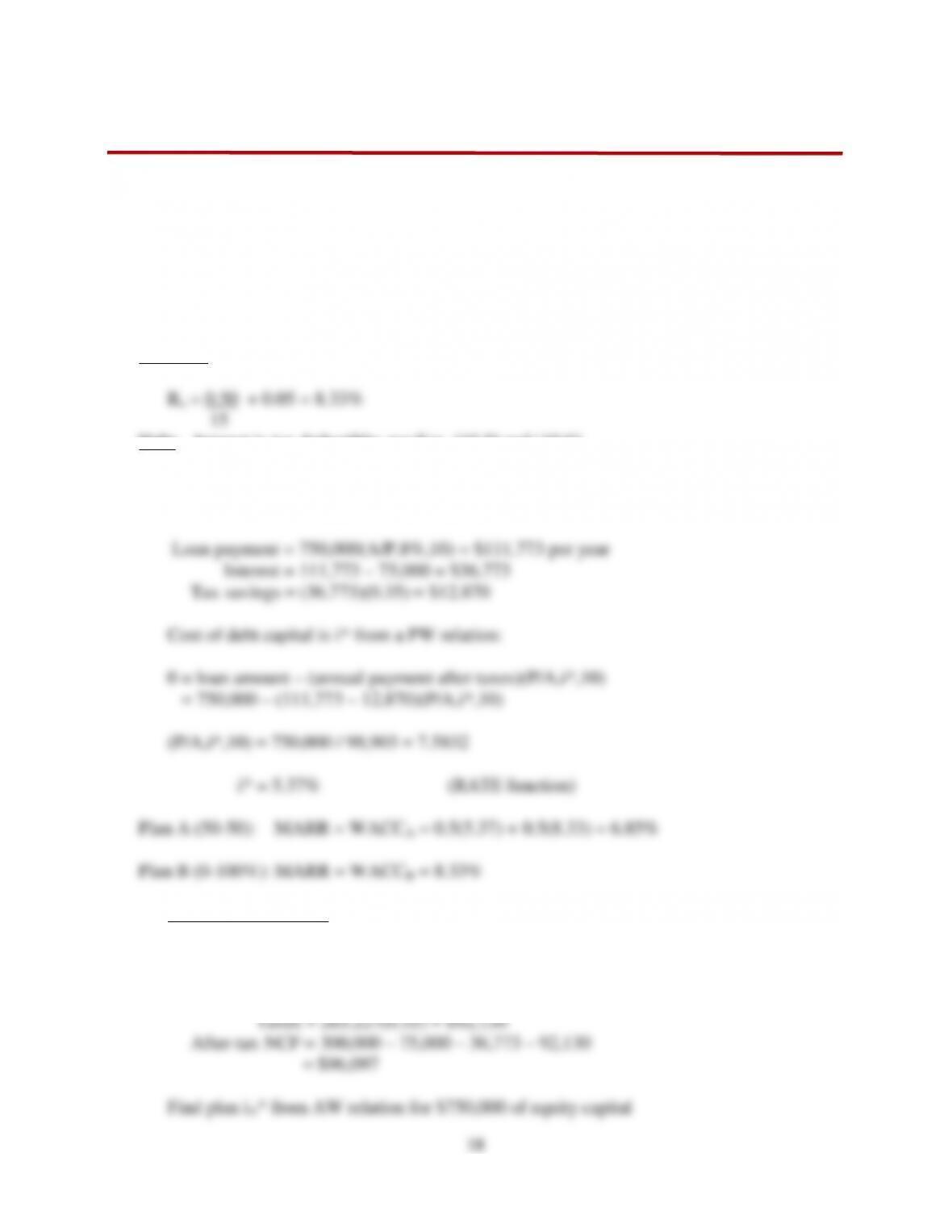
1. Set MARR = WACC
WACC = (% equity)(cost of equity) + (% debt)(cost of debt)
Equity: Use Eq. [10.7]
Debt: Interest is tax deductible; use Eqs. [10.5] and [10.6].
Tax savings = interest(tax rate)
= [loan payment – principal portion](tax rate)
2. A: 50–50 D–E financing
Use relations in case study statement and the results from Question #1.
TI = 300,000 – 36,773 = $263,227
19
B: 0–100 D–E financing
Use relations is the case study statement
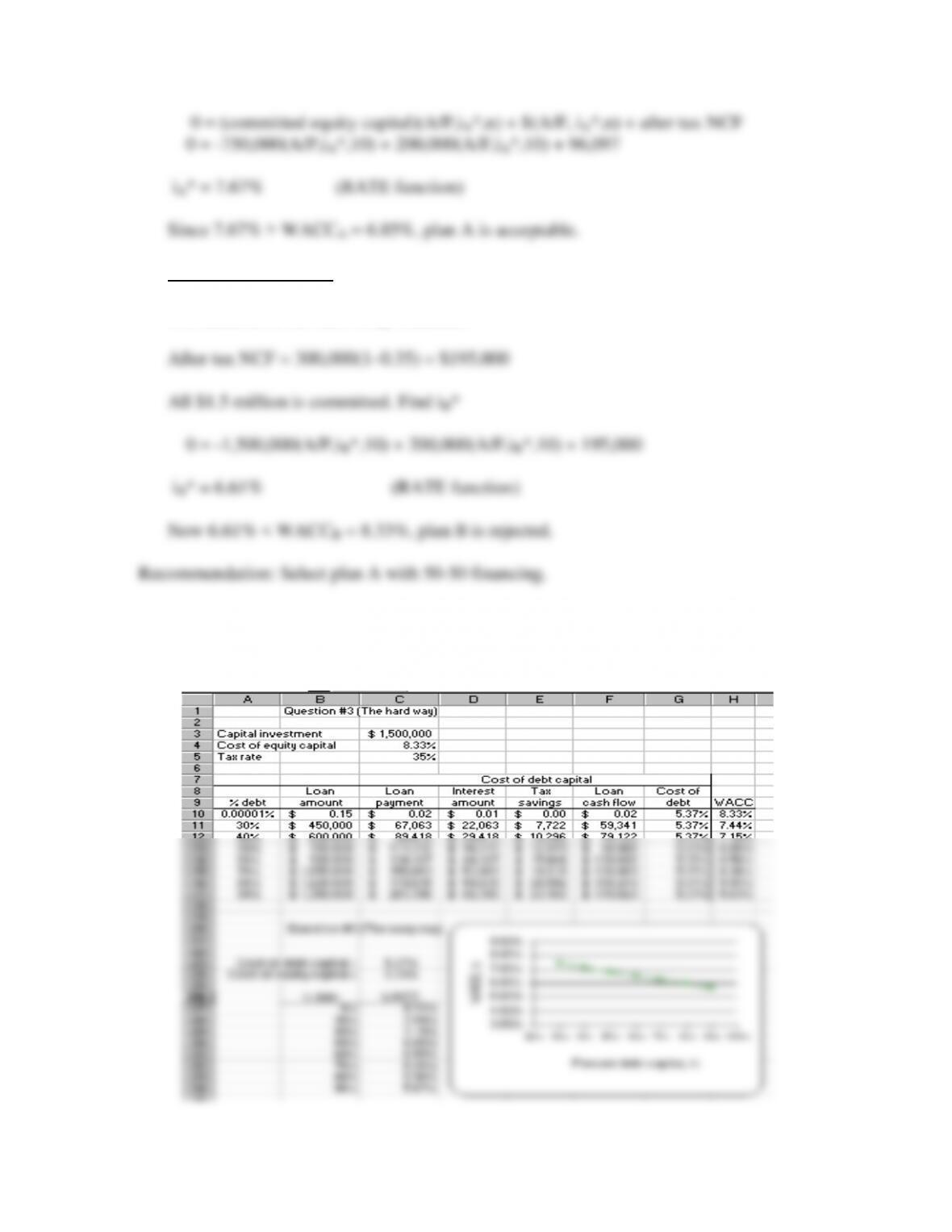
3. Spreadsheet shows the hard way (develops debt-related cash flows for each year) and the easy
way (uses costs of capital from #1) to plot WACC. It is shaped differently than the WACC
curve in Figure 10-2.