
Solutions Manual
for
Digital Communications, 5th Edition
(Chapter 8) 1
Prepared by
Kostas Stamatiou
January 30, 2008
Problem 8.1
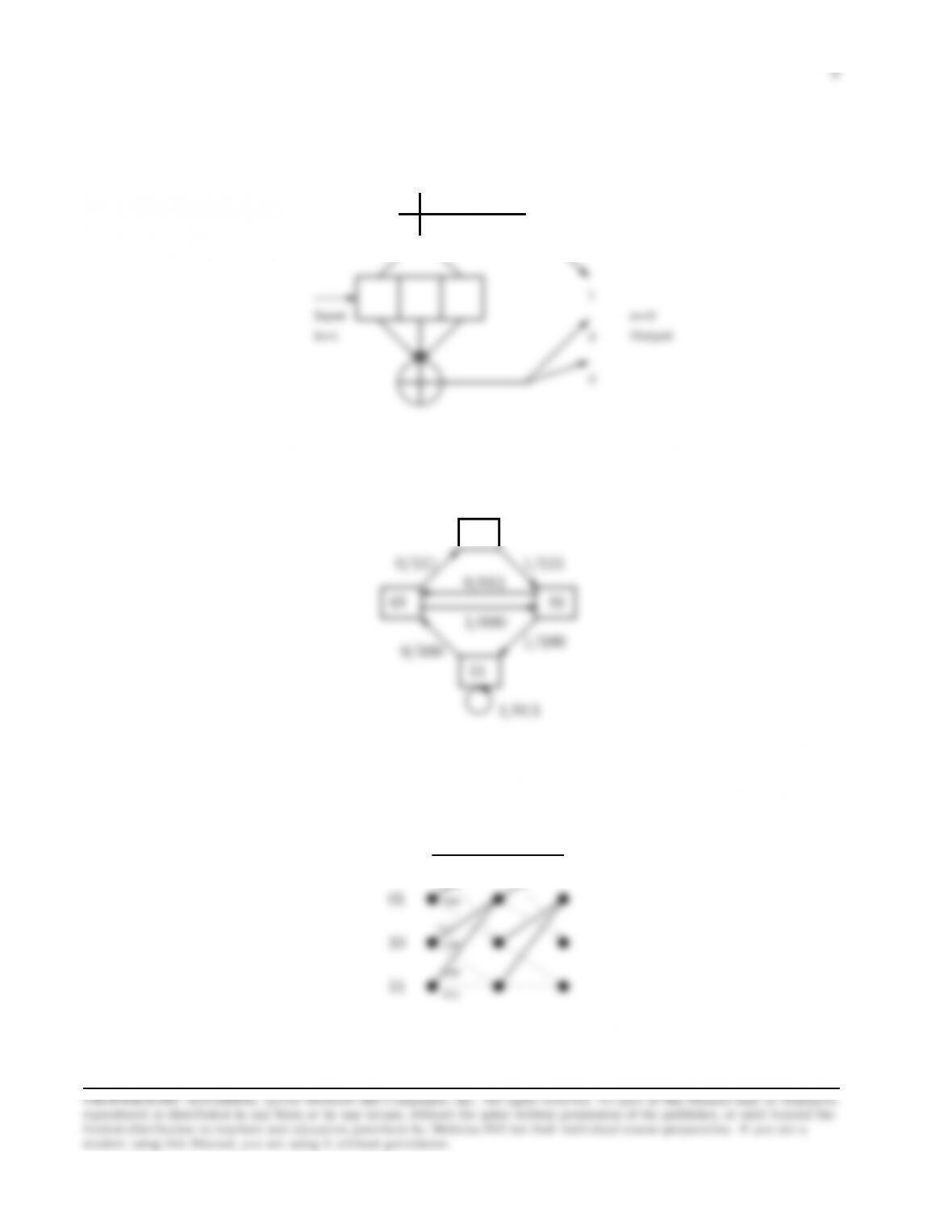
(a) The encoder for the (3,1) convolutional code is depicted in the next figure.
✚✙
✛✘
✚✙
✛✘
❅❘❄
✠
✒
❅
❅■
❅❅❅❅
✏✏✏✏
✏✶
3
(b) The state transition diagram for this code is depicted in the next figure.
✍✌
✍✌
✎☞
.
.
.
.
.
.
.
.
.
.
.
.
.
.
.
.
.
.
.
.
.
.
.
.
.
❥.
✛✲
✒
❅
❅
❅■
✠
❅❅
❅❘
1/011
0/100
0/111
1/100
1/000
0/011
1/111
0/000
11
00
(c) In the next figure we draw two frames of the trellis associated with the code. Solid lines indicate
an input equal to 0, whereas dotted lines correspond to an input equal to 1.
✈
✈
✈✈
✈
✈ ✈
✈
✈
............ ......... . . . . . .. . . . . . .
.........
...........
✑
✑✑✑✑
✑
✓✓✓✓✓
✓
✓✓✓✓✓
✓
✑✑✑✑
✑
✑
11
10
01
00
011
100
100
011
000
111
111
000
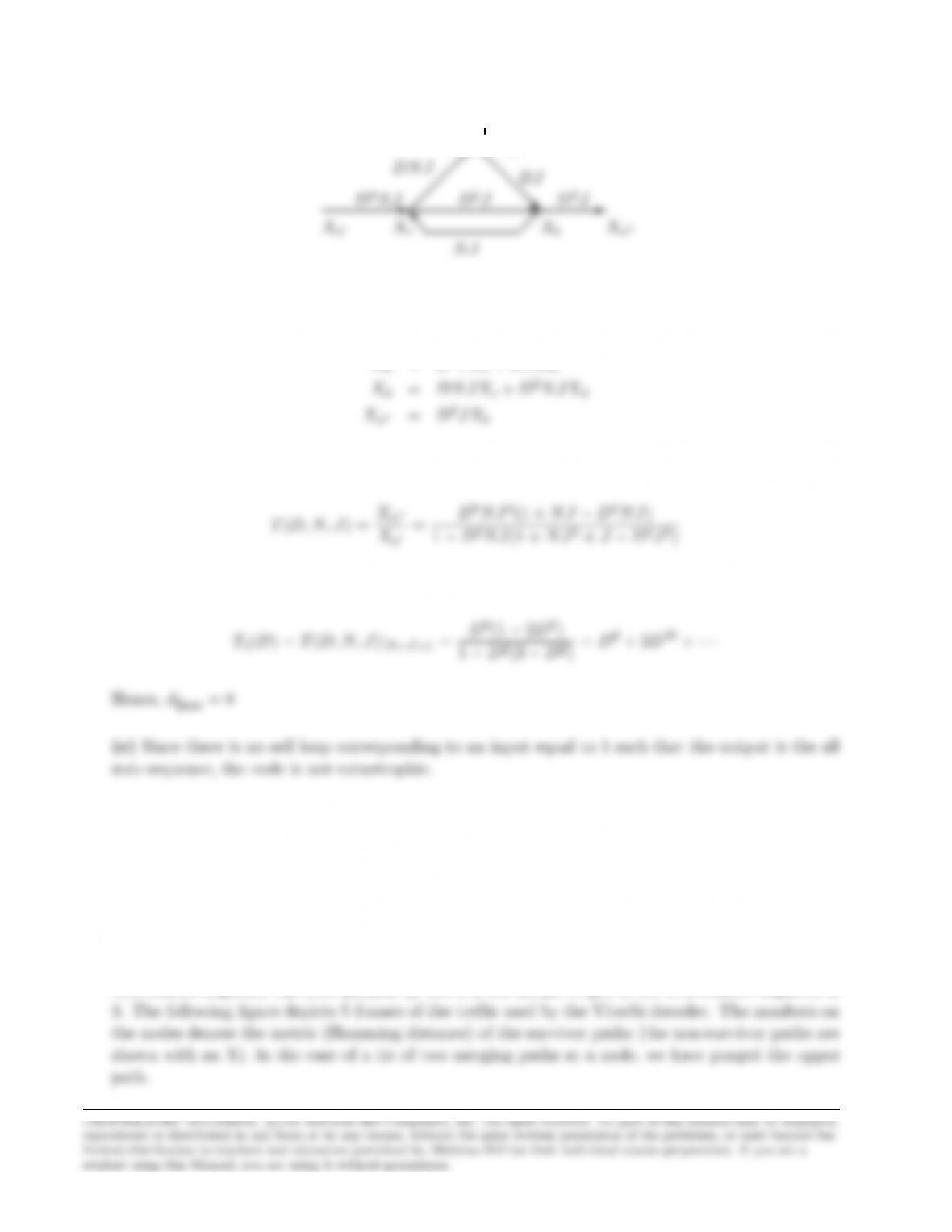
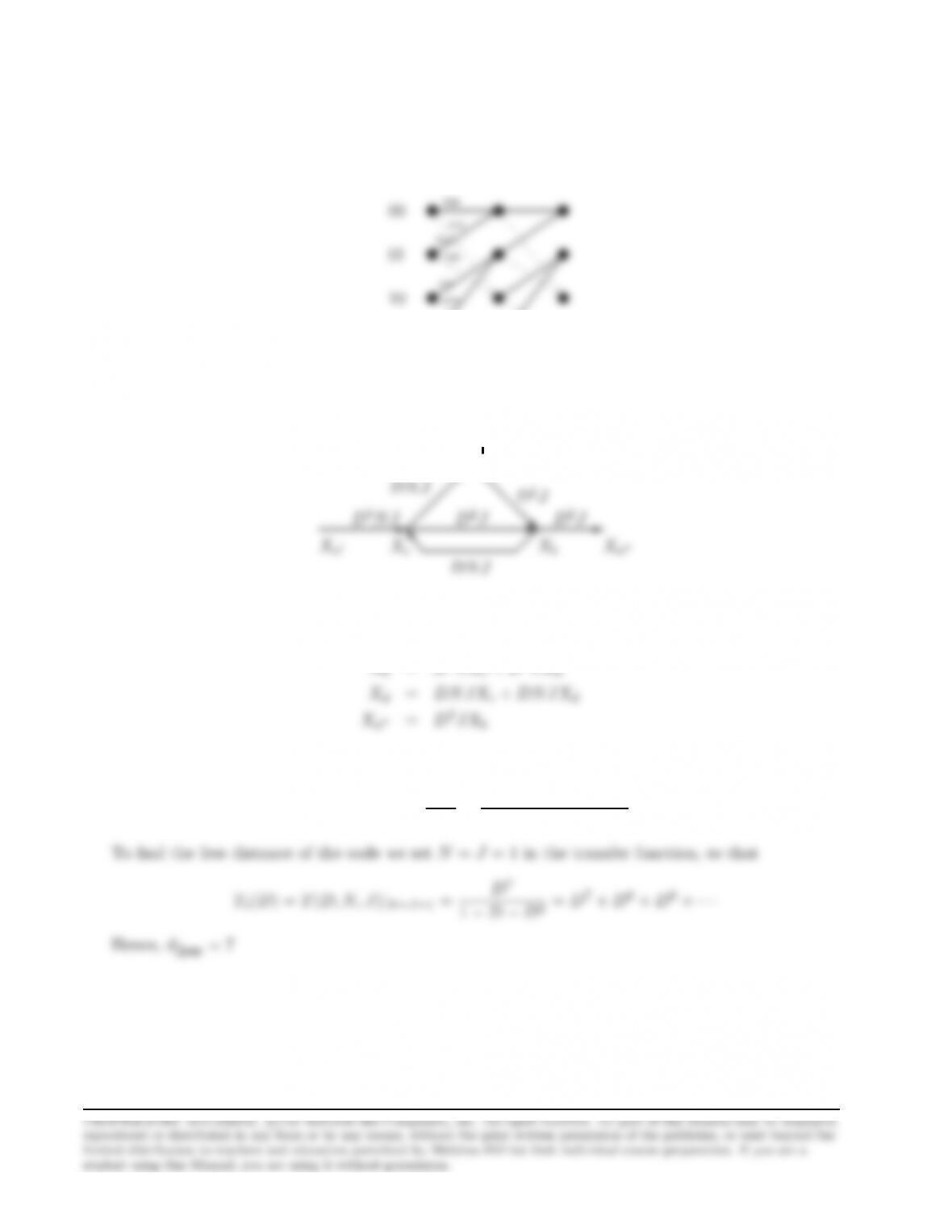
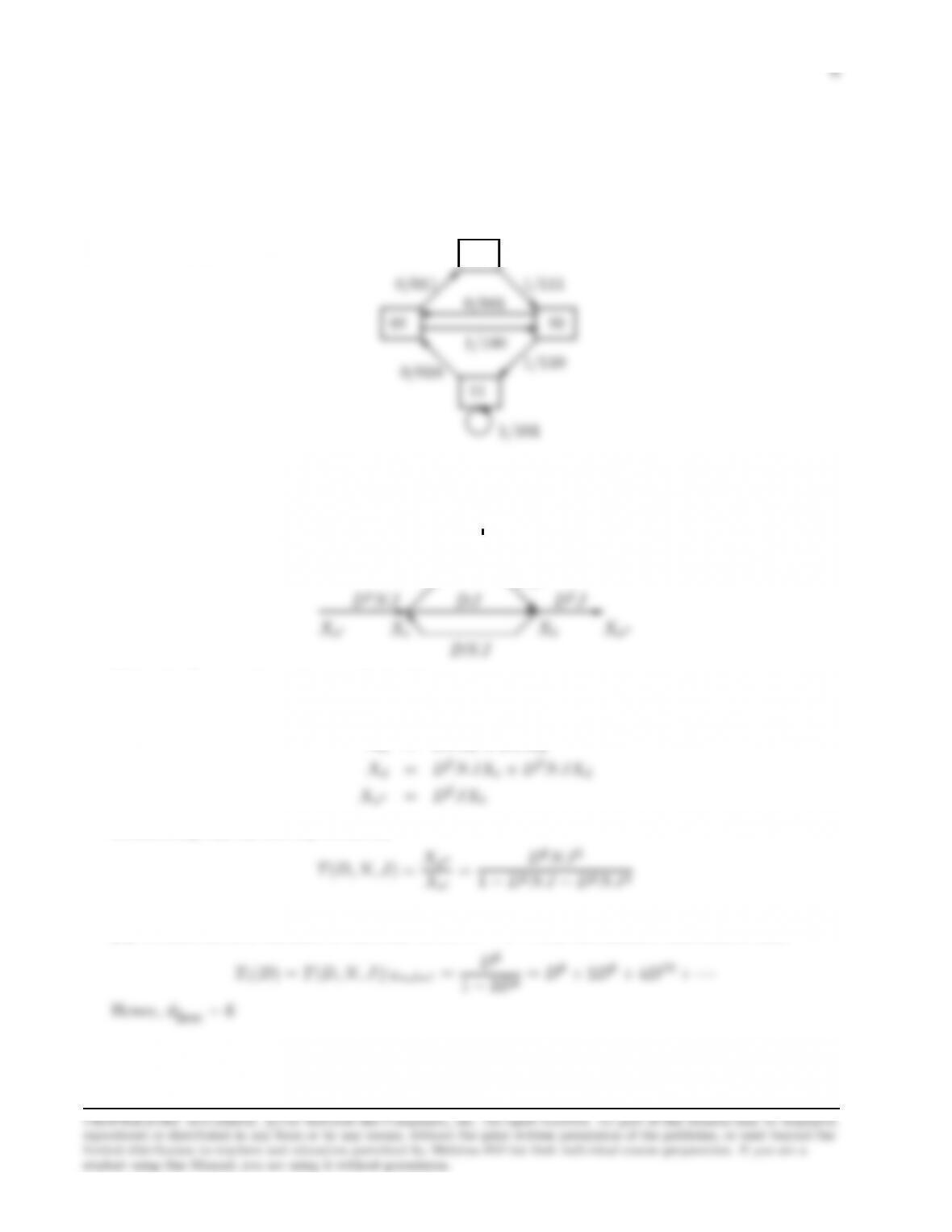
(d) The diagram used to find the transfer function is shown in the next figure.
3
✍✌
✎☞
❄
❅❘ ✲✲
✲D3J
NJ
D2J
D3NJ
D2NJ
Xd
Using the flow graph results, we obtain the system
Xc=D3NJXa′+N JXb
Xb=D2JXc+DJXd
Eliminating Xb,Xcand Xdresults in
To find the free distance of the code we set N=J= 1 in the transfer function, so that
Problem 8.2
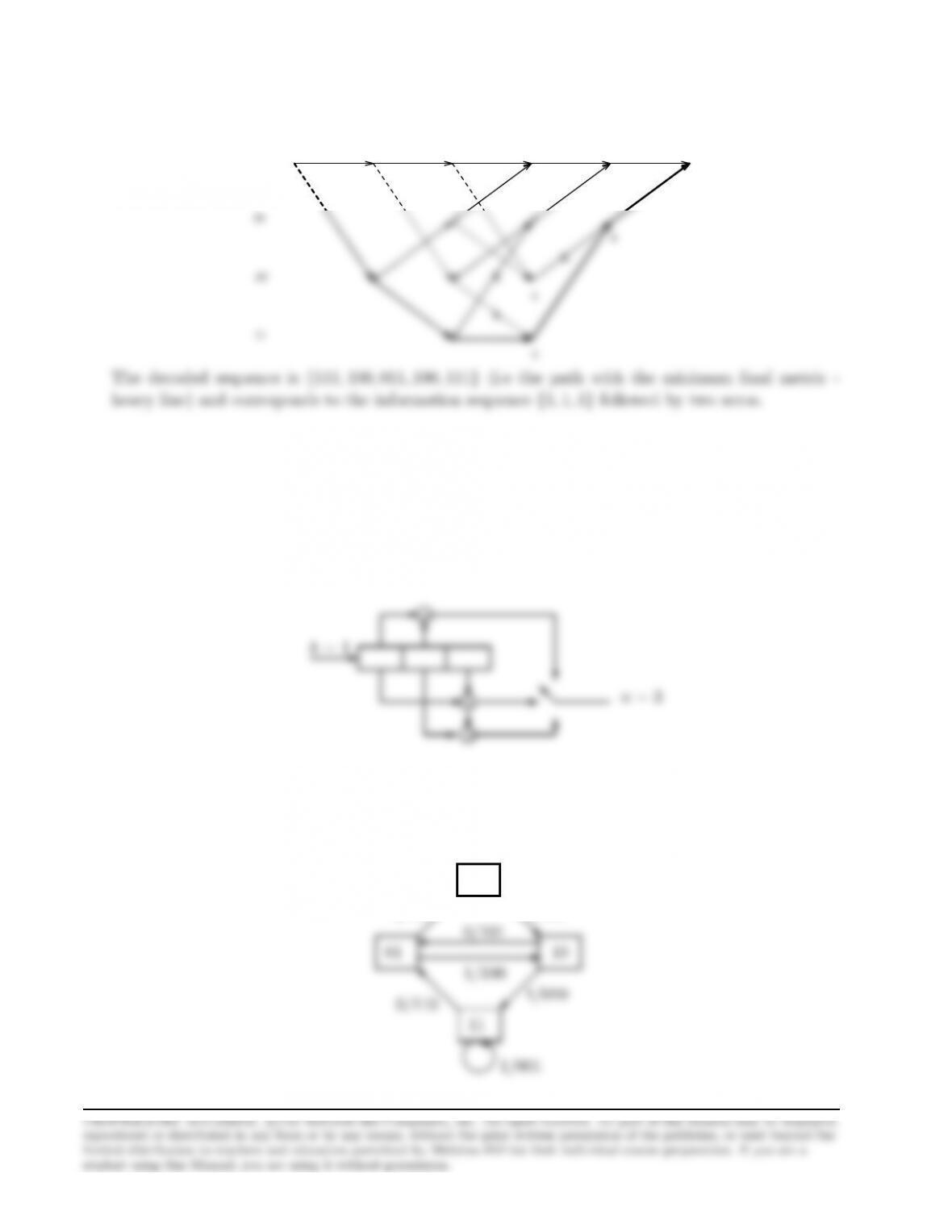
The code of Problem 8-1 is a (3,1) convolutional code with K= 3. The length of the received
sequence yis 15. This means that 5 symbols have been transmitted, and since we assume that the
information sequence has been padded by two 0’s, the actual length of the information sequence is
4
00
101 001 011 110 111
2
3
3
3 5
4
X X
X
X
Problem 8.3
(a) The encoder for the (3,1) convolutional code is depicted in the next figure.
✐
✐
✐
✲
❅
❅■
✻
✲
✲❄
❄
✲
❄
✻
✲
+
+
+
n= 3
k= 1
(b) The state transition diagram for this code is shown below
✒✑
✓✏
✒✑
✓✏
.
.
.
.
.
.
.
.
.
.
.
.
.
.
.
.
.
.
.
.
.
.
.
.
.
.
❥.
✒
❅❅
1/001
0/011
1/111
0/000
11
00
5
(c) In the next figure we draw two frames of the trellis associated with the code. Solid lines indicate
an input equal to 0, whereas dotted lines correspond to an input equal to 1.
✈
✈
✈✈
✈
✈ ✈
✈
✈
.........
............ ......... . . . . . .. . . . . . .
.........
...........
✑✑✑✑
✑
✑
✓✓✓✓✓
✓✓✓✓✓
✑
✑✑✑✑
✑
11
10
01
00
001
110
010
101
100
011
111
000
(d) The diagram used to find the transfer function is shown in the next figure.
✍✌
✎☞
❄
❅❅❅❅
✒
DN J
D2J
DN J
D3NJ
D2J
Xd
Using the flow graph results, we obtain the system
Xc=D3NJXa′+DN JXb
Xb=D2JXc+D2JXd
Eliminating Xb,Xcand Xdresults in
T(D, N, J) = Xa′′
Xa′
=D7NJ3
1−DN J −D3N J2
(e) Since there is no self loop corresponding to an input equal to 1 such that the output is the all
zero sequence, the code is not catastrophic.
Problem 8.4
(a) The state transition diagram for this code is depicted in the next figure.
✍✌
✍✌
✎☞
.
.
.
.
.
.
.
.
.
.
.
.
.
.
.
.
.
.
.
.
.
.
.
.
.
❥.
✛✲
✒
❅
❅
❅■
✠
❅❅
❅❘
1/101
0/010
0/011
1/110
1/100
0/001
1/111
0/000
11
00
(b) The diagram used to find the transfer function is shown in the next figure.
✍✌
✎☞
❄
❅❅❅❅
✒
DN J
D2NJ
DJ
Xd
Using the flow graph results, we obtain the system
Xc=D3NJXa′+DN JXb
Xb=DJXc+DJXd
Eliminating Xb,Xcand Xdresults in
(c) To find the free distance of the code we set N=J= 1 in the transfer function, so that
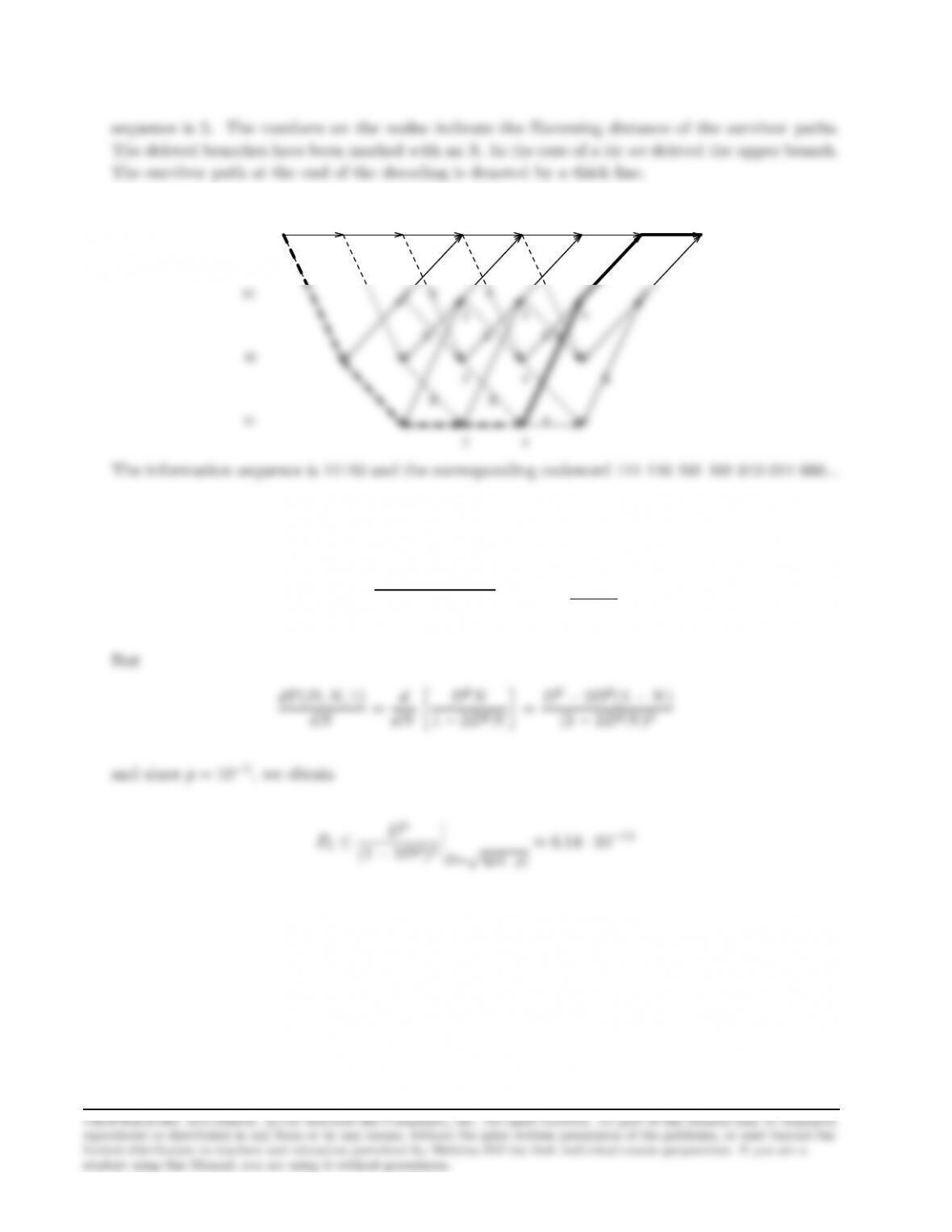
(d) The following figure shows 7 frames of the trellis diagram used by the Viterbi decoder. It is
assumed that the input sequence is padded by two zeros, so that the actual length of the information
7
00
110 110 110 111 010 101 100
2
4
6
3 4
3
4
6
7
X
X
X
X
X
(e) An upper to the bit error probability of the code is given by
Pb≤dT (D, N, J = 1)
dN
N=1,D=√4p(1−p)
(1 −2D2)2
Problem 8.5
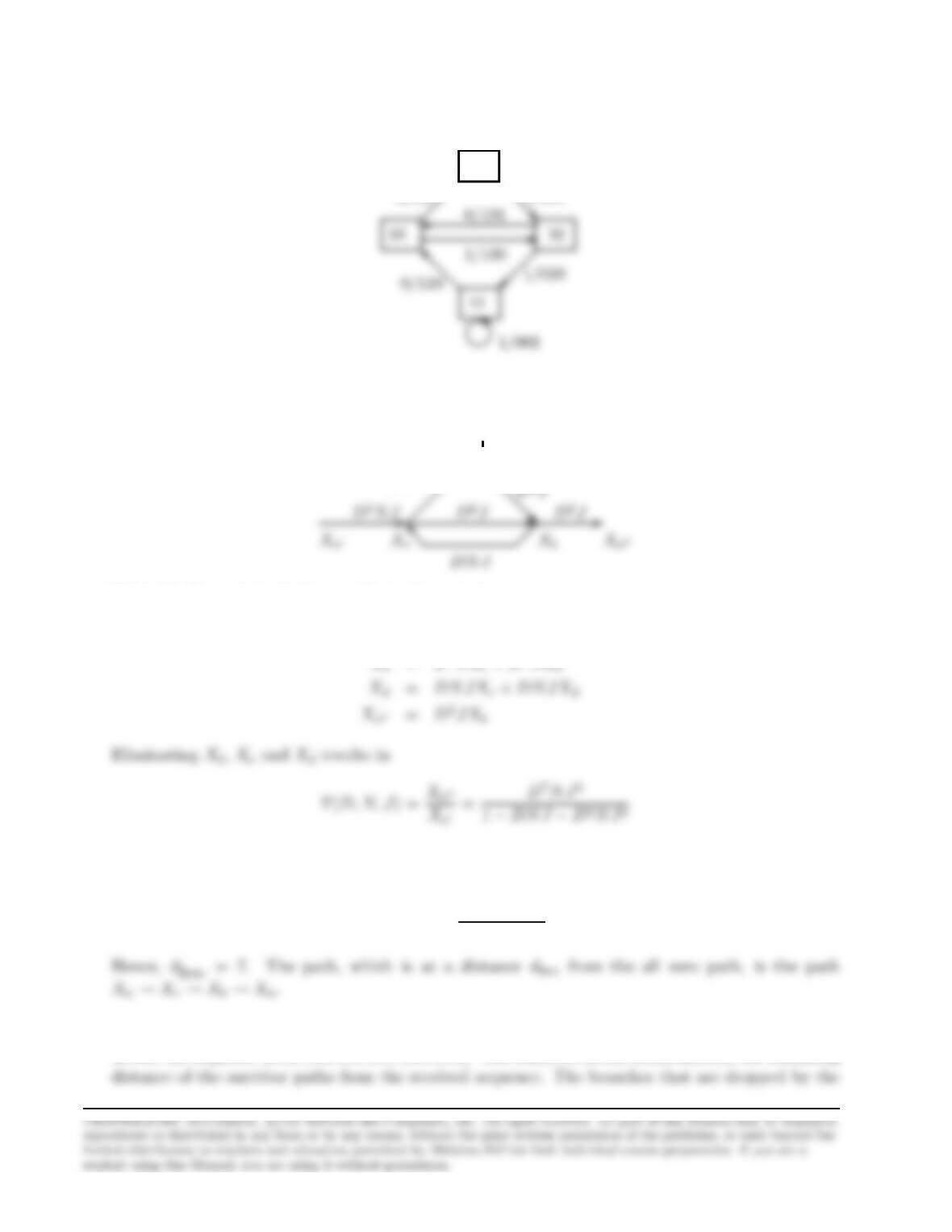
(a) The state transition diagram for this code is shown below
8
✍✌
✍✌
✎☞
.
.
.
.
.
.
.
.
.
.
.
.
.
.
.
.
.
.
.
.
.
.
.
.
.
❥.
✒
❅❅
1/001
0/011
1/111
0/000
11
00
(b) The diagram used to find the transfer function is shown in the next figure.
✍✌
✎☞
❄
❅❅❅❅
✒
DN J
D2J
DN J
D3NJ
D2J
Xd
Using the flow graph results, we obtain the system
Xc=D3NJXa′+DN JXb
Xb=D2JXc+D2JXd
(c) To find the free distance of the code we set N=J= 1 in the transfer function, so that
T1(D) = T(D, N, J)|N=J=1 =D7
1−D−D3=D7+D8+D9+···
(d) The following figure shows 6 frames of the trellis diagram used by the Viterbi algorithm to
decode the sequence {111,111,111,111,111,111}. The numbers on the nodes indicate the Hamming
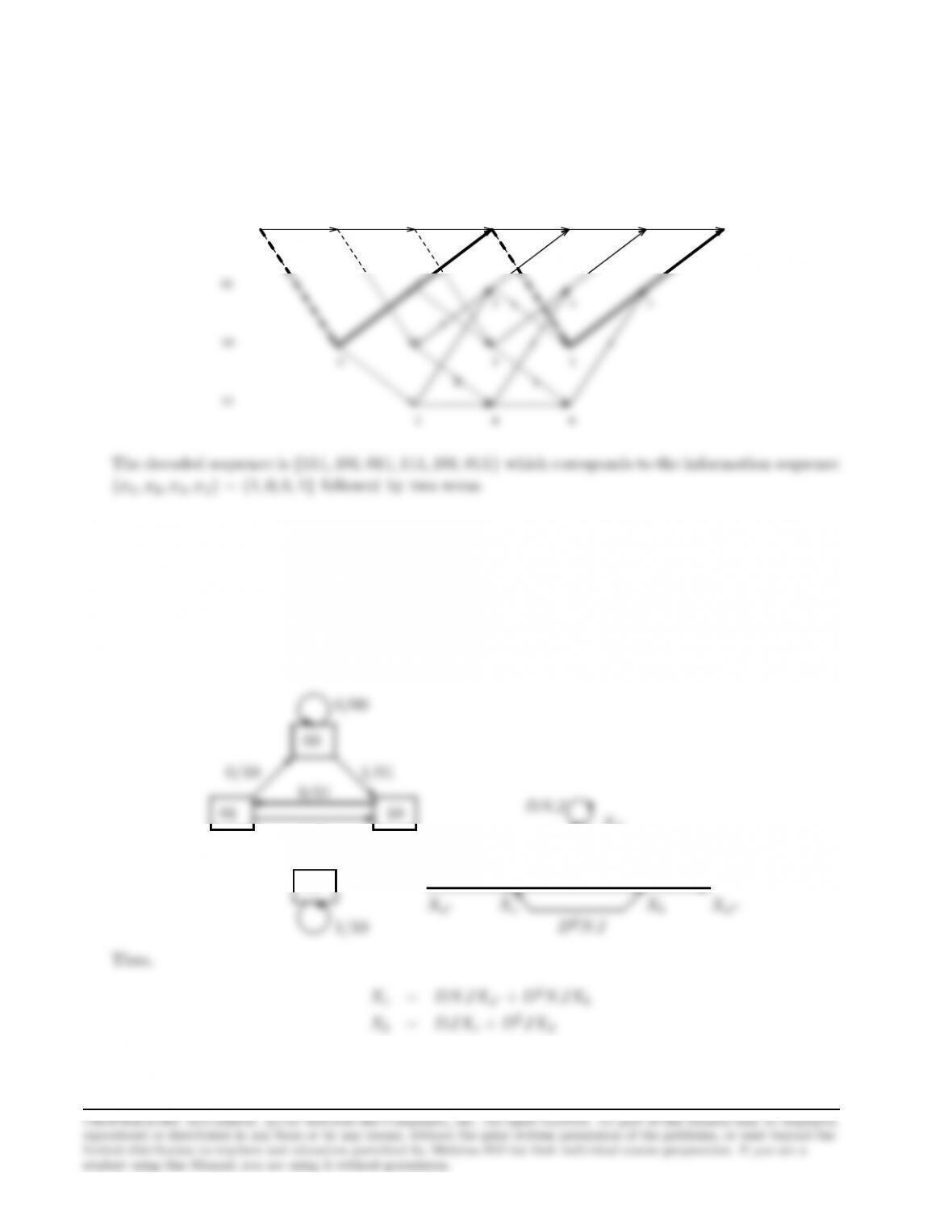
9
Viterbi algorithm have been marked with an X. In the case of a tie of two merging paths, we delete
the upper path.
00
111 111 111 111 111 111
3
6
2 4
X
x
2
6
4
x
5
x
4
x
Problem 8.6
(a) The state transition diagram and the flow diagram used to find the transfer function for this
code are depicted in the next figure.
✒✑
✓✏
.
.
.
.
.
.
.
.
.
.
.
.
.
.
.
.
.
.
.
.
.
❥.
0/00
00
Xd=NJXc+DN JXd
Xa′′ =DJXb
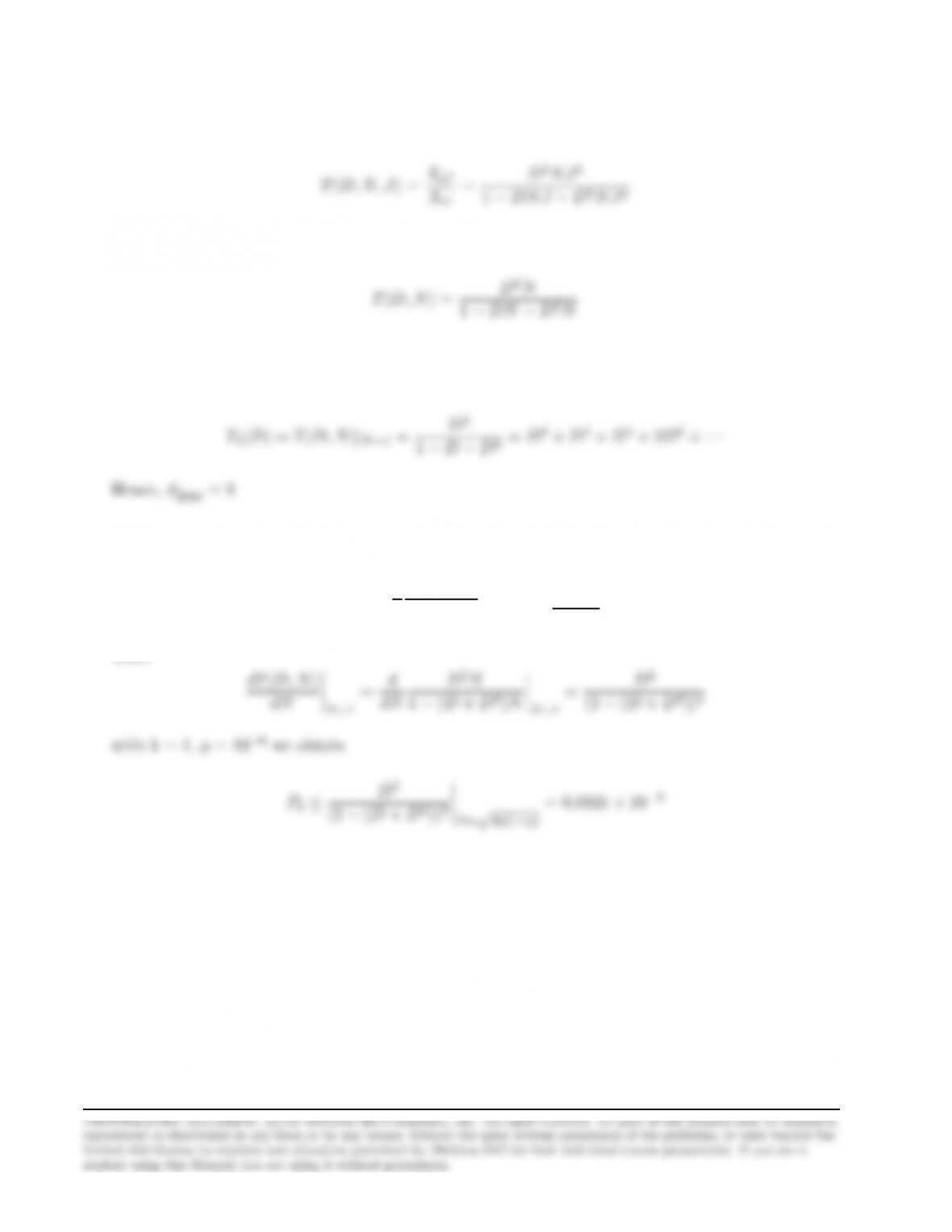
10
and by eliminating Xb,Xcand Xd, we obtain
To find the transfer function of the code in the form T(D, N ), we set J= 1 in T(D, N, J). Hence,
(b) To find the free distance of the code we set N= 1 in the transfer function T(D, N ), so that
(c) An upper bound on the bit error probability, when hard decision decoding is used, is given by
(see (8-2-34))
Pb≤1
k
dT (D, N )
dN
N=1,D=√4p(1−p)
Since
(1 −(D+D3))2
D=√4p(1−p)
Problem 8.7
(a)
g1= [10], g2= [11],states : (a) = [0],(b) = [1]
The tree diagram, trellis diagram and state diagram are given in the following figures :
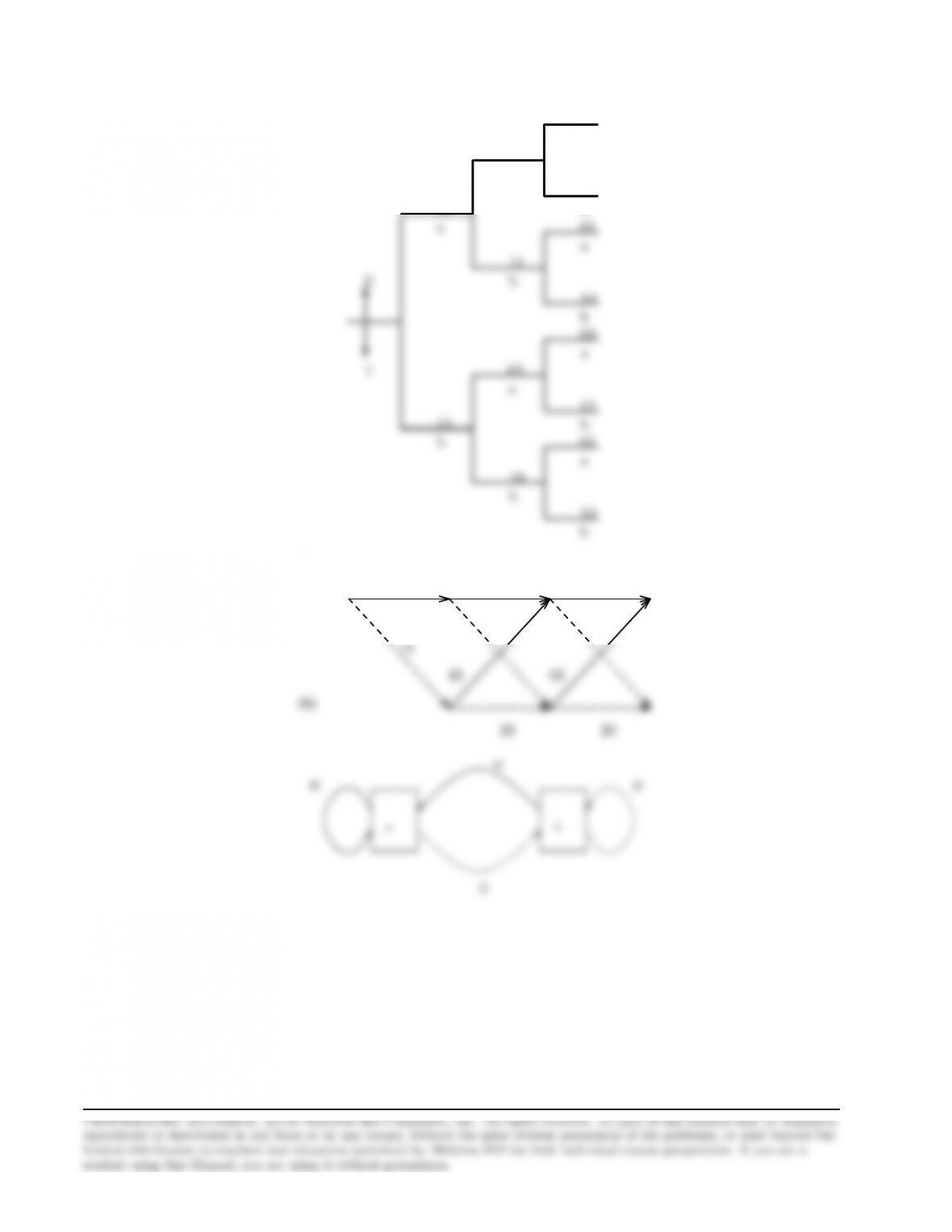
11
a
a
b
b
11
00
00
00
00 00 00
State
(a)
11
11 11
a b
00
11
10
(b) Redrawing the state diagram :
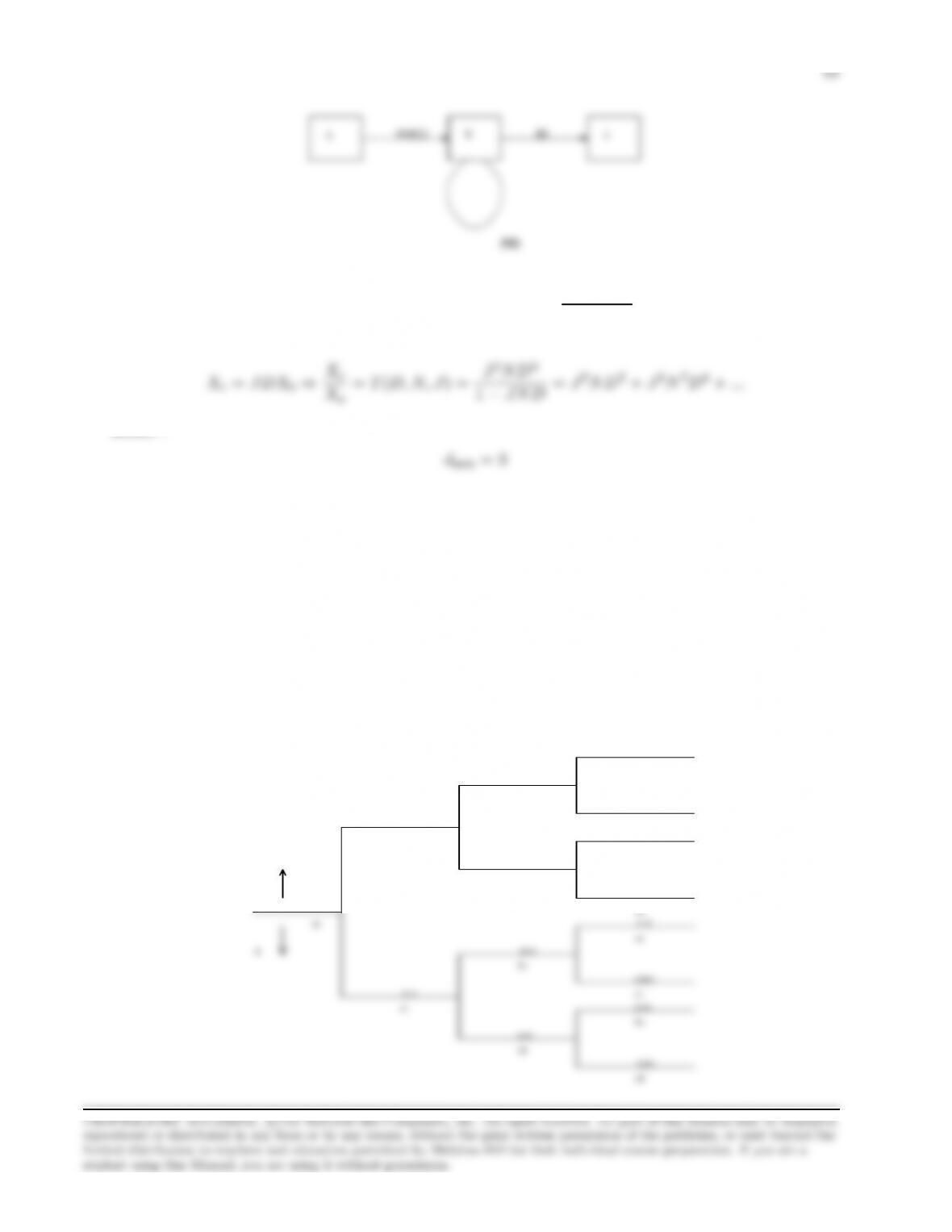
Xb=JN D2Xa+JNDXb⇒Xb=JN D2
1−JN D Xa
Hence :
Problem 8.8
(a)
g1= [111], g2= [101],states : (a) = [00],(b) = [01],(c) = [10],(d) = [11]
The tree diagram, trellis diagram and state diagram are given in the following figures :
0
a
a
a
b
d
c
b
c00
00
00
11
10
01
00
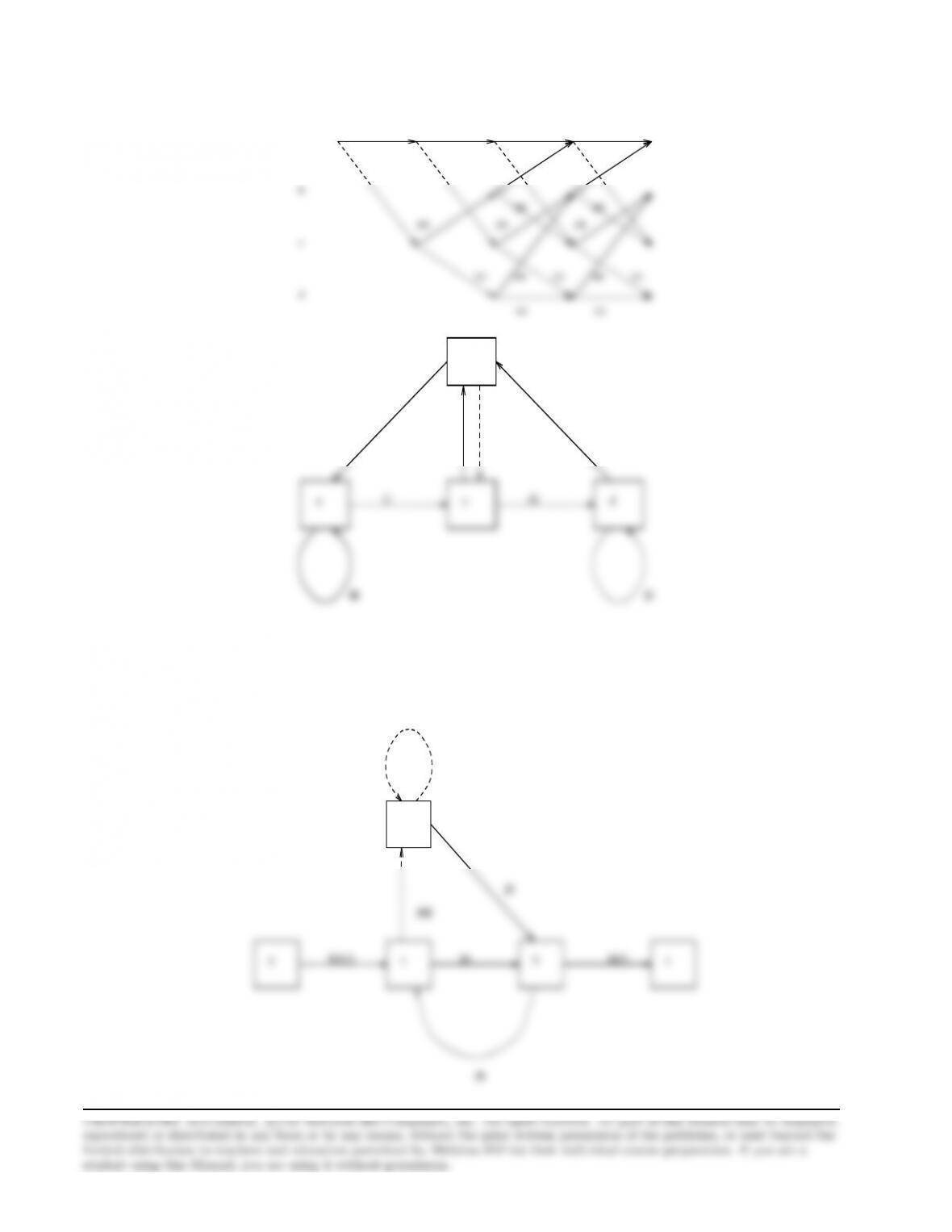
13
State
a
00 00 00 00
11
11 11
11
00 10
(b) Redrawing the state diagram :
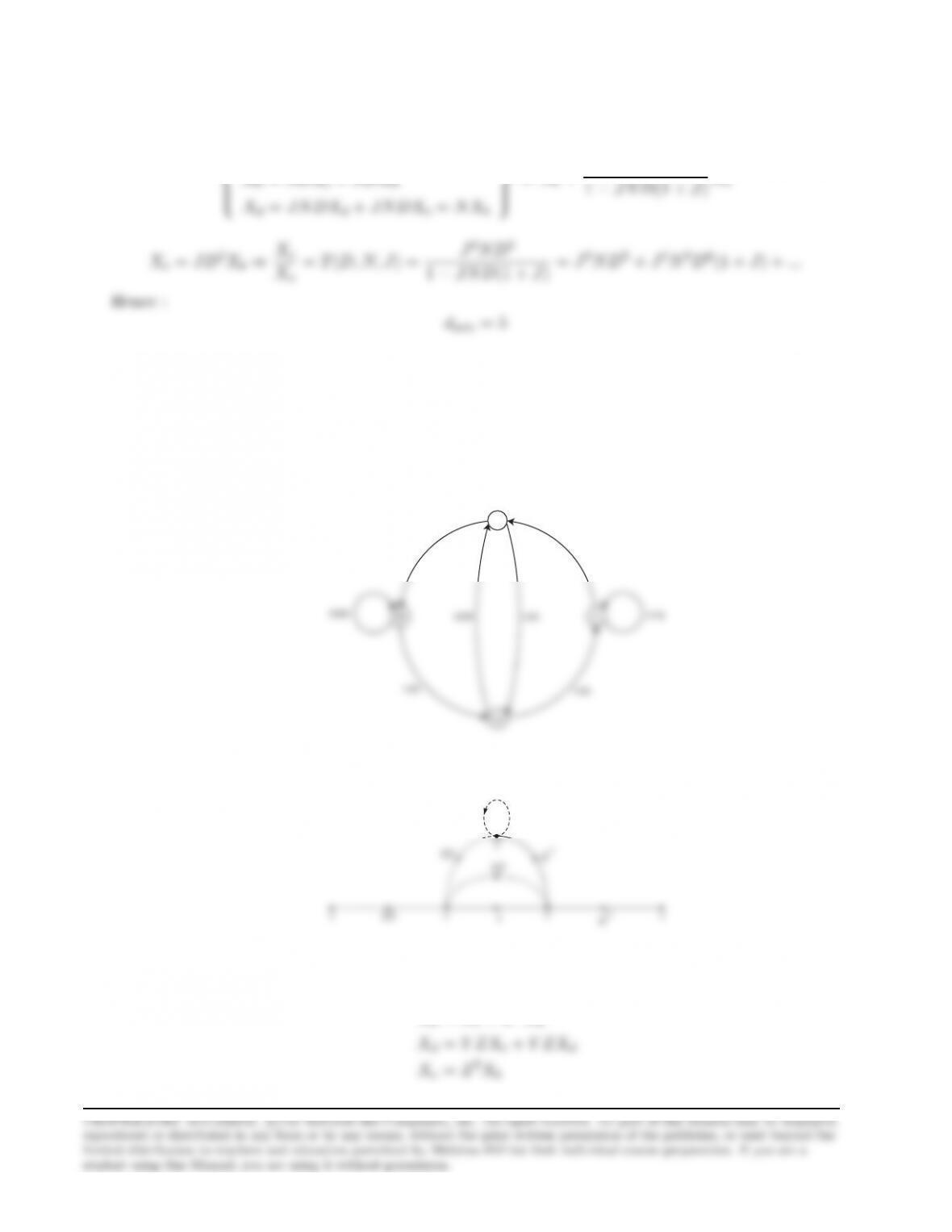
d
JND
14
Xc=JN D2Xa+JNXb
Xb=JDXc+JDXd
⇒Xb=J2ND3
Problem 8.9
1. The state transition diagram is shown below
01
10
0/11
0/11
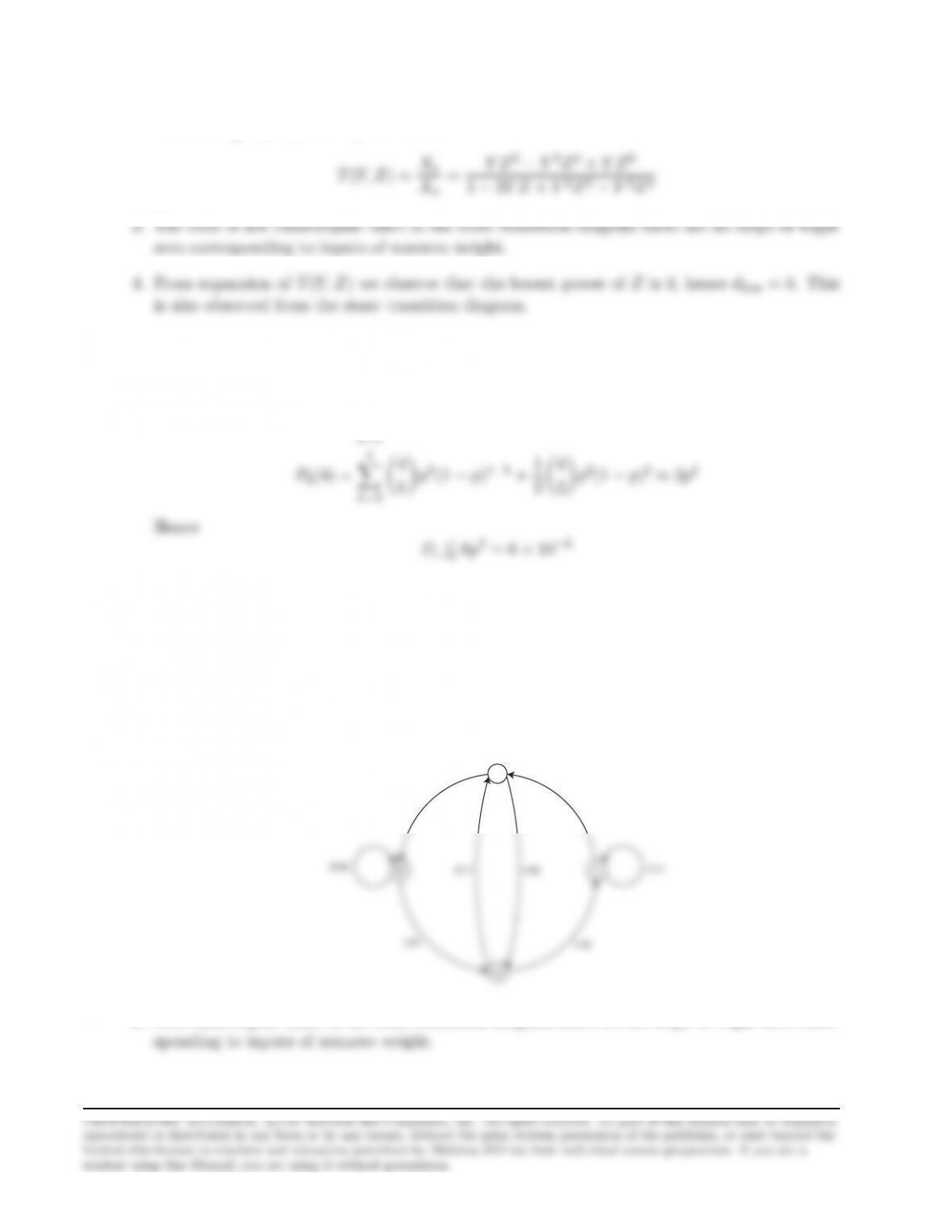
2. The transition diagram is shown below
YZ
and the Equations are
Xc=Y ZXa+Y ZXb
Xb=Xc+Z2Xd
15
Eliminating Xb,Xc, and Xd, we obtain
5. We use Equations 8.2-16–8.2-19 to find a bound on the bit error probability. First we note
that T(Y, Z) = Y Z3+Y2Z4+Y3Z5+…, hence a3=a4=a5= 1 and
P2(3) =
3
X
kpk(1 −p)3−k≈3p2
4
X
Problem 8.10
1. The state transition diagram is shown below
01
10
0/10
0/01
2. Non catastrophic since in the state transition diagram there are no loops of wight zero corre-
3. The transition diagram is shown below
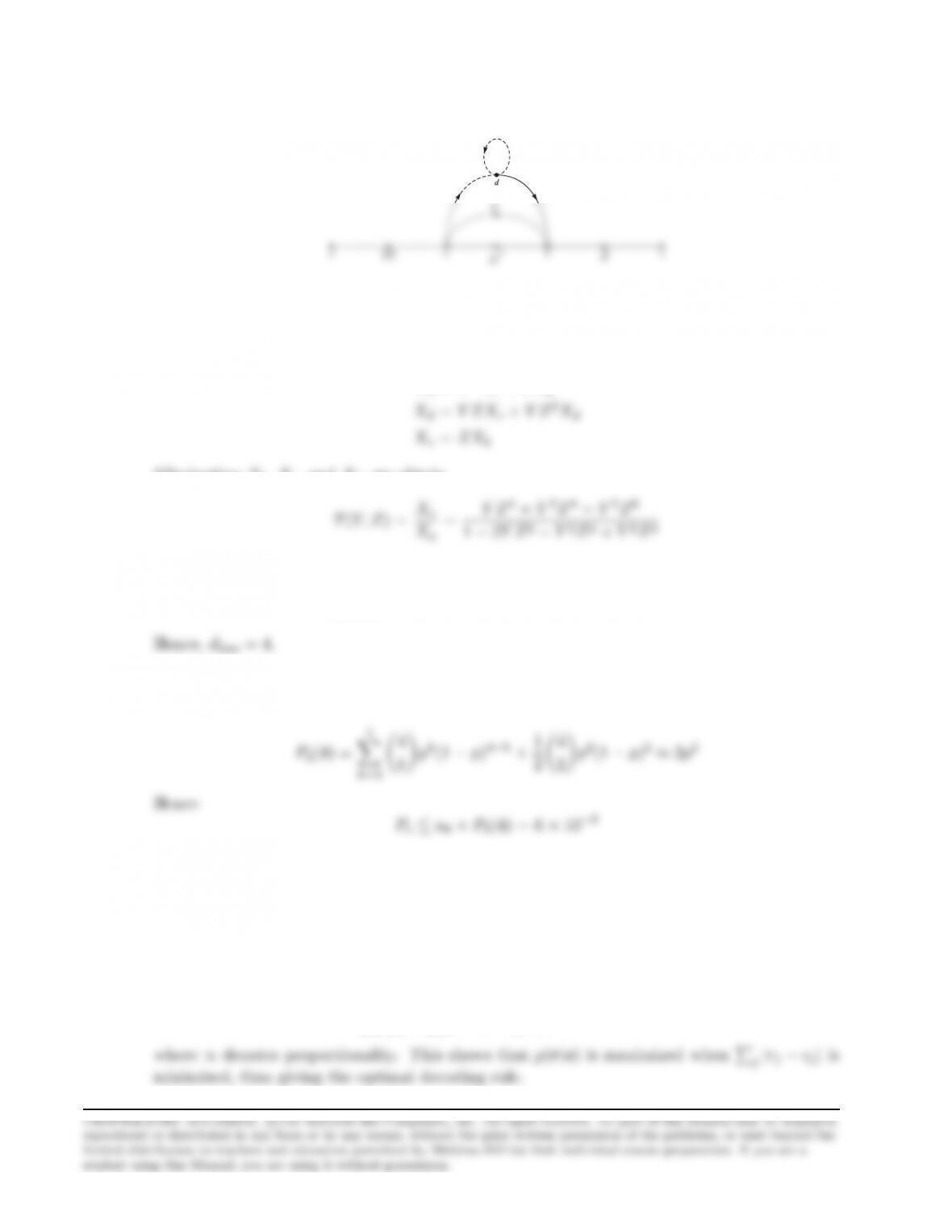
16
YZ
Y
Z
Z 2
and the Equations are
Xc=Y ZXa+Y Xb
Xb=Z2Xc+ZXd
Eliminating Xb,Xc, and Xd, we obtain
4. Expanding T(Y, Z), we have
T(Y, Z) = Y Z4+Y2Z4+ 3Y3Z6+Y4Z6+…
5. We use Equations 8.2-16–8.2-19 to find a bound on the bit error probability. First we note
that T(Z) = 2Z4+ 4Z6+…, hence a4= 2, a6= 3 and
4
X
Problem 8.11
1. We have
p(r|s) = p(n=r−s)∝e−Pj|rj−cj|
2. Since soft decision decoding is employed, we use the bound given by Equation 8.2.15 with ∆
given by Equation 8.2.10. From 8.2.10 we have
∆ = Z∞
−∞ qp(r|c=pEc)p(r|c=−pEc)dr
=Z∞
The transfer function for this convolutional code was derived in the solution to Problem 8.10
and is given by
T(Y, Z) = T(Y, Z) = Y Z4+Y2Z4+ 3Y3Z6+Y4Z6+…
Therefore,
Pb≤3∆4+ 13∆6+…
3. Since the length of the received sequence is 12 and n= 2, we need a trellis of depth 6 which
is shown below
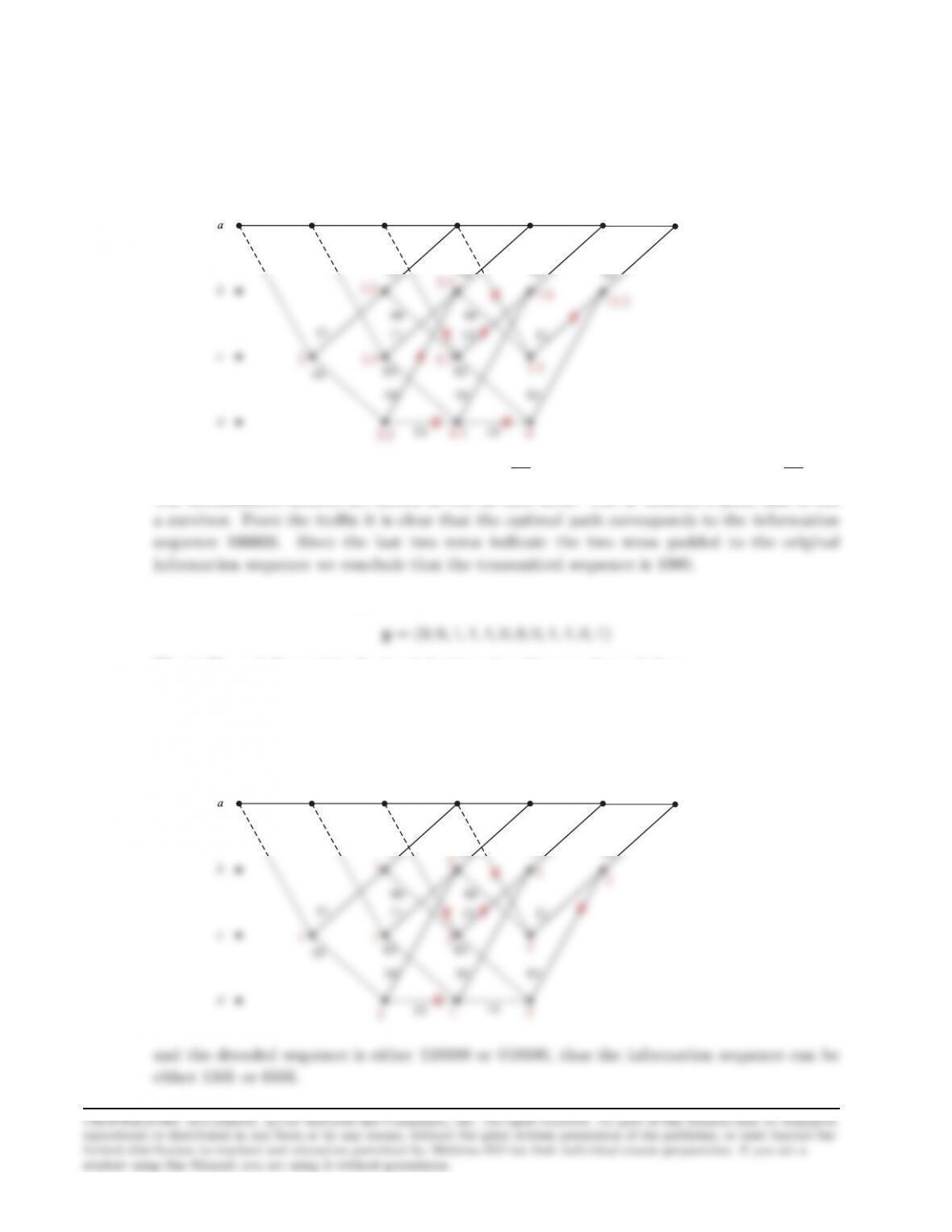
18
00 00 00 00 00 00
01 01 01 01
01 01 01 01
(-1,-1) (1.5,2) (0.7,-0.5) (-0.8,-3) (3,0.2) (0,1)
0
5.5
6.7 8.9 11.1 14.1
###
#
5.3
Note that on the trellis each 0 corresponds to −√Ec=−1 and each 1 corresponds to √Ec= 1.
The accumulated metrics are shown in red on each node. The # denotes a path that is not
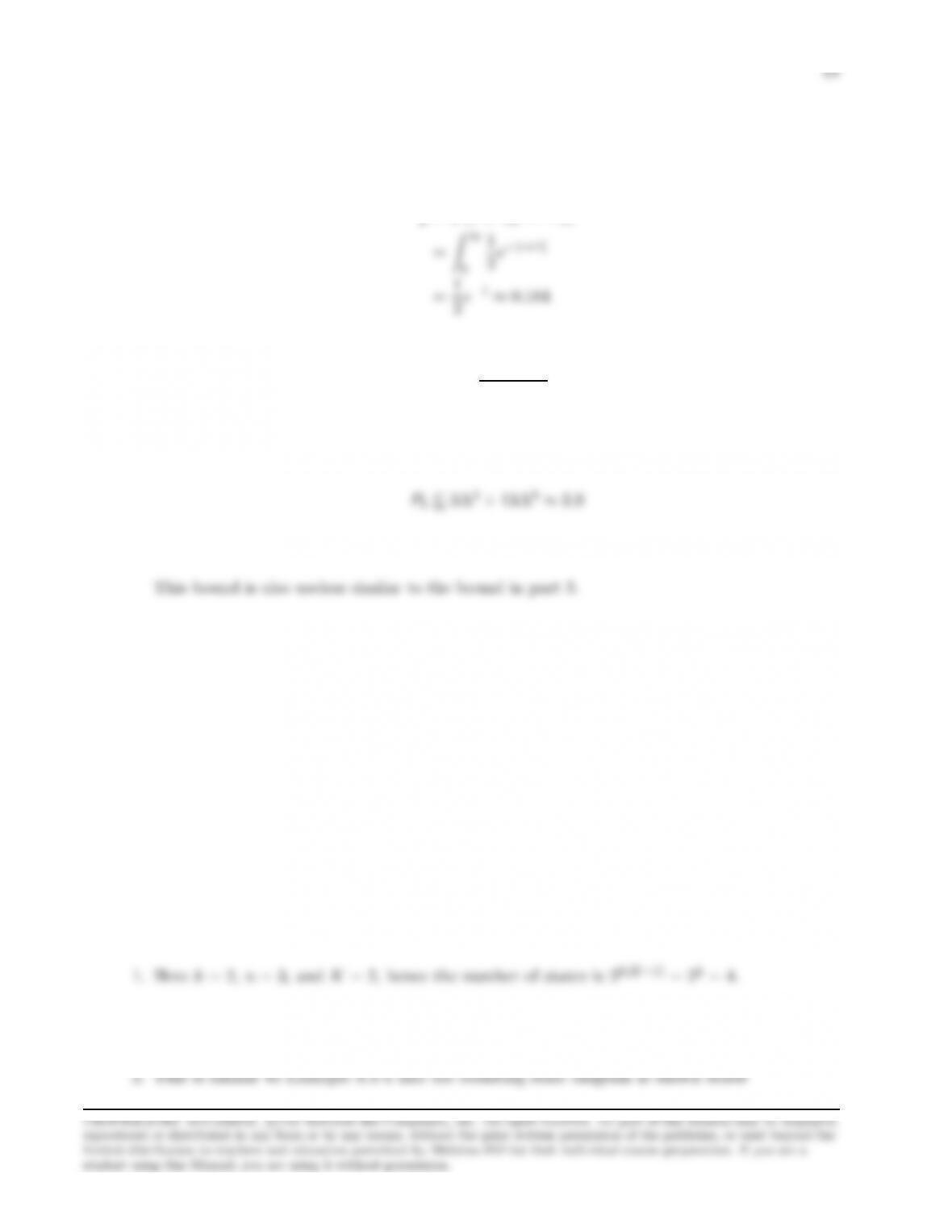
4. After hard decision decoding we have
The trellis and the metrics for hard decision decoding are shown below
00 00 00 00 00 00
01 01 01 01
01 01 01 01
(0,0) (1,1) (1,0) (0,0) (1,1) (0,1)
0
2
3 3 3 2
##
2
5. For hard decision decoding we have
p=P(r > 0|c=−1)
1
and from Equation 8.2-14 we have ∆ = p4p(1 −p) = 0.775. If we use this new ∆ in the
error bound expression of part 3 we obtain
Problem 8.12