
Solutions Manual
for
Digital Communications, 5th Edition
(Chapter 6) 1
Prepared by
Kostas Stamatiou
January 11, 2008
2
Problem 6.1
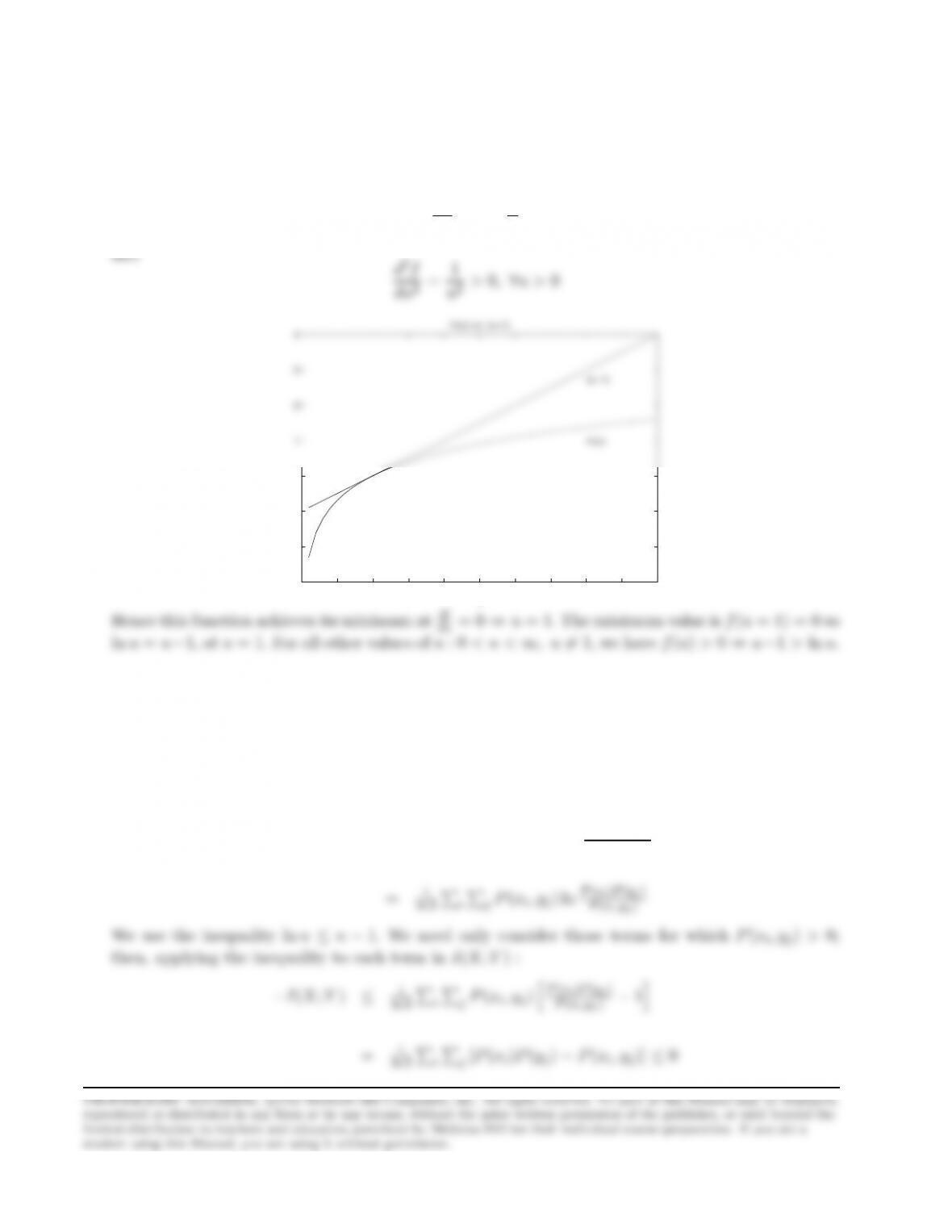
Let f(u) = u−1−ln u. The first and second derivatives of f(u) are
df
du = 1 −1
u
0 0.5 1 1.5 2 2.5 3 3.5 4 4.5 5
−3
−2
−1
0
1
2
3
4
u
ln(u) vs. (u−1)
(u−1)
ln(u)
Hence this function achieves its minimum at df
du = 0 ⇒u= 1.The minimum value is f(u= 1) = 0 so
ln u=u−1,at u= 1.For all other values of u: 0 < u < ∞, u 6= 1,we have f(u)>0⇒u−1>ln u.
Problem 6.2
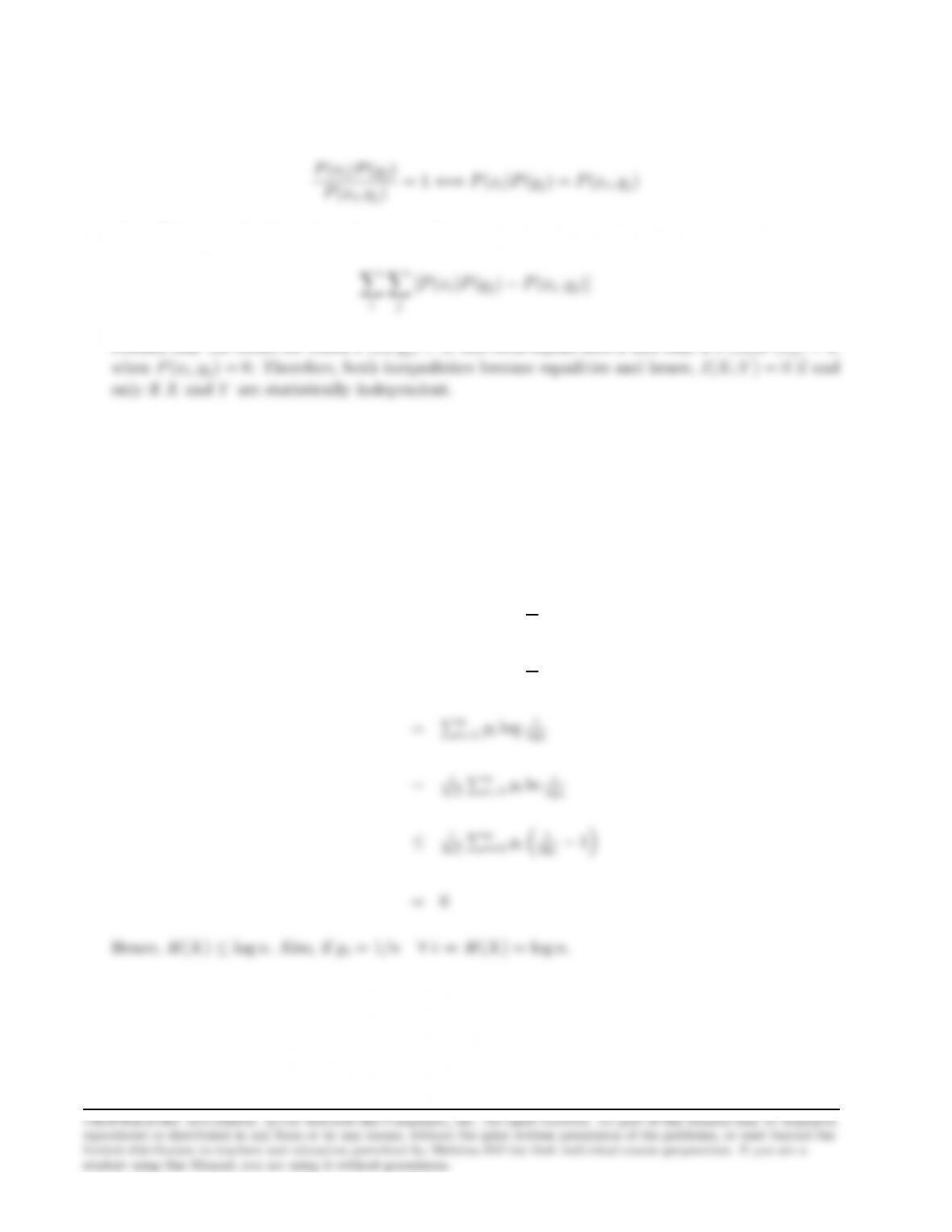
We will show that −I(X;Y)≤0
−I(X;Y) = −PiPjP(xi, yj) log 2P(xi,yj)
P(xi)P(yj)
3
The first inequality becomes equality if and only if
when P(xi, yj)>0.Also, since the summations
iX
j
contain only the terms for which P(xi, yj)>0,this term equals zero if and only if P(Xi)P(Yj) = 0,
Problem 6.3
We shall prove that H(X)−log n≤0 :
H(X)−log n=Pn
i=1 pilog 1
pi−log n
=Pn
i=1 pilog 1
pi−Pn
i=1 pilog n
Problem 6.4
1.
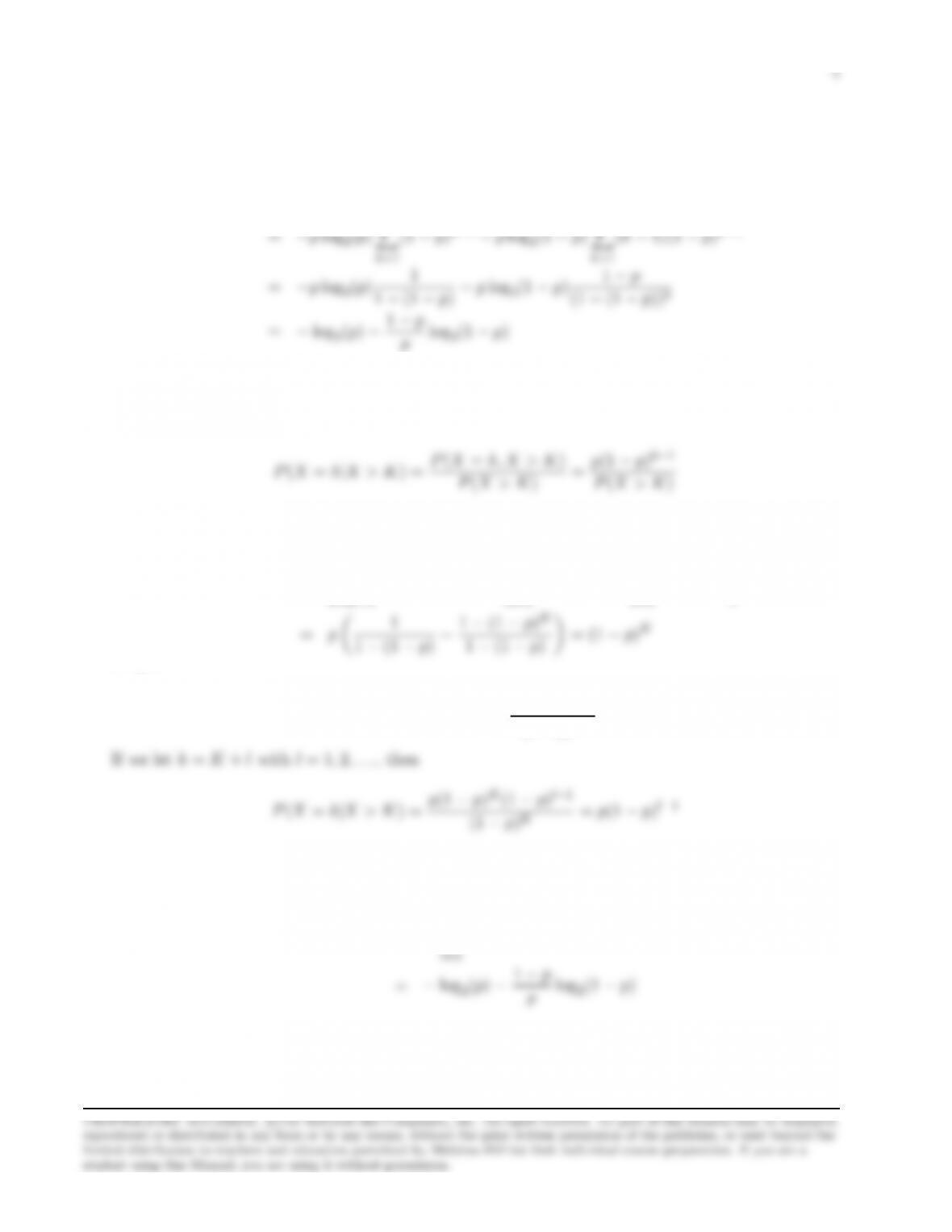
H(X) = −
∞
X
k=1
p(1 −p)k−1log2(p(1 −p)k−1)
∞
X
∞
X
2. Clearly P(X=k|X > K) = 0 for k≤K. If k > K, then
But,
P(X > K) =
∞
X
k=K+1
p(1 −p)k−1=p ∞
X
k=1
(1 −p)k−1−
K
X
k=1
(1 −p)k−1!
so that
P(X=k|X > K) = p(1 −p)k−1
(1 −p)K
that is P(X=k|X > K) is the geometrically distributed. Hence, using the results of the first part
we obtain
H(X|X > K) = −
∞
X
p(1 −p)l−1log2(p(1 −p)l−1)
Problem 6.5
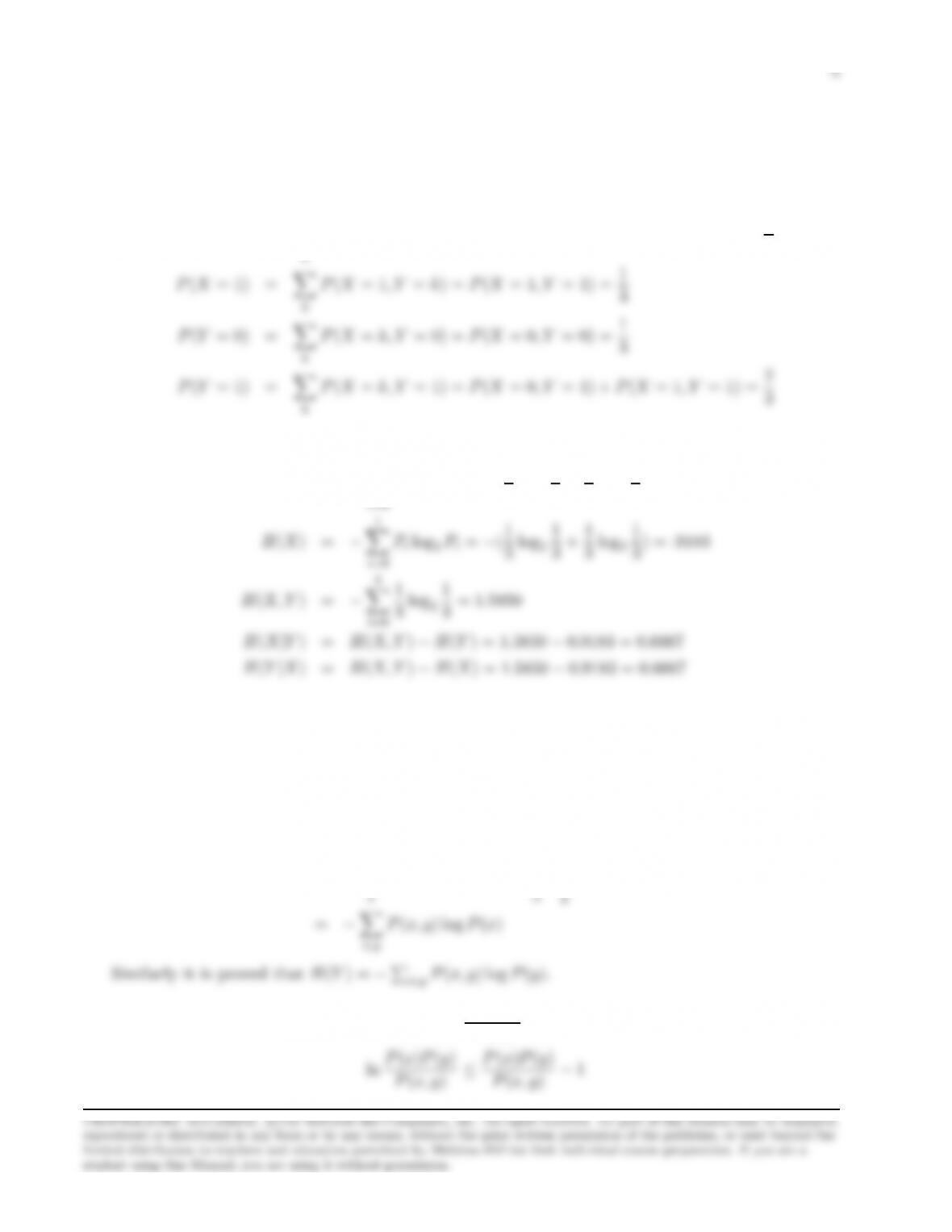
The marginal probabilities are given by
P(X= 0) = X
k
P(X= 0, Y =k) = P(X= 0, Y = 0) + P(X= 0, Y = 1) = 2
3
k
Hence,
H(X) = −
1
X
Pilog2Pi=−(1
3log2
1
3+1
3log2
1
3) = .9183
1
X
1
1
Problem 6.6
1. The marginal distribution P(x) is given by P(x) = PyP(x, y). Hence,
H(X) = −X
P(x) log P(x) = −X
P(x, y) log P(x)
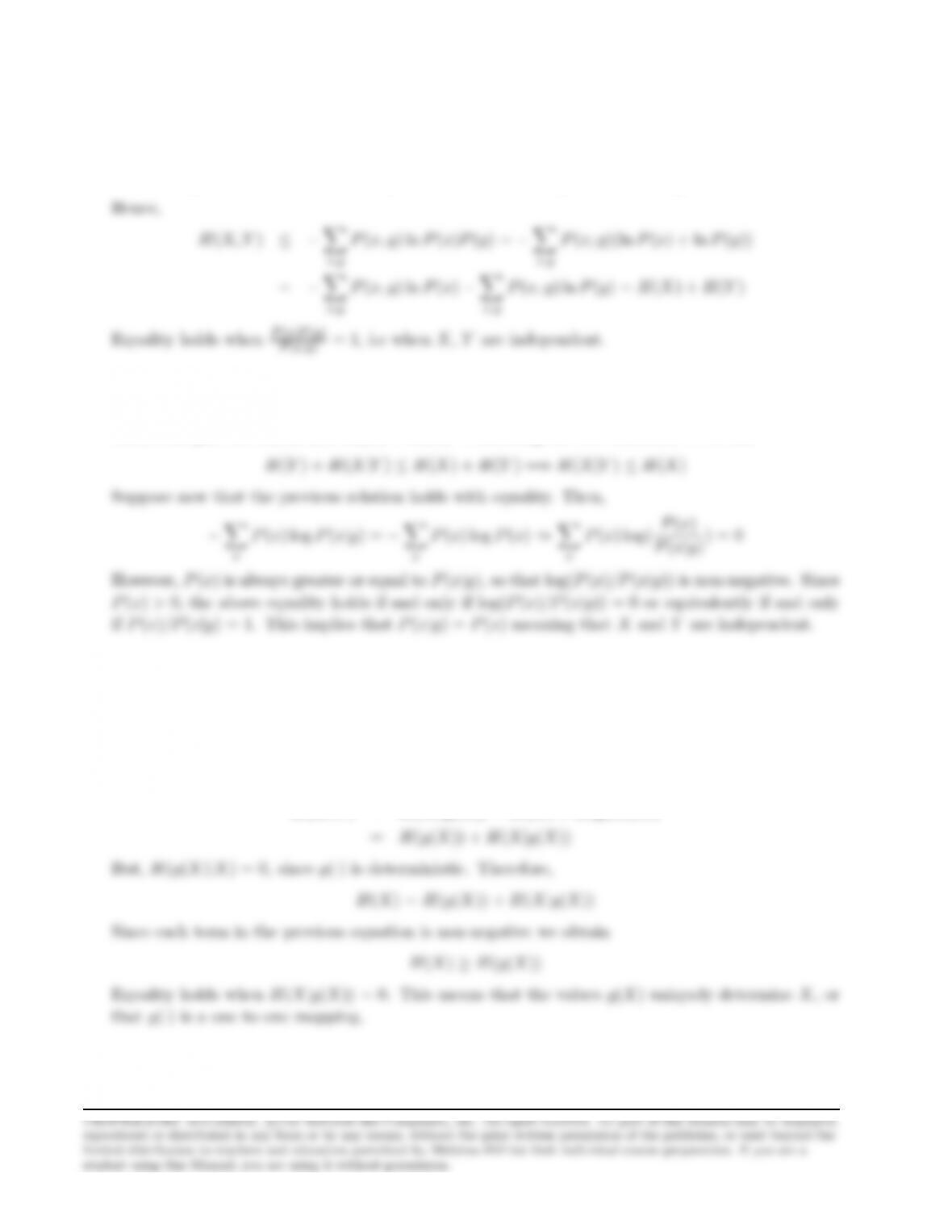
2. Using the inequality ln w≤w−1 with w=P(x)P(y)
P(x,y), we obtain
6
Multiplying the previous by P(x, y) and adding over x,y, we obtain
X
x,y
P(x, y) ln P(x)P(y)−X
x,y
P(x, y) ln P(x, y)≤X
x,y
P(x)P(y)−X
x,y
P(x, y) = 0
3.
H(X, Y ) = H(X) + H(Y|X) = H(Y) + H(X|Y)
Also, from part 2., H(X, Y )≤H(X) + H(Y). Combining the two relations, we obtain
Problem 6.7
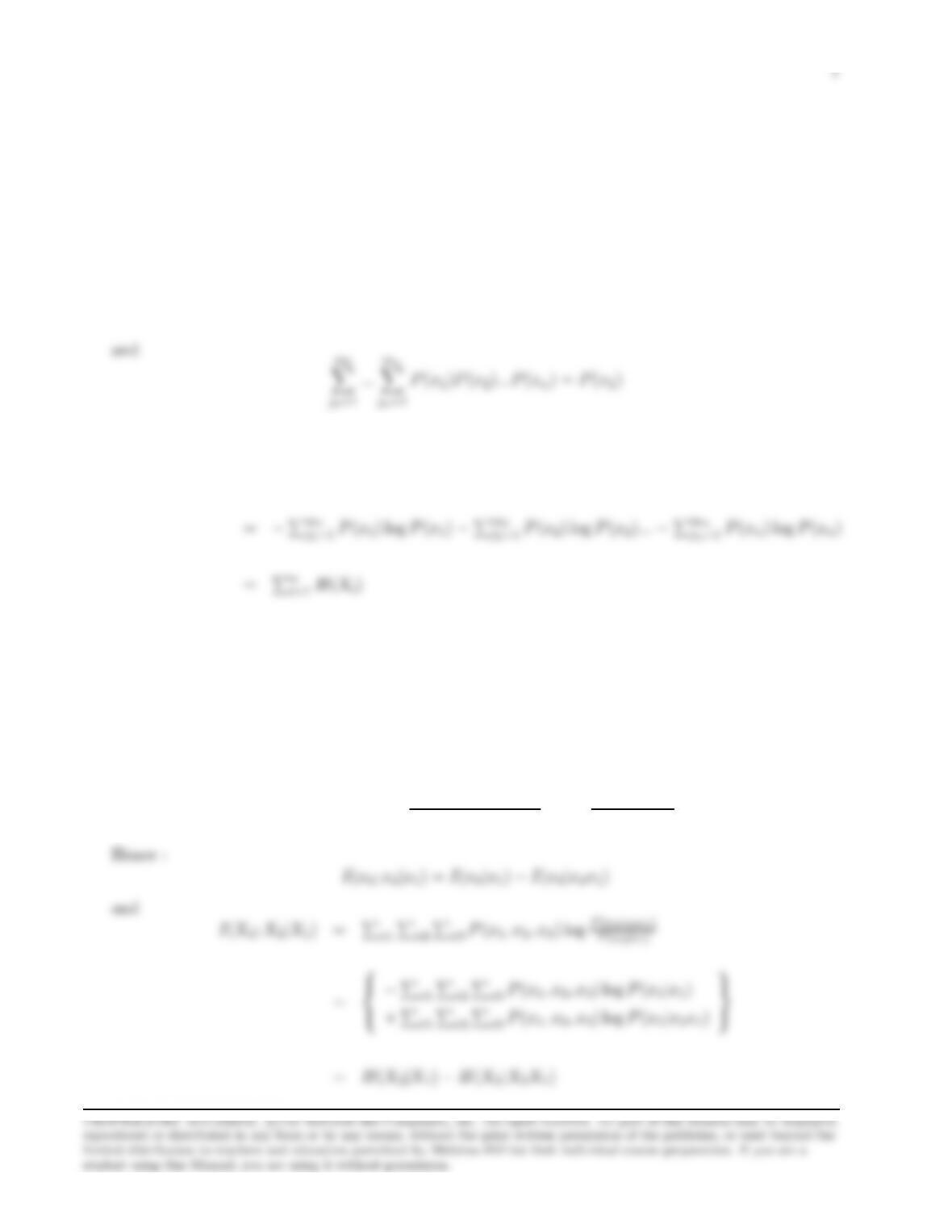
H(X, Y ) = H(X, g(X)) = H(X) + H(g(X)|X)
Problem 6.8
H(X1X2…Xn) = −
m1
X
j1=1
m2
X
j2=1
…
mn
X
jn=1
P(x1, x2, …, xn) log P(x1, x2, …, xn)
Since the {xi}are statistically independent :
P(x1, x2, …, xn) = P(x1)P(x2)…P (xn)
j2=1
jn=1
(similarly for the other xi).Then :
H(X1X2…Xn) = −Pm1
j1=1 Pm2
j2=1 … Pmn
jn=1 P(x1)P(x2)…P (xn) log P(x1)P(x2)…P (xn)
Problem 6.9
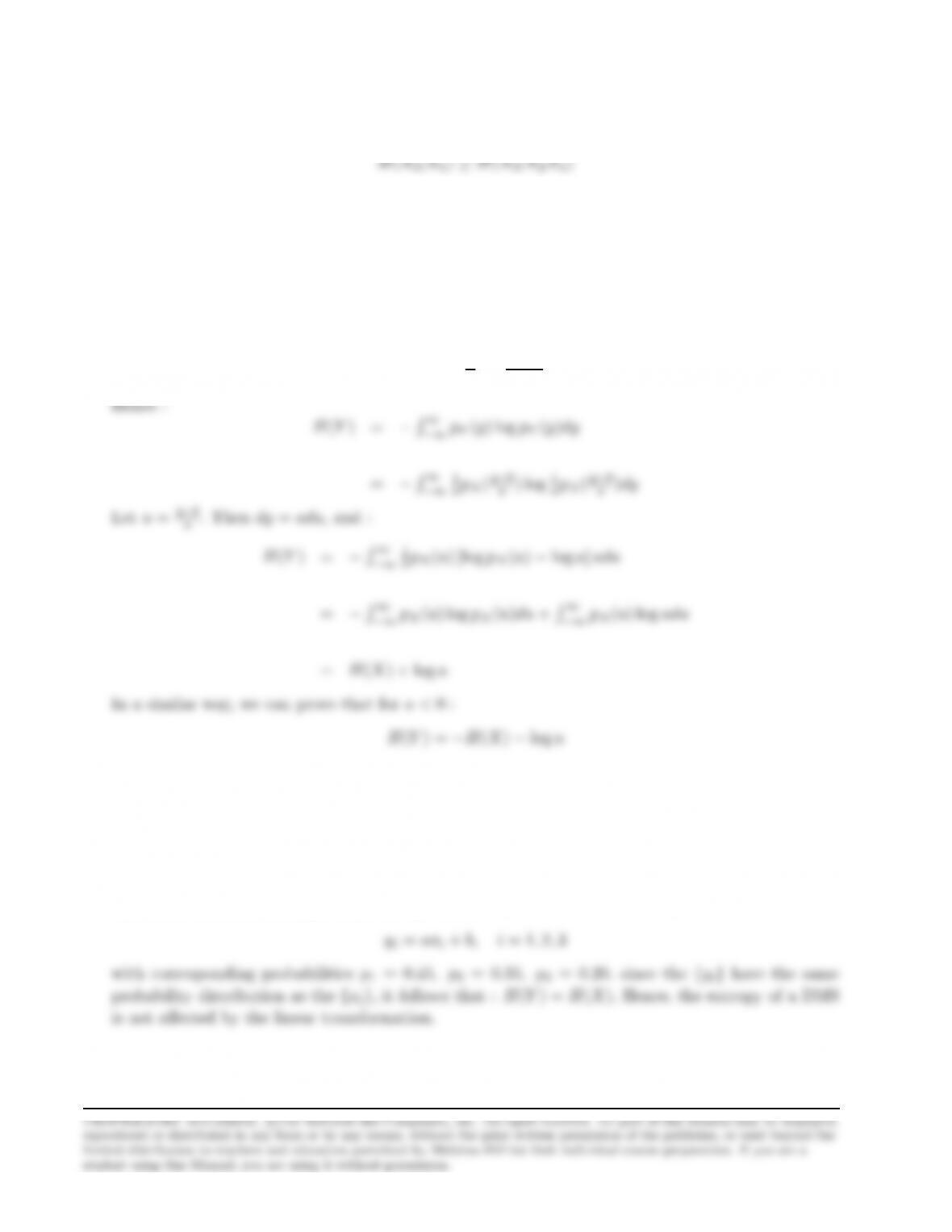
The conditional mutual information between x3and x2given x1is defined as :
I(x3;x2|x1) = log P(x3, x2|x1)
P(x3|x1)P(x2|x1)= log P(x3|x2x1)
P(x3|x1)
8
Since I(X3;X2|X1)≥0,it follows that :
Problem 6.10
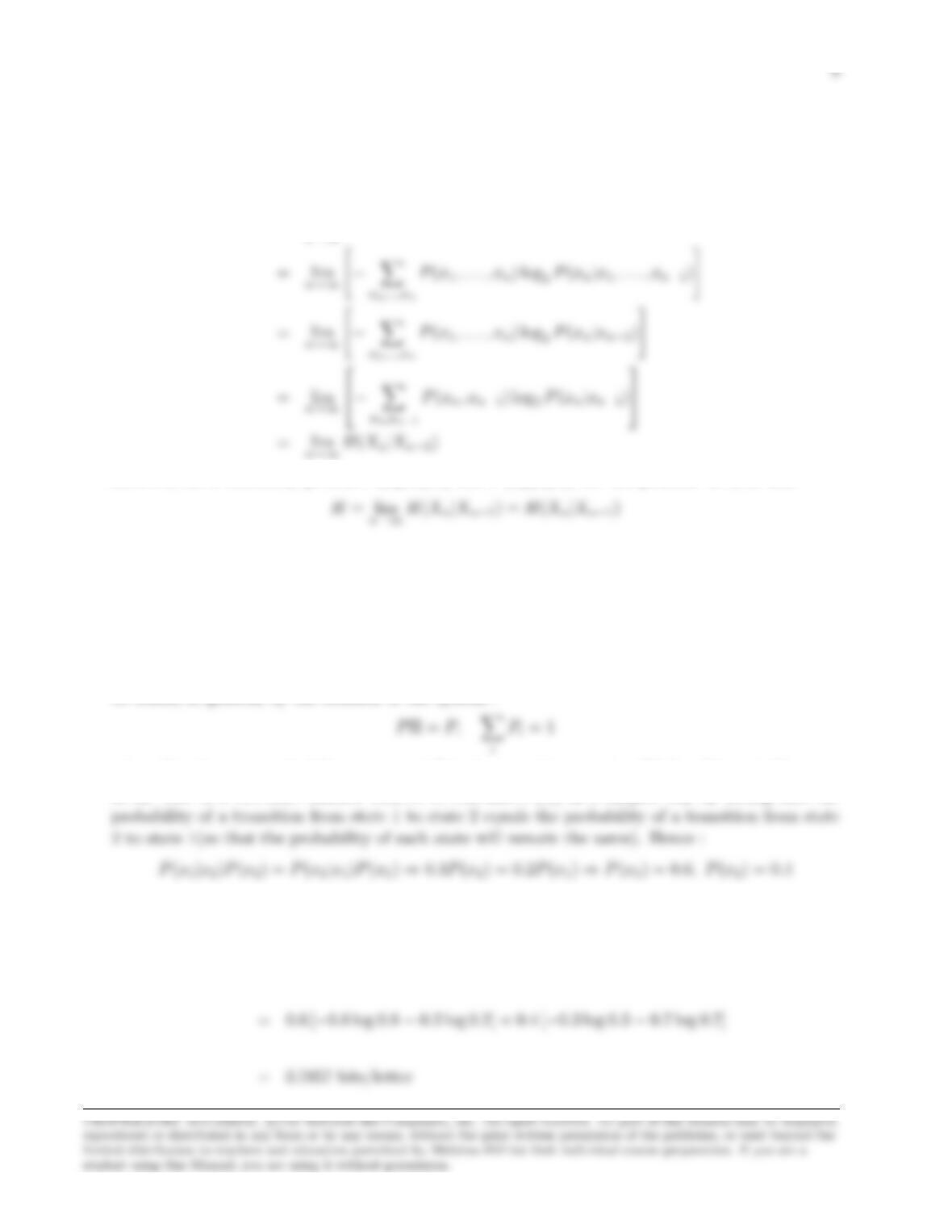
Assume that a > 0.Then we know that in the linear transformation Y=aX +b:
pY(y) = 1
apX(y−b
a)
Problem 6.11
The linear transformation produces the symbols :
Problem 6.12
H= lim
n→∞ H(Xn|X1,…,Xn−1)
However, for a stationary process P(xn, xn−1) and P(xn|xn−1) are independent of n, so that
Problem 6.13
First, we need the state probabilities P(xi), i = 1,2.For stationary Markov processes, these can
be found, in general, by the solution of the system :
i
where Pis the state probability vector and Π is the transition matrix : Π[ij] = P(xj|xi).However,
in the case of a two-state Markov source, we can find P(xi) in a simpler way by noting that the
Then :
H(X) =
P(x1) [−P(x1|x1) log P(x1|x1)−P(x2|x1) log P(x2|x1)] +
P(x2) [−P(x1|x2) log P(x1|x2)−P(x2|x2) log P(x2|x2)]
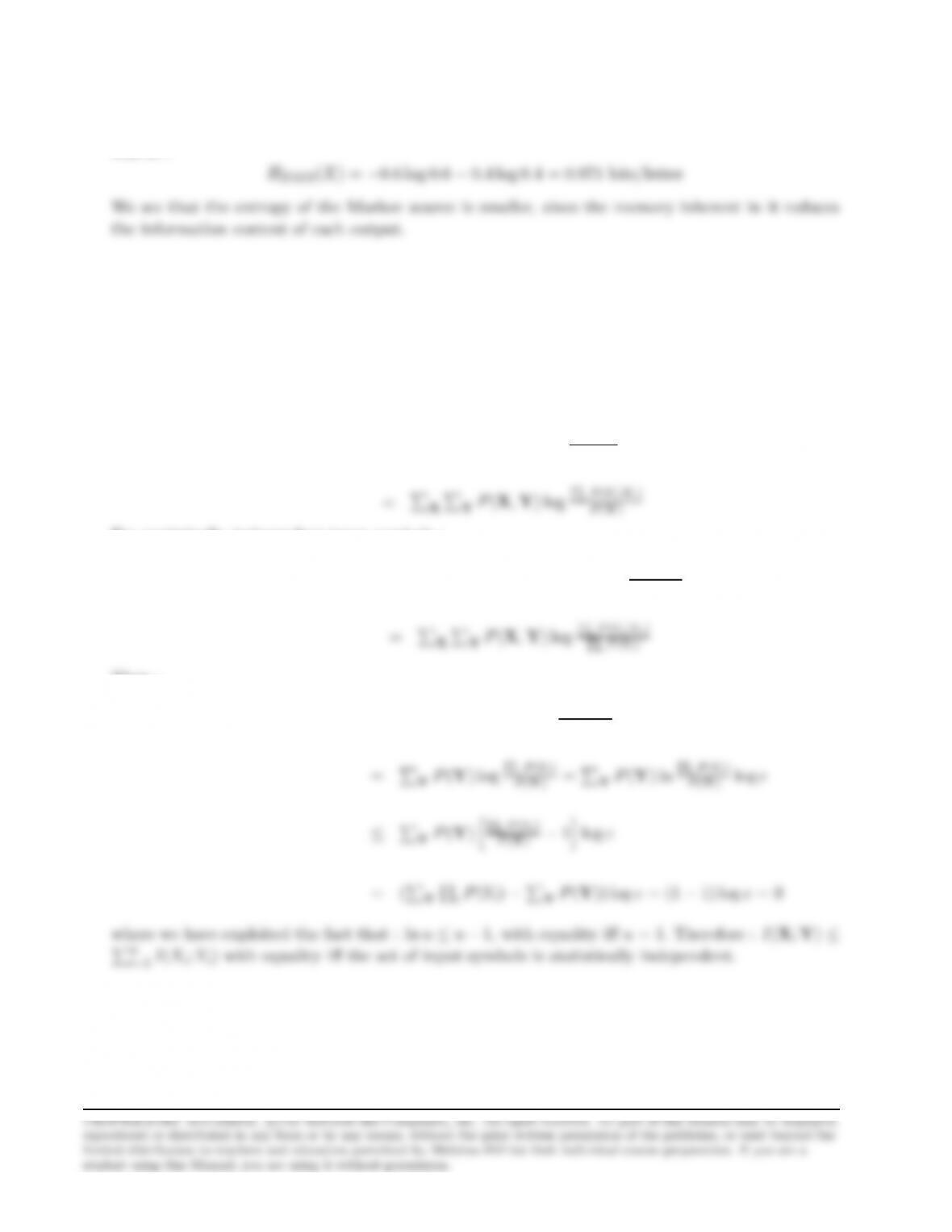
10
If the source is a binary DMS with output letter probabilities P(x1) = 0.6, P (x2) = 0.4,its entropy
will be :
Problem 6.14
Let X= (X1, X2, …, Xn),Y= (Y1, Y2, …, Yn).Since the channel is memoryless : P(Y|X) =
Qn
i=1 P(Yi|Xi) and :
I(X;Y) = PXPYP(X,Y) log P(Y|X)
P(Y)
For statistically independent input symbols :
Pn
i=1 I(Xi;Yi) = Pn
i=1 PXiPYiP(Xi, Yi) log P(Yi|Xi)
P(Yi)
Then :
I(X;Y)−Pn
i=1 I(Xi;Yi) = PXPYP(X,Y) log QiP(Yi)
P(Y)
Problem 6.15
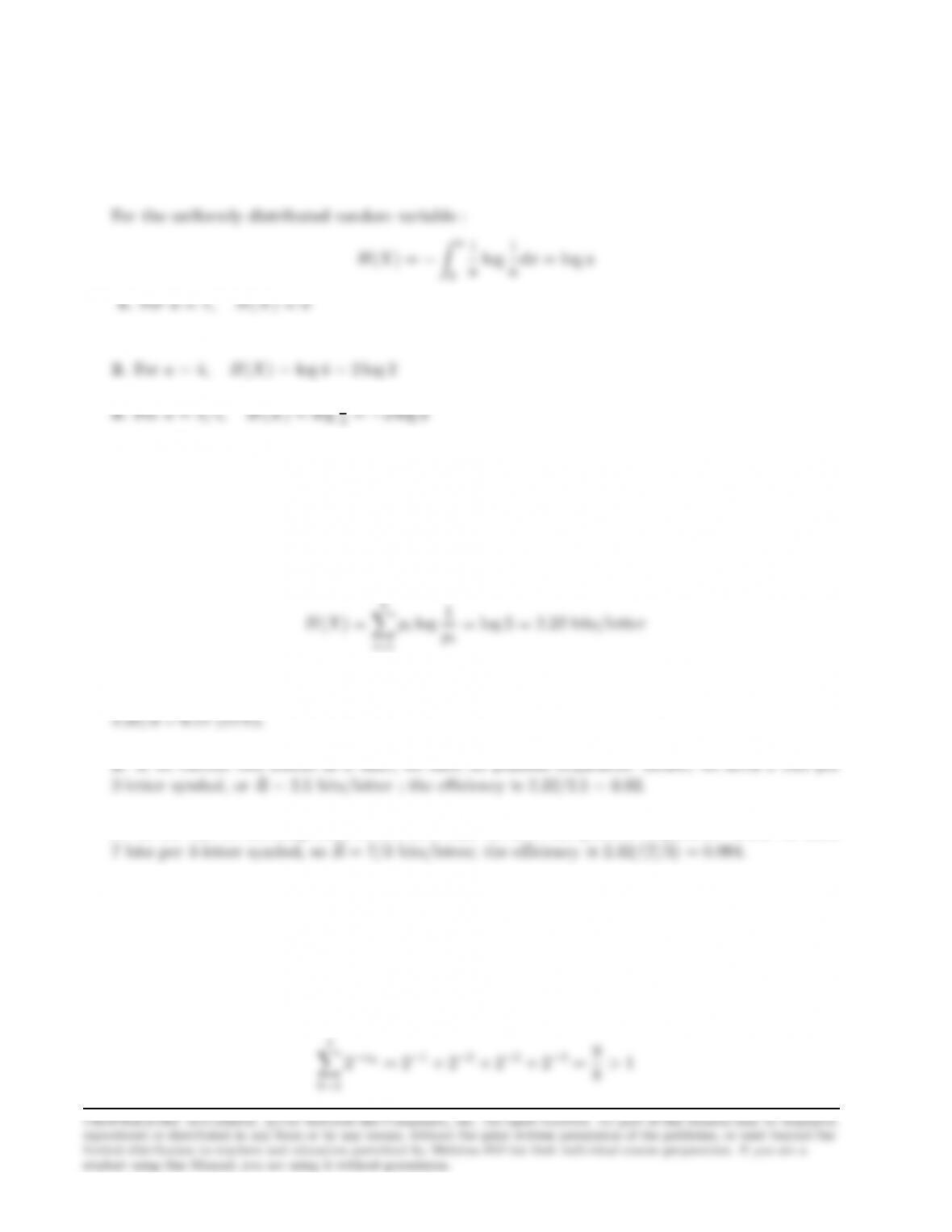
11
By definition, the differential entropy is
H(X) = −Z∞
−∞
p(x) log p(x)dx
Problem 6.16
The source entropy is :
5
X
i=1
pi
1. When we encode one letter at a time we require ¯
R= 3 bits/letter . Hence, the efficiency is
2. If we encode two letters at a time, we have 25 possible sequences. Hence, we need 5 bits per
3. In the case of encoding three letters at a time we have 125 possible sequences. Hence we need
Problem 6.17
Given (n1, n2, n3, n4) = (1,2,2,3) we have :
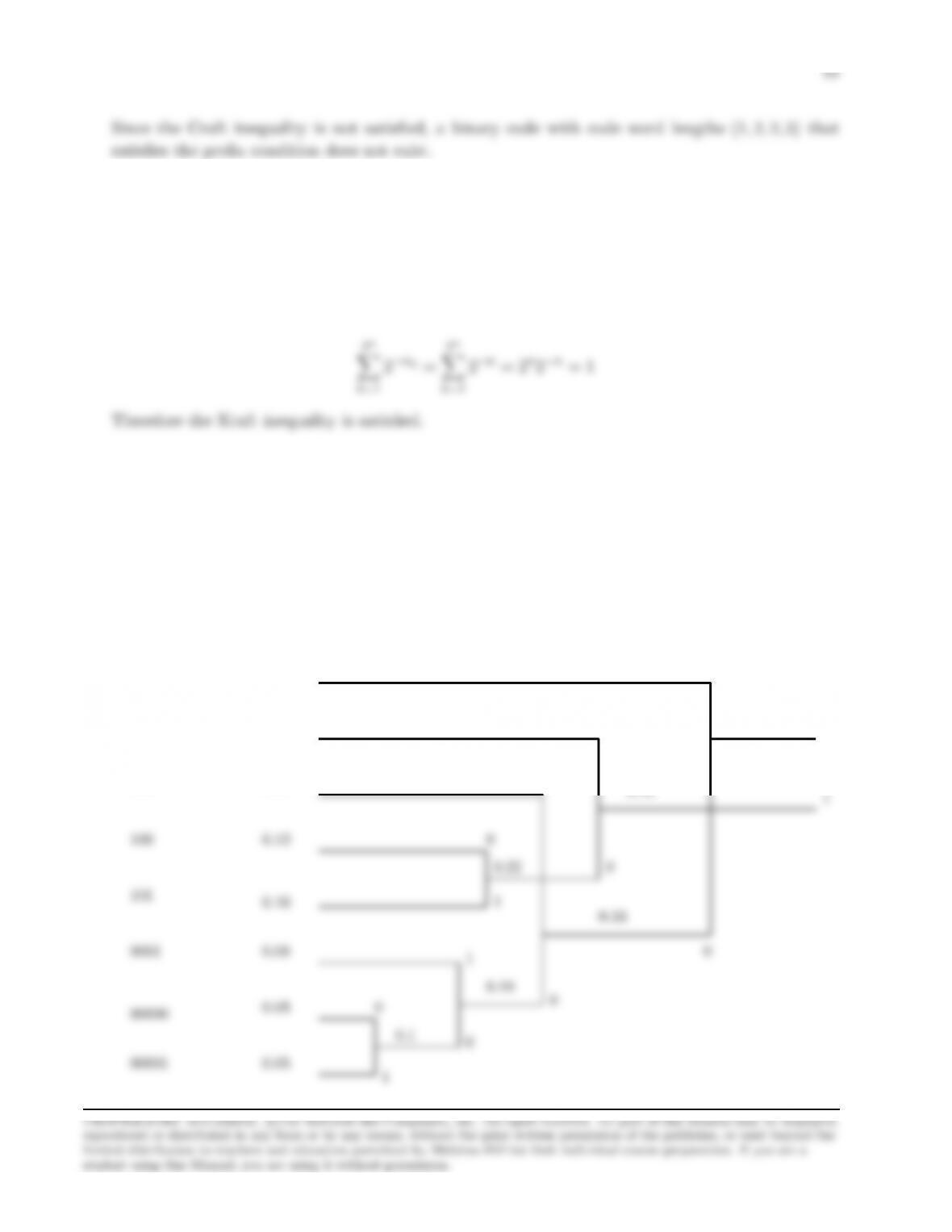
Problem 6.18
Problem 6.19
1. The following figure depicts the design of a ternary Huffman code (we follow the convention
that the lower-probability branch is assigned a 1) :
.
Codeword Probability
0.25
0.20
0.15
0.42
0.58 0
1
1
1
01
11
001
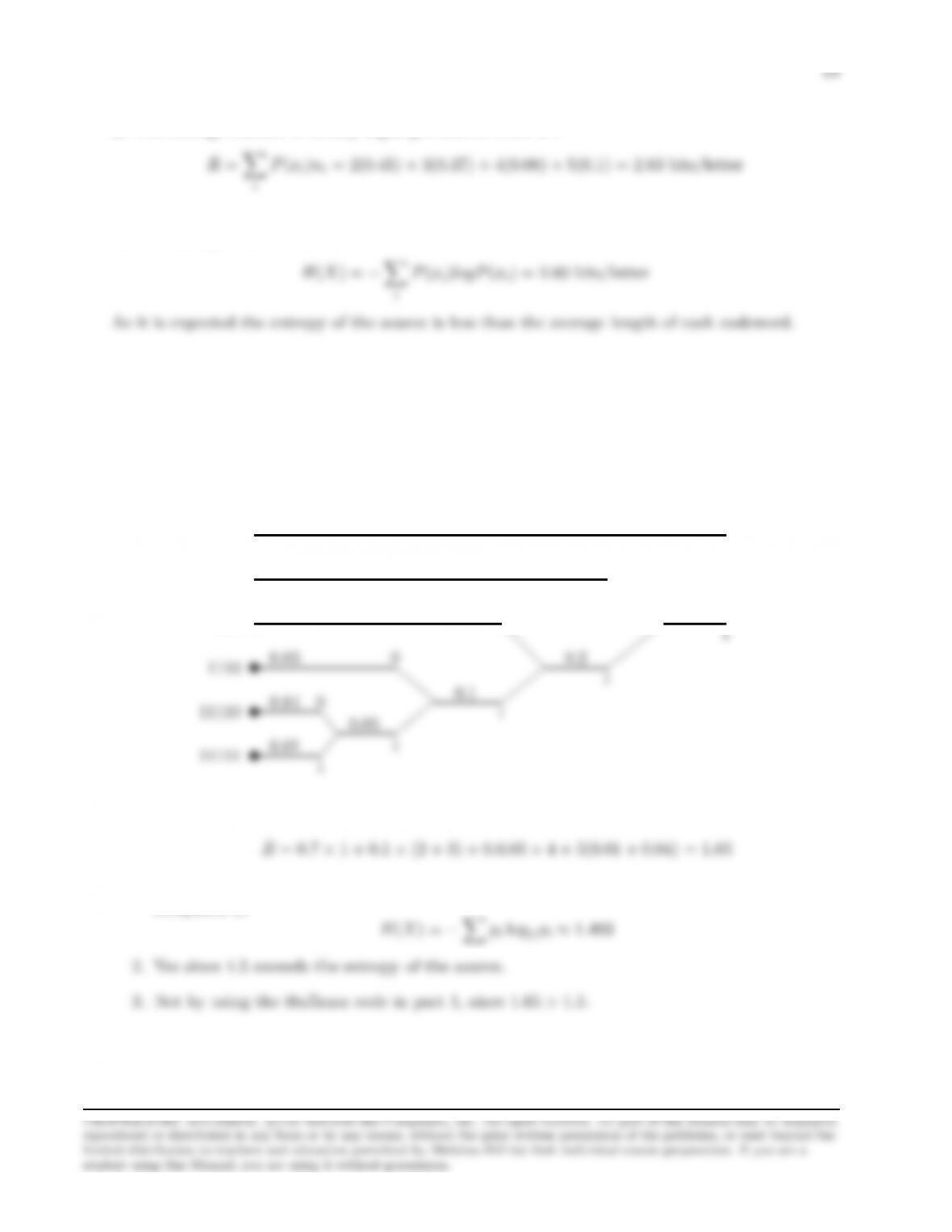
2. The average number of binary digits per source letter is :
i
3. The entropy of the source is :
Problem 6.20
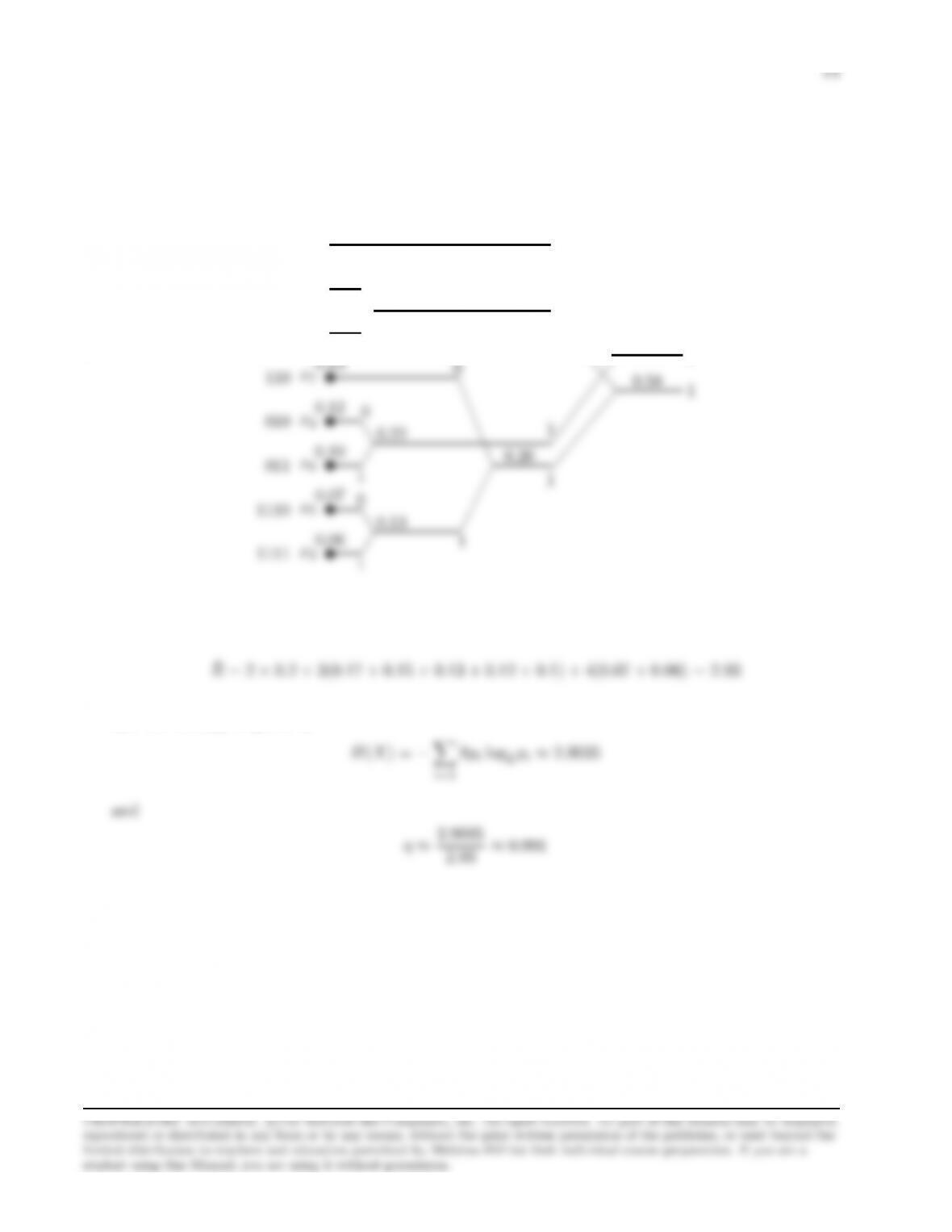
1. The Huffman tree and the corresponding code is shown below:
✉
✉
✉
0.1
0.12
0.15
❩❩❩
❩
★
❧❧❧
❧
✑
✑
✑
✑
0.3
0
0
0
0
10
110
The average codeword length is given by
and the minimum possible average codeword length is equal to the entropy of the source
computed as
Problem 6.21
The Huffman tree is shown below
✉
✉
✉
x1
x8
x4
❚
❚
✔
✔
0.32
❚❚❚❚❚❚❚
❚
0.42
❡❡❡❡❡
0
0
0
0
1
00
100
101
0.20
0.17
0.15
The average codeword length is given by
and the entropy is given by
Problem 6.22
1. The following figure depicts the design of the Huffman code, when encoding a single level at a
time :
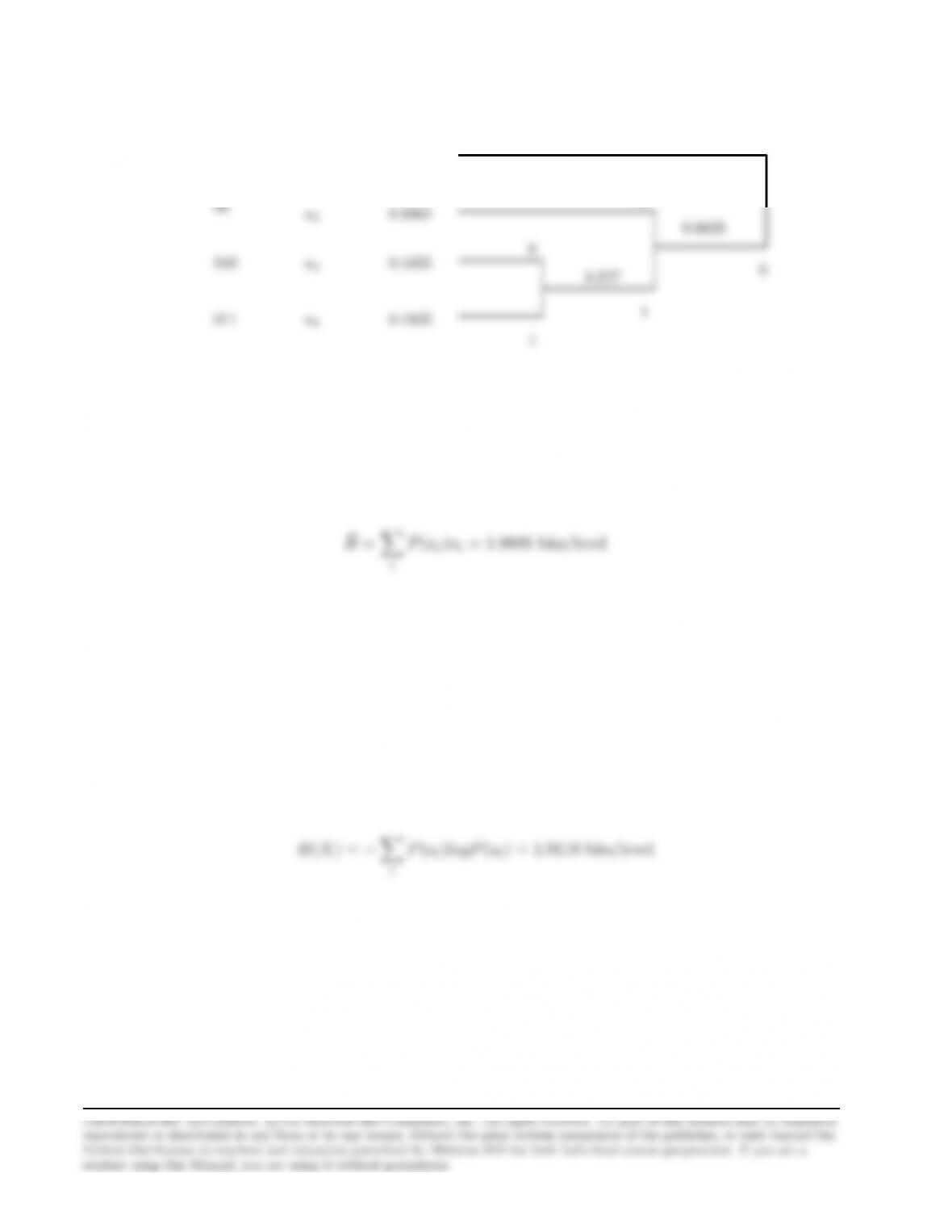
15
Codeword Level Probability
a1
0.3365
1
1
0
1
The average number of binary digits per source level is :
i
The entropy of the source is :
i
2. Encoding two levels at a time :
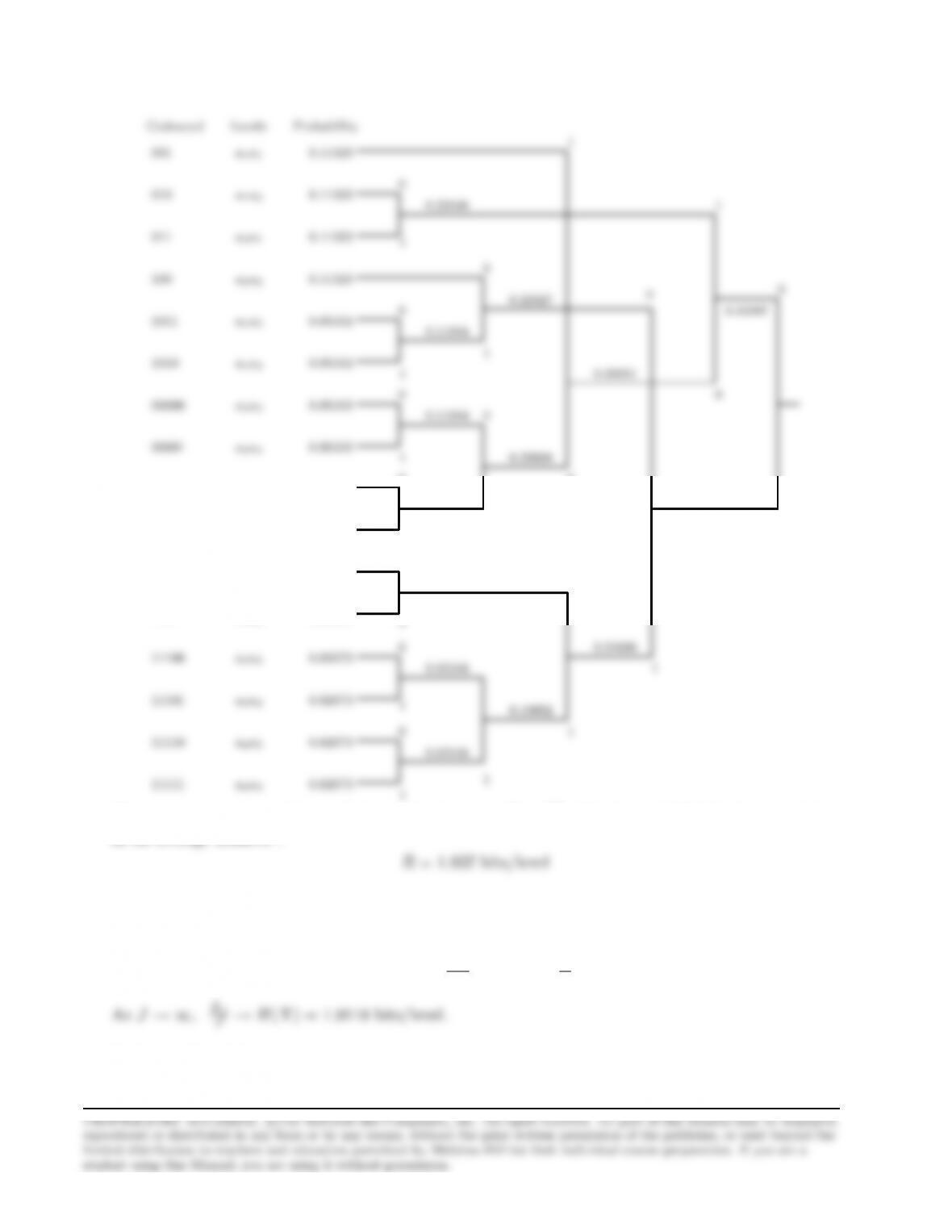
16
a3a2
a4a1
a4a2
a3a3
a3a4
a4a3
a4a4
Codeword ProbabilityLevels
a3a1
0.05502
0.05502
0.05502
0.05502
0.02673
0.02673
0.02673
0.02673
0
0
0
0
1
1
1
1
1
0.11004
0.11004
0.05346
0.05346
0.10692
0.22008
0.21696
0.44023
1
1
1
1
1
0
0
00010
00011
1100
1101
11100
11101
11110
11111
The average number of binary digits per level pair is ¯
R2=PkP(ak)nk= 3.874 bits/pair resulting
in an average number :
3.
H(X)≤¯
RJ
J< H(X) + 1
J
RJ
Problem 6.23
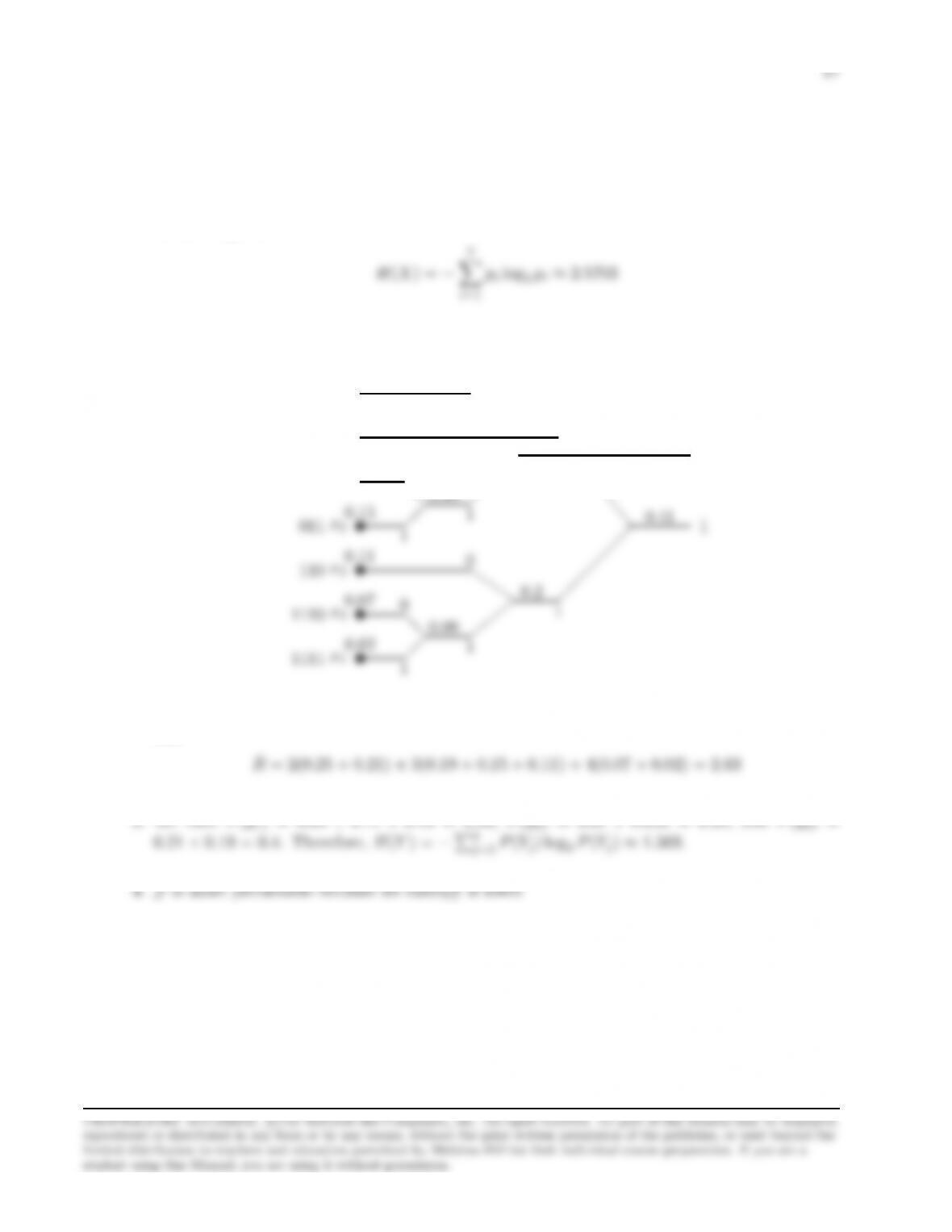
1. The entropy is
7
X
i=1
2. The Huffman tree is shown below
✉
✉
✉
x7
x4
x6
0.25
0.21
0.19
00
10
010
❅
❡❡❡❡❡
❙❙❙❙
0.59 0
0
0
0
and
Problem 6.24
18
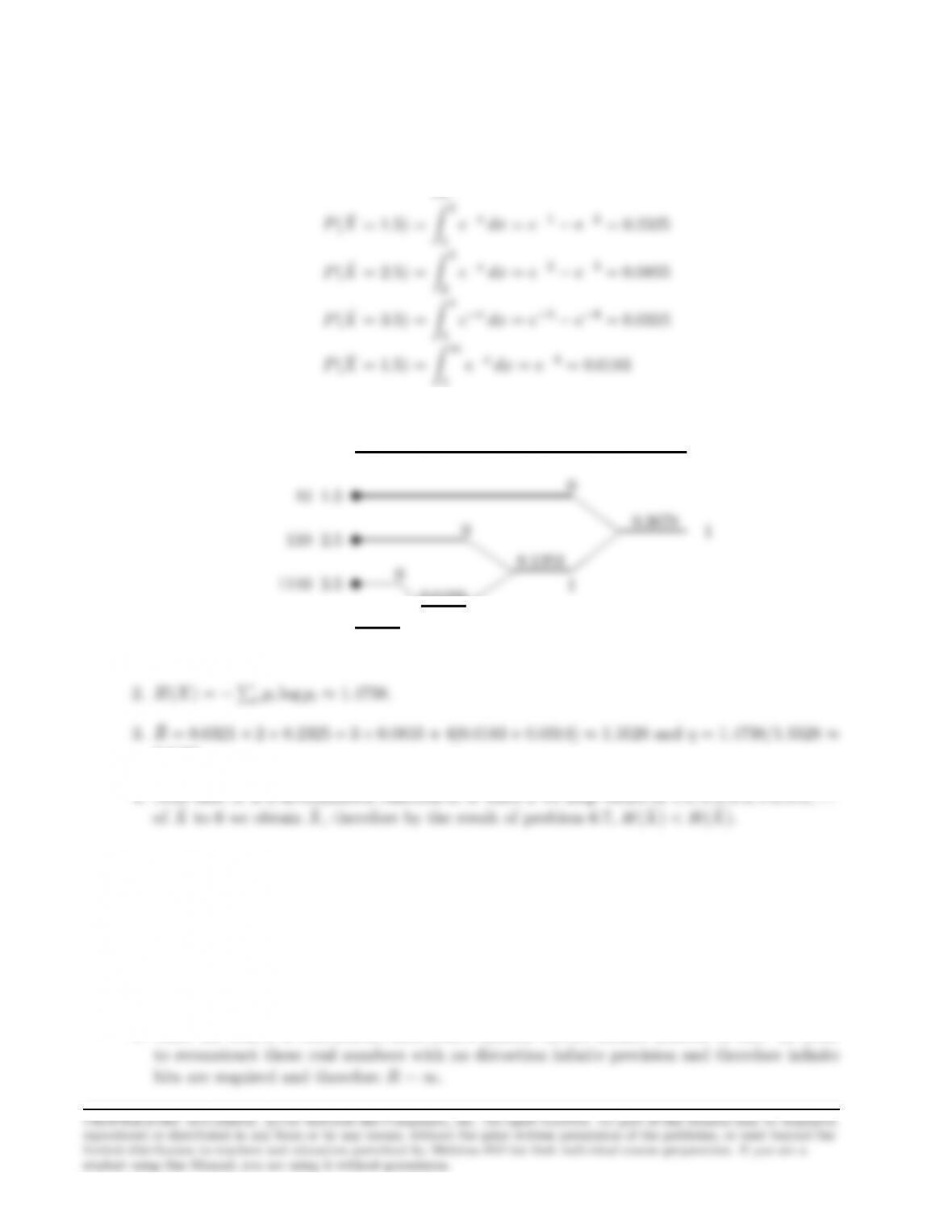
1. We have
P(ˆ
X= 0.5) = Z1
0
e−xdx = 1 −e−1= 0.6321
4
and the Huffman tree is shown below
✉
✉
✉
0.5
6
0
1111
❅
❅
✑
✑
0
0
1
1
0.0498
0.9491.
4. Note that ˆ
Xis a deterministic function of ˜
Xsince if we map values of 4.5,5.5,6.5,7.5,8.5, . . .
Problem 6.25
1. Since the source is continuous, each source symbol carries infinite number of bits. In order
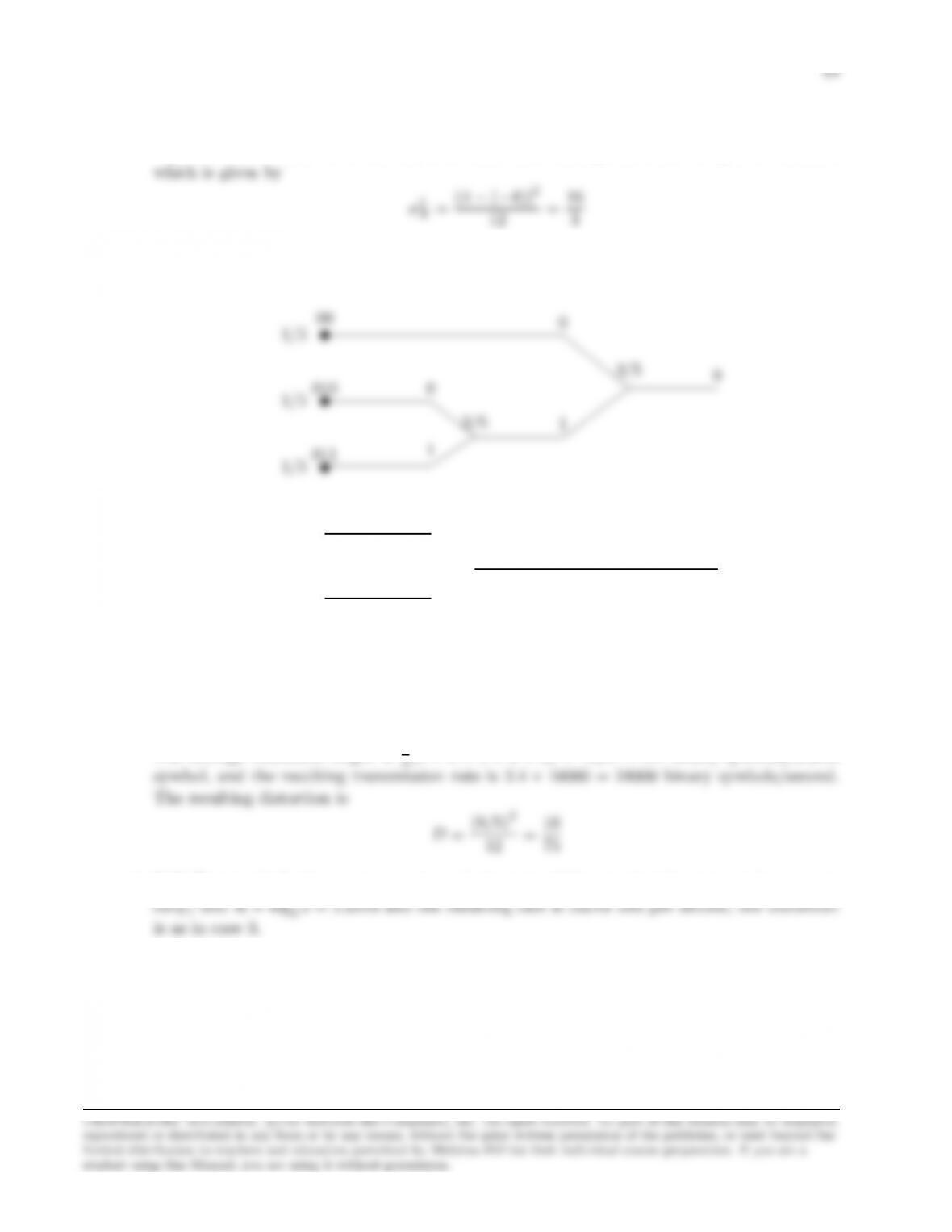
2. For squared error distortion, the best estimate in the absence of any side information is the
expected value which is zero in this case and the resulting distortion is equal to variance
3. An optimal uniform quantizer generates five equiprobable outputs each with probability 1/5.
The Huffman code is designed in the following diagram
✉
✉
❝❝
❝
✑
✑
✑
1/5
1/5
2/5
1
0
1
10
11
The average codeword length is 1
4. If Huffman code for long sequences is used, the rate will be equal to the entropy (asymptoti-
Problem 6.26
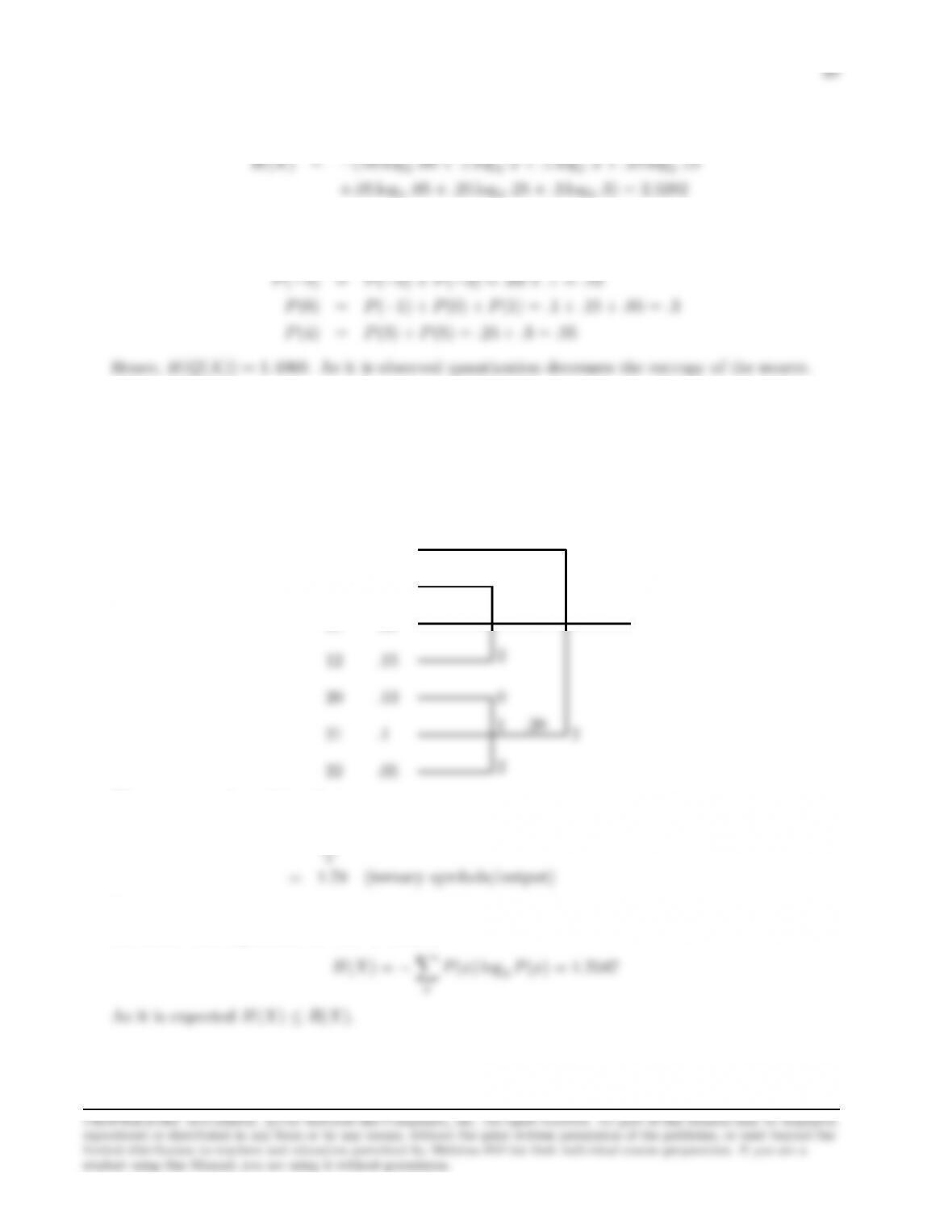
1.
2. After quantization, the new alphabet is B={−4,0,4}and the corresponding symbol probabil-
ities are given by
Problem 6.27
The following figure depicts the design of a ternary Huffman code.
22
20
12
11
10
0
2
1
0
2
1
0
1
0
.50
.28
.05
.13
.15
.17
.18
.22
The average codeword length is
¯
R(X) = X
P(x)nx=.22 + 2(.18 + .17 + .15 + .13 + .10 + .05)
For a fair comparison of the average codeword length with the entropy of the source, we compute
the latter with logarithms in base 3. Hence,