
Solutions Manual
for
Digital Communications, 5th Edition
(Chapter 5) 1
Prepared by
Kostas Stamatiou
January 11, 2008

Problem 5.1
Using the relationship r(t) = PN
n=1 rnfn(t) and s(t;ψ) = PN
n=1 sn(ψ)fn(t) we have :
1
N0R[r(t)−s(t;ψ)]2dt =1
N0RhPN
n=1(rn−sn(ψ))fn(t)i2dt
Problem 5.2
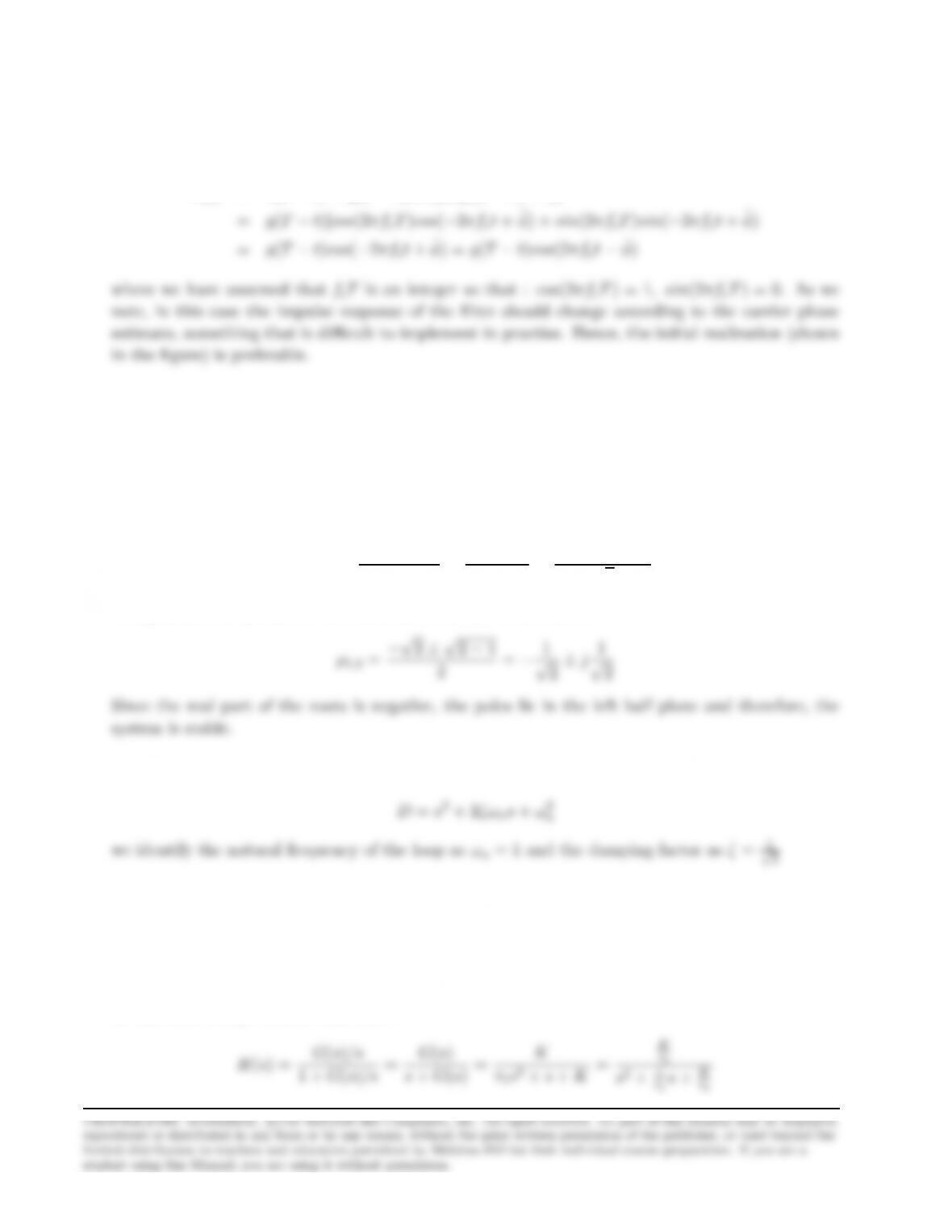
A block diagram of a binary PSK receiver that employs match filtering is given in the following
figure :
l
–
6
–
– –
Matched filter
h(t) = g(T−t)
XSampler and
Detector
Output data
Received signal
As we note, the received signal is, first, multiplied with cos(2πfct+ˆ
φ) and then fed the matched
filter. This allows us to have the filter matched to the baseband pulse g(t) and not to the passband
signal.
3
If we want to have the filter matched to the passband signal, then the carrier phase estimate is
fed into the matched filter, which should have an impulse response:
h(t) = s(T−t) = g(T−t)cos(2πfc(T−t) + ˆ
φ)
Problem 5.3
a. The closed loop transfer function is :
H(s) = G(s)/s
1 + G(s)/s =G(s)
s+G(s)=1
s2+√2s+ 1
The poles of the system are the roots of the denominator, that is
b. Writing the denominator in the form :
Problem 5.4
a. The closed loop transfer function is :
K
τ1

4
The gain of the system at f= 0 is :
b. The poles of the system are the roots of the denominator, that is
In order for the system to be stable the real part of the poles must be negative. Since Kis greater
than zero, the latter implies that τ1is positive. If in addition we require that the damping factor
Problem 5.5
The transfer function of the RC circuit is :
G(s) = R2+1
Cs
R1+R2+1
Cs
=1 + R2Cs
1 + (R1+R2)Cs =1 + τ2s
1 + τ1s
Problem 5.6
Assuming that the input resistance of the operational amplifier is high so that no current flows
through it, then the voltage-current equations of the circuit are :

5
where, V1,V2is the input and output voltage of the amplifier respectively, and V0is the signal at
the input of the filter. Eliminating iand V1, we obtain :
V2
V1
=
R1+1
Cs
R
1 + 1
A−R1+1
Cs
AR
Problem 5.7
In the non decision-directed timing recovery method we maximize the function :
ΛL(τ) = X
m
y2
m(τ)
with respect to τ. Thus, we obtain the condition :
dΛL(τ)
dτ = 2 X
m
ym(τ)dym(τ)
dτ = 0
Suppose now that we approximate the derivative of the log-likelihood ΛL(τ) by the finite difference

Problem 5.8
An on-off keying signal is represented as :
s1(t) = Acos(2πfct+φc),0≤t≤T(binary 1)
Let r(t) be the received signal, that is r(t) = s(t;φc)+n(t) where s(t;φc) is either s1(t) or s2(t) and
n(t) is white Gaussian noise with variance N0
2. The likelihood function, that is to be maximized
with respect to φcover the inteval [0, T ], is proportional to :
N0ZT
0
Maximization of Λ(φc) is equivalent to the maximization of the log-likelihood function :
ΛL(φc) = −2
[r(t)−s(t;φc)]2dt
N0ZT
0
N0ZT
0
N0ZT
0
Since the first term does not involve the parameter of interest φcand the last term is simply a
constant equal to the signal energy of the signal over [0, T ] which is independent of the carrier
phase, we can carry the maximization over the function :
0
Note that s(t;φc) can take two different values, s1(t) and s2(t), depending on the transmission of
a binary 1 or 0. Thus, a more appropriate function to maximize is the average log-likelihood
2ZT
0
2ZT
0
Since s2(t) = 0, the function ¯
V(φc) takes the form :
2ZT
0
Setting the derivative of ¯
V(φc) with respect to φcequal to zero, we obtain :
ϑ¯
V(φc)
= 0 = 1
r(t)Asin(2πfct+φc)dt
1
1
7
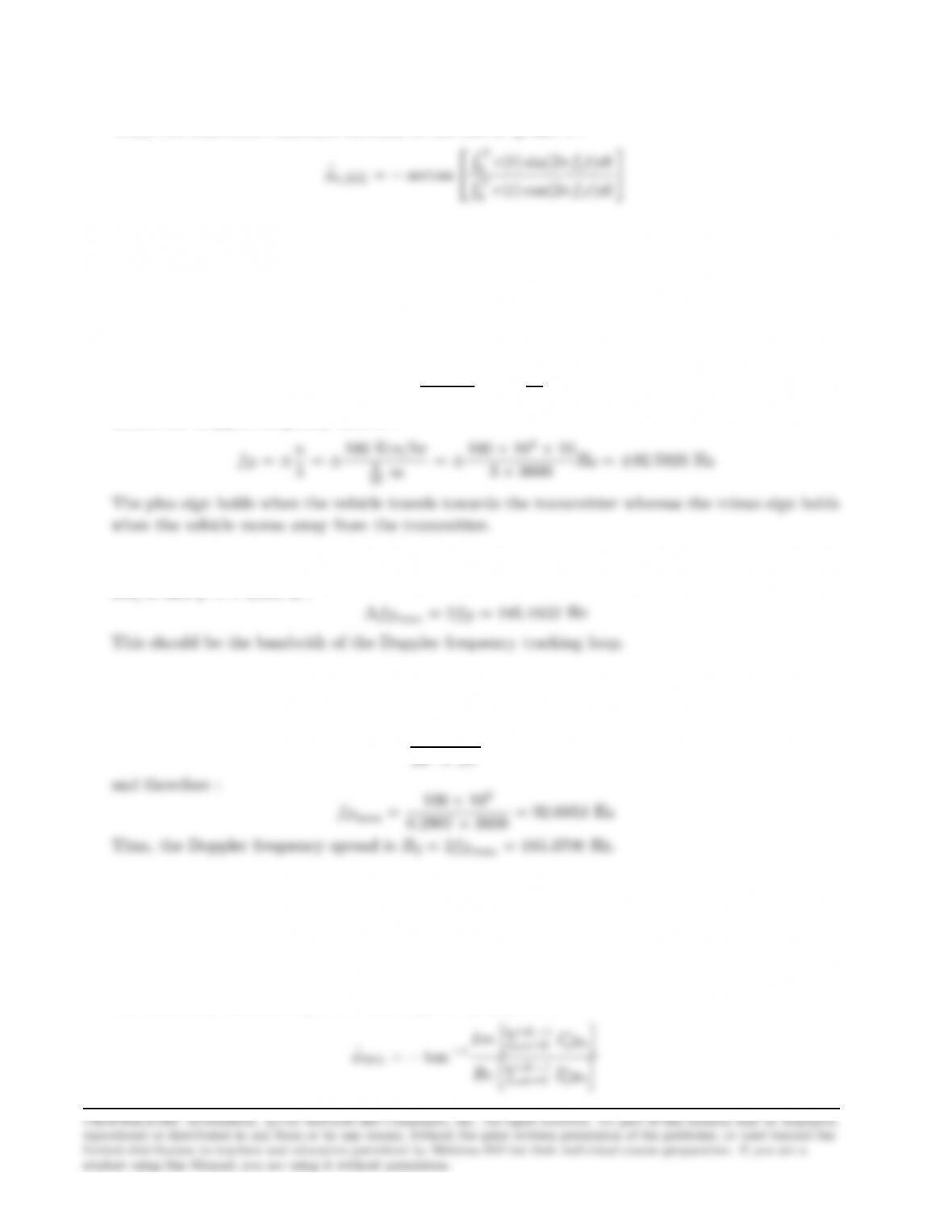
Thus, the maximum likelihood estimate of the carrier phase is :
Problem 5.9
a. The wavelength λis :
λ=3×10⁸
109m = 3
10 m
Hence, the Doppler frequency shift is :
b. The maximum difference in the Doppler frequency shift, when the vehicle travels at speed 100
km/hr and f= 1 GHz, is :
c. The maximum Doppler frequency shift is obtained when f= 1 GHz + 1 MHz and the vehicle
moves towards the transmitter. In this case :
λmin =3×10⁸
109+ 106m = 0.2997 m
Problem 5.10
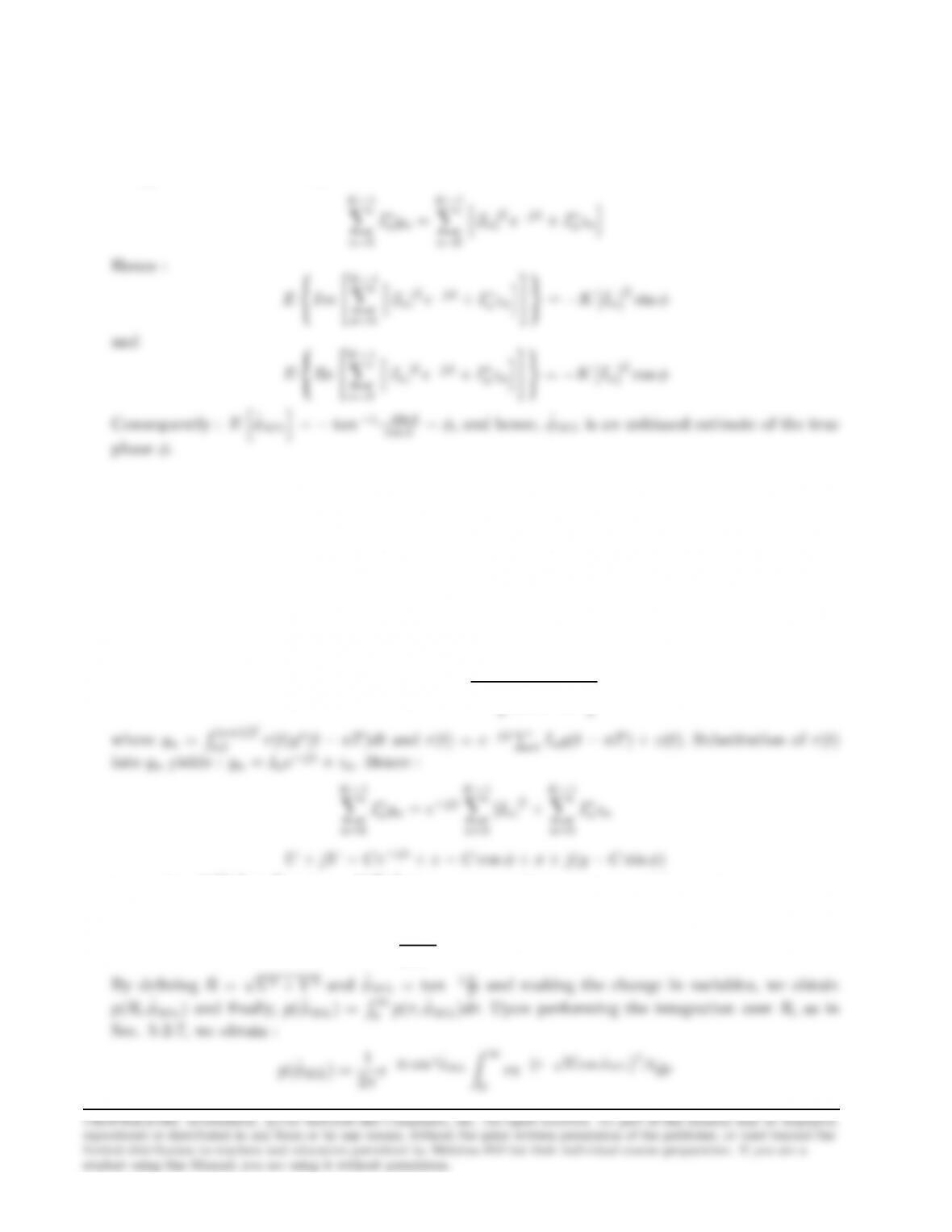
The maximum likelihood phase estimate given by (6-2-38) is :
n=0 I∗
nyni
8
where yn=R(n+1)T
nT r(t)g∗(t−nT )dt. The Re(yn), Im(yn) are statistically independent components
of yn.Since r(t) = e−jφ PnIng(t−nT ) + z(t) it follows that yn=Ine−jφ +zn,where the pulse
energy is normalized to unity. Then :
Problem 5.11
The procedure that is used in Sec. 5-2-7 to derive the pdf p(Θr) for the phase of a PSK signal may
be used to determine the pdf p(ˆ
φML).Specifically, we have :
ˆ
φML =−tan −1Im hPK−1
n=0 I∗
nyni
Re hPK−1
n=0 I∗
nyni
where C=PK−1
n=0 |In|2and z=PK−1
n=0 I∗
nzn=x+jy. The random variables (x,y) are zero-mean,
Gaussian random variables with variances σ2.Hence :
p(U, V ) = 1
2πσ2e−[(U−Ccos φ)2−(V−Csin φ)2]

Problem 5.12
We begin with the log-likelihood function given in (6-2-35), namely :
ΛL(φ) = Re 1
N0ZT0
r(t)s∗
l(t)dtejφ
where A=PK−1
n=0 I∗
nyn−jPK−1
n=0 J∗
nxn.Thus : ΛL(φ) = Re(A) cos φ−Im(A) sin φand :
Problem 5.13
Assume that the signal um(t) is the input to the Costas loop. Then um(t) is multiplied by
cos(2πfct+ˆ
φ) and sin(2πfct+ˆ
φ), where cos(2πfct+ˆ
φ) is the output of the VCO. Hence :
umc(t)
=AmgT(t) cos(2πfct) cos(2πfct+ˆ
φ)−AmˆgT(t) sin(2πfct) cos(2πfct+ˆ
φ)
10
The lowpass filters of the Costas loop will reject the double frequency components, so that :
ymc(t) = AmgT(t)
φ) + AmˆgT(t)
φ)
2sin( ˆ
2cos( ˆ
Note that when the carrier phase has been extracted correctly, ˆ
φ= 0 and therefore :
If the second signal, yms(t) is passed through a Hilbert transformer, then :
ˆgT(t)
and by adding this signal to ymc(t) we obtain the original unmodulated signal.
Problem 5.14
a. The signal r(t) can be written as :
r(t) = ±p2Pscos(2πfct+φ) + p2Pcsin(2πfct+φ)
where an=±1 are the information symbols and PTis the total transmitted power. As it is observed
the signal has the form of a PM signal where :
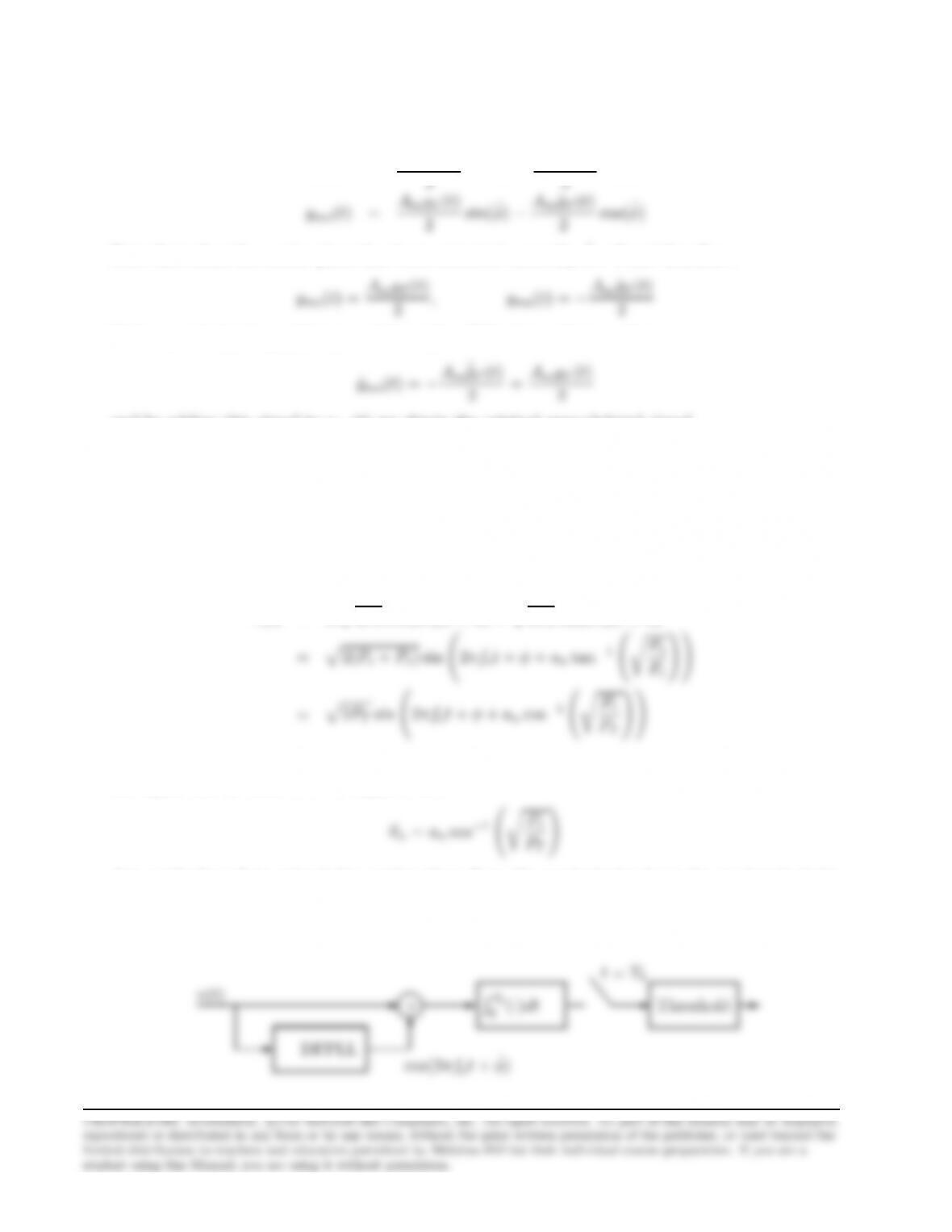
Any method used to extract the carrier phase from the received signal can be employed at the
receiver. The following figure shows the structure of a receiver that employs a decision-feedback
PLL. The operation of the PLL is described in the next part.
\
\––
–– ×Threshold
t=Tb
RTb
v(t)
11
b. At the receiver (DFPLL) the signal is demodulated by crosscorrelating the received signal :
with cos(2πfct+ˆ
φ) and sin(2πfct+ˆ
φ). The sampled values at the ouput of the correlators are :
r1=1
φ+θn) + 1
φ+θn)
2hp2PT−ns(t)icos(φ−ˆ
2nc(t) sin( ˆ
where nc(t), ns(t) are the in-phase and quadrature components of the noise n(t). If the detector
has made the correct decision on the transmitted point, then by multiplying r1by cos(θn) and r2
by sin(θn) and subtracting the results, we obtain (after ignoring the noise) :
r1cos(θn) = 1
φ) cos2(θn) + cos(φ−ˆ
φ) sin(θn) cos(θn)i
2p2PTsin(φ−ˆ
The error e(t) is passed to the loop filter of the DFPLL that drives the VCO. As it is seen only the
phase θnis used to estimate the carrier phase.
c. Having a correct carrier phase estimate, the output of the lowpass filter sampled at t=Tbis :
r=±1
2p2PTsin cos−1 rPc
PT!+n
where nis a zero-mean Gaussian random variable with variance :
σ2
n=EZTb
n(t)n(τ) cos(2πfct+φ) cos(2πfcτ+φ)dtdτ
Note that Tbhas been normalized to 1 since the problem has been stated in terms of the power of
the involved signals. The probability of error is given by :

12
The loss due to the allocation of power to the pilot signal is :
SNRloss = 10 log10 1−Pc
PT
Problem 5.15
The received signal-plus-noise vector at the output of the matched filter may be represented as (see
where θn= 0, π/2, π, 3π/2 for QPSK, and φis the carrier phase. By raising rnto the fourth power
and neglecting all products of noise terms, we obtain :
If the estimate is formed by averaging the received vectors r4
nover K signal intervals, we have
the resultant vector U=K√Ese−jφ + 4 PK
n=1 Nn.Let φ4≡4φ. Then, the estimate of φ4is :
Nnis a complex-valued Gaussian noise component with zero mean and variance σ2=N0/2.Hence,
the pdf of ˆ
φ4is given by (5-2-55) where :
To a first approximation, the variance of the estimate is :
Problem 5.16
The PDF of the carrier phase error φe, is given by :
e
2σ2
13
Thus the average probability of error is :
¯
P2=Z∞
P2(φe)p(φe)dφe
Problem 5.17
The log-likelihood function of the symbol timing may be expressed in terms of the equivalent
low-pass signals as
ΛL(τ) = Re h1
N0RT0r(t)sl∗(t;τ)dti
where yn(τ) = RT0r(t)g∗(t−nT −τ)dt.
A necessary condition for ˆτto be the ML estimate of τis
dΛL(τ)
If we express yn(τ) into its real and imaginary parts : yn(τ) = an(τ) + jbn(τ), the above
n
n
Problem 5.18
We follow the exact same steps of the derivation found in Sec. 6.4. For a PAM signal In∗=In

14
ΛL(φ, τ) = A(τ) cos φ
Then the necessary conditions for the estimates of φand τto be the ML estimates (6.4-8) and
(6.4-9) give
n
Problem 5.19
The derivation for the ML estimates of φand τfor an offset QPSK signal follow the derivation