
Solutions Manual
for
Digital Communications, 5th Edition
(Chapter 4) 1
Prepared by
Kostas Stamatiou
January 11, 2008

Problem 4.1
Nmr =Re ZT
0
z(t)f∗
m(t)dt
1. Define am=RT
0z(t)f∗
m(t)dt. Then, Nmr =Re(am) = 1
2[am+a∗
m].
E(Nmr) = Re ZT
0
E(z(t)) f∗
m(t)dt= 0
2. For m6=k:
E[NmrNkr] = Eham+a∗
m
2
ak+a∗
k
2i
=Ehamak+a∗
mak+ama∗
k+a∗
ma∗
k
4i
mak+ama∗
k
Problem 4.2
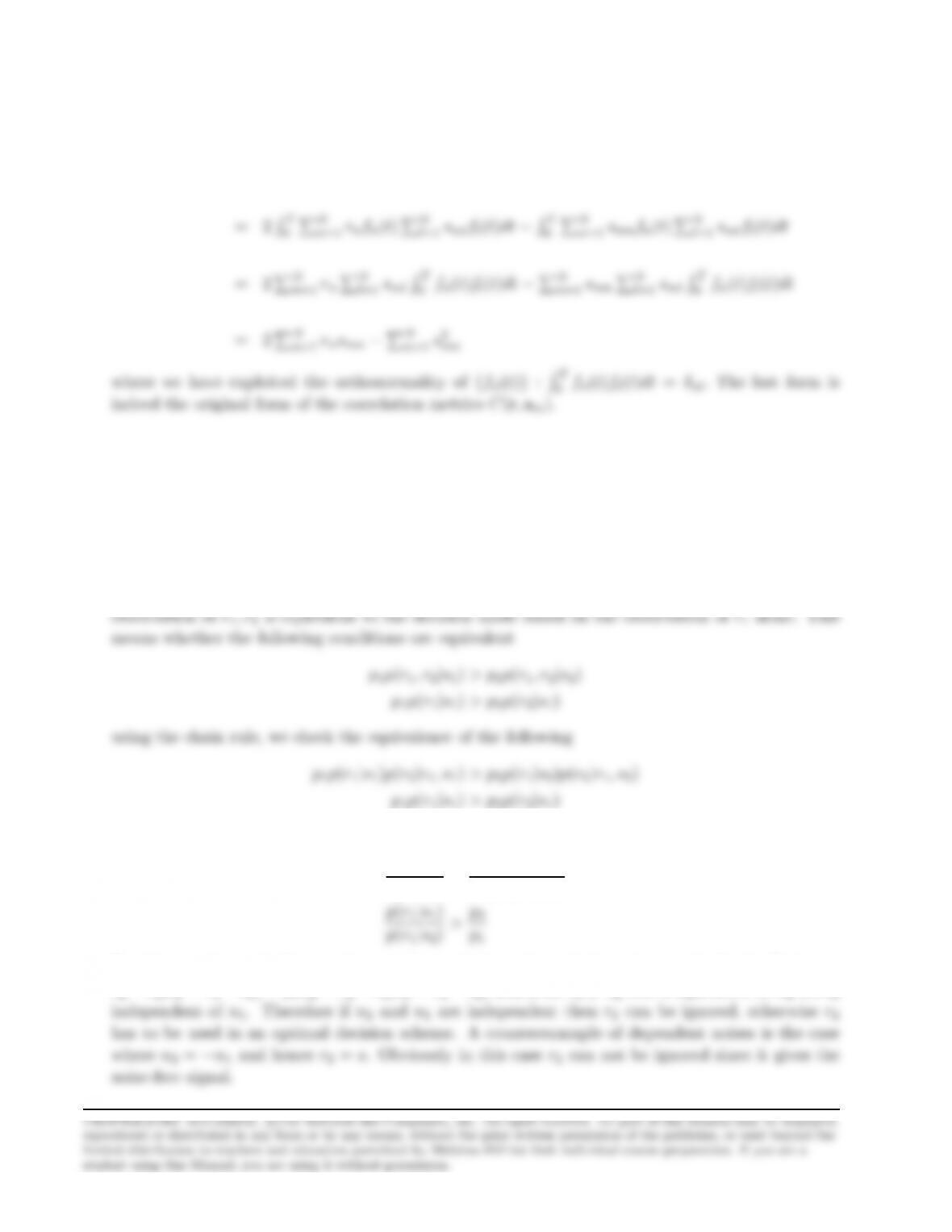
Since {fn(t)}constitute an orthonormal basis for the signal space : r(t) = PN
n=1 rnfn(t), sm(t) =
3
PN
n=1 smnfn(t).Hence, for any m:
C(r,sm) = 2 RT
0r(t)sm(t)dt −RT
0s2
m(t)dt
Problem 4.3
r= (r1, r2) = (s+n1, s +n1+n2)
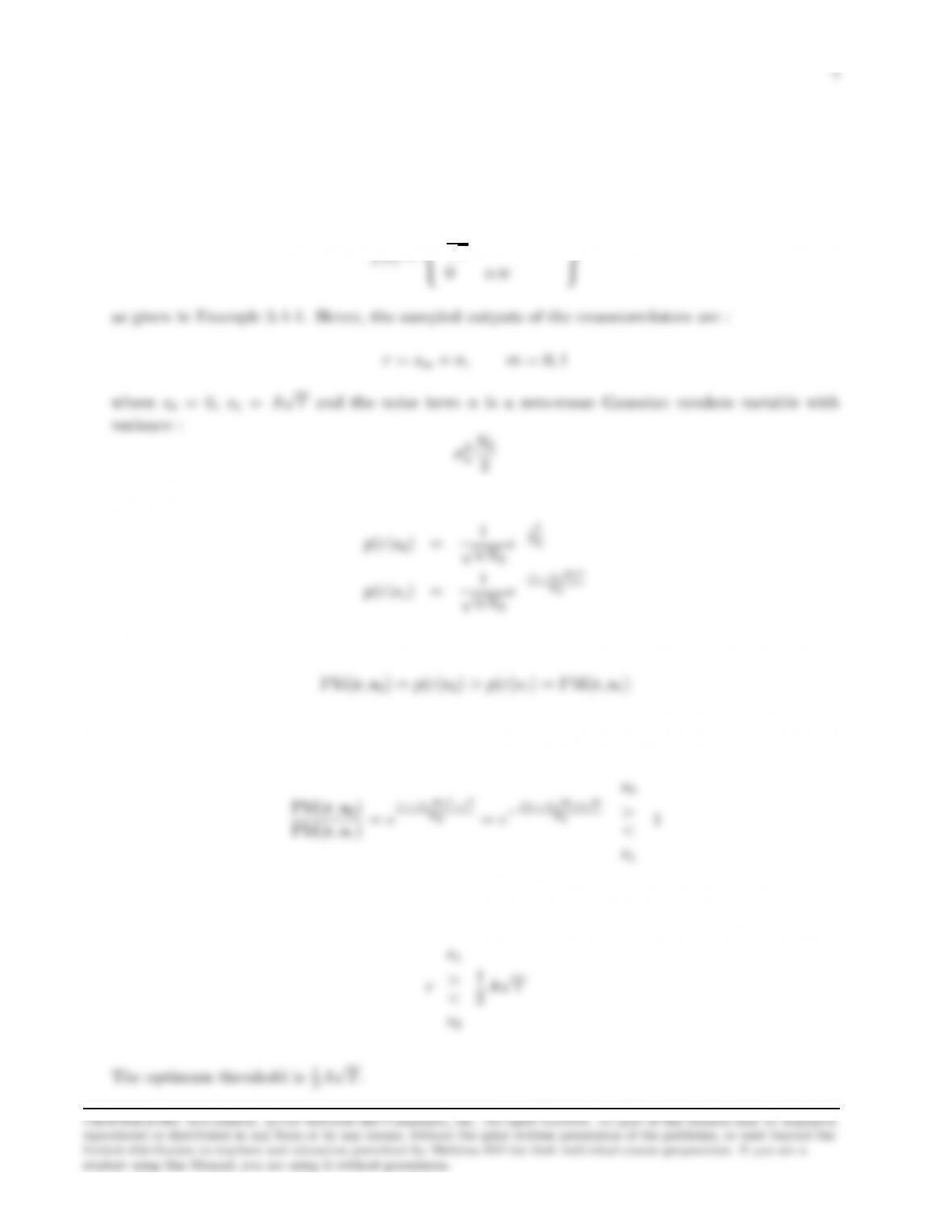
The MAP rule for this problem is max p(s|r). The question is whether decision based on the
or
p(r1|s1)
p(r1|s2)>p2p(r2|r1, s2)
p1p(r2|r1, s1)
For these to be equivalent we have to have p(r2|r1, s1) = p(r2|r1, s2) or equivalently if p(n2=
r2−r1|n1=r1−s1) = p(n2=r2−r1|n1=r1−s2) and since s16=s2this is equivalent to n2being
Problem 4.4
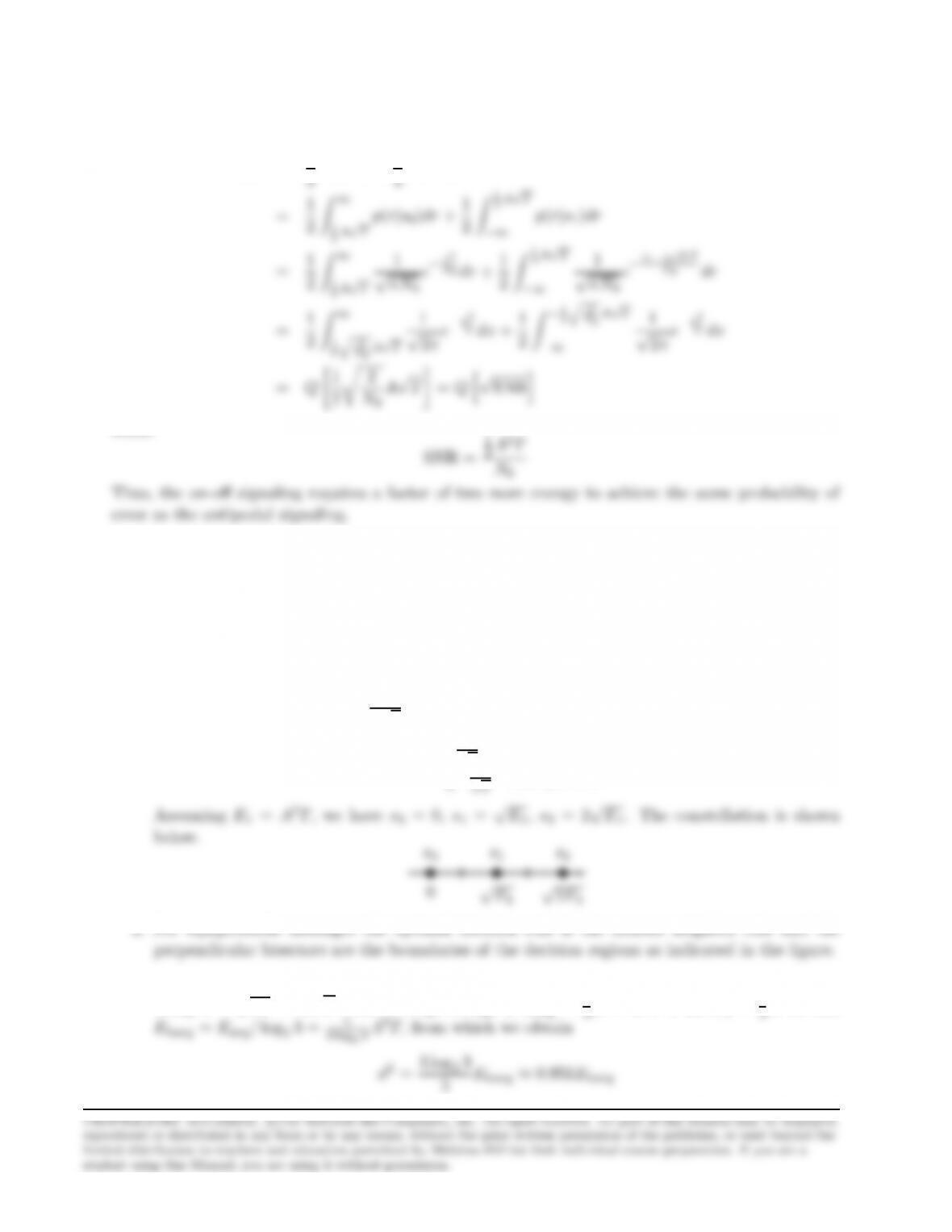
a. The correlation type demodulator employes a filter :
1
√T0≤t≤T
The probability density function for the sampled output is :
N0
p(r|s1) = 1
√πN0
e−(r−A√T)2
Since the signals are equally probable, the optimal detector decides in favor of s0if
otherwise it decides in favor of s1. The decision rule may be expressed as:
PM(r,s1)=e
(r−A√T)2−r2
s0
<
s1
or equivalently :
s1
>
1
5
b. The average probability of error is:
P(e) = 1
2r2
N0
where
1
2A2T
Problem 4.5
1. Note that s2(t) = 2s1(t) and s3(t) = 0s1(t), hence the system is PAM and a singular basis
function of the form φ1(t) = 1
A√Ts1(t) would work
φ(t) = (1
√T0< t ≤T/3
−1
√TT/3≤t < T
✲✉ ✉ ✉
0√E1√2E1
2. For equiprobable messages the optimal decision rule is the nearest neighbor rule and the
3. This is ternary PAM system with the distance between adjacent pints in the constellation
being d=√E1=A√T. The average energy is Eavg =1

6
The error probability of the optimal detector is the average of the error probabilities of the
three signals. For the two outer signals error probability is P(n > d/2) = Qd/2
√N0/2and
Problem 4.6
For binary phase modulation, the error probability is
P2=Q“r2Eb
N0#=Q
sA2T
N0
With P2= 10−6we find from tables that
sA2T
N0
= 4.74 =⇒A2T= 44.9352 ×10⁻¹⁰
Problem 4.7
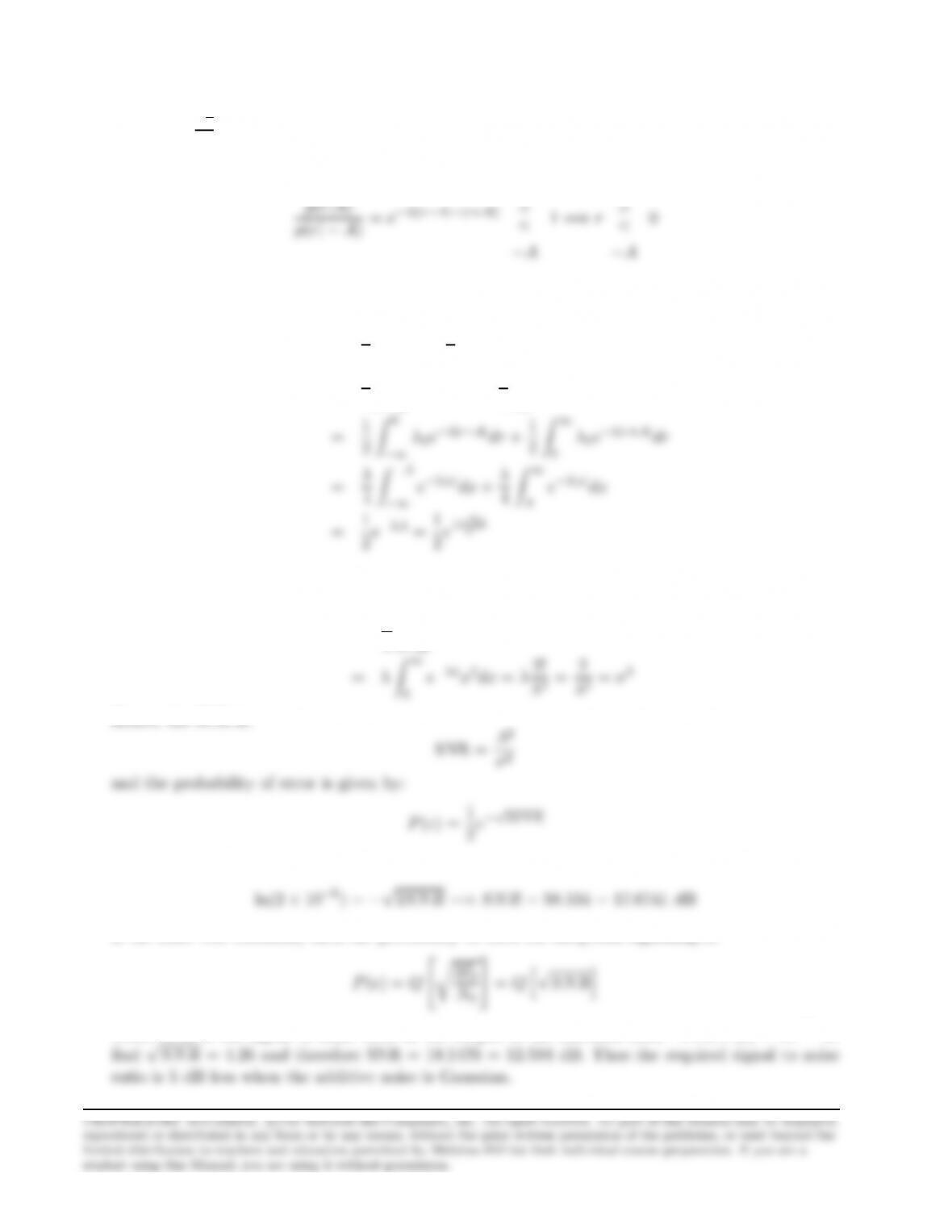
1. The PDF of the noise nis :
p(n) = λ
2e−λ|n|
7
where λ=√2
σThe optimal receiver uses the criterion :
A
−A
A
−A
The average probability of error is :
P(e) = 1
2P(e|A) + 1
2P(e| − A)
=1
2Z0
−∞
f(r|A)dr +1
2Z∞
0
f(r| − A)dr
2e−λA =1
2e−√2A
2. The variance of the noise is :
σ2
n=λ
2Z∞
−∞
e−λ|x|x2dx
Hence, the SNR is:
For P(e) = 10−5we obtain:
If the noise was Gaussian, then the probability of error for antipodal signalling is:
where SNR is the signal to noise ratio at the output of the matched filter. With P(e) = 10−5we

Problem 4.8
1. Since dmin = 2A, from the union bound we have Pe≤15Qqd2
min/2N0= 15Qp2A2/N0.
4. For a 16-level PAL system
Ebavg
Ebavg
Problem 4.9
1. U=Re hRT
0r(t)s∗(t)dti, where r(t) =
s(t) + z(t)
−s(t) + z(t)
depending on which signal was sent.
If we assume that s(t) was sent :
U=Re ZT
0
s(t)s∗(t)dt+Re ZT
0
z(t)s∗(t)dt= 2E+N
mean and variance 2EN0(as we have seen in Problem 5.7). Hence, given that s(t) was sent, the
probability of error is :
Pe1=P(2E+N < A) = P(N < −(2E−A)) = Q2E−A
√2N0E

9
3(Pe1+Pe2+Pe3) = 2
3Q2E−A
3. In order to minimize Pe:dPe
dA = 0 ⇒A=E
where we differentiate Q(x) = R∞
1
√2πexp(−t2/2)dt with respect to x, using the Leibnitz rule :
Problem 4.10
1. The transmitted energy is :
E1=1
2. The correlation coefficient for the two signals is :
ρ=1
2EZT
0
s1(t)s∗
2(t)dt = 1/2
Hence, the bit error probability for coherent detection is :
3. The bit error probability for non-coherent detection is given by (5-4-53) :

10
where Q1(.) is the generalized Marcum Q function (given in (2-1-123)) and :
a=sE
2N01−q1− |ρ|2=rE
2N01−√3
2
Problem 4.11
1. Taking the inverse Fourier transform of H(f), we obtain :
h(t) = F−1[H(f)] = F−11
j2πf − F−1e−j2πfT
j2πf
2
pulse of unit height and width, centered at x= 0.
2. The signal waveform, to which h(t) is matched, is :
s(t) = h(T−t) = 2Π T−t−T
2
T!= 2Π T
2−t
T!=h(t)
2
Problem 4.12
1. The impulse response of the matched filter is :
A
T(T−t) cos(2πfc(T−t)) 0 ≤t≤T

2. The output of the matched filter at t=Tis :
g(T) = h(t)⋆ s(t)t=T=ZT
0
h(T−τ)s(τ)dτ
=A2
(T−τ)2cos2(2πfc(T−τ))dτ
3. The output of the correlator at t=Tis :
q(T) = ZT
0
s2(τ)dτ
Problem 4.13
1. Since the given waveforms are the equivalent lowpass signals :
E1=1
2. Each matched filter has an equivalent lowpass impulse response : hi(t) = si(T−t) . The
following figure shows hi(t) :
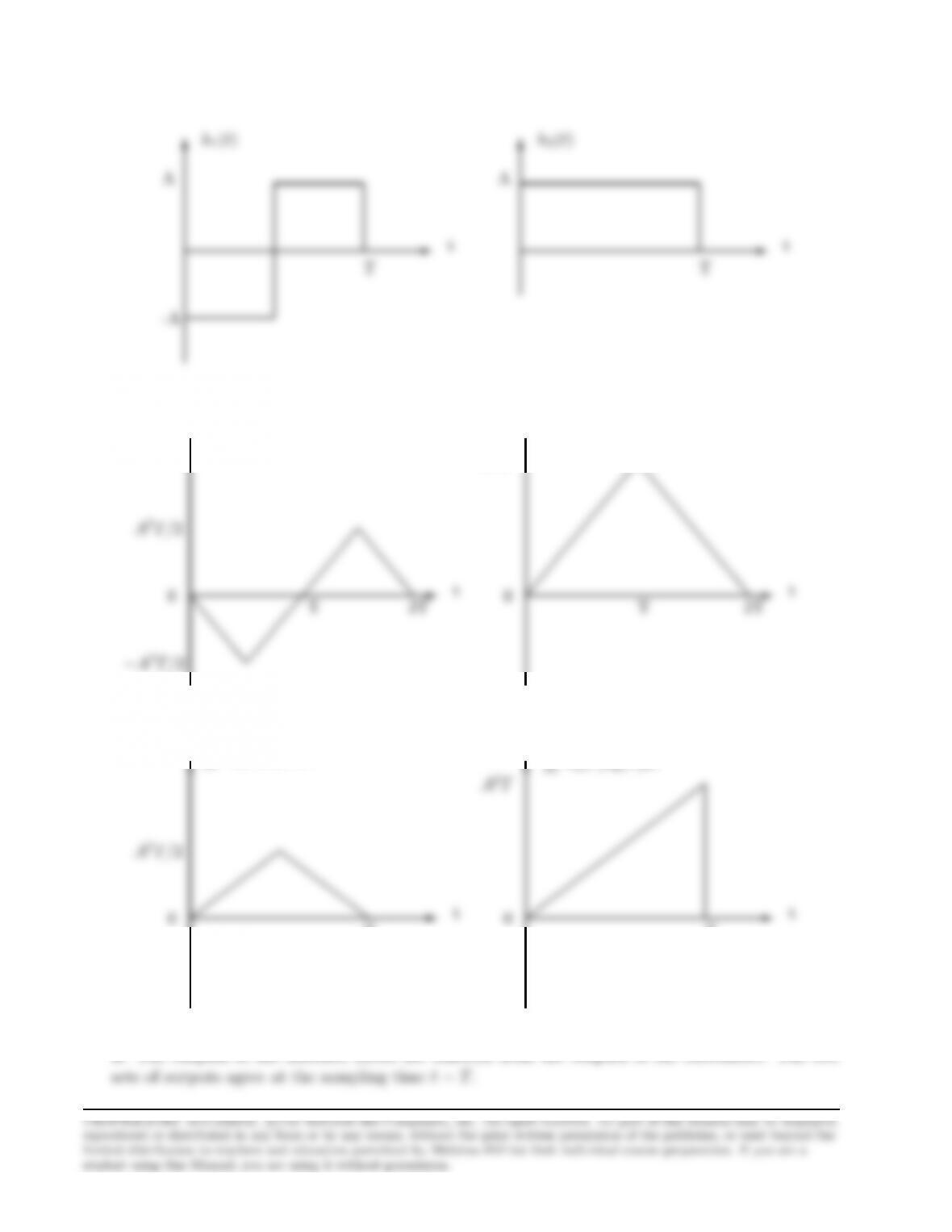
12
✲
✲t
h1(t)
-A
T
t
h2(t)
T
3.
✻
❡✪✪✪✪✪✪✪✪
✪❡❡❡❡
✻
✪❡❡❡❡❡❡❡❡
h2(t)∗s2(t)
h1(t)∗s2(t)
−A2T/2
A2T/2
A2T
4.
RT
RT
0s1(τ)s2(τ)dτ
T T
5. The outputs of the matched filters are different from the outputs of the correlators. The two
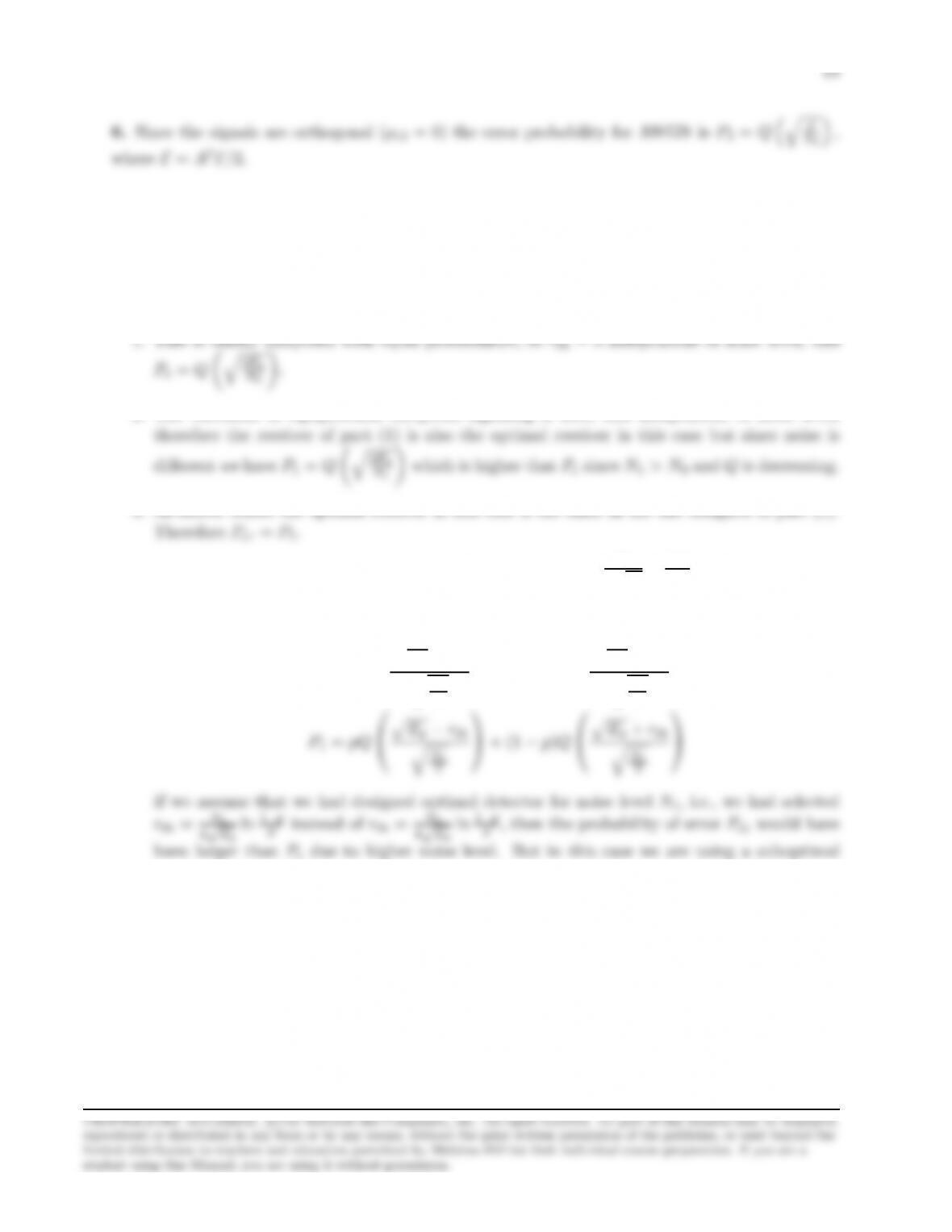
Problem 4.14
2. The threshold in equiprobable antipodal signaling is zero, and independent of noise level,
3. As stated before the optimal receiver in this case is the same as the one designed in part (1).
4. When the probabilities are not equal the threshold is rth =N0
4√Epln 1−p
pwhich now depends
on the noise level. Therefore the optimal receiver designed in case 1 will not be optimal in
case 2. In this case we have
Pe=pQ
pEp−rth
qN0
2
+ (1 −p)Q
pEp+rth
qN0
2
receiver for noise level N1; hence the error probability is even higher that Pe1. Therefore we
can say P1> Pe1> Pe.
Problem 4.15
The following graph shows the decision regions for the four signals :
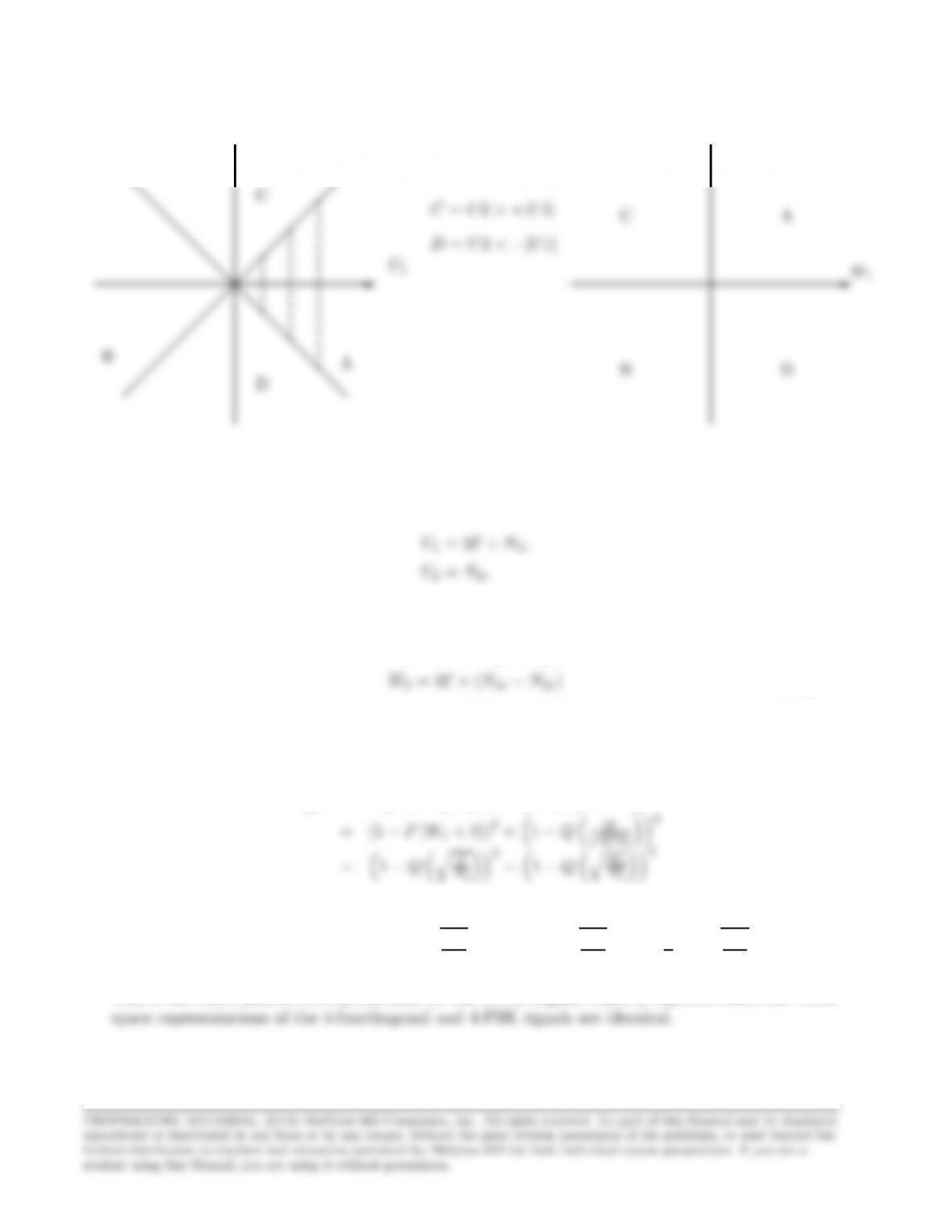
14
✻
✻
❅
A
B
D
U2A=U1>+|U2|
B=U1<−|U2|
W2
W1
B D
As we see, using the transformation W1=U1+U2, W2=U1−U2alters the decision regions to
: (W1>0, W2>0→s1(t); W1>0, W2<0→s2(t); etc.).Assuming that s1(t) was transmitted,
the outputs of the matched filters will be :
where N1r, N2rare uncorrelated (Prob. 5.7) Gaussian-distributed terms with zero mean and vari-
ance 2EN0.Then :
W1= 2E+ (N1r+N2r)
will be Gaussian distributed with means : E[W1] = E[W2] = 2E,and variances : EW2
1=
EW2
2= 4EN0.Since U1, U2are independent, it is straightforward to prove that W1, W2are
independent, too. Hence, the probability that a correct decision is made, assuming that s1(t) was
transmitted is :
Pc|s1=P[W1>0] P[W2>0] = (P[W1>0])2
where Eb=E/2 is the transmitted energy per bit. Then :
Pe|s1= 1 −Pc|s1= 1 − 1−Q r2Eb
N0!!2
= 2Q r2Eb
N0!“1−1
2Q r2Eb
N0!#
This is the exact symbol error probability for the 4-PSK signal, which is expected since the vector
15
Problem 4.16
1. The output of the matched filter can be expressed as :
y(t) = Re hv(t)ej2πfcti
where v(t) is the lowpass equivalent of the output :
0
0Ae−(t−τ)/T dτ =AT 1−e−t/T ,0≤t≤T
0Ae−(t−τ)/T dτ =AT (e−1)e−t/T , T ≤t
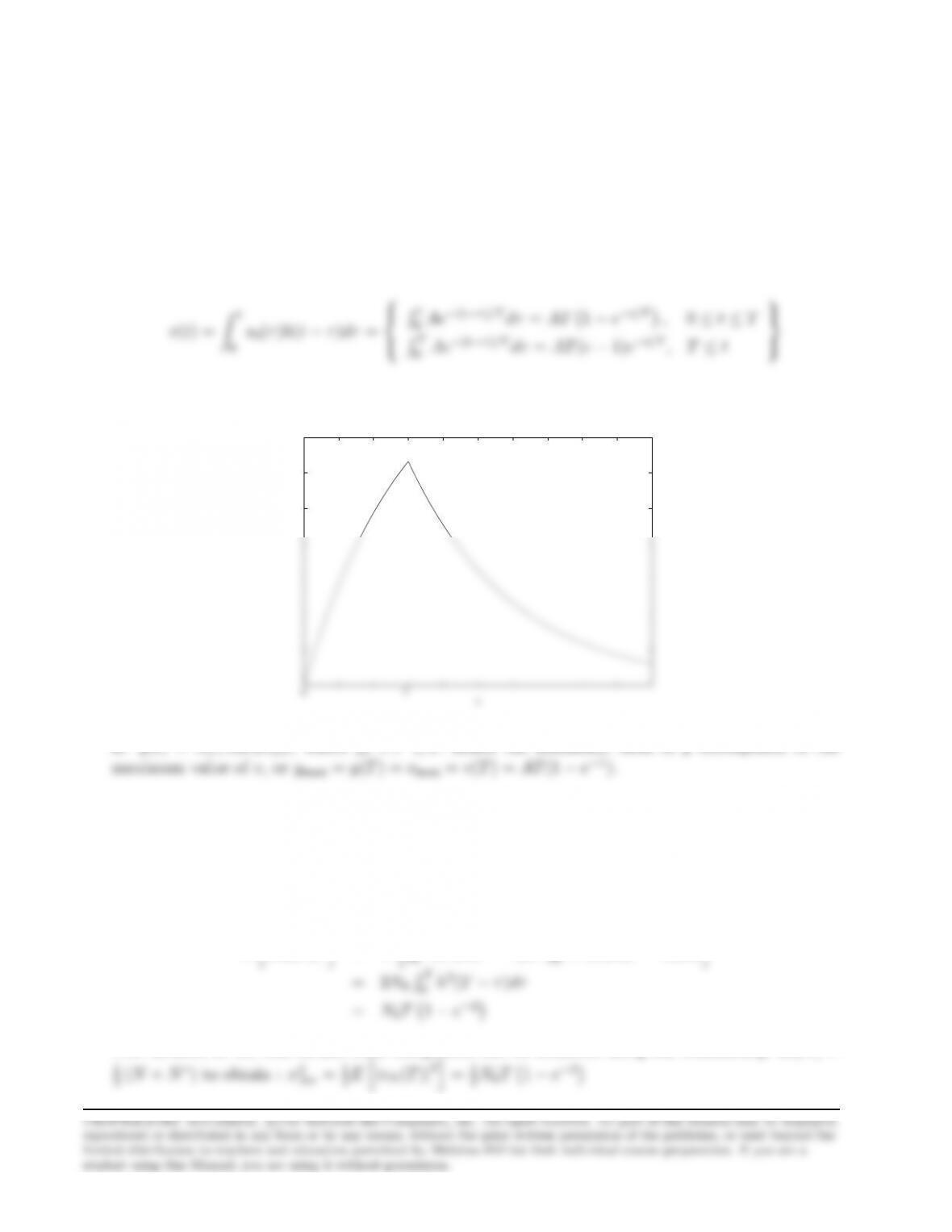
2. A sketch of v(t) is given in the following figure :
0 T
t
v(t)
3. y(t) = v(t) cos 2πfct, where fc>> 1/T. Hence the maximum value of ycorresponds to the
4. Working with lowpass equivalent signals, the noise term at the sampling instant will be :
vN(T) = ZT
0
z(τ)h(T−τ)dτ
The mean is : E[vN(T)] = RT
0E[z(τ)] h(T−τ)dτ = 0,and the second moment :
Eh|vN(T)|2i=EhRT
The variance of the real-valued noise component can be obtained using the relationship Re[N] =

5. The SNR is defined as :
γ=|vmax|2
Eh|vN(T)|2i=A2T
N0
e−1
e+ 1
6. If we have a filter matched to s0(t),then the output of the noise-free matched filter will be :
vmax =v(T) = ZT
0
s2
o(t) = A2T
and the noise term will have second moment :
Eh|vN(T)|2i=EhRT
0z(τ)s0(T−τ)dτ RT
0z∗(w)s0(T−w)dwi
Problem 4.17
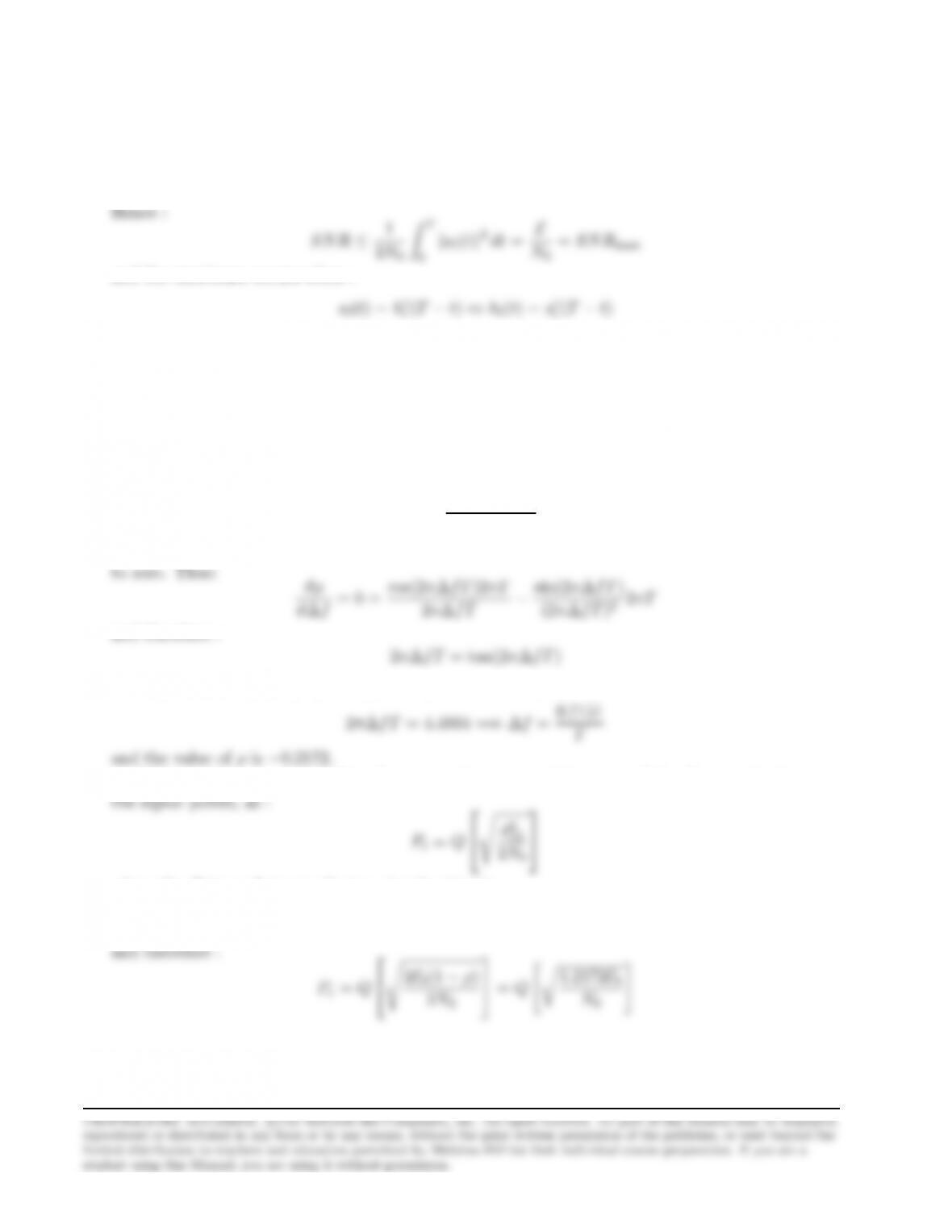
The SNR at the filter output will be :
SNR =|y(T)|2
Eh|n(T)|2i
where y(t) is the part of the filter output that is due to the signal sl(t),and n(t) is the part due to
the noise z(t).The denominator is :
so we want to maximize :
0sl(t)hl(T−t)dt
2
0|hl(T−t)|2dt
17
From Schwartz inequality :
ZT
0
sl(t)hl(T−t)dt
2
≤ZT
0|hl(T−t)|2dt ZT
0|sl(t)|2dt
2N0ZT
0|sl(t)|2dt =E
N0
and the maximum occurs when :
Problem 4.18
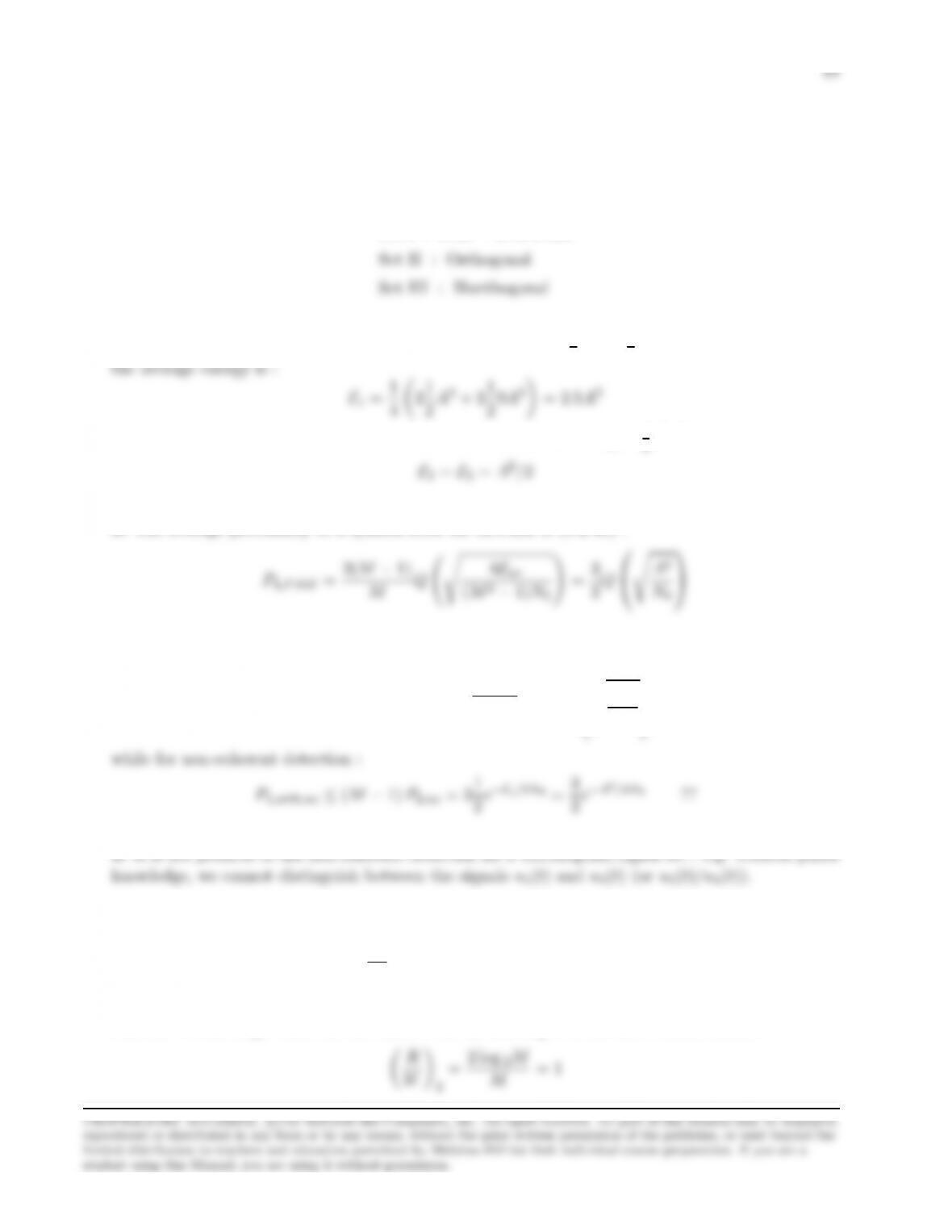
The correlation of the two signals in binary FSK is:
ρ=sin(2π∆fT )
2π∆fT
To find the minimum value of the correlation, we set the derivative of ρwith respect to ∆fequal
Solving numerically (or graphically) the equation x= tan(x), we obtain x= 4.4934. Thus,
We know that the probability of error can be expressed in terms of the distance d12 between
2N0
where the distance between the two signal points is :
d2
12 = 2Eb(1 −ρ)
Problem 4.19
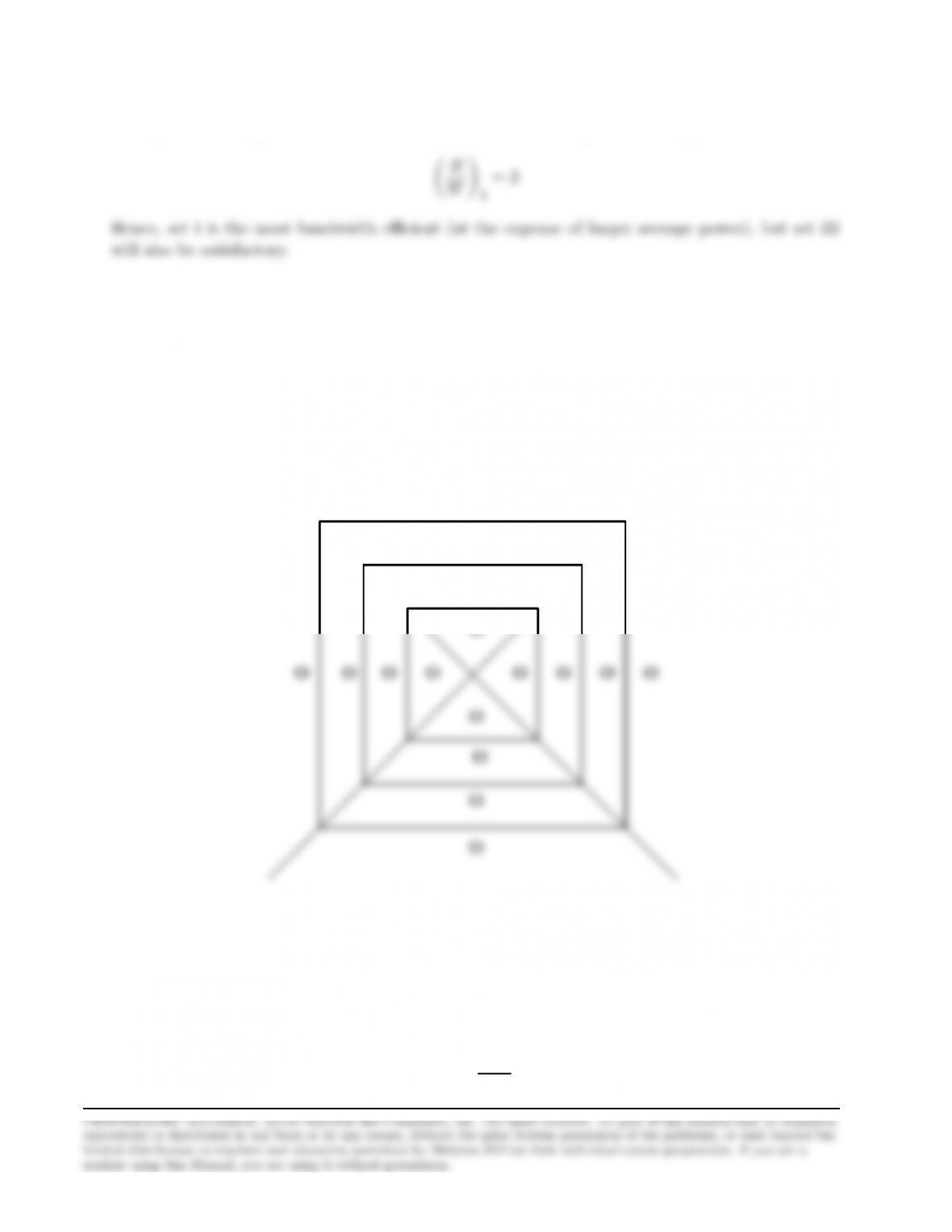
1. It is straightforward to see that :
Set I : Four −level PAM
2. The transmitted waveforms in the first set have energy : 1
2A2or 1
29A2.Hence for the first set
All the waveforms in the second and third sets have the same energy : 1
2A2.Hence :
3. The average probability of a symbol error for M-PAM is (5-2-45) :
MQ s6Eav
(M2−1)N0!=3
2Q
N0
4. For coherent detection, a union bound can be given by (5-2-25) :
P4,orth <(M−1) QpEs/N0= 3Q
sA2
2N0
5. It is not possible to use non-coherent detection for a biorthogonal signal set : e.g. without phase
6. The bit rate to bandwidth ratio for M-PAM is given by (5-2-85) :
R
W1
= 2 log 2M= 2 log 24 = 4
For orthogonal signals we can use the expression given by (5-2-86) or notice that we use a symbol
interval 4 times larger than the one used in set I, resulting in a bit rate 4 times smaller :
19
Finally, the biorthogonal set has double the bandwidth efficiency of the orthogonal set :
Problem 4.20
The optimum decision boundary of a point is determined by the perpedicular bisectors of each line
segment connecting the point with its neighbors. The decision regions for this QAM constellation
are depicted in the next figure:
❅❅❅❅❅❅❅❅❅❅❅❅❅❅❅❅❅❅
❅
❅
❅
❅
O
O
O
Problem 4.21
The transmitted signal energy is
Eb=A2T
2

20
where Tis the bit interval and Ais the signal amplitude. Since both carriers are used to transmit
With Rc
Rs
=10 ×103
100 ×103= 0.1
As
Problem 4.22
1. If the power spectral density of the additive noise is Sn(f), then the PSD of the noise at the
output of the prewhitening filter is
Sν(f) = Sn(f)|Hp(f)|2
2. Let hp(t) be the impulse response of the prewhitening filter Hp(f). That is, hp(t) = F−1[Hp(f)].
Then, the input to the matched filter is the signal ˜s(t) = s(t)⋆ hp(t). The frequency response of
3. The frequency response of the overall system, prewhitenig filter followed by the matched filter,
4. The variance of the noise at the output of the generalized matched filter is
|S(f)|2