
17
1. Since : µa= 0, σ2
a= 1,we have : Sss(f) = 1
T|G(f)|2.But :
G(f) = T
2
sin πfT/2
πfT /2e−j2πf T /4−T
2
sin πfT/2
πfT /2e−j2πf 3T /4
sin πfT/2
2. For non-independent information sequence the power spectrum of s(t) is given by : Sss(f) =
1
T|G(f)|2Sbb(f).But :
Rbb(m) = E[bn+mbn]
=E[an+man] + kE [an+m−1an] + kE [an+man−1] + k2E[an+m−1an−1]
1 + k2,m = 0
and the resulting power spectrum is :
πfT/22
3. The requirement for zeros at f=l/4T, l =±1,±2, … means : Sbb(l/4T) = 0 ⇒1 + k2+

18
form :bn=an+kan−4.Then :
1 + k2,m = 0
Problem 3.20
1. The power spectral density of the FSK signal may be evaluated by using equation (3-4-27) with
K= 2 (binary) signals and probabilities p0=p1=1
2. Thus, when the condition that the carrier
phase θ0and and θ1are fixed, we obtain
S(f) = 1
4T2
∞
X
n=−∞
|S0(n
T) + S1(n
T)|2δ(f−n
T) + 1
4T|S0(f)−S1(f)|2
where S0(f) and S1(f) are the fourier transforms of s0(t) and s1(t). In particular :
Similarly :
S1(f) = ZT
s1(t)e−j2πft dt
where f1=fc+∆f
2. By expressing S(f) as :
S(f) = 1
4T2
∞
X
n=−∞ h|S0(n
T)|2+|S1(n
T)|2+ 2Re[S0(n
T)S∗
1(n
T)]iδ(f−n
T)

1). If we average over the
random phases, these terms drop out. Hence, we have :
S(f) = 1
4T2
∞
X
n=−∞ h|S0(n
T)|2+|S1(n
T)|2iδ(f−n
T)
2. Note that :
|Sk(f)|2=TEb
2“sin πT (f−fk)
π(f−fk)2
+sin πT (f+fk)
π(f+fk)2#
Problem 3.21
1) The power spectral density of X(t) is given by
Sx(f) = 1
TSi(f)|U(f)|2
The Fourier transform of u(t) is
and therefore,

2) If u1(t) is used instead of u(t) and the symbol interval is T, then
Sx(f) = 1
3) If we precode the input sequence as bn=In+αIn−1, then
1 + α2m= 0
and therefore, the power spectral density Sb(f) is
To obtain a null at f=1
4) The answer to this question is no. This is because Sb(f) is an analytic function and unless it
Problem 3.22
1. Since X(t) = Re [P∞
n=−∞(an+jbn)u(t−nT )ej2πfct], the lowpass equivalent signal is Xl(t) =
P∞
2. Defining In=an+jbn, from the values of (an, bb) pair, it is clear that E[In] = 0 and
Ri(m) = E[In+mI∗
n] = (1m= 0
0m6= 0

Using 2.9-14,
SX(f) = 1
44Tsinc4(2T(f−fc)) + 4Tsinc4(2T(f+fc))
3. This is equivalent to a precoding of the form Jn=In+αIn−1where Jn=cn+jdn. Using
3.4-20 we have
SYl(f) = SXl(f)1 + αe−j2πfT
2
Problem 3.23
1. Since s(t) = P∞
n=−∞ αng(t−nT ) cos(2πf0t+θn), we have sl(t) = P∞
n=−∞ αnejθng(t−nT ).
We know that Ssl(f) = 1
Ra(m) = E[am+na∗
n]
From here we have
Sa(f) = 1
64|β|2
∞
X
e−j2πf mT +1
8α2−1
64|β|2
∞
X

22
and
Ssl(f) = 1
TSa(f)|G(f)|2
∞
X
3. For a=bthe constellation is on a circle at angles 45◦apart, therefore it is 8PSK and
4. bn’s will still be independent and equiprobable, therefore the previous parts will not change.
Problem 3.24
1. In general
Sv(f) = 1
T|G(f)|2Si(f)
m=−∞
and Ri(m) = E[InIn+m]. Since the sequence Inis iid we have
2. In this cases the signaling interval is 2Tand Jnsubstitutes In. We have
Rj(m) = E[JnJn+m] = E[(In−1+In+In+1)(In+m−1+In+m+In+m+1)]

23
Hence Sj(f) = P∞
m=−∞ Rj(m)e−j2πmf×2T= 6 + 8 cos(4πf T ) + 4 cos(8πf T ) and
Problem 3.25
1. We have
Ra(m) = E[an+man]
=(E[a2
n]m= 0
(E[an])2m6= 0
4m= 0
Using Sa(f) = P∞
m=−∞ Ra(m)e−j2πfmT , we have
Sa(f) = 19
16 +1
16
∞
X
e−j2πf mT
and since g(t) = sinc(t/T ), we have G(f) = TΠ(T f), hence |G(f)|2=T2Π(T f) and
2. The power spectral density is multiplied by 1 + e−j2πf T −e−j4πfT
2= 3 −2 cos(4πf T ).
3. In this case Sw(f) is multiplied by 1 + je−j2πfT
2= (2 + 2 sin 2πfT ) and

24
Problem 3.26
1. For QPSK we have Xl=P∞
n=−∞(a2n+ja2n+1)g2T(t−2nT ) = P∞
n=−∞ Ing2T(t−2nT ) where
In=a2n+ja2n+1 and therefore
Ri(m) = E[In+mI∗
n]
Therefore Si(f) = P∞
m=−∞ Ri(m)e−j4πfmT = 2. Also note that g2T(t) = Π t−T
2T, and
therefore |G2T(f)|2= 4T2sinc2(2T f). Substituting into SXl(f) = 1
2. Here Xl(t) = P∞
n=−∞ a2ng2T(t−2nT ) + jP∞
n=−∞ a2n+1g2T(t−(2n+ 1)T), and
RXl(t+τ, t) = E[Xl(t+τ)X∗
l(t)]
X
∞
X
3. The only difference here is that instead of the Fourier transform of the rectangular signal we

4. The envelope of Xl, is in general |Xl(t)|, so we need to show that |Xl(t)|is independent of t.
We have
Xl(t) =
∞
X
n=−∞
a2ng2T(t−2nT ) + j
∞
X
n=−∞
a2n+1g2T(t−(2n+ 1)T)
Therefore,
X
X
Problem 3.27
Since an’s are iid
n], m = 0
2, m = 0
2. This means that bn’s individually have the same probabilities as an’s but of
course unlike an’s they are not independent. In fact bndepends on bn−1and bn+1 and since
Rb(m) = E[bnbn+m] = E[(an−1⊕an)(an+m−1⊕an+m)], we conclude that if m6= 0,±1 then

26
and
Sv(f) = 1
T|G(f)|2Sb(f) = Tsinc2(T f )“1
4+1
4
∞
X
m=−∞
e−j2πf mT #
We can simplify this using the relation P∞
n=−∞ ej2πf nT =1
TP∞
n=−∞ δf−n
Tto obtain
∞
X
2. Here, Rb(m) = E[(an+an−1)(an+m+an+m−1)] = 2Ra(m) + Ra(m+ 1) + Ra(m−1), and
and
Sb(f) =
∞
X
m=−∞
Rb(m)e−j2πfmT =1
2+1
4ejπfT +e−j2πfT +
∞
X
m=−∞
e−j2πf mT
Therefore,
∞
X
Problem 3.28
Here we have 8 equiprobable symbols given by the eight points in the constellation.
1. Obviously E(an) = 0 and
m] = 0 n6=m
Hence Sa(f) = r2
1+r2
2
2. Also obviously |G(f)|2=T2sinc2(T f ). Therefore
1+r2
2
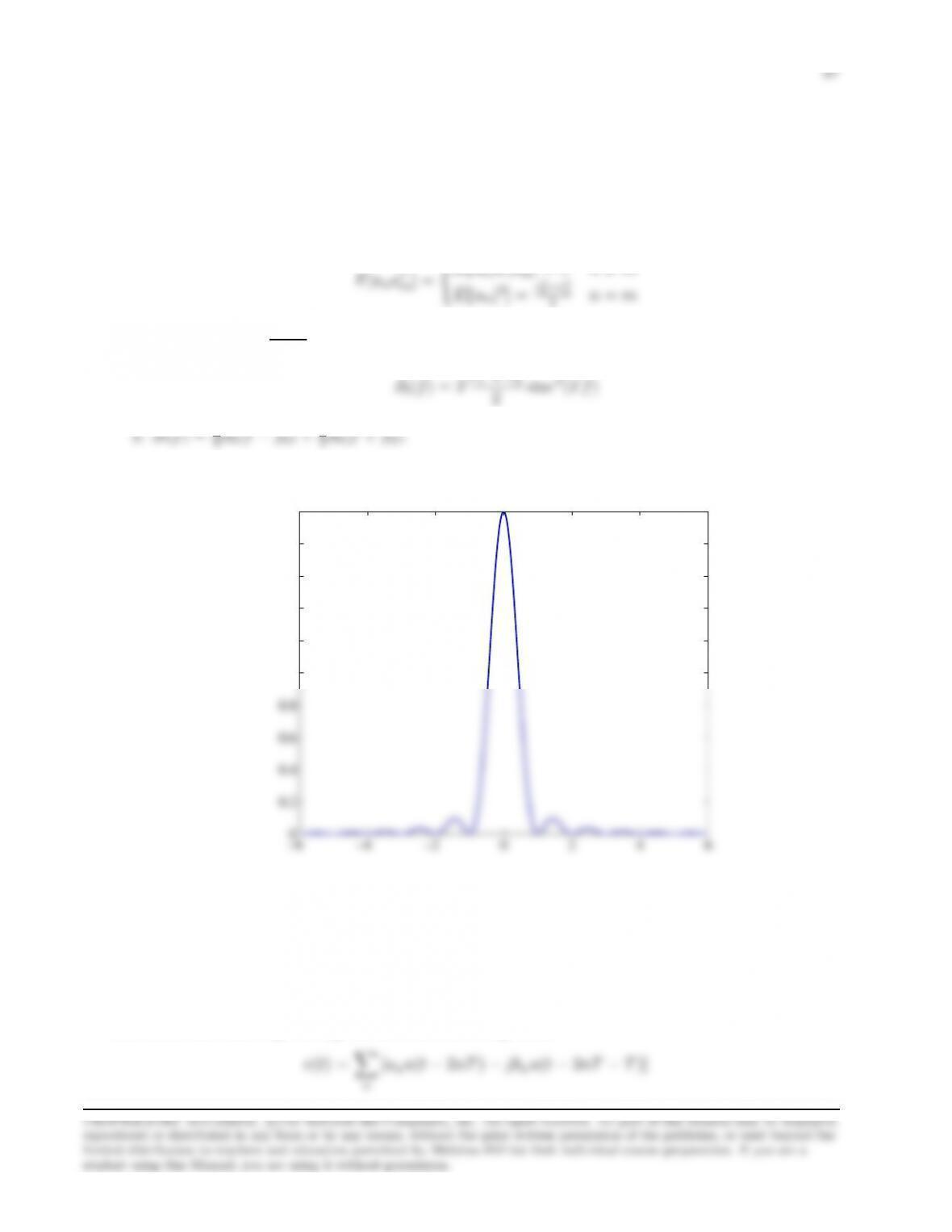
3. In this case Sl(f) = T r2sinc2(T f). An example of the plot is shown below
−6 −4 −2 0 2 4 6
0
0.2
0.4
0.6
0.8
1
1.2
1.4
1.6
1.8
2
Problem 3.29
The MSK and offset QPSK signals have the following form :

28
where for the QPSK :
1,0≤t≤2T
0,o.w.
The derivation is identical to that given in Sec. 3.4.2 with 2Tsubstituted for T. Hence, the result
is:
Rvv (τ) = 1
2TP∞
m=−∞ Rii(m)Ruu(τ−m2T)
For the rectangular pulse of QPSK, we have :
For the MSK pulse :
Ruu(τ) = R∞
(check for tha 1/2 factor in the defn. Of autocorr. Function!)
Problem 3.30
a. For simplicity we assume binary CPM. Since it is partial response :
q(T) = RT
so only the last two symbols will have an effect on the phase :
R(t;I) = 2πh Pn

29
It is easy to see that, after the first symbol, the phase slope is : 0 if In,In−1have different signs,
R((n+ 1)T;I) = π
2
n−1
X
k=−∞
Ik+π
4In
Hence the phase tree is as shown in the following figure :
✦✦✦✦
✦
❛❛❛❛
❛❅❅❅❅❅❅❅❅❅
❅❅❅❅❅
❅
o
o o
oo
o
+1 -1
+1
+1
+
+1+1
-1
-1
-1
-1
o
o o
oo
o
-1 +1
-1
-1
–
-1-1
+1
+1
+
+
0
−π/4
−3π/4
−5π/4
−7π/4
π/4
3π/4
5π/4
7π/4
t=0 t=T t=2T t=3
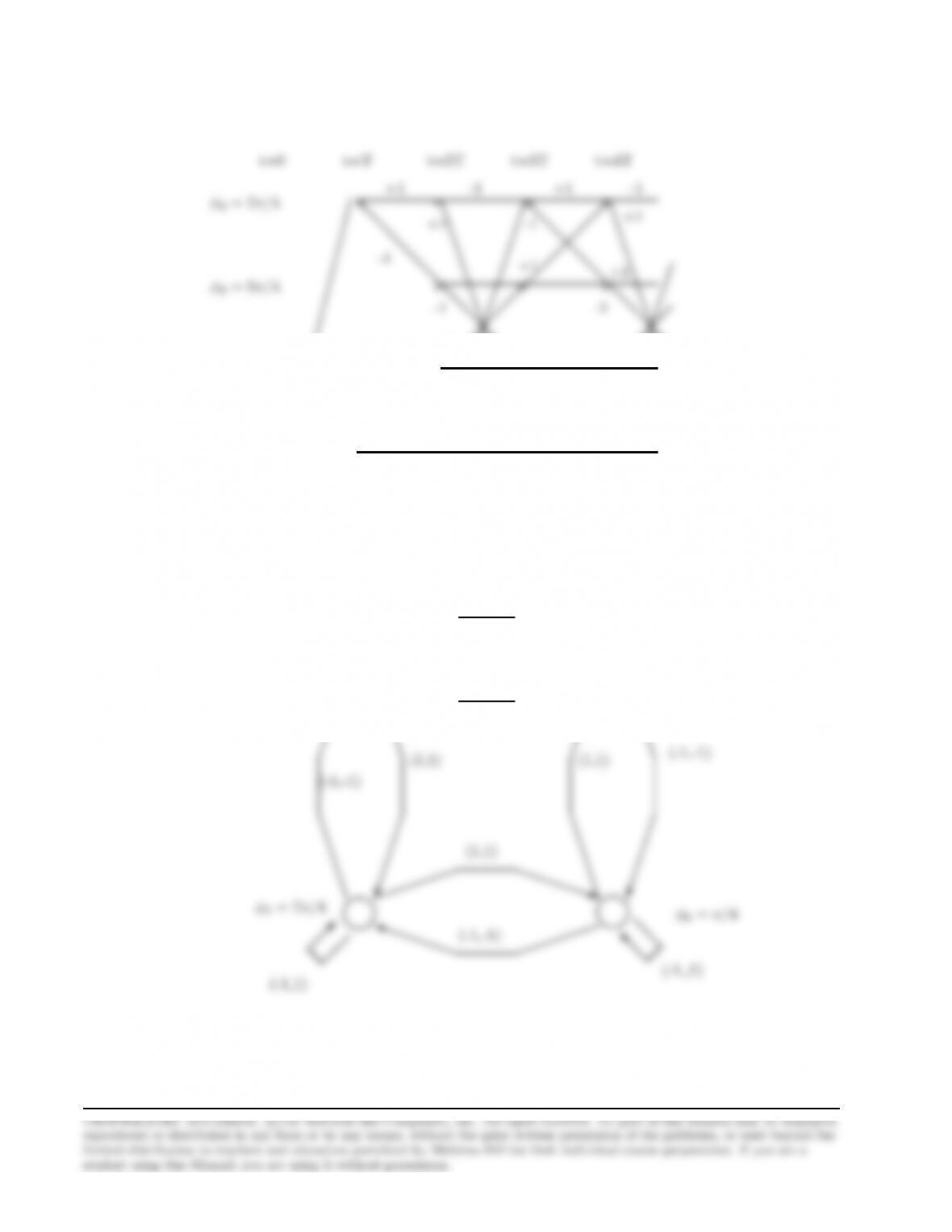
b. The state trellis is obtained from the phase-tree modulo 2π:
30
✑✑✑✑✑
✑
✄✄✄✄✄✄✄✄✄✄✄✄✄✄✄✄✄✄✄✄❇❇❇❇❇❇❇❇❇❇❇❇❇❇❇❇
❇
❅
✂✂✂✂✂✂✂✂✂✂✂✂✂✂✂✂
❅
❇
✂✂✂✂✂✂✂✂✂✂✂✂
ooo
o o
o o o o
o
o
-1 -1+1 +1
+1
+1
-1
-1
-1+1 +1
+1
-1 -1
+1 +1
-1
+1
-1
t=0 t=T t=2T t=3T t=4T
0
φ0=π/4
φ1= 3π/4
φ3= 7π/4
(c) The state diagram is shown in the following figure (with the (In,In−1) or (In−1,In) that cause
the respective transitions shown in parentheses)
✒✑
✓✏ ✒✑
✓✏
❇❇❇❇❇
✂✍
✏✏✏✏✏
✏PPPPP
Pq
P
P
P
P
P
P✐
✏✏✏✏✏
✏❇❇❇❇❇
✂✍
❅
❅
.
.
.
.
.
.
.
.
.
.
.
.
.
.
.
.
.
.
.
.
.
.
.
.
.
.
❅
❅❘
.
.
.
.
.
.
.
.
.
.
.
.
.
.
.
.
.
.
.
.
.
.
.
.
.
.
✠
(1,1)
(-1,-1)
(-1,1)
(-1,1)
(-1,1)
φ1= 3π/4φ2= 5π/4
Problem 3.31

k=−∞
1. Full response binary CPFSK (q(T) = 1/2):
(i) h= 2/3.At the end of each bit interval the phase is : 2π2
1
2. Partial response L= 3,binary CPFSK : q(T) = 1/6, q(2T) = 1/3, q(3T) = 1/2.Hence, at the
end of each bit interval the phase is :
πh
n−2
X
k=−∞
Ik+ 2πh (In−1/3 + In/6) = πh
n−2
X
k=−∞
Ik+πh
3(2In−1+In)
Problem 3.32
We are given by Equation (3.3-33) that the pulses ck(t) are defined as
ck(t) = s0(t)
L−1
Y
n=1
s0[t+ (n+Lak,n)],0≤t≤T·min
n[L(2 −ak,n −n]

32
if all ak,n, n = 0,1, ..., L −1 are zero (for a specific k), and
ˆn= max {n:ak,n = 1}(3.0.2)
Problem 3.33
sk(t) = Iks(t)⇒Sk(f) = IkS(f), E(Ik) = µi, σ2
i=E(I2
k)−µ2
i
K
X
k=1
pkSk(f)
2
=|S(f)|2
K
X
k=1
pkIk
2
=µ2
i|S(f)|2
Therefore, the discrete frequency component becomes :
∞
X

Problem 3.34
The line spectrum in (3.4.27) consists of the term :
1
T2
∞
X
n=−∞
K
X
k=1
pkSkn
T
2
δf−n
T
Now, if PK
k=1pksk(t) = 0,then PK
k=1pkSk(f) = 0,∀f. Therefore, the condition PK
k=1pksk(t) = 0