32
The power density spectrum is
S(f) = P∞
k=−∞ R(k)e−j2πfk
=P−1
k=−∞ 1
2−ke−j2πfk +P∞
k=0 1
2ke−j2πfk
Problem 2.48
We will denote the discrete-time process by the subscript dand the continuous-time (analog) process
by the subscript a. Also, fwill denote the analog frequency and fdthe discrete-time frequency.
a.
Rd(k) = E[X∗(n)X(n+k)]
Hence, the autocorrelation function of the sampled signal is equal to the sampled autocorrelation
function of X(t).
b.
Rd(k) = Ra(kT ) = R∞
−∞ Sa(F)ej2πfkT df
33
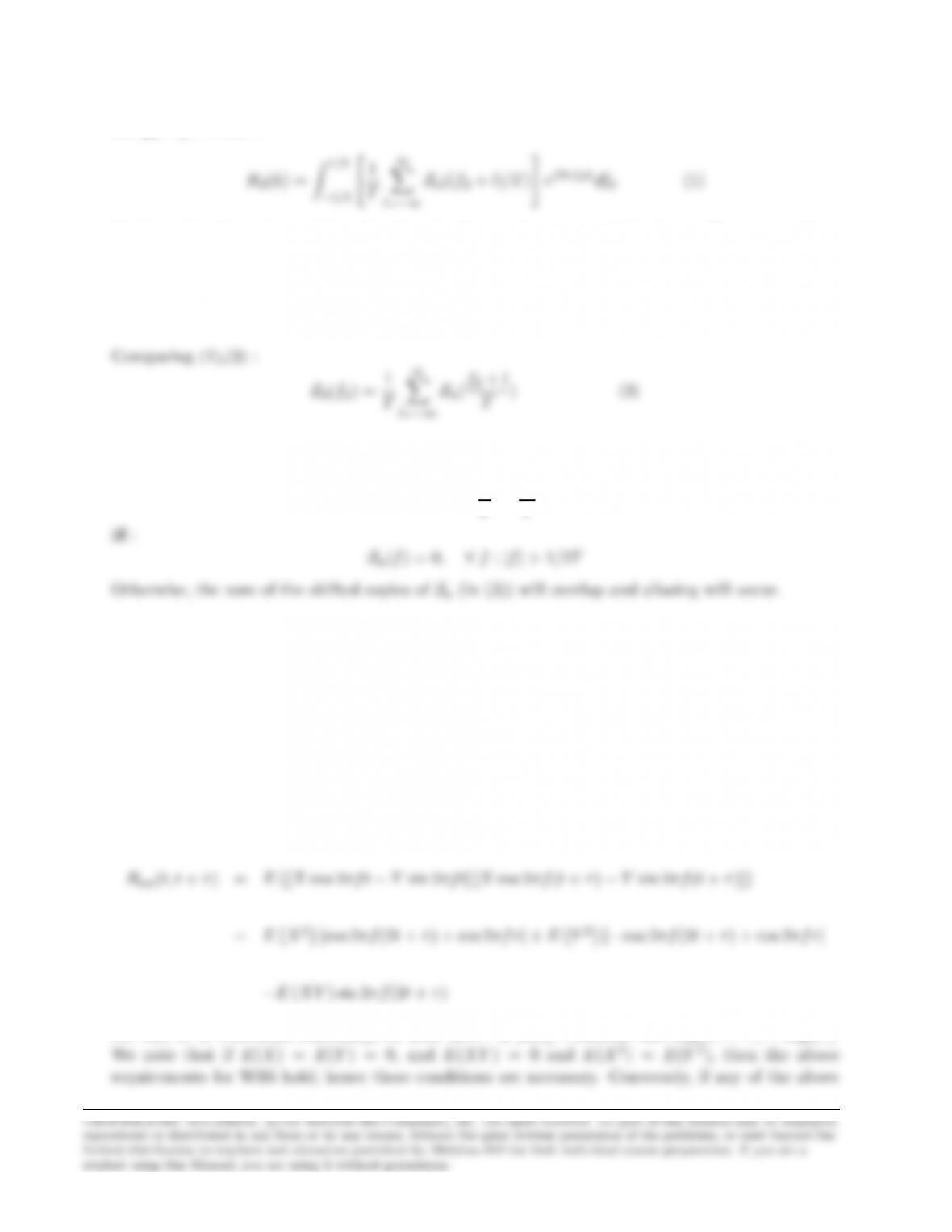
Let fd=fT. Then :
∞
X
We know that the autocorrelation function of a discrete-time process is the inverse Fourier transform
of its power spectral density
Rd(k) = Z1/2
−1/2Sd(fd)ej2πfdkdfd(2)
l=−∞ Sa(fd+l
c. From (3) we conclude that :
Sd(fd) = 1
Problem 2.49
u(t) = Xcos 2πf t −Ysin 2πft
E[u(t)] = E(X) cos 2πft −E(Y) sin 2πf t
and :
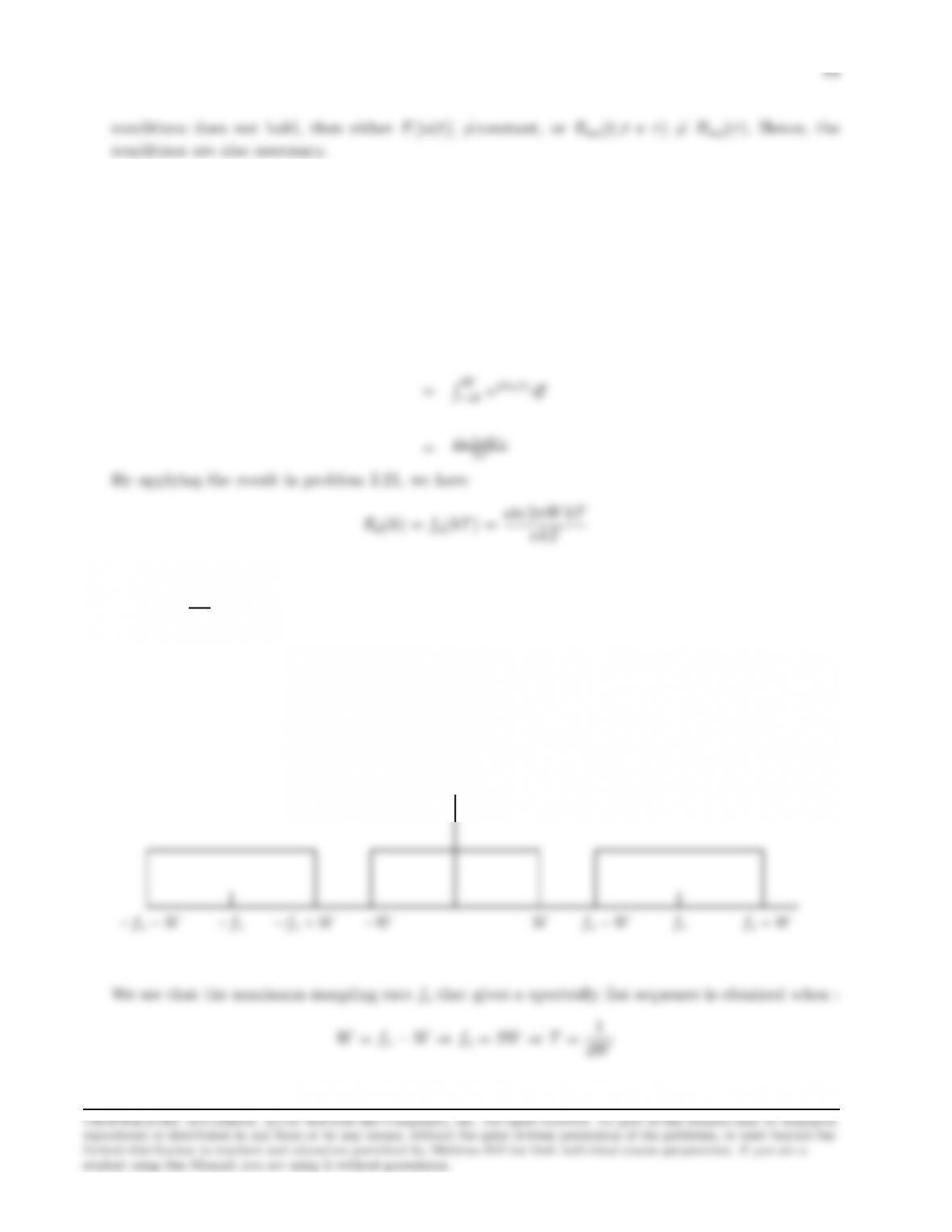
For u(t) to be wide-sense stationary, we must have : E[u(t)] =constant and Ruu(t, t +τ) = Ruu(τ).
Problem 2.50
a.
Ra(τ) = R∞
−∞ Sa(f)ej2πfτ df
b. If T=1
2W,then :
Rd(k) =
2W= 1/T, k = 0
0,otherwise
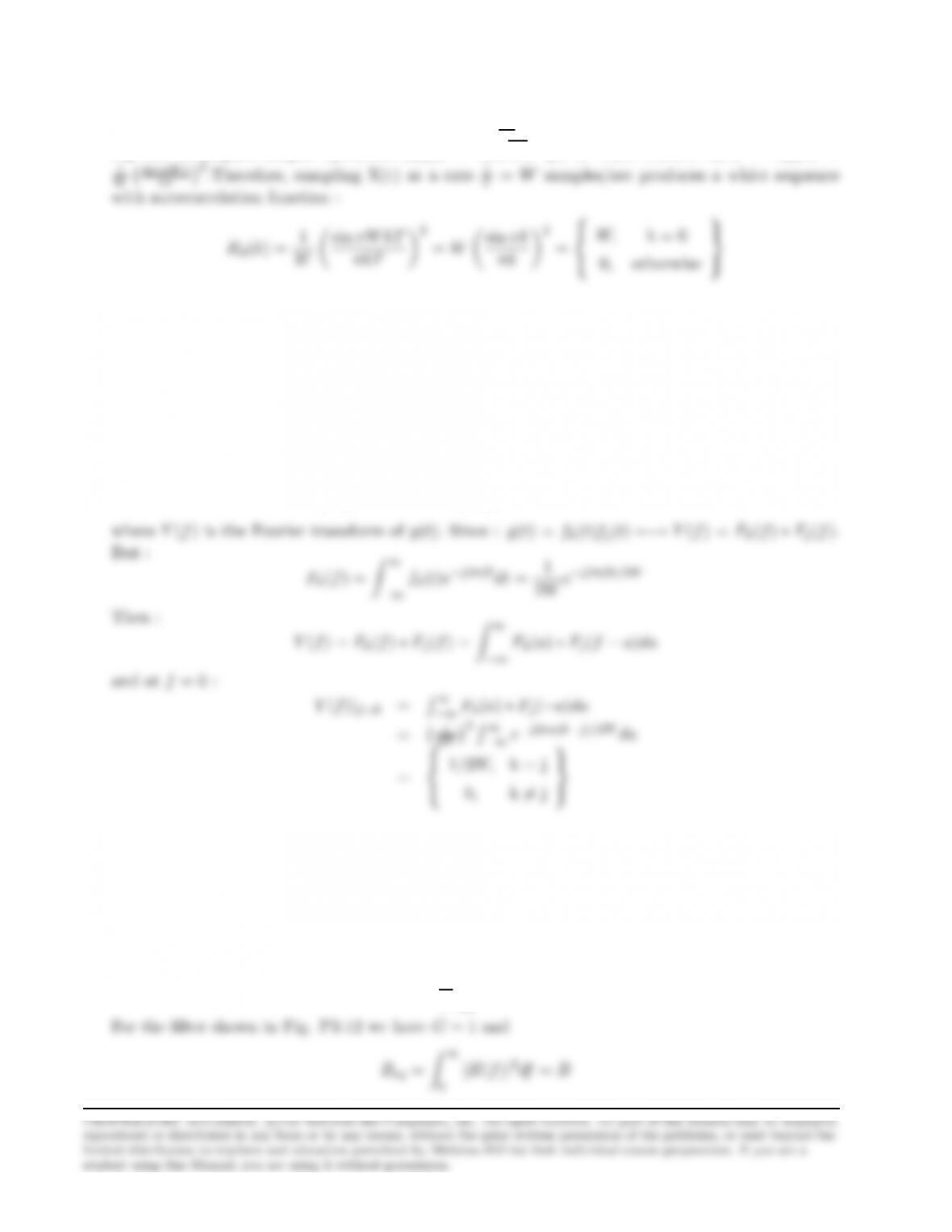
Thus, the sequence X(n) is a white-noise sequence. The fact that this is the minimum value of
Tcan be shown from the following figure of the power spectral density of the sampled process:
35
c. The triangular-shaped spectrum S(f) = 1 −|f|
W,|f| ≤ Wmay be obtained by convolv-
ing the rectangular-shaped spectrum S1(f) = 1/√W , |f| ≤ W/2.Hence, R(τ) = R2
1(τ) =
0,otherwise
Problem 2.51
Let’s denote : y(t) = fk(t)fj(t).Then :
Z∞
−∞
fk(t)fj(t)dt =Z∞
−∞
y(t)dt =Y(f)|f=0
0,k6= j
Problem 2.52
Beq =1
GZ∞
0|H(f)|2df
36
For the lowpass filter shown in Fig. P2-16 we have
H(f) = 1
1 + j2πf RC ⇒ |H(f)|2=1
1 + (2πfRC)2
Problem 2.53
a.
E[z(t)z(t+τ)] = E[{x(t+τ) + jy(t+t)}{x(t) + jy(t)}]
=E[x(t)x(t+τ)] −E[y(t)y(t+τ)] + jE [x(t)y(t+τ)]
b.
V=ZT
0
z(t)dt
Problem 2.54
E[x(t+τ)x(t)] = A2E[sin (2πfc(t+τ) + θ) sin (2πfct+θ)]
where the last equality follows from the trigonometric identity :
sin Asin B=1
2[cos(A−B)−cos(A+B)] .But :
E[cos (2πfc(2t+τ) + 2θ)] = R2π
0cos (2πfc(2t+τ) + 2θ)p(θ)dθ
Problem 2.55
1) We have E[Z(t)] = E[X(t)] + jE[Y(t)] = 0 + j0 = 0 and
RZ(t+τ, t) = E[(X(t+τ) + jY (t+τ)) (X(t)−jY (t))]
2) To compute the power spectral density of Z(t), we have SZ(f) = F[2RX(τ)] = 2SX(f) =
2N0Πf
2W. Note that Π(t) is a rectangular pulse defined as
1,|t|<1
1
3) E[Zj] = EhR∞
−∞ Z(t)R∗
j(t)dti=R∞
−∞ E[Z(t)]R∗
j(t)dt = 0 since Z(t) is zero-mean. For the
38
−∞
−∞
Using Parseval’s Theorem, R∞
−∞ x(t)y∗(t)dt =R∞
−∞ X(f)Y∗(f)df, we have (Sj(f) is the Fourier
transform of Rj(t)).
Z∞
RZ(s−t)R∗
j(s)ds =Z∞
e−j2πf t2N0Πf
j(f)df
−∞
where (a) is due to the fact that Π f
2Wis zero outside the [−W, W ] interval and (b) follows from
Rj(t) being bandlimited to [−W, W ]. From above we have
Z∞
RZ(s−t)R∗
j(s)ds = 2N0Z∞
ej2πf tSj(f)df∗
4) This is done similar to part 3 (lengthy but straightforward) and the result is that for any k,Zkr
and Zki are zero-mean, independent Gaussian random variables with E(Z2
5) We have
E[ˆ
Z(t)Z∗
k] = E[(Z(t)−
N
X
ZjRj(t))Z∗
k]
Now we have
E[Z(t)Z∗
k] = EZ(t)Z∞
Z∗(s)Rk(s)ds
(a): because Rk(t) is bandlimited to [−W, W ].
Problem 2.56
1. Sˆ
X(f) = | − jsgn(f)|2SX(f) = SX(f), hence Rˆ
X(τ) = RX(τ).
40
4. We have
RXl(t+τ, t) = EhZ(t+τ)e−j2πf0(t+τ)Z∗(t)ej2πf0ti
Problem 2.57
1) The power spectral density Sn(f) is depicted in the following figure. The output bandpass
process has non-zero power content for frequencies in the band 49 ×106≤ |f| ≤ 51 ×106. The
power content is
P=Z−49×106
10−81 + f
10−81−f
−49×106
−49×106
51×106
51×106
−5·1075·107
2) The output process N(t) can be written as
41
where Nc(t) and Ns(t) are the in-phase and quadrature components respectively, given by
Nc(t) = N(t) cos(2π50 ×106t) + ˆ
N(t) sin(2π50 ×106t)
3) The power spectral density of Nc(t) and Ns(t) is
SNc(f) = SNs(f) =
SN(f−50 ×106) + SN(f+ 50 ×106)|f| ≤ 50 ×106
0 otherwise
4) The power spectral density of the output is given by
SY(f) = SX(f)|H(f)|2= 10−6(|f| − 49 ×106)(10−8−10−16|f|) for 49 ×106≤ |f| ≤ 51 ×106
Hence, the power content of the output is
The power spectral density of the in-phase and quadrature components of the output process is
given by
SYc(f) = SYs(f) = 10−6((f+ 50 ×106)−49 ×10610−8−10−16(f+ 50 ×106))
42
for |f| ≤ 106and zero otherwise. The power content of the in-phase and quadrature component is
PYc=PYs= 10−6Z106
(−2×10⁻¹⁶f2+ 10−2)df
106
106