13
10-9
10-7
10-6
10-5
10-4
10-3
10-2
10-1
100
0 5 10 15 20
Outage probability
Average SNR (dB)
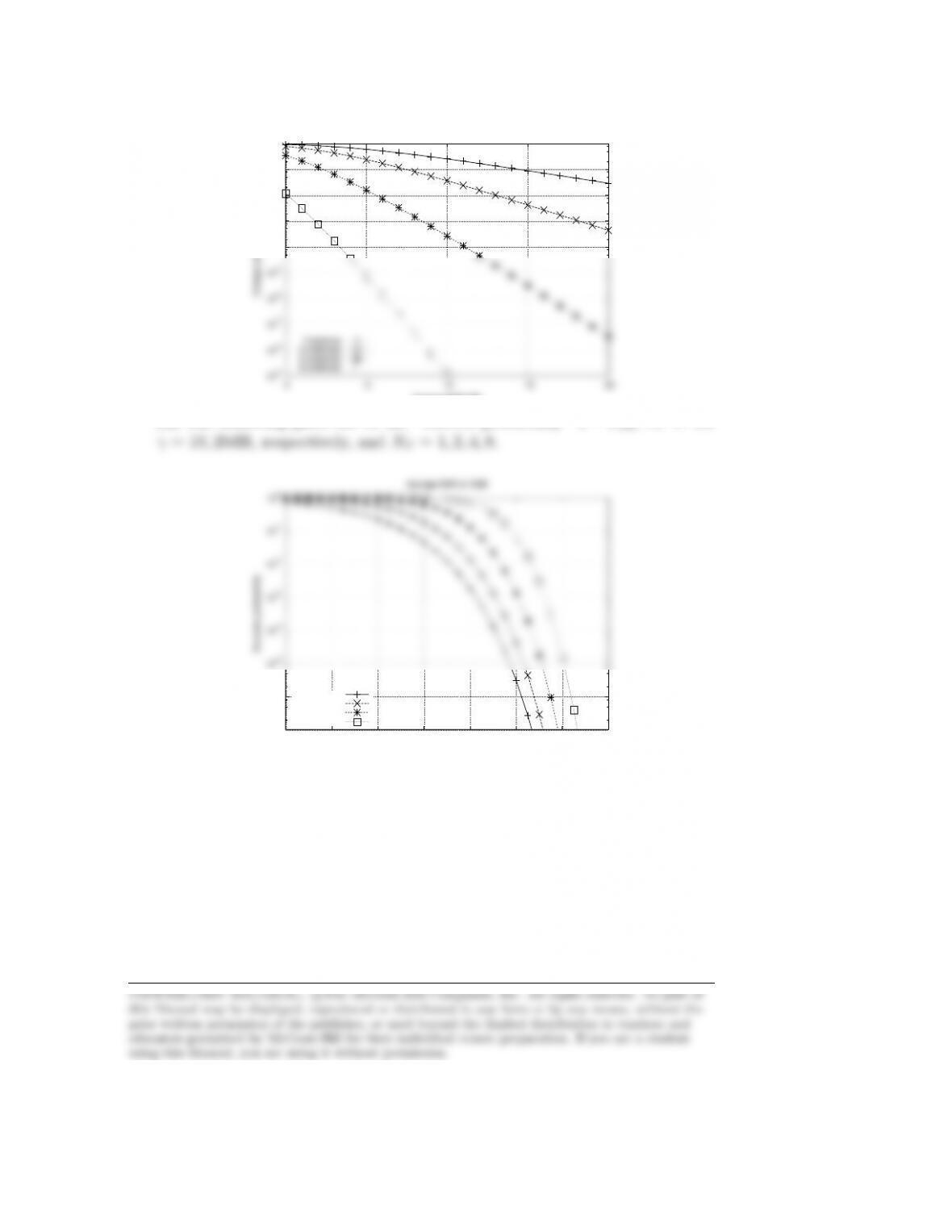
Outage capacity is 2 bps/Hz
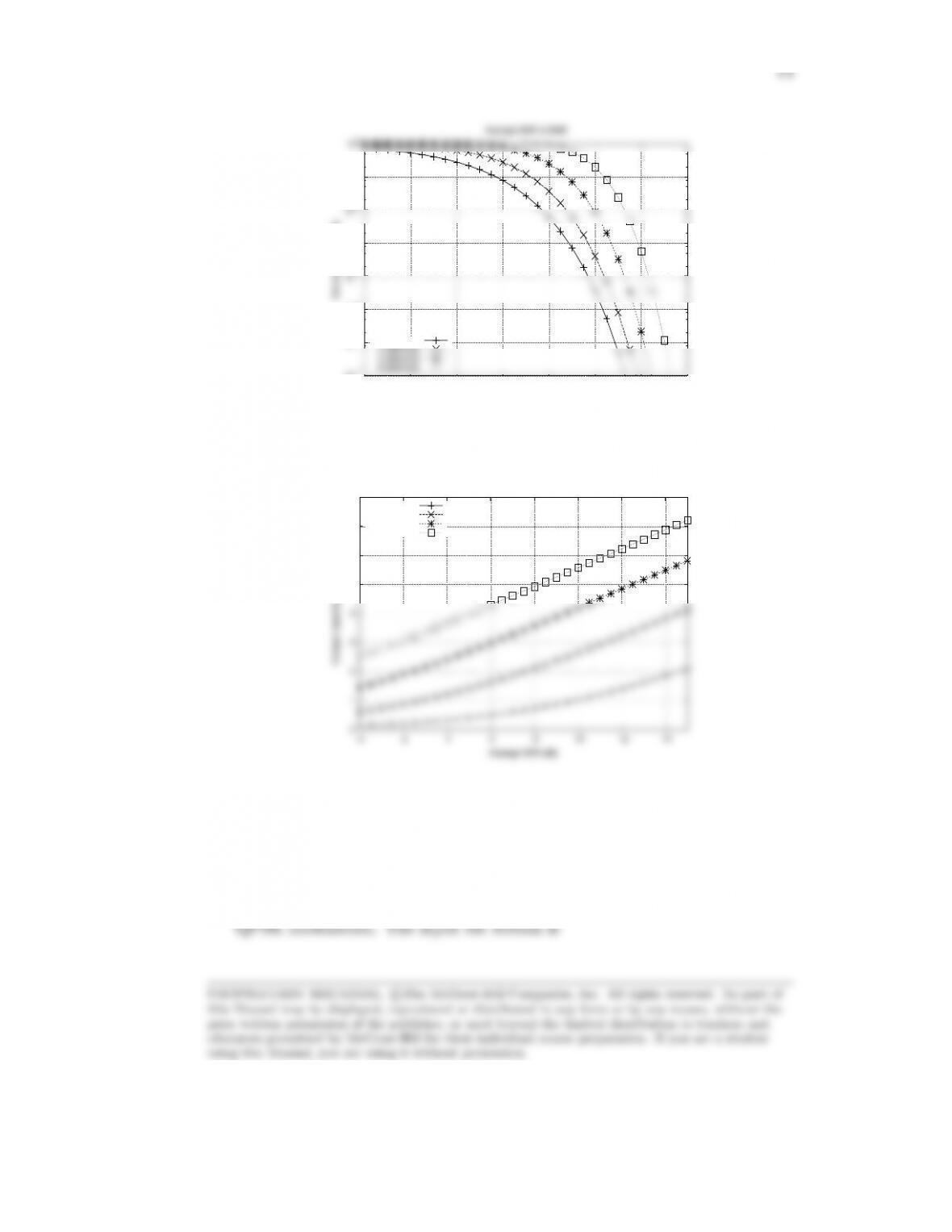
(d) The following plots are of the “success probability” 1 −Pout vs. Cfor
10-7
10-6
10-5
10-4
10-3
10-2
10-1
100
2 3 4 5 6 7 8 9
Outage capacity (bps/Hz)
1 antenna
2 antennas
4 antennas
8 antennas
10-7
10-6
10-5
10-3
10-1
5 6 7 8 9 10 11 12
Outage capacity (bps/Hz)
1 antenna
(e) Setting Pout = 0.1, we plot Cvs. γfor NT= 1,2,4,8.
0
1
2
3
4
5
6
7
8
Outage capacity (bps/Hz)
Outage probability is 0.1
1 antenna
2 antennas
4 antennas
8 antennas
Problem 15.13
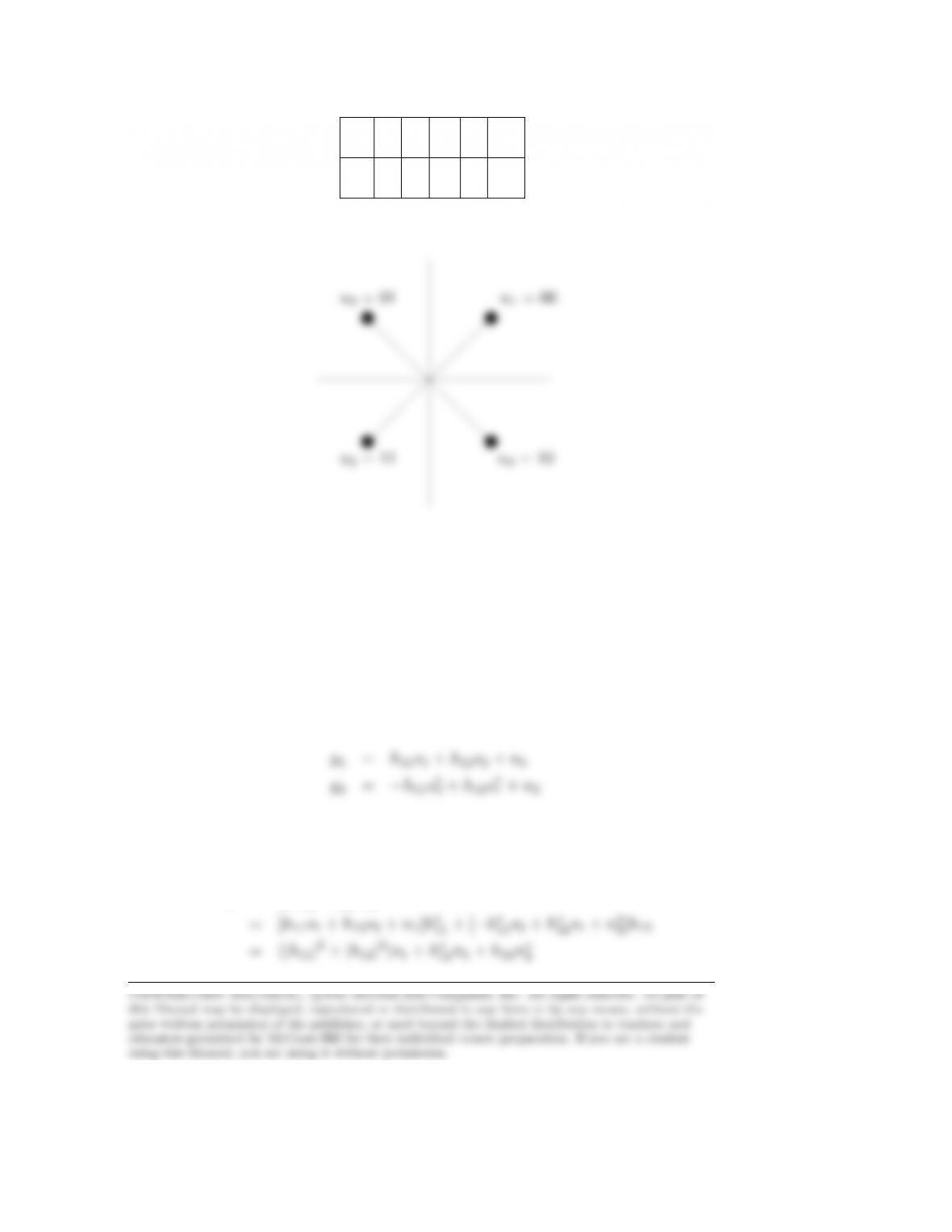
An (NT, NR) = (2, NR) MIMO system employs the Alamouti code with
15
01 10 10 01 11 00
s1s2s3s4s5s6
Problem 15.14
We wish to show that the decision metrics in equations (15.4-25) and (15.4-
22) are equivalent. The received signals are
and
ˆs1=y1h∗
11 +y∗
2h12

16
Signalling interval Antenna 1 Antenna 2
1s1=v2s2=v4
2−s∗
2=v3s∗
1=v3
The decision metric µ(s1) may be expressed as
µ(s1) = 2Re{y1h∗
11s∗
1+y∗
2h12s∗
1} − |s1|2(|h11|2+|h12|2)
We substitute for ˆs1= (|h11|2+|h12|2)s1+h∗
11n1+h12n∗
2into µ(s1) and
obtain
µ(s1) = 2Re{s∗
1(|h11|2+|h12|2)s1/2 + (h∗
11n1+h12n∗
2)}
Problem 15.15
Since
GHG=|s1|2+|s2|2+|s3|2I3

17
and the received signals are
y1=h11s1+h12s2+h13s3+n1
the maximum likelihood detector bases its decisions on the estimates ˆs1,ˆs2,ˆs3,
where
ˆs1=h∗
11y1+h12y∗
2−h13y∗
3
For example, if we substitute for y1, y2and y3in the estimate ˆs1, we obtain
ˆs1= (|h11|2+|h12|2+|h13|2)s1+h∗
11n1+h∗
12n∗
2−h13n∗
3
Problem 15.16
Gis given by equation (15.4-42). The received signal vector is
y=Gh+n=G[h11 h12 h13 h14]T+ [n1n2. . . n8]T
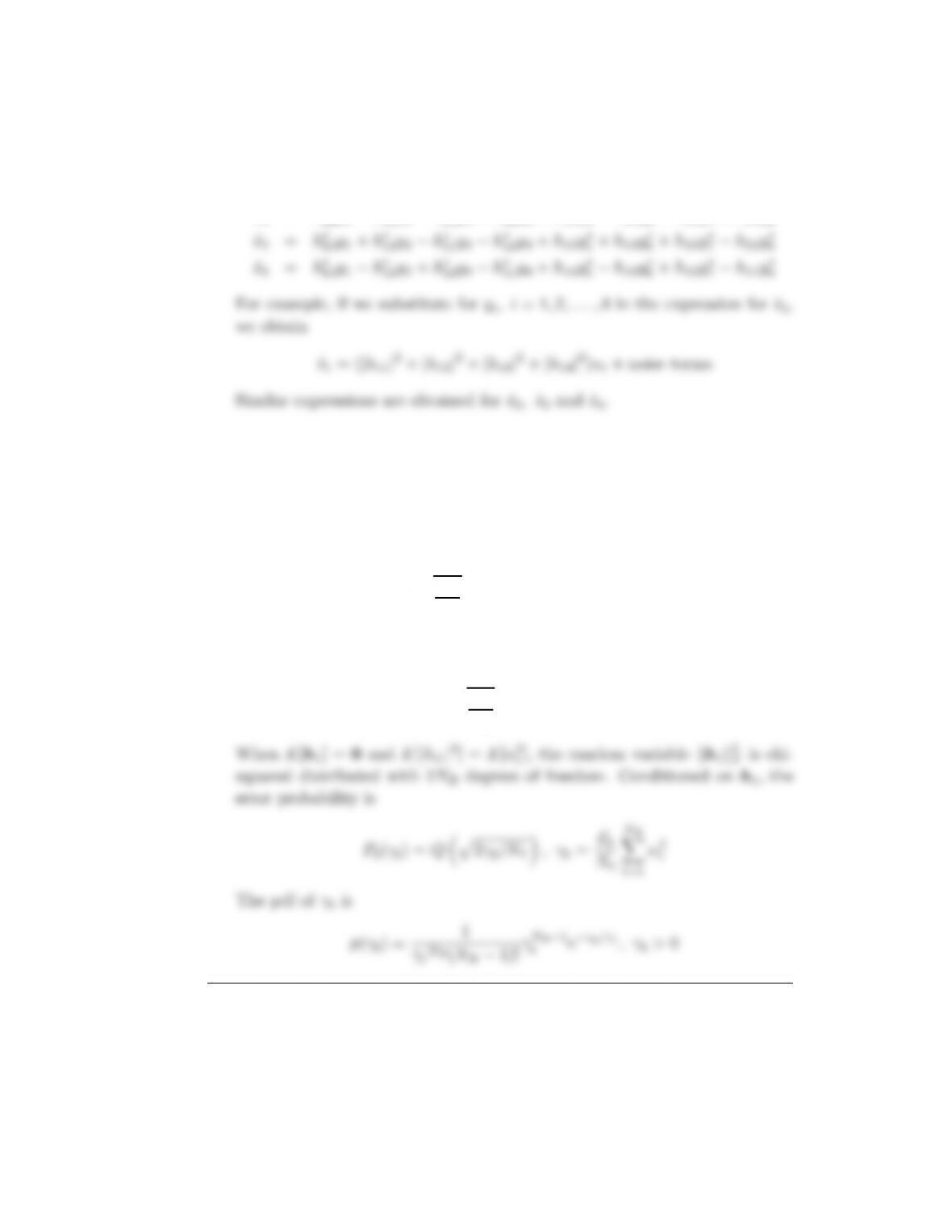
The received signal components are:
y1=h11s1+h12s2+h13s3+h14s4+n1
3+h13s∗
2+h14s∗
1+n8
18
Since GHG=P4
i=1 |si|2I4, the maximum-likelihood detector bases its deci-
sions on the estimates:
ˆs1=h∗
11y1+h∗
12y2+h∗
13y3+h∗
14y4+h11y∗
5+h12y∗
6+h13y∗
7+h14y∗
8
ˆs2=h∗
12y1−h∗
11y2−h∗
14y3+h∗
13y4+h12y∗
5−h11y∗
6−h14y∗
7+h13y∗
8
Problem 15.17
From equation (15.3-2), the output of the MRC is
µj=hH
jyj=rEb
NT
sjkhjk2
F+hH
jnj, j = 1,2,…,NT
For BPSK modulation, assume sj=±1 and consider the case of the signal
transmitted from antenna 1. Then, with s1= 1,
µ1=rEb
NT
s1kh1k2
F+hH
1n1
¯γcNR(NR−1)!γNR−1
PROPRIETARY MATERIAL. c
The McGraw-Hill Companies, Inc. All rights reserved. No part of
this Manual may be displayed, reproduced or distributed in any form or by any means, without the
prior written permission of the publisher, or used beyond the limited distribution to teachers and
educators permitted by McGraw-Hill for their individual course preparation. If you are a student
using this Manual, you are using it without permission.

19
Problem 15.18
For the SIMO (1,2) system, with transmitted energy √Eband AWGN, we
simply have the performance of a conventional dual diversity system with
MRC. Hence, from equation (13.4-15), with L= 2, we have
PSIMO =1
4(1 −µ)2(2 + µ)
Problem 15.19
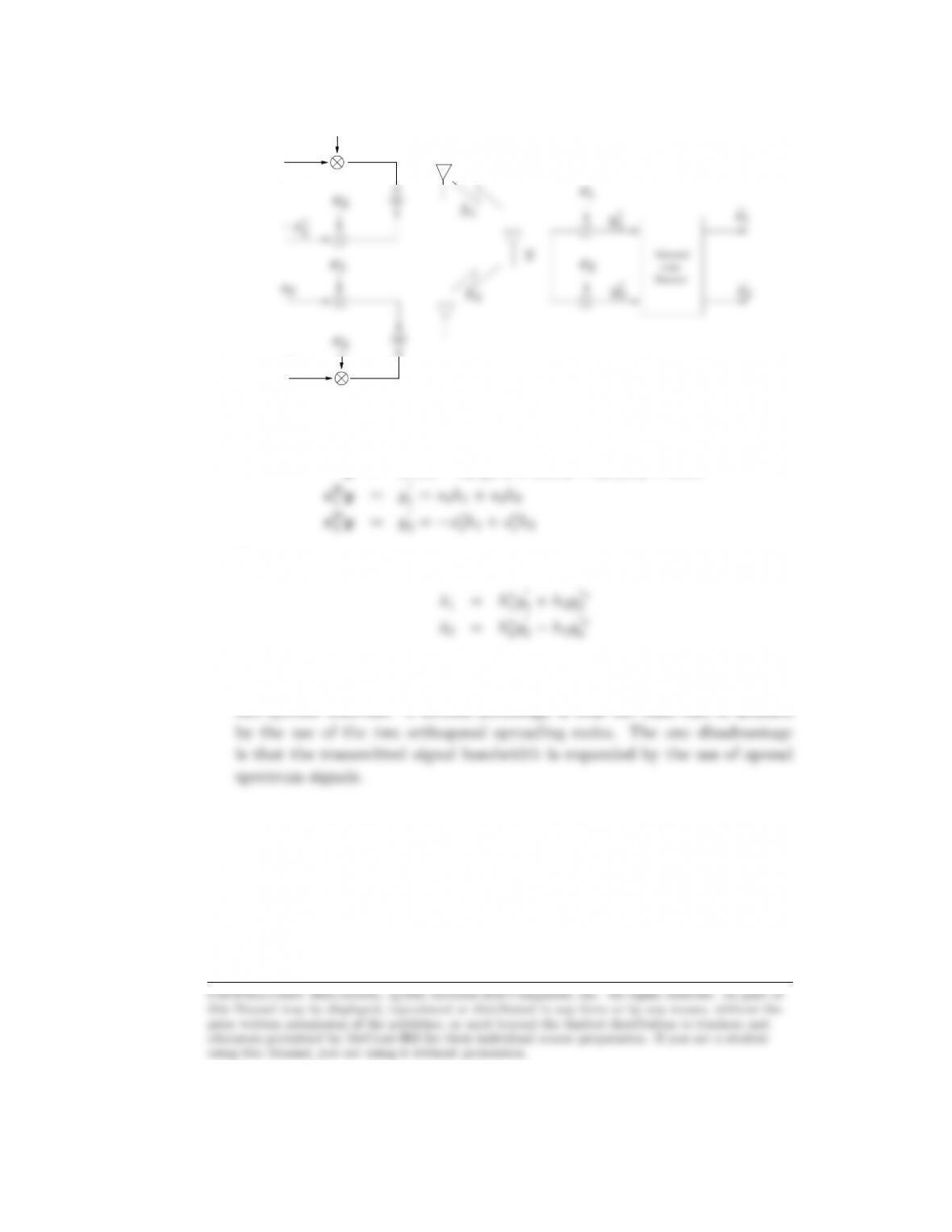
20
+
+
s1
s∗
1
2
h1
h2
c1
c1
c2
c2
(b)
y= (c1s1−c2s∗
Hence,
(c) One advantage is that the two symbols are transmitted and detected in
the same time interval, so the channel is not required to be constant over
Problem 15.20
(a)
y=Hs+n
21
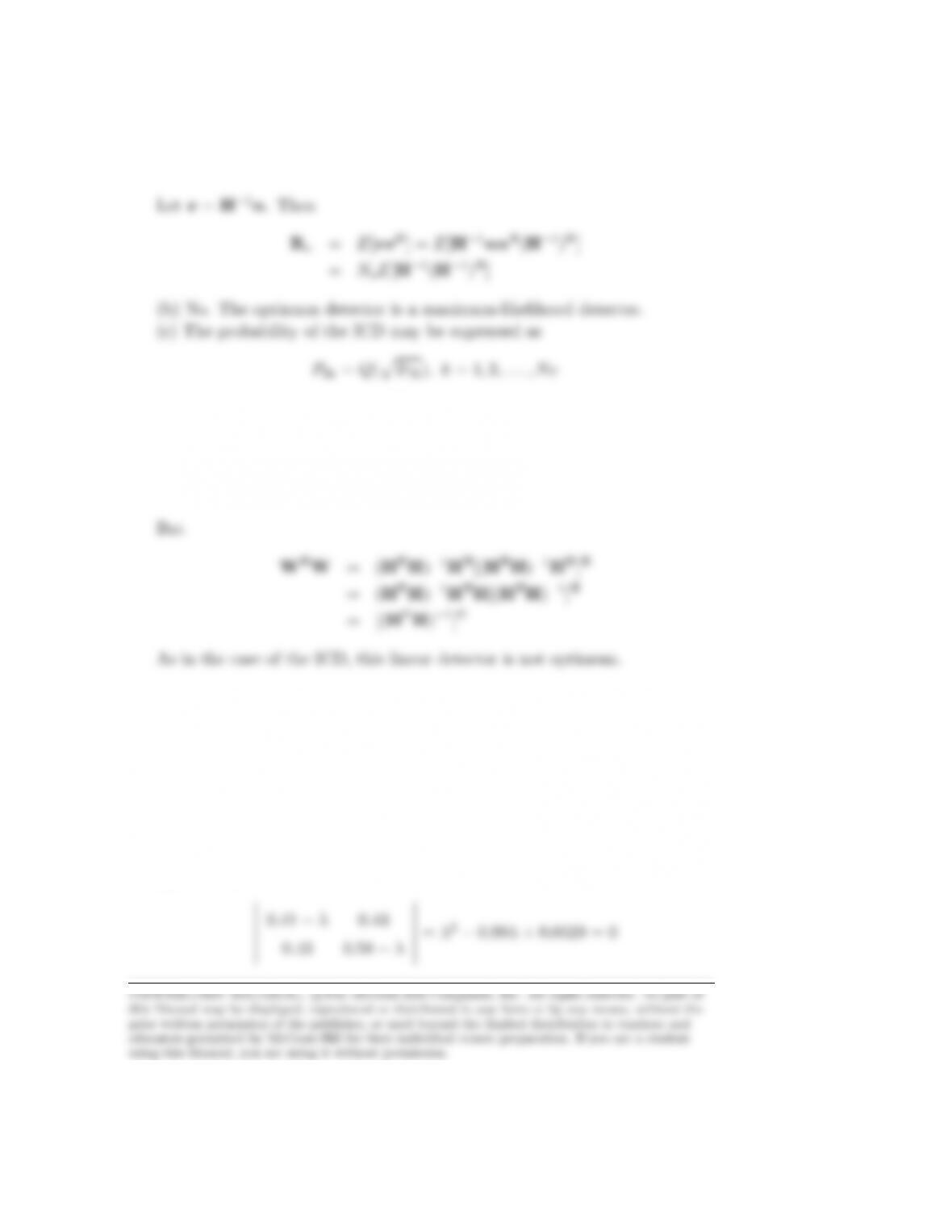
The ICD computes
H−1y=H−1Hs+H−1n=s+H−1n
where γkis the SNR for the kth received symbol. The SNR is variable
because the noise variance may differ among the NTsymbols.
(d) If ˆ
s=WHy, then the noise component is WHn. Hence
Rw=E[WHnnHW] = NoWHW
Problem 15.21
H=
0.4 0.5
0.7 0.3
HHH=
0.41 0.43
0.43 0.58
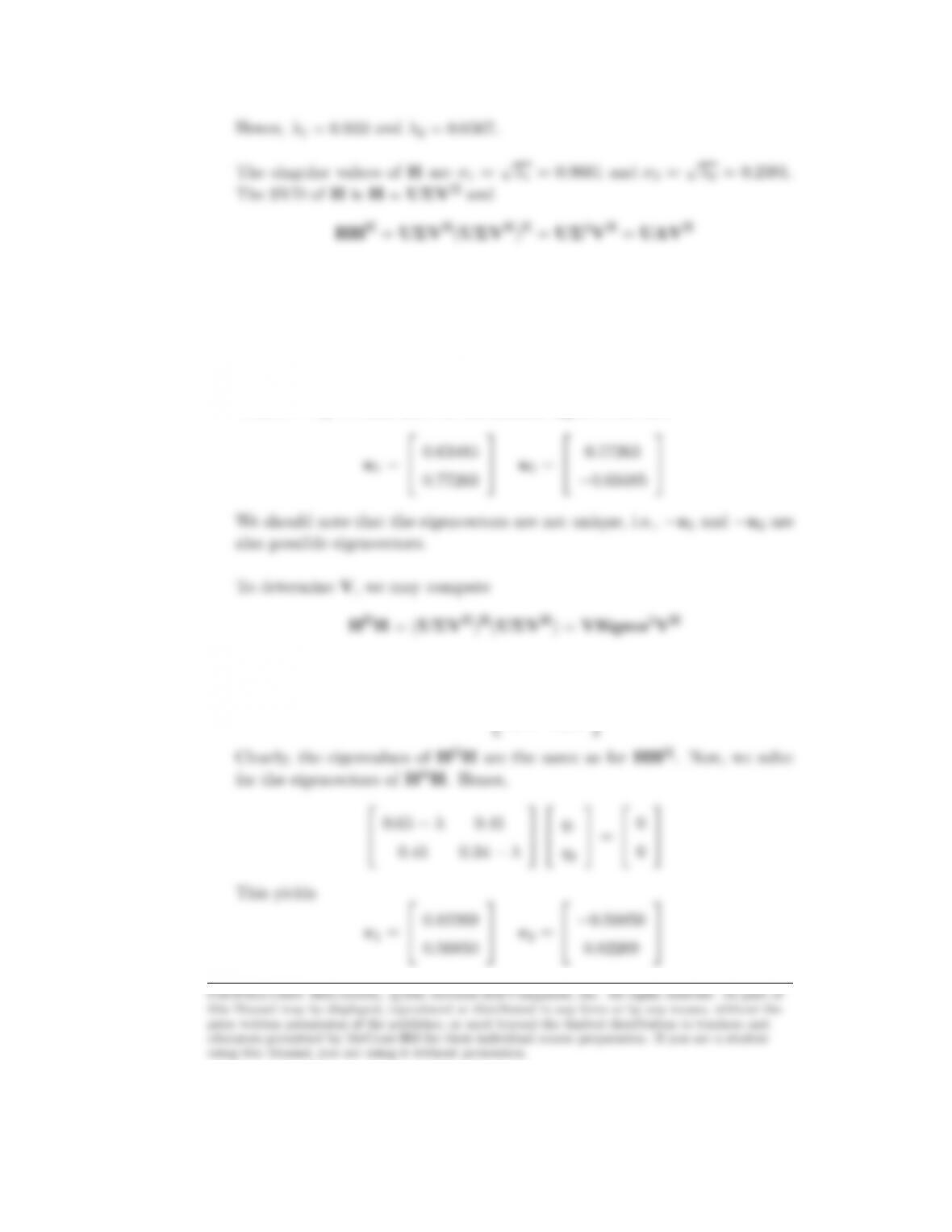
(a) The eigenvalues of HHHare found as follows:
22
where Λ= diag(λ1, λ2). Therefore, Umay be determined by computing the
eigenvectors of HHH. Thus
0.41 −λ0.43
0.43 0.58 −λ
q1
q2
=
0
0
With λ=λ1, we find that the normalized eigenvectors are
0.63485
0.77263
Hence,
HHH=
0.65 0.41
0.41 0.34
23
(b) When the channel is known at the transmitter and the receiver, the
MIMO channel is equivalent to two parallel SISO channels whose outputs
ks
k=1
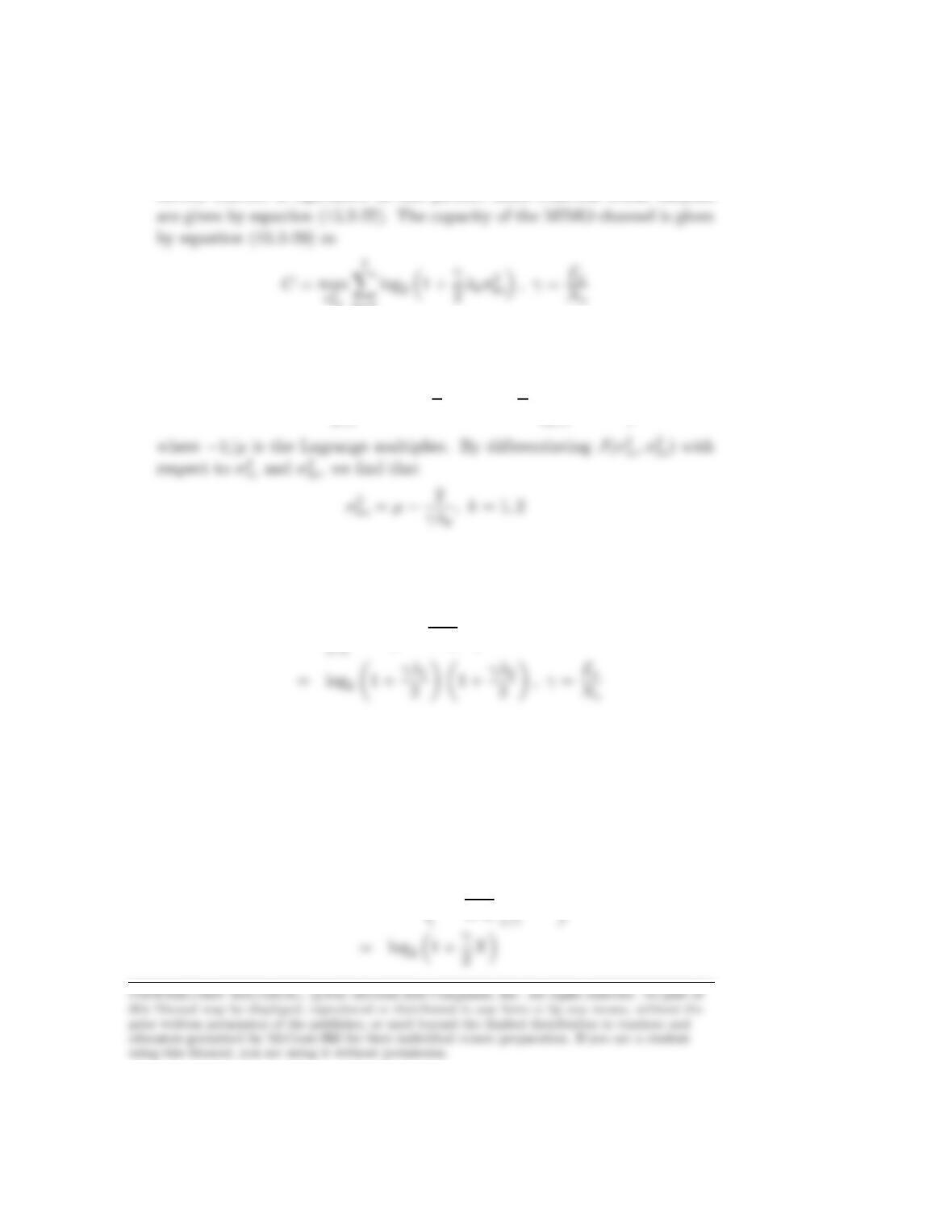
with the constraint that σ2
1s+σ2
2s=NT= 2. The optimum power allocation
can be determined by maximizing
J(σ2
1s, σ2
2s) =
2
X
k=1
log21 + γ
2λkσ2
ks−1
µ 2
X
k=1
σ2
ks −2!
ks =µ−2
γλk
(c) When His known at the receiver only, the capacity is given as
C=
2
X
log21 + Es
2No
λi
Problem 15.22
The capacity of the MISO (2,1) channel which is known at the receiver only,
with AWGN, is given as
CMISO = log2 1 + Es
2No
2
X
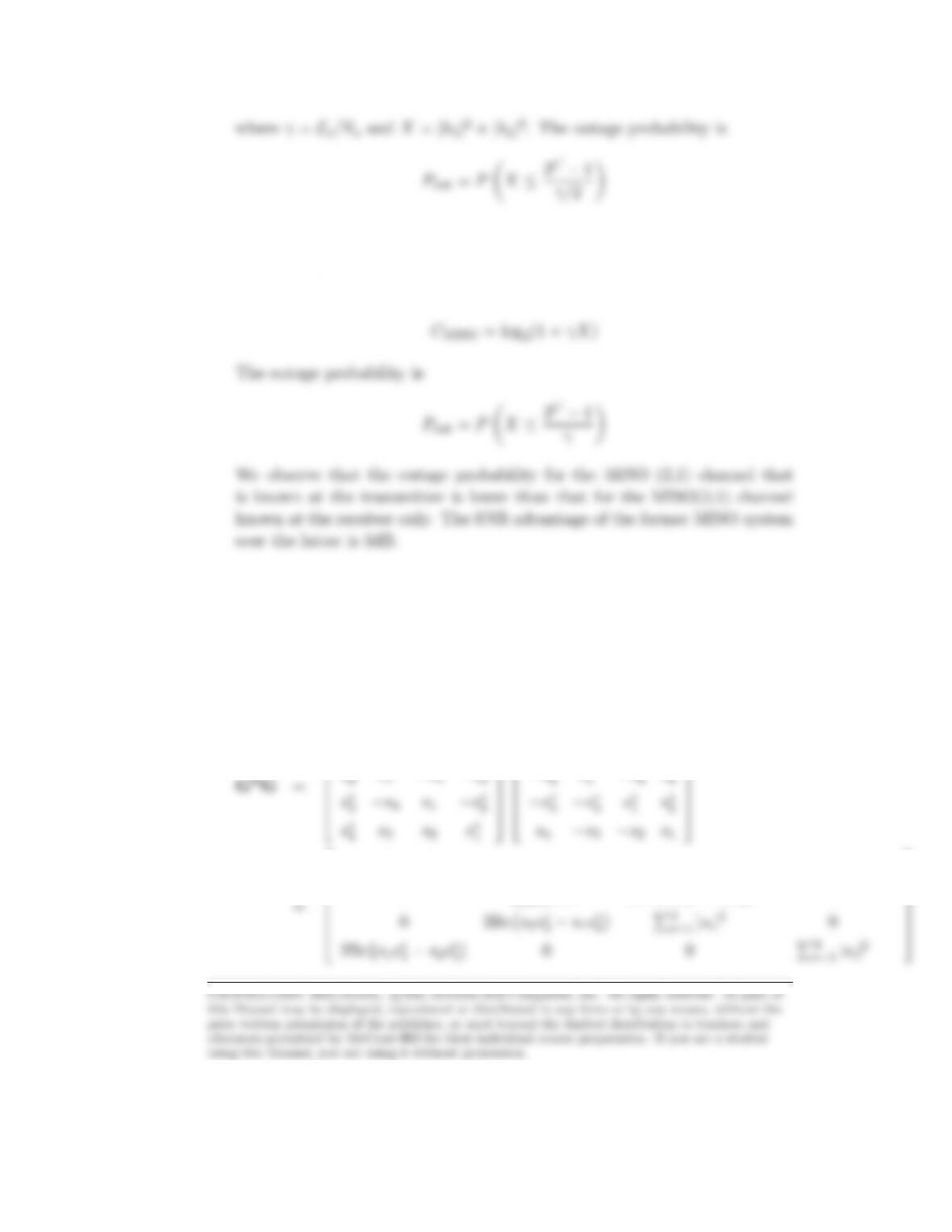
24
When the MISO (2,1) channel is known at the transmitter, the capacity
of the channel is (see problem 15.10b),
Problem 15.23
(a)
s∗
1−s2−s3s∗
4
s1s2s3s4

25
Since GHGis not a diagonal matrix, the code is not orthogonal.
(b) The received signals in the four signal intervals are:
y1=h11s1+h12s2+h13s3+h14s4+n1
y2=−h11s∗
2+h12s∗
1−h13s∗
4+h14s∗
3+n2
p(y1, y2, y3, y4|H,s)∼ |y1−(h11s1+h12s2+h13s3+h14s4)|2
+|y2−(−h11s∗
2+h12s∗
1−h13s∗
4+h14s∗
3)|2