Solutions Manual
for
Digital Communications, 5th Edition
(Chapter 15) 1
Prepared by
Kostas Stamatiou
March 12, 2008
2
Problem 15.1
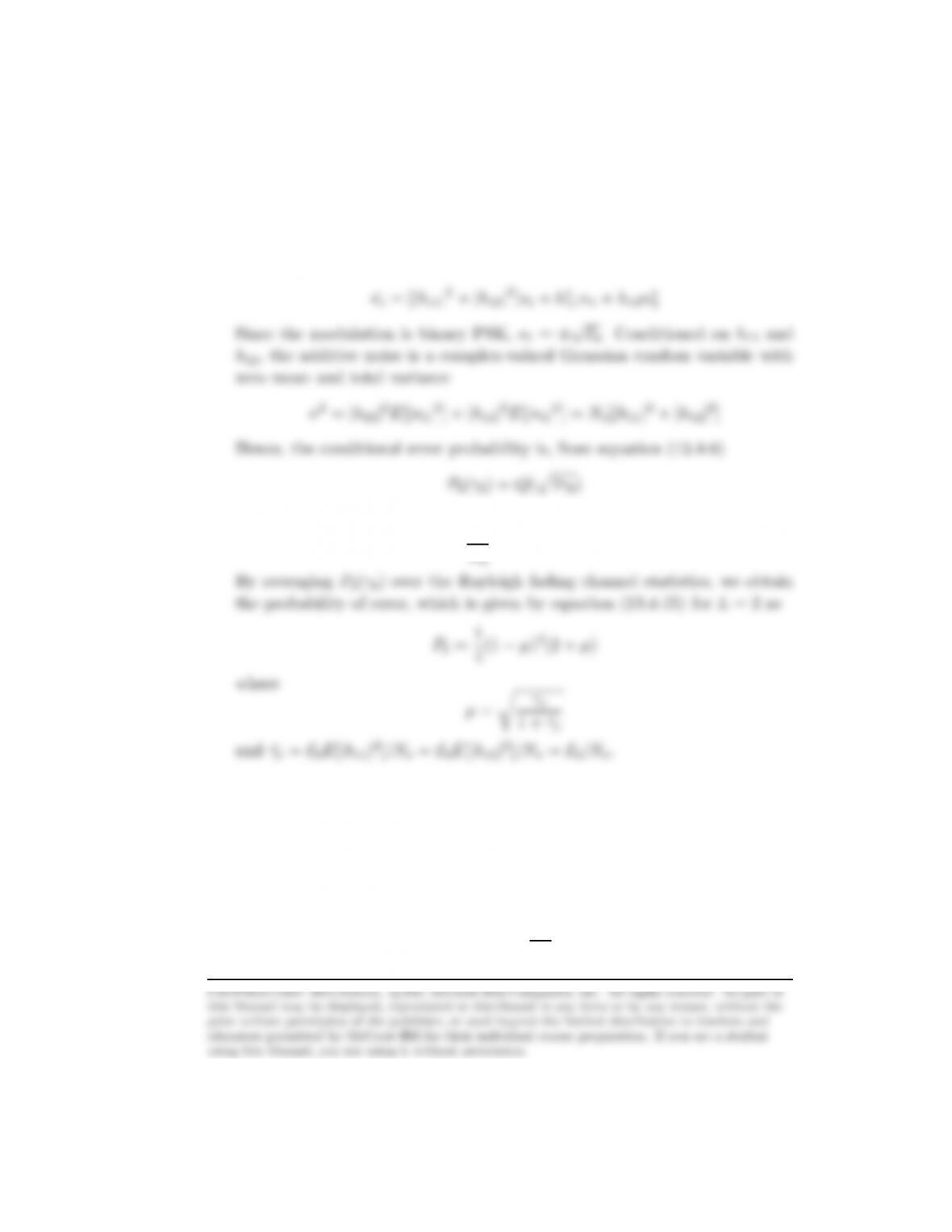
From equation (15.4-25), the estimate for symbol s1is
ˆs1=y1h∗
11 +y∗
2h12
where y1and y2are given in equation (15.4-17). Substituting for y1and y2
in the equation for ˆs1, we obtain
where
γb=Eb
No
[|h11|2+|h12|2]
Problem 15.2
The capacity of the SIMO channel with selection diversity is
C= log21 + E
No|h|2
max
3
No|h|2
Then, C= log2(1 + γsc).
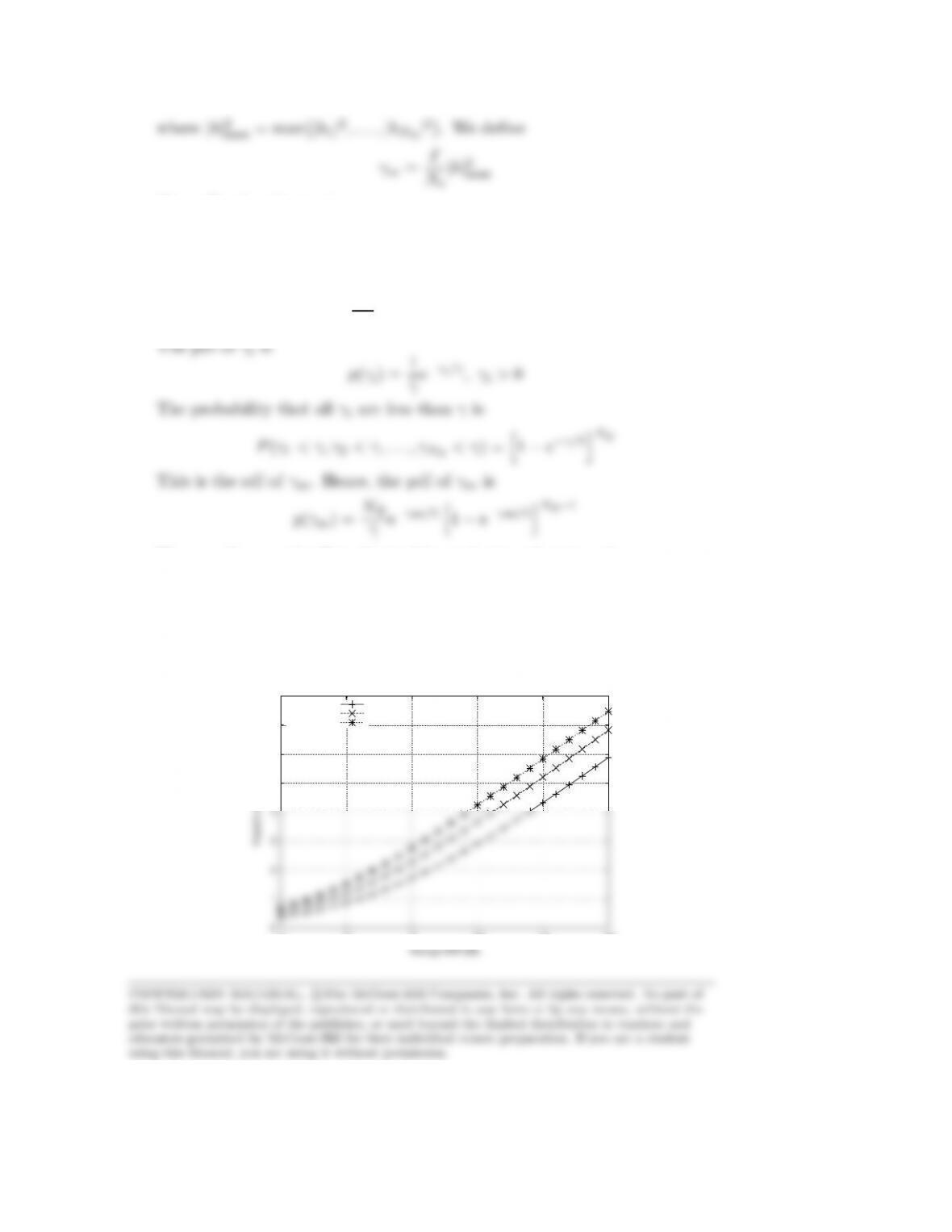
To determine the ergodic capacity ¯
C=E[C], we need the pdf of γsc. We
assume that the channel coefficients of the SIMO channel are i.i.d., complex-
valued Gaussian, with zero mean and identical variance. Hence, we define
¯γ=E
No
E[|hi|2],for 1 ≤i≤NR
The ergodic capacity ¯
Cis obtained by evaluating the integral
¯
C=Z+∞
0
log2(1 + γsc)p(γsc)dγsc
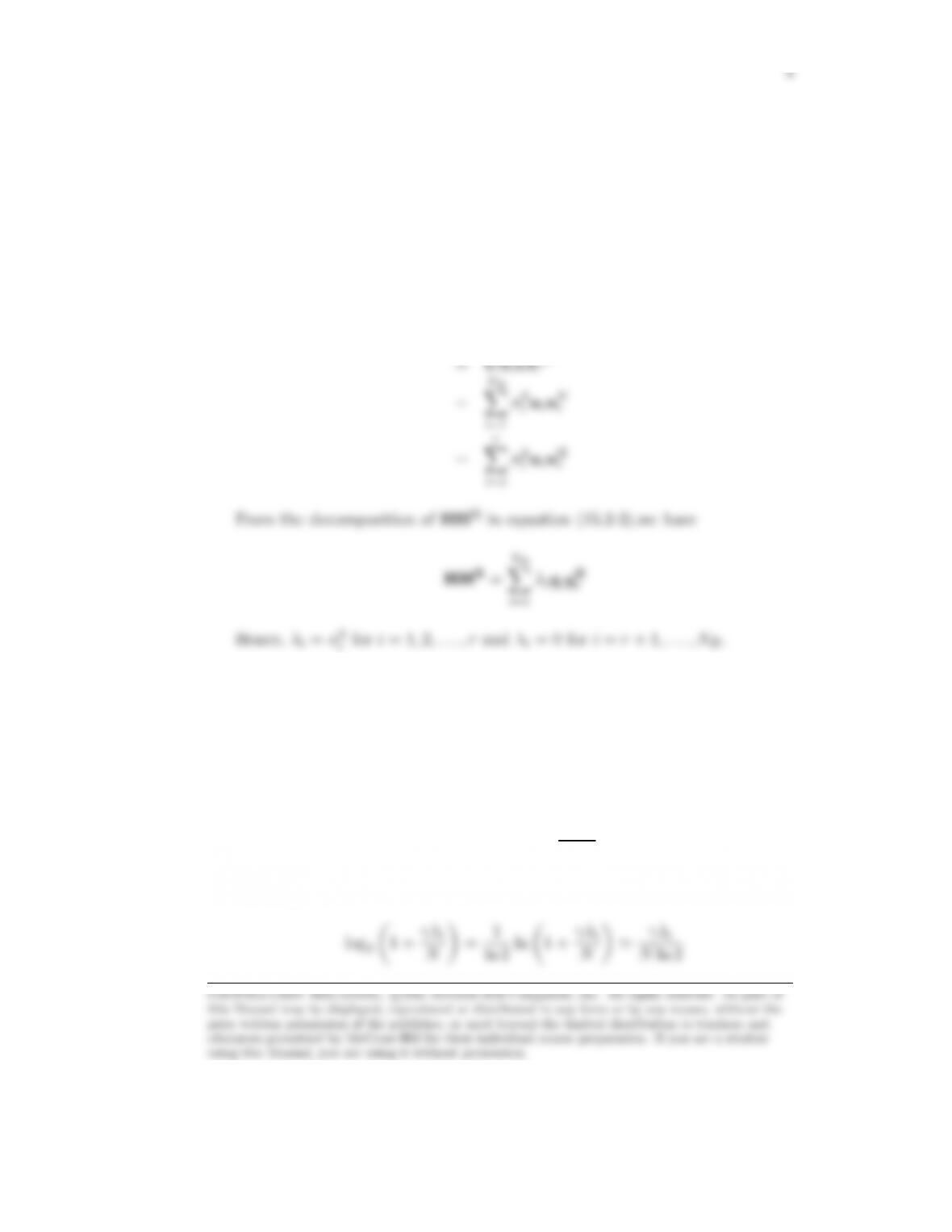
A plot of ¯
Cvs. ¯γis shown below.
4
5
6
7
8
Ergodic capacity of SIMO channel with selection diversity
1 antenna
2 antennas
4 antennas
Problem 15.3
By using the SVD equation for H, we have
HHH= (UΣVH)(UΣVH)H
=UΣVHVΣUH
Problem 15.4
¯
C=E“N
X
i=1
log21 + Es
NNo
λi#
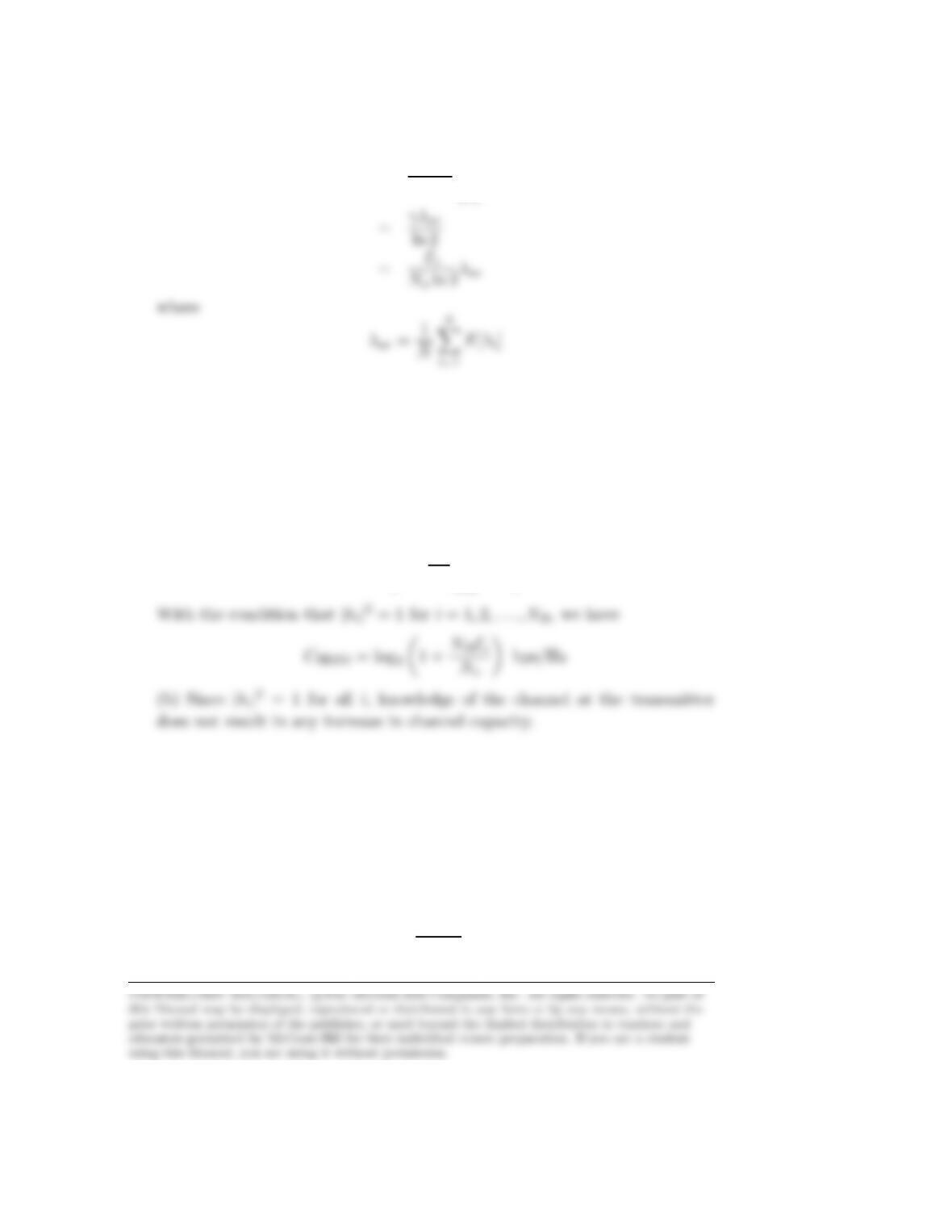
For large N,
5
Hence,
¯
C≃γ
Nln 2
N
X
i=1
E[λi]
N
i=1
Problem 15.5
(a) The capacity of a deterministic SIMO channel with AWGN is given by
equation (15.2-15) as
CSIMO = log2 1 + Es
No
NR
X
i=1 |hi|2!bps/Hz
Problem 15.6
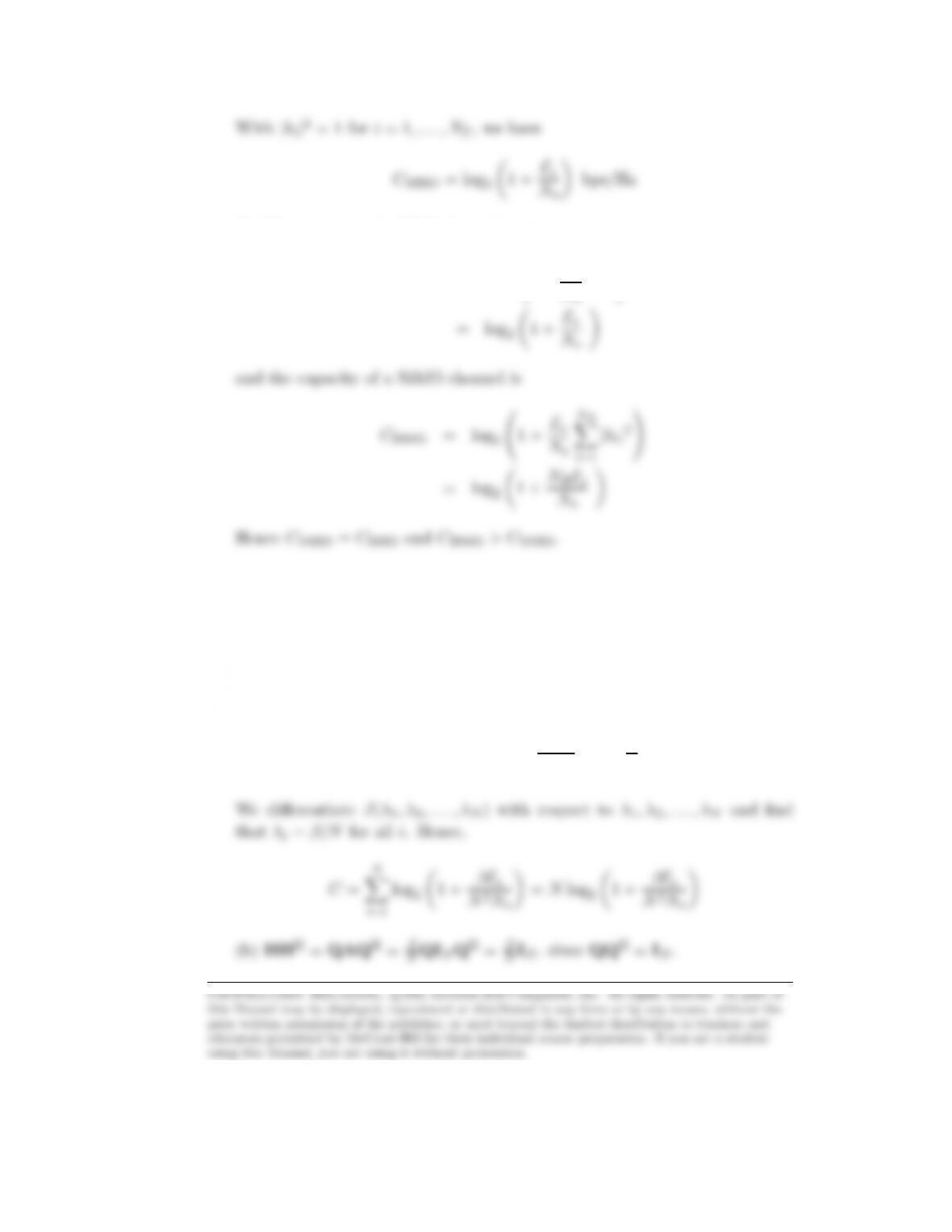
(a) The capacity of the deterministic MISO channel with AWGN is given
by equation (15.2-17) as
CMISO = log2 1 + Es
NTNo
NT
X
i=1 |hi|2!bps/Hz
6
(b) The capacity of a SISO channel is
CSISO = log21 + Es
No|h|2
Problem 15.7
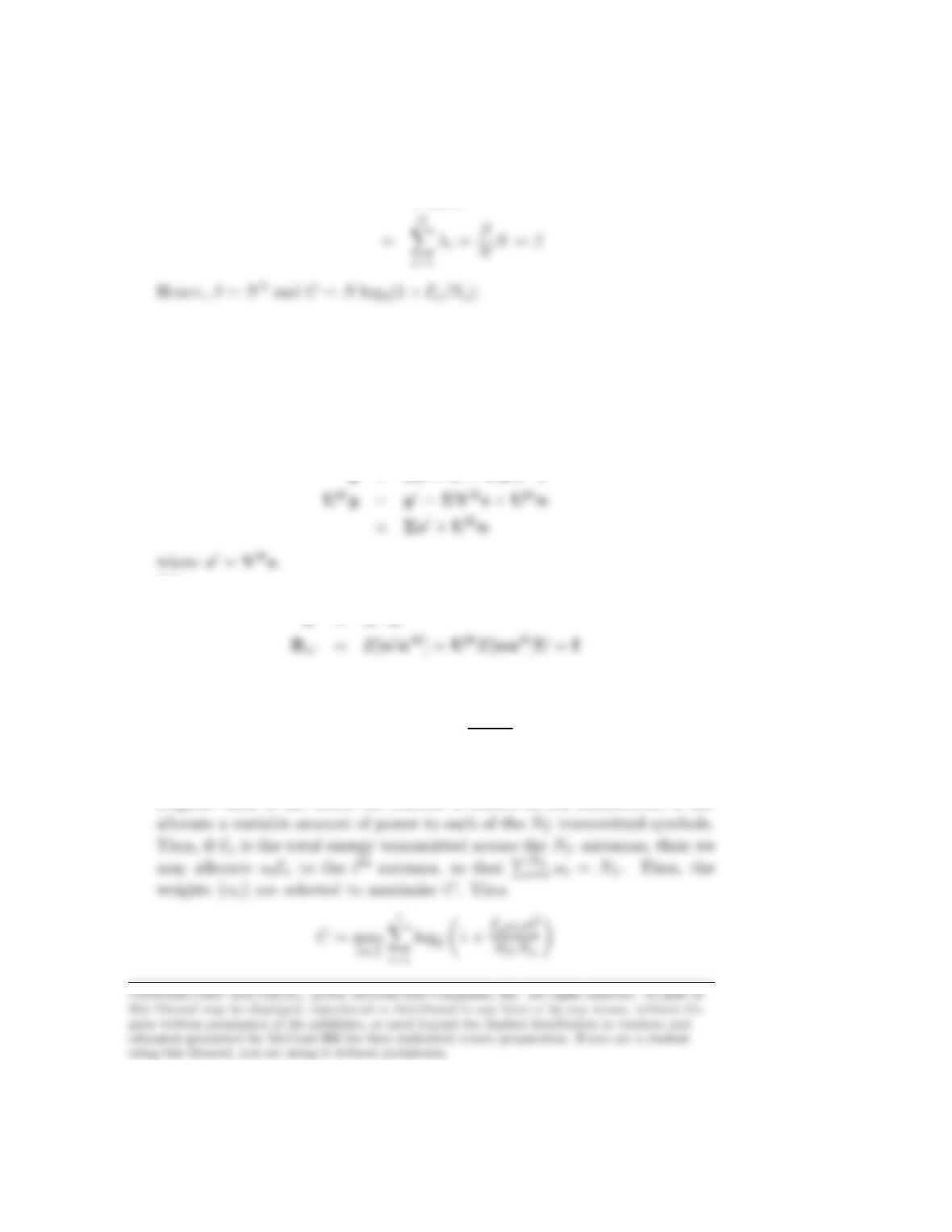
(a) By using the Lagrange multiplier −1/α, we have
J(λ1, λ2,…,λN) =
N
X
i=1
log21 + Es
NNo
λi−1
α N
X
i=1
λi−β!
7
(c)
kHk2
F=
N
X
i=1
N
X
j=1 |hij |2=N2
N
X
Problem 15.8
(a)
y=Hs+n=UΣVHs
(b)
(c) As shown in equation (15.2-12)
C=
r
X
i=1
log21 + Es
NTNo
λi
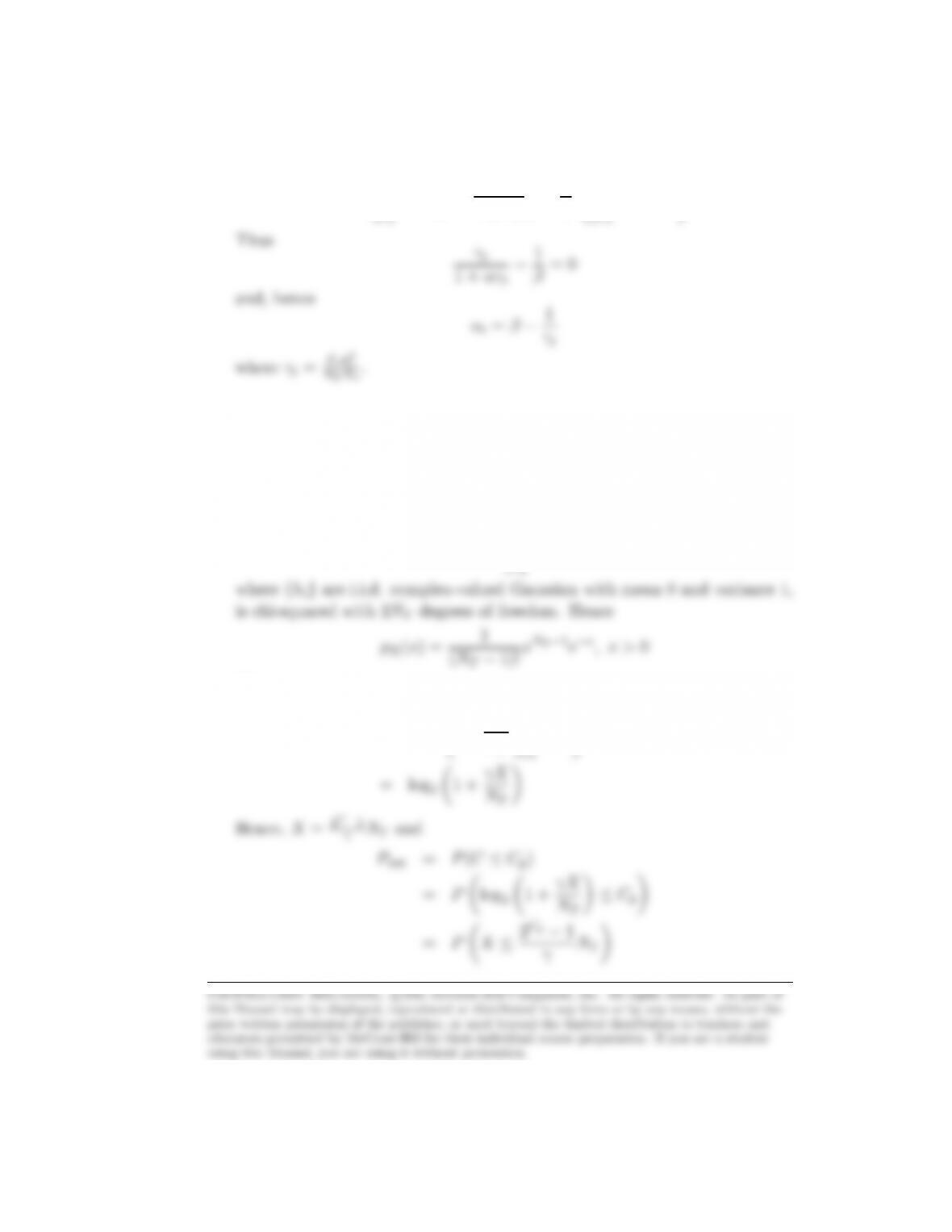
where λiis the ith eigenvalue of HHH. But λi=σ2
i, where σiis the ith
singular value of H. Since the channel is known at the transmitter, it can
8
subject to the constraint that PNT
i=1 αi=NT. Using the Lagrange multiplier
−1/β, we solve for the optimum power (energy) allocation by differentiating
J=
r
X
log21 + Esαiσ2
i
NTNo−1
β NT
X
αi−NT!
Problem 15.9
(a) The pdf of
X=
NT
X
(b)
C= log2 1 + γ
NT
NT
X
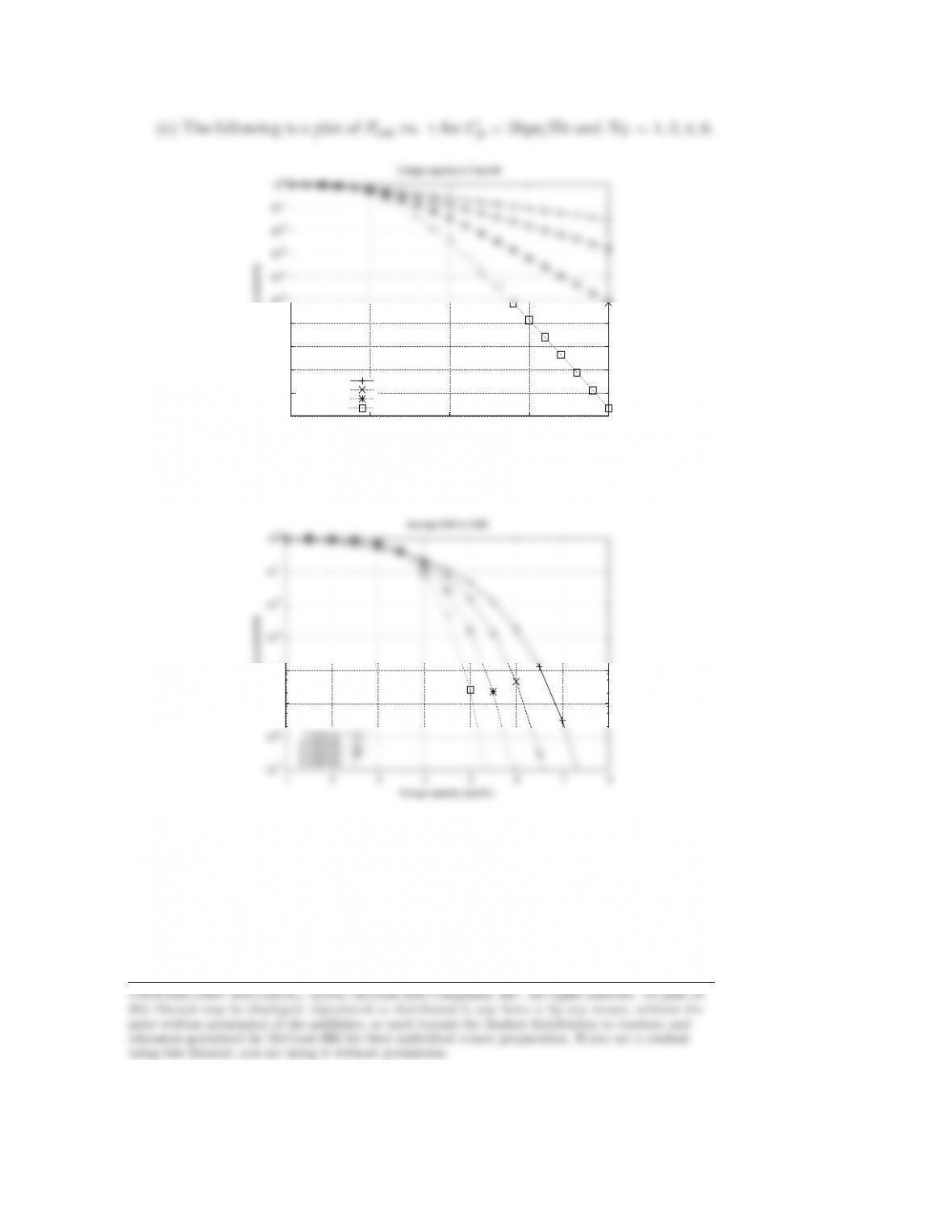
9
10-10
10-9
10-8
10-7
10-6
10-5
10-4
10-3
10-2
10-1
100
0 5 10 15 20
Outage probability
Average SNR (dB)
1 antenna
2 antennas
4 antennas
8 antennas
(d) The following plots are of the “success probability” 1 −Pout vs. Cfor
γ= 10,20dB, respectively, and NT= 1,2,4,8.
10-2
10-1
100
Average SNR is 10dB
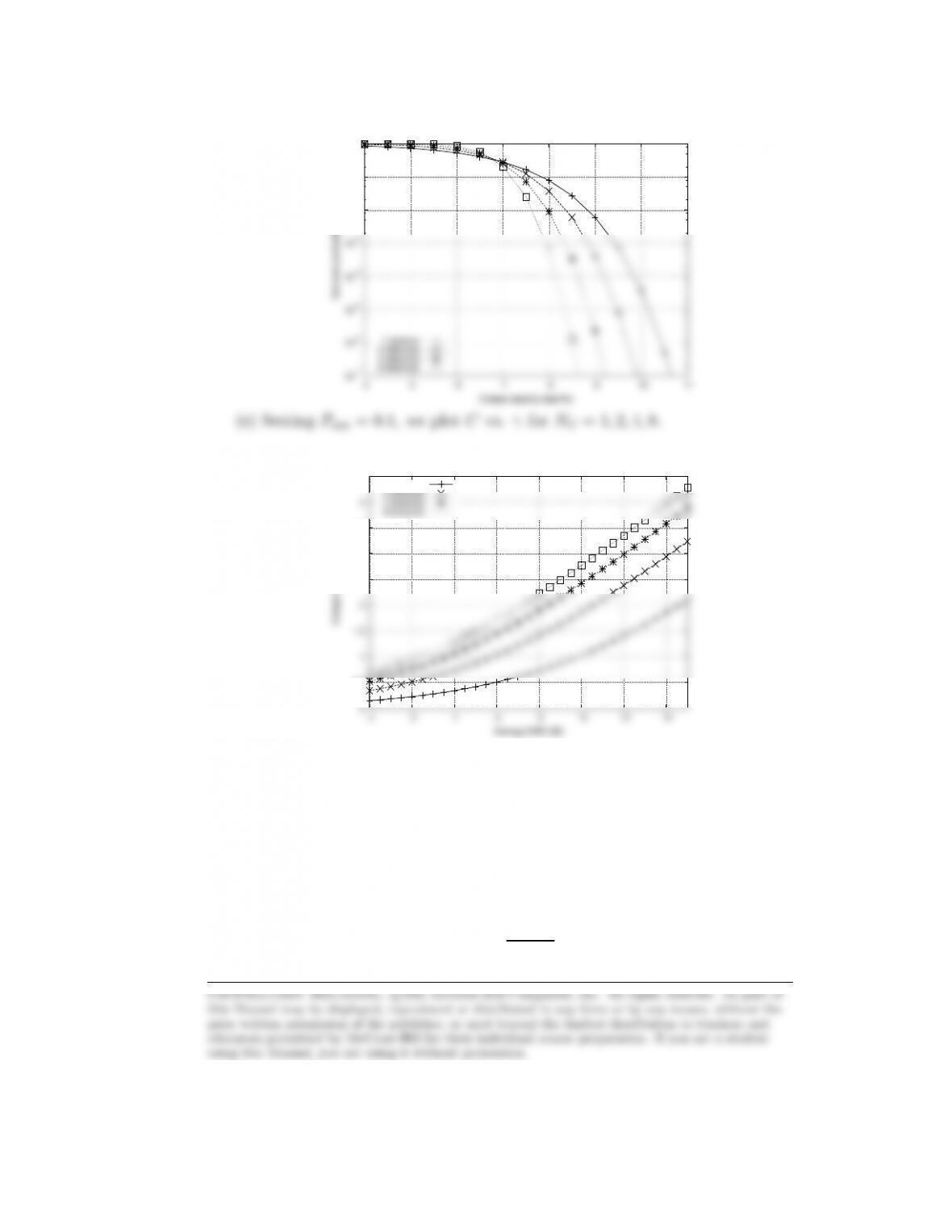
10
10-5
10-4
10-3
10-2
10-1
100
Success probability
Average SNR is 20dB
Problem 15.10
(a) E[y] = hHsand σ2
y=E[|y|2]. The SNR is defined as
γ=|hHs|2
2σ2
y
11
The maximum γis obtained when sis colinear with h, i.e., sis propor-
(b) The capacity of the MISO (NT,1) channel with AWGN is given as
C= max
r
X
i=1
log21 + Es
NTNo
αiλi
Problem 15.11
We have
Pout =P(C≤Cout) = P(C≤2)
NTNo
and
Pout =Plog21 + Es
NTNo
X≤2,where NT= 4
12
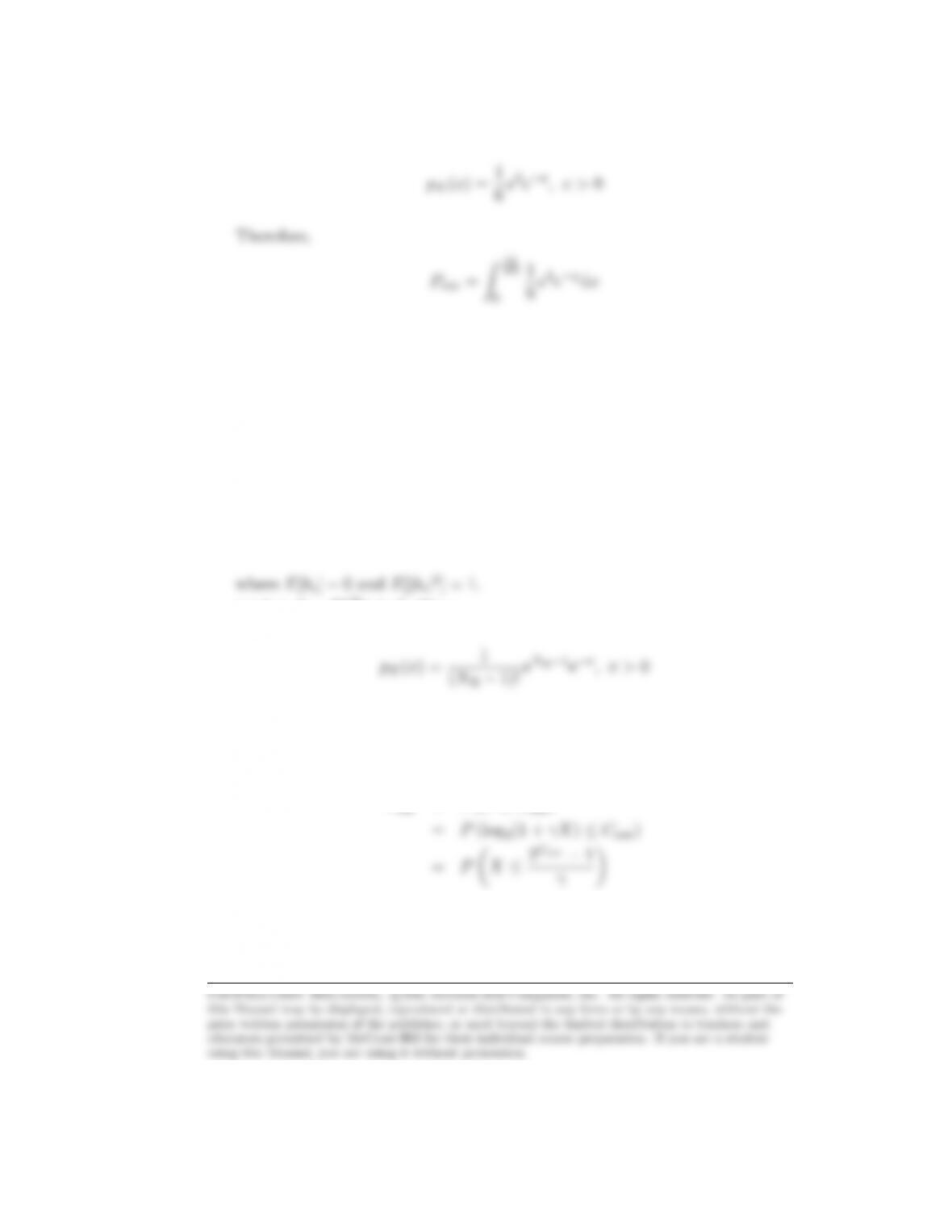
where the pdf of Xis
Problem 15.12
CSIMO = log2 1 + γ
NR
X
i=1 |hi|2!, γ =Es/No
(a) Let X=PNR
i=1 |hi|2. Then
(b)
Pout =P(C≤Cout)
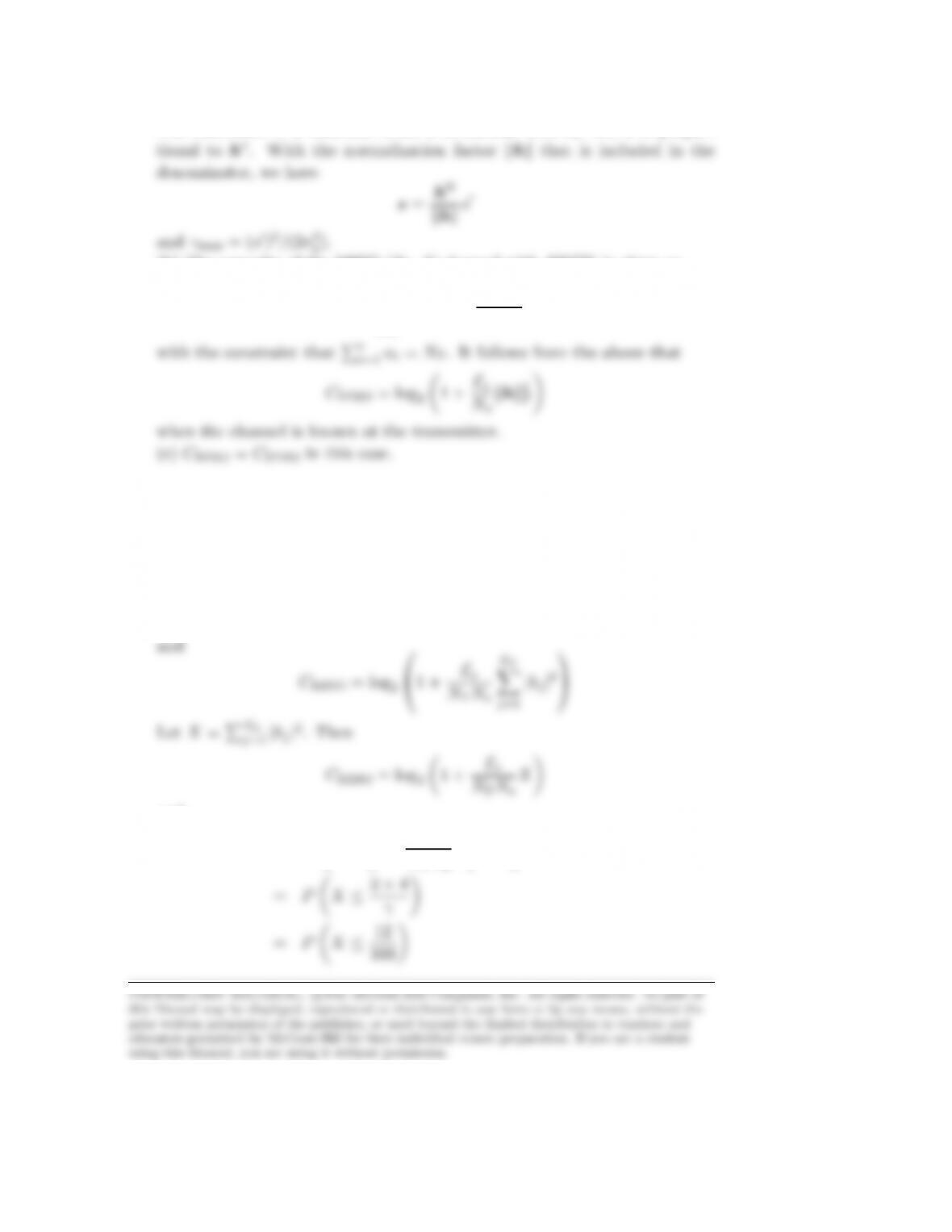
(c) The following is a plot of Pout vs. γfor Cp= 2bps/Hz and NT= 1,2,4,8.