
Solutions Manual
for
Digital Communications, 5th Edition
(Chapter 14) 1
Prepared by
Kostas Stamatiou
March 9, 2008
2
Problem 14.1
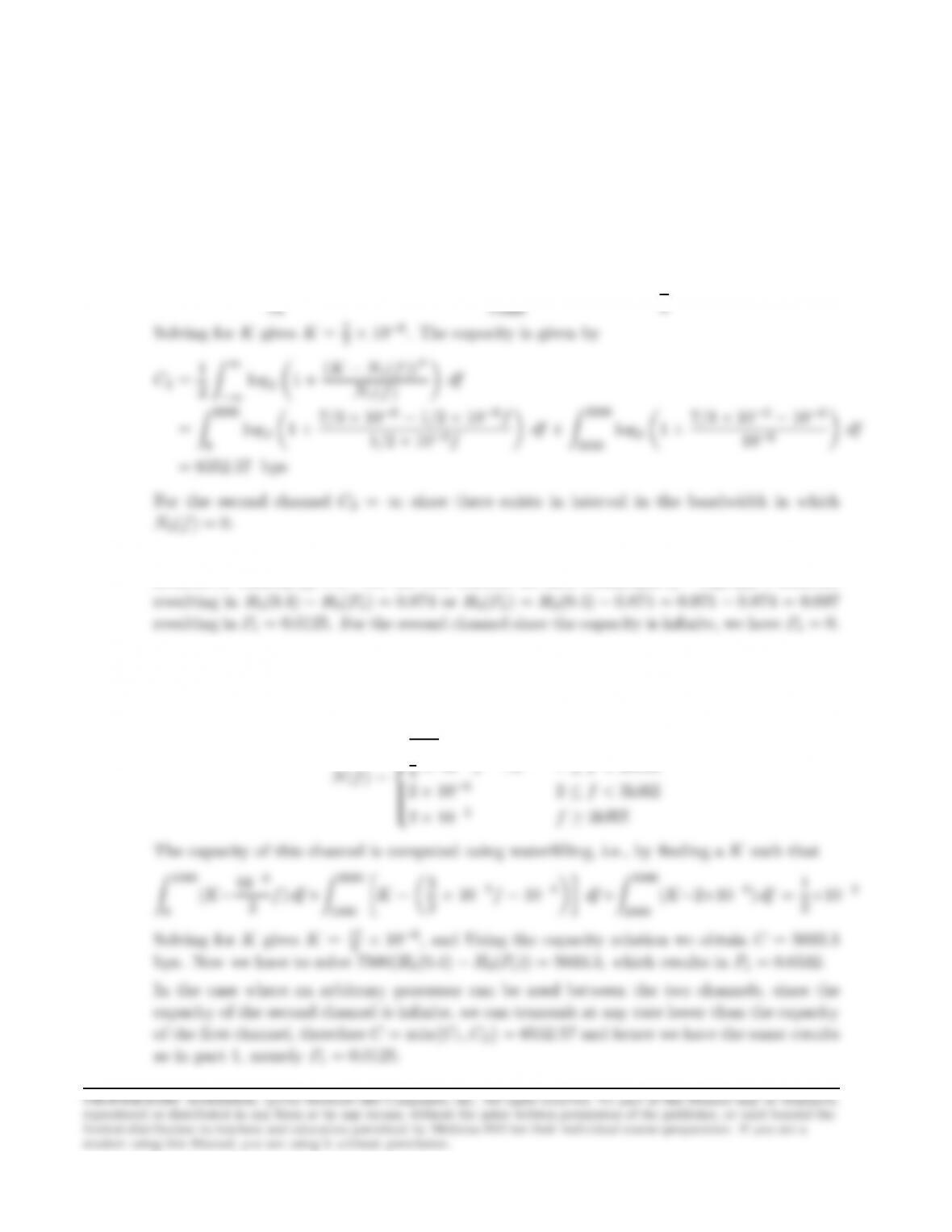
1. We use the water filling argument similar to what is given by Equations 14.1-10–14.1-13. To
determine C1we need to find Ksuch that
Z∞
−∞
(K−N1(f))+df = 10−2
or Z2000
(K−0.5×10⁻⁹f)df +Z3000
(K−10−6)df =1
2. For this source R(D) = R(Pe) = Hb(p)−Hb(Pe) = Hb(0.4) −Hb(Pe). The resulting Peis the
solution of 7500R(Pe) = C. For the first channel we have 7500(Hb(0.4) −Hb(Pe)) = 6552.57,
3. In the first case where the two channels are directly concatenated, by independence of the two
noise processes the PSD of the noise is the sum of the two noise PSD’s, N(f) = N1(f)+N2(f).
The equivalent channel is AWGN with noise PSD (for positive frequencies)
10−9
2f0≤f < 1kHZ
3
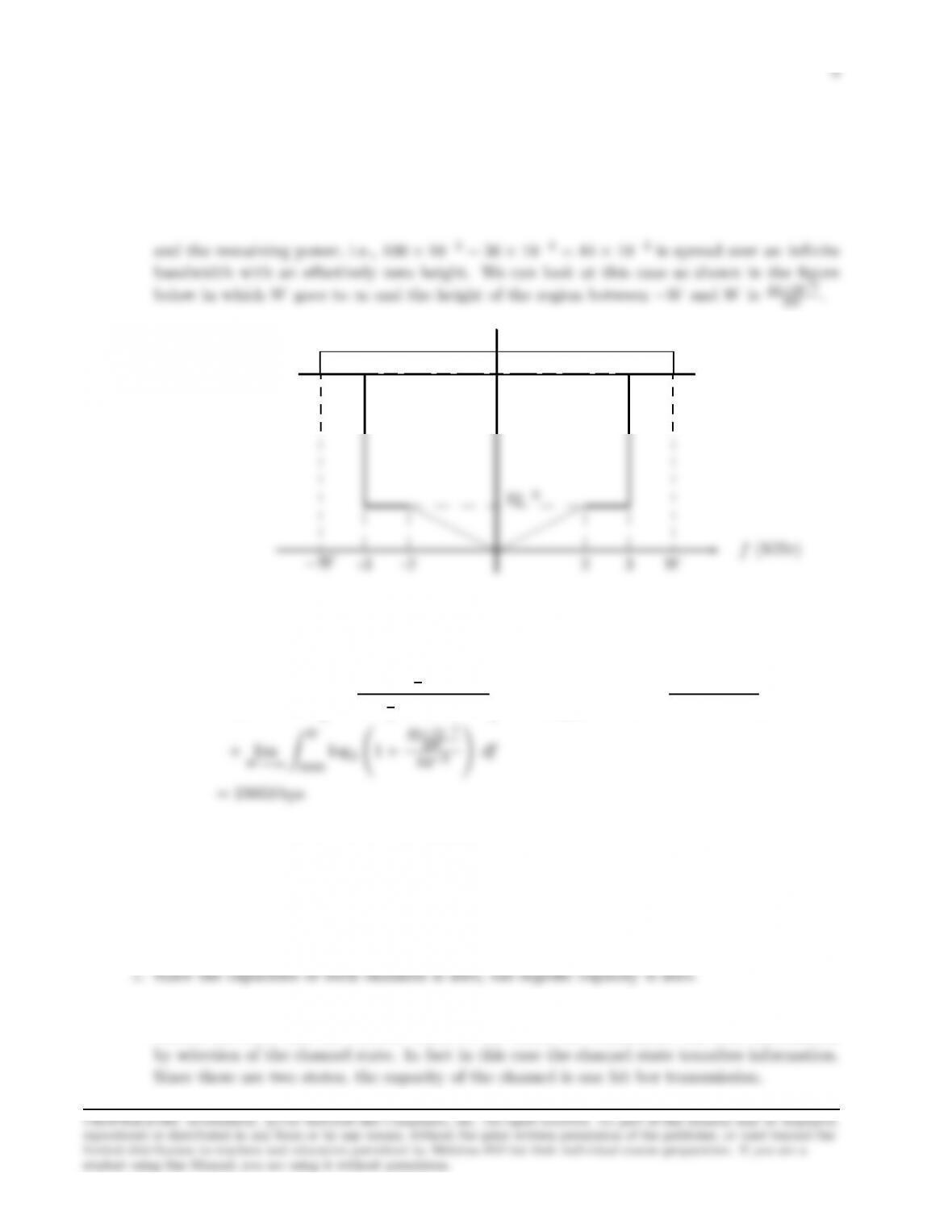
4. In this case the waterfilling argument can still be used but the input power will be spread
over an infinite bandwidth of the channel since Kexceeds the 10−5level. Here if K= 10−5,
then
P= 10−6×2000 + 6000 ∗(10−5−10−6) = 2 ×10⁻³+ 6 ×10⁻²−6×10−3= 56 ×10−3
f(KHz)
The capacity is given by
C=Z2000
0
log2 1 + 10−5−1
2×10⁻⁹f
1
2×10⁻⁹f!df +Z3000
2000
log21 + 10−5−10−6
10−6df
44×10−3
2W
Problem 14.2
2. In this case, although the capacity of each channel is zero but since the transmitter can
control the state and the receiver observes the state, the transmitter can send information

Problem 14.3
Since the channel state is available only at the transmitter, random variable Vis degenerate
Problem 14.4
This is the case where V=U. WE have
max
p(t)I(T;Y|V) = max
p(t)I(T;Y|U)
= max
p(t)X
u
p(u)I(T;Y|U=u)
u
where the last step follows from the fact that since x=t(u), for a given u, any PDF on tinduces
a PDF on X. On the other hand we have
u
since the right hand side corresponds to a particular probability distribution on Tin which the
probability distribution of the uth component of Tis selected to be p(x|u) independent of other
components. These two relations show that in this case
u
Problem 14.5
5
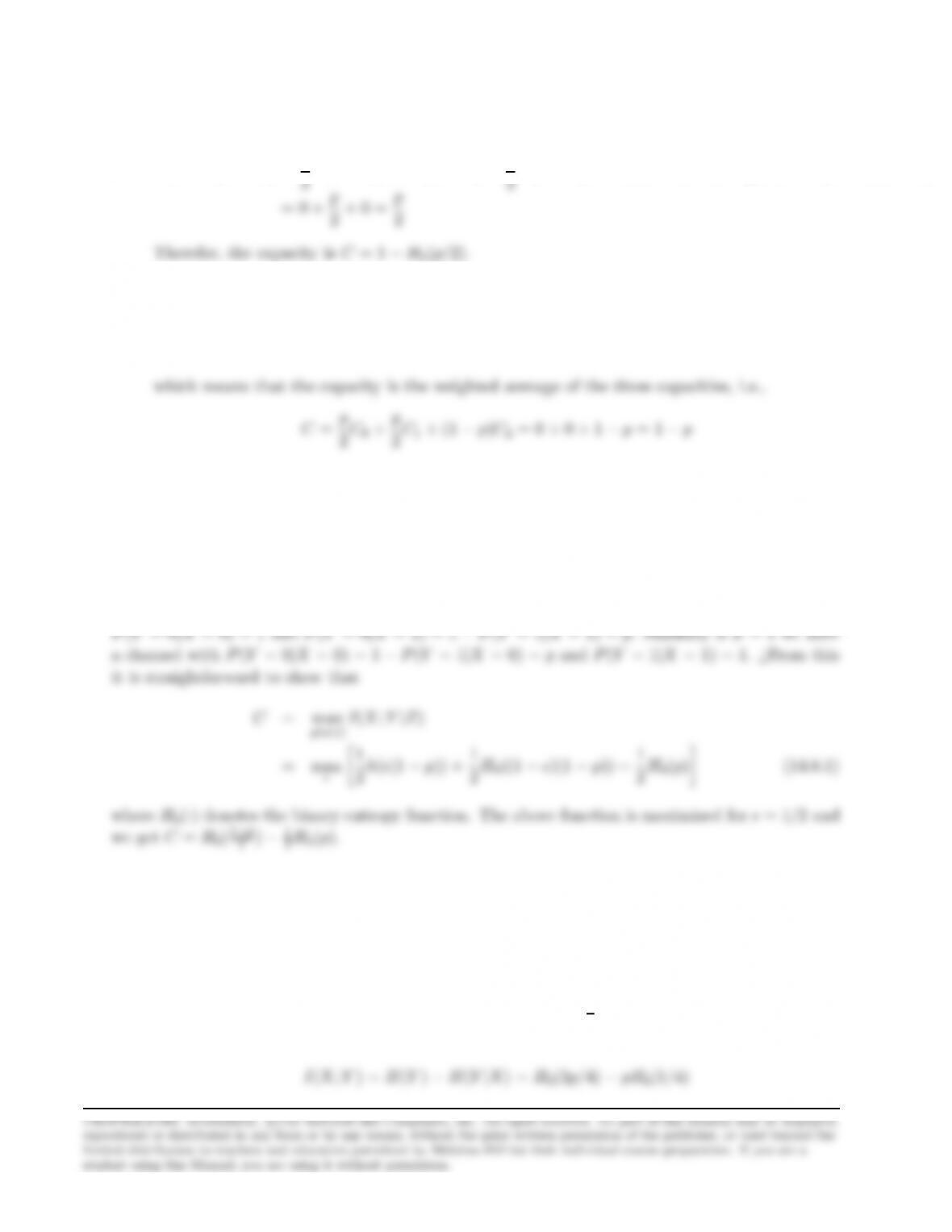
1. In this case the channel is a BSC with crossover probability
P(Y= 1|X= 0) = p
2. In this case we can use Equation 14.1-25 with U=S. Hence,
C=X
u
P(s) max
P(x|s)I(X;Y|S=s)
Problem 14.6
It can be easily shown that if Z= 0, we have a binary input, binary output channel with
Problem 14.7
1. We have P(Y= 0|X= 0) = 1 and P(Y= 0|X= 1) = 1
4, therefore the overall channel is
equivalent to a Z-channel. For this Z-channel
6
Differentiating the mutual information and finding the root of the derivative gives
q1
4
2. When channel state information is available at both sides, the capacity is a weighted sum of
3. If only the receiver knows the state of the channel the capacity is given by
C= max
p(x)I(X;Y|S) = max
p(x)1
2I(X;Y|S= 1) + 1
2I(X;Y|S= 2)
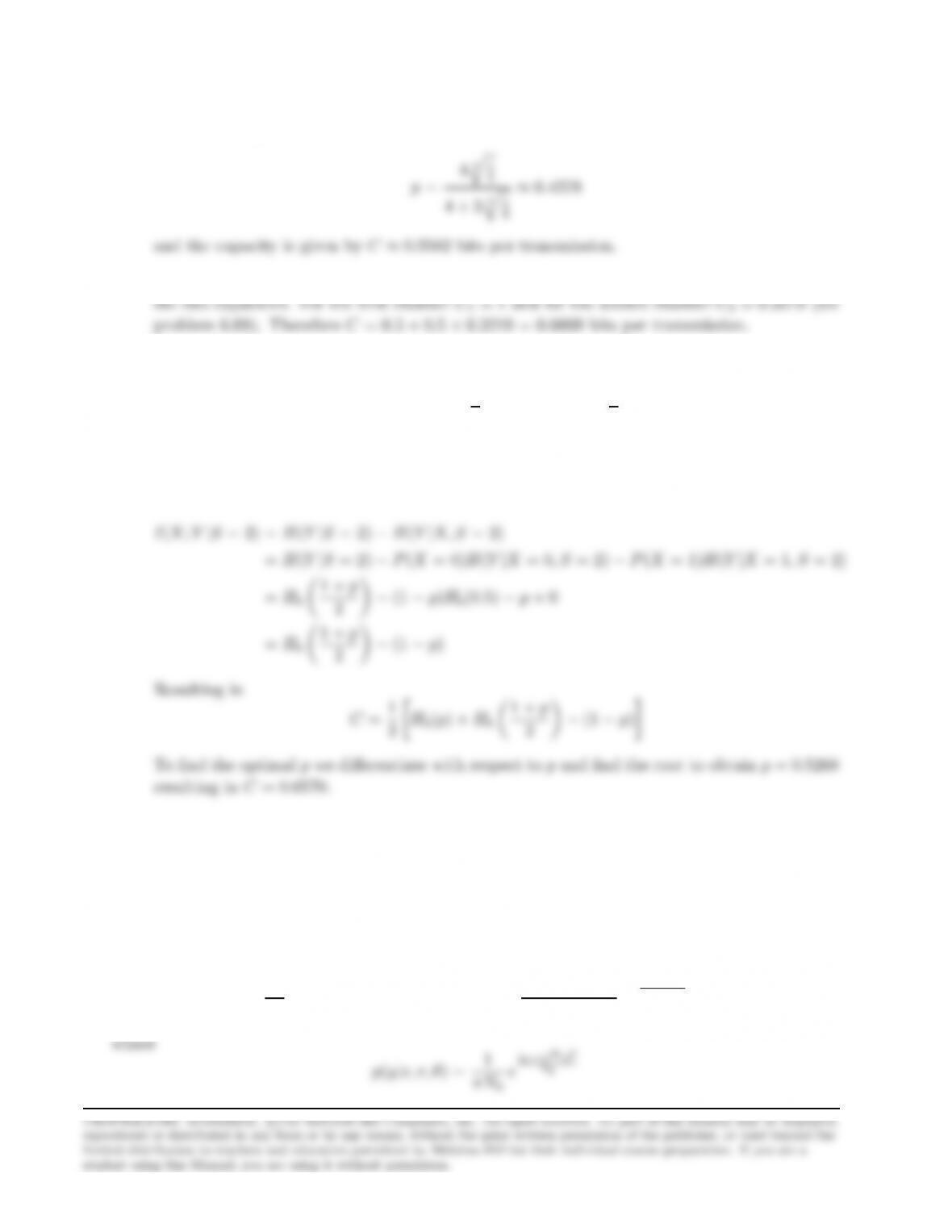
Assuming p=P(X= 1) = 1 −P(X= 0), we have I(X;Y|S= 1) = Hb(p) and for the
Z-channel the output probabilities will be P(Y= 1) = (1 + p)/2 and P(Y= 0) = (1 −p)/2.
Therefore,
Problem 14.8
We need to show that
1
2πZ2π
0Z∞
0
p(y|x, r, θ)p(r)drdθ =1
π(N0+|x|2)e−|y|2
N0+|x|2

7
Here xand yare complex constants, and p(r) = 2re−r2for r > 0. We can change to the Cartesian
coordinates and define
rejθ =α+jβ
where αand βare independent zero-mean Gaussian RV’s each with variance 1/2, and δr,δi, and
γare real constants. With these changes we have
1
πN0
e|y−rejθx|2
N0=1
πN0
e−|x|2
N0(y
x−rejθ )2
πN0
Also note that by changing the integration to Cartesian coordinates rdrdθ =dαdβ, hence
1
p(y|x, r, θ)p(r)drdθ =1
1
e−1
γ[(α−δr)2+(β−δi)2]2e−(α2+β2)dαdβ
1
1
−∞
But
g(φ, ω) = Z∞
1
√πe−(φ−ω)2+γφ2
γdφ
1
γ»“φ√1+γ−ω
√1+γ”2+γω2
1+γ–dφ
N0+|x|2e−ω2
where we have introduced the change of variable
√1+γ
8
Using this result, we obtain
1
p(y|x, r, θ)p(r)drdθ =1
g(α, δr)g(β, δi)
r
i
Problem 14.9
φ
√Es
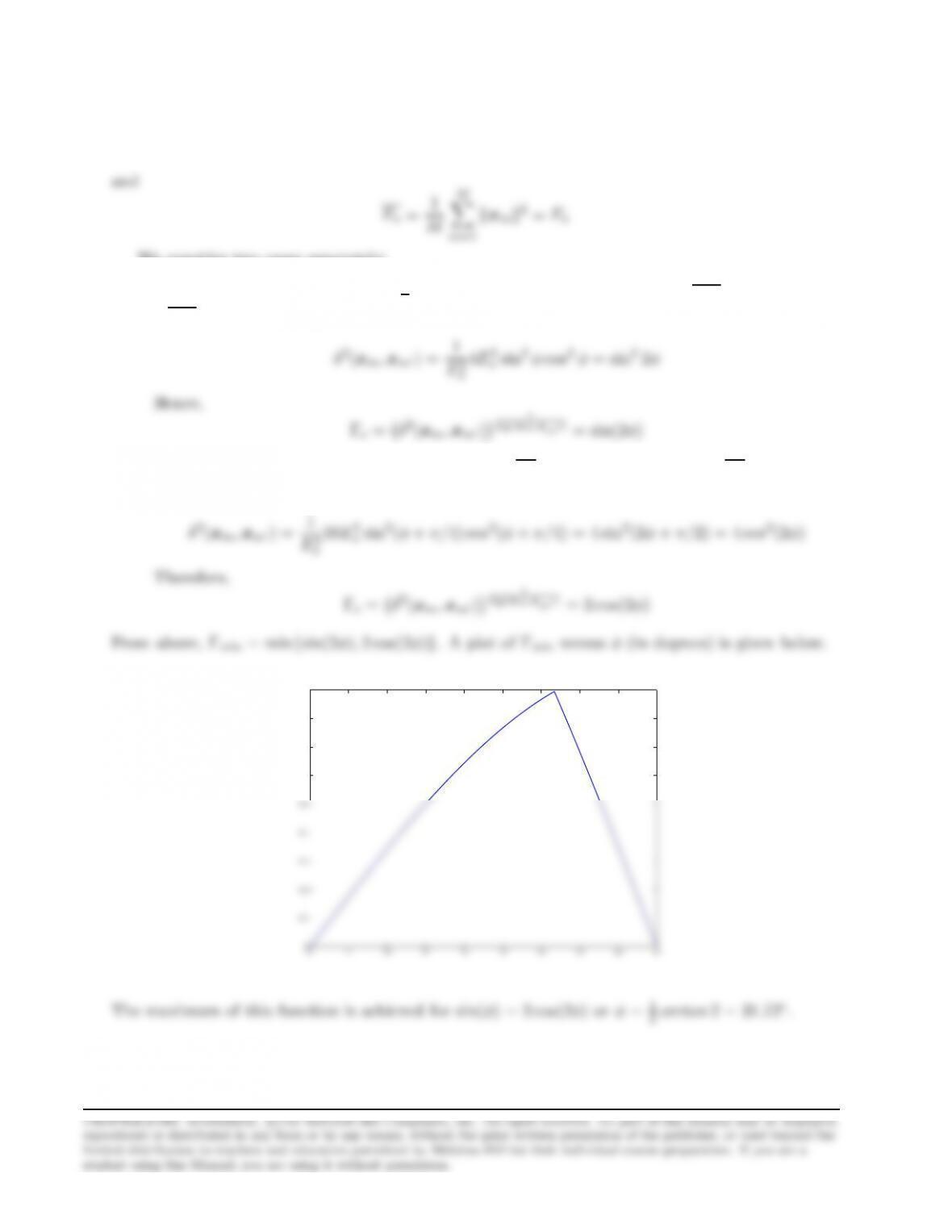
Consider a rotation of φas shown in the figure above. With this rotation we have Γmin =
min{Γe,Γd}where Γecorresponds to two points in the constellation that share an edge and Γd
corresponds to two diagonal points in the constellation. We have
Γmm′=δ2(xm,xm′)1
dH(xm,xm′)
9
where
dH(xm,xm′) = |Jmm′|={1≤j≤n:xmj 6=xm′j}
We consider two cases separately:
1. Γe: In this case for 0 < φ < π
4,dH(xm,xm′) = 2 and dmm′1=√2Escos φ,dmm′2=
√2Essin φ. Therefore,
Γe=δ2(xm,xm′)1
2. Γd: Similar to the other case we have dmm′1= 2√Escos(φ+π/4), dmm′2= 2√Essin(φ+π/4).
Hence,
Problem 14.10
If channel state information is not available at the receiver, we have
ˆm= arg max
m
Pmp(y|xm)
= arg max
m
PmZ∞
0
p(r, y|xm)dr
N0ky−rxk2
Problem 14.11
Using Equation 13.4-13 with ¯γc= 100 ∼20 dB, we have
p(γb) = 1
(Nr−1)!100NrγNr−1
be−γb
100
0
0
100 e−γb
2. Nr= 2, in this case
Z10
1
100 dγb= 0.0047
3. For Nr= 4 we have
Z10
0
1
6×10⁸γ3
be−γb
100 dγb= 3.85 ×10⁻⁶
Problem 14.12
1. Let β=√1−α2, where we assume αis real and |α|<1. We have the recursive relation
h(m) = βh(m−1) + αw(m), m = 1,2,3,…
which defines a difference equation with initial condition h(0). Solution of this equation gives
h(n) = βnh(0) +
n
X
βn−iw(i)
2. The coherence time Tcis obtained when k=Tc/Tsis such that βk= 1/2. From this relation
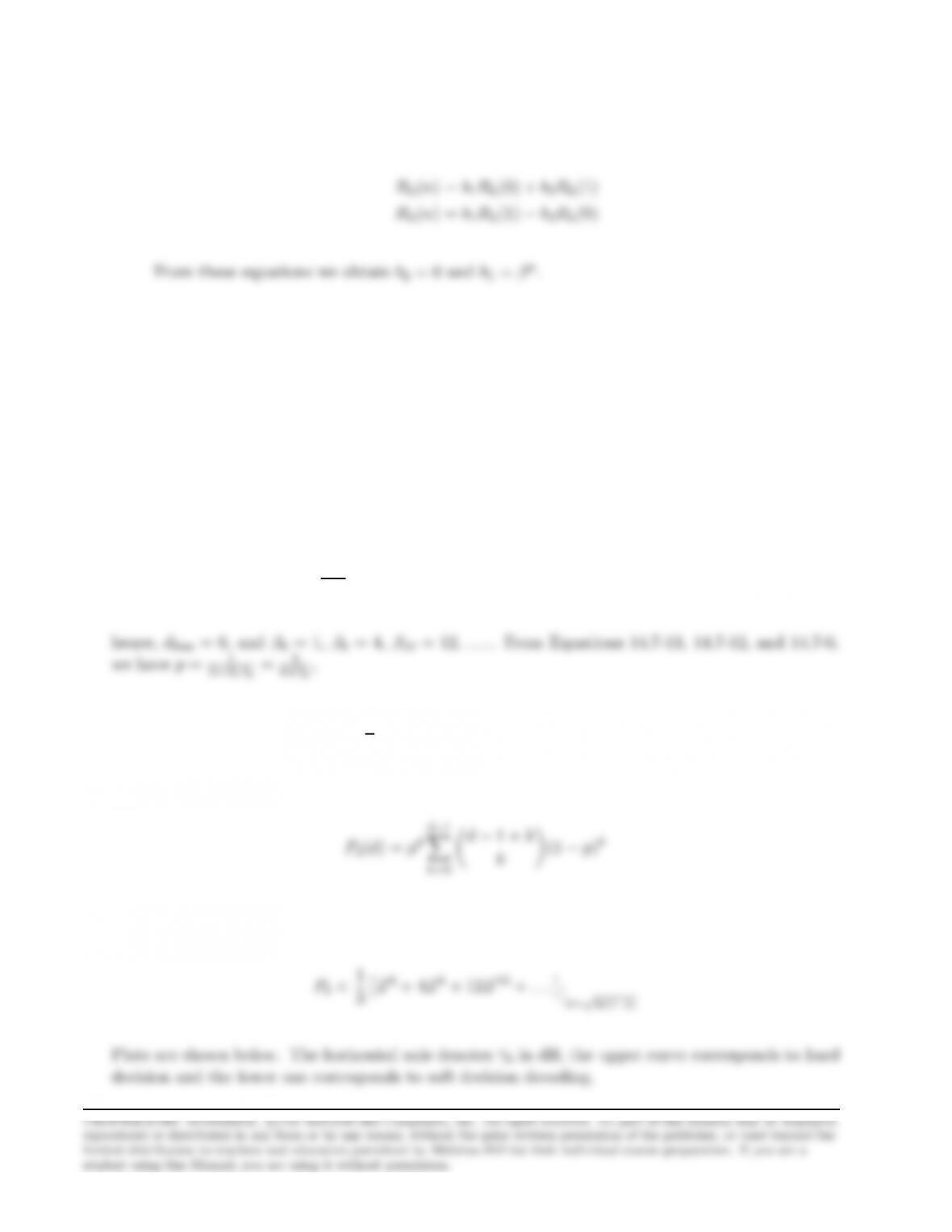
3. This is a MMSE estimation problem, therefore we can invoke the orthogonality principle
E[(h(m)−b1h(m−n)−b2h(m−n−1))h∗(m−n)] = 0
12
resulting in
Problem 14.13
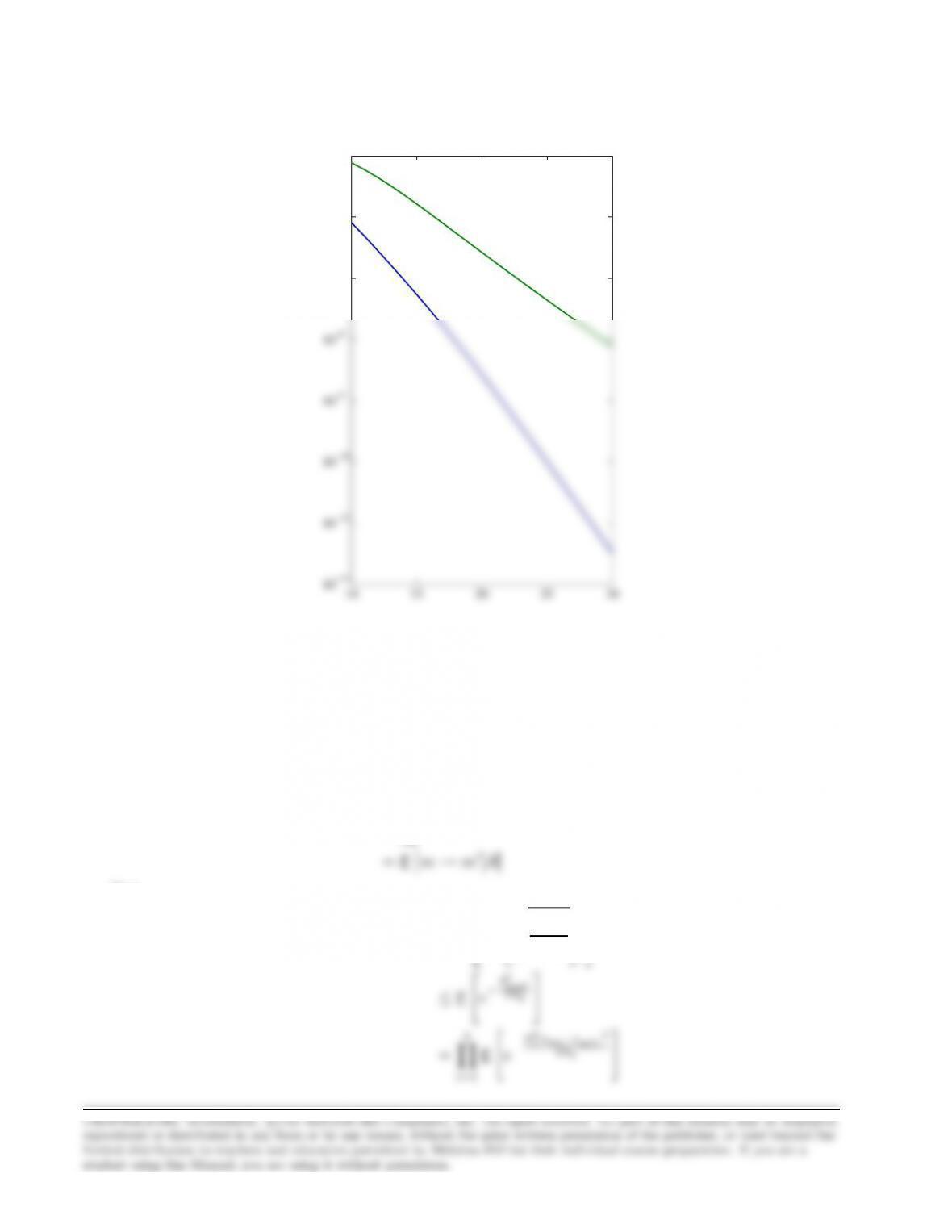
For soft decision decoding, from Equation 8.1-21, We obtain
∂
∂Y T(Y, Z)Y=1
=Z6+ 4Z8+ 12Z10 +…
Pb<1
3[P2(6) + 4P2(8) + 12P2(10) + …]
and
d−1
X
k=0 d−1 + k
For hard decision decoding, we essentially have the same expressions, except that
13
10 15 20 25 30
10−14
10−12
10−10
10−8
10−6
10−4
10−2
100
Problem 14.14
The channel model is yi=Rixi+niand the PEP can be written as
Pm→m′=Z∞
0
Pm→m′R=rp(r)dr
=Em→m′R
But
Em→m′R
=E
Q
sd2
mm′
2N0
mm′
4N0#
14
Note that R2
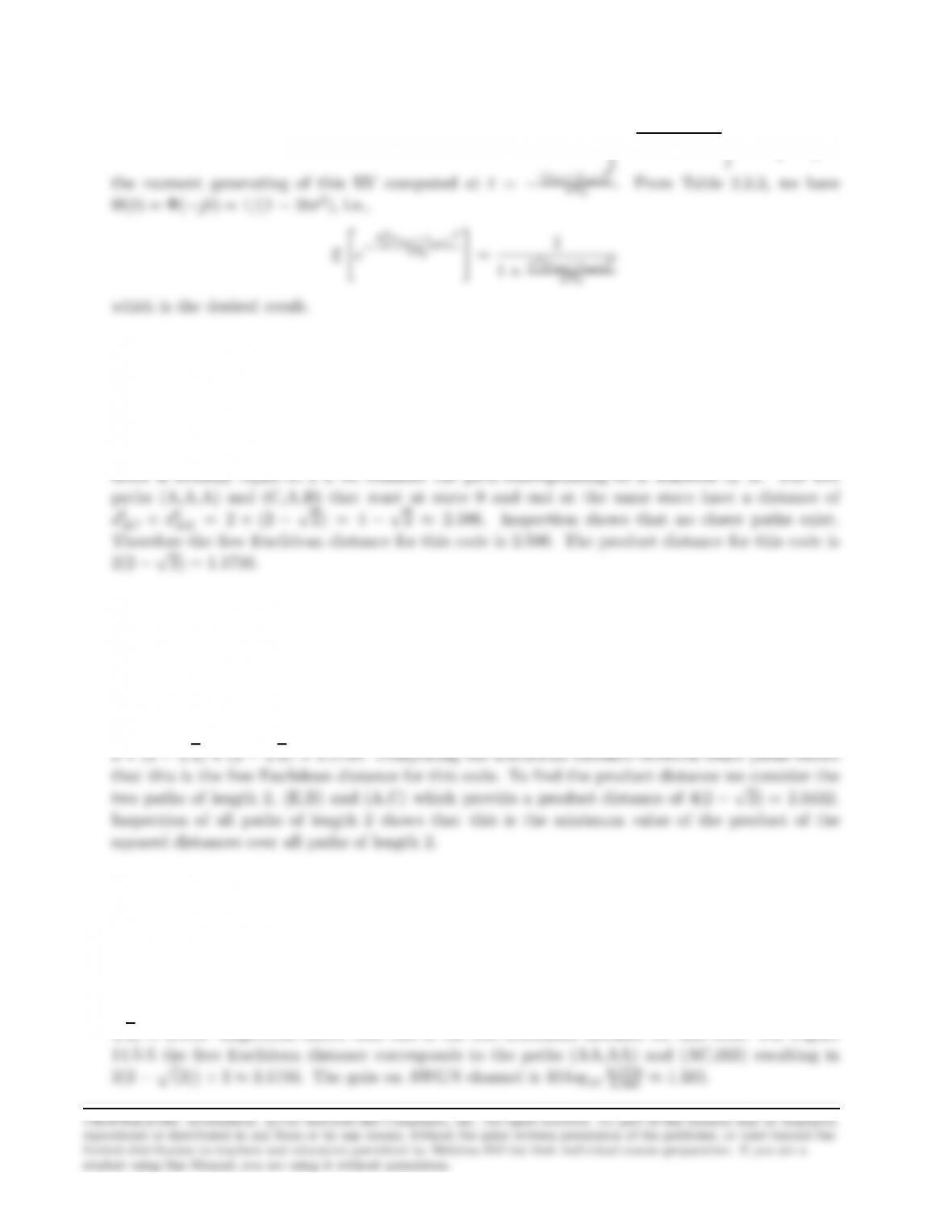
iis a χ2RV with two degrees of freedom and E“e−R2
i|xmi−xm′i|2
4N0#=EhetR2
iiis
Problem 14.15
Since there are no parallel branches in the trellis the diversity order is at least 2. The diversity
Problem 14.16
In this case we consider that paths corresponding to (E,B,G) and (C,A,F) which start and
finish at the zero state. The Euclidean distance between these paths is d2
EC +d2
AB +d2
F G =
Problem 14.17
In Figure 14.5-4 consider the two paths starting from zero state and ending in the zero state
corresponding to (AA,AA) and (BB,BH). This Euclidean distance between these paths is 4(2 −
√2) ≈2.343. Inspection shows that this is the free Euclidean distance for this code. For Figure
Problem 14.18
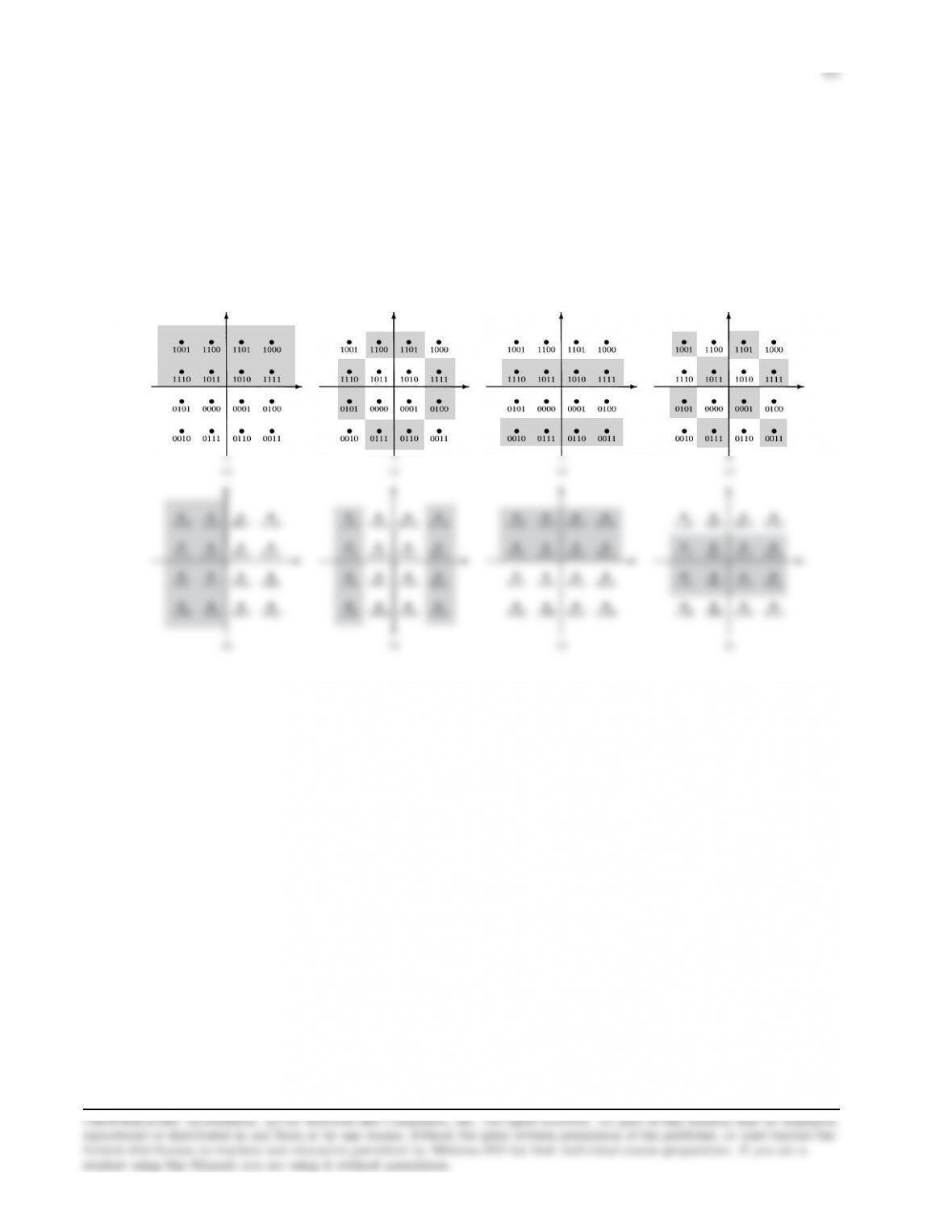
The figure shown below gives the answer to the problem χi
1is shown in gray. The four columns
from left to right correspond to i= 1,2,3,4, respectively.