
Solutions Manual
for
Digital Communications, 5th Edition
(Chapter 13) 1
Prepared by
Kostas Stamatiou
January 20, 2008
2
Problem 13.1
Based on the info about the scattering function we know that the multipath spread is Tm= 1 ms,
and the Doppler spread is Bd= 0.2Hz.
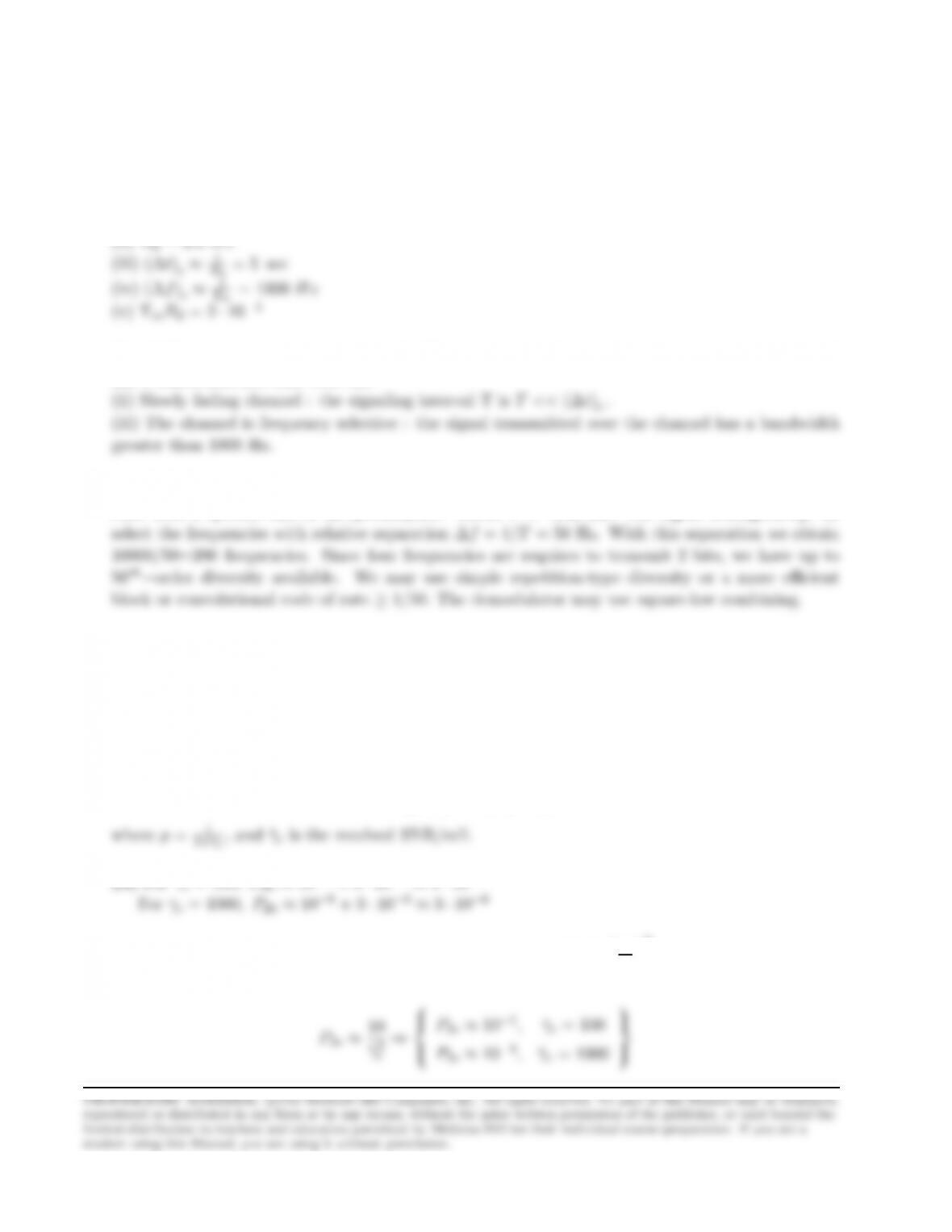
(a) (i) Tm= 10−3sec
(b) (i) Frequency non-selective channel : This means that the signal transmitted over the channel
has a bandwidth less that 1000 Hz.
(c) The signal design problem does not have a unique solution. We should use orthogonal M=4
FSK with a symbol rate of 50 symbols/sec. Hence T= 1/50 sec. For signal orthogonality, we
Problem 13.2
(a)
P2h=p3+ 3p2(1 −p)
(b) For ¯γc= 100, P2h≈10−6+ 3 ·10−4≈3·10−4
(c) Since ¯γc>> 1,we may use the approximation : P2s≈2L−1
L1
¯γcL,where L is the order of
diversity. For L=3, we have :
P2s≈10−5,¯γc= 100
3
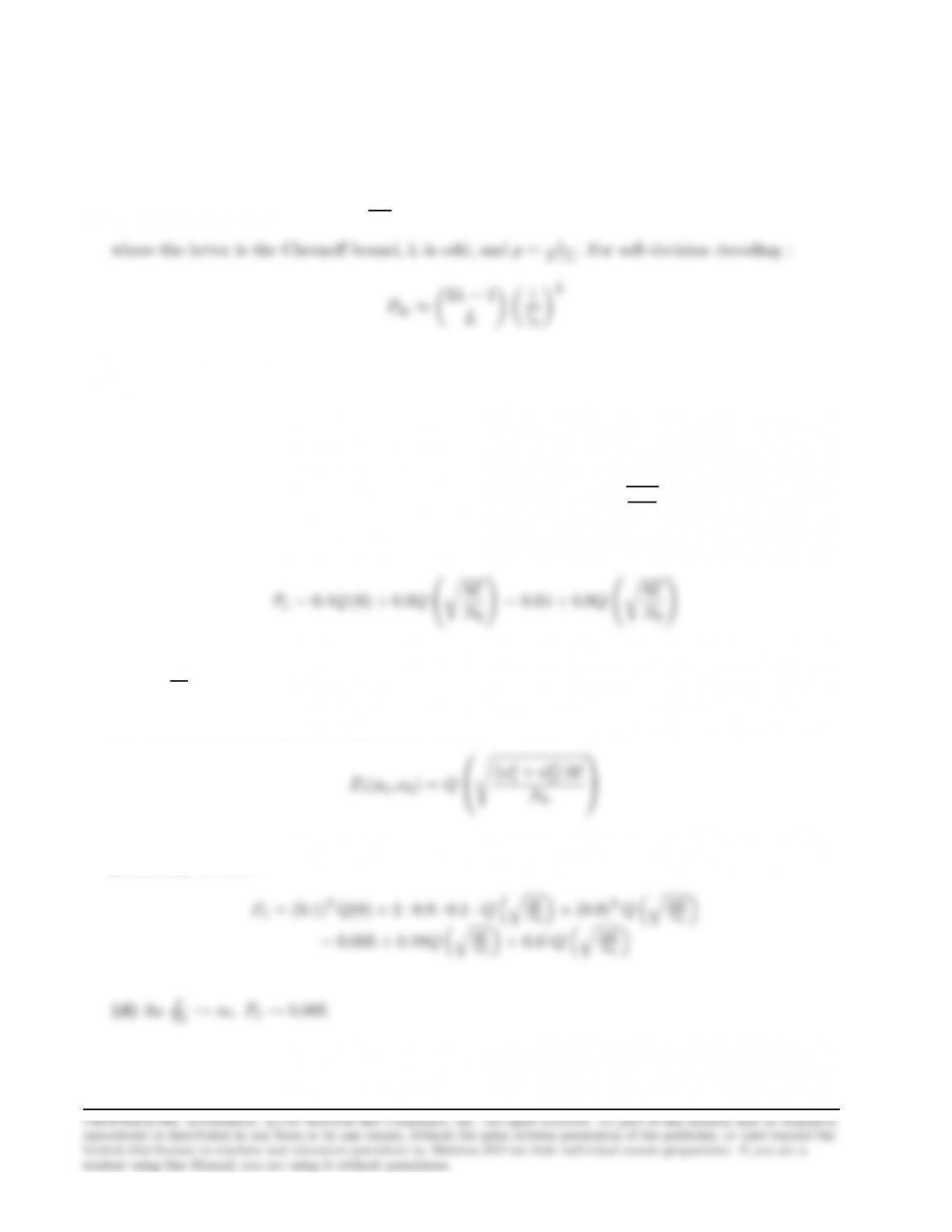
(d) For hard-decision decoding :
P2h=
L
X
k=L+1
2L
kpk(1 −p)L−k≤[4p(1 −p)]L/2
Problem 13.3
(a) For a fixed channel, the probability of error is : Pe(a) = Qqa22E
N0.We now average this
conditional error probability over the possible values of α, which are a=0, with probability 0.1, and
a=2 with probability 0.9. Thus :
(b) As E
N0→ ∞, Pe→0.05
(c) When the channel gains a1, a2are fixed, the probability of error is :
1+a2
22E
N0
Averaging over the probability density function p(a1, a2) = p(a1)·p(a2),we obtain the average
probability of error :

Problem 13.4
(a)
Tm= 1 sec ⇒(∆f)c≈1
Tm= 1 Hz
(d) The desired data rate is not specified in this problem, and must be assumed. Note that with a
pulse duration of T= 10 sec, the binary PSK signals can be spaced at 1/T = 0.1Hz apart. With a
(e) We use the approximation :
P2≈2L−1
L 1
4¯γcL
4¯γc5
(f) The tap spacing between adjacent taps is 1/5=0.2 seconds. the total multipath spread is
(g) Since the fading is slow relative to the pulse duration, in principle we can employ a coherent
(h) For an error rate of 10−6,we have :
Problem 13.5
(a)
p(n1, n2) = 1
2πσ2e−(n2
1+n2
2)/2σ2
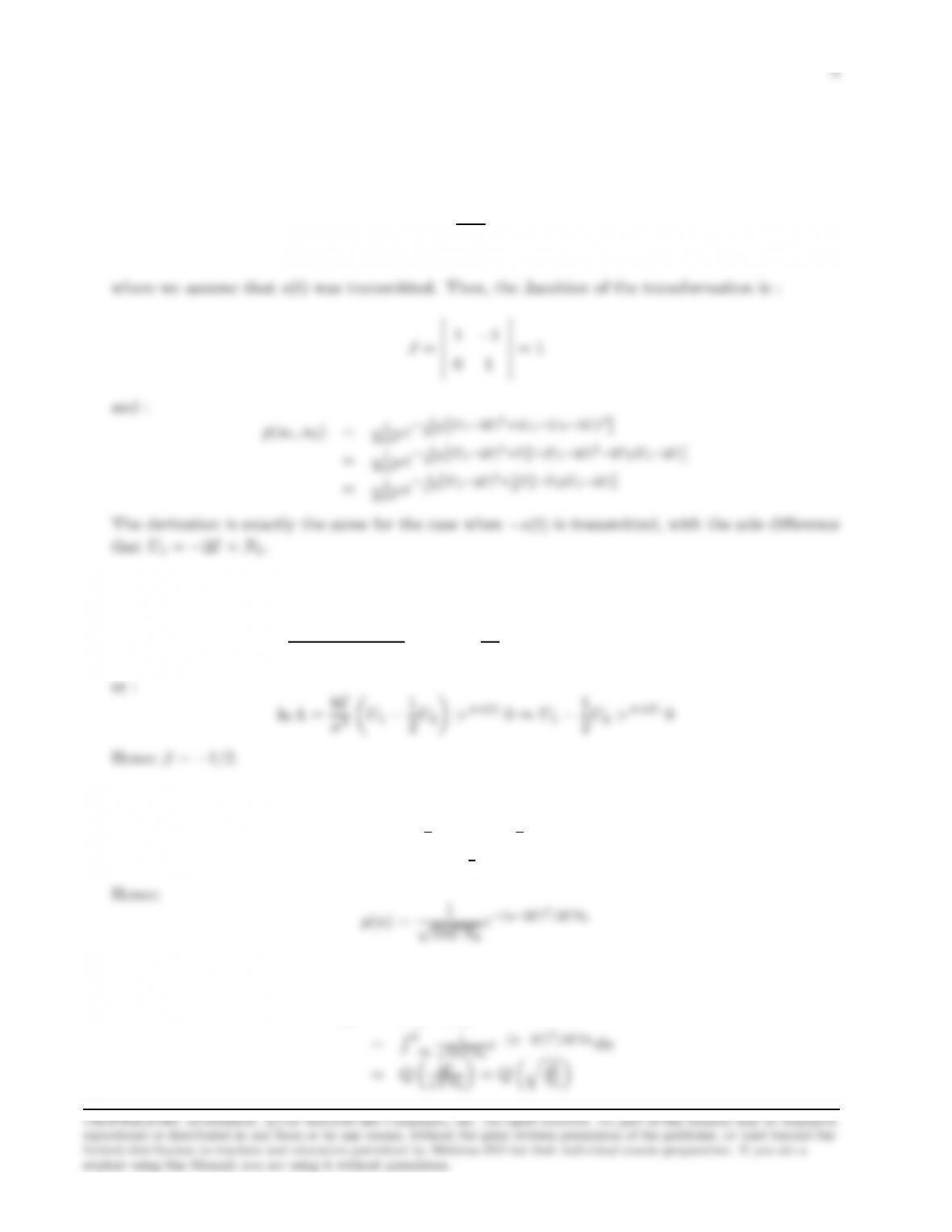
U1= 2E+N1, U2=N1+N2⇒N1=U1−2E, N2=U2−U1+ 2E
(b) The likelihood ratio is :
Λ = p(u1, u2|+s(t))
p(u1, u2| − s(t)) = exp −1
σ2(−8EU1+ 4EU2)>+s(t)1
(c)
U=U1−1
2U2= 2E+1
2(N1−N2)
E[U] = 2E, σ2
U=1
4σ2
n1+σ2
n2=EN0
(d)
Pe=P(U < 0)
1

6
(e) If only U1is used in reaching a decision, then we have the usual binary PSK probability of
Problem 13.6
(a)
U=Re “L
X
k=1
βkUk#>10
where Uk= 2Eake−jφk+vkand where vkis zero-mean Gaussian with variance 2EN0k.Hence, U
is Gaussian with :
E[U] = Re hPL
k=1 βkE(Uk)i
(b) The probability of error is :
P2=Z0
−∞
p(u)du =Qp2γ
(c) To maximize P2,we maximize γ. It is clear that γis maximized with respect to {θk}by selecting
θk=φkfor k= 1,2, …, L. Then we have :
γ=EhPL
k=1 ak|βk|i2
PL
k=1 |βk|2N0k

7
Consequently :
|βl|=al
N0l
Problem 13.7
(a)
p(u1) = 1
2σ2
1L(L−1)!uL−1
1e−u1/2σ2
1, σ2
1= 2EN0(1 + ¯γc)
p(u2) = 1
2σ2
2L(L−1)!uL−1
2e−u2/2σ2
2, σ2
2= 2EN0
0
But :
P(U2> U1|U1) = R∞
u1p(u2)du2=R∞
u1
1
(2σ2
2)L(L−1)! uL−1
2e−u2/2σ2
2du2
(−2σ2
2)(L−1)
(2σ2
2)L−1(L−1)! uL−1
1e−u1/2σ2
u1
(2σ2
2)L−1(L−2)! uL−2
2e−u2/2σ2
Continuing, in the same way, the integration by parts, we obtain :
P(U2> U1|U1) = e−u1/2σ2
2
L−1
X
k=0 u1/2σ2
2k
k!

8
The integral that exists inside the summation is equal to :
R∞
0uL−1+ke−uadu =
where a= (1/σ2
1+ 1/σ2
2)/2 = σ2
1+σ2
2
2σ2
1σ2
2
.Continuing the integration by parts, we obtain :
0
aL+k(L−1 + k)! = 2σ2
σ2
1+σ2
2L+k
Hence :
P2=PL−1
k=0 1
k!(2σ2
2)k(2σ2
1)L(L−1)! R∞
0uL−1+k
1e−u1(1/σ2
1+1/σ2
2)/2du1
1σ2
2
Problem 13.8
U=
L
X
k=1
Uk
(a) Uk= 2Eak+vk,where vkis Gaussian with E[vk] = 0 and σ2
v= 2EN0.Hence, for fixed {ak}, U
is also Gaussian with : E[U] = PL
k=1 E(Uk) = 2EPL
k=1 akand σ2
u=Lσ2
v= 2LEN0.Since Uis
Gaussian, the probability of error, conditioned on a fixed number of gains {ak}is
k=1 ak
v
u
u
t2EPL
k=1 ak2

9
(b) The average probability of error for the fading channel is the conditional error probability
averaged over the {ak}.Hence :
Pd=Z∞
0
da1Z∞
0
da2… Z∞
0
daLPb(a1, a2, …, aL)p(a1)p(a2)…p(aL)
Problem 13.9
(a) The plot of g(¯γc) as a function of ¯γcis given below :
0 1 2 3 4 5 6 7
0.15
0.16
0.17
0.18
0.19
0.2
0.21
0.22
gamma_c
g(gamma_c)
The maximum value of g(¯γc) is approximately 0.215 and occurs when ¯γc≈3.
(b) ¯γc= ¯γb/L. Hence, for a given ¯γbthe optimum diversity is L= ¯γb/¯γc= ¯γb/3.
(c) For the optimum diversity we have :
10
For the non-fading channel :P2=1
2e−0.5γb.Hence, for large SNR (¯γb>> 1),the penalty in SNR is:
0.5
Problem 13.10
The radio signal propagates at the speed of light, c= 3 ×10⁸m/ sec .The difference in propagation
delay for a distance of 300 meters is
Problem 13.11
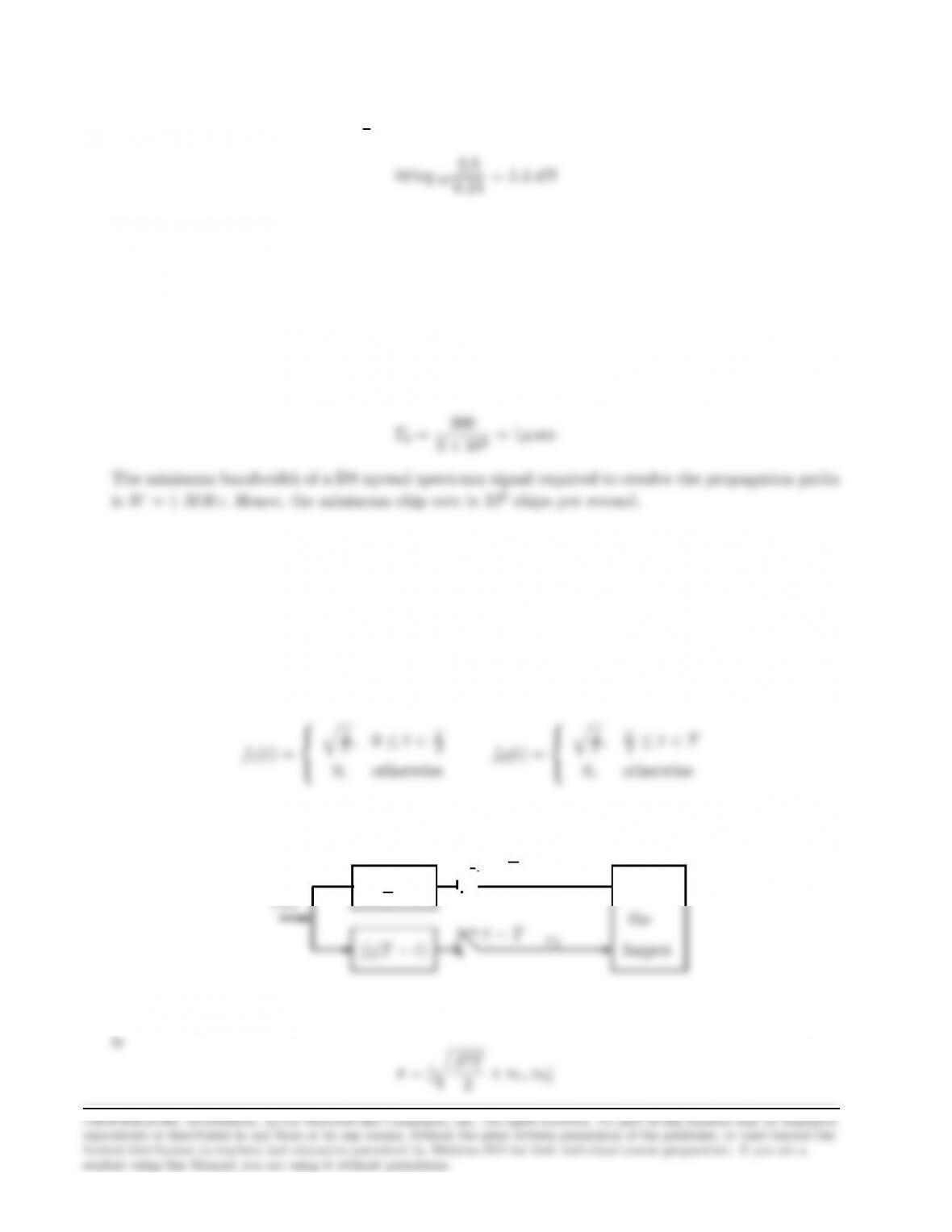
(a) The dimensionality of the signal space is two. An orthonormal basis set for the signal space is
formed by the signals
T,0≤t < T
2
T,T
2≤t < T
(b) The optimal receiver is shown in the next figure
R
@
@
–
–
Select
t=T
2
r1
f1(T
2−t)
(c) Assuming that the signal s1(t) is transmitted, the received vector at the output of the samplers
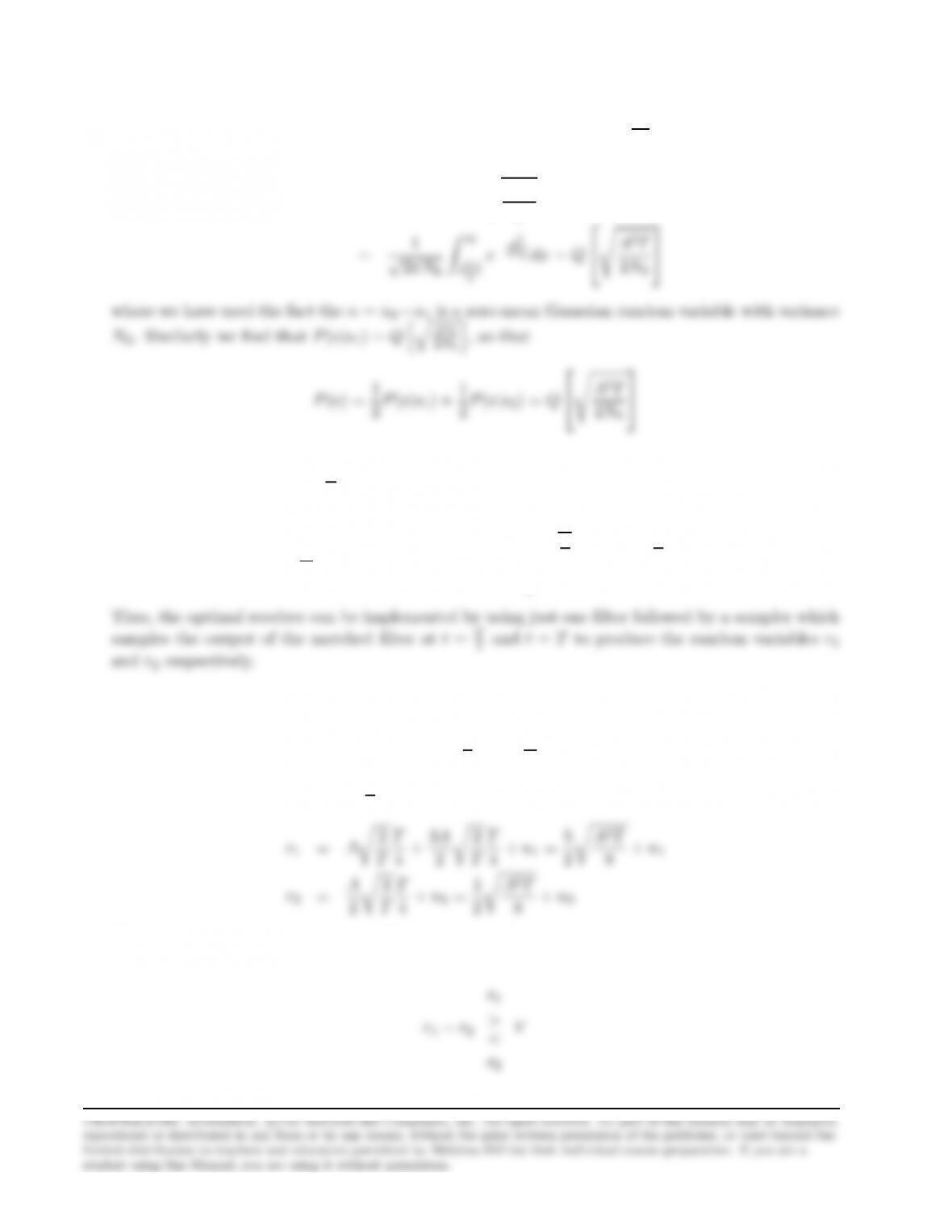
11
where n1,n2are zero mean Gaussian random variables with variance N0
2. The probability of error
P(e|s1) is
P(e|s1) = P(n2−n1>rA2T
2)
2N0dx =Q
2P(e|s1) + 1
2P(e|s2) = Q
2N0
(d) The signal waveform f1(T
2−t) matched to f1(t) is exactly the same with the signal waveform
f2(T−t) matched to f2(t). That is,
f1(T
2−t) = f2(T−t) = f1(t) =
q2
T,0≤t < T
2
0,otherwise
(e) If the signal s1(t) is transmitted, then the received signal r(t) is
r(t) = s1(t) + 1
2s1(t−T
2) + n(t)
The output of the sampler at t=T
2and t=Tis given by
T
T
If the optimal receiver uses a threshold Vto base its decisions, that is
s1
>

then the probability of error P(e|s1) is
P(e|s1) = P(n2−n1>2rA2T
8−V) = Q
2sA2T
8N0−V
√N0
2rA2T
8+V) = Q
2sA2T
8N0
Thus, the average probability of error is given by
P(e) = 1
ϑP (e)
ϑV = 0 =
2sA2T
8N0−V
√N0
−
5
2sA2T
8N0
+V
√N0
or by solving in terms of V
V=−1
8rA2T
2
(f) Let abe fixed to some value between 0 and 1. Then, if we argue as in part (e) we obtain

13
and the probability of error is
The mean square estimation of V(a) is
Problem 13.12
(a)
14
–M.F. 2
( )2
–M.F. 2
( )2
l
×
–
l
×
–
6
?
h
+
?
6
cos 2πf2t
sin 2πf2t
–M.F. 1
( )2
l
×
–
?
?
cos 2πf1t
6
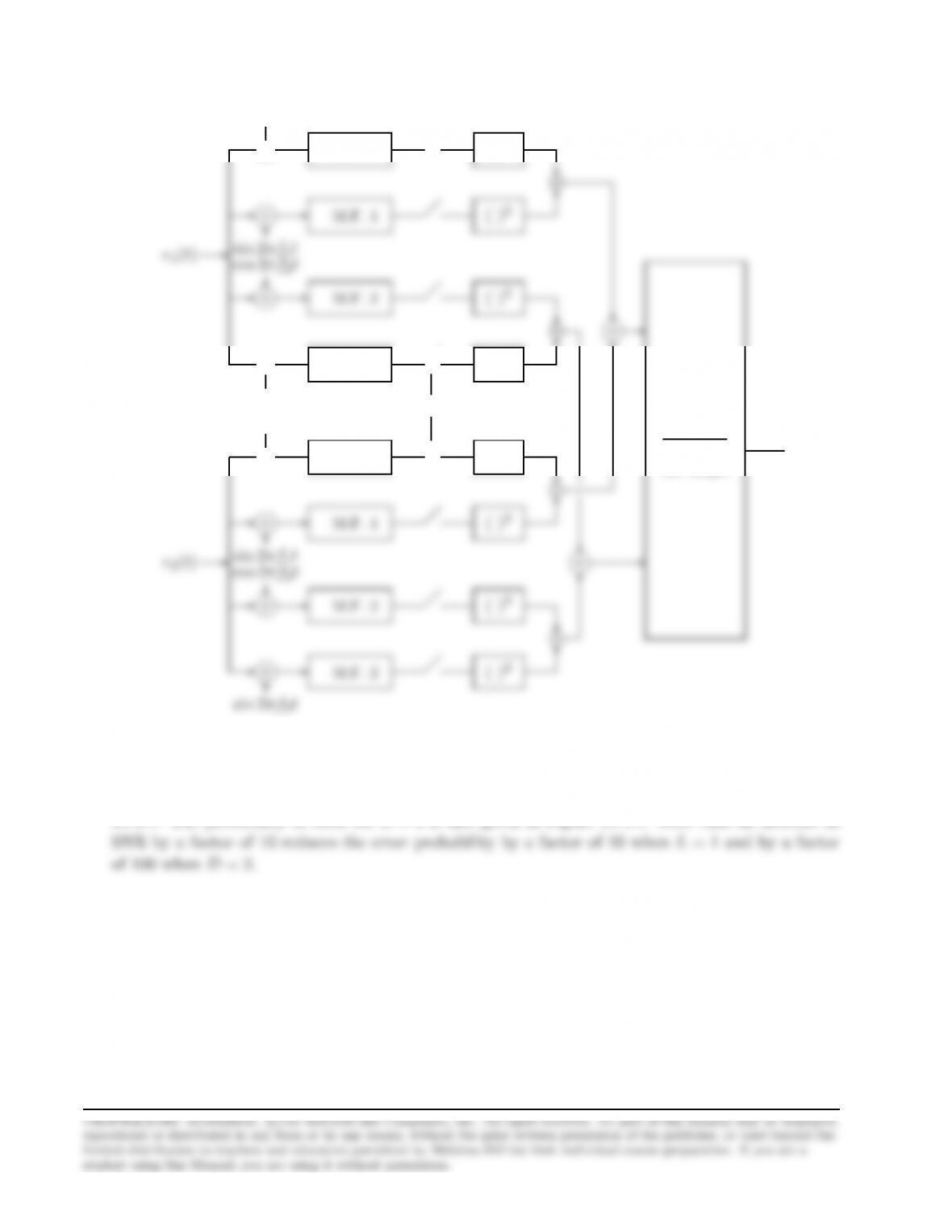
(b) The probability of error for binary FSK with square-law combining for L= 2 is given in Figure
14-4-7. The probability of error for L= 1 is also given in Figure 14-4-7. Note that an increase in
Problem 13.13
(a) The noise-free received waveforms {ri(t)}are given by : ri(t) = h(t)∗si(t), i = 1,2,and they
are shown in the following figure :
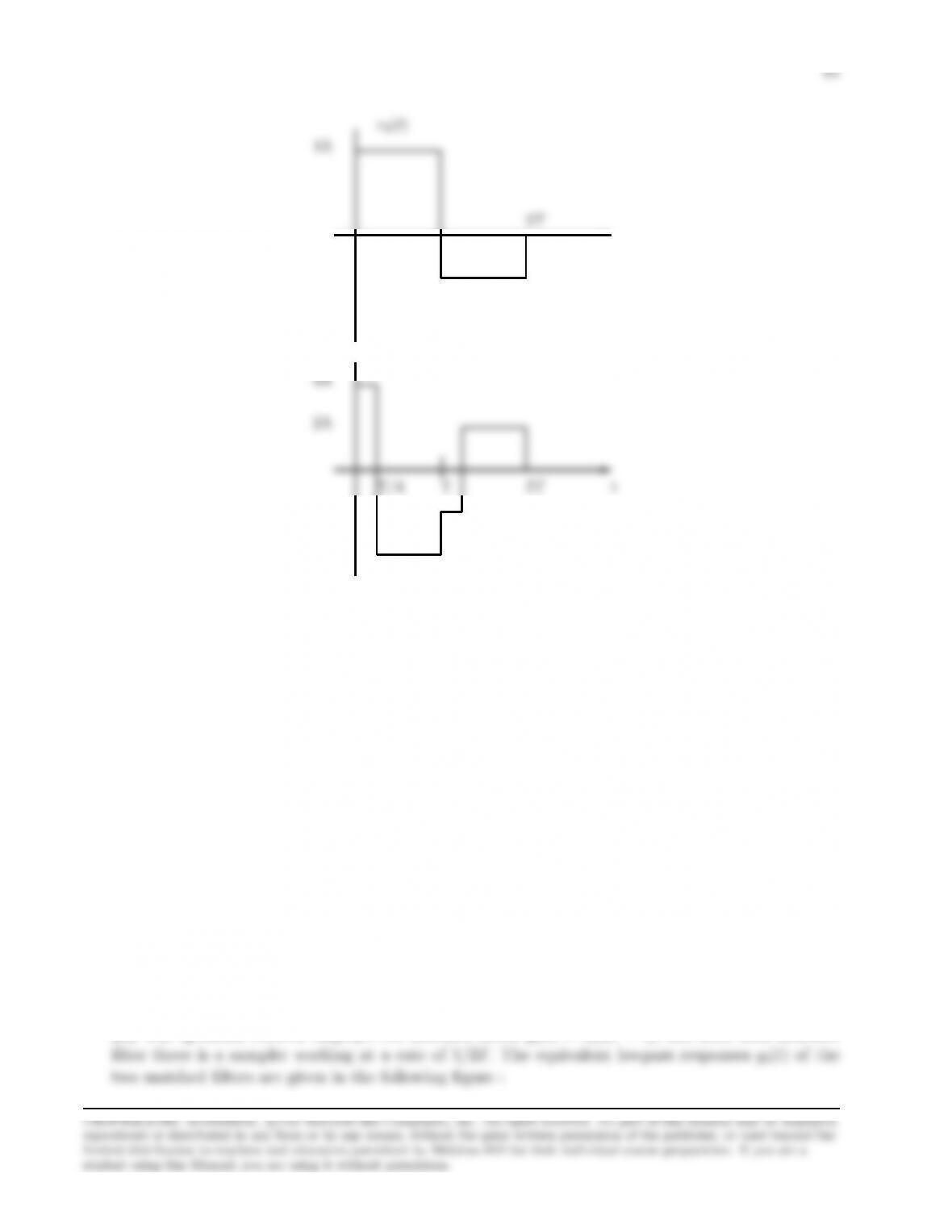
-4A
(b) The optimum receiver employs two matched filters gi(t) = ri(2T−t),and after each matched
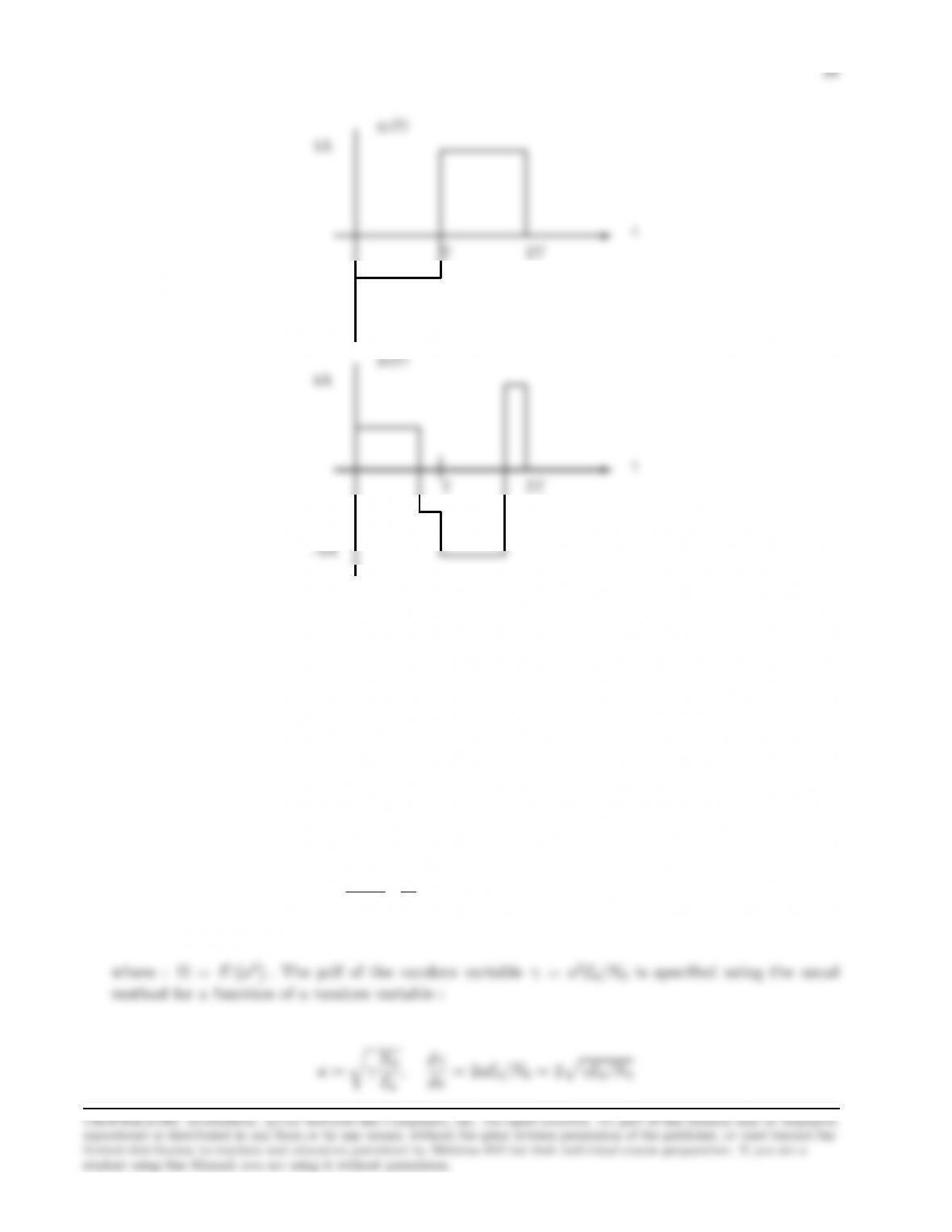
–
t
T 2T
-4A
Problem 13.14
Since afollows the Nakagami-m distribution :
pa(a) = 2
Γ(m)m
Ωma2m−1exp −ma2/Ω, a ≥0

17
Hence :
pγ(γ) = dγ
da −1paqγN0
Eb
2
Problem 13.15
(a) By taking the conjugate of r2=h1s∗
2−h2s∗
1+n2
r1
r∗
2
=
h1h2
−h∗
2h∗
1
s1
s2
+
n1
n∗
2
Hence, the soft-decision estimates of the transmitted symbols (s1, s2) will be
(b) The bit error probability for dual diversity reception of binary PSK is given by Equation
(14.4-15), with L= 2 and µ=q¯γc
1+ ¯γc(where the average SNR per channel is ¯γc=E
N0E[h2] = E
N0)
Then (14.4-15) becomes
P2=1
2(1 −µ)211
0+ [1
2(1 + µ)]2
1

18
(c) The bit error probability for dual diversity reception of binary PSK is given by Equation
(14.4-41), with L= 2 and µas above. Replacing we get
Problem 13.16
The DFT of r(m) is
R(m) = WHH(m)Ws(m) + WHn(m) = G(m)s(m) + WHn(m)
where G(m) is defined in equation 13.6-26 as G(m) = WHH(m)W. We select bk(m) to minimize
But
ER(m)RH(m)=E(G(m)s(m) + WHn(m))(sH(m)GH(m) + nH(m)W)
Problem 13.17
We have

19
Eα′(t+τ)(α′(t))∗=Elim
h1→0
α(t+τ+h1)−α(t+τ)
h1
lim
h2→0
α∗(t+h2)−α∗(t)
h2
= lim
Problem 13.18
The zero-mean complex-valued Gaussian process αk(t) is passed through a differentiator whose
transfer function is H(f) = j2πf . Therefore, the power spectral density of the signal at the output
of the differentiator is
Sy(f) = |H(f)|2S(f)
where S(f) is the power spectral density of αk(t). Consequently,