
Solutions Manual
for
Digital Communications, 5th Edition
(Chapter 12) 1
Prepared by
Kostas Stamatiou
January 29, 2008
2
Problem 12.1
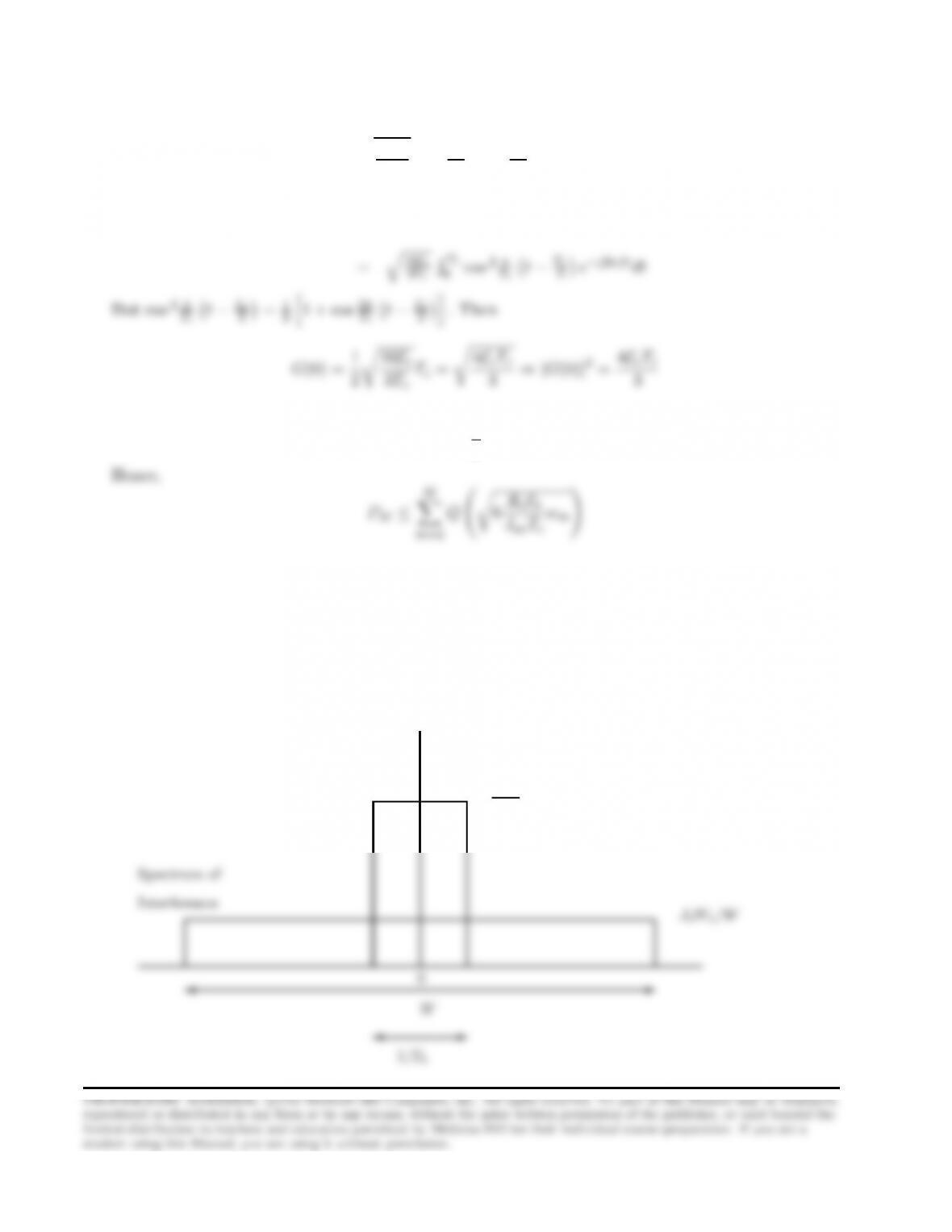
g(t) = r16Ec
3Tc
cos 2π
Tct−Tc
2,0≤t≤Tc
G(f) = R∞
−∞ g(t)e−j2πf tdt
and
σ2
m= 2wmJav |G(0)|2=8
3EcTcwmJav,Ec=RcEb
m=2
JavTc
Problem 12.2
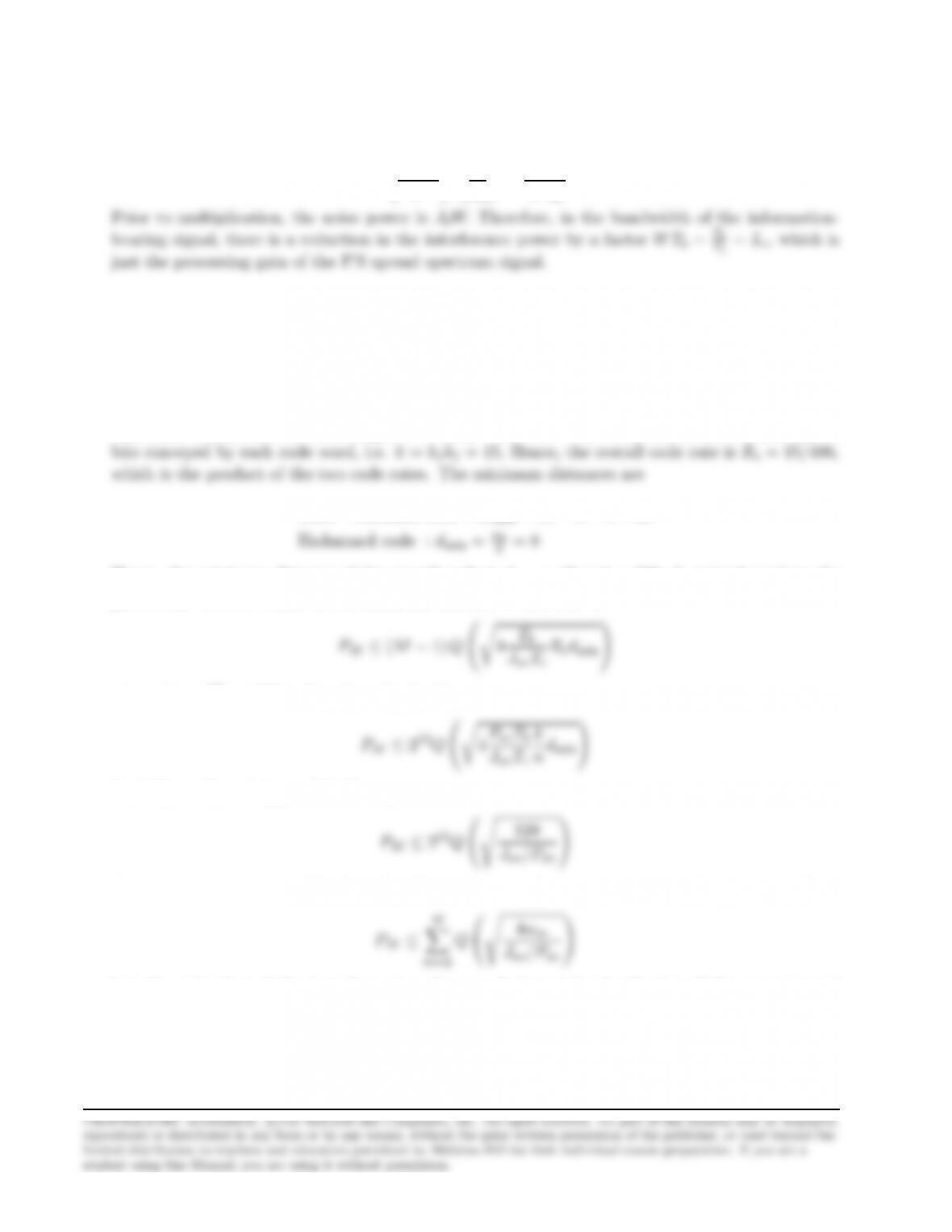
The PN spread spectrum signal has a bandwidth W and the interference has a bandwidth W1,
where W >> W1.Upon multiplication of the received signal r(t) with the PN reference at the
receiver, we have the following (approximate) spectral characteristics
6
J0W1/W
Spectrum of
Interference
W S0
1/Tb=W S0Tb
3
After multiplication with the PN reference, the interference power in the bandwidth 1/Tboccupied
by the signal is
J0W1
W1
Tb=J0W1
W Tb
Problem 12.3
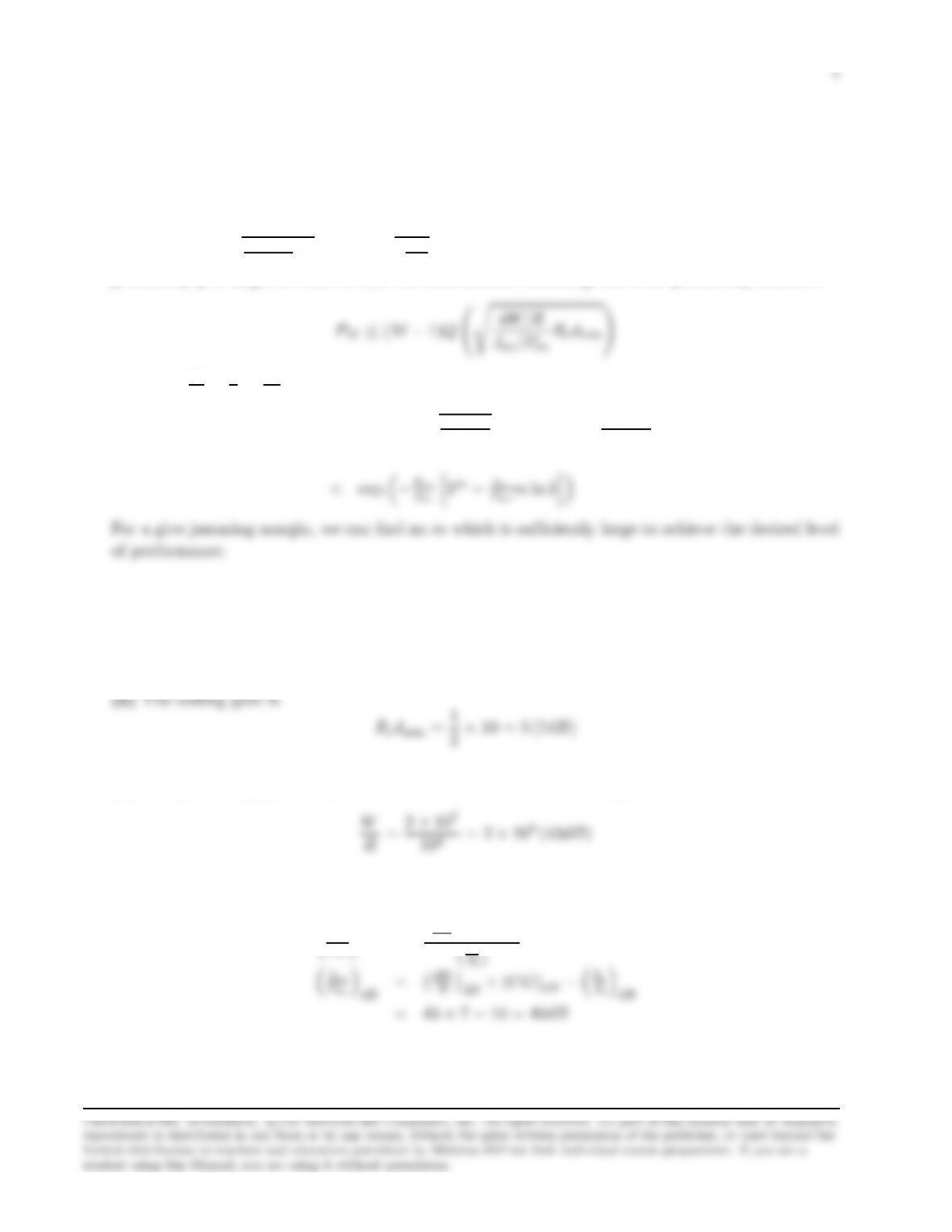
The concatenation of a Reed-Solomon (31,3) code with the Hadamard (16,5) code results in an
equivalent binary code of black length n=n1n2= 31 ×16 = 496 bits. There are 15 information
Reed −Solomon code : Dmin = 31 −3 + 1 = 29
Hence, the minimum distance of the overall code is dmin = 28 ×8 = 232.A union bound on the
probability of error based on the minimum distance of the code is
JavTc
where M= 215 = 32768.Also, Eb=PavTb.Thus,
k
But kTb=nTcand dmn = 232.Hence,
Due to the large number of codewords, this union bound is very loose. A much tighter bound is
M
X
m=2
but the evaluation of the bound requires the use of the weight distribution of the concatenated
code.
Problem 12.4
For hard-decision decoding we have
PM≤(M−1) [4p(1 −p)]dmin/2= 2m+1 [4p(1 −p)]2m−2
where p=Qq4W/R
Jav/Pav Rc=Qq4Pav
Jav .Note that in the presence of a strong jammer, the
probability pis large, i.e close to 1/2. For soft-decision decoding, the error probability bound is
Jav/Pav
We select W
R=n
k=1
Rcand hence:
PM≤2m+1Qq 2m+1
Jav /Pav <2mexp −2m
Jav/Pav
Problem 12.5
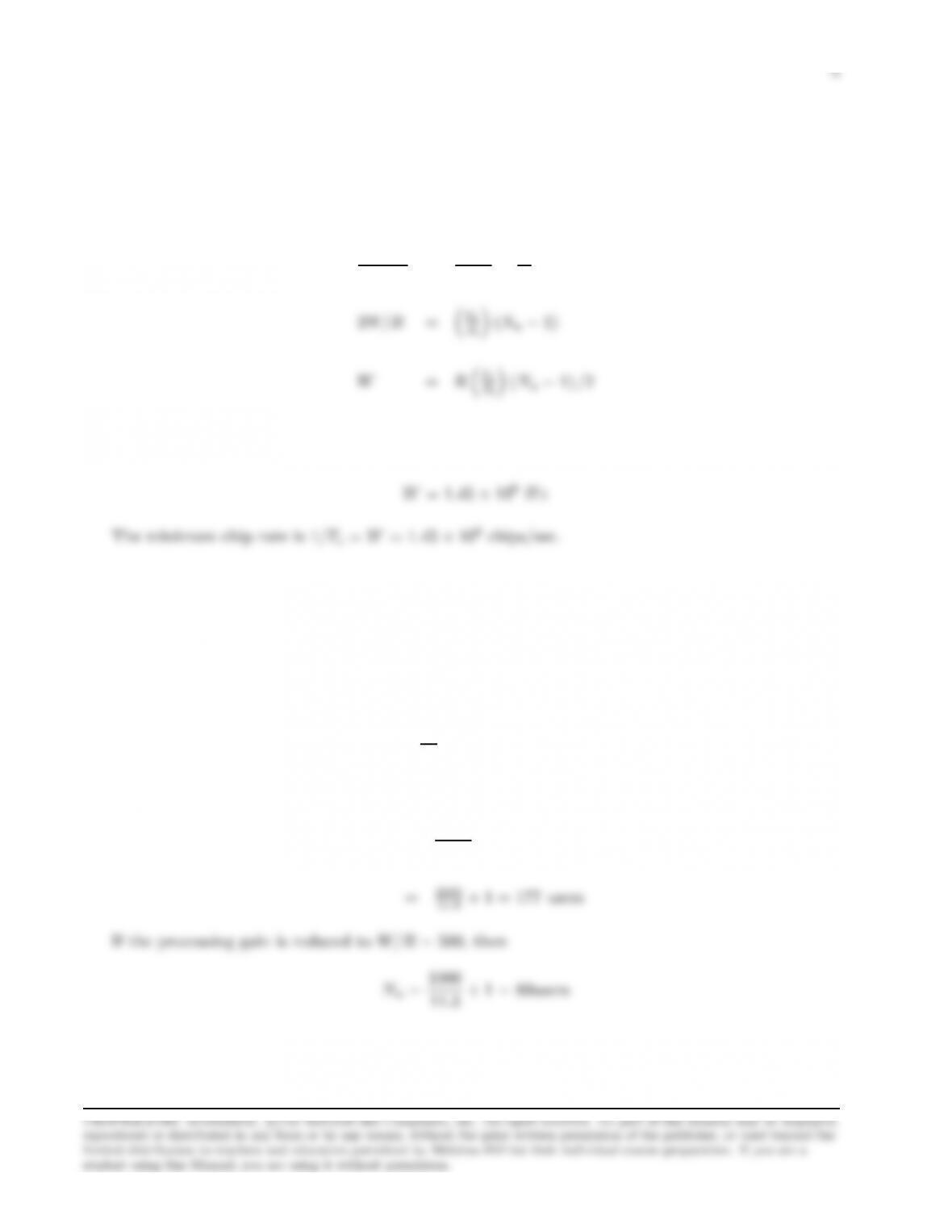
(b) The processing gain is W/R, where W= 107Hz and R= 1000bps. Hence,
(c) The jamming margin is
Jav
Pav =(2W
R)·(Rcdmin)
“Eb
Problem 12.6
We assume that the interference is characterized as a zero-mean AWGN process with power spectral
density J0. To achieve an error probability of 10−5, the required Eb/J0= 10 . Then, by using the
relation in (12-2-46) and (12-2-37), we have
2W/R
Jav/Pav =2W/R
Nu−1=Eb
J0
where R= 104bps, Nu= 30 and Eb/J0= 10.Therefore,
Problem 12.7
To achieve an error probability of 10−6,we require
Eb
J0dB
= 10.5dB
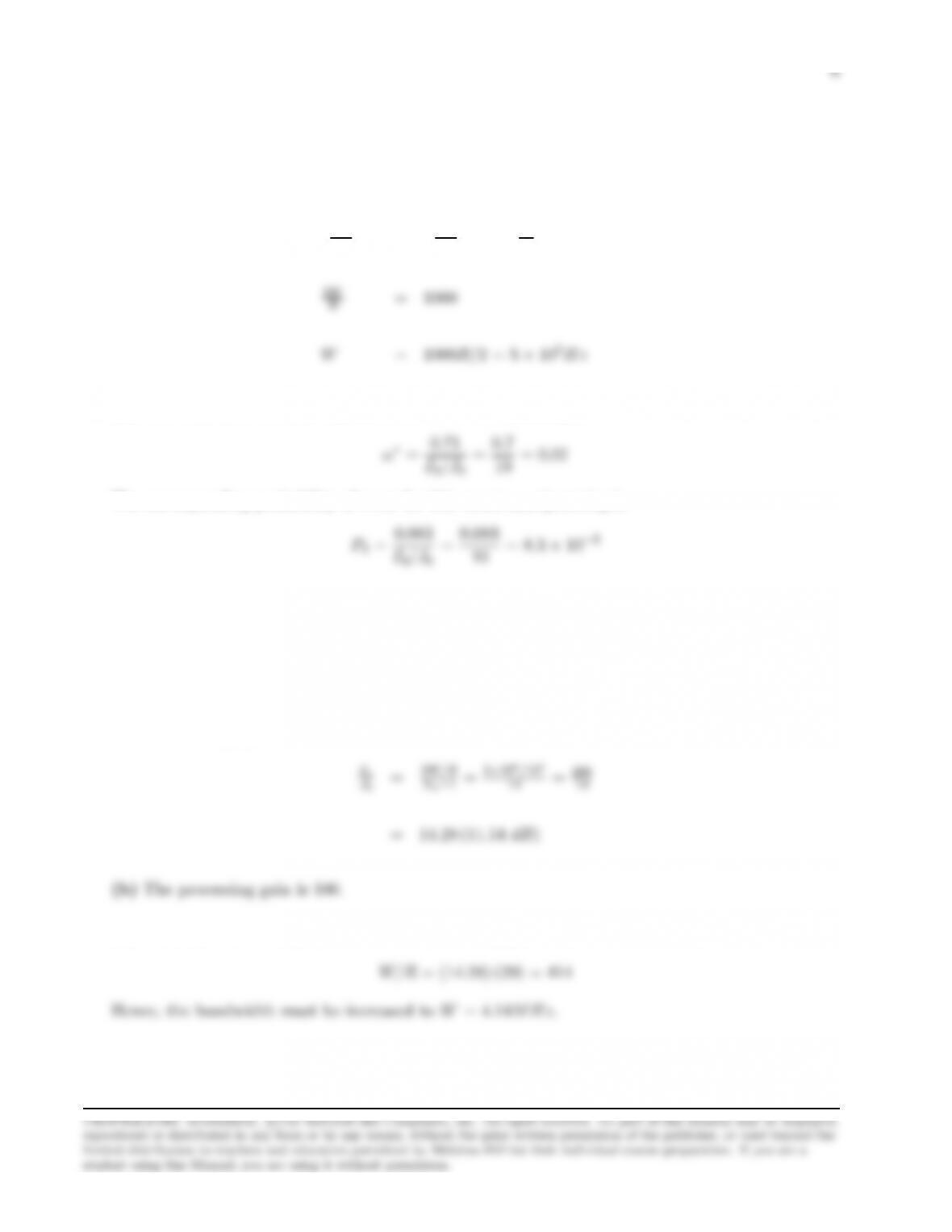
Then, the number of users of the CDMA system is
Nu=2W/R
Eb/J0+ 1
Problem 12.8
(a) We are given a system where (Jav /Pav)dB = 20 dB, R = 1000 bps and (Eb/J0)dB = 10 dB.
Hence, using the relation in (12-2-37) we obtain
2W
RdB =Jav
Pav dB +Eb
J0dB = 30 dB
(b) The duty cycle of a pulse jammer for worst-case jamming is
The corresponding probability of error for this worst-case jamming is
Problem 12.9
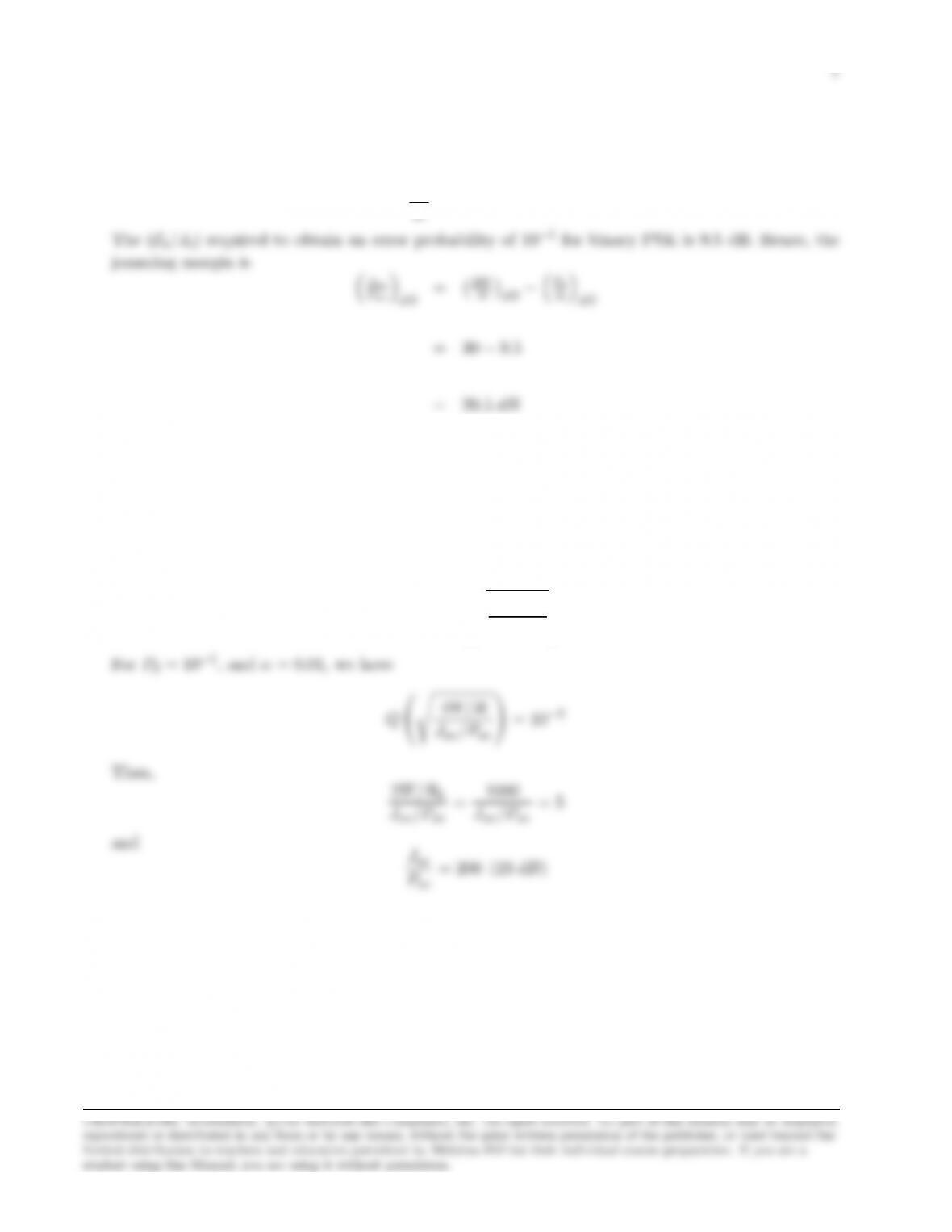
(a) We have Nu= 15 users transmitting at a rate of 10,000 bps each, in a bandwidth of W=
1MHz. The Eb/J0is
(c) With Nu= 30 and Eb/J0= 14.28,the processing gain should be increased to
Problem 12.10
The processing gain is given as
W
R= 500 (27 dB)
Problem 12.11
If the jammer is a pulse jammer with a duty cycle α= 0.01,the probability of error for binary
PSK is given as
P2=αQ s4W/R
Jav/Pav !
Pav
Problem 12.12
c(t) =
∞
X
n=−∞
cnp(t−nTc)
8
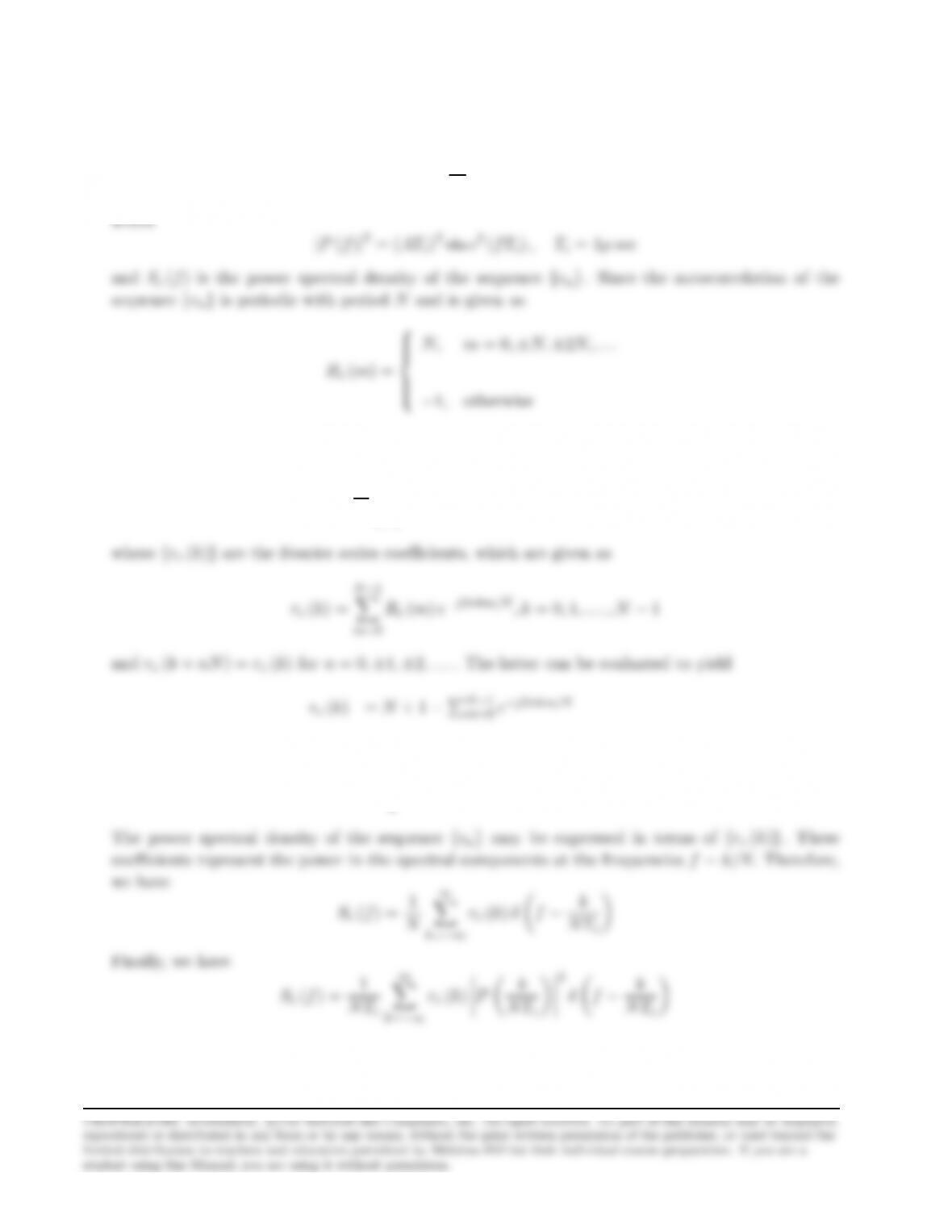
The power spectral density of c(t) is given by (3.4.15) as
Sc(f) = 1
Tc
Sc(f)|P(f)|2
then, Rc(m) can be represented in a discrete Fourier series as
φc(m) = 1
N
N−1
X
k=0
rC(k)ej2πmk/N , m = 0,1,…,N −1
=
1, k = 0,±N, ±2N,…
N+ 1,otherwise
Problem 12.13
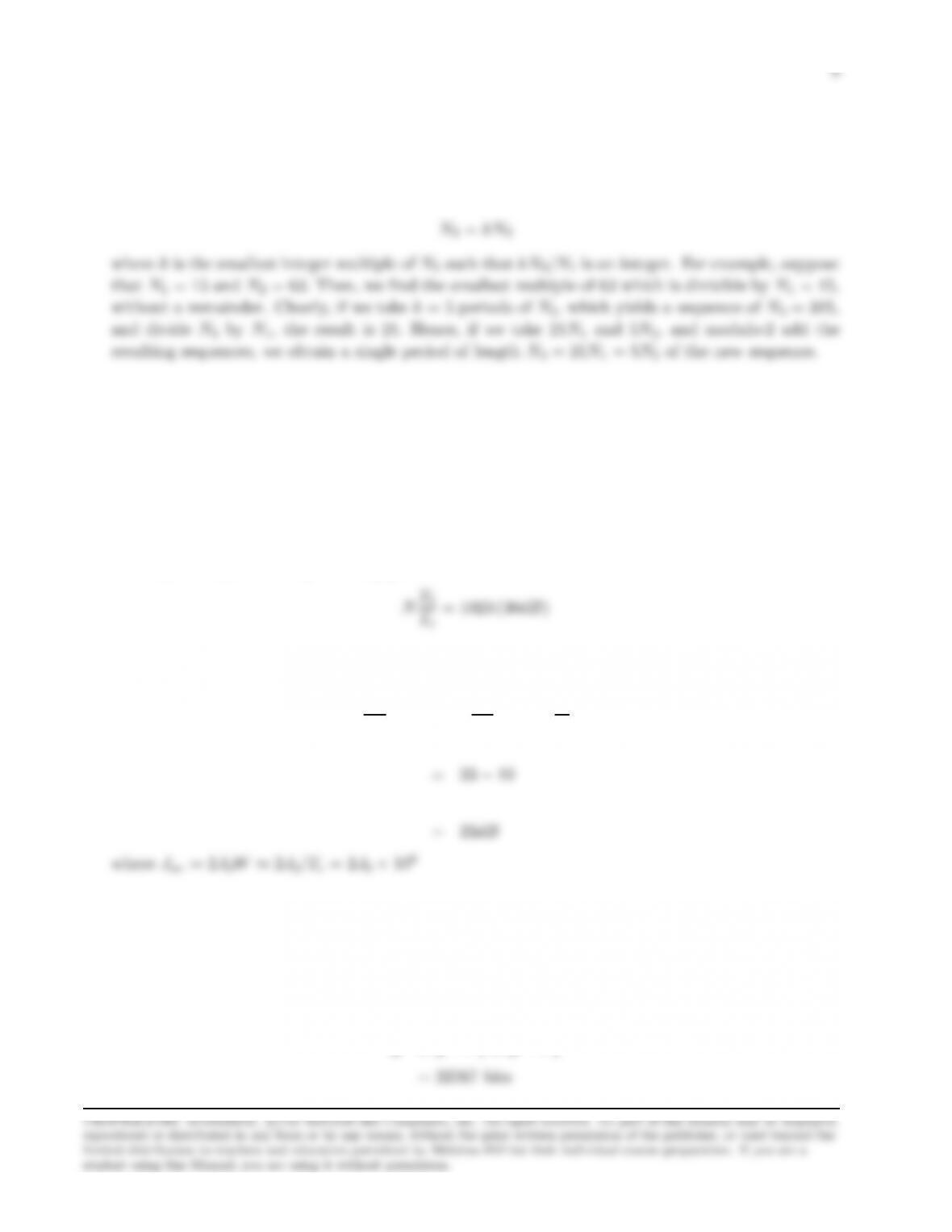
Without loss of generality, let us assume that N1< N2.Then, the period of the sequence obtained
by forming the modulo-2 sum of the two periodic sequences is
Problem 12.14
(a) The period of the maximum length shift register sequence is
N= 210 −1 = 1023
Since Tb=NTc,then the processing gain is
Tc
(b) According to (12-2-37), the jamming margin is
Jav
Pav dB =2W
RbdB −Eb
J0dB
Problem 12.15
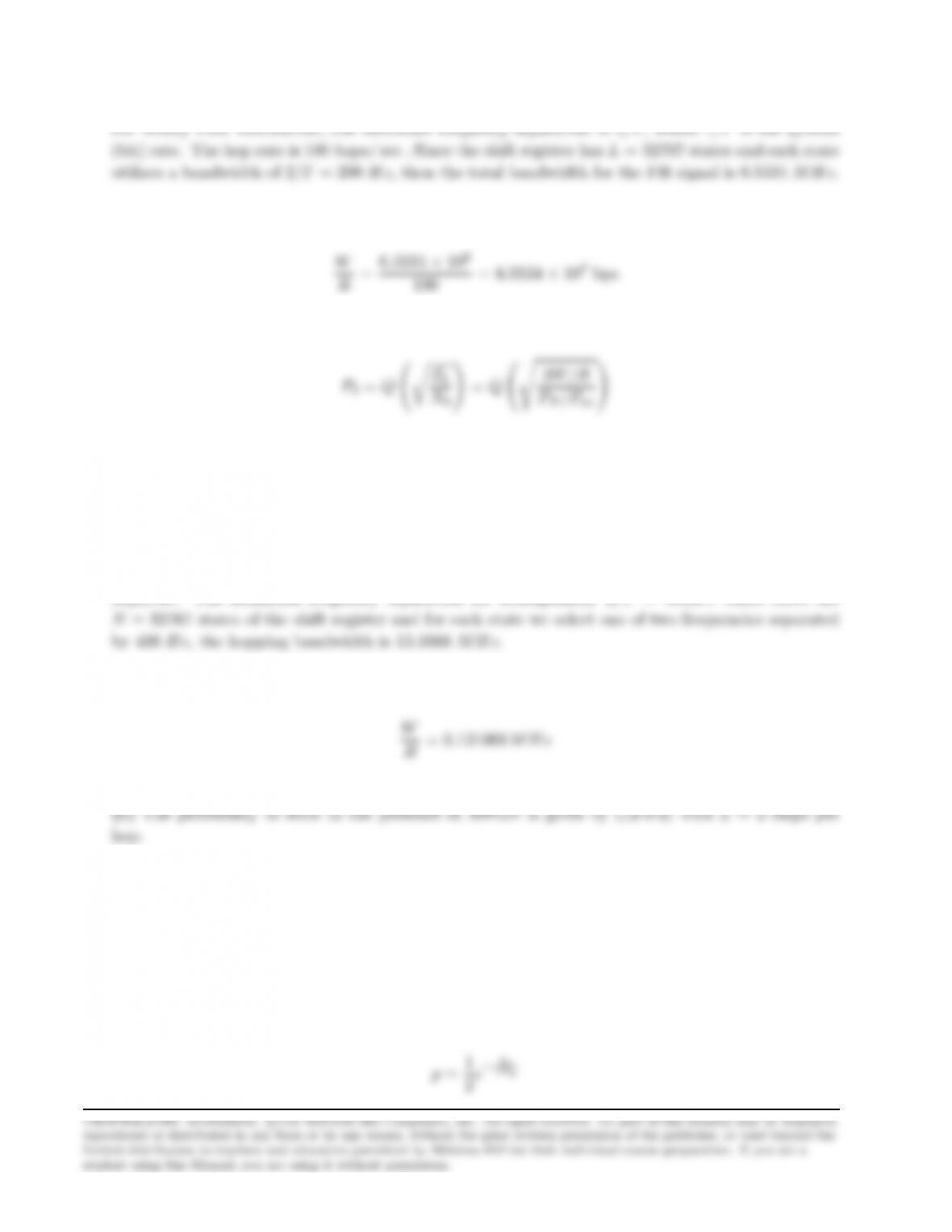
(a) The length of the shift-register sequence is
L= 2m−1 = 215 −1
10
(b) The processing gain is W/R. We have,
(c) If the noise is AWG with power spectral density N0,the probability of error expression is
Problem 12.16
(a) If the hopping rate is 2 hops/bit and the bit rate is 100 bits/sec, then, the hop rate is 200
hops/sec. The minimum frequency separation for orthogonality 2/T = 400Hz. Since there are
(b) The processing gain is W/R, where W= 13.1068 MHz and R= 100bps. Hence
Problem 12.17
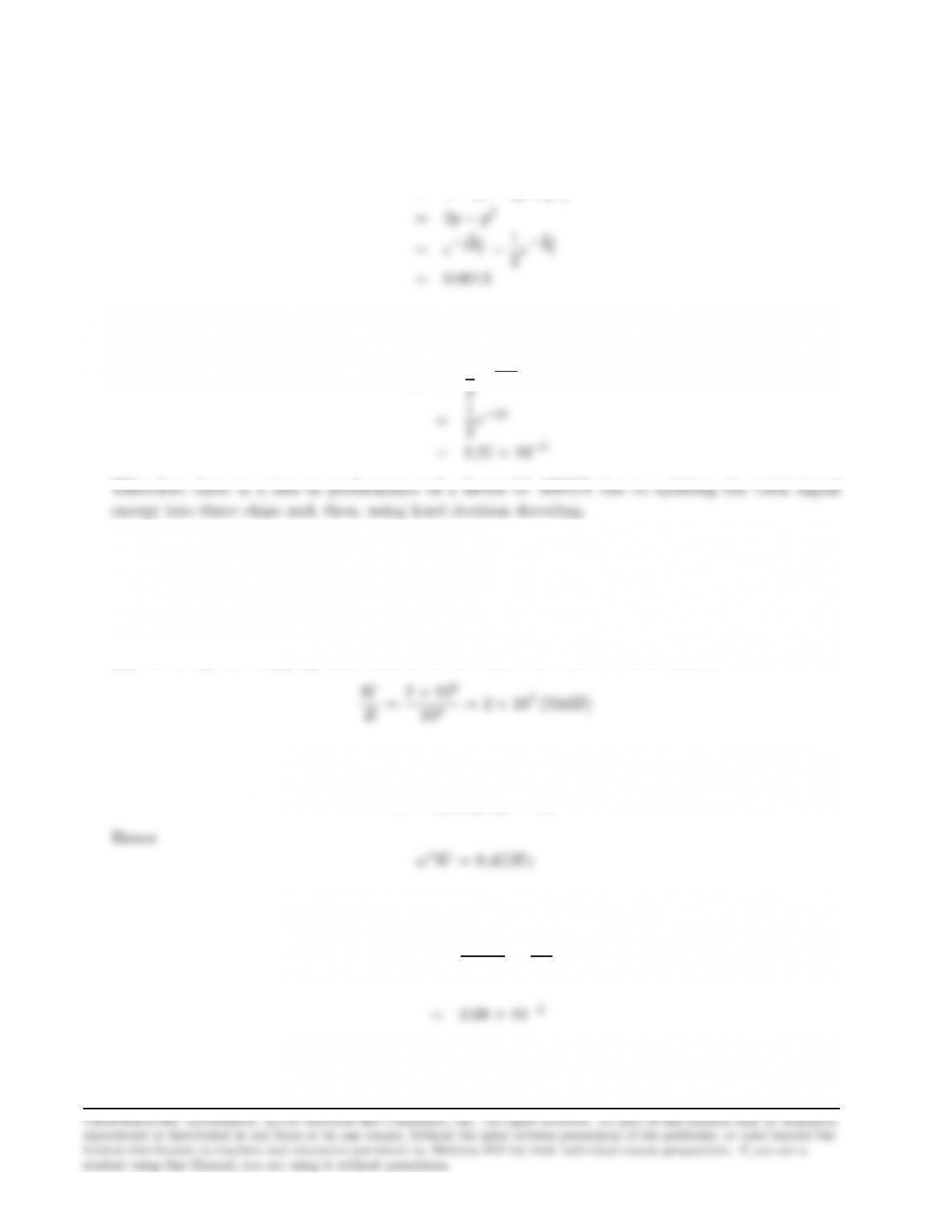
(a) The total SNR for three hops is 20 ∼13 dB.Therefore the SNR per hop is 20/3. The probability
of a chip error with noncoherent detection is
2N0
11
where Ec/N0= 20/3. The probability of a bit error is
Pb= 1 −(1 −p)2
= 1 −(1 −2p+p2)
b) In the case of one hop per bit, the SNR per bit is 20, Hence,
Pb=1
2N0
Problem 12.18
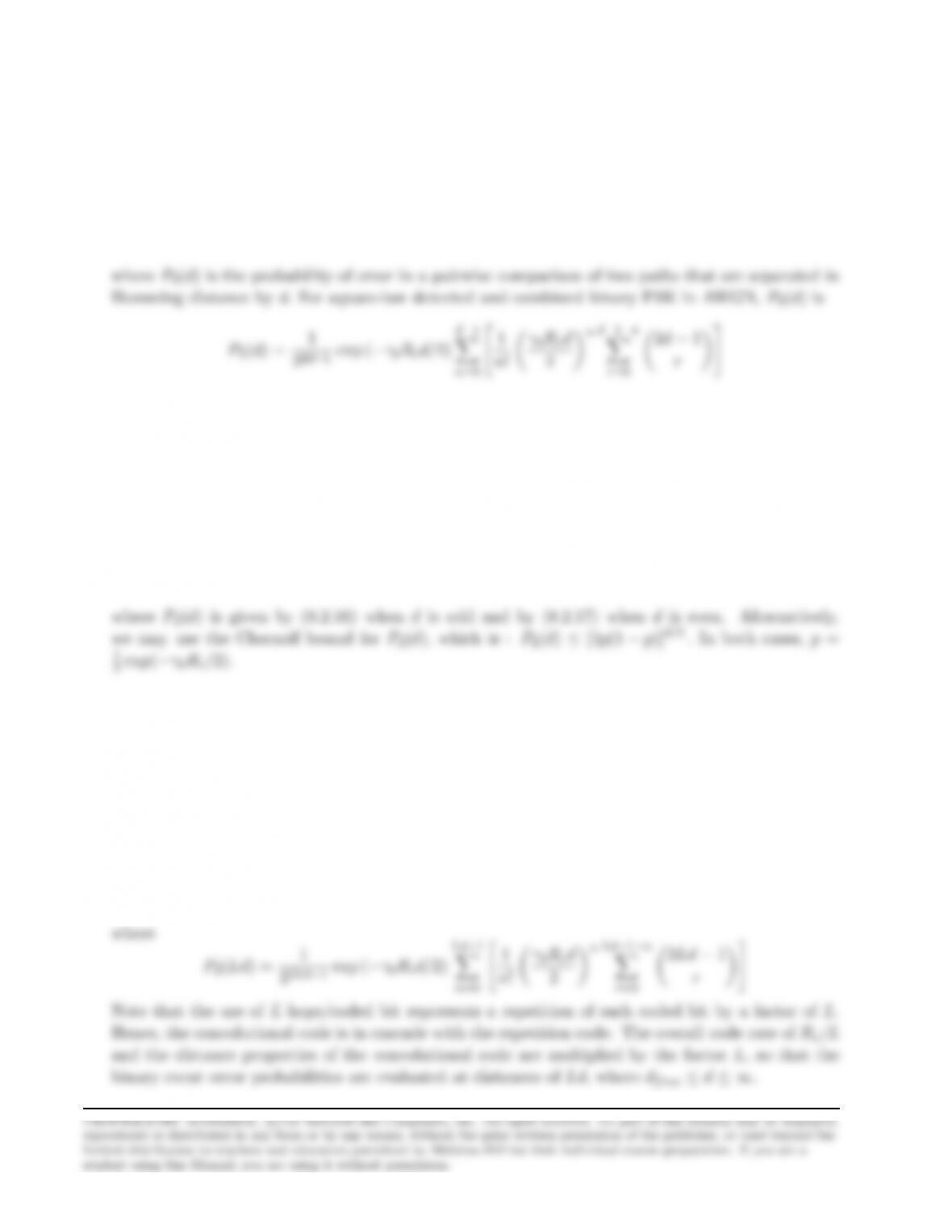
(a) We are given a hopping bandwidth of 2 GHz and a bit rate of 10 kbs. Hence,
(b) The bandwidth of the worst partial-band jammer is α∗W, where
α∗= 2/(Eb/J0) = 0.2
(c) The probability of error with worst-case partial-band jamming is
P2=e−1
(Eb/J0)=e−1
10
12
Problem 12.19
The error probability for the binary convolutional code is upper-bounded as
Pb≤
∞
X
d=df ree
βdP2(d)
n=0 “1
r=0 2d−1
Problem 12.20
For hard-decision Viterbi decoding of the convolutional code, the error probability is
Pb≤
∞
X
d=df ree
βdP2(d)
Problem 12.21
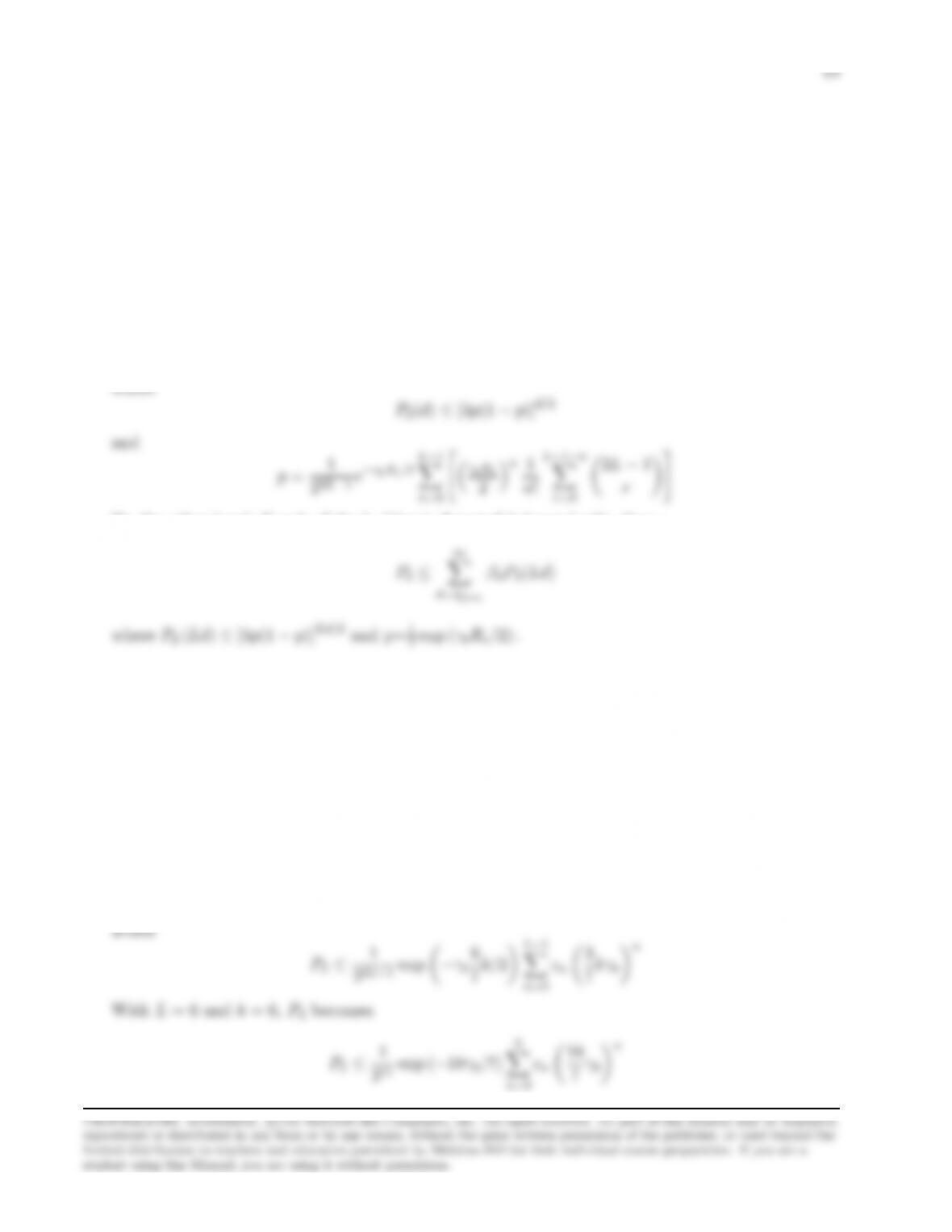
For fast frequency hopping at a rate of Lhopes/bit and for soft-decision decoding, the performance
of the binary convolutional code is upper bounded as
Pb≤
∞
X
d=df ree
βdP2(Ld)
Problem 12.22
For fast frequency hopping at a rate of Lhopes/bit and for hard-decision Viterbi decoding, the
performance of the binary convolutional code is upper bounded as
Pb≤
∞
X
d=df ree
βdP2(Ld)
n=0 “γbRc
r=0 2L−1
On the other hand, if each of the L chips is detected independently, then :
∞
X
Problem 12.23
There are 64 decision variables corresponding to the 64 possible codewords in the (7,2) Reed-
Solomon code. With dmin = 6,we know that the performance of the code is no worse than the
performance of an M= 64 orthogonal waveform set, where the SNR per bit is degraded by the
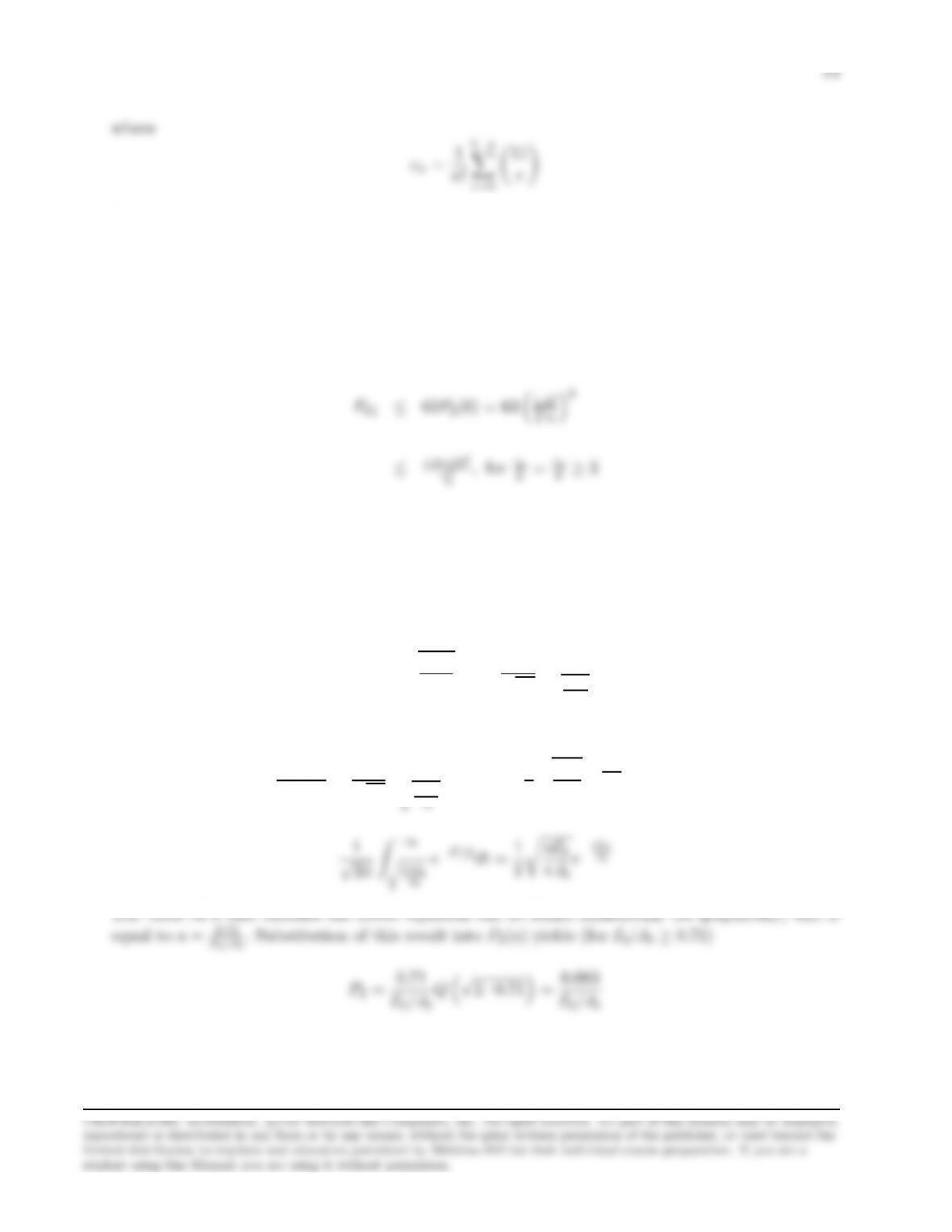
factor 6/7. Thus, an upper bound on the code word error probability is
P64 ≤(M−1)P2= 63P2
r=0 11
Problem 12.24
In the worst-case partial-band interference channel, the (7,2) Reed-Solomon code provides an ef-
fective order of diversity L= 6.Hence
b
Problem 12.25
P2(a) = aQ r2aEb
J0!=a1
√2πZ+∞
r2aEb
J0
e−t2/2dt
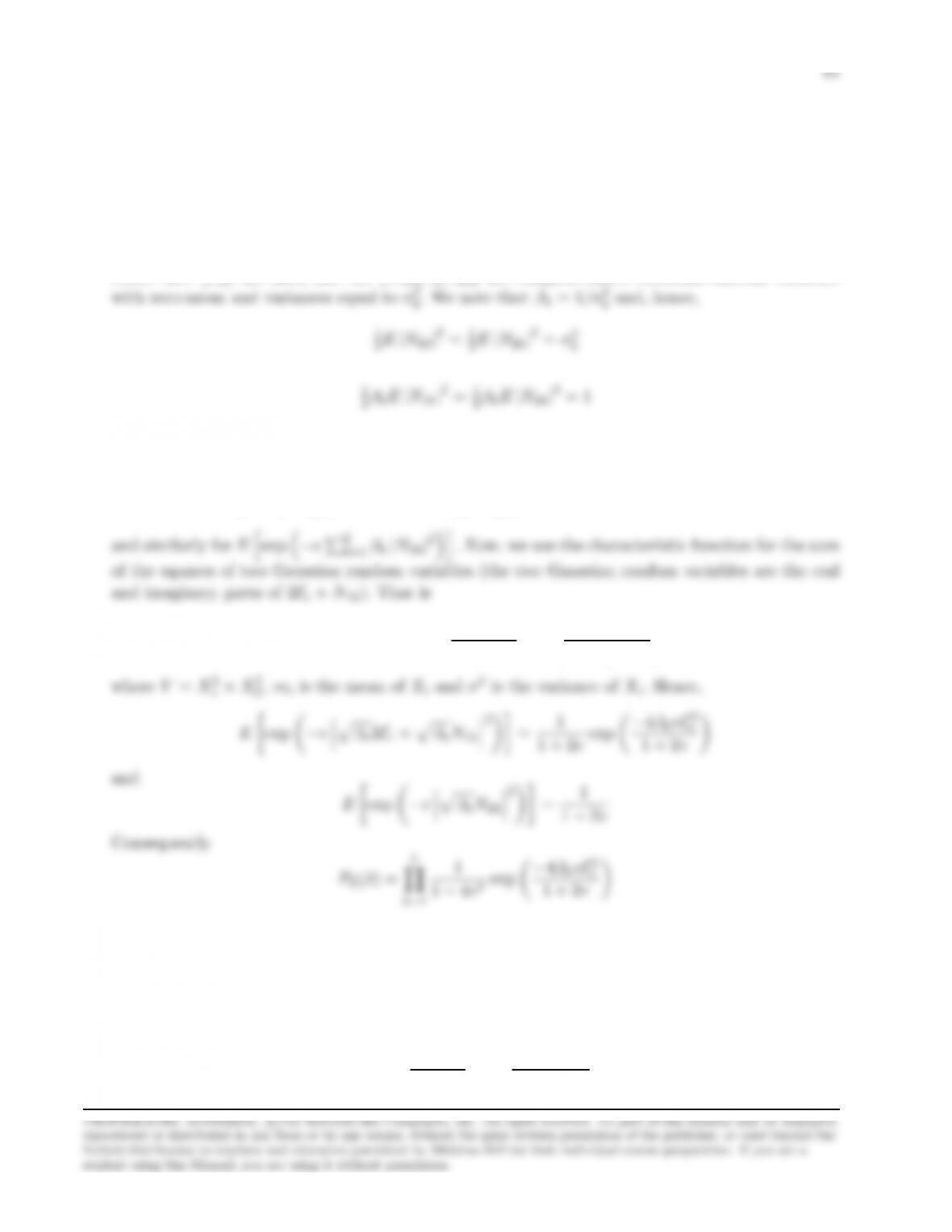
Hence, the maximum occurs when
dP2(a)
da =1
√2πZ+∞
r2aEb
J0
e−t2/2dt −1
2raEb
πJ0
e−aEb
J0= 0 ⇒
Problem 12.26
The problem is to determine
E“exp −v
L
X
k=1
βk|2Ec+N1k|2−v
L
X
k=1
βk|N2k|2!#
where thee {βk}are fixed and the {N1k},{N2k}are complex-valued Gaussian random variables
Since the {N1k},and {N2k}are all statistically independent
E“exp −v
L
X
k=1
βk|2Ec+N1k|2!#=
L
Y
k=1
Ehexp −vβk|2Ec+N1k|2i
ψY(ju) = EejuY =1
1−juσ2exp ju Pm
i=1 m2
i
1−juσ2
k=1
Problem 12.27
The function
f(v, a) = a
1−4v2exp −2avE2
c
J0(1 + 2v)L
16
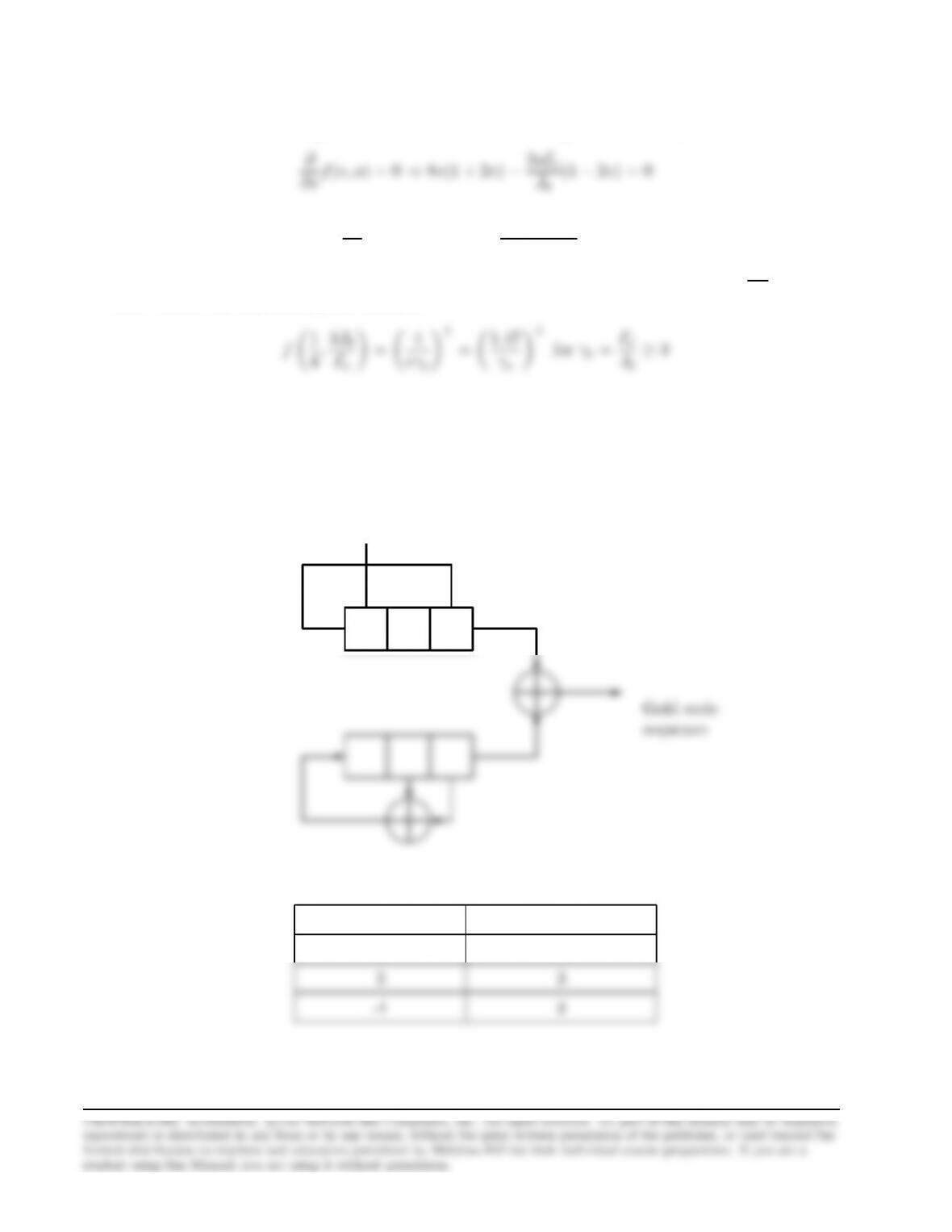
is to be minimized with respect to vand maximized with respect to a. Thus,
∂v f(v, a) = 0 ⇒8v(1 + 2v)−2aEc
J0
and ∂
∂af(v, a) = 0 ⇒1−2avEc
J0(1 + 2v)= 0
The simultaneous solution of these two equations yields the result v= 1/4 and a=3J0
Ec≤1.For
these values, the function f(v, a) becomes
Problem 12.28
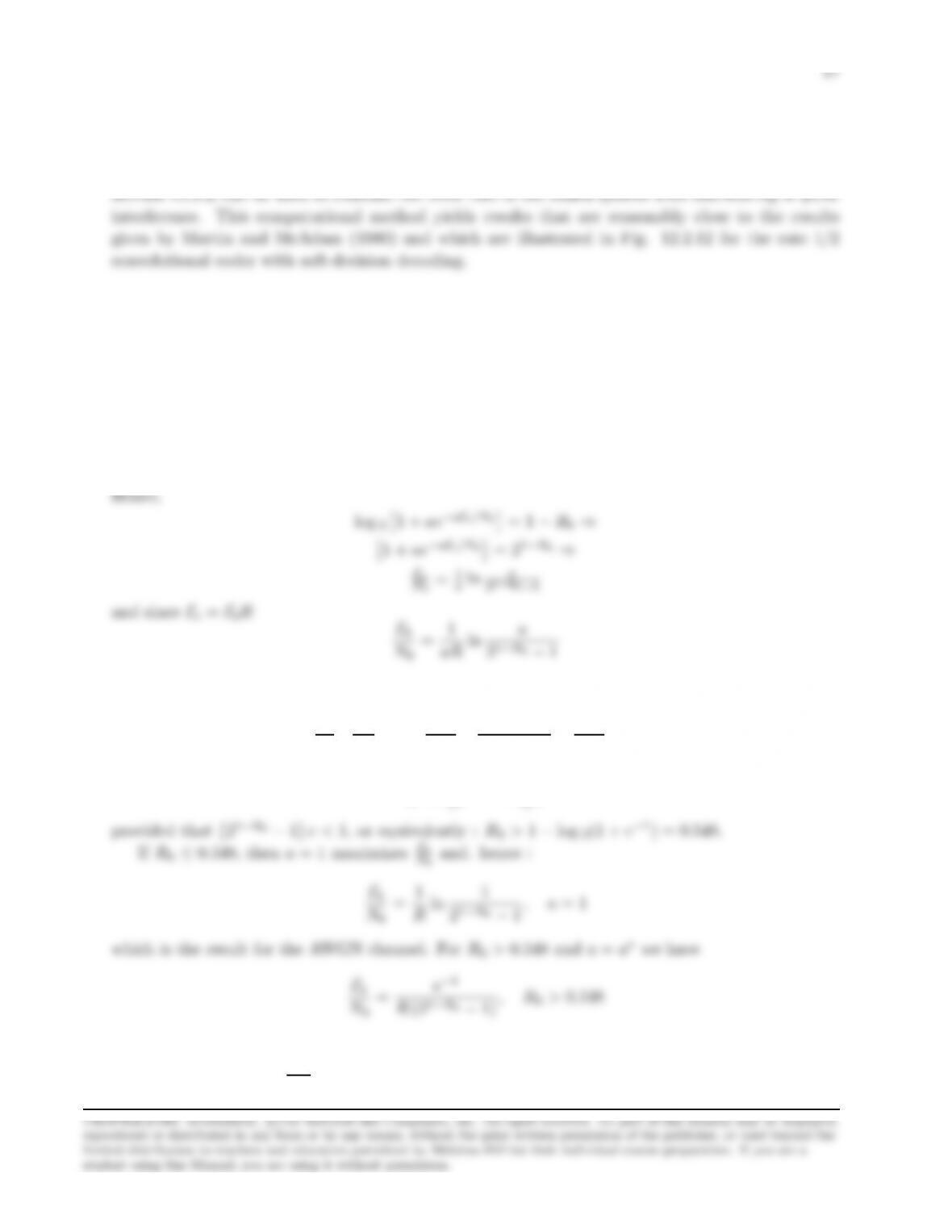
The Gold code sequences of length n= 7 may be generated by the use of two feedback shift registers
of length 4 as shown below
?
–
6
–
These sequences have the following cross-correlation values
Values of correlation Frequency of this value
-5 1
Problem 12.29
The method of Omura and Levitt (1982) based on the cut-off rate R0,which is described in
Problem 12.30
(a) For the coded and interleaved DS binary PSK modulation with pulse jamming and soft-decision
decoding, the cutoff rate is
R0= 1 −log 2h1 + ae−aEc/N0i
(b)
d
da Eb
N0=−1
a2Rln a
21−R0−1+1
a2R= 0
Hence, the worst-case ais
a∗=21−R0−1e
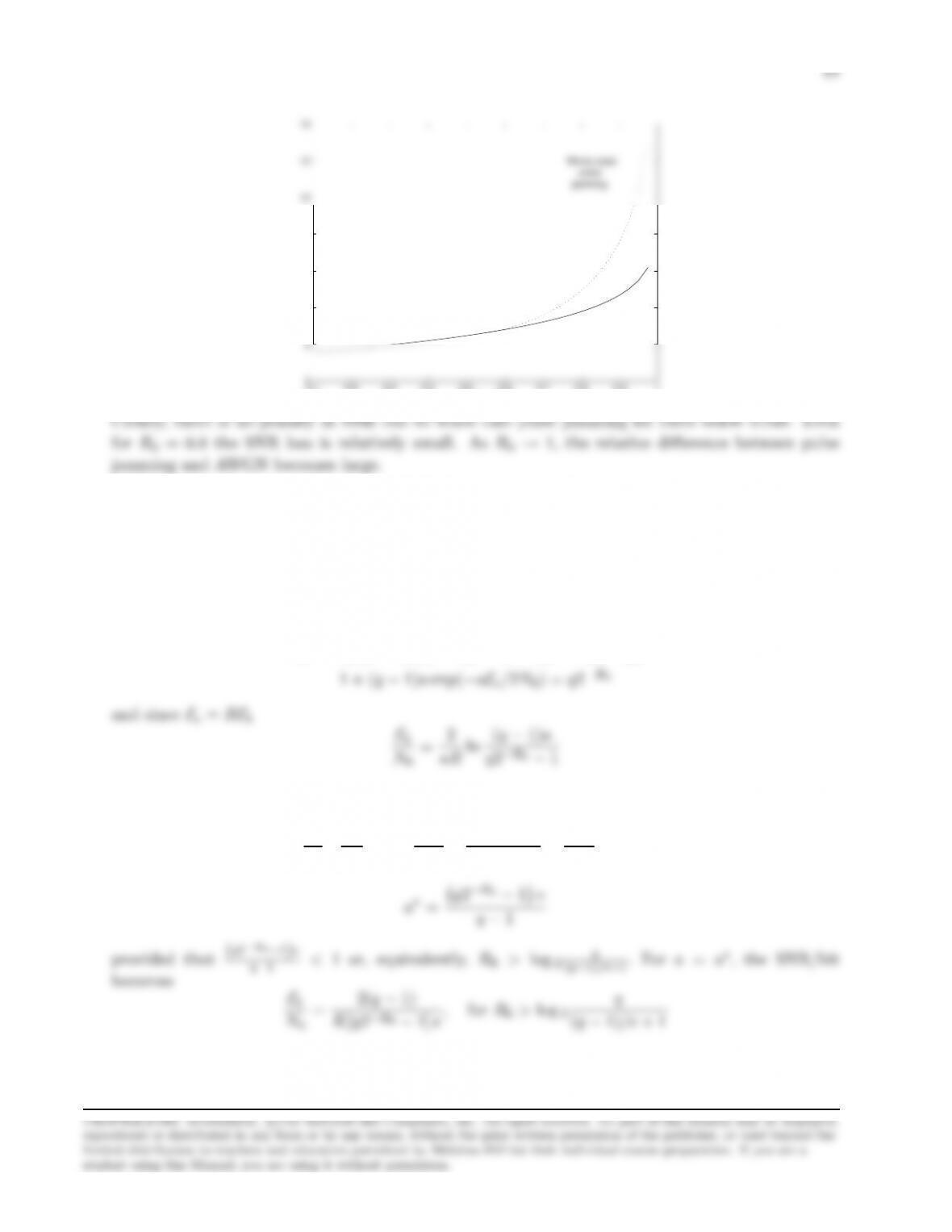
(c) The plot of 10 log Eb
rN0versus R0,is given in the following figure:
0.1 0.2 0.3 0.4 0.5 0.6 0.7 0.8 0.9 1
0
2
4
6
8
10
12
14
Cut−off rate R0
10log(Eb/rN)
AWGN
Worst−case
pulse
jamming
Clearly, there is no penalty in SNR due to worst case pulse jamming for rates below 0.548. Even
for R0= 0.8 the SNR loss is relatively small. As R0→1,the relative difference between pulse
jamming and AWGN becomes large.
Problem 12.31
(a)
R0= log 2q−log 2[1 + (q−1)aexp(−aEc/2N0)] ⇒
(b)
d
da Eb
N0=−2
a2Rln (q−1)a
q2−R0−1+2
a2R= 0 ⇒
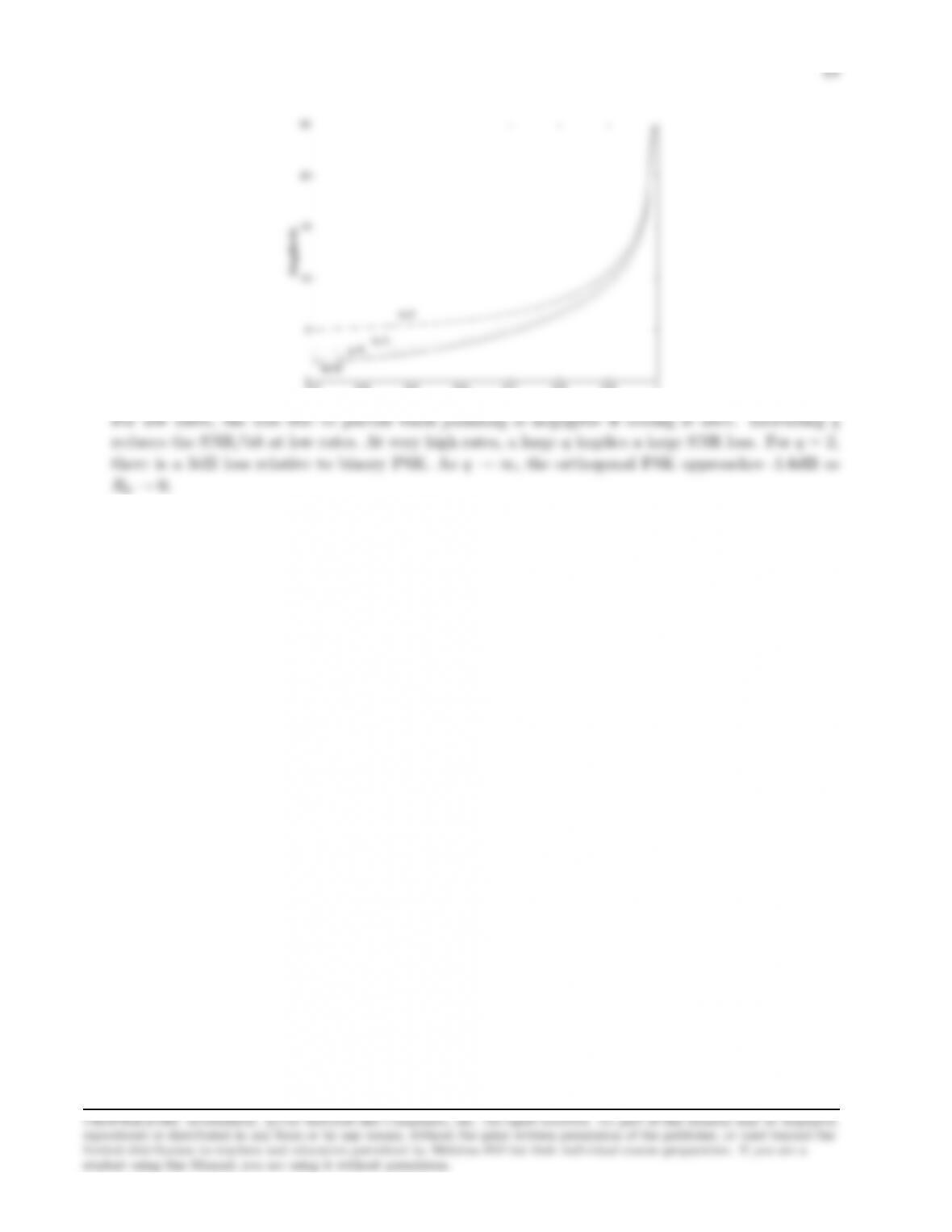
(c) The plots are given in the following figure
0.3 0.4 0.5 0.6 0.7 0.8 0.9 1
0
5
10
15
20
25
R0/log2(q)
10log(Eb/rN)
q=2
q=4
q=32
q=8
For low rates, the loss due to partial band jamming is negligible if coding is used. Increasing q
reduces the SNR/bit at low rates. At very high rates, a large qimplies a large SNR loss. For q= 2,
there is a 3dB loss relative to binary PSK. As q→ ∞,the orthogonal FSK approaches -1.6dB as
R0→0.