Solutions Manual
for
Digital Communications, 5th Edition
(Chapter 11) 1
Prepared by
Kostas Stamatiou
January 15, 2008
Problem 11.1
(a)
U=
N
X
n=1
Xn
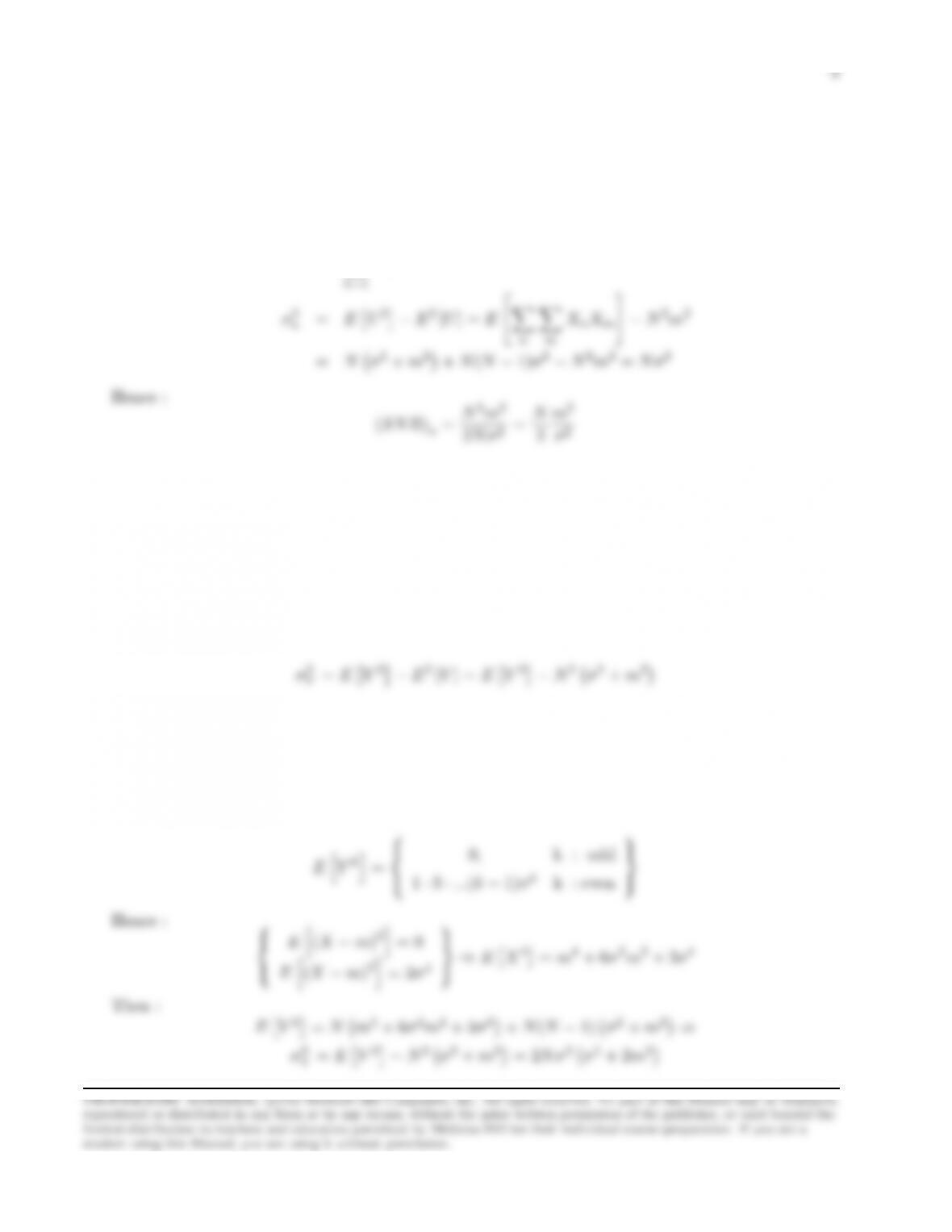
E[U] =
N
X
E[Xn] = Nm
(b)
V=
N
X
n=1
X2
n
E[V] =
N
X
n=1
EX2
n=Nσ2+m2
For the variance of Vwe have :
But :
EV2=X
nX
m
EX2
nX2
m=
N
X
n=1
X4
n+X
nX
m,n6=m
EX2
nEX2
m=NE X4+N(N−1)E2X2
To compute EX4we can use the fact that a zero-mean Gaussian RV Yhas moments :
0,k : odd
3
Note : the above result could be obtained by noting that Vis a non-central chi-square RV, with
N degrees of freedom and non-centrality parameter equal to Nm2; then we could apply directly
expression (2-3-40). Having obtained σ2
V,we have :
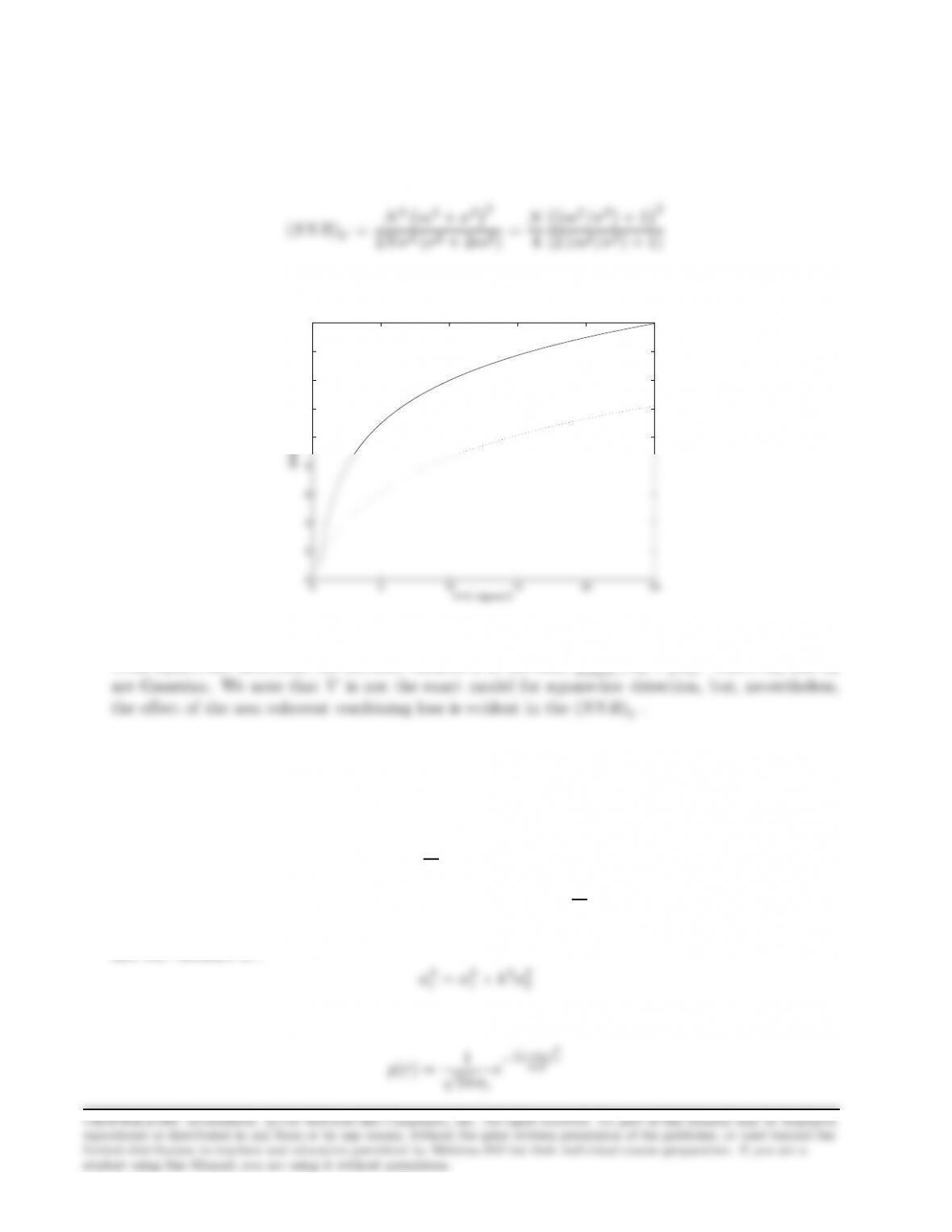
(c) The plot is given in the following figure for N=5 :
0 5 10 15 20 25
0
2
4
6
8
10
12
14
16
18
m^2 / sigma^2
SNR(db)
SNR(U)
SNR(V)
(d) In multichannel operation with coherent detection the decision variable is Uas given in (a).
With square-law detection, the decision variable is of the form PN
Problem 11.2
(a) ris a Gaussian random variable. If √Ebis the transmitted signal point, then :
E(r) = E(r1) + E(r2) = (1 + k)pEb≡mr
and the variance is :
The probability density function of ris
2σ2
4
and the probability of error is :
P2=Z0
p(r)dr
r
The value of kthat maximizes this ratio is obtained by differentiating this expression and solving
for the value of kthat forces the derivative to zero. Thus, we obtain
k=σ2
1
σ2
2
m2
r
σ2
r
=(1 + 1
3)2Eb
σ2
1+1
9(3σ2
1)=4
3Eb
σ2
1
On the other hand, if kis set to unity we have
PROPRIETARY MATERIAL. c
The McGraw-Hill Companies, Inc. All rights reserved. No part of this Manual may be displayed,
reproduced or distributed in any form or by any means, without the prior written permission of the publisher, or used beyond the
limited distribution to teachers and educators permitted by McGraw-Hill for their individual course preparation. If you are a
student using this Manual, you are using it without permission.
Problem 11.3
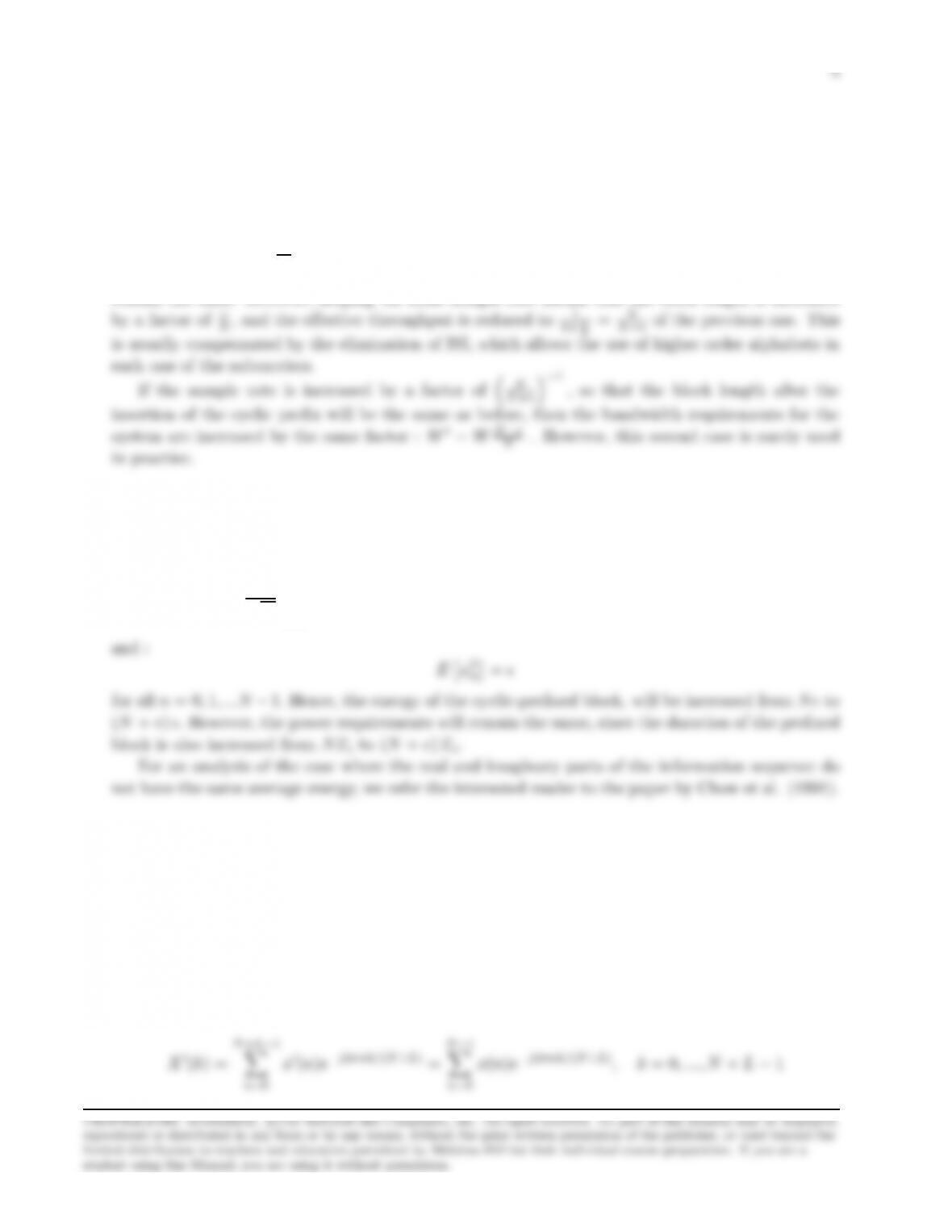
(a) If the sample rate 1
Ts=˜
N·∆f=W, does not alter with the insertion of the cyclic prefix (which
indeed is the case in most multicarrier systems), then the bandwidth requirements for the system
remain the same. However, keeping the same sample rate means that the block length is increased
(b) If the real and imaginary parts of the information sequence {Xk}have the same average energy
:E[Re(Xk)]2=E[Im(Xk)]2,then it is straightforward to prove that the time-domain samples
{xn}, that are the output of the IDFT, have the same average energy:
xn=1
√N
N−1
X
k=0
(Re(Xk) + j·Im(Xk)) exp(j2πnk/N), n = 0,1, …, N −1
Problem 11.4
X(k) =
N−1
X
n=0
x(n)e−j2πnk/N , k = 0, ..., N −1
and for the padded sequence :
N+L−1
X
N−1
X
6
where we have used the fact that : x′(n) = 0, n =N, N + 1, …, N +L−1.We have also chosen to
use the traditional definition of the DFT (without a scaling factor in front of the sum). Then:
N−1
X
n=0
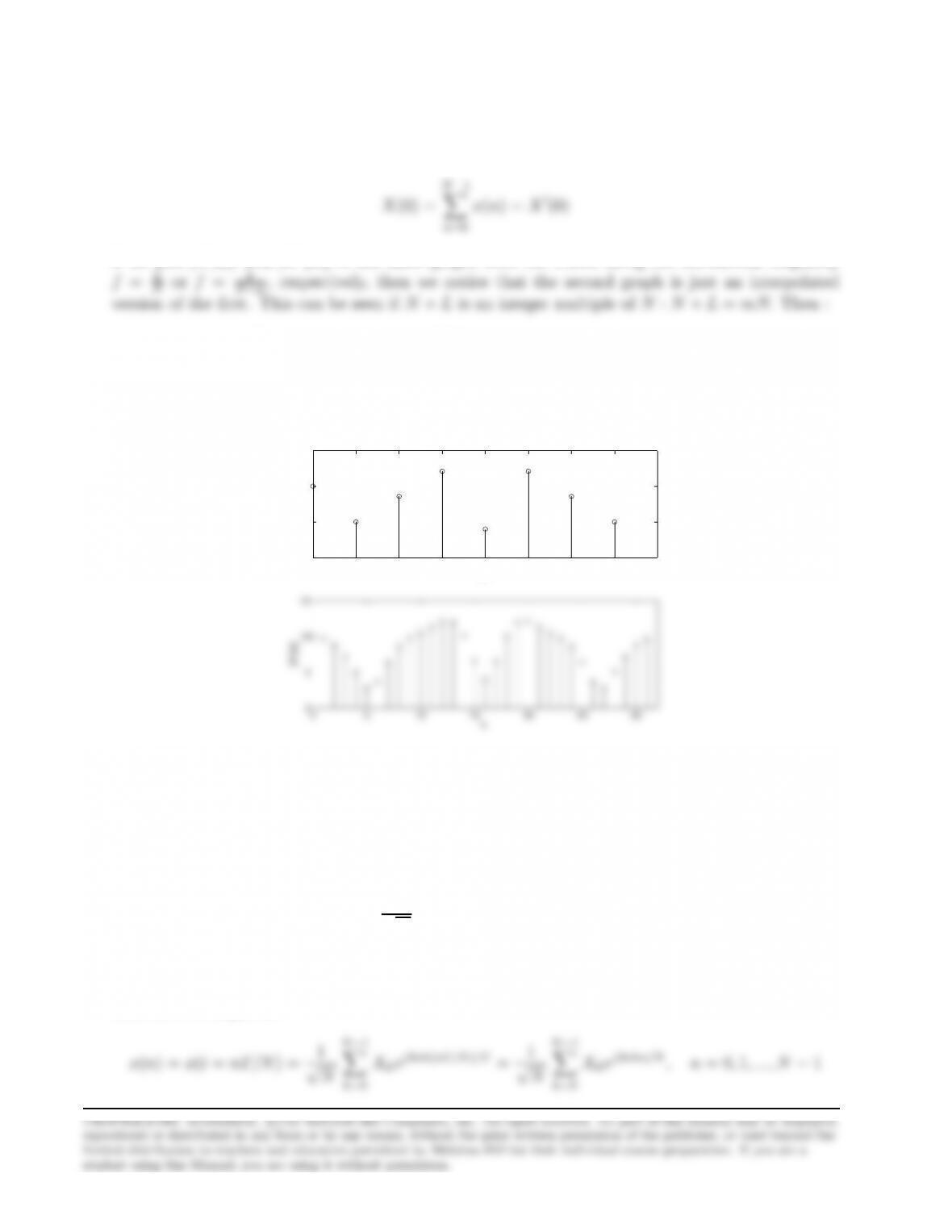
If we plot |X(k)|and |X′(k)|in the same graph, with the x-axis being the normalized frequency
X′(mk) =
N−1
X
n=0
x(n)e−j2πnmk/mN =
N−1
X
n=0
x(n)e−j2πnk/N =X(k), k = 0,1, …N −1
This is illustrated in the following plot, for a random sequence x(n), of length N= 8, which is
padded with L= 24 zeros.
0 5 10 15 20 25 30
0
5
10
15
k
|X”(k)|
012345678
0
5
10
15
k
|X(k)|
Problem 11.5
The analog signal is :
x(t) = 1
√N
N−1
X
k=0
Xkej2πkt/T ,0≤t < T
The subcarrier frequencies are : Fk=k/T, k = 0,1, … ˜
N , and, hence, the maximum frequency
in the analog signal is : ˜
N/T. If we sample at the Nyquist rate : 2 ˜
N/T =N/T, we obtain the
discrete-time sequence :
N−1
X
N−1
X
7
Problem 11.6
The reseting of the filter state every Nsamples, is equivalent to a filter with system function :
Hn(z) = 1−z−N
1−exp(j2πn/N)z−1
We will make use of the relationship that gives the sum of finite geometric series : PN−1
k=0 ak=1−aN
1−a.
Using this we can re-write each system function Hn(z) as :
N−1
X
Problem 11.7
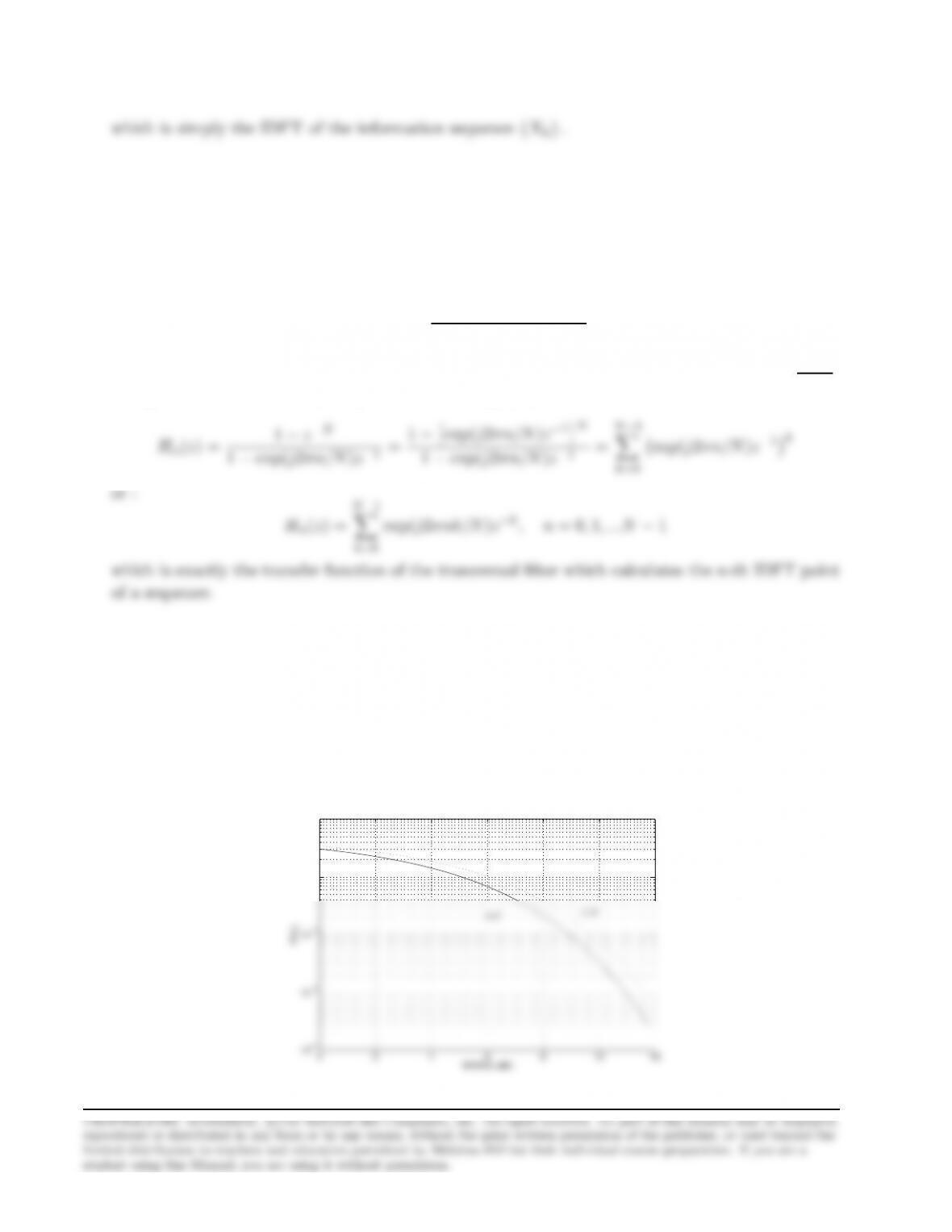
We assume binary (M= 2) orthogonal signalling with square-law detection (DPSK signals wil have
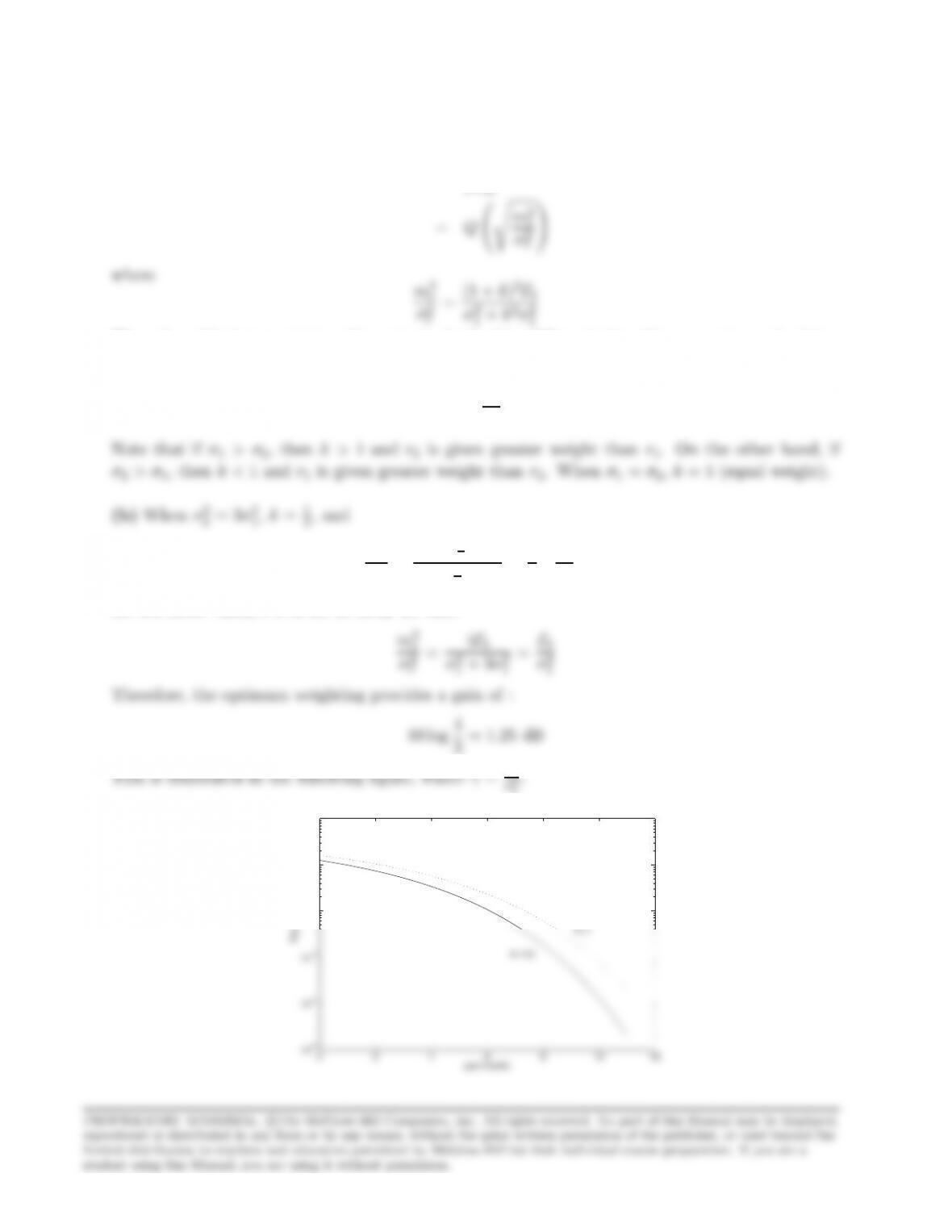
the same combining loss). Using (11-1-24) and (11-1-14) we obtain the following graph for P2(L),
where SNR/bit =10log10γb:
0 2 4 6 8 10 12
10−4
10−3
10−2
10−1
100
SNR/bit (dB)
P2(L)
L=1 L=2
PROPRIETARY MATERIAL. c
The McGraw-Hill Companies, Inc. All rights reserved. No part of this Manual may be displayed,
reproduced or distributed in any form or by any means, without the prior written permission of the publisher, or used beyond the
limited distribution to teachers and educators permitted by McGraw-Hill for their individual course preparation. If you are a
student using this Manual, you are using it without permission.