Which of the following activities create a negative externality?
A) cleaning up the sidewalk on your block
B) graduating from college
C) repainting the house you live in to improve its appearance
D) keeping a junked car parked on your front lawn
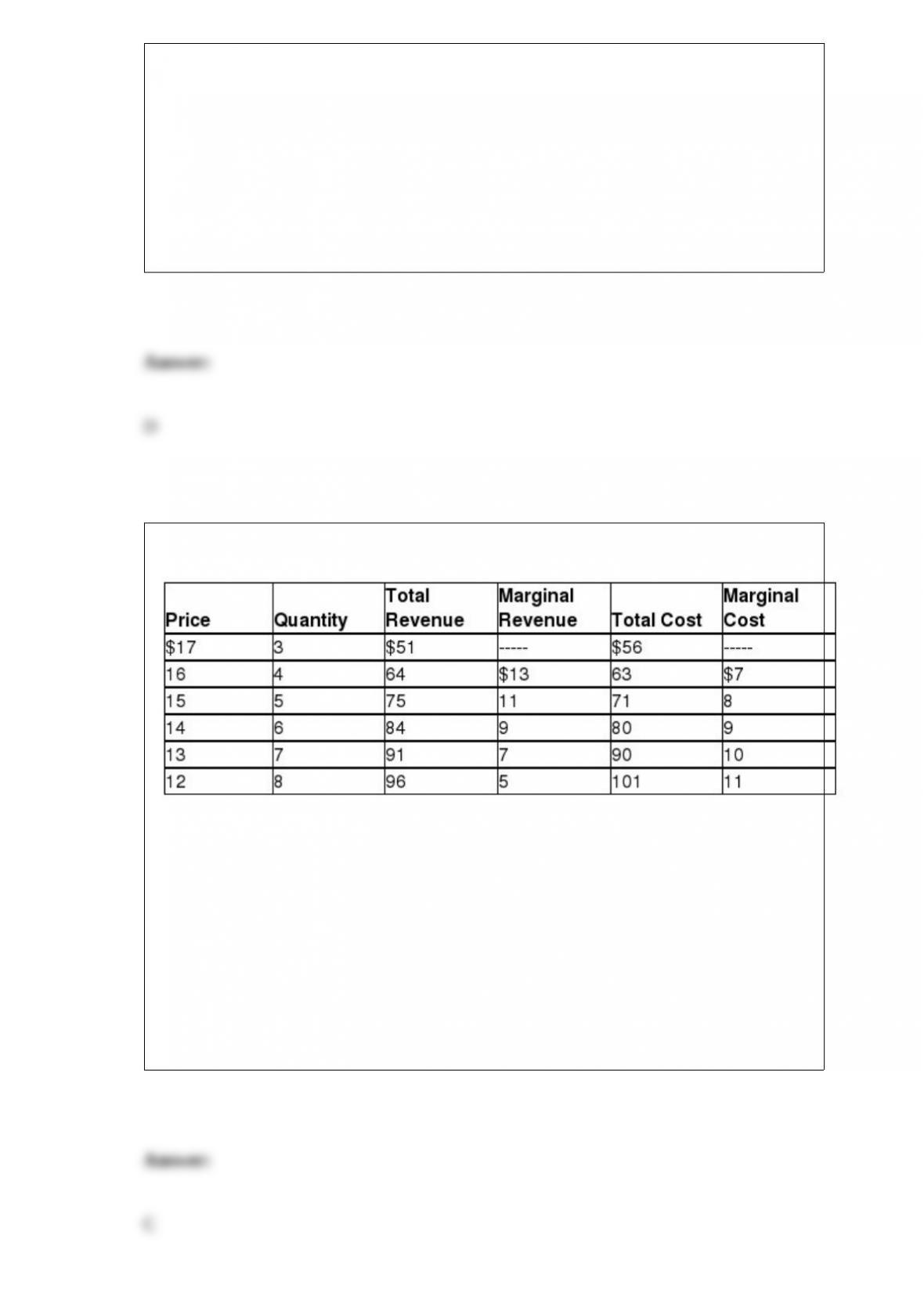
Table 15-3
Assume Table 15-3 gives the monthly demand and costs for subscriptions to basic cable
for Comcast, a cable television monopoly in Philadelphia. If Comcast maximizes its
profits how much profit will it earn?
A) $84
B) $40
C) $4
D) Comcast will break even.

According to the quantity theory of money, inflation is caused by
A) the money supply growing slower than real GDP.
B) GDP growing faster than the money supply.
C) GDP growing at the same rate as the money supply.
D) the money supply growing faster than real GDP.
The Business Cycle Dating Committee, a part of the ________, officially decides when
a recession begins and ends.
A) federal government
B) Bureau of Labor Statistics
C) National Bureau of Economic Research
D) Federal Reserve
The increase in the amount that the government collects in taxes when the economy
expands and the decrease in the amount that the government collects in taxes when the
economy goes into a recession is an example of
A) automatic stabilizers.

B) discretionary fiscal policy.
C) discretionary monetary policy.
D) automatic monetary policy.
Which of the following determines the amount of money the banking system as a whole
can create?
A) the quantity of bank reserves
B) the quantity of vault cash held by banks
C) the gold reserves held by the Federal Reserve
D) the limit on profits by banks imposed by the U.S. Congress
Which of the following would cause an increase in the equilibrium wage?
A) The supply of labor increases more than the demand for labor.
B) The supply of jobs increases more than the demand for jobs.
C) The demand for labor increases faster than the supply of labor.
D) The supply of labor increases and the demand for labor decreases.

Barbara, the consummate hostess, proudly announced as she served dessert, “A port is
often the perfect end to a meal, sipped with a piece of my scrumptious chocolate cake.”
Evidently, Barbara views
A) port and chocolate cake as luxury items.
B) port and chocolate cake as necessities.
C) port and chocolate cake as complementary goods.
D) port and chocolate cake as substitutes to other desserts.
If a decrease in income leads to an increase in the demand for macaroni, then macaroni
is
A) an inferior good.
B) a neutral good.
C) a necessity.
D) a normal good.
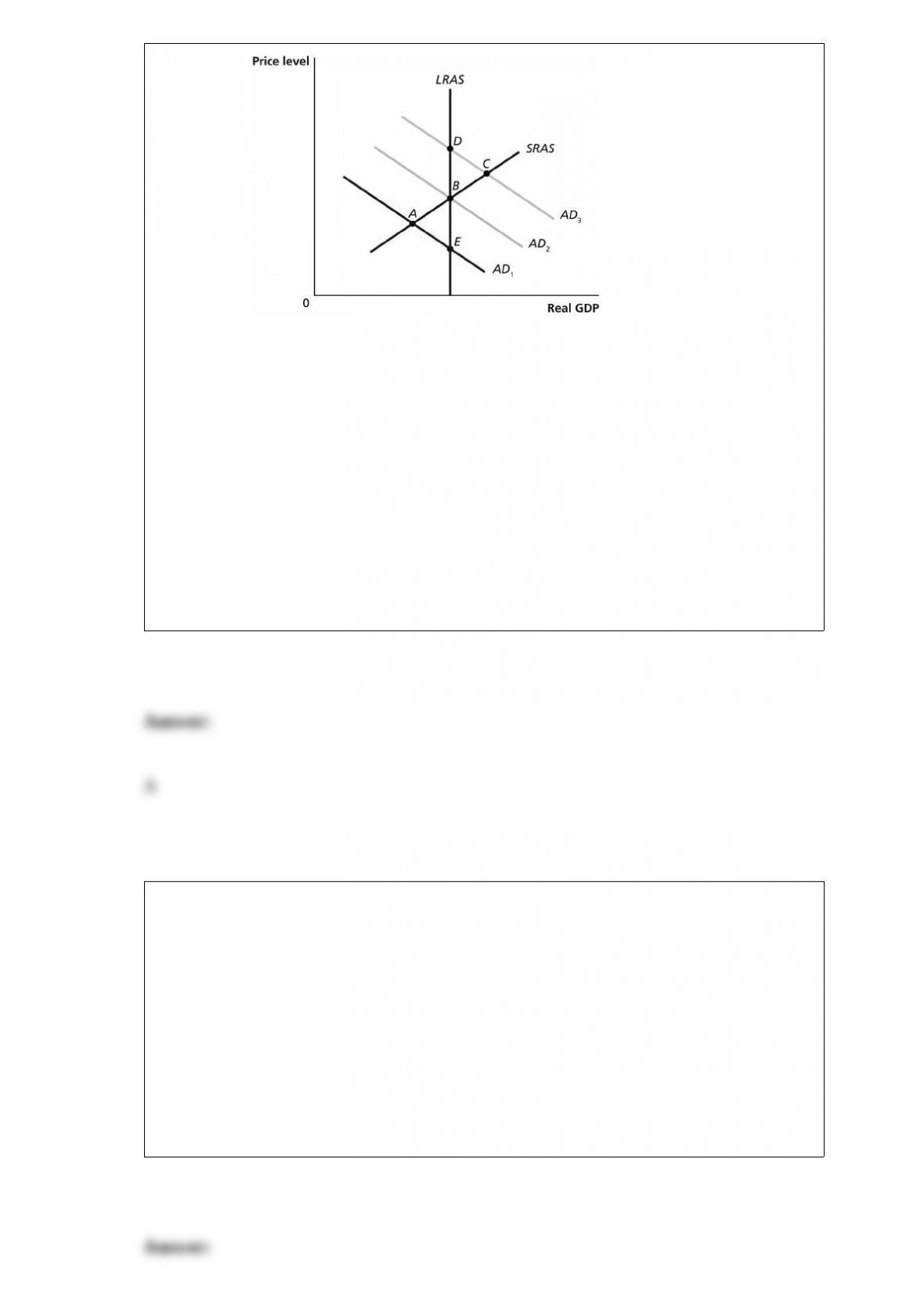
Figure 26-7
Suppose the Fed lowers its target for the federal funds rate. Using the static AD–AS
model in the figure above, this situation would be depicted as a movement from
A) A to B.
B) B to A.
C) C to B.
D) E to A.
E) C to D.
Suppose you withdraw $500 from your checking account deposit and bury it in a jar in
your back yard. If the required reserve ratio is 10 percent, checking account deposits in
the banking system as a whole could drop up to a maximum of
A) $0.
B) $50.
C) $500.
D) $5,000.

Recessions cause the unemployment rate to ________ and the inflation rate to
________.
A) rise; rise
B) rise; fall
C) fall; rise
D) fall; fall
Which of the following is motivated by an equity concern?
A) Some states have transferred funds to food bank programs in order to increase
benefits to lower-income families.
B) Following the implementation of subsidies for energy conservation, household
demand for rooftop solar panels increased quite significantly in California.
C) The United Network for Organ Sharing advocates a system of rationing scarce
kidneys that would favor young patients over old in an effort to wring more life out of
donated organs.
D) The United States offers patent protection to pharmaceutical manufacturers to
prevent others from duplicating their products.

Which of the following statements is true?
A) An increase in supply causes a change in equilibrium price; the change in price does
not cause a further change in demand or supply.
B) A decrease in supply causes equilibrium price to rise; the increase in price then
results in a decrease in demand.
C) If both demand and supply increase, there must be an increase in equilibrium price;
equilibrium quantity may either increase or decrease.
D) If demand decreases and supply increases, one cannot determine if equilibrium price
will increase or decrease without knowing which change is greater.
All of the following are true statements about the multiplier except
A) The formula for the multiplier overstates the real world multiplier when we take into
account the impact of changes in GDP on imports, inflation and the interest rate.
B) The larger the MPC, the larger the multiplier.
C) The multiplier is the ratio of the change in real GDP to the change in autonomous
expenditure.
D) The multiplier makes the economy less sensitive to changes in autonomous
expenditure.
Table 17-1
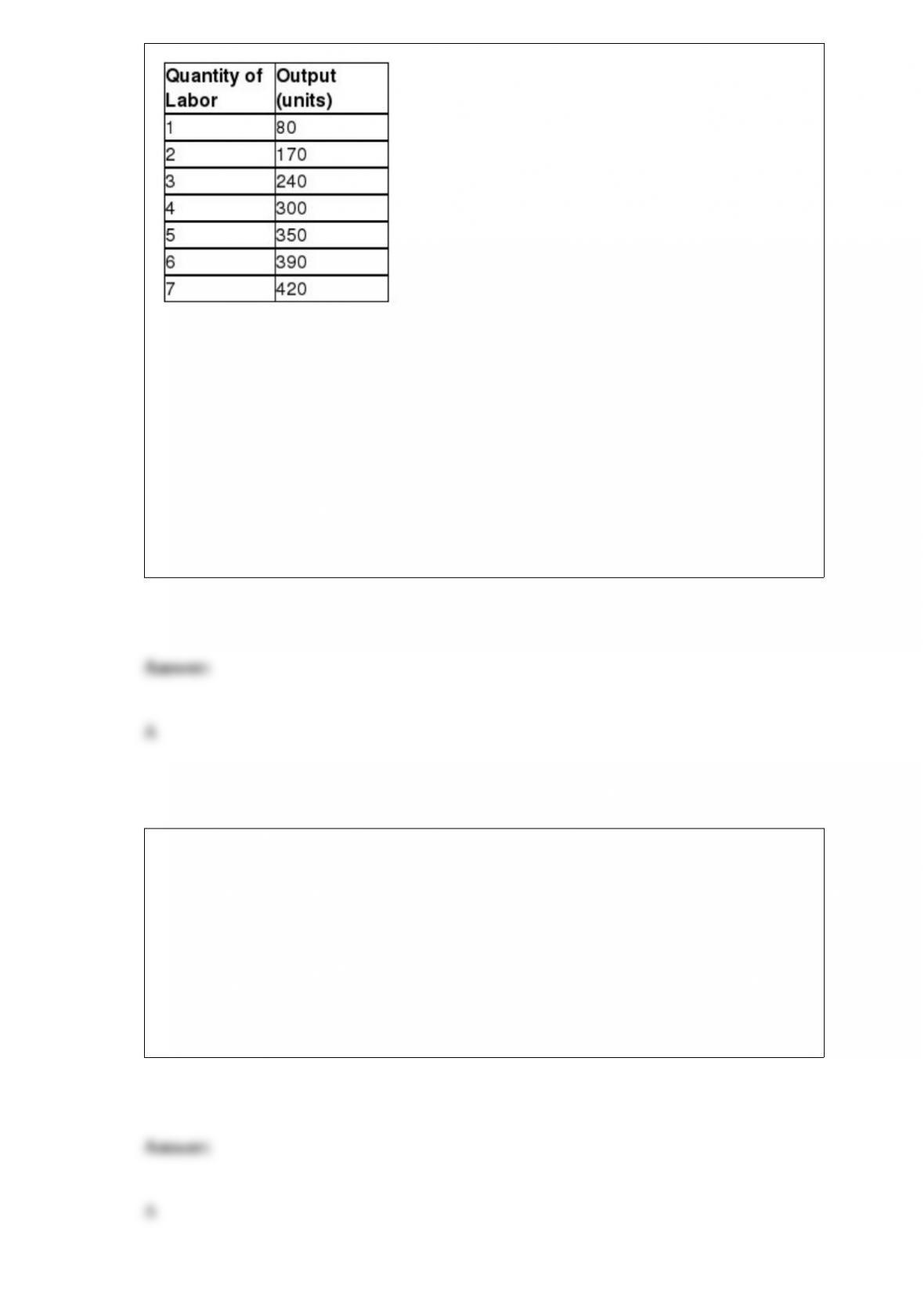
Suppose the output price is $3. If the wage rate is $90, what is the profit-maximizing
quantity of labor that the firm should hire?
A) 7 units
B) 5 units
C) 4 units
D) 3 units
If foreign holdings of U.S. dollars increase, holding all else constant,
A) the balance on the U.S. financial account will increase.
B) the balance on the U.S. current account will increase.
C) the balance on the U.S. capital account will increase.
D) the U.S. balance of trade will increase.

What is the trade-off that consumers face when buying the product of a
monopolistically competitive firm?
A) Consumers pay higher prices but receive better quality goods compared to the output
of perfectly competitive firms.
B) Consumers pay a price greater than marginal cost, but have the luxury of choices
more suited to their tastes.
C) Consumers pay higher prices but the products are produced by highly efficient firms.
D) Consumers pay lower prices but have fewer choices.