Chapter 43: The Physical Examination and Patient History
MATCHING
Match the following terms with the correct definition.
a.
to open
b.
difficulty breathing
c.
irregular or abnormal heart beat
d.
patient name, age, gender, species
e.
assessment of each body system
f.
wheezing sound like musical note
g.
swishing sound of the heart
h.
background information on the life of the animal
i.
the reason the animal is being seen by the vet
j.
inspection of an animal at a distance
k.
shrinking of the muscle due to no use
l.
to listen to the heart and lungs
m.
to close
1. atrophy
2. chief complaint
3. auscultation
4. observation
5. dyspnea
6. dilate
7. patient history
8. constrict
9. rales
10. signalment
Match the following terms with the correct definition.
a.
signalment
m.
arrthymia
b.
oral cavity
n.
dilate
c.
knee jerk reaction
o.
atrophy
d.
toe pinch response
p.
triage
e.
murmur
q.
patient history
f.
constrict
r.
crackles
g.
alopecia
s.
auscultation
h.
rales
t.
dysnea
i.
observation
u.
integumentary
j.
head exam
v.
chief complaint
k.
hydration status
w.
nervous system
l.
urogenital system
x.
wheel barrow technique
11. area of hair loss
12. slightly lifting the animal’s hind end off the ground and pushing the bodyforward in a
motion to assess the nervous system
13. the patient’s name, age or date of birth, gender, color, and breed or species
14. includes the kidneys, urinary bladder, external genitals, mammary glands, and rectal area
15. abnormal heart beat
16. to open
17. abnormal sounds within the chest that sound like cellophane paper
18. process of listening, with a stethoscope, to the heart, chest, and lungs for any abnormal sounds
19. the shrinking of the muscle when it is not being used
20. includes examining the eyes, ears, and nose
21. area evaluated over the neck and shoulders, eye sockets and gums to determine how much
water loss has occurred
22. to close
23. background information of past medical, surgical, nutritional, and behavioral factors that have
occurred over the life of the animal
24. difficulty breathing
25. the reason the animal is being seen by the veterinarian
26. includes the skin, hair, pads, horns, beak, nails, hooves, and feathers
27. a quick general assessment of an animal to determine how quickly the animal needs a
veterinarian’s attention
28. abnormal heart sound that produces a swishing sound
29. includes the gums, mouth, teeth, tongue, and throat.
30. an inspection of an animal at a distance to see what it looks like, acts like, or how it moves
naturally
31. assessment of the brain and spinal cord through the response of pupil reflexes and the gait, as
well as other body reflexes such as limbs, paws and digits
32. abnormal sounds within the chest that sound like musical notes
COMPLETION
1. The __________________ is a tool used to tap areas of the body in order to determine
responses to the nervous system.
2. A scale or tape is used to determine the ________________________ of an animal.
3. A or an ______________________ is used to evaluate the ears and nasal cavity.
4. A normal CRT is ____ to ____ seconds.
5. The __________________ pulse should be evaluated on the limb of animals.
6. The oral exam is used to determine ________________, ______________, or
_____________________.
7. The ________________________ system includes feathers and hooves.
8. The _________________________ is listening to the heart and lungs.
9. The hydration status of animals is obtained from the _________________________ or
elasticity of the skin.
10. The abdomen should be _____________________ or felt with gentle pressure.
11. Insulin is normally produced by the _____________________.
MULTIPLE CHOICE
1. Which of the following is true about recording the physical exam?
a.
Wear exam gloves to record in the medical chart
b.
Complete the medical PE noted after working with the animal and
discarding the exam gloves
c.
Use pencil to note all PE skills
d.
Record information as you go
2. Which of the following is the typical time a thermometer needs to be in the rectum until
reading?
a.
1 minute
c.
60 seconds
b.
30 seconds
d.
both A and C
3. Which of the following is NOT felt within an abdominal palpation?
a.
feces
c.
mass
b.
pregnancy
d.
all of the above are palpable
4. Which of the following is a term for hair loss?
a.
alopecia
c.
anastomosis
b.
anorexia
d.
atrophy
5. Which of the following assessments uses the reflex hammer?
a.
wheelbarrow technique
c.
toe pinch response
b.
knee jerk reaction
d.
none of the above
6. Which of the following is the definition of arrthymia?
a.
difficulty breathing
c.
abnormal heart beat
b.
swishing sound within the heart
d.
sound of cellophane within the heart
7. Which of the following is also the heart rate?
a.
temperature
c.
respiration
b.
pulse
d.
weight
8. Which of the following is examined to determine the CRT?
a.
lips
c.
gums
b.
tongue
d.
eyes
9. Which of the following is NOT a cause of stress?
a.
change in diet
c.
infectious disease
b.
change in environment
d.
all of the above cause stress
TRUE/FALSE
1. Feathers are not part of the integumentary system.
2. The pupils should constrict when light is placed within them.
3. The lips should be lifted first when evaluating the oral cavity.
4. Livestock are too large to be weighed on a scale.
SHORT ANSWER
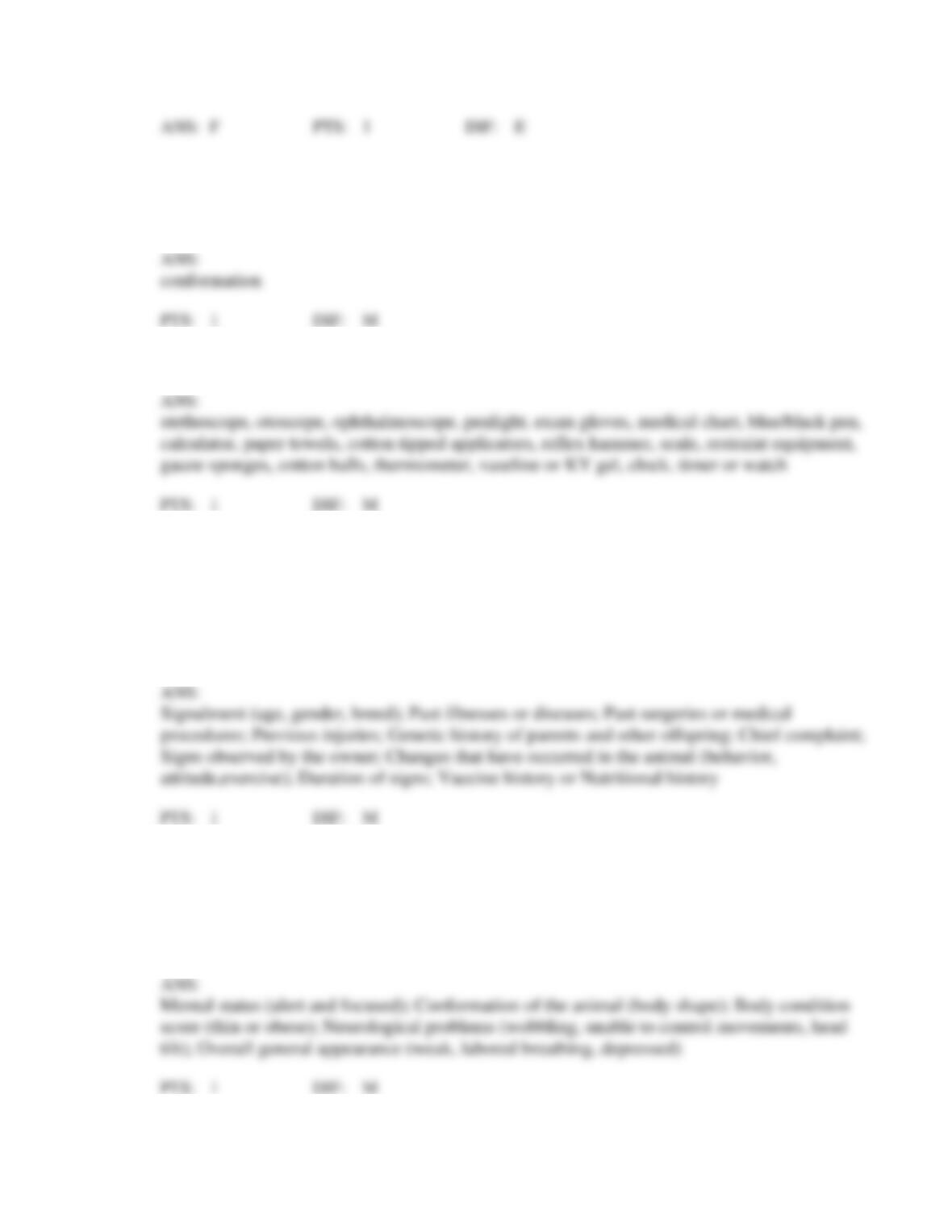
1. What is the term for the body’s shape and appearance?
2. Name 4 tools used in the PE assessment.
3. List 5 items to address during the patient history.
a.
b.
c.
d.
e.
4. List 4 areas of the patient observation.
a.
b.
c.
d.
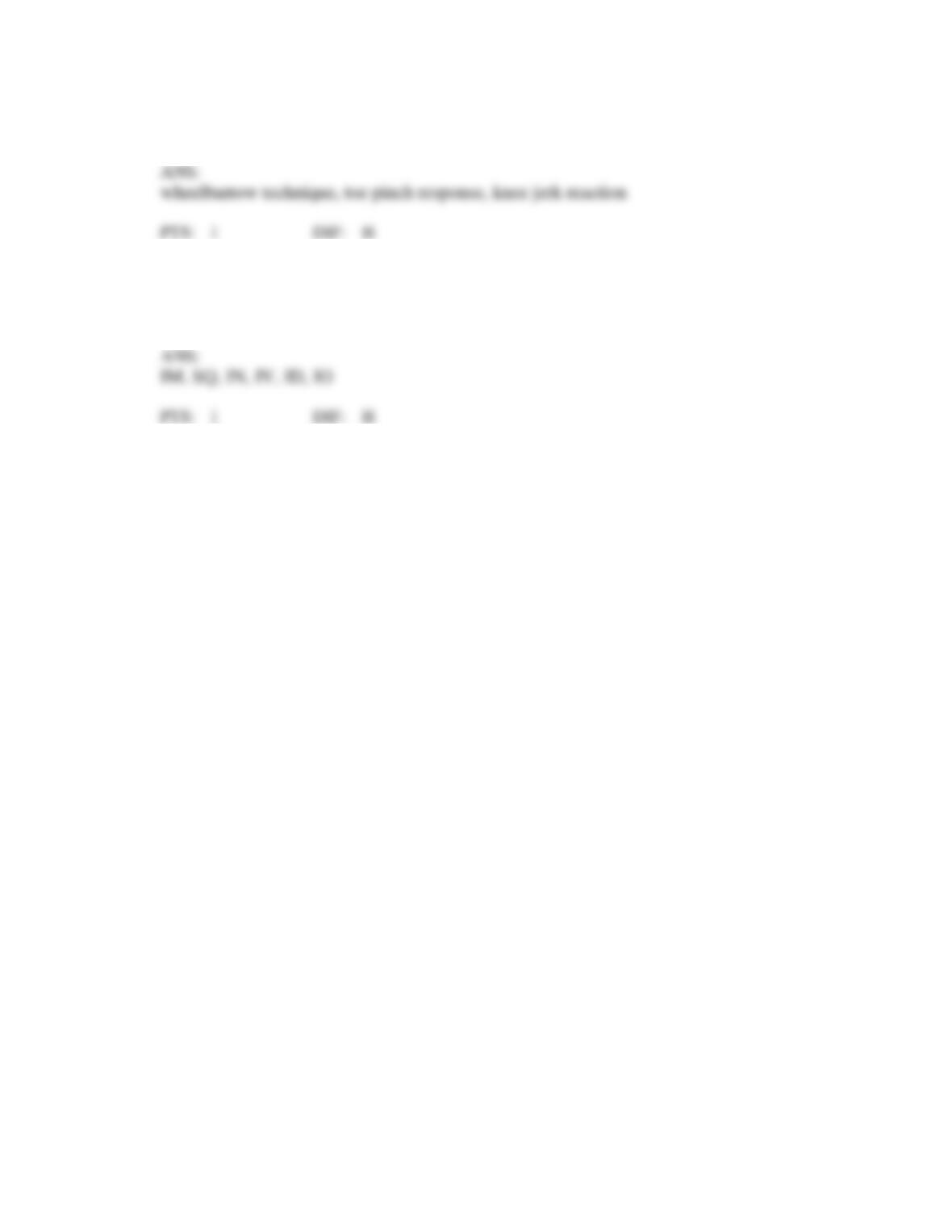
5. Name 3 reflexes that are evaluated with the nervous system.
a.
b.
c.
6. The common types of injections include ____________________,
______________________________, _______________________, and
______________________________.