702 ⚫ UNIT TEST 1 – CHAPTERS 1–4
EBC, 8e Unit Test 1, Chapters 1–4 Name _______________________
Write your answers on the test ONLY if your instructor directs.
True-False
Circle T or F on this sheet OR record your answers on a machine form.
1. The most successful players in today’s workplace will be those with highly
developed communication skills. 1. T F
2. Communication is best defined as “the transmission of information and
meaning from one individual or group to another.” 2. T F
3. Most people have good listening skills because they listen with 75 percent
efficiency. 3. T F
4. When verbal and nonverbal messages conflict, receivers put more faith in
nonverbal cues. 4. T F
5. Communicators in high-context cultures (such as those in China, Japan, and
Arab countries) tend to be logical, analytical, and action oriented. 5. T F
6. The first phase of the writing process involves researching, organizing, and
composing the message. 6. T F
7. Because revising is the most important phase of the writing process, good
writers can expect to spend most of their time in this phase. 7. T F
8. Confidential or sensitive messages should be sent using a fast
communication channel such as e-mail or instant messaging. 8. T F
9. Smart communicators profile their audience before writing and choose
appropriate tone, language, and channels for their messages. 9. T F
10. Every lawyer must submit his legal brief to the clerk of courts is an effective
example of using inclusive, nonbiased language. 10. T F
11. Research is necessary only when preparing longer, more formal business
documents. 11. T F
12. Use the direct pattern when your audience may be uninterested, hostile, or
displeased. 12. T F

UNIT TEST 1 – CHAPTERS 1–4 ⚫ 703
13. Because your goal is to communicate clearly, you’re better off limiting your
sentences to about 20 or fewer words. 13. T F
14. Although active-voice verbs are preferred in business writing, the passive
voice can be used to de-emphasize negative news. 14. T F
15. Transitional expressions such as therefore, as a result, and meanwhile can be
used to achieve paragraph coherence. 15. T F
16. Revising and proofreading are not necessary for short, informal business
messages sent by e-mail. 16. T F
17. I am writing this e-mail message to inform you that is a recommended and
professional way to begin business letters and memos. 17. T F
18. Every field has its own special jargon. Using that jargon within the field is
acceptable and even necessary for accurate, efficient communication. 18. T F
19. Careful writers avoid clichés such as beyond a shadow of a doubt because
these clichés lack freshness and clarity. 19. T F
20. You are more likely to find errors in a document if you proofread it on your
computer screen. 20. T F
Multiple-Choice
Write the appropriate answer in the blank OR record your answers on your machine form.
21. Which of these is the most accurate statement about communication skills in
today’s workplace?
a. Many employers consider communication skills critical to effective job
placement, performance, career advancement, and organizational
success.
b. Strong communication skills are essential only for advancement into
management positions.
c. Writing skills are less important on the job today because people are
writing less than ever before.
d. All of the above statements are accurate. 21. ____

704 ⚫ UNIT TEST 1 – CHAPTERS 1–4
22. Which is the least accurate statement about today’s workplace?
a. Improving productivity and profitability will be everyone’s job, not just
management’s.
b. Because of today’s innovative communication technologies, you can
expect to be communicating more often and more rapidly than ever
before.
c. Communication skills are less important for those participating on virtual
teams or telecommuting from home.
d. Corporate America is increasingly aware that information and knowledge
are the keys to better products and increased profitability. 22. ____
23. The communication process begins when
a. a message is put into words.
b. a message is sent over a communication channel to a receiver.
c. the sender has an idea.
d. the receiver actually receives the message and decodes it. 23. ____
24. Several barriers may cause poor listening. Which of the following is a physical barrier?
a. Faking attention but not really listening
b. Using emotionally charged words
c. Having noisy surroundings
d. Tuning out speakers whose ideas do not match our own 24. ____
25. In a conversation with someone from another culture, you can reduce
misunderstandings by using simple English, speaking slowly and clearly, and
a. finishing the other person’s thoughts to speed up the communication
process.
b. accepting a yes or a nod to affirm comprehension.
c. placing blame for miscommunications on others.
d. following up in writing. 25. ____
26. In preparing business messages, your writing needs to be economical, persuasive,
audience oriented, and
a. direct.
b. purposeful.
c. procedural.
d. impressive. 26. ____
27. During the prewriting phase of the writing process, you should
a. research and organize background information.
b. compose the document using precise and concrete language.
c. analyze the audience for and the purpose of the message.
d. evaluate the effectiveness of your message. 27. ____
28. Choosing an appropriate channel for your business message depends on the importance
of the message, feedback needed, necessity of a permanent record, cost of the channel,
confidentiality and sensitivity of the message, and

UNIT TEST 1 – CHAPTERS 1–4 ⚫ 705
a. degree of formality required.
b. the channel used by your competitors.
c. the use of primary or secondary research.
d. the sender’s preference. 28. ____
29. Shipping clerk Christina included this sentence in her message to a customer: Pertaining to
your returns, we must verify the shipping numbers and lot codes of all outstanding
merchandise prior to issuance of a refund. This sentence is an example of
a. an unprofessional tone.
b. overly formal language.
c. a conversational style.
d. plain English. 29. ____
30. Which of the following sentences best demonstrates the “you” view?
a. You will receive a complimentary printer with your purchase of a Dell
laptop computer.
b. Dell offers free printers with the purchase of any Dell laptop computer.
c. We can’t provide a free printer with your purchase of a PDA.
d. The offer for a free printer expired on September 30; you should have
checked the advertisement before ordering. 30. ____
31. Collecting information before composing a business message helps the writer to
a. shape the message.
b. identify transitional expressions.
c. develop a sprint writing technique.
d. create unified sentences and coherent paragraphs. 31. ____
32. Jacqueline began her memo with background information and explanations before
announcing a reduction in insurance coverage. The pattern Jacqueline used is called
a. frontloading.
b. direct.
c. passive voice.
d. indirect. 32. ____
33. Which of the following is an independent clause?
a. When you receive the request for your budget reduction plan.
b. After closing several branch offices to conserve resources.
c. The restructuring plan will save money but cost jobs.
d. Because we are hoping to retain as many positions as possible. 33. ____

706 ⚫ UNIT TEST 1 – CHAPTERS 1–4
34. Which of the following uses active voice in a complete sentence?
a. The company’s rigid return policy was criticized by a few unhappy
customers.
b. Because a few unhappy customers criticized the company’s rigid return
policy.
c. Managers were told about the unhappy customers who criticized the
company’s rigid return policy.
d. A few unhappy customers criticized the company’s rigid return policy. 34. ____
35. How should the following sentence be classified? David applied with several large
high-tech companies he also applied with some small start-ups.
a. Complete sentence
b. Fused or run-on sentence
c. Fragment
d. Comma splice 35. ____
36. Revising means
a. improving the content and sentence structure of your message.
b. correcting the grammar, spelling, punctuation, format, and mechanics of
your message.
c. selecting the appropriate pattern for good or bad news messages.
d. searching for graphics and photos to include in your message. 36. ____
37. Which of the following best demonstrates concise writing?
a. There are several things that each and every employee must know about
workplace hazards.
b. The directors are of the opinion that HAZMAT training is absolutely
essential.
c. Although this training is a company requirement, it must be completed at
the employee’s expense.
d. This is to inform you that until such time as training is completed, pay
raises will be withheld. 37. ____
38. If you have any questions, please do not hesitate to ask is an example of
a. a trite business phrase.
b. inappropriate jargon.
c. a long lead-in.
d. strong business writing. 38. ____

UNIT TEST 1 – CHAPTERS 1–4 ⚫ 707
39. Which of the following sentences avoids noun conversion?
a. Your supervisor must give approval of all capital budget purchases.
b. The committee worked on the establishment of a fund for scholarships.
c. The benefits committee will be responsible for the acquisition of an
endowment.
d. The scholarship committee approved the plan. 39. ____
40. Which of the following is the best advice for proofreading long, complex documents?
a. Proofread complex documents immediately after writing because your
thoughts are still fresh.
b. Thoroughly proofreading once is typically adequate.
c. Expect to find mistakes.
d. Rely solely on your word processor’s spell check program. 40. ____
Composition and Short-Answer Questions
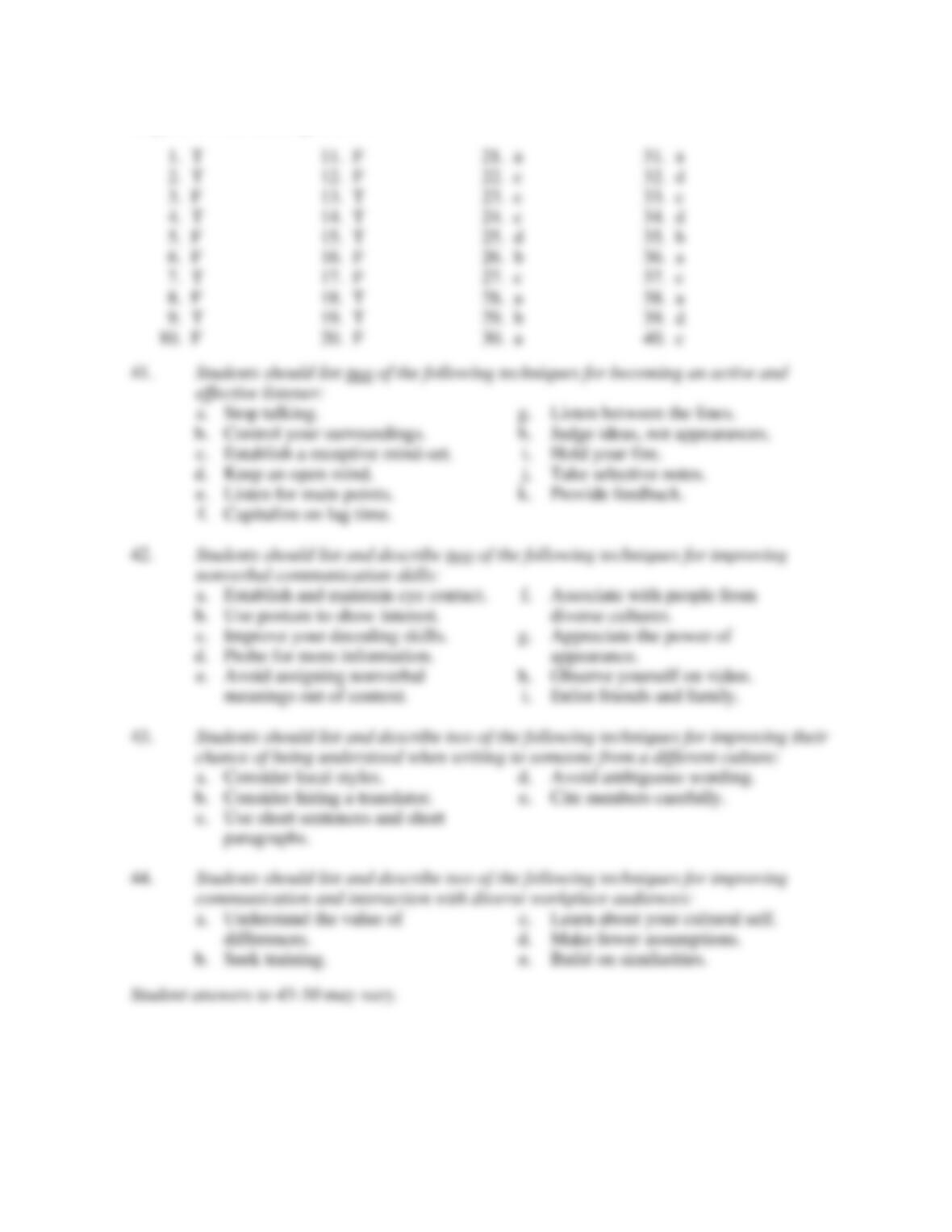
41. List two techniques for becoming an active and effective listener.
42. List and describe two techniques for improving nonverbal communication skills.
43. List and describe two techniques for improving your chance of being understood when
writing to someone from a different culture.
44. List and describe two techniques for improving communication and interaction with
diverse workplace audiences.
708 ⚫ UNIT TEST 1 – CHAPTERS 1–4
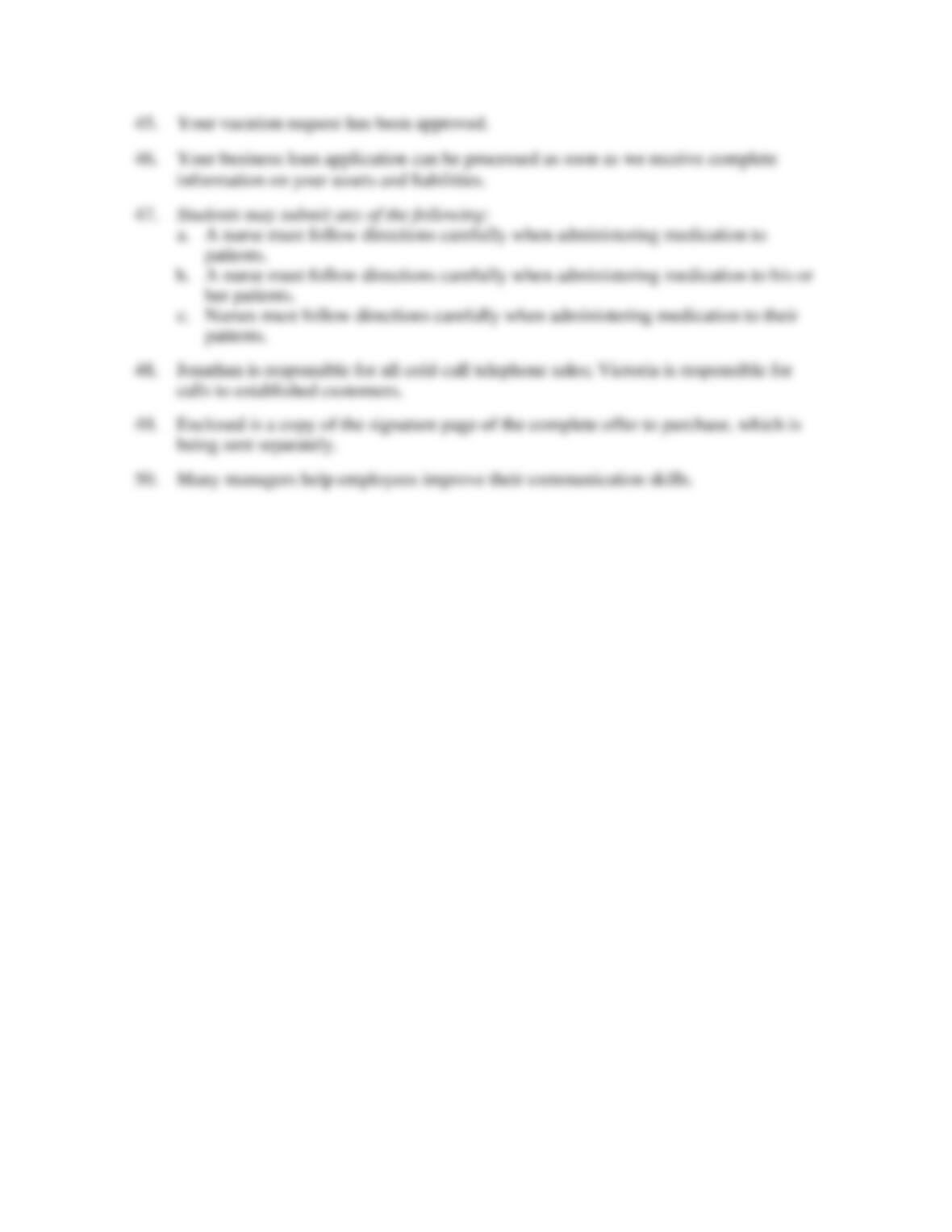
45. Revise the following sentence to express the idea in the “you” view:
We have approved your vacation request.
46. Revise the following sentence to use positive language:
We cannot process your business loan application because you did not provide
complete information on current assets and liabilities.
47. Revise the following sentence to use inclusive language:
A nurse must follow directions carefully when administering medication to her patients.
48. Revise the following sentence to achieve parallelism:
Jonathan is responsible for all cold-call telephone sales; calls to established customers
are made by Victoria.
49. Revise and improve the following sentence to avoid trite business phrases:
Enclosed herein please find a copy of the signature page of the complete offer to
purchase, which is being sent under separate cover.
50. Revise and improve the following sentence:
There are many managers who help employees make improvements in their
communications skills.
UNIT TEST 1 – CHAPTERS 1–4 ⚫ 709
Key, Unit Test 1, Chapters 1–4
710 ⚫ UNIT TEST 1 – CHAPTERS 1–4