TVM Module: Time Value of Money Module
99. Suppose you borrow money from your parents for college tuition on January 1, 2013. Your parents require four annual
payments of $1,000 each, with the first payment due on January 1, 2017. They are charging you 6% annual interest.
What is the cost of the college tuition?
a.
$2,909.37
b.
$1,593.85
c.
$4,000.00
d.
$2,744.69
a
1
Moderate
ACCT.WHAL.TVM.9 – LO: TVM.9
United States – BUSPROG: Reflective Thinking – BUSPROG: Analytic
United States – OH – Default City – AICPA: FN-Decision Modeling
100. Balance sheet values are calculated using compound interest (present value) calculations for all of the following
except
a.
bonds payable.
b.
long-term notes receivable.
c.
long-term lease liabilities.
d.
deferred income taxes.
d
1
Easy
ACCT.WHAL.TVM.10 – LO: TVM.10
United States – BUSPROG: Reflective Thinking – BUSPROG: Analytic
United States – OH – Default City – AICPA: FN-Decision Modeling
TVM Module: Time Value of Money Module
101. FASB financial accounting concepts on using estimated future cash flow information in accounting measurements to
value various assets and liabilities identified each of the following elements except
a.
an estimate of the future cash flows and the timing of those cash flows.
b.
an increase in the interest for any expected risk.
c.
estimates about variations in the amount or timing of those cash flows.
d.
that estimated cash flows should reflect a single most likely minimum or maximum possible amount, rather
than a range of possible cash flows.
d
1
Moderate
ACCT.WHAL.TVM.10 – LO: TVM.10
United States – BUSPROG: Reflective Thinking – BUSPROG: Analytic
United States – OH – Default City – AICPA: FN-Decision Modeling
102. Bunsen Company is involved in a consumer liability lawsuit. Company attorneys have assessed the contingent
outcomes of the lawsuit. Because the attorneys think the company will probably lose the lawsuit, To prepare for this
loss, Bunsen management has decided to set aside funds in an investment account that earns a 9% return rate.
Furthermore, there is general agreement that there is a 60% probability the company will have to pay the defendants
$6 million four years from now; a 30% probability the company will need to pay $10 million eight years from now,
and a 10% probability the company will pay nothing. What amount should Bunsen accrue as a contingent liability?
a.
$4,055,928
b.
$6,179,473
c.
$6,600,000
d.
$9,269,210
a
1
Challenging
ACCT.WHAL.TVM.10 – LO: TVM.10
United States – BUSPROG – BUSPROG: Analytic
United States – OH – Default City – AICPA – FN-Decision Modeling
Bloom’s: Analyzing
TVM Module: Time Value of Money Module
103. Rita deposited $8,000 in a savings account that provides for interest at the rate of 16% compounded quarterly.
Required:
Compute the balance in the account at the end of seven years.
= $ 8,000(fn = 28, i = 4%)
= $ 8,000 × 2.998703
104. Using the compound interest tables, answer the following questions.
Required:
a.
How much will be accumulated on January 1, 2018 if $450,000 is deposited on January 1,
2014, and interest is compounded annually at 10%?
b.
How much will be accumulated on December 31, 2024 if $80,000 is deposited on
December 31, 2014, and the fund pays 9% interest compounded semiannually?
c.
b.
United States – BUSPORG: Analytic
United States – OH – Default City – AICPA: FN-Measurement
What will be on deposit on January 1, 2019 if $50,000 is deposited on January 1, 2014, in a
fund that earns 16% interest compounded quarterly?
105. Using the compound interest tables, answer the following questions.
Required:
a.
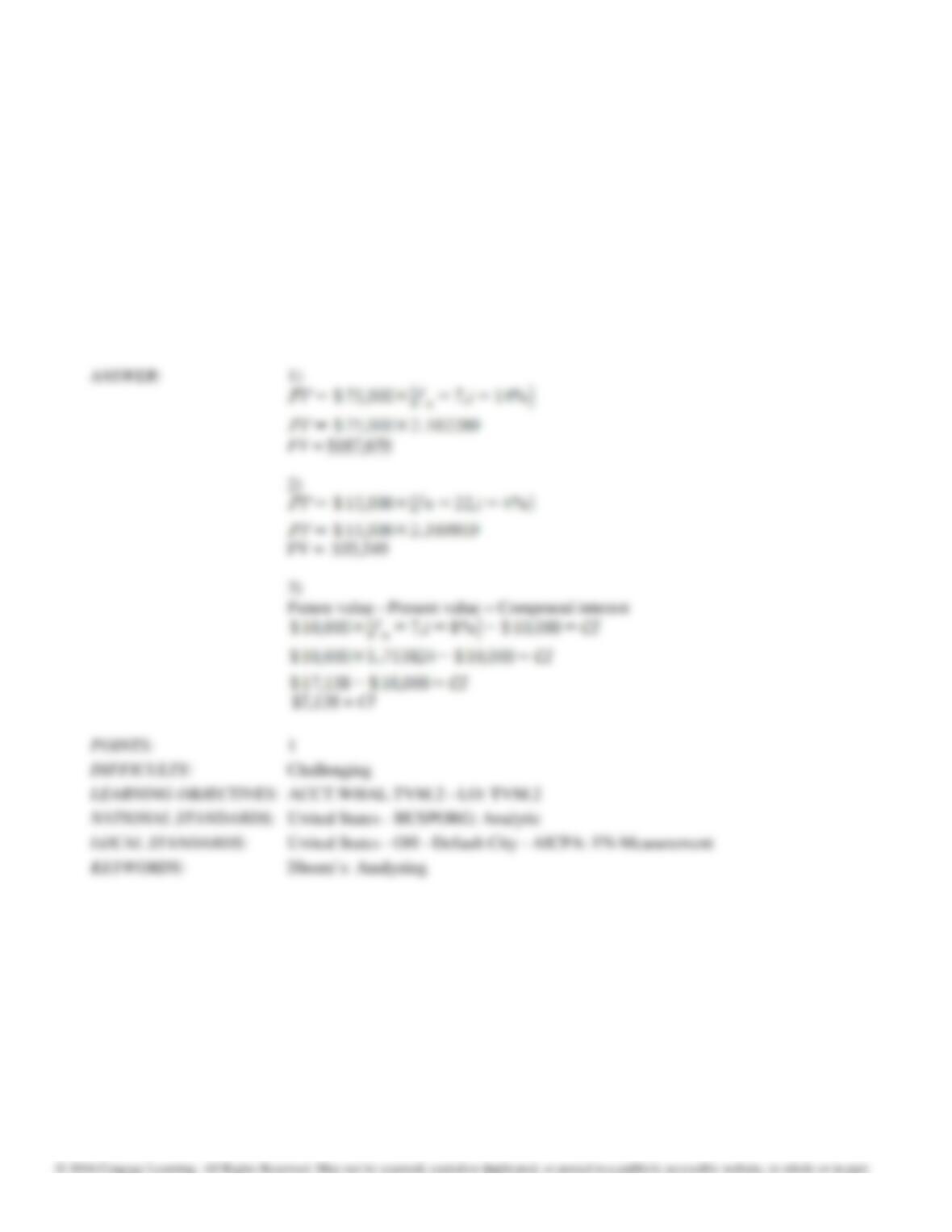
What amount of interest will be earned on an investment of $10,500 left on deposit by
Marcy for three years at 9% interest compounded annually?
b.
Travis deposited $10,000 in a fund that earns 8% interest compounded annually. How
many years will it take for the fund to grow to $21,589.25?
$7,500 × 1.295029 (n = 3, i = 9%)
n =10 years
TVM Module: Time Value of Money Module
106. Using the future value tables to answer the following questions.
Required:
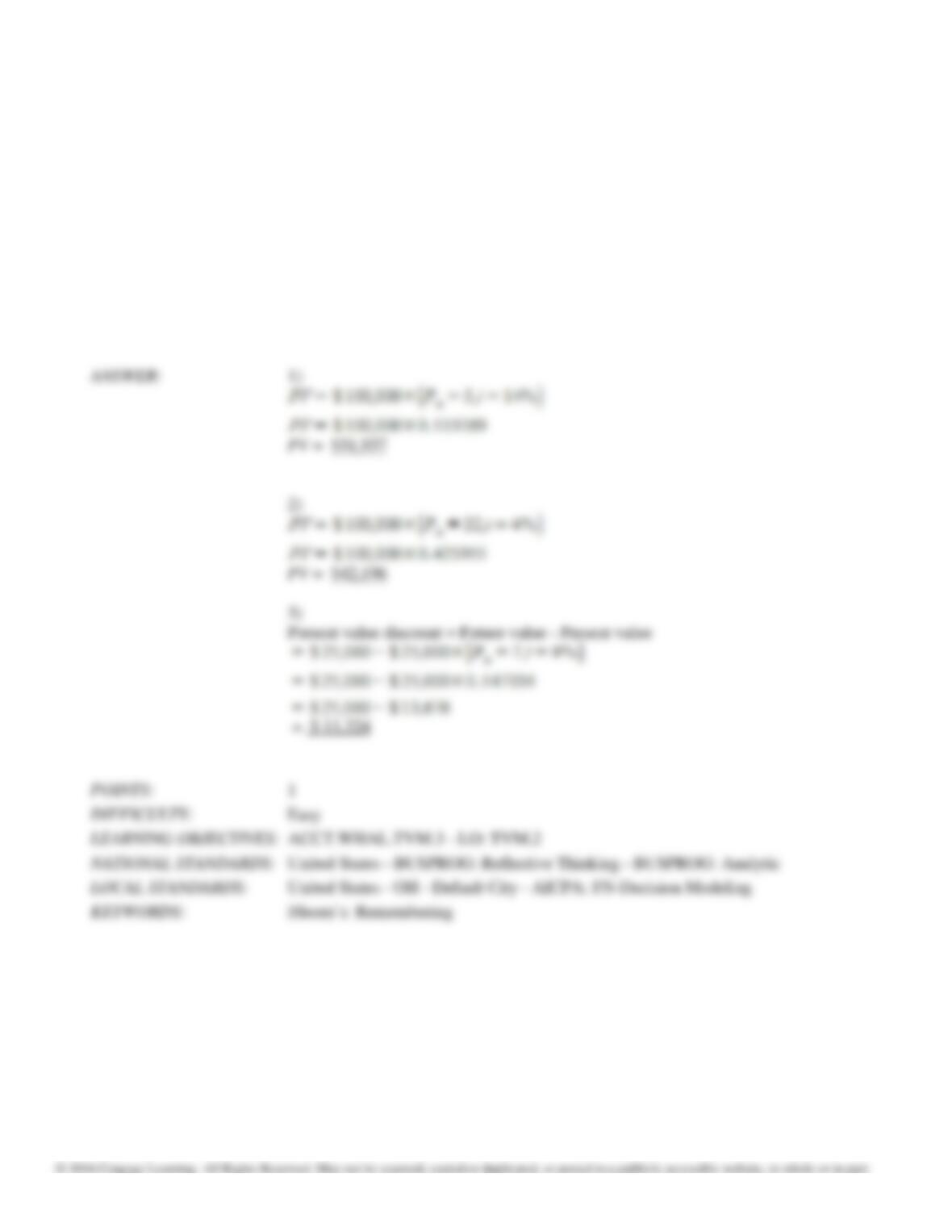
1) What is the value on January 1, 2023, of $75,000 deposited on January 1, 2016, which accumulates interest at
14% annually?
2) What is the value on January 1, 2021, of $15,000 deposited on July 1, 2016, which accumulates interest at 16%
compounded quarterly?
3) What is the compound interest on an investment of $10,000 left on deposit for 7 years at 8% compounded
annually?
TVM Module: Time Value of Money Module
107. Using the present value tables, solve the following problems.
Required:
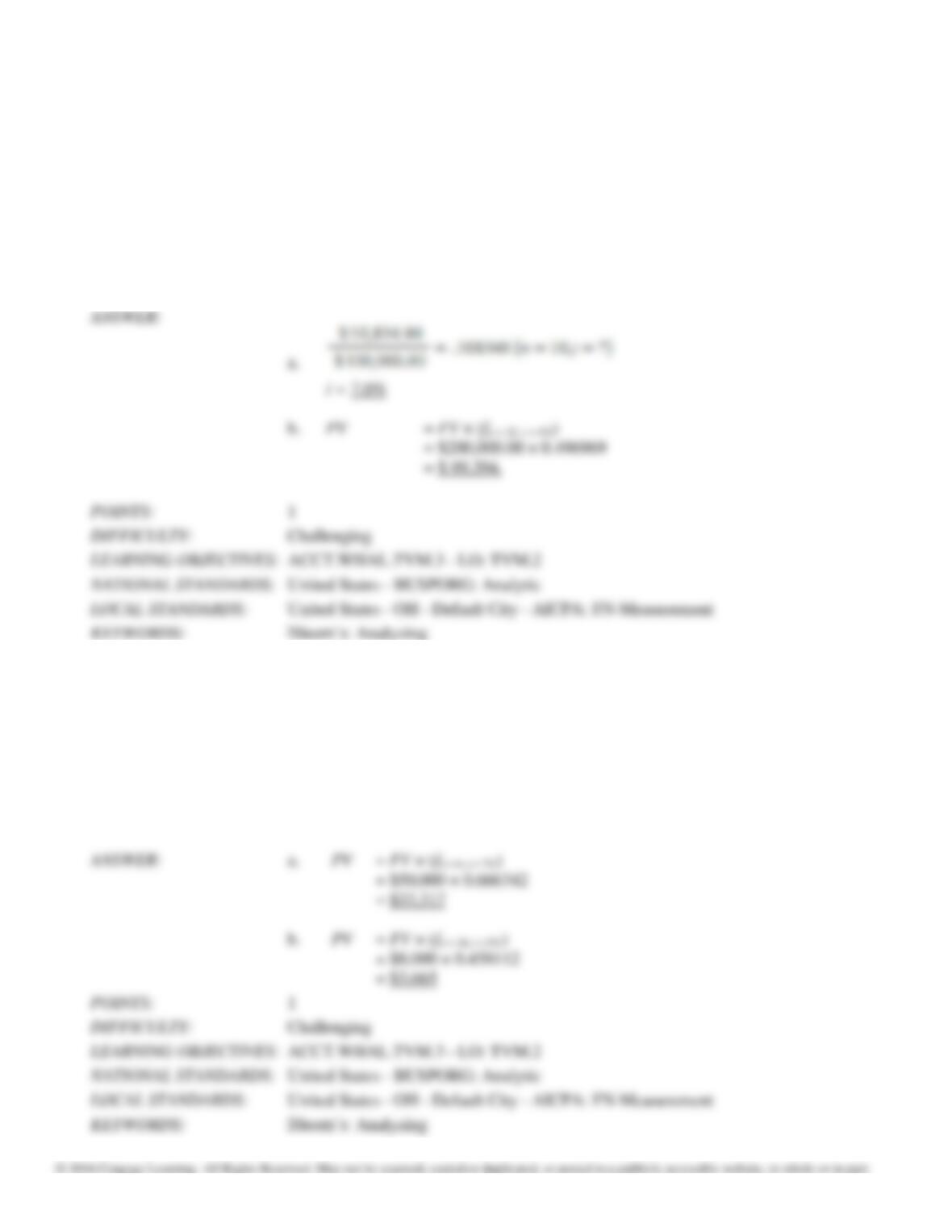
1) What is the present value of a $100,000 loan issued on January 1, 2016, due on January 1, 2021, discounted at
14% compounded annually?
2) What is the present value of a $100,000 loan issued on January 1, 2016, due on July 1, 2021 discounted at 16%
compounded quarterly?
3) What is the amount of the present value discount on $25,000 due at the end of seven years at 9% compounded
annually?
TVM Module: Time Value of Money Module
108. Using the compound interest tables, answer each of the following questions.
Required:
a.
Assuming that $100,000 to be paid at the end of ten years has a present value today of
$50,834.90, what interest rate compounded annually is used in the calculation of the
present value?
b.
What amount must be deposited today if $200,000 is to be accumulated six years from
today, and interest at 12% is compounded semiannually?
b.
109. Using the compound interest tables, answer each of the following questions.
Required:
a.
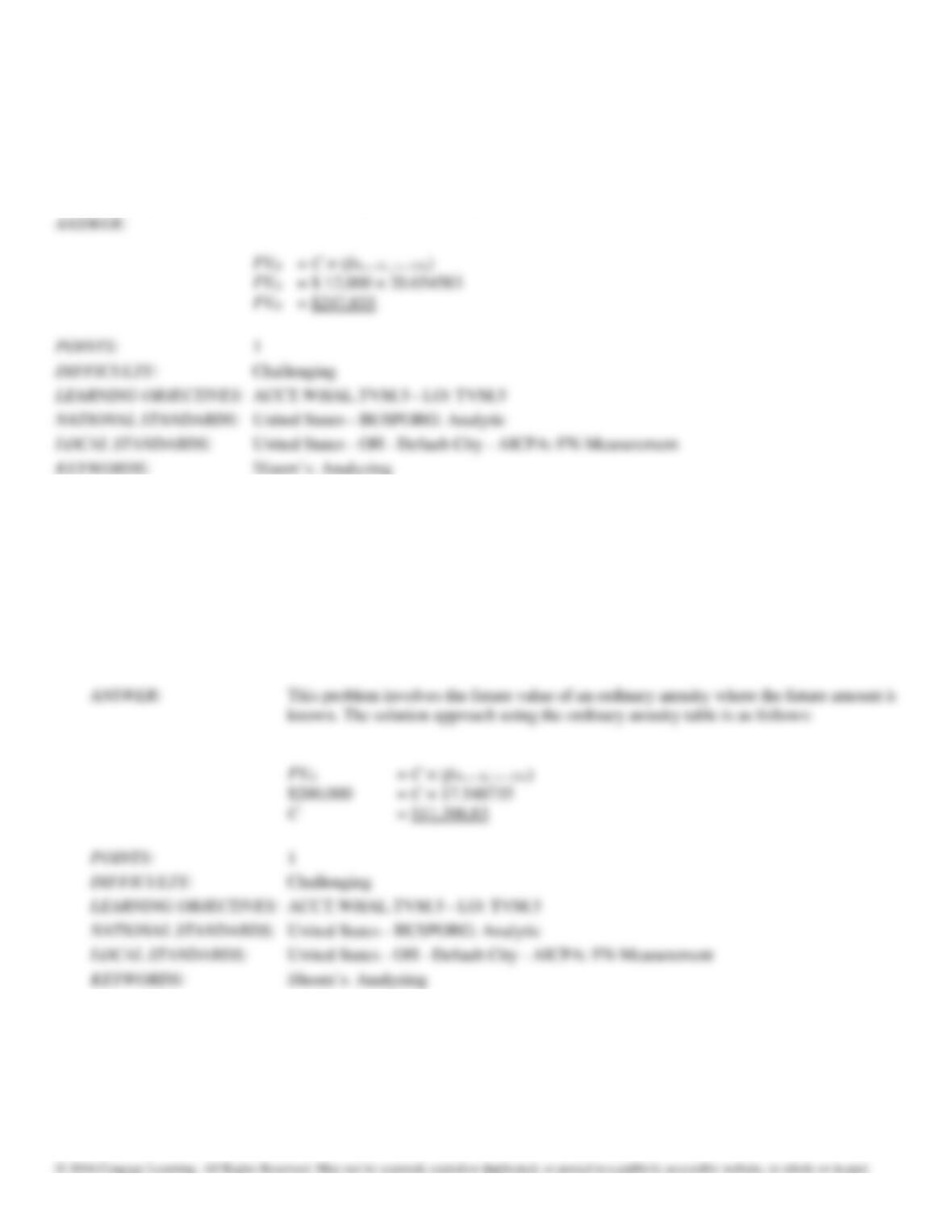
What is the present value on January 1, 2014, of $50,000 due on January 1, 2020, and
discounted at 7% compounded annually?
b.
b.
What is the present value on January 1, 2014, of $8,000 due on January 1, 2022, and
discounted at 10% compounded semiannually?
TVM Module: Time Value of Money Module
110. Using an appropriate compound interest table, answer the following question.
Required:
What is the future amount on December 31, 2024, of eleven deposits of $12,000 each with the first deposit being made on
December 31, 2014, and interest at 12% compounded annually?
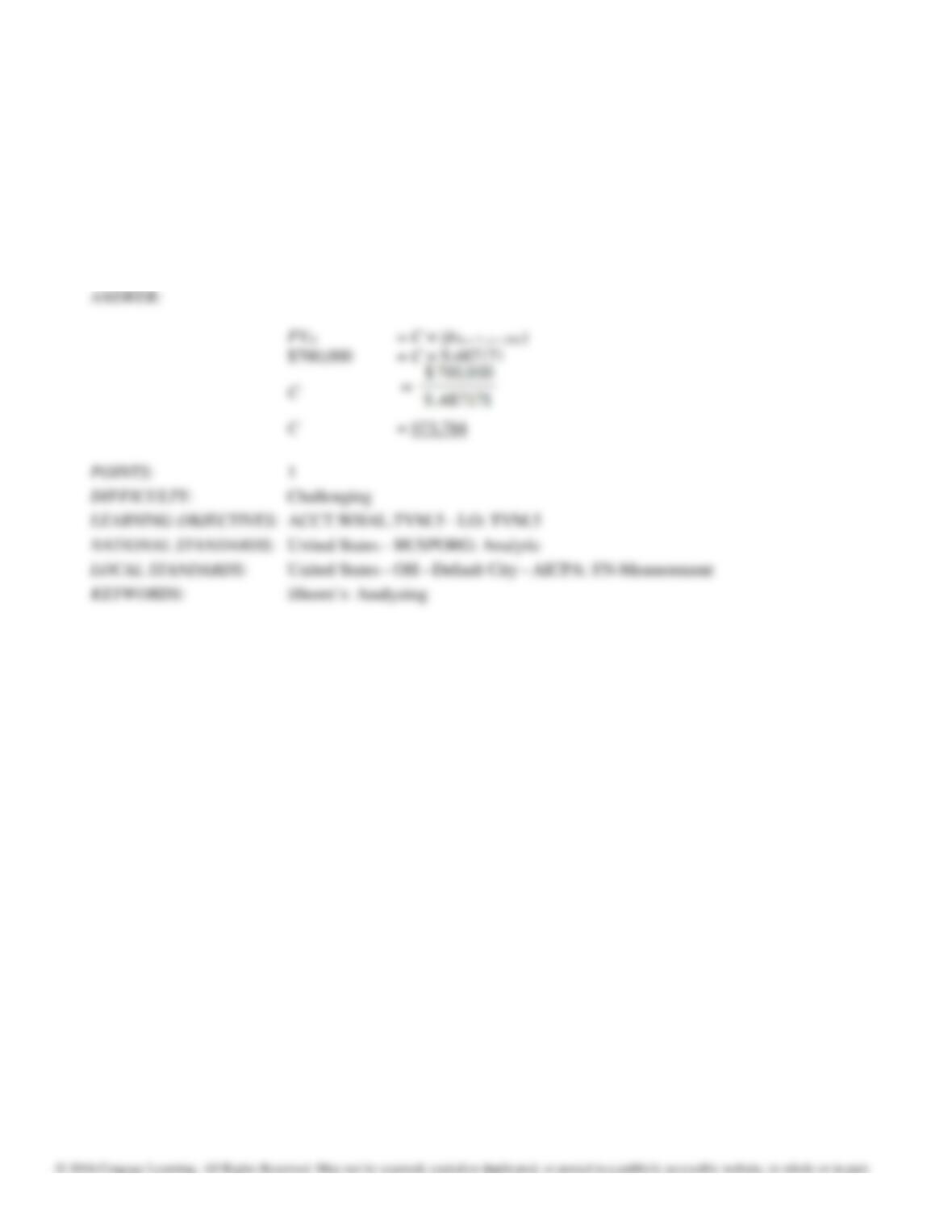
111. Taylor would like to retire on December 31, 2026, and take a trip around the world. In order to do this, she feels she
must accumulate $200,000 in her retirement account by that date. She is willing to deposit a certain amount each
year into her retirement account, which earns 12% interest compounded annually. Taylor will make the first deposit
on December 31, 2017, and the last deposit on December 31, 2026.
Required:
Determine the amount Taylor must deposit into her retirement account each year. Clearly label all work.
TVM Module: Time Value of Money Module
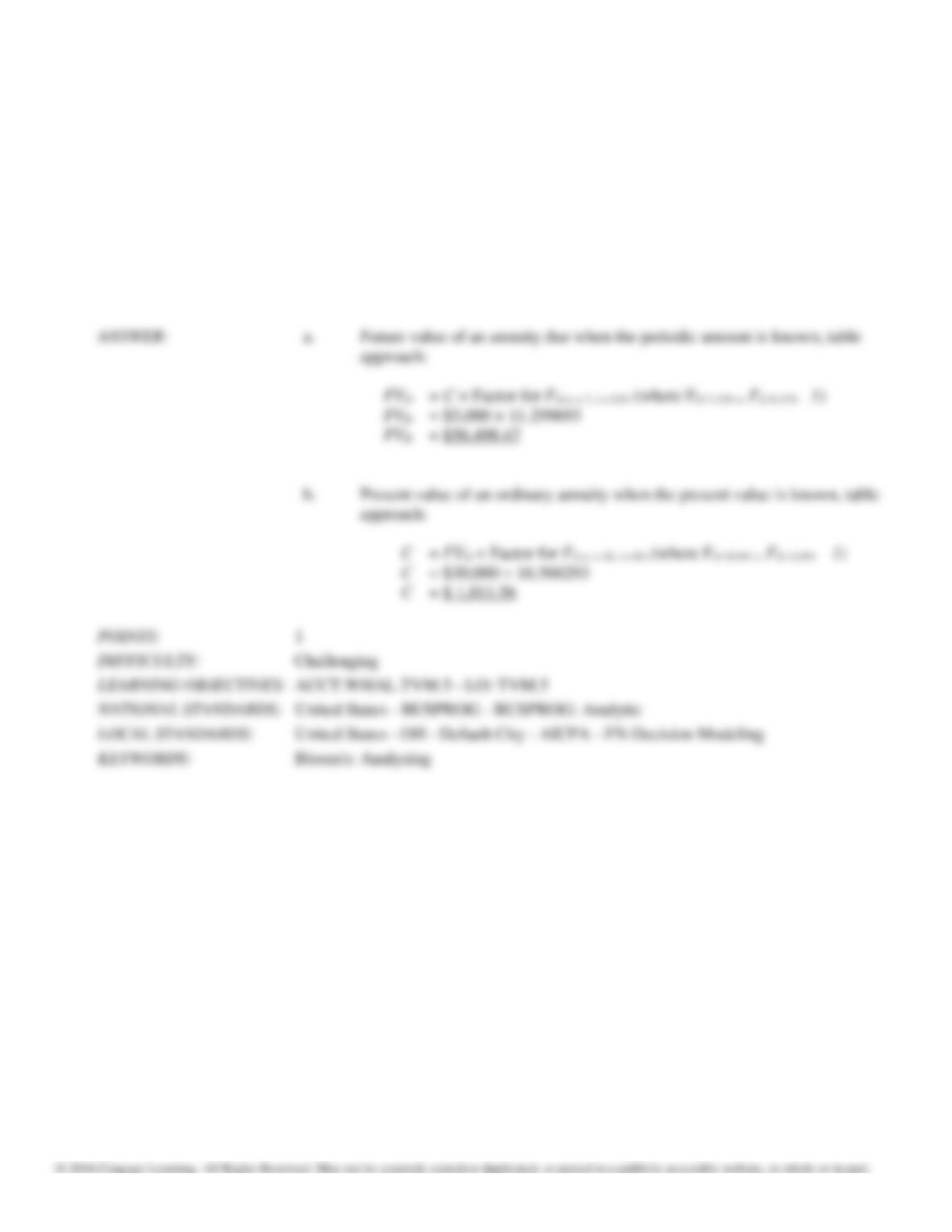
112. At the beginning of 2017, Lisa Co. issued bonds with a face value of $700,000 due on December 31, 2023. The
company desires to accumulate a fund to retire these bonds at maturity by making equal annual deposits beginning
on December 31, 2017.
Required:
Compute the amount that the company must deposit at the end of each year, assuming that the fund will earn 10%
interest a year compounded annually and seven deposits are made.
TVM Module: Time Value of Money Module
113. Using the compound interest tables, answer each of the following questions.
Required:
a.
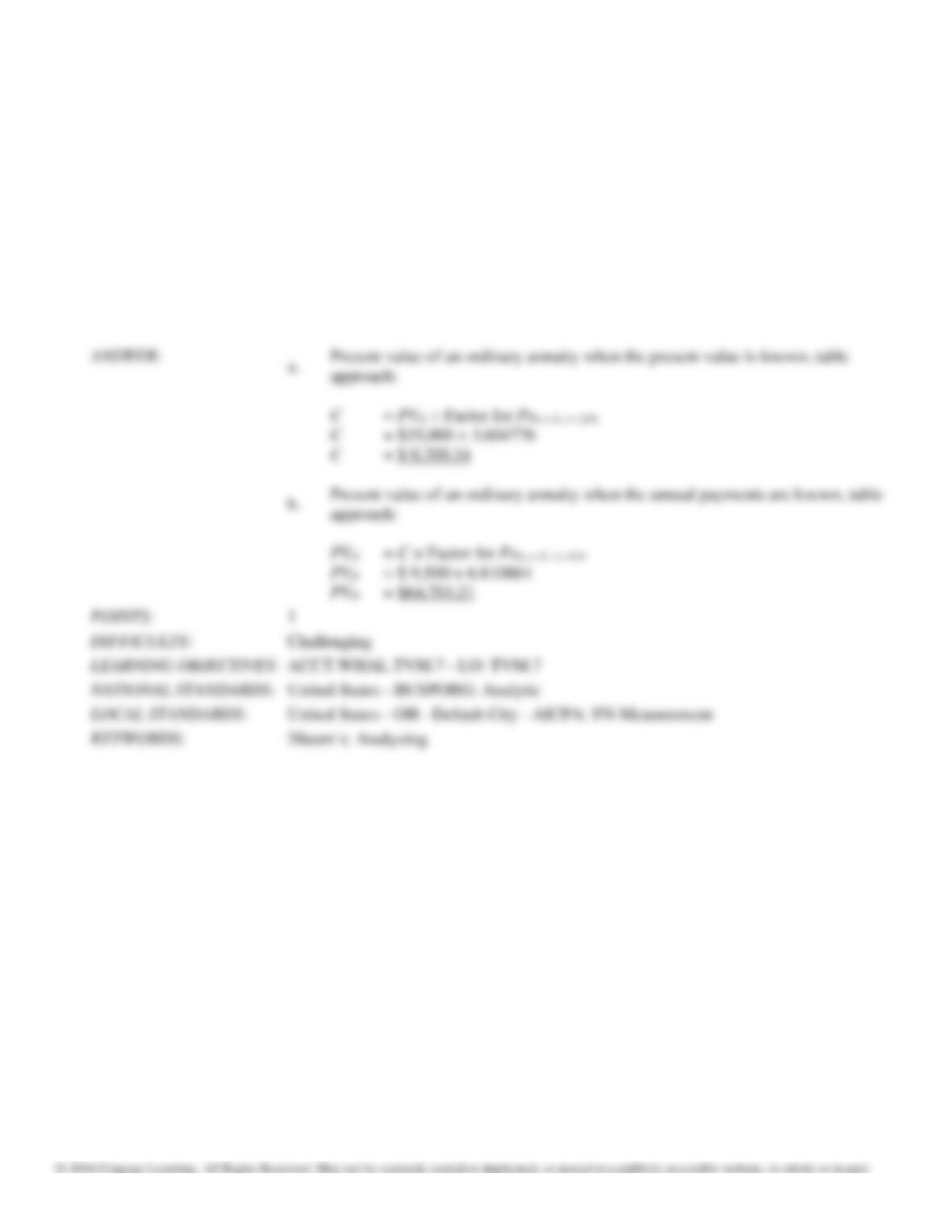
Pedro has decided he can save $5,000 a year for the next seven years, starting today. What
amount will be available seven years from today if the investment account earns 12%
compounded annually?
b.
b.
Anaposa needs $30,000 ten years from today. She has found an investment account that
earns 9% compounded annually. How much must she deposit into that account each year
for the next ten years, starting today to achieve her investment goal?
TVM Module: Time Value of Money Module
114. Using the compound interest tables, answer each of the following questions.
Required:
a.
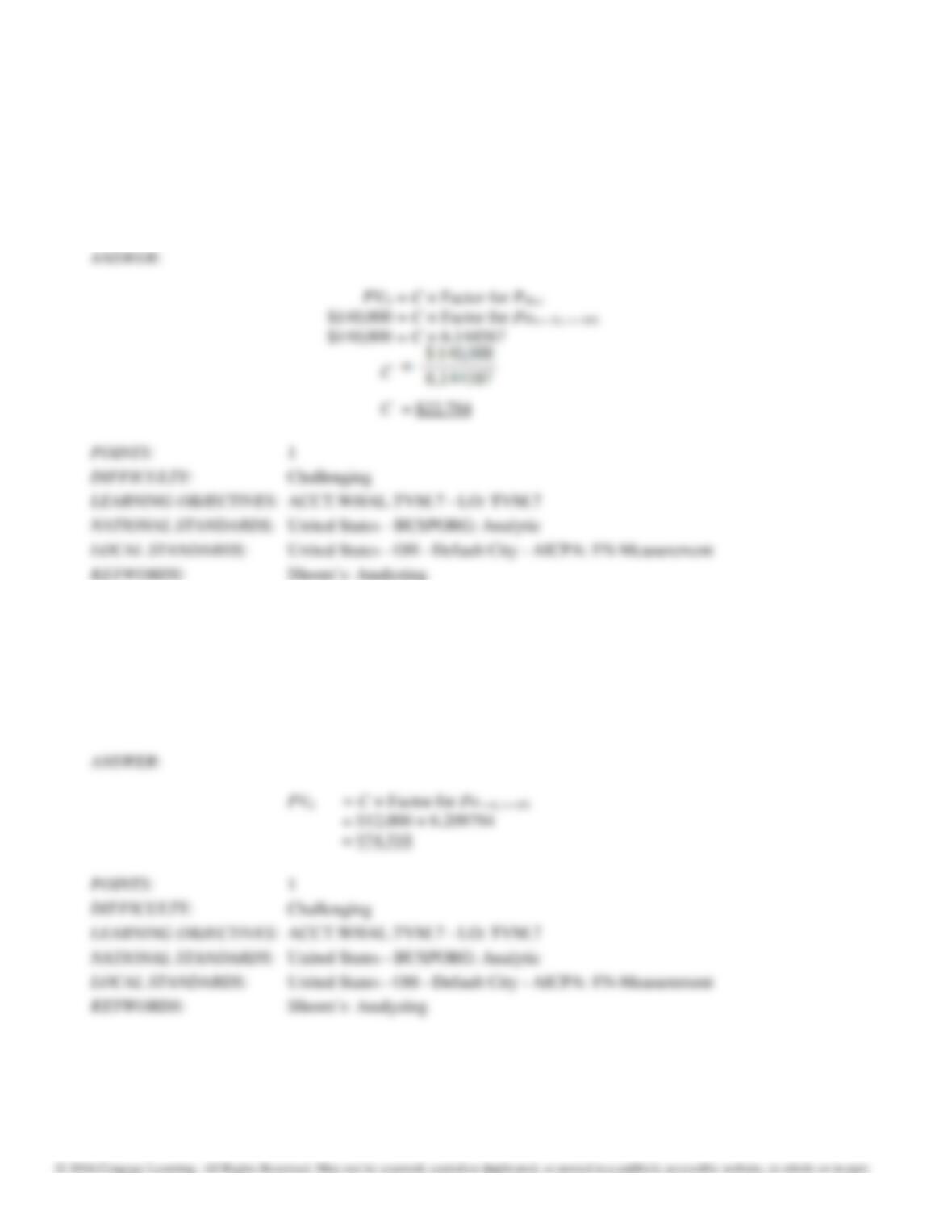
Jane has a $35,000 bank loan that she wishes to pay off in five equal annual payments with
12% interest. If the first payment is due one year from today, what will be the amount of
the annual payment necessary?
b.
Joan wants to borrow some money from the bank to start a small business. Joan can afford
to pay off the loan in 15 annual installments of $9,500. The bank charges an annual interest
rate of 12%. If Joan makes the first payment one year from the date of the loan, how much
can Joan borrow?
TVM Module: Time Value of Money Module
115. Beginning December 31, 2014, ten equal, annual withdrawals are to be made.
Required:
Using the appropriate tables, determine the equal, annual withdrawals if $140,000 is invested on January 1, 2014 at
an interest rate of 10% compounded annually.
116. On January 1, 2016, Bob’s Meat Market leased some equipment from another company. The lease contract calls for
$12,000 annual payments for eight years, beginning on December 31, 2016.
Required:
Calculate the present value of the lease payments on January 1, 2016. Assume a 6% interest rate.
TVM Module: Time Value of Money Module
117. Compound interest factors are provided below:
5%, n = 10
5%, n = 20
10%, n = 10
10%, n = 20
Future value of a single sum
1.629
2.653
2.594
6.728
Future value of an ordinary annuity
12.578
33.067
15.937
57.275
Present value of a single sum
0.614
0.377
0.386
0.149
Present value of an ordinary annuity
7.722
12.462
6.145
8.514
Present value of an annuity due
8.108
13.085
6.759
9.365
Using the above factors, answer each of the following questions.
a.
How much will you have in 10 years if you invest $30,000 in an investment that earns 10%
semiannually?
b.
How much do you have to invest today to have $30,000 in 10 years if the investment earns
10% annually?
c.
How much will you have in 10 years if you invest $15,000 at the end of each year in an
investment earning 10% annually?
d.
How much do you have to invest today and every six months thereafter for the next 10
years if you want to accumulate a total of $400,000 10 years from today in an investment
paying 10% semiannually?
TVM Module: Time Value of Money Module
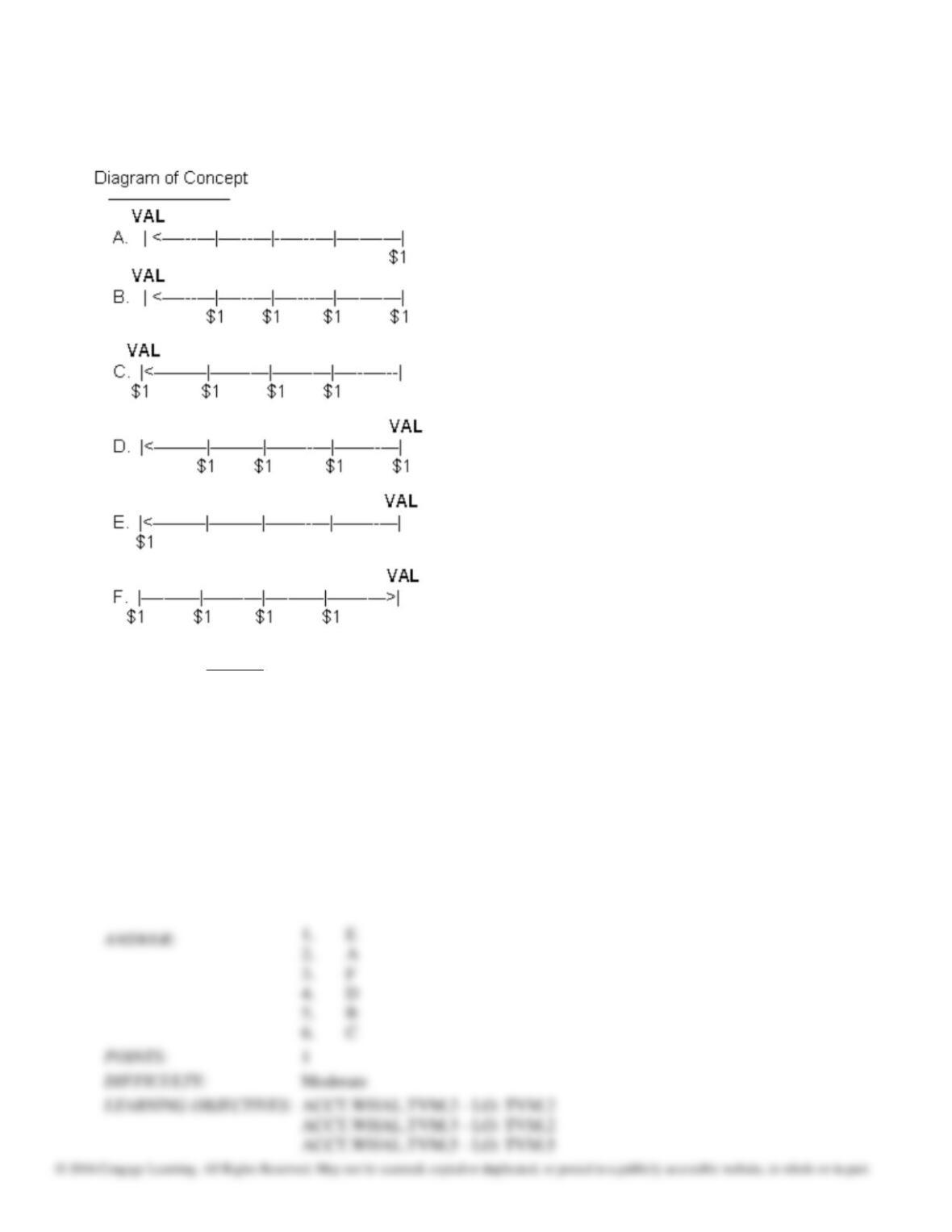
118. Match the diagrams with the concepts by writing the identifying letter of the diagram on the blank line to the left of
the concept. “VAL” represents the value to be calculated.
Concept
___
1.
Future value of $1
___
2.
Present value of $1
___
3.
Future value of an annuity due of $1
___
4.
Future value of an ordinary annuity of $1
___
5.
Present value of an ordinary annuity of $1
___
6.
Present value of an annuity due of $1
1.
2.
3.
4.
5.
6.