TVM Module: Time Value of Money Module
ACCT.WHAL.TVM.6 – LO: TVM.7
ACCT.WHAL.TVM.7 – LO: TVM.7
ACCT.WHAL.TVM.8 – LO: TVM.8
NATIONAL STANDARDS:
United States – BUSPROG: Reflective Thinking – BUSPROG: Analytic
LOCAL STANDARDS:
United States – OH – Default City – AICPA: FN-Decision Modeling
KEYWORDS:
Bloom’s: Understanding
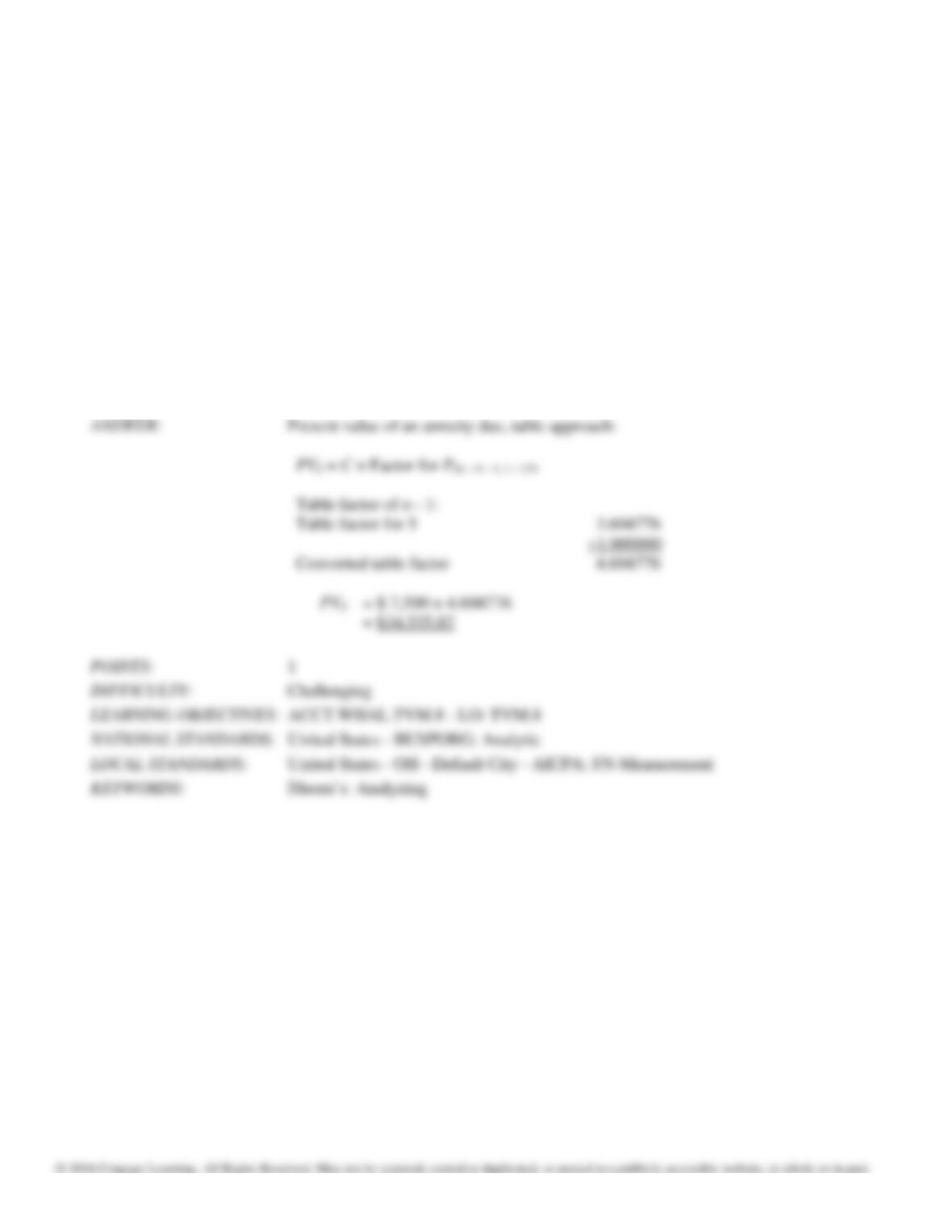
119. On January 1, 2017, Jefferson Company completed arrangements to purchase a new piece of equipment. The
agreement calls for equal annual payments on January 1 of each year for six years. The first payment of $7,500 is to
be made on January 1, 2017. The interest rate is 12%.
Required:
Calculate the cost of the equipment to Jefferson Company.
POINTS:
1
DIFFICULTY:
Challenging
ACCT.WHAL.TVM.8 – LO: TVM.8
NATIONAL STANDARDS:
United States – BUSPORG: Analytic
LOCAL STANDARDS:
United States – OH – Default City – AICPA: FN-Measurement
KEYWORDS:
Bloom’s: Analyzing
TVM Module: Time Value of Money Module
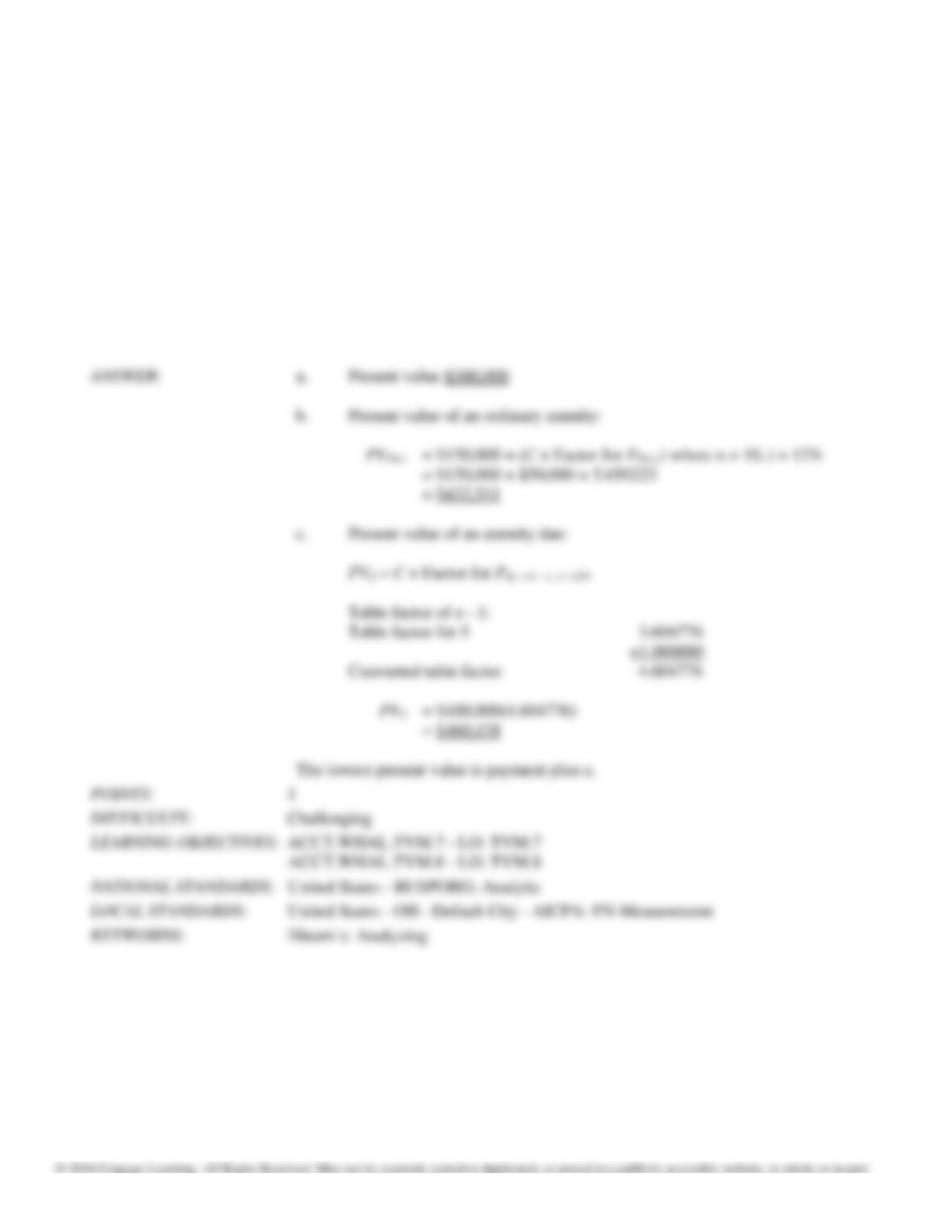
120. On August 1, 2016, Jason purchased machinery from Morgan for expanding its production operation. Morgan has
given Jason three options for payment:
a.
$300,000 in cash now
b.
$150,000 down payment now and $50,000 per year for the next ten years beginning August
1, 2017
c.
$100,000 now and $100,000 per year for five years beginning August 1, 2017
1
Challenging
ACCT.WHAL.TVM.8 – LO: TVM.8
United States – BUSPORG: Analytic
United States – OH – Default City – AICPA: FN-Measurement
Required:
Determine which of the above payment plans has the lowest present value. Clearly label all of your work. The
effective annual interest rate is expected to be 12% during this period.
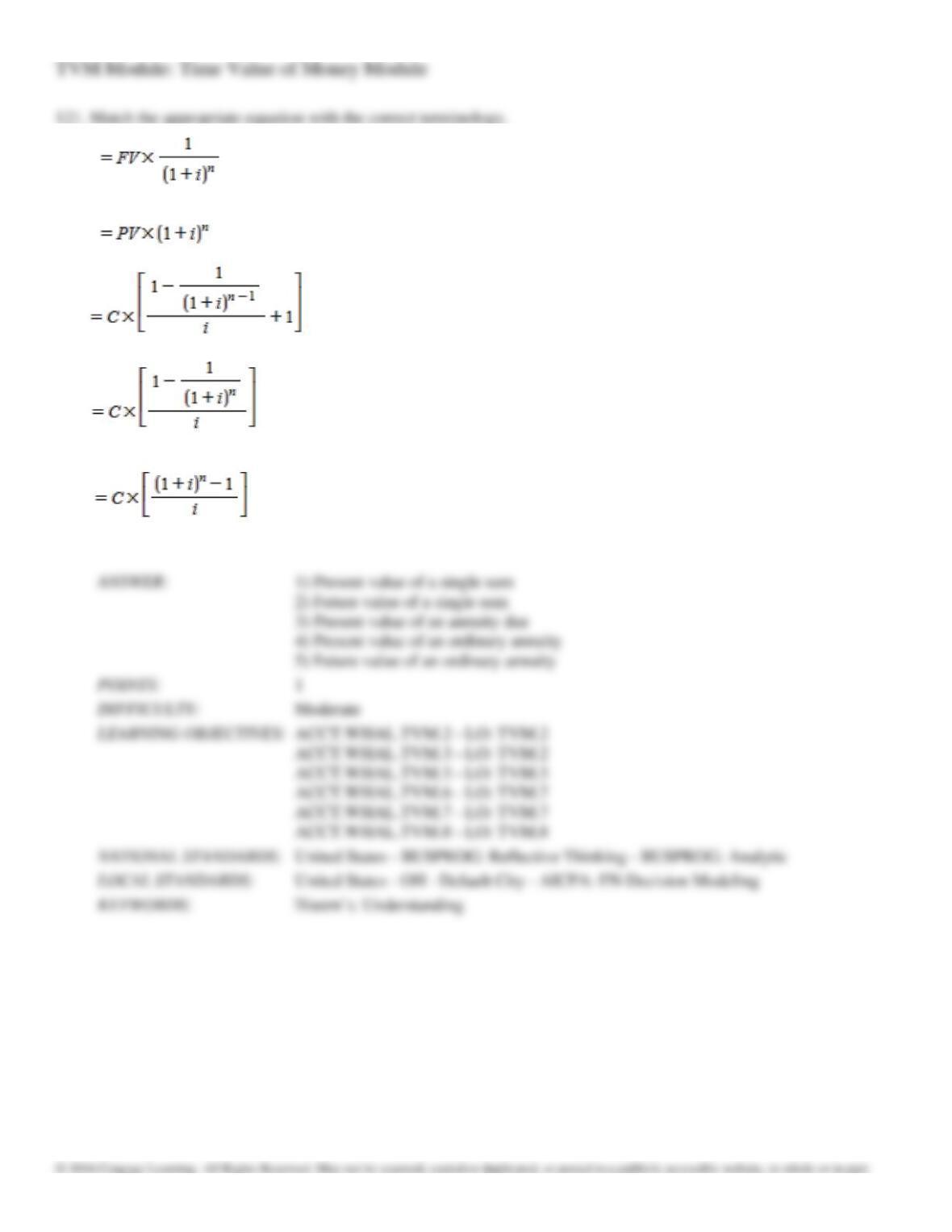
1)
2)
3)
4)
5)
TVM Module: Time Value of Money Module
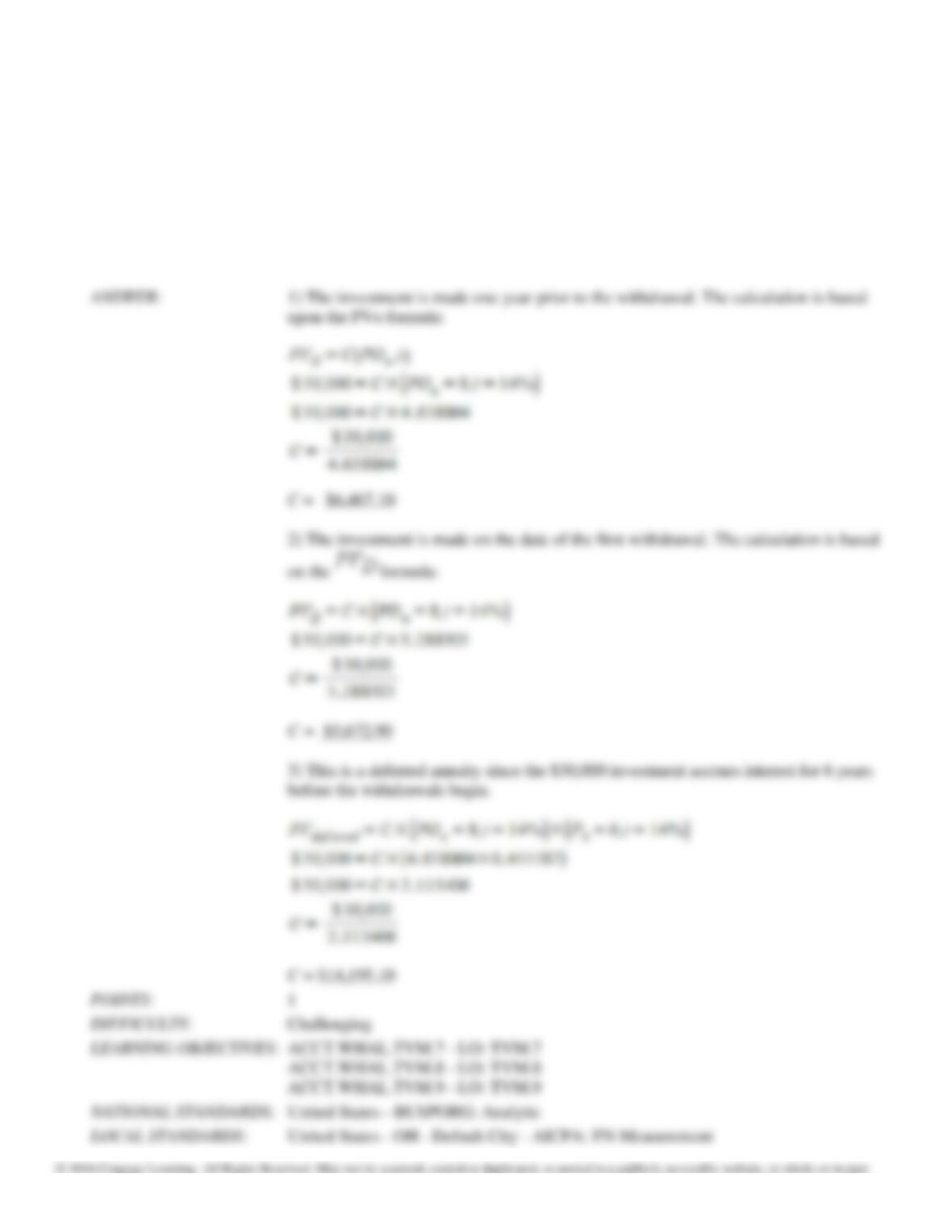
122. Beginning December 31, 2021, eight equal annual withdrawals will be made.
Required:
Using the appropriate tables, determine the equal annual withdrawals if $30,000 is invested at an interest rate of 14%
compounded annually on:
1) January 1, 2021
2) December 31, 2021
3) January 1, 2016
TVM Module: Time Value of Money Module
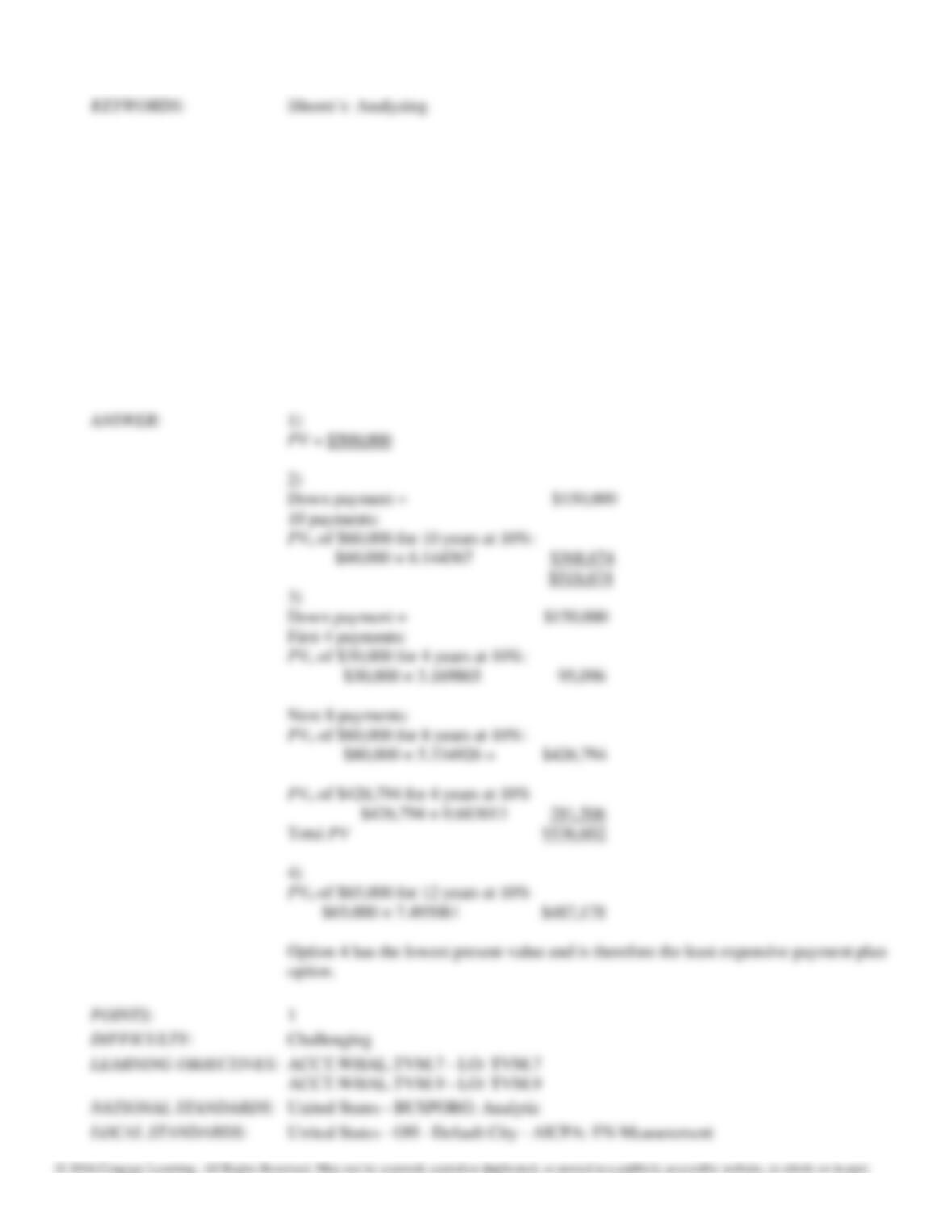
123. Samos Excavating is considering purchasing some new equipment for the company. Due to the expense involved, the
equipment company is giving Samos the option of choosing between four different payments plans.
1) $500,000 due immediately in cash
2) $150,000 down payment due immediately; $60,000 per year for 10 years, beginning at the end of the current year
3) $150,000 down payment due immediately; $30,000 per year for 4 years beginning at the end of the current year;
$80,000 per year for 8 years beginning at the end of the fourth year after the initial purchase
4) $65,000 due immediately and at the beginning of each of the next 11 years
Required:
Samos has to decide between the four payment plans, whichever one provides the smallest present value will be
chosen. The effective interest rate during the future periods is 10%. Which option should Samos choose?
TVM Module: Time Value of Money Module
KEYWORDS:
Bloom’s: Analyzing
DIFFICULTY:
LOCAL STANDARDS:
KEYWORDS:
Bloom’s: Analyzing
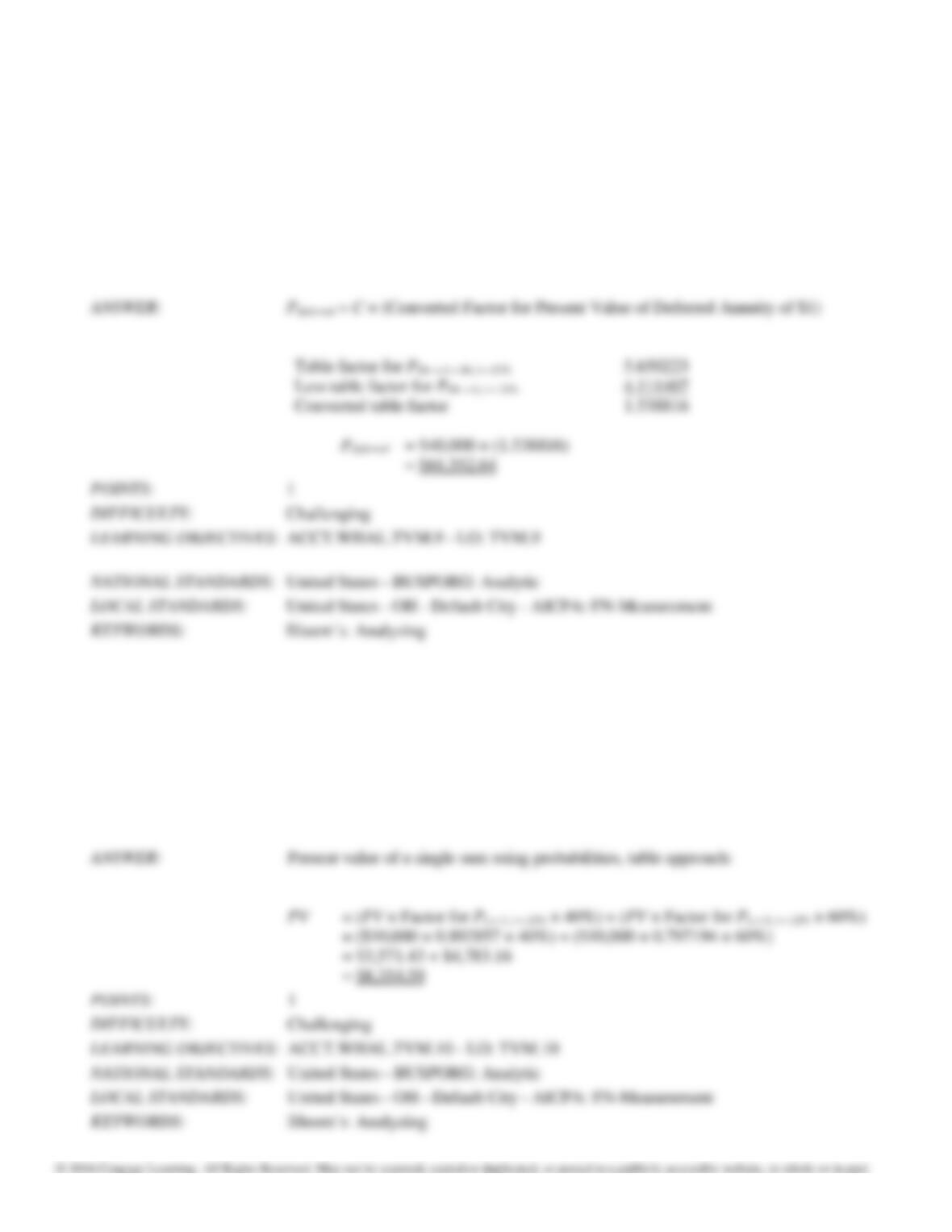
124. Aunt Darla has agreed to deposit a lump sum into an account that pays 12% interest compounded annually in order to
pay for her niece’s college education. The niece estimated that she will need to withdraw $40,000 at the beginning of
each year for four years to pay for room, board, tuition, and books. Aunt Darla will deposit the lump sum on August
1, 2016, and the niece will make the first withdrawal on August 1, 2022.
Required:
Determine the amount that Aunt Darla must deposit. Clearly label all work.
POINTS:
DIFFICULTY:
NATIONAL STANDARDS:
KEYWORDS:
125. The FASB concepts statement relating to cash flow information introduces the concept of expected cash flows when
using present values for accounting measurements. Assume that Smith Company determined that it has a 40%
probability of receiving $10,000 one year from now and a 60% probability of receiving $10,000 two years from now.
Required:
Using the FASB concepts, calculate the present value of the expected cash flows assuming a 12% interest rate
compounded annually.
TVM Module: Time Value of Money Module
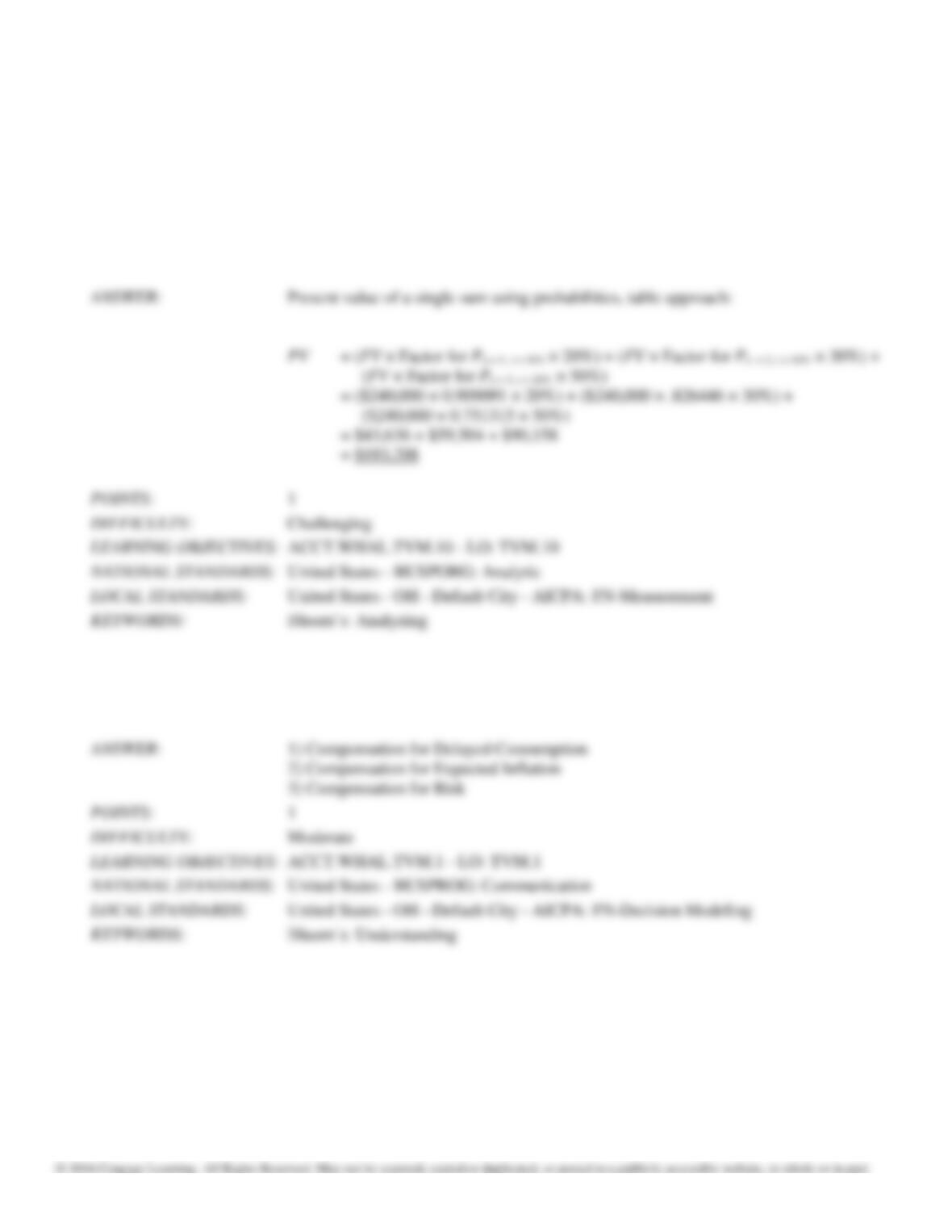
126. Mathias Company estimated that it has a 20% probability of receiving $240,000 one year from now, a 30%
probability of receiving $240,000 two years from now, and a 50% probability of receiving $240,000 three years from
now.
Required:
Using the FASB’s concept of “expected cash flows,” calculate the present value of the expected cash flows assuming
a 10% interest rate compounded annually.
127. Complete the following equation:
Time Value of Money = ______(1)_________+_____(2)________+_______(3)_______
TVM Module: Time Value of Money Module
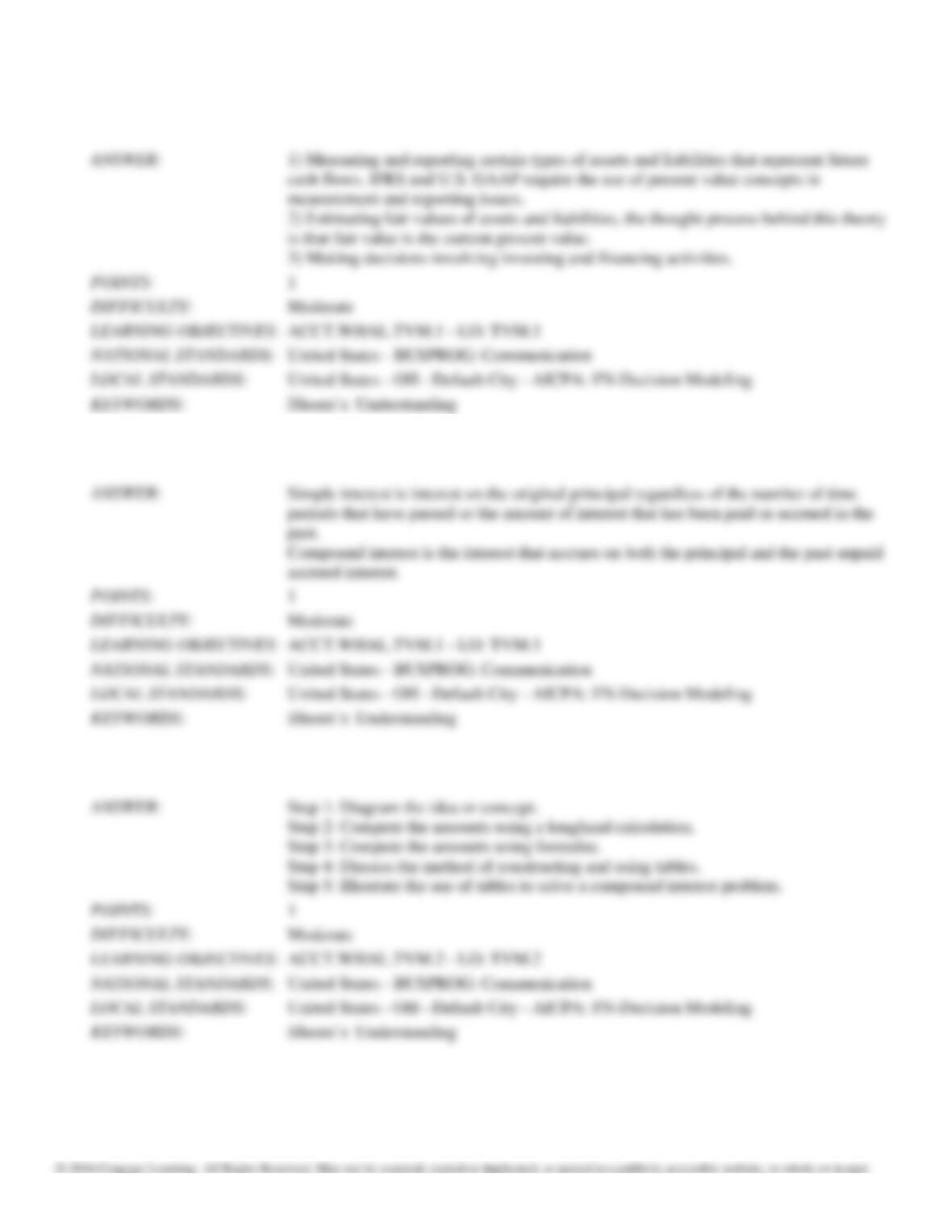
128. In what situations would a company use present or future value?
129. What is the difference between simple interest and compound interest?
130. What are the five steps that can be applied to all of the time value of money techniques to assist in calculations?
TVM Module: Time Value of Money Module
131. What is the formula to compute the future value of a single sum?
132. What is the formula to compute the present value of a single sum?
133. What four conditions must exist in solving measurement problems involving the use of annuities?
TVM Module: Time Value of Money Module
134. Explain how the factors in a present value of an ordinary annuity table are converted into the factors in a present
value of an annuity due table.
135. What estimations are involved in present value measurements?
136. The FASB Statement of Financial Accounting Concepts No. 7 describes five elements that together may be used to
determine the value of various assets and liabilities, what are these five elements?
TVM Module: Time Value of Money Module
137. A beginning accounting student comes to you with the following question, “What is the time value of money and
does it relate to interest?”
Required:
Explain the two concepts and how they are related.
138. A beginning accounting student has just been introduced to present and future values analysis and has been told that
it is based on compound interest, not simple interest. The student is confused about the differences between the two
interest methods.
Required:
Explain the difference between the two methods using a single deposit of $1,000 for two years at 10% interest.
TVM Module: Time Value of Money Module
139. The present values of ordinary annuities, annuities due, and deferred annuities were discussed in the textbook.
Discuss the ways these three annuities are similar and dissimilar.
140. Although most accountants believe that the use of present value creates relevant accounting measurements, there are
some reliability questions. Discuss the reasons why present value computations create less reliable measurements.
TVM Module: Time Value of Money Module
141. An accounting student has just been introduced to present value analysis and comes to you with the following
question, “How is present value used in the financial statements?”
Required:
Give the student examples of financial statement accounts that are stated at present value and explain the advantages
of using present value for certain financial statement items.
TVM Module: Time Value of Money Module
142. A local CPA has told you “Just give me a table of the factors for the Present Value of $1 and I can easily create all
those other tables in an Excel spreadsheet.” Explain how this would be done.