
Achievement Test 6: Chapters 11 and 12 Name _________________________
Financial Accounting, 9e Instructor ______________________
Section # _______ Date _________
Part
I
II
III
IV
V
VI
Total
Points
32
20
6
12
14
16
100
Score
PART I — MULTIPLE CHOICE (32 points)
Instructions: Designate the best answer for each of the following questions.
____ 1. Restrictions of retained earnings may result from each of the following except
a. contractual restrictions.
b. legal restrictions.
c. prior period adjustment restrictions.
d. voluntary restrictions.
____ 2. Penner, Inc. has 15,000 shares of 6%, $100 par value, noncumulative preferred stock
and 30,000 shares of $1 par value common stock outstanding at December 31, 2015.
There were no dividends declared in 2014. The board of directors declares and pays a
$170,000 dividend in 2015. What is the amount of dividends received by the common
stockholders in 2015?
a. $0
b. $80,000
c. $170,000
d. $90,000
_______3. Canton Manufacturing declared a 10% stock dividend when it had 150,000 shares of
$3 par value common stock outstanding. The market price per common share was
$12 per share when the dividend was declared. The entry to record this dividend
declaration includes a credit to
a. Stock Dividends for $45,000.
b. Common Stock Dividends Distributable for $180,000.
c. Common Stock for $45,000.
d. Paid-in Capital in Excess of Par for $135,000.
4. Glaser Company paid $48,000 to buy 3,000 shares of its $5 par value common stock
for the treasury. The stock was originally sold for $36,000. The entry to record the
purchase includes a
a. debit to Treasury Stock for $36,000.
b. credit to Treasury Stock for $20,000.
c. debit to Treasury Stock for $48,000.
d. credit to Common Stock for $36,000.

Test Bank for Financial Accounting, Ninth Edition
AT6- 2
_____ 5. The purchase of treasury stock
a. increases total assets and decreases total stockholders’ equity.
b. decreases total assets and decreases total stockholders’ equity.
c. increases total assets and increases total stockholders’ equity.
d. decreases total assets and increases total stockholders’ equity.
____ 6. The resale of treasury stock for an amount greater than its cost
a. increases net income.
b. increases total assets and decreases total stockholders’ equity.
c. decreases total assets and increases total stockholders’ equity.
d. increases total assets and increases total stockholders’ equity.
____ 7. Each of the following decreases retained earnings except
a. stock splits.
b. large stock dividends.
c. small stock dividends.
d. cash dividends.
____ 8. Treasury stock is reported in the balance sheet as a deduction from
a. capital stock.
b. additional paid-in capital.
c. retained earnings.
d. paid-in capital and retained earnings.
____ 9. Andrews, Inc. paid $45,000 to buy back 9,000 shares of its $1 par value common
stock. This stock was sold later at a selling price of $6 per share. The entry to record
the sale includes a
a. credit to Paid-in Capital from Treasury Stock for $9,000.
b. credit to Common Stock for $9,000.
c. debit to Paid-in Capital from Treasury Stock for $45,000.
d. debit to Retained Earnings for $45,000.
____ 10. Restrictions of retained earnings
a. are reported on the balance sheet as liabilities.
b. do not change total stockholders’ equity.
c. provide insurance coverage for contingencies.
d. are reported as expenses on the income statement.
____ 11. Ownership of common stock ordinarily carries the right to
a. declare dividends.
b. establish a drawing account.
c. enter into contracts for the corporation.
d. vote on corporate actions that require stockholder approval.
____ 12. Which of the following may either increase or decrease retained earnings?
a. Stock dividends
b. Disposals of treasury stock
c. Net income
d. Prior period adjustments

Achievement Test 6
AT6- 3
____ 13. Common Stock Dividends Distributable is reported in the balance sheet
a. as an addition to retained earnings.
b. as an asset.
c. in paid-in capital as an addition to common stock issued.
d. as a liability.
____ 14. Under the equity method of accounting, the investment in common stock is initially
recorded at cost and the investment account is subsequently
a. credited for cash dividends received.
b. debited for the investor‘s share of investee net income.
c. debited for cash dividends received and credited for the investor’s share of
investee net income.
d. debited for the investor’s share of investee net income and credited for cash
dividends received.
____ 15. The preparation of consolidated financial statements is useful to
a. only the subsidiary company.
b. creditors of the subsidiary company.
c. only the parent company.
d. both the parent and the subsidiary company.
____ 16.. The account Unrealized Loss—Income is reported
a. as a contra account in the stockholders’ equity section of the balance sheet.
b. in the other expenses and losses section of the income statement.
c. in the operating section of the income statement.
d. as a contra account in the current asset section of the balance sheet.

Test Bank for Financial Accounting, Ninth Edition
AT6- 4
PART II — CORPORATE EQUITY TRANSACTIONS (20 points)
Instructions: Journalize the following transactions for Fortier Company.
1. Issued 7,000 shares of no-par common stock. The market price of the stock is $12 per share.
2. Issued 3,000 shares of 5%, $100 par, cumulative preferred stock for $122 per share.
3. Declared dividends on preferred dividend of 5% per share.
4. Purchased 500 shares of common stock at $14 for treasury.
5. Paid preferred dividend declared in #3.

Achievement Test 6
AT6- 5
PART III — INVESTMENT VALUATION (6 points)
At December 31, 2015, Biltmore Corporation has the following securities:
Securities Cost _ Fair Value
Trading $108,000 $102,000
Available-for-Sale $145,000 $162,000
Prepare the necessary adjusting entries to report the securities at fair value.

Test Bank for Financial Accounting, Ninth Edition
AT6- 6
PART lV — DIVIDEND COMPUTATIONS (12 points)
Torres Wholesale Merchandise had 20,000 shares of 4%, $20 par value preferred stock and
15,000 shares of $25 par value common stock outstanding throughout 2015. These data apply to
each of the independent situations below.
1. Assuming that total dividends declared in 2015 were $25,000 and that the preferred stock is
noncumulative, common stockholders should receive total 2015 dividends of
$________________.
2. Assuming that total dividends declared in 2015 were $80,000 and that the preferred stock is
cumulative with two years’ preferred dividends in arrears, the preferred stockholders should
receive 2015 dividends totaling
$________________.
3. Assuming that total dividends declared in 2015 were $30,000 and that the preferred stock is
cumulative with two years’ preferred dividends in arrears, the preferred stockholders should
receive 2015 dividends totaling
$________________.
4. Assuming that total dividends declared in 2015 were $45,000 and that the cumulative
preferred stock was issued on January 1, 2014, and that $8,000 of preferred dividends were
declared and paid in 2014, the common stockholders should receive 2015 dividends totaling
$________________.
Achievement Test 6
AT6- 7
PART V — TREASURY STOCK TRANSACTIONS (14 points)
Bingham Corporation has the following stockholders’ equity accounts on January 1, 2015:
Common Stock, $10 par value …………………………………… $1,500,000
Paid-in Capital in Excess of Par…………………………………… 200,000
Retained Earnings …………………………………………………….. 500,000
Total Stockholders’ Equity …………………………………….. $2,200,000
The company uses the cost method to account for treasury stock transactions. During 2015, the
following treasury stock transactions occurred:
April 1 Purchased 15,000 shares at $15 per share.
August 1 Sold 5,000 shares at $18 per share.
October 1 Sold 6,000 shares at $12 per share.
Instructions
Journalize the treasury stock transactions for 2015.

Test Bank for Financial Accounting, Ninth Edition
AT6- 8
PART Vl — LONG-TERM STOCK INVESTMENTS (16 points)
1. Green Corporation purchased 3,000 shares of Flynn Company’s common stock for $12 per
share as a long-term available-for-sale investment on June 30, 2015. Flynn declared and paid
a cash dividend of $1.00 per share on its common stock on September 30, and had a closing
fair value of $18 per share on December 31. Assuming this investment is appropriately
accounted for using the fair value method, it will increase Green’s 2015 income before taxes
by
$_______________.
2. Hogan Inc. purchased 40% of the outstanding common stock of Wyatt Industries on
January 1, 2015 for $180,000. Wyatt reported net income of $70,000 for 2015 and declared
and paid cash dividends on common stock of $30,000. The amount of Hogan’s investment in
Wyatt on December 31, 2015 should be
$_______________.
3. Baker Company purchased 30% of the outstanding common stock of Grey Corp. on January
1, 2015. Grey reported net income of $90,000 for 2015 and declared and paid cash dividends
on common stock of $25,000. Baker should report revenue from its investment in Grey for
2015 of
$_______________.
4. Berlin Inc. accounts for its investment in Nolan Corporation using the fair value method. Berlin
bought 3,000 shares (5%) of Nolan’s outstanding common stock for $28 per share on January
1, 2015. Nolan earned $3 per share for 2015, declared and paid cash dividends of $1 per
common share, and had a closing fair value of $24 per share on December 31. The reported
balance sheet value of Berlin’s investment in Nolan at December 31, 2015 is
$_______________.
Achievement Test 6
AT6- 9
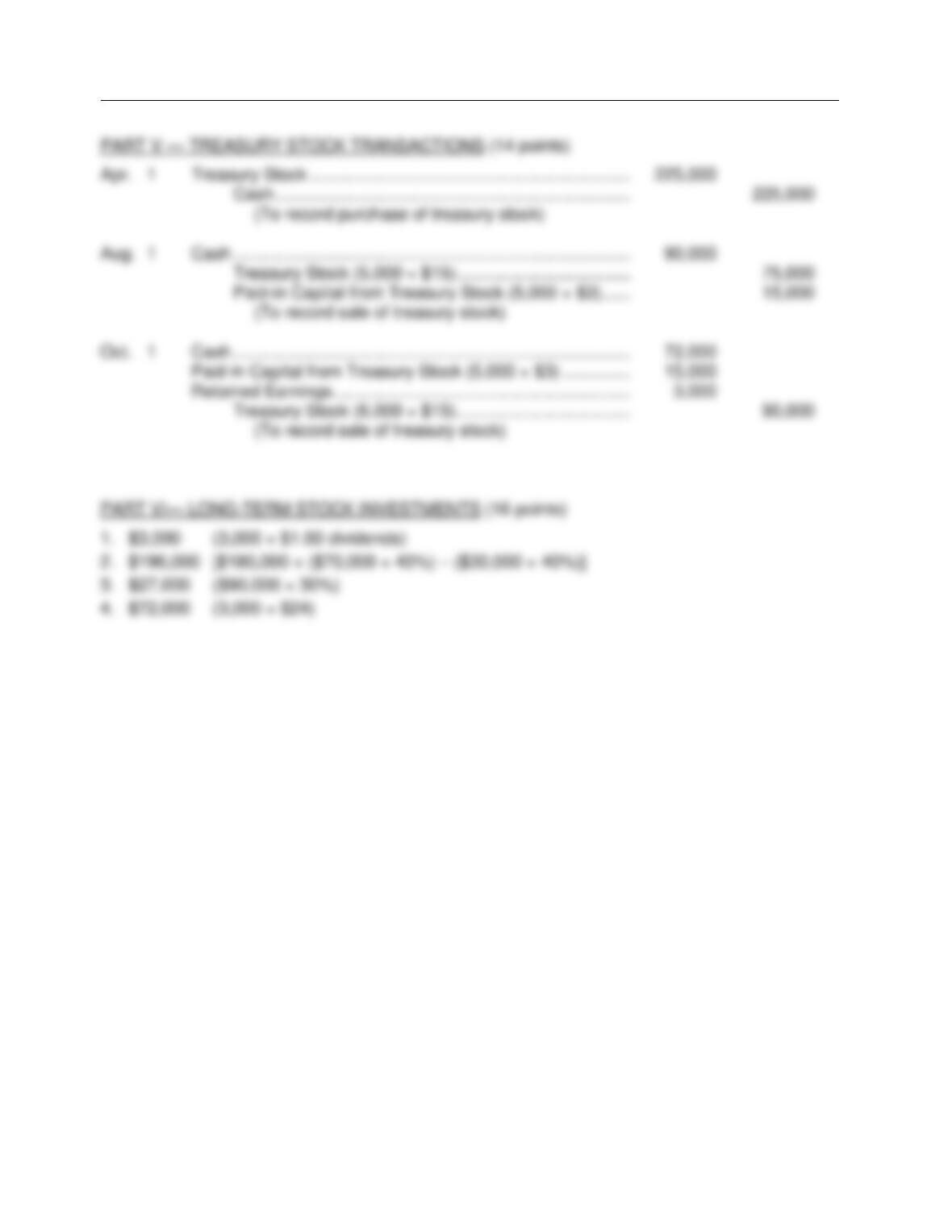
Solutions — Achievement Test 6: Chapters 11-12
Test Bank for Financial Accounting, Ninth Edition
AT6- 10