Achievement Test 4: Chapters 7 and 8 Name _________________________
Financial Accounting, 9e Instructor ______________________
Section # _______ Date _________
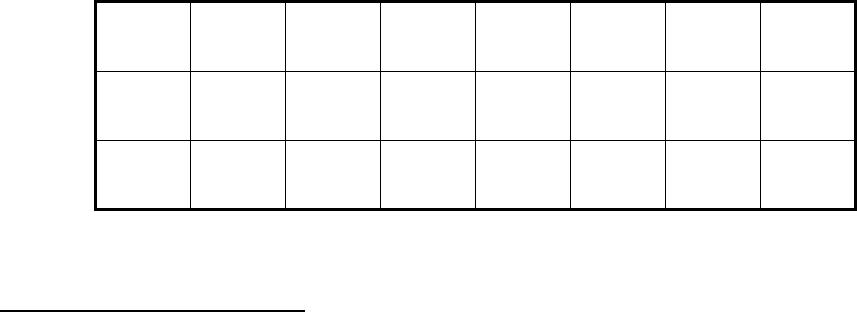
Part
I
II
III
IV
V
VI
Total
Points
20
15
20
10
20
15
100
Score
PART I — MULTIPLE CHOICE (20 points)
Instructions: Designate the best answer for each of the following questions.
____ 1. The use of a cash register for cash receipts is an example of the internal control
principle of
a. documentation procedures.
b. physical controls.
c. independent internal verification.
d. segregation of duties.
____ 2. Cash includes all of the following items except
a. checks.
b. currency.
c. money orders.
d. all of these answers are included.
____ 3. The objectives of internal control are to
a. prevent unintentional errors and irregularities.
b. safeguard assets and enhance the accuracy and reliability of the accounting
records.
c. enhance the accuracy and reliability of financial statements.
d. safeguard assets and prevent thefts.
____ 4. When a petty cash fund is in use,
a. an entry must be made to the appropriate expense, asset, etc. account when a
disbursement is made.
b. the size of the fund should be such that it can be used to cash employees’ bi-
monthly payroll checks.
c. entries are generally made to Petty Cash only when it is initially set up or the
stipulated amount of the fund is changed.
d. an entry is made to Petty Cash when the fund is replenished to its original amount.

Test Bank for Financial Accounting, Ninth Edition
AT4- 2
____ 5. Lack of agreement between the cash balance per bank and the cash balance per
books is due to
a. errors and poor internal control.
b. errors and bank memoranda.
c. time lags and poor internal control.
d. time lags and errors.
____ 6. The bank statement that a depositor receives from the bank includes
a. notification of amounts deducted by the bank to cover such things as the cost of a
supply of new checks ordered by the depositor.
b. a designation of which checks are still outstanding at the end of the month.
c. a designation of which deposits are in transit at the end of the month.
d. notification of errors made by the depositor in recording checks written during the
month in the depositor’s accounts.
____ 7. Which of the following receivables would not be classified as an “other receivable”?
a. Advance to an employee
b. Refundable income tax
c. Notes receivable
d. Interest receivable
_____ 8. An aging of a company’s accounts receivable indicates that $7,000 are estimated to
be uncollectible. If Allowance for Doubtful Accounts has a $1,100 credit balance, the
adjustment to record bad debts for the period will require a
a. debit to Bad Debts Expense for $7,000.
b. debit to Allowance for Doubtful Accounts for $5,900.
c. debit to Bad Debts Expense for $5,900.
d. credit to Allowance for Doubtful Accounts for $7,000.
_____ 9. Watson Retailers accepted $75,000 of Citibank Visa credit card charges for
merchandise sold on July 1. Citibank charges 4% for its credit card use. The entry to
record this transaction by Watson Retailers will include a credit to Sales of $75,000
and a debit(s) to
a. Cash $72,000 and Service Charge Expense $3,000.
b. Accounts Receivable $72,000 and Service Charge Expense $3,000.
c. Cash $72,000 and Interest Expense $3,000.
d. Accounts Receivable $75,000.
_____10. Receivables might be sold to
a. lengthen the cash-to-cash operating cycle.
b. take advantage of deep discounts on the cash realizable value of receivables.
c. generate cash quickly.
d. finance companies at an amount greater than cash realizable value.

Achievement Test 4
AT4- 3
PART II — INTERNAL CONTROL OVER CASH RECEIPTS AND DISBURSEMENTS (15 points)
Six internal control principles related to cash transactions are discussed in the textbook. These
principles, with code letters, are:
Code Internal Control Principle
A Establishment of responsibility
B Segregation of duties
C Documentation procedures
D Physical controls
E Independent internal verification
F Human resource controls
Instructions: Match the above principles to the following applications related to cash receipts
and cash disbursements by placing the code in the space provided. Each code letter can be used
once, more than once, or not at all.
____ 1. The duties of receiving and recording cash should be assigned to different individuals.
____ 2. Daily cash counts should be made by cashier department supervisors.
____ 3. Employees should be required to take vacations.
____ 4. Cash register tapes should be used for over-the-counter receipts.
____ 5. Each check should be compared with approved invoices before being issued.
____ 6. The duties of approving an item for payment and paying the item should be performed
by different individuals.
____ 7. All checks should be prenumbered.
____ 8. Only the treasurer should be authorized to sign checks.
____ 9. All personnel who handle cash should be bonded.
____ 10. Blank checks should be stored in a safe, and access should be restricted.

Test Bank for Financial Accounting, Ninth Edition
AT4- 4
PART III — BANK RECONCILIATION WITH ENTRIES (20 points)
Instructions: Given the information provided below, prepare (a) a bank reconciliation in proper
format, and (b) the necessary journal entries for the month of September for Tolan Company.
1. Balance per bank on September 30—$24,070
2. Balance per books on September 30—$19,500
3. Total outstanding checks at September 30—$3,600
4. Debit memoranda:
a. NSF check from Lee Co.—$540
b. Printing company checks—$60
c. Payment to bank of $2,400 note owed bank by Tolan plus $200 interest.
5. Credit memorandum: Collection of note receivable for $7,500 plus $560 interest less $60
collection fee.
6. Errors:
a. A check written this month to Nance Co. for office supplies cleared the bank at the correct
amount of $680, but was recorded by Tolan at $860.
b. The bank charged a $210 check of Thome Company against Tolan’s account this month.
7. Deposit in transit on September 30—$3,800.
(a) Bank Reconciliation
____________________________________________________________________________
____________________________________________________________________________
____________________________________________________________________________
____________________________________________________________________________
____________________________________________________________________________
____________________________________________________________________________
____________________________________________________________________________
____________________________________________________________________________
____________________________________________________________________________
____________________________________________________________________________
____________________________________________________________________________
____________________________________________________________________________
____________________________________________________________________________
____________________________________________________________________________
____________________________________________________________________________
____________________________________________________________________________

Achievement Test 4
AT4- 5
(b) Journal Entries (Note: Assume no interest has been accrued on the note.)
____________________________________________________________________________
____________________________________________________________________________
____________________________________________________________________________
____________________________________________________________________________
____________________________________________________________________________
____________________________________________________________________________
____________________________________________________________________________
____________________________________________________________________________
____________________________________________________________________________
____________________________________________________________________________
____________________________________________________________________________
____________________________________________________________________________
____________________________________________________________________________
____________________________________________________________________________
____________________________________________________________________________
____________________________________________________________________________
____________________________________________________________________________
____________________________________________________________________________
____________________________________________________________________________
____________________________________________________________________________
____________________________________________________________________________
____________________________________________________________________________
____________________________________________________________________________

Test Bank for Financial Accounting, Ninth Edition
AT4- 6
PART IV — PETTY CASH FUND (10 points)
The ledger accounts given below, with an identification number for each, are used by Quayle
Company.
Instructions: Prepare appropriate entries for the month of March for each of the listed petty cash
fund transactions by placing the appropriate identification number(s) in the debit and credit
columns provided. Write “N/A” if no entry is appropriate.
1. Cash 6. Supplies Expense
2. Petty Cash 7. Postage Expense
3. Accounts Receivable 8. Freight-Out
4. Supplies 9. Miscellaneous Expense
5. Inventory 10. Cash Over and Short
———————————————————————————————————————————
Account(s) Account(s)
Entry Information Debited Credited
———————————————————————————————————————————
Mar. 1 Issued a check for $500 to establish a petty cash
fund.
———————————————————————————————————————————
Mar. 3 Disbursed $40 for pizza and drinks for staff
working overtime.
———————————————————————————————————————————
Mar. 5 Paid collect United Parcel Service bill for goods
purchased for resale $20.
———————————————————————————————————————————
(March 6 – 17 various other disbursements took place.)
———————————————————————————————————————————
Mar. 18 Replenished the petty cash fund by writing a check
for $345. On this date the fund consisted of $155
in cash plus the following petty cash receipts:
Freight on inventory purchased $118, supplies
$145, and miscellaneous expense $79.
———————————————————————————————————————————
Mar. 21 A check was written for $200 to increase the
stipulated amount of the fund.

Achievement Test 4
AT4- 7
PART V — ACCOUNTS RECEIVABLE (20 points)
A. ACCOUNTS RECEIVABLE—UNCOLLECTIBLE ACCOUNTS
Instructions: Present the journal entries specified below; show supporting calculations.
The trial balance of Hiller Company at December 31, 2014 includes the following:
Debits Credits
Accounts Receivable ……………………………………………………… 100,000
Allowance for Doubtful Accounts ……………………………………… 500
Sales (all on credit) ………………………………………………………… 700,000
Sales Returns and Allowances ………………………………………… 30,000
(1) If Hiller uses the aging method and estimates that $6,000 of receivables will be uncollectible,
prepare the adjusting entry.
(2) If Hiller estimates uncollectibles at 1% of net credit sales, prepare the appropriate adjusting
entry.
(3) Assume that on February 10, 2015 the specific account of Mark Nolan with a balance of
$600, is deemed uncollectible. Record the write-off.
(4) Assume that on May 12, 2015 Nolan pays one-half of the above balance in full and is
expected to pay the remainder within 30 days. Record the appropriate entries.
B. SALE OF ACCOUNTS RECEIVABLE
Instructions: Present the journal entries specified below.
(1) Rosen Company sells $600,000 of accounts receivable to National Factors, Inc. for cash
less a 2.5% service charge. Record the sale.
(2) Made Visa credit card sales totaling $9,500. A 2% service fee is charged by Visa. Record
the sale on the books of Rosen Company.

Test Bank for Financial Accounting, Ninth Edition
AT4- 8
PART VI –– NOTES RECEIVABLE (15 points)
Instructions: Prepare journal entries to record the following events:
July 1 Howell Company received an 8%, 4-month $75,000 note dated July 1 from a customer
in exchange for an outstanding account.
Nov. 1 The note is honored and no interest has been accrued.
Nov. 1 Assume instead that the note is dishonored by its maker and there is hope of future
collection.
Nov. 1 Assume instead that upon maturity the note is dishonored and there is no hope of
future collection.
Achievement Test 4
AT4- 9
Solutions — Achievement Test 4: Chapters 7 and 8
Test Bank for Financial Accounting, Ninth Edition
AT4- 10