
In some collectivistic cultures, Confucian teachings emphasize that listening is
A. people-oriented
B. content-oriented
C. sensitive to others’ feelings
D. all of the options are correct
E. none of the options are correct
Which of the following is NOT a friendship rule?
A. always agree with your friends
B. show support
C. defend your friends
D. avoid public criticism
E. maintain equity
Virtual friendships can help people with chronic shyness

A. interact with others
B. garner social support
C. find emotional support
D. minimize anxiety that results from face-to-face encounters
E. all of the options are correct
Although Shannon enjoys being with her family, she purposely keeps her life at college
a secret. What family maintenance strategy could Shannon improve upon?
A. communication
B. assurances
C. positivity
D. self-disclosure
E. equity
A student arrives on the first day of her interpersonal communication class and observes
that the instructor makes wild gestures while lecturing. If the student chooses to focus
only on the contentwhile trying to ignore the nonverbal communicationwhat strategy is

she employing?
A. suppression
B. attention focus
C. reappraisal
D. venting
E. encounter structuring
Studies have suggested that, to demonstrate that we like someone, we can
A. increase distance
B. decrease vocal expressiveness
C. sit up straight
D. increase gaze
E. decrease eye contact
Which of the following types of nonverbal communication has a primary influence
upon our interpersonal impressions?

A. eye contact
B. gestures
C. facial expression
D. posture
E. enhancement
Which of the following is a distinguishing characteristic of friendship?
A. friendship is volatile
B. friendship is voluntary
C. friendship is characterized by self-disclosure
D. friendship is rooted in liking
E. all of the options are correct
While having a serious conversation about your relationship, your romantic partner
stops midsentence and exclaims, “We are out of milk.” Your partner’s comment is an
example of
A. interpersonal communication

B. intrapersonal communication
C. impersonal communication
D. interactive communication
E. none of the options are correct
Emotional intelligence refers to
A. the ability to suppress emotion
B. the ability to vent emotion
C. the ability to mask an emotion
D. the ability to accurately perceive and interpret emotions
E. none of the options are correct
Which of the following is NOT true of cyberslacking?
A. your employer cannot track your keystrokes if you sign into your personal e-mail
B. workers spend almost two hours a day cyberslacking

C. younger males higher in organizational status are most likely to cyberslack
D. anything done on a company computer is considered company property
E. companies have the right to access employee private accounts
Which of the following behaviors would demonstrate the most power in the United
States?
A. feet planted firmly on the ground
B. erect posture
C. relaxed posture
D. avoiding eye contact
E. none of the options are correct
A communal friendship is one in which
A. you frequently provide emotional support
B. you and your friend help each other with practical goals
C. you don”t feel the need to share your time

D. you and your friend remain emotionally independent
E. all of your communication takes place over e-mail
Which of the following is NOT true of gender differences in love?
A. women and men experience passionate love similarly
B. women score higher than men on pragma love
C. there is no difference between women’s and men’s experience of pragma love
D. men tend to idealize their partners more than women do
E. men tend to believe “there is only one true love for each person”
Which of the following nonverbal codes is considered to be the richest and most
powerful?
A. proxemics
B. territoriality
C. kinesics
D. vocalics

E. none of the options are correct
Interpersonal communication is characterized by all of the following EXCEPT:
A. interpersonal communication is reversible
B. interpersonal communication can be intentional
C. interpersonal communication conveys content information
D. interpersonal communication conveys relationship information
E. interpersonal communication can be unintentional
Collaborative conflict management means
A. attacking the problem, not the person
B. focusing on common interests
C. developing creative options before making decisions
D. evaluating your solutions
E. all of the options are correct

World-mindedness is NOT
A. demonstrating acceptance of and respect for other cultures.
B. acceptance of other people’s expression of their culture.
C. avoiding the tendency to judge and evaluate others’ cultures.
D. believing that your own culture is superior to others.
E. treating members of other cultures with respect.
Which of the following is NOT involved in the human perception process?
A. selection
B. organization
C. interpretation
D. response
E. punctuation

You don”t often see your friend, Ivan; however, when you do, he is always willing to
fix
your laptop computer or help you study for an exam. What type of friendship do you
have?
A. virtual
B. agentic
C. communal
D. avoidant
E. collaborative
Which of the following traits does NOT necessarily demonstrate ethical
communication?
A. neutrality
B. positivity
C. respect
D. kindness
E. honesty

According to communication accommodation theory, we tend
A. not to adapt our communication in different situations
B. to change our communication if we dislike the receiver
C. not to change our communication if we like the receiver
D. to adapt our communication when seeking to establish relationships with others
E. none of the options are correct
Our self-esteem is likely to
A. increase as we decrease differences between our ought and ideal selves
B. decrease as we increase differences between our ought and ideal selves
C. stay the same as long as we align our ought and ideal selves
D. increase once we find our ideal self
E. increase only if we live in an appearance-obsessed culture

Which of the following conclusions can be made about gender differences?
A. women and men are substantially similar
B. women and men are substantially dissimilar
C. women and men are essentially similar and respond similarly
D. women use indirect language, whereas men use direct language
E. none of the options are correct
Integrative agreements occur
A. when two people develop a creative solution to their problem
B. when one person gets his or her way
C. when one party withdraws from the conflict encounter
D. when people change the basic understanding of their relationship
E. when one person uses accommodation and the other gets his or her way
Affect displays are primarily displayed through the

A. head and eyes
B. hands and eyes
C. eyes and hands
D. face and voice
E. none of the options are correct
Conflict can be described as having all the following characteristics EXCEPT
A. it is perceptual
B. it is a process
C. it is dynamic
D. it stems from a series of unrelated events
E. none of the options are correct
If you perceive yourself as professionally capable and do well in a job interview as a
result, your experience exemplifies
A. social comparison

B. the looking-glass self
C. self-discrepancy theory
D. self-fulfilling prophecy
E. none of the options are correct
If you overindulge at a Chinese buffet and later explain that everyone overeats at
buffets, what perceptual error are you demonstrating?
A. fundamental attribution error
B. salience
C. internal attribution
D. actor-observer effect
E. none of the options are correct
Mark screams “You are so dumb!” at his younger brother. What strategy of cooperative
verbal communication is he violating?
A. being easy to understand

B. adapting messages to the context
C. taking ownership of one’s own thoughts and feelings
D. being honest
E. none of the options are correct
Interpersonal communication can be considered
A. intentional
B. unintentional
C. irreversible
D. dynamic
E. all of the above options are correct
If Mark has never had a long-term relationship because he reacts negatively to any
perceived problem or “bump” in the relationship, what type of attachment style is Mark
likely to have?
A. secure
B. none of the options are correct

C. fearful
D. dismissive
E. preoccupied
According to Uncertainty Reduction Theory, which of the following is a primary goal
of initial interaction?
A. reduce uncertainty
B. explain behavior
C. predict behavior
D. help anticipate how others will respond to us
E. all of the options are correct
Which of the following is NOT true of self-disclosure?
A. people tend to disclose more quickly online than face-to-face
B. self-disclosure increases mental health and relieves stress
C. Euro-Americans tend to disclose less than Hispanics

D. women disclose more than men
E. keeping problems to yourself can cause problems
One of the most common reasons why friendships fade over time is that
A. friendships are volatile
B. friendships can”t withstand romantic attraction
C. friendships are inherently short-term relationships
D. friendships shift when shared interests or beliefs change
E. none of the options are correct
Attention focus is an effective strategy for managing emotions after they have occurred.
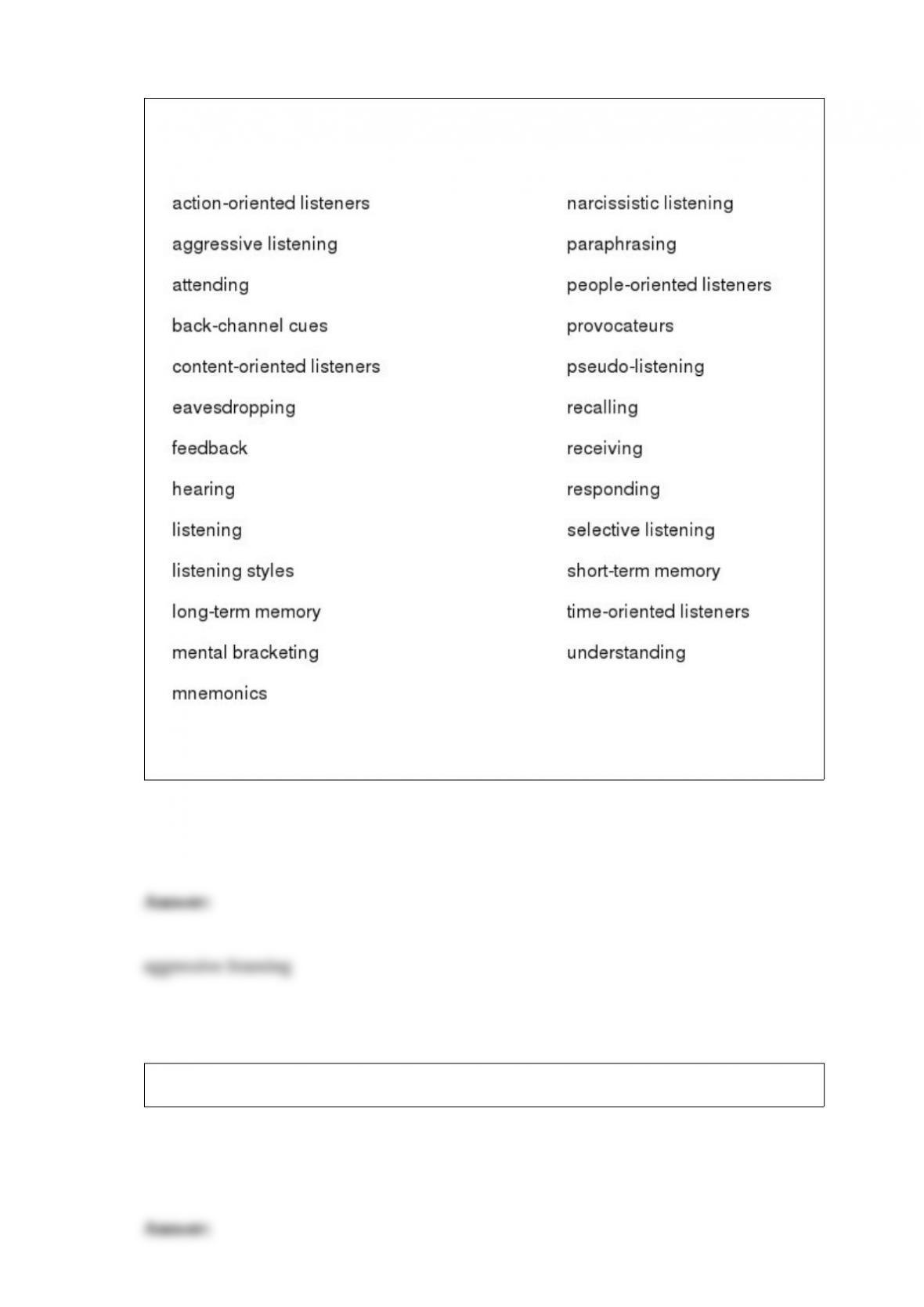
Match the concept, term, or theory with its correct response or definition.
Attending to what others say solely for the purpose of identifying opportunities for
attack or ambush.
Define empathy and its two components.
Explain what the fundamental attribution error is and why it is so common.
Interpersonal communication competence is simply a matter of acquiring knowledge
about communication.
If you are ruled by the clock, always need to be on time, and hate to be late for an
appointment, you are considered to have a polychronic time orientation.

A halo effect may occur when we attribute positive motives to someone’s actions
without having actually observed those particular qualities.
Match the concept, term, or theory with its correct response or definition.
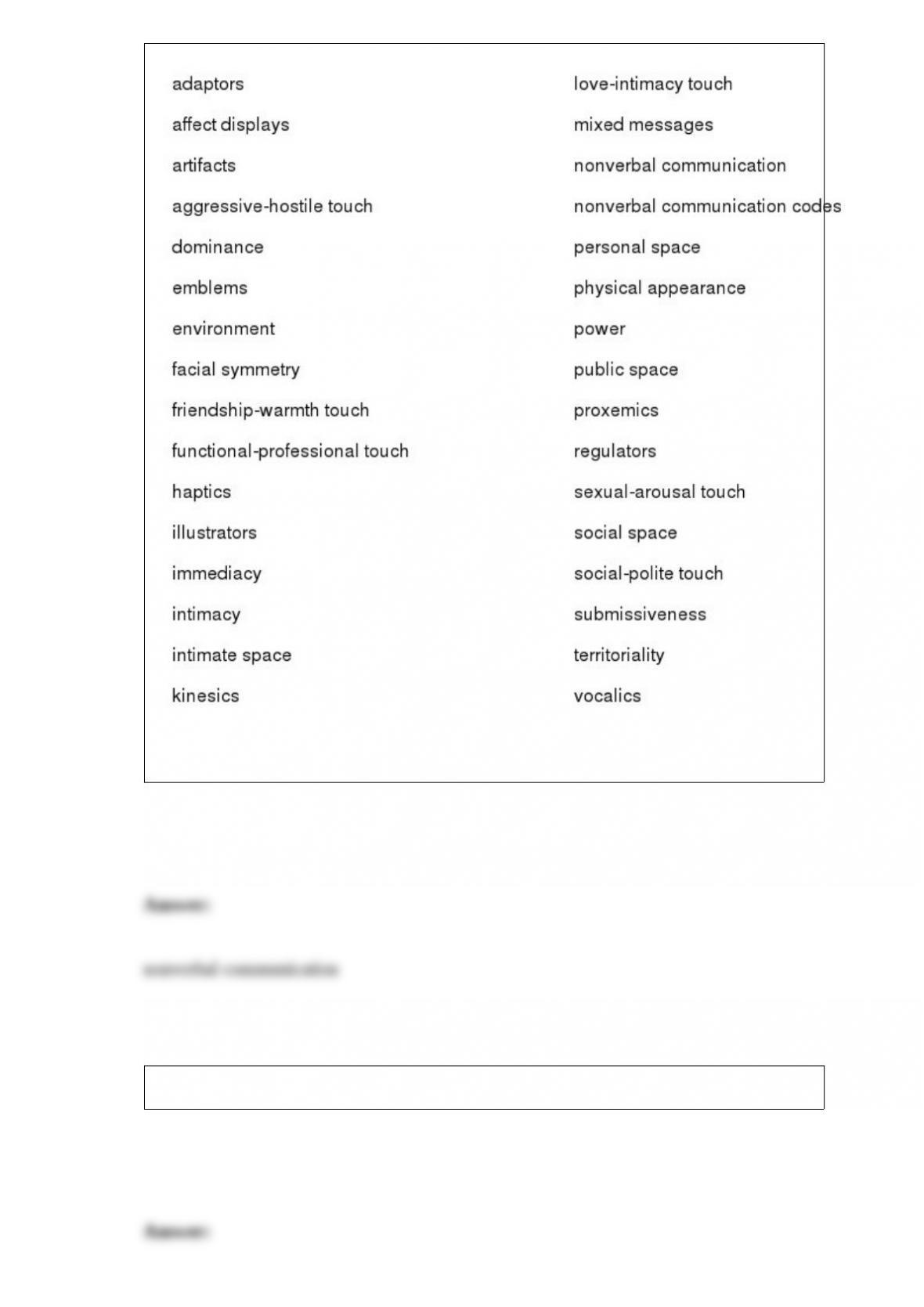
Intentional or unintentional transmission of meaning through an individual’s nonspoken
physical and behavioral cues.
Identify the benefits of self-disclosure.
Define conflict.
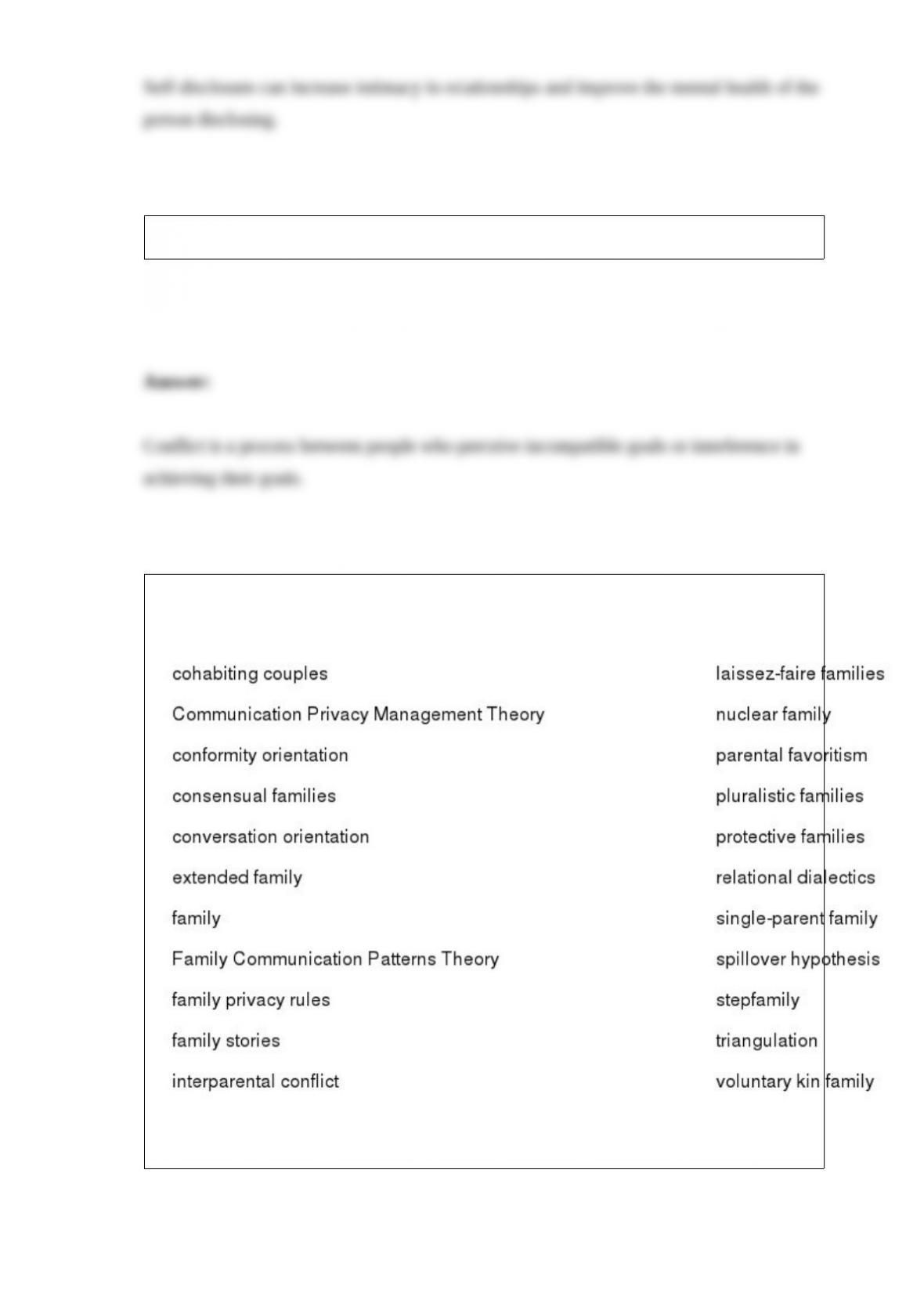
Match the concept, term, or theory with its correct response or definition.
Conditions governing what family members can talk about, how they can discuss
topics, and who should have access to family-related information.
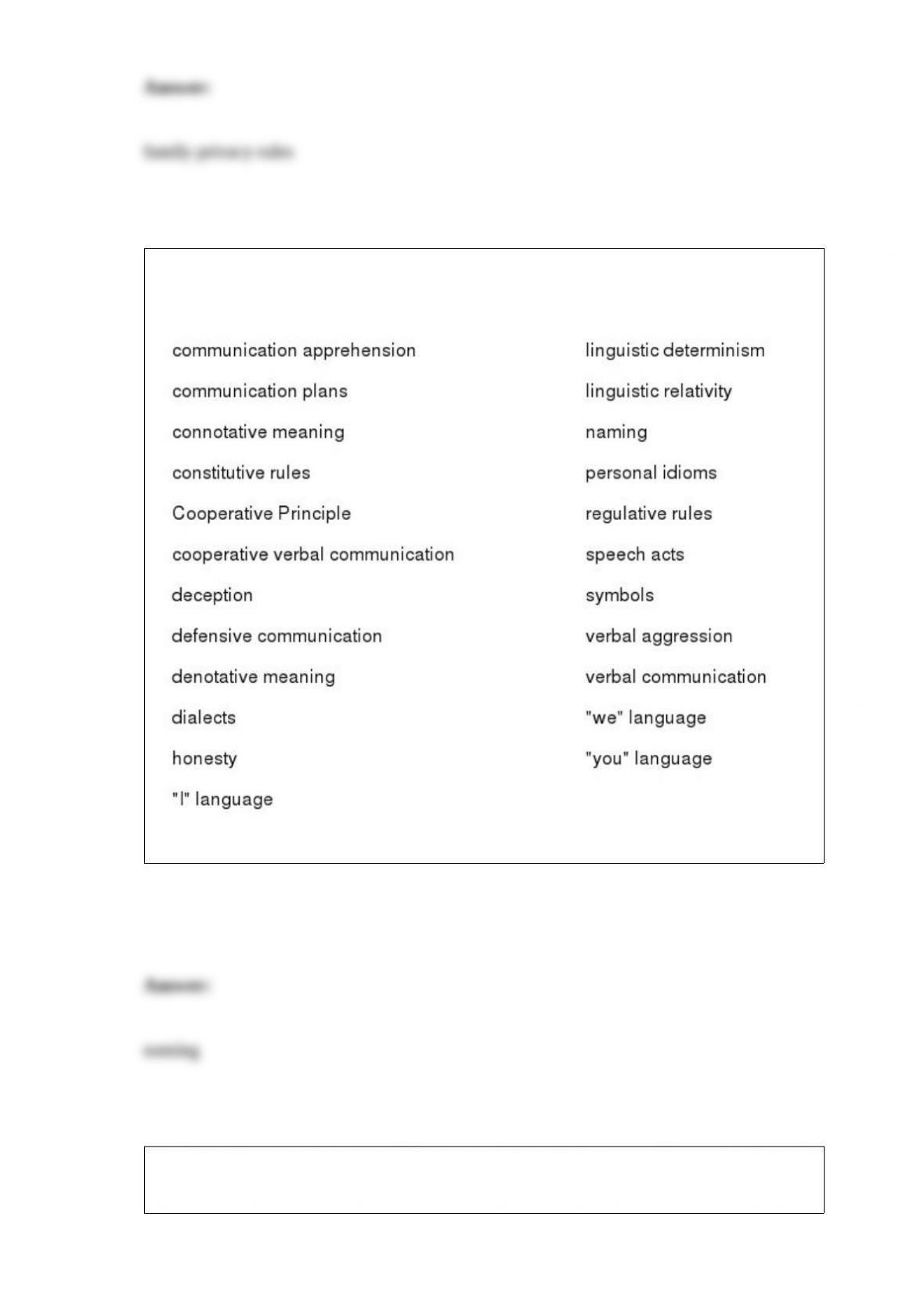
Match the concept, term, or theory with its correct response or definition.
Creating linguistic symbols for objects.
What does your textbook suggest are potential benefits of studying interpersonal
communication and making informed communication decisions?
Identify strategies one can use to improve conflict-management skills.
What’s the difference between feelings and moods?